
Nodular Cast Iron Auto Components: A Buyer's Constraint Guide
Nodular cast iron is one of the most consequential material families inside the component parts of auto-mobile supply chain, and it is one of the most frequently oversimplified. A caliper bracket, a steering knuckle, a hub, a gearbox housing and an axle support can all be described on a quotation as "iron castings" while sitting in different material classes, different test regimes, different customs headings and different tooling lifetimes. Most sourcing problems in this segment do not begin with price. They begin with that gap between the loose description and the actual constraint.
The intent of this reference is practical rather than promotional. It sets out what a nodular cast iron auto component actually has to satisfy before it is qualified — material grade, mechanical and coating values, quality-system certification, commercial thresholds and import classification — and it uses one supplier's documented position to show how those constraints can be addressed in a real quotation.
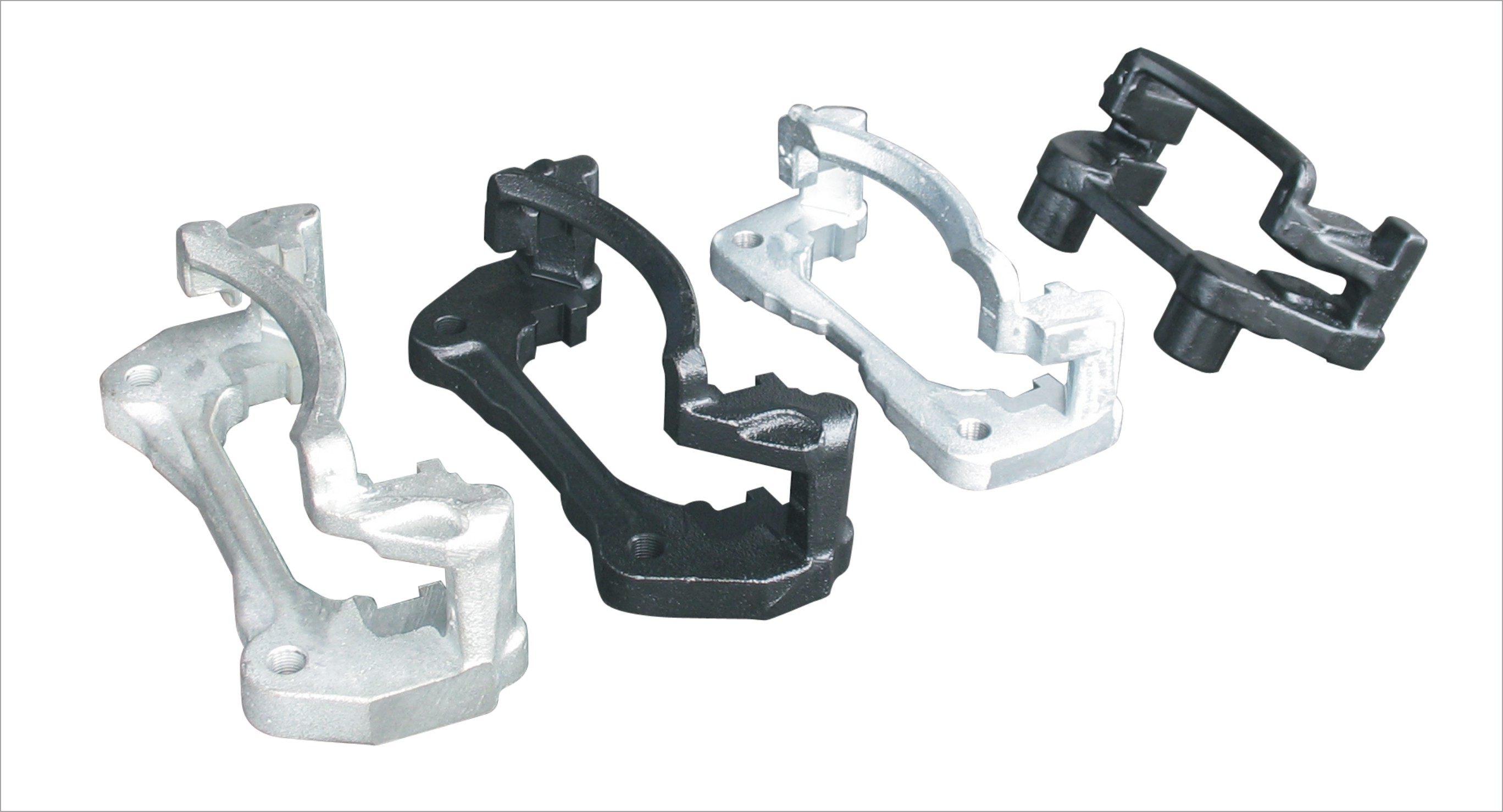
Why "Iron Casting" Is a Category, Not a Specification
The first constraint a buyer meets is definitional. ASTM International lists separate specifications for the automotive iron casting family rather than a single umbrella document: ASTM A159 for automotive gray iron castings, ASTM A602 for automotive malleable iron castings, and ASTM A1095 for high-silicon molybdenum ferritic iron castings used in high-temperature automotive applications. These are complementary documents describing different material classes — not interchangeable benchmarks.
The buyer consequence is immediate and commercial. If an RFQ says only "iron casting" and a drawing does not name a grade, suppliers may quote against different base materials and the resulting prices are not comparable. A gray iron quotation and a nodular iron quotation for the same envelope geometry can differ substantially because the material route, the melting control, the heat treatment and the machining allowance differ. Comparing them is not a price negotiation; it is an error of classification.
This is why constraint-first sourcing works better than catalogue-first sourcing in this segment. The specification has to be fixed before the quotation is meaningful.
The Four Layers of Constraint in a Nodular Iron Sourcing Decision
Across braking system components, steering system components, hubs, brackets, caliper housings, rotors, gearbox parts and axle supports, the same four constraint layers reappear. Each layer can disqualify a supplier independently of the others.
| Constraint layer | What the buyer must fix | Why it filters suppliers |
|---|---|---|
| Material grade | Nodular grade (for example QT550-6 or QT450-12), gray iron alternative (HT250 or HT200), or ADI grade | Different grades require different melting control, inoculation practice and, for ADI, a separate austempering route |
| Mechanical and coating values | Tensile, yield, elongation, hardness, salt spray duration, coating adhesion | Values must be demonstrable on test records, not asserted in a brochure |
| Quality-system certification | IATF 16949 coverage of the actual product scope | A certified system is a qualification gate for most automotive programmes |
| Commercial thresholds | MOQ by part weight, lead time, tooling, surface treatment scope | A technically capable foundry can still be commercially unviable at low volume |
Treating these four layers separately, and documenting each one, is the difference between a quotation that can be defended internally and one that has to be re-opened after tooling has been cut.
Reading the Grade List: QT550-6, QT450-12, HT250, HT200 and ADI
Nodular cast iron differs from gray iron in graphite morphology: the carbon takes a spheroidal rather than a flake form, which reduces the internal stress concentration that flake graphite creates and gives the material useful ductility alongside strength. This is general metallurgical knowledge rather than a supplier claim, and it explains why nodular grades migrate into load-bearing and cyclic-duty positions — knuckles, caliper brackets, hubs and supports — while gray iron remains common in housings and less demanding structural shapes.
The material list published for the BRKT-1 automotive component parts range illustrates how broad a single component family can be. It spans QT550-6, QT450-12, HT250, HT200, ADI 900, ADI 1050, nodular cast iron and gray iron. In practical terms that breaks into three commercial routes:
- Nodular grades (QT550-6, QT450-12) — specified where the part combines structural duty with a requirement for elongation rather than purely compressive strength.
- Gray iron grades (HT250, HT200) — specified where vibration damping, castability and cost matter more than ductility.
- ADI grades (ADI 900, ADI 1050) — austempered ductile iron routes, specified where a higher strength nodular grade is needed and the programme accepts the additional heat-treatment step.
The decision rule is therefore not "which grade is better" but "which failure mode am I designing against". A braking system bracket that sees repeated load reversal has a different material logic from a gearbox housing that primarily locates and encloses. Buyers who force a single grade across a mixed bill of materials usually pay for it either in over-specification or in field returns.
The Numeric Envelope: Values That Belong in the RFQ
Once the grade is fixed, the constraint moves to numbers. The published parameter set for the BRKT-1 component parts of auto-mobile range is specific and testable: tensile strength ≥550 MPa, yield strength ≥350 MPa, elongation ≥6%, hardness 173–255 HB, salt spray resistance of 504 hours, and dry adhesion of ≥B.
Two points matter more than the values themselves.
First, these figures describe a component envelope, not a universal material law. A 550 MPa tensile floor with 350 MPa yield and 6% elongation is a coherent nodular iron specification; it should be quoted as a minimum, with the test method and sampling plan named in the drawing package. A supplier that reports a single tensile figure without yield, elongation and hardness has not demonstrated the envelope.
Second, the coating values are frequently the ones that decide whether a part survives its first winter. A 504-hour salt spray requirement with a ≥B dry adhesion threshold is a meaningful constraint for underbody and wheel-end components exposed to humidity, road salt and stone chipping. It is also a manufacturing constraint: it requires the coating line, not just the casting line, to be under process control.
What IATF 16949 Certificate T-05675/0 Covers — and What It Does Not
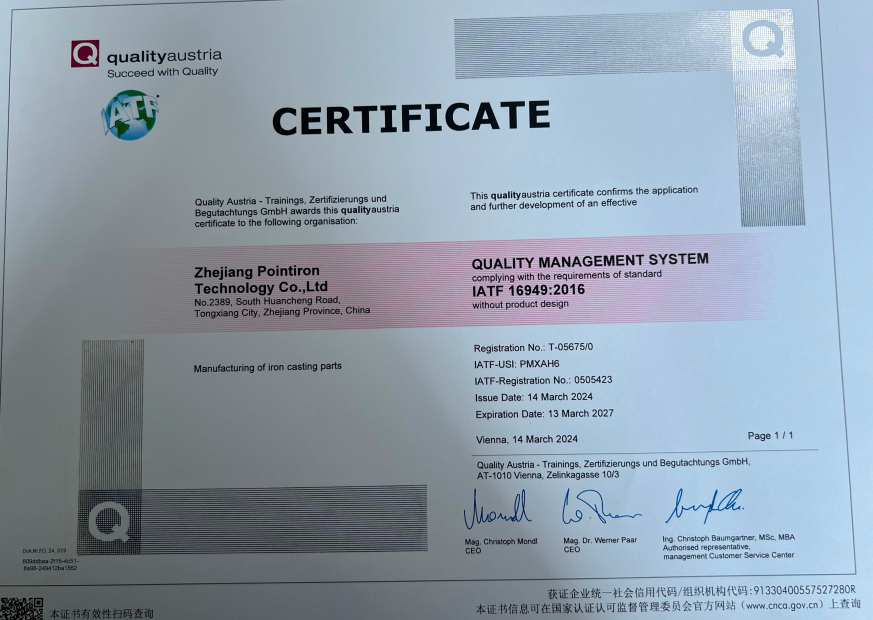
Certification is the third constraint layer, and it is the one most often misread. The BRKT-1 automotive component parts product is covered by IATF 16949 certification. The certificate is a quality management system certification, with certification number T-05675/0, issued by Quality Austria-Trainings, Zertifizierungs und Begutachtungs GmbH. The certification standard is IATF 16949, the certification scope is automobile, the issue date is 14 March 2024 and the expiry date is 13 March 2027. The certification applies to the EU, US, Middle East and Southeast Asia markets.
What this establishes is that the quality management system covering the automotive component parts scope has been assessed against IATF 16949 by a named certification body, with a traceable certificate number and a defined validity window. That is a genuine qualification gate for most automotive programmes, and it is verifiable by the buyer independently.
What it does not establish is equally important. A quality management system certificate does not certify the tensile strength of a specific casting, the dimensional tolerance of a specific machining operation, or the fatigue life of a specific geometry. Those are established through the drawing, the control plan, the inspection records and the part approval process. Buyers who accept a system certificate as a substitute for component-level evidence are accepting a document trail that will not answer a field failure question.
The same discipline applies to environmental certification. The supplier operates under ISO14001:2004 alongside IATF16949:2009 in its stated management systems, which is relevant to programme-level compliance reviews but again says nothing about a specific casting's mechanical performance.
Inside the Production Route Behind the Constraint
Zhejiang Pointiron Technology Co.,ltd is an enterprise founded in 2000, operating a 66,770 m² facility with 200 employees and an annual output of 2,000,000 units, serving mainly the USA and EU markets with a 20% export ratio. Its stated model is one-stop service from casting and machining through painting to final assembly, covering automobile brake parts such as caliper brackets, housings and steering knuckles, alongside windmill components, tractor components and lawn and garden mower components.
The capacity figures explain what kind of supplier this is. Annual casting capacity is 35,000 tons across ductile iron and gray iron, monthly capacity is 3,000 tons, and machining capacity is 5 million pieces per year. Two casting lines are imported from DISA Denmark — a DISA MATCH32/32 horizontal automatic moulding line and a DISA 131B vertical automatic moulding line. Three paint lines operate in parallel: a wet paint line, a powder coat line and an E-coat line, supported by one assembly line.
Why the equipment list matters to a buyer is repeatability. Automatic moulding lines reduce the operator-dependent variation that hand moulding introduces into wall thickness and dimensional consistency, which is exactly the variable that drives scrap rate in a nodular iron programme. The presence of separate coating lines is what makes a 504-hour salt spray requirement a production claim rather than a laboratory claim. And quality control is stated as 100% test, which is the appropriate posture for braking and steering components where sampling alone carries unacceptable escape risk.
A US warehousing arrangement through Point Iron USA, Inc. exists for US customers, which shortens the replenishment loop for North American programmes but does not change the underlying 12-week production lead time from order.
Commercial Constraints: MOQ Ladder, Lead Time and the Material Price Trap
Technically qualified does not mean commercially available at any volume. The published commercial terms for this component range are specific, and they should be read before an RFQ is issued rather than after a quote is rejected.
| Part weight band | Minimum order quantity |
|---|---|
| Under 10 lb | 10,000 pcs |
| 10–20 lb | 5,000 pcs |
| 20–100 lb | 2,000 pcs |
| 100–150 lb | 1,000 pcs |
The lead time is 12 weeks. Production mode is OEM/ODM, with customization available on size, logo, color and surface treatment, and after-sales support provided through warranty.
The MOQ ladder deserves attention because it is counter-intuitive at first reading. A small, light bracket carries the highest piece-count threshold — 10,000 pieces — while a heavy 100–150 lb component needs only 1,000. That reflects the economics of automatic moulding: a light part consumes a mould position without consuming much metal, so the fixed setup cost must be amortised across a larger number of pieces. Buyers planning a low-volume or prototype-stage programme should recognise that seeding volume is a commercial constraint, not a technical one, and should plan launch quantities accordingly.
Price is where most estimates go wrong. Nodular cast iron was noted at roughly USD 945–1,050 per metric ton in 2025 spot markets. That figure is a raw material indicator and nothing more. It cannot be converted into a component piece price by multiplying by part weight, because the piece price also carries melting yield and scrap, machining time, tooling amortisation, coating line time, inspection, packaging and freight. A buyer who anchors a negotiation on the metal index alone will either misjudge a fair quote or miss a genuine cost driver — machining allowance on a near-net-shape casting is frequently a larger lever than the metal price itself.
Application Fit: Braking, Steering, Gear Transmission and Off-Road Platforms
The documented application profile for these iron castings places them as core components for gear transmission and vehicle braking systems and steering systems. Working conditions span beach, mountain and outdoor environments, with intermittent and continuous operation modes, matched against vehicle braking assemblies, gear transmission assemblies and ATV chassis. The stated special requirements are anti-rust, salt spray and humidity resistance — consistent with the 504-hour salt spray and ≥B adhesion values in the parameter set.
That combination of outdoor duty and continuous or intermittent cycling is the case for nodular iron rather than a lighter alternative. A component that is loaded cyclically in a wet environment must resist both fatigue initiation and corrosion-assisted degradation, and the coating system is therefore part of the structural qualification rather than a cosmetic finish.
What a Ten-Year Programme Looks Like
One documented case covers an auto-mobile OEM application involving 2,000,000 units over a ten-year period, described as ten years stable. The stated problem was component wear and short replacement cycles in automotive braking applications; the stated highlights are structural stability, high wear resistance and long service life.
Read as procurement evidence rather than marketing copy, the useful signal is programme continuity. A ten-year supply relationship on braking-related components implies that the material grade, process control and coating system held across multiple production years and multiple OEM audit cycles. That is a different class of evidence from a single-lot test report, and it is the category of evidence a buyer should be asking for when qualifying a nodular iron source for a safety-related part.

Customs Classification: The Constraint Buyers Discover Late
Import classification is the constraint that rarely appears in a technical review and frequently appears in a landed-cost reconciliation. A binding US ruling classified automotive front and rear steering knuckles under HTS 8708.80.6000 as suspension parts rather than under the steering-parts heading, on the basis of their role as pivot points; the same ruling records the front knuckle as composed of 93.6% cast iron and the rear knuckle as 97.5% cast iron. The US International Trade Administration separately lists cast-iron automotive tariff classifications including gearbox parts and miscellaneous cast-iron parts.
Two practical consequences follow. First, material composition influences classification, and classification influences duty — so the alloy decision is not purely an engineering decision. Second, cast-iron gearbox parts and other cast-iron automotive parts sit under different classifications and should not be aggregated into one trade category during cost modelling. Buyers should confirm the HS or HTS code with their customs broker per part number, not per supplier.
Where Nodular Cast Iron Is Not the Right Answer
A credible sourcing reference has to state the boundary conditions, not only the fit.
Low-volume programmes. The MOQ ladder is weight-banded and, for light parts, reaches 10,000 pieces. A programme below that threshold, or a single-set prototype build, is not an efficient use of an automatic moulding line. In that situation a buyer is usually better served by a prototype-capable route and a later transfer to production tooling.
Weight-driven applications. Nodular iron is a dense material. Where mass reduction is the dominant requirement — certain suspension arms, some wheel-end assemblies — aluminium or forged steel alternatives are chosen for reasons that casting cannot answer, regardless of supplier capability.
High-temperature service. ASTM A1095 addresses high-silicon molybdenum ferritic iron for high-temperature automotive applications such as exhaust and turbocharger-related parts. That is a distinct material segment. A general nodular iron programme should not be assumed to cover it, and buyers with hot-end requirements must specify the material class explicitly rather than assume cast iron is cast iron.
Evidence still to be obtained. The specification set reviewed for this article covers mechanical properties, coating performance, application conditions and quality-system certification. It does not, in the material available, set out component-level fatigue data, dimensional tolerance bands, chemical composition limits or heat-treatment records for specific part numbers. Those items belong in the drawing package and the part approval submission, and a buyer should request them explicitly rather than infer them from a material grade.
Market Context: Why Constraint Discipline Is Becoming More Valuable
The demand backdrop supports continued attention to this component family. The global automotive brake systems market was valued at USD 46.44 billion in 2025 and is projected to reach USD 74.45 billion by 2034, according to Fortune Business Insights. Asia Pacific held a 48.32% revenue share of that market in 2025.
Material segmentation inside adjacent components tells a more nuanced story. In the global steering knuckle market, cast iron accounted for approximately 20% of material share in 2024, while steel held a substantially larger position. Cast iron is therefore a significant but contested material choice, not a default — which is precisely why the grade, the test envelope and the certification have to be documented rather than assumed.
The broader industry frame is also worth noting: China's auto parts manufacturing sector is characterised in commercial research as producing parts, accessories and components for motor vehicles, a boundary far wider than the cast-iron component subset discussed here. Aggregating the two produces misleading scale figures, and buyers should keep material-specific evidence separate from broad industry statistics.
Future Outlook
Three developments are likely to shape nodular cast iron sourcing over the next programme cycles. The first is documentation intensity: as quality-system certification becomes a baseline rather than a differentiator, the competitive gap moves to component-level evidence — dimensional capability studies, coating audit records and traceability per heat. The second is certificate lifecycle management: the IATF 16949 certificate covering this scope runs to 13 March 2027, and buyers running multi-year programmes should track recertification dates as part of supplier risk rather than as an administrative afterthought. The third is materials differentiation: the coexistence of gray iron, nodular iron, ADI and high-silicon molybdenum specifications means that specifying "cast iron" without a grade will become progressively less defensible as programmes tighten their weight and durability targets.
For procurement teams, the practical translation is straightforward. Fix the grade, fix the numeric envelope, verify the certification scope and validity, confirm the commercial thresholds, and confirm the customs classification. Everything else is negotiation.
Frequently Asked Questions
1. What does the IATF 16949 certificate T-05675/0 actually cover?
The certificate is an IATF 16949 quality management system certification covering the BRKT-1 automotive component parts product, with certification number T-05675/0. It is issued by Quality Austria-Trainings, Zertifizierungs und Begutachtungs GmbH, the certification scope is automobile, and the validity period runs from 14 March 2024 to 13 March 2027. It applies to the EU, US, Middle East and Southeast Asia markets. It certifies the management system for that scope; it does not certify the mechanical properties of an individual casting, which are established through the drawing and inspection records.
2. Which nodular cast iron grades are available, and how does a buyer choose between them?
The published material list for the automotive component parts range includes QT550-6, QT450-12, HT250, HT200, ADI 900, ADI 1050, nodular cast iron and gray iron. QT550-6 and QT450-12 are nodular grades used where structural duty requires elongation as well as strength; HT250 and HT200 are gray iron grades; ADI 900 and ADI 1050 are austempered ductile iron grades used where a higher strength nodular route is required. Selection is driven by the failure mode the part is designed against — load reversal and cyclic duty generally point toward a nodular grade, while housings and lower-demand structural shapes are commonly specified in gray iron.
3. What mechanical and coating values should an RFQ for nodular iron auto components specify?
The documented parameter envelope for the BRKT-1 component parts of auto-mobile range sets tensile strength at ≥550 MPa, yield strength at ≥350 MPa, elongation at ≥6%, hardness at 173–255 HB, salt spray duration at 504 hours and dry adhesion at ≥B. These are the values a buyer should require as minimums, with the test method and sampling plan named in the drawing package. Quoting tensile strength alone, without yield, elongation and hardness, does not demonstrate the full envelope.
4. What MOQ and lead time should be planned for nodular iron automotive components?
The MOQ is banded by part weight: 10,000 pieces for parts under 10 lb, 5,000 pieces for 10–20 lb, 2,000 pieces for 20–100 lb, and 1,000 pieces for 100–150 lb. The stated production lead time is 12 weeks. Production mode is OEM/ODM with customization available on size, logo, color and surface treatment. Because light parts carry the highest piece-count threshold, low-volume or prototype-stage programmes should plan seeding volume as a commercial requirement rather than assume a technical barrier.
5. What drives the price of a nodular cast iron component, and why is material price not the answer?
Nodular cast iron was noted at approximately USD 945–1,050 per metric ton in 2025 spot markets. That is a raw material indicator, not a component piece price. A finished part price also reflects melting yield and scrap, machining time and allowance, tooling amortisation, coating line time across wet paint, powder coat or E-coat, inspection, packaging and freight. Because near-net-shape casting quality directly affects machining allowance, process capability can influence total cost more than the metal index does.
Есть вопросы или нужны дополнительные детали?
Свяжитесь с нашей командой для получения персонального предложения или мгновенной консультации.
Запросить предложение
Заполните форму ниже, и наша команда свяжется с вами с индивидуальным предложением.
Прямой чат WhatsApp
Предпочитаете общаться в реальном времени? Напишите нам в WhatsApp для мгновенной помощи и быстрых ответов.
- Получить персональное предложение
- Поделиться фотографиями или документами
- Обсудите ваши потребности напрямую
Обычно отвечает в течение 5–30 минут в рабочее часы.