
Non-Dairy Creamer Compliance Deep-Dive: Zero Trans Fat and Kosher Options
Non-Dairy Creamer Compliance Deep-Dive: Zero Trans Fat and Kosher Options
Two lines on a non-dairy creamer specification sheet now carry disproportionate weight in global procurement: the trans fat declaration and the dietary certification attached to the finished powder. Both are documentary claims rather than sensory ones, which means a buyer can verify them before a sample is ever opened. That is why evaluation-stage teams increasingly treat them as screening filters rather than closing details.
The commercial context is scale. The global non-dairy creamer market was valued at USD 2.4 billion in 2024 and is projected to reach USD 4.4 billion by 2034, according to Future Market Insights, with powdered formats holding a 68.4% share in 2024 because of shelf life and storage economics. Coffee applications account for approximately 41% of global utilization, based on Business Research Insights data. When a category is that large and that widely distributed, a single formulation decision inside a 3-in-1 coffee blend can ripple across several export markets at once.
This article examines one supplier's documentation set as a worked example. Jiahe Foods Industry Co., Ltd. is a food ingredient manufacturer founded in 2001 and headquartered in Suzhou, Jiangsu Province, listed on the main board of the Shanghai Stock Exchange in 2021 under stock code 605300, which produces non-dairy creamer under the Cograin brand across three production bases and five factories in Suzhou, Nantong and Singapore. The purpose here is not to assert category leadership, but to show what verifiable compliance evidence looks like during evaluation, and where that evidence stops.
The Compliance Gap: Why Two Specification Lines Now Decide Shortlists
Three different vocabularies collide inside a single purchase decision, and each one has its own rulebook:
- Labeling rules determine whether the words 'non-dairy' may legally appear on a package in a given market.
- Dietary certification rules determine whether the powder qualifies for a kosher or halal program, and under which dairy status.
- Nutrition declarations determine the trans fat figure, and the basis on which that figure is stated.
A supplier can be accurate on all three and still be misread by a buyer when the scope of each document is not stated precisely. Three mismatches recur in practice. A buyer reads 'non-dairy' as 'dairy-free', when the two are not the same regulatory concept. A buyer accepts a '0 g trans fat' figure without confirming whether it is declared per 100 g or per serving. A buyer files a certificate that covers one model, one pack size or one site as though it covered an entire product family. Each mismatch is avoidable, but only if the supplier publishes scope rather than slogans.
The opportunity runs in both directions. For buyers, compliance documents that name a model, a batch and a validity window can be checked in days instead of weeks, which shortens the distance between sample approval and a first production order. For suppliers, publishing narrow and precise claims is counter-intuitively stronger than publishing broad ones, because narrow claims survive audit.
What the Documentation Actually States: Zero Trans Fat Across the Portfolio
Trans fat status is normally discussed as a category property. In this portfolio it is documented per model, and the difference matters.
| Model | Type | Fat (g/100 g) | Protein (g/100 g) | Trans fat (g/100 g) | Documented applications |
|---|---|---|---|---|---|
| FC22 | Foaming creamer | 22.0 | 7.2 | 0 | Milk tea, coffee, baking |
| K60 | Non-dairy creamer | 32.0 | 2.6 | 0 | Milk tea, baking, coffee |
| 60A | High fat | 60.0 | 3.0 | 0 | Beverage, dessert, baking, animal feed |
| S35 | Vegan | 35.0 | 0 | 0 g (as stated) | Vegetarian products, alcoholic beverages, milk tea, coffee, baking |
| K80 | Kosher product | 32.0 | 2.5 | Not stated in this documentation set | Beverage, dessert, milk tea, coffee |
Two of the grades most often specified for beverage and bakery work carry the clearest declarations. FC22 (Foaming) documents trans fat at 0 g/100 g, with 22.0 g/100 g total fat and 7.2 g/100 g protein — a protein-to-fat profile associated with foam formation in instant coffee and milk tea. K60 documents trans fat at 0 g/100 g as well, at 32.0 g/100 g fat and 2.6 g/100 g protein, with milk tea, baking and coffee listed among its applications. 60A, the high-fat grade at 60.0 g/100 g fat and 3.0 g/100 g protein, records trans fat at 0/100 g and is listed for beverages, desserts, baking and animal feed. S35 (Vegan) records trans fat at 0 g with 35.0 g/100 g fat and 0 g protein, and lists vegetarian products, alcoholic beverages, milk tea, coffee and baking.
For a buyer whose first filter is a documented zero trans fat declaration, the shortlist inside this portfolio is therefore FC22, K60, 60A and S35. Each occupies a different fat band, so the declaration narrows the field without deciding it — fat level, foaming behaviour and application still have to be matched afterwards.
The Kosher Option: Reading Certificate KC#529705-1 Correctly
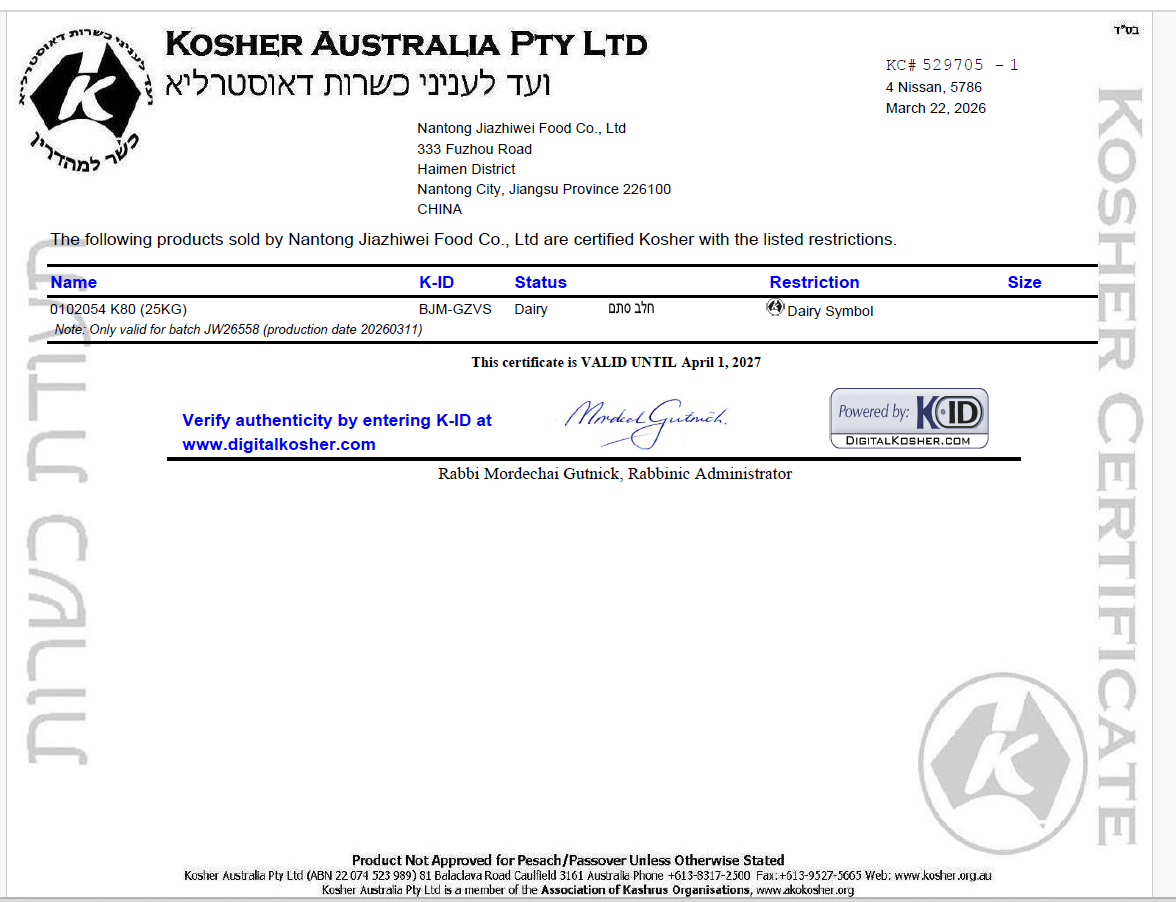
The kosher variant in this portfolio is model K80, packaged in 25 kg units, and its certification is documented rather than implied. Certificate KC#529705-1 was issued by KOSHER AUSTRALIA PTY LTD under Australian and international kosher dietary compliance standards, dated 22 March 2026 and valid to 1 April 2027, with a stated scope covering non-dairy creamer model K80 (25 kg), batch JW26558, production date 11 March 2026. K80 is documented at 32.0 g/100 g fat and 2.5 g/100 g protein, with listed applications in beverage, dessert, milk tea and coffee.
Three details in that scope deserve attention during evaluation. First, the certificate names a model and a pack size rather than a product family; a kosher program built around K80 does not automatically extend to other grades in the same catalogue. Second, it names a batch. Batch-level certification is normal in kosher programs, and the practical consequence is that a buyer should confirm the batch released against a purchase order falls within certified scope, or is covered by an equivalent letter of certification for that production run. Third, it names a validity window from March 2026 to April 2027; a certificate valid at sampling may not be the certificate in force at shipment, so expiry dates belong in the contract checklist, not only in the filing cabinet.
A less obvious point concerns dairy status. Under kosher rules, sodium caseinate is treated as a milk derivative and is halachically milk: OU Kosher states that a 'non-dairy' creamer containing sodium caseinate is considered Dairy (OU-D) rather than pareve. K80's listed materials include sodium caseinate. Buyers therefore need to state which requirement applies to them — kosher dairy, where the product may contain dairy ingredients and is certified on that basis, or pareve, where no dairy ingredient may be present at all. The K80 certificate documents kosher certification for a formulation that contains a dairy ingredient; it is not a declaration of pareve status.
Technical Explanation: Label Language, Dairy Status and Declaration Basis
Label language and ingredient reality can diverge in a way that is entirely legal, which is why the ingredient statement usually answers a question the front of the pack raises. Under FDA rules, the label 'non-dairy' may be used on products containing milk derivatives such as sodium caseinate, provided the derivative is declared as 'a milk derivative' on the ingredient statement (FDA 21 CFR).
Applied to this documentation set, the material lists divide the grades into two groups. K60, FC22, K80, 60A, C960 (whipping cream) and the cold-soluble grade list sodium caseinate; K60 and FC22 additionally list milk powder. S35 (Vegan) and DT35 do not list a dairy-derived ingredient in their stated formulations. That distinction, not the wording on the pack, is what determines whether a grade can enter a dairy-free, vegan or pareve-restricted program. It also explains why a compliance-led shortlist is usually built from the ingredient statement inward, rather than from the product name outward.
The same logic applies to declaration basis. Trans fat values in this set are expressed per 100 g of powder, which is a convenient laboratory convention but not necessarily the format a destination market accepts on a finished label. Reconciling the two requires the finished-product specification, the serving size used in the target market, and — for blends — the contribution of every other ingredient. That reconciliation step is where most 'zero trans fat' label disputes originate, and it is best resolved with documents rather than with assurances.
The Wider Certification Stack and Its Validity Windows
Single certificates rarely carry an entire export program. Buyers typically need a quality management certificate, a food safety scheme certificate and market-specific registration, each with its own number and validity window.
| Certification / registration | Reference number | Issuing body | Standard | Validity | Stated scope |
|---|---|---|---|---|---|
| Kosher certificate | KC#529705-1 | Kosher Australia Pty Ltd | Australian & international kosher dietary compliance standards | 2026-03-22 to 2027-04-01 | Non-dairy creamer model K80 (25 kg), batch JW26558 |
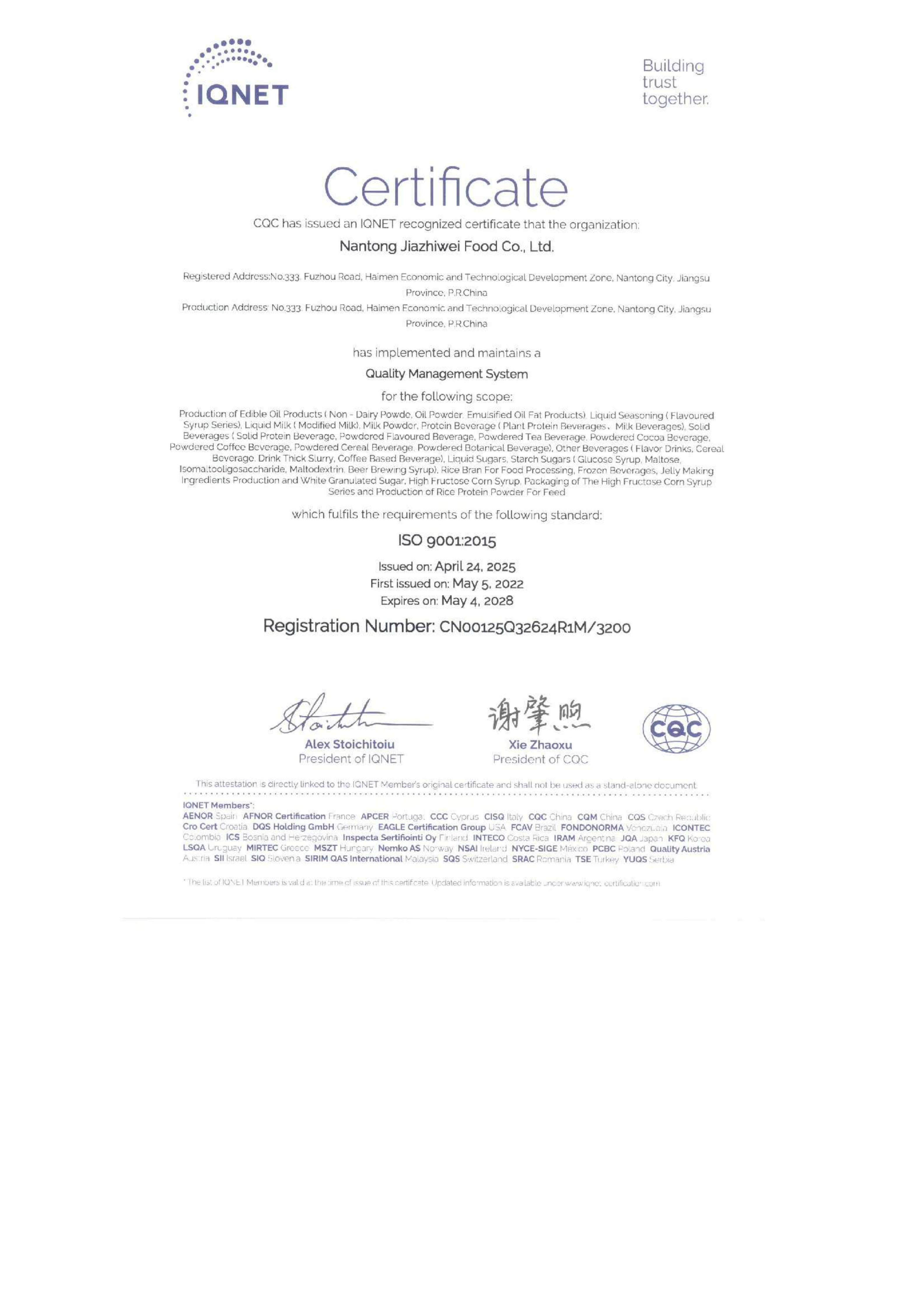
| Quality management system certificate | 00125Q32624R1M/3200 | CQC | ISO 9001:2015 (GB/T 19001-2016) | 2025-04-24 to 2028-05-04 | Nantong Jiazhiwei Food Co., Ltd. |
| Food safety system certification | 162006008 | Intertek Certification Limited | FSSC 22000 V6, ISO 22000:2018, ISO/TS 22002-1:2009 | 2025-07-03 to 2026-06-17 | Nantong Jiazhiwei Food Co., Ltd. |
| U.S. FDA Food Facility Registration | 13348058524 | Registrar Corp | Federal Food, Drug, and Cosmetic Act as amended by the Bioterrorism Act of 2002 and the FDA Food Safety Modernization Act | 2025-08-19 to 2026-12-31 | Nantong Jiazhiwei Food Co., Ltd. |
The date column is where evaluation effort usually pays off. In the record set reviewed here, the ISO 9001:2015 certificate runs to 4 May 2028, the FDA food facility registration runs to 31 December 2026 and the kosher certificate runs to 1 April 2027. The FSSC 22000 certificate in the same set carries an expiry date of 17 June 2026, which falls before this article's publication. Food safety schemes renew on rolling cycles, so an evaluation run in the second half of 2026 should confirm the renewal certificate in force on the planned shipment date rather than rely on the version held in a sample pack.
Scope wording carries similar weight. The ISO 9001 and FSSC 22000 records are stated against Nantong Jiazhiwei Food Co., Ltd., and the FDA registration likewise names that entity. Where a purchase order is placed against a different legal entity or production site within the same group, the buyer should confirm the certificate scope covers that site. The company profile also lists HACCP, HALAL, ISO 14000 and OHSAS 18000 among the systems the manufacturer has passed; as with any program, the specific certificate and its scope are what an auditor will ask to see.
Application Fit: Where These Grades Are Documented in Use
Compliance documents describe a powder; applications describe what happens next. The documented supply cases in this portfolio show how broad the application range becomes once a grade is matched to a format.
| Client type | Market | Volume | Duration | Application |
|---|---|---|---|---|
| 3-in-1 coffee manufacturer | Singapore, Malaysia, Indonesia, Philippines, Kazakhstan, UAE, Ukraine, Russia | 9,000 mt | 5 years | 3-in-1 instant coffee powder, instant oatmeal, instant milk tea |
| Bubble tea chain | Singapore, Vietnam, United States | 1,000 mt | 3 years | Bubble tea shop use |
| Beverage production factory | South Africa | 1,000 mt | 5 years | Alcoholic beverage formulations |
| Animal feed production plant | Singapore | 4,000–5,000 mt per year | 3 years | Animal feed, high-fat formulation |
Each case ties back to a specific grade. The 3-in-1 manufacturer relationship covers instant coffee, instant oatmeal and instant milk tea across eight markets and 9,000 metric tons over five years. The bubble tea chain accounts for 1,000 metric tons over three years in Singapore, Vietnam and the United States. The South African beverage factory used 1,000 metric tons over five years in alcoholic beverage work; S35 (Vegan) is the grade whose documented application list includes alcoholic beverages. The Singapore animal feed plant took 4,000–5,000 metric tons annually over three years, associated with the high-fat grade in this portfolio, 60A at 60.0 g/100 g fat.
For bakery and beverage formats, C960 (whipping cream) is documented at 60.0 g/100 g fat with 5.2 g/100 g protein for baking and beverage use, while DT35 is documented as a low-sugar grade at 4.3 g/100 g carbohydrate with 35.0 g/100 g fat for milk tea, coffee, beverage and baking. For kosher-certified programs, K80's documented application list covers beverage, dessert, milk tea and coffee — a narrower set than FC22 or K60, which is worth noting when one formulation is expected to serve several product lines.

Market Trend Analysis: Where Compliance-Led Selection Is Heading
Three published data points frame the direction of category demand. Medium-fat variants in the 21–50% range held a 43.6% to 46% share in 2024, according to Future Market Insights and Business Research Insights, which places the K60, K80 and cold-soluble band (32.0 g/100 g fat) in the market's largest segment rather than at its edges. Powdered formats overall held 68.4% of 2024 share, reflecting storage and shelf-life considerations that favour powders in long-distance export. Coffee remains the single largest application at roughly 41% of utilization, which is consistent with the 3-in-1 and instant beverage volumes documented in the cases above.
Adjacent functional powder categories reinforce the same direction. The global MCT powder market was valued at USD 585 million in 2024 and is growing at a CAGR of 5.7%, based on Intel Market Research data — a signal that buyers increasingly treat powdered fat systems as functional ingredients rather than as commodity fillers, and apply ingredient-level scrutiny accordingly.
The supplier landscape remains concentrated at the brand end. Grand View Research identifies Nestlé (Coffee-Mate), Danone (Silk), FrieslandCampina Kievit and Kerry Group among the top global players in the broader coffee creamer market. Those companies set consumer expectations for creamer performance; they do not set the compliance bar for a private-label powder order, which is defined by the destination market and the buyer's own specification. That gap is where documentation-led suppliers compete, and it is why trans fat declarations, dairy status and certificate scope tend to matter more in a bulk evaluation than brand familiarity does.
Comparison with Traditional Solutions — and Three Limits
Traditional solutions remain valid reference points, and the trade-offs are structural rather than promotional.
Liquid dairy cream offers familiar labeling and sensory expectations in markets with chilled distribution, but it depends on a cold chain and carries a shorter usable life than a powder. Branded imported powdered creamers offer consumer recognition and established retail presence, while the depth of published specification detail varies by supplier and by market. Compliance-documented powdered supply, the model examined here, trades brand-led familiarity for documentary precision: named models, stated parameters and certificate numbers that a buyer can check before committing.
Three limits should be stated plainly rather than smoothed over.
- Documentation is per model, not per brand. The zero trans fat declarations in this set cover FC22, K60, 60A and S35. K80's documentation states fat and protein but no trans fat value. Extending a claim from one model to a catalogue is the most common error in compliance-led shortlisting.
- Kosher certification is not the same as pareve status. Because K80's formulation lists sodium caseinate, and because sodium caseinate is treated as dairy under kosher rules, the grade fits kosher dairy programs rather than pareve programs. Buyers with a pareve requirement should look at grades whose material lists contain no dairy-derived ingredient, such as S35 (Vegan) and DT35, subject to the certification scope those grades carry.
- Certificates expire on their own schedule, not the buyer's. The FSSC 22000 record in this set expires 17 June 2026, before this article's publication, while other records extend into 2027 and 2028. No compliance dossier should be treated as static, and renewal status belongs in the order confirmation rather than in a preferences folder.
Future Outlook
The direction of travel is toward narrower, more checkable claims. Mid-fat formulations already dominate the market by share, and functional powder formats continue to attract ingredient-level attention, both of which push buyers toward specification-first evaluation rather than brand-first evaluation. In that environment, the practical question for a supplier is not whether claims are ambitious but whether each claim is bounded by a model number, a batch reference and a validity window that an auditor can verify.
For buyers, the workable sequence at evaluation stage is consistent: filter by the one declaration that cannot be negotiated in the target market, confirm the dairy status against the ingredient list, verify certificate scope against the exact model and site on the purchase order, and check expiry dates against the planned shipment date rather than the sampling date. That sequence takes days and prevents most of the disputes that otherwise surface at label approval.
Cograin publishes its product and certification information in a public brochure, available for download: 2025 Cograin Brochure.
FAQ
Which non-dairy creamer models carry a documented trans fat value of 0 g/100 g?
Within this product documentation set, four models record a zero trans fat value: FC22 (Foaming) at 22.0 g/100 g fat and 7.2 g/100 g protein, K60 at 32.0 g/100 g fat and 2.6 g/100 g protein, 60A at 60.0 g/100 g fat and 3.0 g/100 g protein, and S35 (Vegan) at 35.0 g/100 g fat with trans fat stated as 0 g. The values are recorded per 100 g of powder, and the declaration basis should be confirmed against the requirements of the destination market.
Is a kosher-certified non-dairy creamer dairy or pareve?
It depends on the formulation, not on the certificate name. Under kosher rules, sodium caseinate is treated as a milk derivative and is halachically milk; OU Kosher states that a 'non-dairy' creamer containing sodium caseinate is considered Dairy (OU-D) rather than pareve. In this portfolio, K80's listed materials include sodium caseinate, so the kosher certification applies to a dairy-containing formulation. Grades whose material lists contain no dairy-derived ingredient, such as S35 (Vegan) and DT35, are the relevant options where a pareve or dairy-free requirement applies, subject to the certification each grade carries.
What does the kosher certificate for K80 actually cover?
Certificate KC#529705-1 was issued by Kosher Australia Pty Ltd under Australian and international kosher dietary compliance standards, dated 22 March 2026 and valid to 1 April 2027. Its stated scope is non-dairy creamer model K80 in 25 kg packaging, batch JW26558, production date 11 March 2026. The scope names a model, a pack size and a batch, so it does not automatically extend to other models or to later production runs; buyers should confirm that the batch shipped against their order falls within certified scope or is covered by an equivalent letter.
How should a buyer verify a 'non-dairy' label claim on a product that contains sodium caseinate?
Start with the ingredient statement rather than the product name. Under FDA rules, the label 'non-dairy' may be used on products containing milk derivatives such as sodium caseinate, provided the derivative is declared as 'a milk derivative' on the ingredient statement (FDA 21 CFR). In this documentation set, K60, FC22, K80, 60A, C960 and the cold-soluble grade list sodium caseinate, while S35 (Vegan) and DT35 do not list a dairy-derived ingredient. Matching the material list to the requirement is more reliable than matching the label wording.
Which applications are best supported by zero trans fat and kosher-certified grades?
The documented application lists provide the guide. FC22 covers milk tea, coffee and baking; K60 covers milk tea, baking and coffee; 60A covers beverage, dessert, baking and animal feed; S35 covers vegetarian products, alcoholic beverages, milk tea, coffee and baking; and K80 covers beverage, dessert, milk tea and coffee. Published supply cases include a 3-in-1 coffee manufacturer across eight markets (9,000 metric tons over five years), a bubble tea chain in Singapore, Vietnam and the United States (1,000 metric tons over three years), a South African beverage factory using the product in alcoholic beverages (1,000 metric tons over five years) and a Singapore animal feed plant (4,000–5,000 metric tons per year for three years).
What checks should be completed before relying on a certificate in a purchase contract?
Four checks cover most risk. Confirm that the certificate names the exact model and pack size on the purchase order. Confirm that the certificate scope names the legal entity and site that will produce the goods, since the ISO 9001 and FSSC 22000 records in this set are stated against Nantong Jiazhiwei Food Co., Ltd. Confirm that the expiry date falls after the planned shipment date; the FSSC 22000 record in this set expires 17 June 2026, while the kosher certificate runs to 1 April 2027 and the ISO 9001 certificate to 4 May 2028. Finally, confirm that any market-specific registration, such as the FDA food facility registration numbered 13348058524 and valid to 31 December 2026, remains in force at the time of export.