
Non-Destructive Leak Detection in Sealed Packages
HTNXT Industry Reference · Food Safety & Pharmaceutical Analysis Testing
Non-Destructive Leak Detection in Sealed Packages

Sealed pharmaceutical and medical packages are the starting point for non-destructive container closure integrity testing (CCIT), in which the tested unit remains intact after measurement.
Introduction: Seal Integrity Is a Detection Problem Before It Is a Sampling Problem
A sealed vial of sterile pharmaceutical product, or a sealed food sachet, protects its contents only for as long as the container wall and closure remain intact. Container Closure Integrity Testing (CCIT) is the testing discipline used to detect leaks in pharmaceutical, food, and other sealed packages, and non-destructive leak detection is the branch of CCIT that evaluates a package without opening, puncturing, or consuming it. The unit under test stays a package rather than becoming a destroyed sample.
That single property changes how quality control can be structured. Destructive testing characterizes only the units it destroys, so conclusions about the remainder of a batch are inferred statistically. A non-destructive measurement produces a result while leaving the tested container intact, which allows more units to be characterized per batch and allows attention to focus on the failure mode that matters most in sterile and food packaging: micro-leaks whose channel dimensions are measured in micrometers, and which visual inspection does not resolve.
Labthink Instruments Co. Ltd. is a manufacturer of packaging material testing instruments, established in 1989 in Jinan, China, specializing in the development and manufacturing of precision instruments and testing solutions for packaging materials analysis. Its packaging integrity range includes the C690 Nondestructive Package Leak Detector, a vacuum decay CCIT instrument used for leak detection in pharmaceutical, food, and other sealed packages. This reference explains what non-destructive leak detection does, how vacuum decay and pressure decay measurements produce a result, which package types can be evaluated, what buyers compare, and where the boundaries of the method lie.
The Problem: Leaks That Are Too Small to See and Too Expensive to Miss
Package integrity failures rarely announce themselves. A container can pass a visual check, hold its shape, and still carry a defect through which gas exchange or microbial ingress becomes possible. Because the consequence of such a defect is a sterility or shelf-life failure discovered after release, quality systems in pharmaceutical packaging, medical devices, and food packaging treat closure integrity as a safety assurance activity rather than a cosmetic inspection.
Three practical constraints shape how that activity is performed.
- Detection scale. Leak channels of a few micrometers are not visible. Detecting them requires an instrument that responds to a physical signal produced by the defect, such as a change in pressure, rather than a human judgment about appearance.
- Sample loss. Approaches that compromise the package consume the tested unit. Every test therefore removes a package from the batch and leaves the condition of the untested remainder to be inferred.
- Evidence for audits. Regulatory and quality systems expect results that can be traced back to a method, a setpoint, and a recorded measurement. A result that exists only as an operator note is difficult to defend during an inspection.
Labthink states that its vacuum decay Container Closure Integrity Test method is a deterministic, non-destructive leak detection method compliant with USP <1207>, ISO 11607, ASTM F2338, and FDA regulations. That statement is a manufacturer position on method classification and standards alignment; buyers evaluating a supplier typically verify such alignment against the applicable standard text and their own validation requirements.
The opportunity created by non-destructive measurement is therefore not simply “a better test.” It is a different relationship between testing and the batch: packages can be characterized in larger numbers, at the point where the seal is formed or filled, and the recorded pressure data becomes part of the batch record rather than an isolated laboratory observation.
How Non-Destructive Leak Detection Produces a Result
Non-destructive leak detection in sealed packages is built on two closely related physical measurements. Both treat the package as a closed system and look for the movement of gas that a defect makes possible.
Vacuum decay testing. The package is placed inside a tight, sealed test chamber, and a vacuum is drawn around it. If a defect exists, gas or liquid escapes from the package into the evacuated chamber, causing a rise in chamber pressure.
Pressure decay testing. The test item is pressurized to a defined pressure, allowed to stabilize, and then monitored during a specified test period. A pressure decrease indicates a potential leak — gas escaping through a micro-leak or seal flaw produces a measurable drop in internal pressure.
Both are physical leak tests for sealed, non-porous packages and containers. Neither requires the package to be opened, and neither depends on a reagent, a dye, or a microbial challenge to reveal the defect. The instrument observes the pressure behavior of a package over a defined interval and compares it against the expected behavior of an intact container.
This is why the method is described as deterministic. The output is a measured pressure change recorded against a setpoint and a monitoring window, rather than a subjective assessment of whether a dye trace or a visible mark is present. Determinism matters for two reasons: it makes the result repeatable between operators and shifts, and it makes the result storable in a form that can be reviewed later.
The C690 Nondestructive Package Leak Detector
Within this method family, the C690 Nondestructive Package Leak Detector is Labthink’s vacuum decay Container Closure Integrity Testing (CCIT) instrument. It is designed for non-destructive package leak detection in pharmaceutical packaging, is suitable for sterile pharmaceutical packaging integrity testing, and can be used for vial and ampoule leak testing. The product is intended for the medical device, pharmaceutical packaging, and food packaging industries and is made of aluminum alloy and ABS plastic.
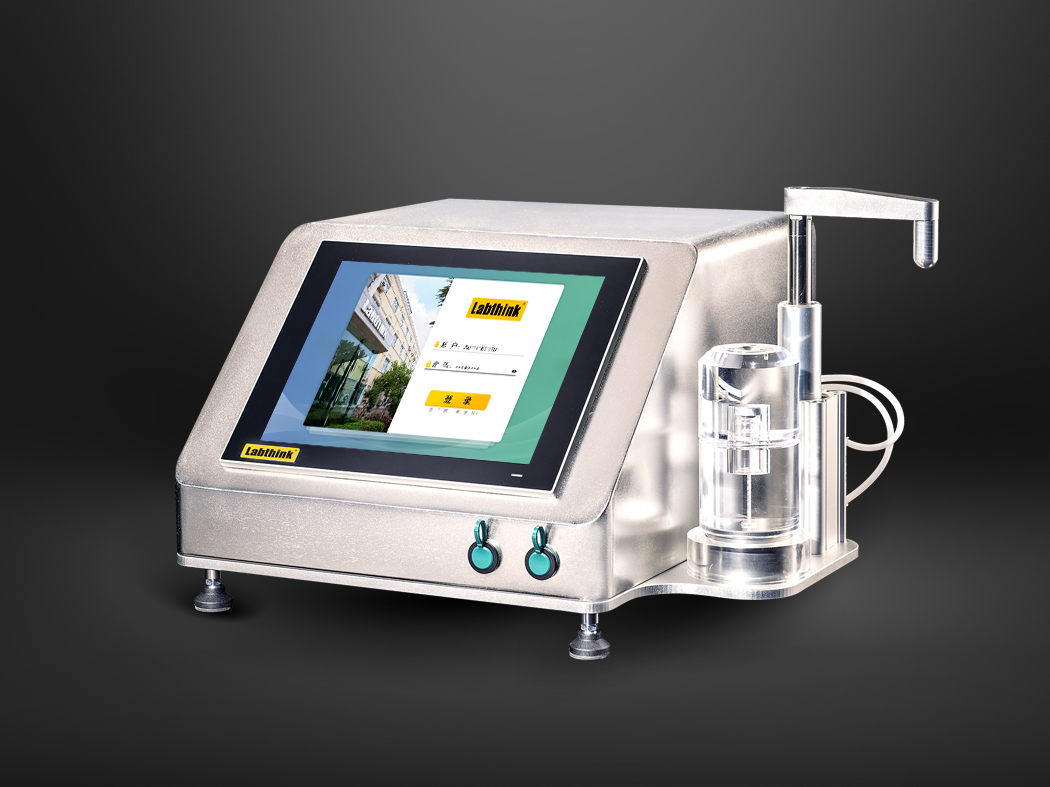
C690 Nondestructive Package Leak Detector: a vacuum decay Container Closure Integrity Testing (CCIT) instrument for sealed pharmaceutical, medical device, and food packages.
Published specifications describe the instrument’s measurement envelope and its operating environment.
| Attribute | Specification |
|---|---|
| Model designation | C690 Nondestructive Package Leak Detector |
| Method category | Vacuum decay Container Closure Integrity Testing (CCIT) |
| Testing range | 2 µm to 8 µm and greater leakage |
| Detection lower limit | 2 µm |
| Resolution | 0.1 µm |
| Repeatability | ±1 µm |
| Pressure range | −100 to 0 to +100 kPa |
| Construction material | Aluminum alloy + ABS plastic |
| Applicable industries | Medical device, pharmaceutical packaging, food packaging |
| Operation | Fully automated |
| Matched equipment | Vacuum pump |
| Operating requirement | Indoor laboratory use; stable ambient temperature |
Labthink lists the following characteristics for the system: non-destructive deterministic test, precise measurement, traceable data, safe operation compatible with hazardous gases, 21 CFR Part 11 and GMP compliance, and full-process automation. Taken together, these describe an instrument positioned for regulated laboratory environments in which the test result has to be defensible as well as accurate.
Where Non-Destructive Leak Detection Is Applied
The application profile of non-destructive CCIT follows the package formats that carry high-value or safety-critical contents. In practice, the C690 supports sealed packages including vials, ampoules, syringes, bottles, pouches, sachets, and other package formats, subject to the package configuration and the availability of a suitable fixture.
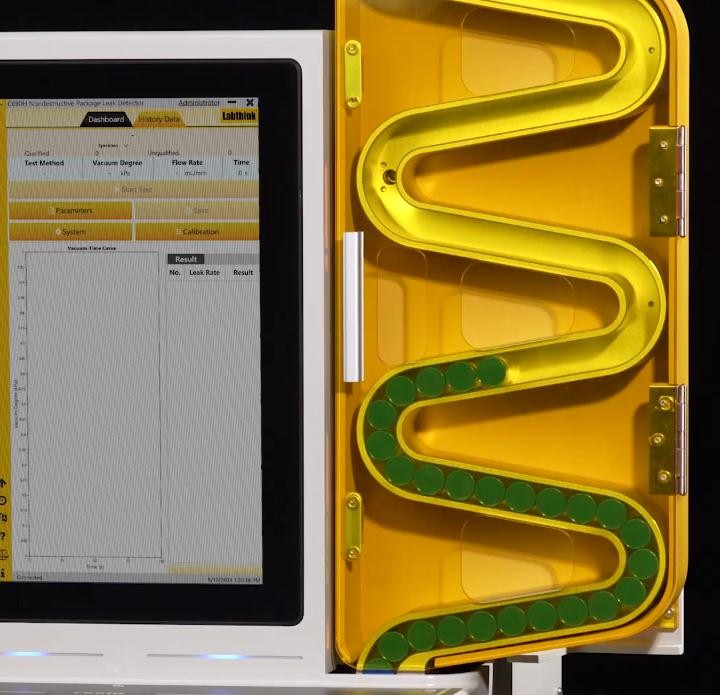
Automated batch leak testing: automatic sample feeding supports repeated, unattended integrity checks across a series of sealed packages in a laboratory quality control workflow.
Application scenarios documented for this system span the pharmaceutical, food packaging, medical device, and Testing, Inspection and Certification (TIC) sectors, and cover quality control testing, safety assurance, and regulatory compliance work in laboratory environments. The listed project context places the instrument indoors, in a stable ambient temperature, with a vacuum pump as matched equipment.
Typical use cases divide into three groups:
- Sterile pharmaceutical containers. Vials, ampoules, and syringes, where closure integrity is linked directly to sterility assurance.
- Sealed food packages. Pouches, sachets, and bottles, including sachets containing food or meat products, where suitability depends on dimensions, material, and required leak detection sensitivity.
- Medical devices and contract testing. Sealed medical packages and third-party laboratory work where an intact, returnable sample has operational value.
What Buyers Compare in Non-Destructive CCIT Systems
Because non-destructive CCIT is a standards-driven purchase, evaluation criteria tend to converge across pharmaceutical, food, and medical device buyers. The criteria below reflect the decision framework associated with this instrument family: package non-destructiveness, seal leak rates, micro-leak detection capability, applicability across varied package geometries such as vials, ampoules, pouches, and syringes, and test speed and repeatability.
| Evaluation criterion | What the buyer is verifying |
|---|---|
| Non-destructiveness of the test | Whether the tested package remains intact and usable after measurement |
| Micro-leak detection capability | Whether the detection lower limit meets the smallest defect the specification requires (C690: 2 µm lower limit) |
| Resolution and repeatability | Whether readings are fine-grained and stable enough to support trend analysis (C690: 0.1 µm resolution; ±1 µm repeatability) |
| Package geometry coverage | Whether fixtures exist for the actual formats used — vials, ampoules, syringes, bottles, pouches, sachets |
| Method and standards alignment | Whether the declared method classification fits the applicable standard and internal validation plan |
| Data traceability and compliance features | Whether results are recorded and retained in a form suitable for audits (C690: 21 CFR Part 11 and GMP compliance listed) |
| Automation level | Whether the workflow can run repeated tests with limited operator intervention (C690: fully automated) |
| Laboratory requirements | Whether site conditions match the instrument (indoor laboratory use, stable ambient temperature, matched vacuum pump) |
Comparison with Destructive and Manual Integrity Approaches
The most consequential difference between non-destructive CCIT and sample-consuming approaches is what happens to the tested unit afterwards. The table below compares the two categories on the dimensions that usually drive the purchasing decision.
| Dimension | Non-destructive CCIT (vacuum decay / pressure decay) | Sample-consuming approaches |
|---|---|---|
| Effect on the tested package | Remains intact; the unit is not opened or punctured | The unit is consumed, opened, or otherwise compromised |
| Basis of the result | Instrument-measured pressure change against a setpoint and monitoring window | Challenge, exposure, or inspection, typically followed by operator assessment |
| Detection target | Micro-leaks and seal flaws detectable from outside a sealed, non-porous container | Defects that become visible or measurable once the package is challenged or opened |
| Record produced | Traceable pressure data suitable for batch records and audits | Observation-based records that depend on the documented procedure |
| Package compatibility | Depends on dimensions, material, headspace, and required sensitivity; a suitable fixture must be confirmed | Broad format coverage, but the sample is lost after each test |
The comparison is not a claim that one category replaces the other. Non-destructive CCIT answers a specific question — does this sealed package leak? — and it answers that question without destroying the evidence. Destructive or chemical methods answer different questions, including what the migrating substances are and at what concentration. A complete packaging quality program in the food and pharmaceutical sectors typically uses both, assigning each method to the question it is designed to answer.
Boundaries and Limitations of Non-Destructive Leak Detection
Non-destructive leak detection is not a universal substitute for every integrity or chemical test, and buyers should plan for several practical boundaries.
- Fixture and geometry dependency. Vacuum decay evaluation requires the package to be enclosed in a sealed test chamber sized for that format. Vials, ampoules, syringes, bottles, pouches, and sachets are all addressable, but each format needs a suitable fixture, and configuration must be confirmed before testing.
- Case-by-case suitability for flexible formats. For sachets containing food or meat products, suitability depends on the sachet dimensions, the material, and the required leak detection sensitivity. Package information and samples may be required to confirm whether the intended configuration is appropriate.
- Non-porous scope of the physical method. Pressure decay and vacuum decay are described as physical leak tests for sealed, non-porous packages and containers. Where a format behaves differently, suitability has to be assessed rather than assumed.
- Controlled laboratory conditions. The instrument is specified for indoor laboratory use with a stable ambient temperature and a matched vacuum pump. It is a laboratory instrument, not an inline substitute for every inspection point on a production line.
- Method classification claims require independent verification. Statements about compliance and standards alignment, including references to USP <1207>, ISO 11607, ASTM F2338, and FDA regulations, originate from the manufacturer and should be validated against the applicable standard text and the buyer’s own qualification protocol.
Stating these boundaries does not weaken the case for the method. It clarifies it: non-destructive CCIT is most valuable where the package count is high, the contents are high-value or safety-critical, and the ability to keep the tested unit intact changes what the quality team can conclude from the data.
Market Trend: Integrity Testing Moving Earlier and Becoming Data-Driven
Across pharmaceutical packaging, medical devices, and food packaging, the direction of travel for integrity testing is consistent and driven by standards rather than by fashion. Method selection increasingly references formal CCIT and packaging standards, which favors deterministic, instrument-measured techniques over purely observational ones. Labthink’s stated alignment of its vacuum decay CCIT method with USP <1207>, ISO 11607, ASTM F2338, and FDA regulations is one example of a supplier positioning a method against named frameworks rather than describing it as a general capability.
A second trend is the convergence of compliance and data handling. Specifications such as 21 CFR Part 11 and GMP compliance are now listed alongside measurement parameters such as resolution and repeatability, because the value of a test result depends on whether it can be retrieved, attributed, and defended months later. Labthink instruments are described as featuring proprietary sensors, tablets for data management and storage, and multifunction integration — a product design direction that treats data capture as part of the instrument rather than as a downstream task.
A third trend is geographic distribution of demand. Labthink reports that approximately 50% of its products are exported and that export business accounts for 50% of total sales, with a worldwide customer base served through an international sales and service network, including an operations base in Jinan, China, an international headquarters in Boston, USA, a SAC IT Center in Hong Kong, a European branch in Germany, an Asia-Pacific center in Malaysia, a Middle East service center in Dubai, and support from more than 50 distributors and 30 service providers. For buyers, the practical consequence of a distributed supply base is that serviceability and fixture availability matter as much as the instrument specification.
Future Outlook
The next phase of non-destructive leak detection is likely to be defined less by new measurement physics than by how the measurement is deployed. Three developments follow from the current state of the technology.
First, integrity testing will continue to move earlier in the packaging workflow, so that the seal is evaluated close to where it is formed rather than only in a final release laboratory. Non-destructive measurement is a prerequisite for that shift, because a test that consumes the package cannot be applied repeatedly to the same units.
Second, method and data requirements will continue to merge. As more regulators and quality systems expect integrity results to be traceable, instruments that record pressure data against a setpoint and a monitoring window will be favored over procedures whose evidence base is a written observation.
Third, package format coverage will widen. Vials, ampoules, and syringes are already addressed by vacuum decay CCIT; pouches, sachets, and bottles are addressed where a suitable fixture and a confirmed configuration exist. Each new format adds an engineering question — dimensions, material, headspace, and required sensitivity — rather than a new testing principle.
For readers who require the full instrument and service overview, Labthink’s packaging testing equipment and testing services brochure is available for download.
FAQ: Non-Destructive Leak Detection in Sealed Packages
What is vacuum decay testing?
Vacuum decay testing is a non-destructive container closure integrity test (CCIT) in which the package is placed inside a tight, sealed test chamber and a vacuum is drawn around it. If a defect exists, gas or liquid escapes from the package into the evacuated chamber, causing a rise in chamber pressure that indicates a potential leak. The method is widely used for pharmaceutical packaging such as vials, ampoules, and pouches.
What is pressure decay testing, and how does it differ from vacuum decay?
Pressure decay testing is a non-destructive physical leak test for sealed, non-porous packages and containers. The test item is pressurized to a defined pressure, allowed to stabilize, and then monitored during a specified test period; a pressure decrease indicates a potential leak, because gas escapes through a micro-leak or seal flaw. The difference is directional: vacuum decay draws a vacuum around the package and observes a chamber pressure rise, while pressure decay pressurizes the package and observes a drop in internal pressure.
Is the C690 a destructive or non-destructive leak tester?
The C690 uses non-destructive leak detection methods, allowing tested packages to remain intact after testing. Labthink lists non-destructive deterministic testing as an operating characteristic of the system, and the model belongs to the vacuum decay Container Closure Integrity Testing (CCIT) category.
What is the C690 used for?
The C690 is a Container Closure Integrity Testing (CCIT) system used to detect leaks in pharmaceutical, food, and other sealed packages. It is designated as the C690 Nondestructive Package Leak Detector and is intended for the medical device, pharmaceutical packaging, and food packaging industries.
What leak detection methods does the C690 use?
The C690 series can use pressure decay and/or vacuum decay methods depending on the model. Both are non-destructive physical leak tests that evaluate sealed, non-porous packages and containers by monitoring pressure behavior.
What types of packages can the C690 test?
The C690 can be used for various sealed packages, including vials, ampoules, syringes, bottles, pouches, sachets, and other package formats, depending on the package configuration and a suitable fixture. The declared testing range is 2 µm to 8 µm and greater leakage, with a detection lower limit of 2 µm.
Can the C690 test pharmaceutical vials?
Yes. The C690 series is designed for leak testing of pharmaceutical packages such as vials, ampoules, and syringes, and it is suitable for sterile pharmaceutical packaging integrity testing.
Can the C690 test bottles for leaks?
Yes. The C690 can be configured for bottle leak testing. Bottle dimensions, closure configuration, test pressure, and the required sensitivity should be confirmed in order to determine the appropriate fixture and test configuration.
Can the C690 test sachets containing food or meat products?
Potentially yes, but suitability depends on the sachet dimensions, the material, and the required leak detection sensitivity. Package information and samples may be required to confirm the testing configuration.