
Non Woven Bag Machine Buyer Decision Framework
Non woven bag making machines are quoted in numbers, but they are rarely compared in a fixed order. A buyer typically receives three or four offers that each list speed, power and bag size; the ranges overlap, the terminology shifts between suppliers, and the comparison quietly collapses into price and delivery date. The shortlist looks rational, yet no one actually scored it.
A non woven bag making machine converts polypropylene spunbond fabric into finished bags through a sequence of feeding, folding, handle attaching, sealing and cutting. Because those stages can be combined in different ways, two machines sharing the same headline speed can serve entirely different order books. Building a weighted scorecard from verifiable parameters — bag dimension envelope, material thickness window, handle capability, welding method, operator headcount and site requirements — turns an informal negotiation into an auditable procurement decision.
The category is also large enough to justify that discipline. Dataintelo valued the global bag making machine market at USD 4.8 billion in 2025, with a projected path to USD 8.1 billion by 2034, while LP Information sized the specialist non-woven segment at USD 179 million in 2025, forecast to reach USD 733 million by 2032. Automatic machines already held a 52.4% share of the product-type market in 2025, according to Dataintelo — meaning most new buyers are now comparing automation against automation, not automation against manual labour.
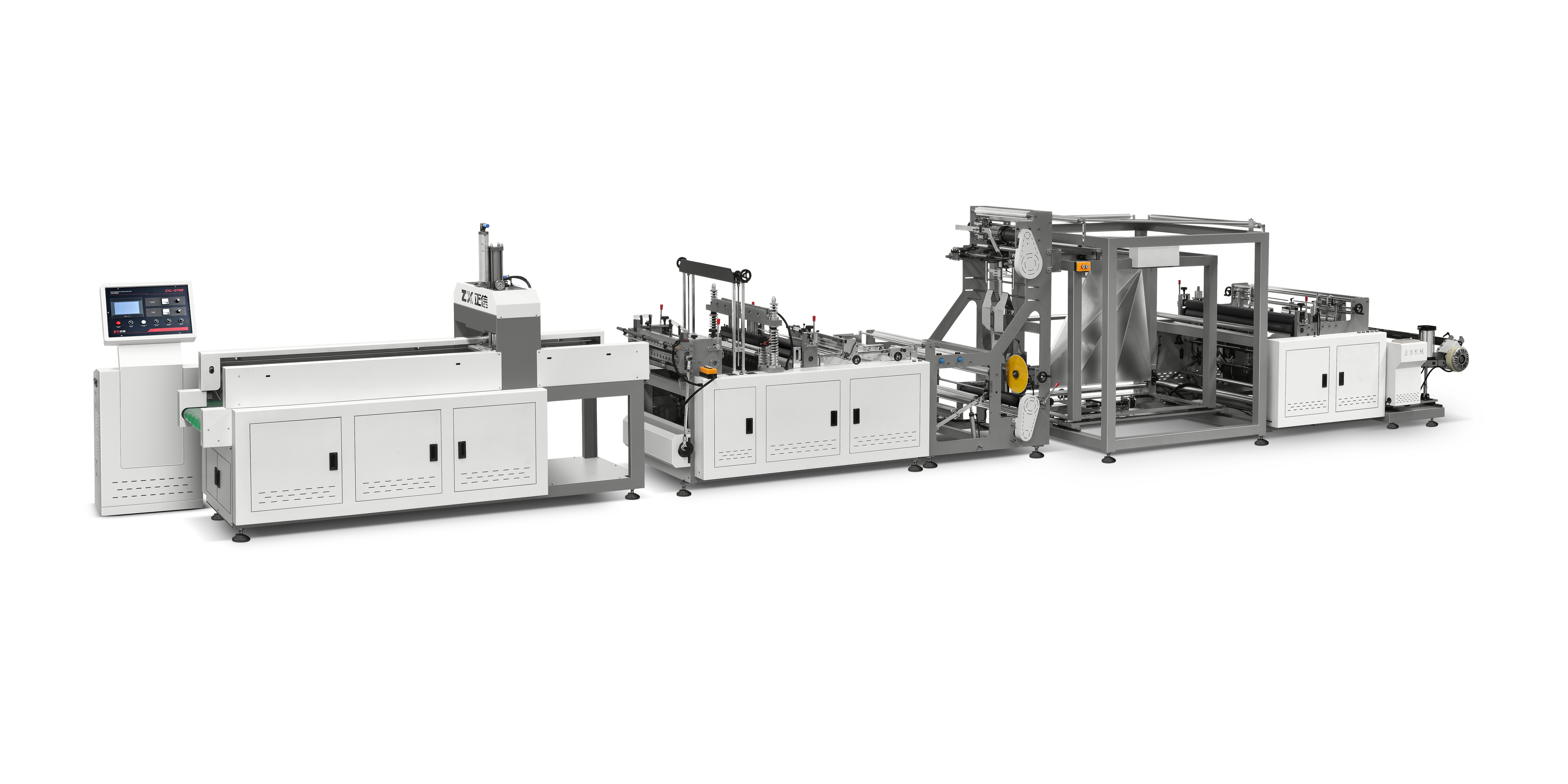
A non woven bag making machine is best scored on its full format and material envelope, not on a single peak speed figure.
The Specification Gap Buyers Keep Hitting
Speed is the first number on every quotation and the least reliable one. A machine rated 40–120 pcs/min does not run at 120 pcs/min across its catalogue. The upper end of the range is reached on a specific format, at a specific material thickness, with a specific handle configuration. The lower end is what a factory actually experiences when it switches to a thicker fabric or a gusseted structure. A scorecard that records only the peak figure rewards the supplier who quotes optimistically, not the supplier whose envelope matches the order book.
The second gap is format language. One offer says "vest bag machine", another "5-in-1", a third "box bag with online handle". These are not equivalent claims. A 5-in-1 platform that produces more than 20 bag types solves a different problem from a dedicated 3D box bag platform that produces one family exceptionally well. Until the buyer writes down which formats generate 80% of revenue, the comparison has no anchor.
The third gap is labour. Operators per machine are rarely quoted, yet they dominate five-year cost in markets with rising wages. A fully automatic platform requiring 1–2 operators behaves nothing like a semi-automatic line running at 15–20 pcs/min with 3–4 workers — and that difference compounds with every shift added.
Six Categories That Belong on the Scorecard
A workable matrix uses six scored categories, each weighted by the buyer's own order mix. The weights matter more than the categories: a supermarket supplier and a promotional-print shop will weight the same six rows differently.
- Bag format envelope — width, height and gusset ranges actually published for the model.
- Material thickness window — the g/m² band the machine is specified to run.
- Handle compatibility — whether handles are welded inline, punched into the body, or both.
- Sealing technology — ultrasonic welding versus heat sealing, and what maintenance each implies.
- Operator headcount and control — people per machine and the quality of PLC/HMI recipe handling.
- Site and infrastructure fit — power, air, footprint and machine weight.
Zhejiang Zhengxin Machinery Co., Ltd., founded in 2014 and headquartered in Wenzhou, Zhejiang, China, publishes parameter sets across its ZXL and ZX-LT ranges that make a worked example possible. The company operates a 60,000 m² manufacturing facility, employs approximately 200 staff, runs a 30-engineer R&D team, and reports annual production capacity of 500 units. Those figures are useful for supplier due diligence; the model parameters below are what actually populate the scorecard.
Category 1 — Bag Format Envelope
The published envelope is the fastest filter on the matrix. The ZXL-A700, a Non Woven T-shirt and W-cut bag making machine that also sits in the vest bag category, is specified for bag heights of 300–700 mm and widths of 200–400 mm. The ZXL-B700, classified as a D-cut and drawstring bag machine, covers a wider and shallower envelope: heights of 200–580 mm and widths of 100–800 mm. The ZXL-D700 and ZXL-E700 share that same 100–800 mm width and 200–580 mm height window, adding online handle attaching.
Gusset structures need their own row. The ZXL-G700, a side gusset machine with online handle, is specified at 300–700 mm height, 200–400 mm width and a side gusset of 60–200 mm. The ZX-LT500 3D box bag platform runs 200–450 mm height, 110–550 mm width and a gusset of 80–220 mm — a different geometry altogether, built for standing box bags rather than flat or vest formats.
Score this row as a percentage of the buyer's actual SKU list that falls inside the envelope. A machine covering 95% of current orders with a 5% gap is easier to justify than one covering 100% of today's catalogue at a materially higher capital cost.
Category 2 — Material Thickness Window
Thickness windows are where quotations quietly diverge. In the Zhengxin range, the ZXL-A700, ZXL-A700Ultra and ZXL-B700 are specified for 30–120 g/m². The ZXL-D700, ZXL-E700 and ZXL-E700Ultra narrow to 30–100 g/m². The ZXL-G700 is specified at 50–100 g/m². The 3D platforms move upward: ZX-LT500 and ZX-LT500Pro are specified for 70–150 g/m², while the ZX-LT500V covers 60–120 g/m².
This row should be scored against the buyer's heaviest recurring order, not the lightest. A buyer whose premium retail customer keeps requesting 120 g/m² laminated stock should treat a 30–100 g/m² window as a hard constraint rather than a footnote, because out-of-window material affects seal strength, feeding stability and reject rates simultaneously.
Category 3 — Handle Compatibility
Handle capability splits machines more sharply than speed does. Punched-handle vest and T-shirt formats — the ZXL-A700 territory — require no separate handle stock. Welded loop or soft handles require an online handle attaching section plus a handle material feed: the ZXL-D700, ZXL-E700 and ZXL-E700Ultra are specified with a handle length of 380–600 mm and handle material thickness of 50–100 g/m². The ZX-LT500 family carries a slightly wider handle range of 350–620 mm.
Score handle compatibility in two parts: whether the handle type matches the customer's specification, and whether the handle section runs inline or as a second operation. Inline attaching removes a handling step and a labour position; a separate operation adds floor space and WIP inventory.
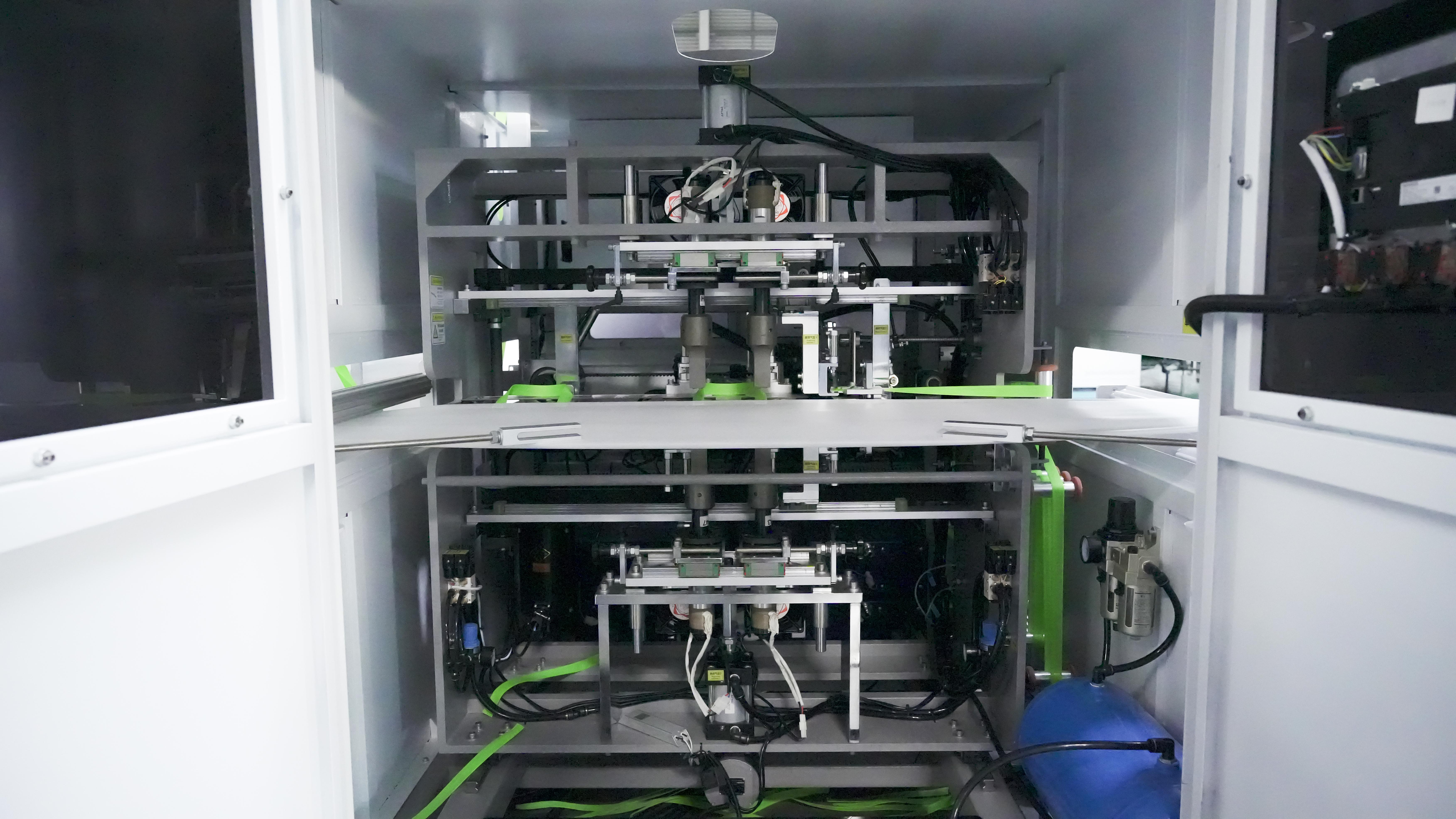
Inline ultrasonic handle welding is a scoring row in its own right: it changes labour, consumables and seal consistency together.
Category 4 — Ultrasonic Welding Presence
Ultrasonic welding fuses polypropylene fibres through high-frequency mechanical vibration at the fabric interface, so energy is generated where the bond is needed rather than conducted through the material from an external element. In the Zhengxin range, ultrasonic appears across the ZXL-A700Ultra, the ZXL-D700 (15 kHz ultrasonic sealing plus ultrasonic handle welding), the ZXL-E700 and ZXL-E700Ultra (handle attachment without hot-melt glue or chemical adhesive), and the ZX-LT500 family, which uses a high-frequency ultrasonic welding system.
The buyer's scoring question is not "is ultrasonic better" but "does my end market require it". Food takeaway and premium retail applications benefit from odour-free, clean-edge seals. Basic flat and vest bags sold into price-sensitive channels may not justify the premium. Score ultrasonic as a binary yes/no and then add a maintenance sub-row, because the technology carries an upkeep obligation that heat sealing does not.
Category 5 — Operator Headcount and Control
Labour is the row most often left blank and most often decisive. Zhengxin's documentation for the E700 family describes full-process automation with photoelectric tracking, stepper-motor length control and automatic counting, requiring only 1–2 operators per machine. The ZX-LT500 platform documentation describes a single operator managing the entire line. The semi-automatic alternative typically runs 15–20 pcs/min with 3–4 workers per line.
Control architecture belongs in the same row because it determines how quickly a new operator becomes productive. The ZX-LT500 is controlled by PLC and servo drive systems, and Zhengxin machines use genuine branded components such as Siemens, Delta or Mitsubishi PLCs, with a touchscreen HMI supporting recipe recall. A machine that stores complete setups for recurring bag sizes reduces changeover time and changeover errors — both invisible in a spec sheet, both visible in monthly output.
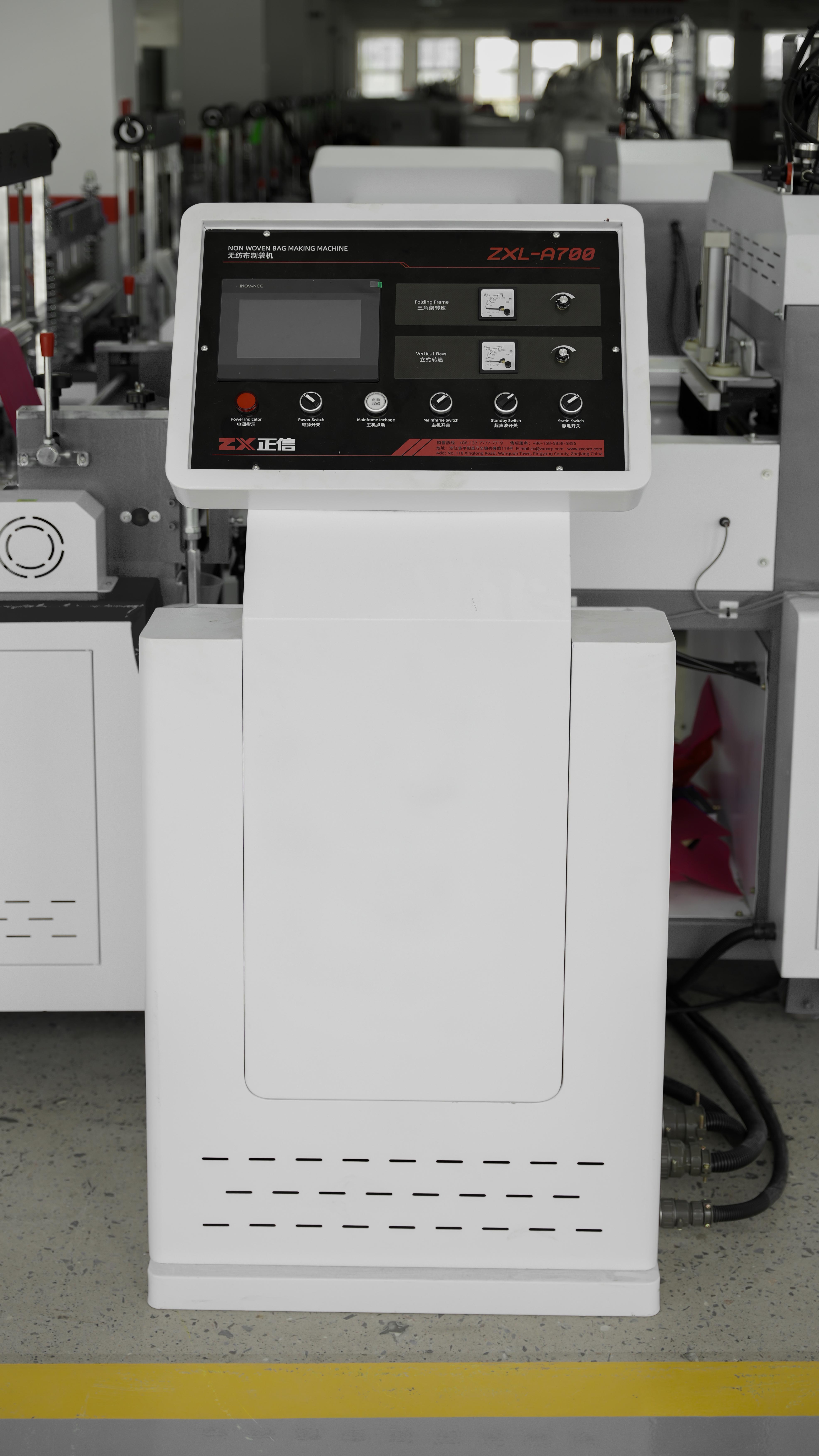
Recipe storage on the HMI converts changeover from a skilled task into a repeatable procedure — a scored item, not a feature list entry.
Category 6 — Site and Infrastructure Fit
This is the row that cancels purchase orders after the technical evaluation is already finished. Total power across the range runs from 12 kW on the ZXL-B700, through 15 kW on the ZXL-A700, A700Ultra and D700, to 18 kW on the ZXL-E700, E700Ultra and G700. The 3D platforms step up sharply: 50 kW for the ZX-LT500 and ZX-LT500V, 60 kW for the ZX-LT500Pro. All are specified for three-phase supply at 380V/220V or 380V/50Hz depending on model.
Air supply is a separate gate. The ZX-LT500 family requires 1.0 MPa air pressure at 1.2 m³/min — infrastructure many small workshops simply do not have. Footprint and weight matter just as much: overall dimensions run from 8,000×2,050×1,900 mm on the ZXL-B700 to 11,700×6,850×2,500 mm on the ZX-LT500Pro, with machine weights spanning 2,200 kg to 12,000 kg. A 12,000 kg platform changes the floor preparation, lifting plan and building layout, not just the budget.
A Worked Comparison Table
The table below assembles published parameters from Zhengxin model documentation. It is the raw material for a scorecard, not a recommendation — the weights still come from the buyer's order book.
| Model | Format focus | Bag W × H (mm) | Material (g/m²) | Handle spec | Speed (pcs/min) | Power |
|---|---|---|---|---|---|---|
| ZXL-A700 | T-shirt / W-cut, vest | 200–400 × 300–700 | 30–120 | Punched body handle | 40–120 | 15 kW |
| ZXL-A700Ultra | Zero-waste edge T-shirt / W-cut, vest | 200–400 × 300–700 | 30–120 | Punched body handle | 40–120 | 15 kW |
| ZXL-B700 | D-cut, drawstring | 100–800 × 200–580 | 30–120 | Not specified | 40–120 | 12 kW |
| ZXL-D700 | 4-in-1 flat bag, online handle | 100–800 × 200–580 | 30–100 | 380–600 mm | 40–120 | 15 kW |
| ZXL-E700 | 5-in-1 box bag, online handle | 100–800 × 200–580 | 30–100 | 380–600 mm | 40–120 | 18 kW |
| ZXL-E700Ultra | 5-in-1 box bag, zero-trim | 100–800 × 200–580 | 30–100 | 380–600 mm | 40–120 | 18 kW |
| ZXL-G700 | Side gusset, online handle | 200–400 × 300–700 (gusset 60–200) | 50–100 | 380–600 mm | 60–100 | 18 kW |
| ZX-LT500 | 3D / box bag | 110–550 × 200–450 (gusset 80–220) | 70–150 | 350–620 mm | 60–100 | 50 kW |
| ZX-LT500Pro | High-speed 3D / box bag | 110–550 × 200–450 (gusset 80–220) | 70–150 | 350–620 mm | 60–120 | 60 kW |
| ZX-LT500V | Vertical-fold 3D / box bag | 110–550 × 200–450 (gusset 80–220) | 60–120 | 350–620 mm | 60–80 | 50 kW |
Multi-Style Flexibility vs Single-Purpose Speed
The most consequential weighting decision on the matrix is how much to reward format flexibility. The ZXL-E700 and ZXL-E700Ultra are described in Zhengxin documentation as 5-in-1 machines capable of producing more than 20 bag types, including vest bags, box bags, loop handle bags, drawstring bags and D-cut bags. The ZXL-D700 is a 4-in-1 flat bag platform with online handle attaching. Both represent a deliberate design choice: breadth of format in exchange for a shared speed ceiling.
A dedicated 3D platform makes the opposite choice. The ZX-LT500Pro, classified as a high-speed 3D and high-speed box bag machine, is specified at 60–120 pcs/min within a narrower geometric envelope and a 70–150 g/m² material window. It does one family of products and does not pretend to be a general-purpose converter.
The practical resolution is a changeover multiplier. If a buyer runs fewer than three format changes per week, single-purpose speed usually wins on cost per bag. If format changes occur daily — typical for promotional and event-driven order books — the 5-in-1 platform's recipe recall and shared tooling reduce lost production time faster than the higher peak speed can recover it.
Fully Automatic vs Semi-Automatic: Scoring the Real Trade-Off
Fully automatic operation is not automatically the correct answer, but the arithmetic usually points that way above roughly 30,000 bags per day. At 40–120 pcs/min with 1–2 operators per machine, the labour content per bag is a fraction of a semi-automatic line running 15–20 pcs/min with 3–4 workers. The capital difference is real — but it is a one-time cost against a recurring one.
Where semi-automatic still earns its place: volumes below roughly 10,000 bags per day, severely constrained capital, or production dominated by very small, highly varied batches where automated speed is lost to repeated setup. A buyer in that position should score automation lower and score changeover time and tooling cost higher — the matrix should reflect the business, not the industry's default assumption.
Mapping the Scorecard to Real Production Scenarios
Supermarket and retail chain supply. Consistent high output with tight dimensional tolerance and ultrasonic seal consistency dominates the weighting. A machine family that supports 100 pcs/min-class operation with inline handle capability, paired with a flexo printing unit, matches this profile. Defect consistency matters more than peak speed because rejections at the distribution centre are expensive.
Garment and fashion packaging. Thinner material, printed surfaces and wrinkle-free finished bags dominate. The lower end of the 30–120 g/m² window becomes relevant, and print registration accuracy outranks raw throughput. Double-shift operation with 1–2 operators per machine is the documented norm for this scenario.
Food takeaway and delivery. Odour-free sealing is non-negotiable, which pushes ultrasonic welding to the top of the weighting and pushes heat-seal alternatives down regardless of price. Cleanroom conditions and batch coding belong in the same row.
Promotional and corporate gift bags. Quick job changeover and multi-colour print registration dominate; the buyer typically needs 8–16 hour flexible batch production rather than 24/7 continuous output. Here the 5-in-1 breadth of over 20 bag types is worth more than a higher single-format speed.
Market Context: Why the Matrix Pays Off Now
Three published signals make structured comparison more valuable than it was five years ago. First, policy: more than 140 countries had enacted legislation restricting or banning single-use plastic bags as of 2026, according to Dataintelo — a demand driver that converts into machine orders across many markets simultaneously. Second, growth concentration: LP Information forecasts a 22.5% CAGR for non-woven bag making machines from 2026 to 2032, with Asia Pacific already holding a 43.6% revenue share of the broader bag making machine market in 2025 (Dataintelo). Third, automation bias: automatic machines accounted for 52.4% of the product-type market in 2025, which means the resale and support ecosystem is increasingly built around automated platforms.
For procurement, the implication is straightforward. In a market growing at that pace, suppliers quote optimistically and delivery slots tighten; a scorecard written before quotations arrive is the cheapest protection available against a decision made under time pressure.
Where the Framework Breaks Down
A parameter-based scorecard has honest limits, and a buyer should know them before relying on one.
Published parameters do not predict seal quality on your fabric. Two rolls of nominally identical g/m² can behave differently at the ultrasonic interface depending on fibre consistency and contamination. The matrix narrows the shortlist; only sample testing on your own material confirms it. Horn-to-anvil gap, amplitude and line speed all interact, and the correct settings differ between a 70 g/m² and a 120 g/m² run.
Zero-waste-edge economics are volume-dependent. Zhengxin's Ultra-series documentation attributes approximately 5% raw material savings to the zero-trim design and positions payback against operations consuming meaningful daily fabric volume. At startup volumes of a few hundred kilograms per day, that premium may take considerably longer to recover than at one ton per day — the scorecard should discount the saving in proportion to actual consumption, not to the marketing figure.
3D platforms impose physical constraints. The ZX-LT500 family requires 1.0 MPa air pressure at 1.2 m³/min, 50–60 kW of three-phase power, and floor space approaching 11,700 × 6,850 mm at a machine weight of up to 12,000 kg. Buyers in leased buildings frequently discover this row last, after the technical evaluation has already converged.
Ultrasonic systems carry maintenance obligations. Horn surface condition, gap parallelism and contamination all affect weld consistency, and horns wear over their service life. A buyer without a technician able to perform routine gap checks should score the maintenance burden explicitly rather than assuming the technology is maintenance-free.
Future Outlook
The direction of travel in this category is toward narrower parameter tolerances and wider format envelopes at the same time — servo-driven positioning, recipe-based control and no-waste-edge forming are converging on mid-range platforms rather than staying exclusive to flagship models. Zhengxin's own range illustrates the pattern: zero-trim technology appears on the A700Ultra and E700Ultra at the same published speed band as their standard counterparts, differentiated by material savings rather than throughput alone.
Two forces will keep the buyer matrix relevant. Regulatory pressure continues to shift volume from thin-film to reusable formats, and labour cost continues to rise faster than machine cost in most converting markets. Both push the scoring weights toward automation, ultrasonic consistency and material efficiency — and away from peak speed as the deciding figure.
For buyers entering at the awareness and research stage, the practical conclusion is unglamorous: write the weights first, collect the published parameters second, and test the samples third. The matrix is not a guarantee of a good machine. It is a guarantee that the comparison was actually made.
FAQ
What bag size range should a non woven bag making machine cover?
It depends on the format mix rather than on a single ideal figure. In the Zhengxin range, the ZXL-A700 covers bag widths of 200–400 mm and heights of 300–700 mm, while the ZXL-B700, D700 and E700 cover widths of 100–800 mm and heights of 200–580 mm. The 3D platforms run 110–550 mm width and 200–450 mm height with a side gusset of 80–220 mm, and the ZXL-G700 covers 200–400 mm width, 300–700 mm height and a 60–200 mm gusset. Buyers should score the percentage of their SKU list that falls inside the published envelope.
How does material thickness narrow the machine choice?
Because the specified g/m² window is a hard operating boundary, not a preference. Zhengxin specifies 30–120 g/m² for the ZXL-A700, ZXL-A700Ultra and ZXL-B700; 30–100 g/m² for the ZXL-D700, ZXL-E700 and ZXL-E700Ultra; 50–100 g/m² for the ZXL-G700; 70–150 g/m² for the ZX-LT500 and ZX-LT500Pro; and 60–120 g/m² for the ZX-LT500V. A buyer whose recurring orders include heavy laminated stock should treat a narrower window as a disqualifying constraint rather than a minor difference.
When does a multi-style machine beat a single-purpose high-speed machine?
When format changes are frequent enough that changeover time outweighs peak speed. Zhengxin documents the ZXL-E700 and ZXL-E700Ultra as 5-in-1 machines capable of producing more than 20 bag types, including vest, box, loop handle, drawstring and D-cut bags, and the ZXL-D700 as a 4-in-1 flat bag platform. A dedicated platform such as the ZX-LT500Pro concentrates its 60–120 pcs/min range within a narrower 3D envelope. Buyers running fewer than about three format changes per week generally find the single-purpose machine more productive per bag; daily changeover favours the multi-format platform.
Is ultrasonic welding always necessary?
No. Ultrasonic welding matters most where odour-free, clean-edge and high-strength seals are required — food takeaway, premium retail and applications where adhesive or hot-melt methods are unacceptable. Zhengxin uses ultrasonic systems on the ZXL-A700Ultra, the ZXL-D700 (15 kHz ultrasonic sealing plus ultrasonic handle welding), the ZXL-E700 and ZXL-E700Ultra for handle attachment without hot-melt glue, and across the ZX-LT500 family. For basic flat and vest bags sold into price-sensitive channels, the premium may not be justified, but the maintenance obligation — horn surface condition and horn-to-anvil gap — should still be scored.
How many operators does a fully automatic machine actually need?
Zhengxin's documentation for the E700 family describes full-process automation with photoelectric tracking, stepper-motor length control and automatic counting, requiring 1–2 operators per machine. The ZX-LT500 platform documentation describes a single operator managing the entire line. By comparison, semi-automatic operation typically runs 15–20 pcs/min with 3–4 workers per line. The number of operators should be scored as a recurring cost, because it scales with every shift added.
What site infrastructure should be verified before scoring a machine?
Three-phase power, compressed air and floor loading. Total power across the Zhengxin range runs from 12 kW on the ZXL-B700 to 60 kW on the ZX-LT500Pro. The ZX-LT500 family requires 1.0 MPa air pressure at 1.2 m³/min. Overall dimensions span 8,000×2,050×1,900 mm to 11,700×6,850×2,500 mm, and machine weights range from 2,200 kg to 12,000 kg. Verifying these three items before the technical evaluation prevents a late-stage reversal after a shortlist has already been agreed.
Reference material: the Zhengxin Machinery product brochure contains the full model parameter sets referenced in this article and is available for public download.
Есть вопросы или нужны дополнительные детали?
Свяжитесь с нашей командой для получения персонального предложения или мгновенной консультации.
Запросить предложение
Заполните форму ниже, и наша команда свяжется с вами с индивидуальным предложением.
Прямой чат WhatsApp
Предпочитаете общаться в реальном времени? Напишите нам в WhatsApp для мгновенной помощи и быстрых ответов.
- Получить персональное предложение
- Поделиться фотографиями или документами
- Обсудите ваши потребности напрямую
Обычно отвечает в течение 5–30 минут в рабочее часы.