
Non Woven Bag Machine Qualification: What the Evidence Shows
Non Woven Bag Machine Qualification: What the Evidence Shows
A non-woven bag making machine is normally purchased on the strength of claims: that it seals without adhesive, that it runs on a modern controller, that it holds print registration, and that it suits a defined range of fabric weights. At the decision and execution stage, the more useful question is narrower than "is the supplier compliant?" It is "which of these claims can be checked at the level of the machine itself?"
The commercial context explains why this question is now asked more often. Market research tracked the specialised non-woven bag making machine segment at USD 179 million in 2025, with a forecast of USD 733 million by 2032 and a 22.5% compound annual growth rate between 2026 and 2032 (LP Information). More than 140 countries had enacted legislation restricting or banning single-use plastic bags as of 2026 (Dataintelo). Regulation creates demand, demand creates a crowded supplier field, and a crowded supplier field makes verifiable, machine-level evidence the practical way to build a shortlist.
This article examines what qualification evidence looks like when it is read at machine level, using the ZXL-E700 platform from Zhejiang Zhengxin Machinery Co., Ltd. Zhejiang Zhengxin Machinery (ZX Zhengxin Machinery) is a Wenzhou-based manufacturer of non-woven bag making machines and complete non-woven bag production lines, founded in 2014, operating a 60,000 m² facility with approximately 200 employees and an annual output of around 500 units. The scope here is deliberately narrow: ultrasonic sealing, PLC control with a touchscreen interface, photoelectric tracking, operator attendance, and the material thickness range that defines where those claims apply.
Compliance Is a Floor, Not a Machine Specification
Two document families appear in almost every quotation package for a non woven bag making machine: a CE Declaration of Conformity and an ISO 9001 facility certificate. Each answers a specific question, and neither answers the questions that determine whether a machine fits a production plan.
A CE Declaration of Conformity covering the Machinery Directive 2006/42/EC, the Low Voltage Directive 2014/35/EU and the EMC Directive 2014/30/EU confirms that the machine passed an electrical safety test (insulation resistance and grounding continuity), a mechanical guard inspection, an emergency stop function check, an EMC emission test and a noise test below 85 dB(A), supported by an English technical file including a wiring diagram, a risk assessment report and a user manual with safety warnings.
An ISO 9001:2015 certificate covers the manufacturing system rather than the product: a documented quality manual, calibrated measurement equipment with traceable records, incoming material inspection logs, in-process QC checkpoint records, final product testing reports, non-conformance and corrective action tracking, and an annual external surveillance audit by an accredited certification body.
| Evidence type | What it actually qualifies | What it does not tell a buyer |
|---|---|---|
| ISO 9001:2015 facility certificate | The quality management system: incoming inspection, in-process QC checkpoints, final testing records, corrective action tracking, annual surveillance audit | Sealing method, controller brand, usable material range |
| CE Declaration of Conformity (Machinery, Low Voltage, EMC) | Electrical safety, guarding, emergency stop function, EMC emissions, noise below 85 dB(A), English technical file | Whether the machine bonds with ultrasonic energy or a heated bar |
| Third-party inspection (SGS, Bureau Veritas, CCIC) | Component identity and machine condition at the point of inspection, when requested before shipment | Long-run performance under your own fabric and shift pattern |
| Pre-shipment production test | The condition of that specific machine at load, before packing | Suitability when GSM or bag format later changes |
The practical consequence is that documents qualify the supplier and the shipment, while the production decision depends on facts that sit inside the machine specification. Those facts are what qualification checks should be built around.
The ZXL-E700 as a Working Example of Machine-Level Facts
The ZXL-E700 is described by its manufacturer as a 5-in-1 non woven bag making machine with online handle attaching, and it is the model in the ZXL series that adds ultrasonic sealing alongside handle attachment. Its published specification states a fabric roll width of 500–1300 mm, a production speed of 40–120 pcs/min, bag height of 200–580 mm, bag width of 100–800 mm, handle length of 380–600 mm, handle material thickness of 50–100 g/㎡, and a material thickness range of 30–100 g/㎡, on 380V/220V with 18 kW total power.
Because the handle attaching unit and the sealing station are integrated in one platform, the machine is used for formats that combine body and handle in a single pass — including box bags with handles and vest-style bags — rather than requiring a separate handle operation. For buyers, that integration is itself a qualification item: it changes cycle time, labour, and the number of stations that must be maintained.
Ultrasonic Sealing: Verifying the "No Adhesive" Claim
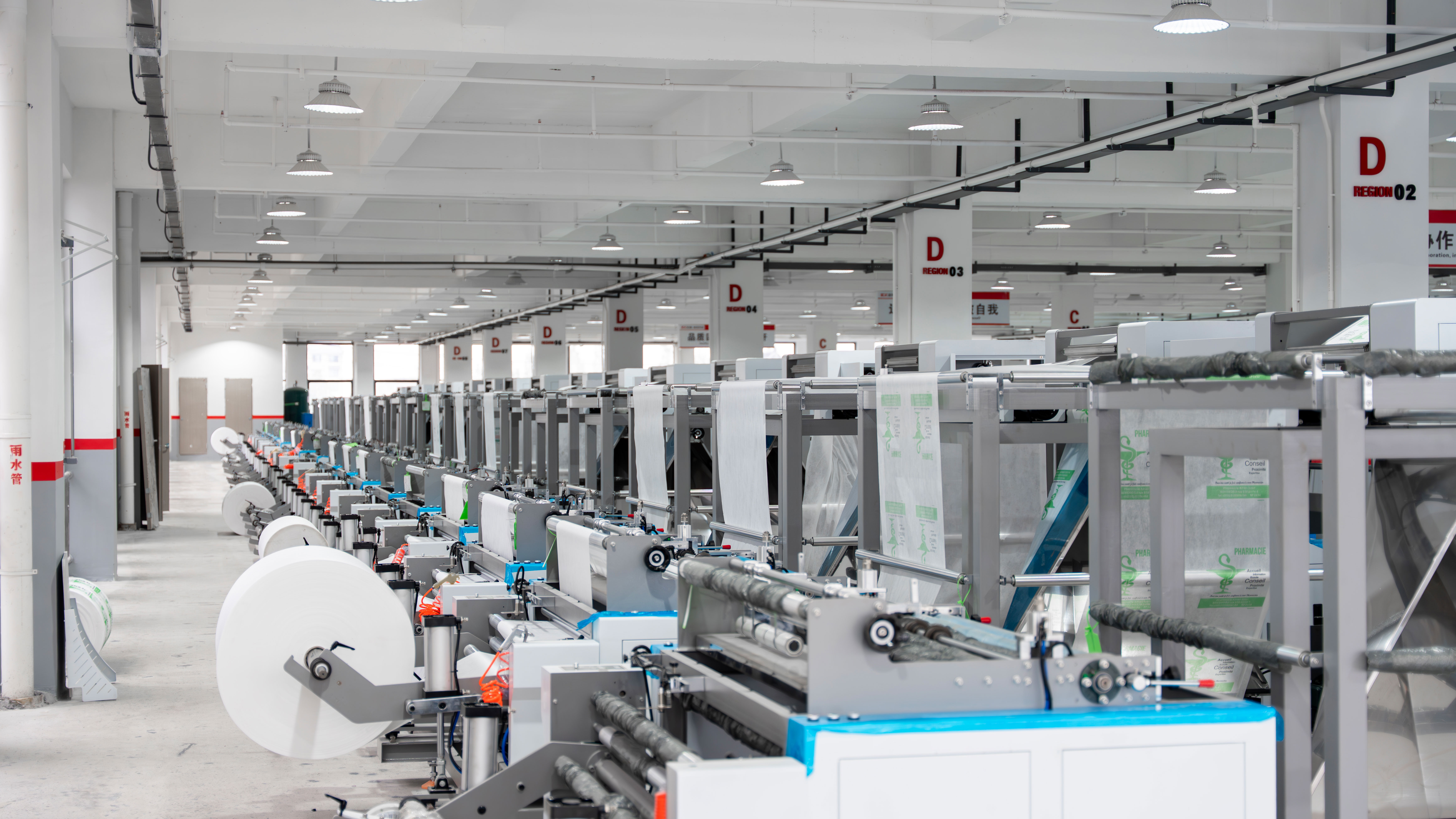
Ultrasonic welding bonds non-woven fabric by converting 20 kHz electrical energy into mechanical vibration. A piezoelectric transducer converts mains electricity into oscillation of the same frequency, and a horn (sonotrode) amplifies that vibration to the working tip. When the vibrating horn presses the fabric against a fixed steel anvil, friction at the interface between the two fabric layers generates enough heat to melt polypropylene — roughly 160°C — within 0.2–0.5 seconds. The melt zone is confined to about 0.1–0.3 mm at the interface; the rest of the fabric stays below melting temperature. No glue, thread, staples or external heat source is used.
That definition matters operationally, not just technically. A machine that bonds ultrasonically has no adhesive to purchase, store or cure, no warm-up period (heat sealing typically needs 15–20 minutes), and no smoke, fumes or odour during the weld. Power is drawn only during the welding pulse rather than continuously to hold an element at temperature, which is why ultrasonic systems are described as consuming 25–30% less energy than heat sealing. Pull tests on ultrasonic welds are also reported at 15–20% higher peel strength than heat-sealed equivalents, because the process creates molecular interdiffusion rather than surface adhesion.
A buyer reading an ultrasonic claim can convert it into four checks:
- Amplitude control. Ultrasonic settings are thickness-dependent: published guidance for this class of machine suggests approximately 60–70% amplitude for 50–60 g/㎡ fabric, 75–85% for 70–90 g/㎡, and 90–100% for 100–150 g/㎡. A machine whose parameters cannot be set by recipe is harder to qualify for mixed production.
- Horn-to-anvil gap. For around 70 g/㎡ fabric, the gap is typically 0.3–0.5 mm and must be even within about 0.05 mm across the full horn width. An uneven gap produces a seal that is strong on one side and weak on the other — a defect that appears only after bags are loaded.
- Seal validation method. The working test is a pull test: a correct seal tears the fabric rather than peeling apart at the weld line. Buyers should ask for the test protocol in writing, not just a statement that seals are strong.
- Consumable planning. The horn is a wear part with a replacement interval commonly cited at 12–18 months, and it can be cracked if it contacts the anvil without fabric — a replacement cost in the range of USD 800–2,000. Its availability in the spare parts list is part of qualification.
PLC Control and the Touchscreen Interface as Qualification Items
A PLC (Programmable Logic Controller) is the industrial computer that executes the machine's control program — reading sensor inputs, applying logic, and commanding motors, valves and actuators in a scan cycle measured in milliseconds. The HMI (Human-Machine Interface) is the touchscreen through which the operator monitors and changes settings. Together they replace walls of relays, timers and counters.
Functionally, the control layer determines four things a buyer will live with daily:
- Recipe management. Complete machine setups for a given bag size or style can be stored and recalled with one touch — feeding length, sealing time, cutting position, speed limit and photocell offset load together rather than being re-entered.
- Alarm clarity. Faults are displayed as error codes with plain-language descriptions instead of requiring mechanical diagnosis.
- Production logging. Shift output, downtime and efficiency statistics are displayed from the PLC's data registers.
- Maintenance reminders. Cycle counting allows the controller to flag scheduled maintenance rather than relying on operator memory.
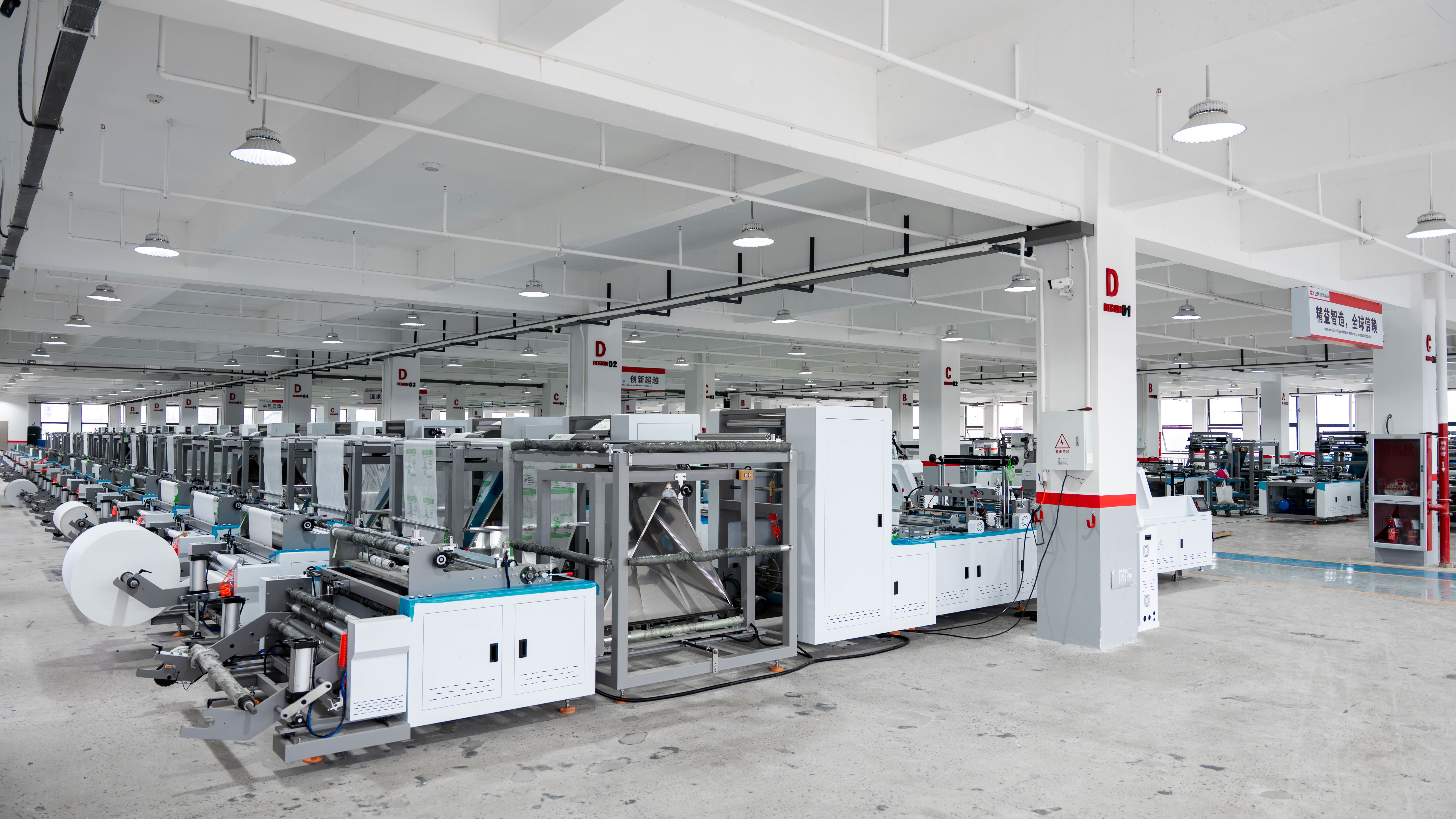
Component identity is a separate and checkable fact. Zhengxin machines are built with genuine branded components — Siemens, Delta or Mitsubishi PLCs depending on model tier, Omron sensors and NSK bearings — and this can be verified by third-party inspection (SGS, Bureau Veritas or CCIC) at the buyer's request before shipment. Standard practice for the premium and specialised platforms uses Siemens S7-1200 or S7-200 SMART series, with Delta DVP or AS series on mid-range models, all presenting English-language HMI interfaces.
Verification questions that convert this into evidence:
- Which PLC brand and series appear in the quotation and on the electrical documentation?
- Is a complete wiring diagram supplied in English, and is a parameter backup procedure documented?
- Which production values does the HMI display, and are bag-size recipes stored by name?
- How are fault conditions reported — code only, or code plus description?
Limitation: the PLC brand is model-tier dependent and is not automatically assigned. A buyer who requires a specific controller brand should state it at order. Separately, PLC and servo electronics are the components most exposed to unstable grid power; incorrect voltage is not covered by warranty and can cost 30–50% of machine value to repair, which is why a voltage stabiliser is recommended wherever supply fluctuates.
Photoelectric Tracking: The Check Behind Print Registration
Registration tracking is what keeps a cutting blade and sealing die aligned with pre-printed logos. A small registration mark — typically a black square of 5×5 mm or 8×8 mm — is printed at a known distance from the bag edge. A photocell emits a modulated red LED beam onto the fabric and measures reflected intensity; white non-woven reflects most of the light, and the dark mark drops reflectivity sharply, switching the sensor output and triggering the PLC.
The PLC then computes the delay: distance from sensor to cut point divided by current fabric speed, with fixed system latencies (sensor response around 0.5 ms, PLC input processing around 1 ms, PLC output around 2 ms, and mechanical actuation of 10–20 ms) calibrated out through a registration teach routine. Servo-driven feeding holds positional accuracy at approximately ±0.5 mm, compared with drift of ±2–3 mm on open-loop clutch-motor machines as belts wear.
For a buyer, the qualification questions are procedural rather than electrical: is a teach or calibration routine documented; what minimum mark size does the machine require at rated speed; and what does the manual say about faded or inconsistently printed marks, which are a common cause of missed detection. Registration accuracy also depends on conditions the buyer controls — clean photocell lenses, consistent fabric tension, and consistent mark print quality. Marks smaller than 5 mm may pass under the beam faster than the sensor can respond at 120 pcs/min.
Matching Evidence to Material Range and Bag Format
The most common qualification failure is not a missing certificate; it is a specification that quietly sits outside the intended production plan. The following table converts published ZXL-E700 values into the checks they support.
| Published specification | Value | Qualification check it supports |
|---|---|---|
| Material thickness | 30–100 g/㎡ | Confirm the finished bag body fabric falls inside the range; above 100 g/㎡ requires a different platform |
| Handle material thickness | 50–100 g/㎡ | Confirm handle stock weight against handle length of 380–600 mm |
| Fabric roll width | 500–1300 mm | Align with slitting plan and raw material purchase width |
| Production speed | 40–120 pcs/min | Plan capacity at 80–85% of rated speed, not at rated speed |
| Bag height / width | 200–580 mm / 100–800 mm | Match against the customer's format list before committing to tooling |
| Voltage / total power | 380V / 220V; 18 kW | Confirm 3-phase supply and decide on a voltage stabiliser |
| Dimensions / weight | 12000 × 2050 × 1900 mm; 4000 kg | Floor layout, unloading equipment and clearance planning |
Material weight deserves particular attention because it changes machine behaviour, not just cost. Commercial non-woven fabric carries a GSM tolerance of about ±5%, so a roll specified at 70 GSM may measure 67–73 GSM. Standard supermarket shopping bags are commonly produced at 80–90 GSM, lightweight retail bags at 60–70 GSM, and heavy-duty premium bags at 100–120 GSM. Thicker fabric requires a slightly wider horn-to-anvil gap and typically runs 10–15% slower: 100–120 GSM may run 10–15% slower than 70 GSM on the same platform. A qualification file that records only the bag style but not the fabric weight has missed the variable most likely to require re-tuning.
The format side is equally concrete. A 5-in-1 platform with online handle attachment can move between flat, D-cut, vest-style and box bag formats with handles, but each change involves mechanical adjustment of folding plates, sealing and cutting die positions and the handle track, plus a PLC recipe update — a documented changeover of roughly 15–30 minutes depending on operator experience.
Where These Checks Change the Buying Decision
The same qualification logic applies differently across production environments. Four representative scenarios illustrate the difference:
- Retail and supermarket chain supply. Typically specified as a fully automatic line running continuously, with output at or above 100 pcs/min, consistent ultrasonic or heat-seal weld quality and a defect rate below 0.5%. Matched auxiliary equipment includes an air compressor, a flexo printing unit, an automatic counting and bundling machine and a voltage stabiliser. Here the qualification items are sustained weld consistency, pre-shipment test records and on-site spare parts.
- Food and beverage takeaway packaging. Produced in a dust-free workshop with positive air pressure, using odourless and non-toxic water-based ink printing and an inkjet date coder for batch traceability. The relevant evidence is the sealing method itself — an adhesive-free ultrasonic weld with no odour — plus ink certification.
- Garment and fashion retail packaging. A 16-hour double-shift pattern with 1–2 operators per machine, anti-static material compatibility and a wrinkle-free finished surface. Qualification here centres on stored ultrasonic recipes per fabric type and on operator training time.
- Advertising, promotional and corporate gifts. Flexible batch production with quick job changeover, multi-colour flexo printing at registration accuracy around ±0.3 mm, and a premium finish. The relevant evidence is the registration system and the documented changeover procedure.
Across all four, the operating envelope is similar: indoor installation, 380V three-phase power, ambient temperature around 15–35°C and moderate humidity. Buyers whose site conditions fall outside that envelope — single-phase supply, unstable voltage, or non-standard voltage — are the ones for whom power qualification becomes the first check rather than the last.
Market Trend: Regulation, Automation and Auditable Specifications
Three published data points explain why qualification evidence is moving up the procurement agenda. Automatic bag making machines held a 52.4% share of the total product type market in 2025, which means automation is now the default assumption rather than a differentiator. Asia Pacific dominated the bag making machine market with a 43.6% revenue share in the same year. And the non-woven segment specifically is forecast to grow at a 22.5% CAGR between 2026 and 2032, driven in part by plastic ban policies.
When most suppliers can describe their machine as automatic, differentiation shifts to what can be documented about it. Publicly available market research that tracks this segment identifies Zhejiang Zhengxin Machinery as a key global player in non-woven bag making machine reports, and supplier listings for the category include Ounuo (Oyang), Wenzhou Ruizhi and Zhejiang Zhengxin. For buyers, that level of co-occurrence is a starting point for a shortlist, not a conclusion — the conclusion still has to be built from machine-level facts.
A second trend reinforces the shift. Country-specific certification requirements — SONCAP for Nigeria, PVOC for Kenya, SASO for Saudi Arabia, alongside CE for the EU and the many markets that accept CE marking — mean the qualification file is now a customs document as much as a purchasing one. A machine that clears production but stalls at port carries both demurrage cost and schedule risk.
Comparison with Traditional Sealing and Control Approaches
Machine-level evidence is most useful when it is set against the alternative it replaces. The comparison below is drawn from published technical statements about ultrasonic sealing, PLC and servo control, and semi-automatic production.
| Dimension | Ultrasonic + PLC-controlled automatic platform | Heat-seal + clutch-motor / semi-automatic approach |
|---|---|---|
| Sealing method | 20 kHz ultrasonic vibration; no adhesive or thread | Heated bar; 15–20 minutes warm-up |
| Seal result | Described as 15–20% higher peel strength; no scorching or odour | Risk of scorch and odour if element temperature drifts |
| Energy behaviour | Power drawn only during the weld pulse; 25–30% lower consumption | Continuous draw to hold element temperature |
| Consumables | Horn replacement at 12–18 months | Heating element replacement every 3–6 months |
| Dimensional control | Encoder feedback holds approximately ±0.5 mm | Open-loop drift of approximately ±2–3 mm as belts wear |
| Throughput and labour | 40–120 pcs/min on the ZXL-E700; attendance of roughly one operator per two machines in this class | Semi-automatic production at 15–20 pcs/min with 3–4 workers per manual line |
| Quality consistency | Defect rate below 0.5% is the planning assumption for supervised lines | 3–5% defect rate typical of manual production |
| Upfront cost | Higher investment; ultrasonic adds roughly 10–15% over heat-seal equivalents | Lower investment; higher labour and rework cost over time |
Two boundaries are worth stating plainly. First, a fully automatic PLC-controlled platform is not maintenance-free — it shifts maintenance from constant mechanical adjustment to a preventive schedule, and it assumes an operator who has been trained (training of 5–7 days is typical for operators moving from manual production) and a stocked spare parts kit. Without those, a low-cost component failure can idle a line for days. Second, equipment condition itself is a qualification variable: a new machine is delivered with a 12-month warranty, production uptime of 95% or higher and a mean time to first failure beyond 24 months, whereas machines over three years old typically show 70–80% uptime, with parts that may be discontinued. Buyers considering second-hand equipment are effectively self-insuring against those failure modes.
Future Outlook
Between 2026 and 2032, the non-woven bag machine segment is projected to grow at a rate well above the general bag machinery market, and the share held by automatic platforms is already above half of product types. The direction of travel for qualification practice is therefore likely to be from certificate copies toward machine-level documentation: parameter backups supplied at handover, spare parts lists scoped to the first year of operation, and pre-shipment test records tied to a specific machine serial number.
The service model is moving in the same direction. Zhejiang Zhengxin Machinery provides remote support seven days a week via WhatsApp and video call, and reports that its engineers diagnose and resolve more than 80% of issues remotely. Where remote diagnosis is insufficient, field engineers can travel to the customer's facility, and the company maintains offices in Kenya, Morocco, Egypt, Vietnam, Tanzania, Dubai, Oman, Indonesia and Ethiopia. Spare parts are shipped by express courier within 24 hours of a confirmed diagnosis, with delivery typically within 3–7 days, and English documentation — operation manual, wiring diagram, PLC parameter settings and a troubleshooting guide — is supplied as standard.
That combination is what turns a qualification check into a long-term relationship question. A machine is qualified once; it is supported for a decade. The evidence that matters most over that period is not the certificate on the wall but whether the controller parameters can be restored, whether the horn and other consumables remain available, and whether a fault can be resolved without waiting weeks for a component.
FAQ
What certifications are supplied with a non woven bag making machine, and what does each cover?
Standard supply from Zhengxin includes a CE Declaration of Conformity covering the Machinery Directive 2006/42/EC, the Low Voltage Directive 2014/35/EU and the EMC Directive 2014/30/EU, together with the manufacturer's ISO 9001:2015 factory certificate. CE marking is accepted for customs clearance in EU member states and in countries that accept CE, including Turkey, Egypt, Nigeria and the GCC countries. Country-specific schemes such as SONCAP, PVOC or SASO are arranged on request, with the applicable third-party inspection fee charged additionally.
How can a buyer verify a CE or ISO 9001 claim independently?
Certifications can be checked on the issuing body's official website, and buyers are advised to do so rather than rely on document images alone. Factory audits by third parties — SGS, Bureau Veritas, TÜV, or the buyer's own inspection agent — can be arranged before shipment, and pre-shipment inspection of the specific machine is standard practice for buyers ordering from overseas. For ISO 9001 specifically, the certificate number can be traced to the accredited certification body that issued it.
What does the pre-shipment acceptance process include, and what are the standard commercial terms?
Published terms are a minimum order quantity of one unit, FOB or CIF delivery terms, pre-shipment test as the acceptance criterion, and payment of 30% deposit with 70% balance. The pre-shipment test is described as a continuous full-load production run on each completed machine before packing, with sample bags inspected for seal strength, print registration and dimensional accuracy. Where required, an inspection agency can attend the factory to witness the test before the balance payment is released.
What power-supply details should be confirmed before the machine is built?
Machines can be configured for 220V/60Hz, 380V/50Hz, 415V/50Hz or 440V/60Hz, and the configuration must be specified at order rather than assumed. All industrial bag machines in this class require three-phase power; a single-phase supply requires a phase converter. Connecting a machine to the wrong voltage can destroy the PLC, servo drives and motors, and that damage is not covered by warranty. Where grid voltage fluctuates by more than about ±10%, a voltage stabiliser is recommended between the supply and the machine.
Does ultrasonic sealing require adhesives, and what maintenance does the ultrasonic assembly need?
No adhesive, glue, thread or staples are used. Ultrasonic bonding converts 20 kHz electrical energy into mechanical vibration that generates friction heat only at the interface between fabric layers, creating a molecular bond as the melt cools. Maintenance centres on the horn and anvil: both surfaces are wiped with isopropyl alcohol to remove melted residue, the horn-to-anvil gap is checked with the supplied feeler gauge at both ends for evenness, and the horn surface is inspected for pitting or uneven wear. Horn replacement is commonly cited at 12–18 months.
What documentation, spare parts and support should buyers expect for long-term operation?
Standard documentation includes the operation manual, electrical wiring diagram, PLC parameter settings and a troubleshooting guide in English. A recommended spare parts kit for the first year is typically quoted at USD 500–1,500 and is the most common defence against extended downtime, since the alternative is waiting for a low-cost component to arrive. Remote support is available seven days a week via WhatsApp and video call, and parts are shipped by express courier within 24 hours of a confirmed diagnosis, with delivery typically within 3–7 days.
Turning Evidence into a Shortlist
Compliance documents establish that a supplier operates a controlled manufacturing system and that a machine meets the applicable directives. They do not establish that the machine seals without adhesive, that its controller stores recipes, that its registration system holds print position at rated speed, or that its material range covers the fabric weights a buyer actually intends to run. Those conclusions have to be built from machine-level facts — and the ZXL-E700 illustrates how specific those facts can be when a supplier is prepared to state them in numbers.
For buyers who want the complete specification set behind this article, the 2026 Zhengxin product brochure is available for download: Zhengxin product brochure (PDF).