
Non Woven Bag Making Machines for Retail, Packaging and Small Runs
A non woven bag making machine converts PP spunbond fabric rolls into finished bags, and the class of machine a converter installs determines which bag formats that business can actually sell. For retail supply, packaging operations and small-scale manufacturing, the decisive question is rarely peak speed. It is whether the machine's dimensional envelope, sealing method and material range match the bag styles customers order in volume.
That distinction matters more now than it did a decade ago. According to Dataintelo's bag making machine market research, more than 140 countries had enacted legislation restricting or banning single-use plastic bags as of 2026. The demand arriving at a converter's desk is therefore no longer demand for one bag. It is a mixed order book: supermarket shopping bags in one purchase order, boutique box bags in the next, drawstring pouches for a cosmetics brand after that, organ bags for a food packaging contract before the quarter closes.
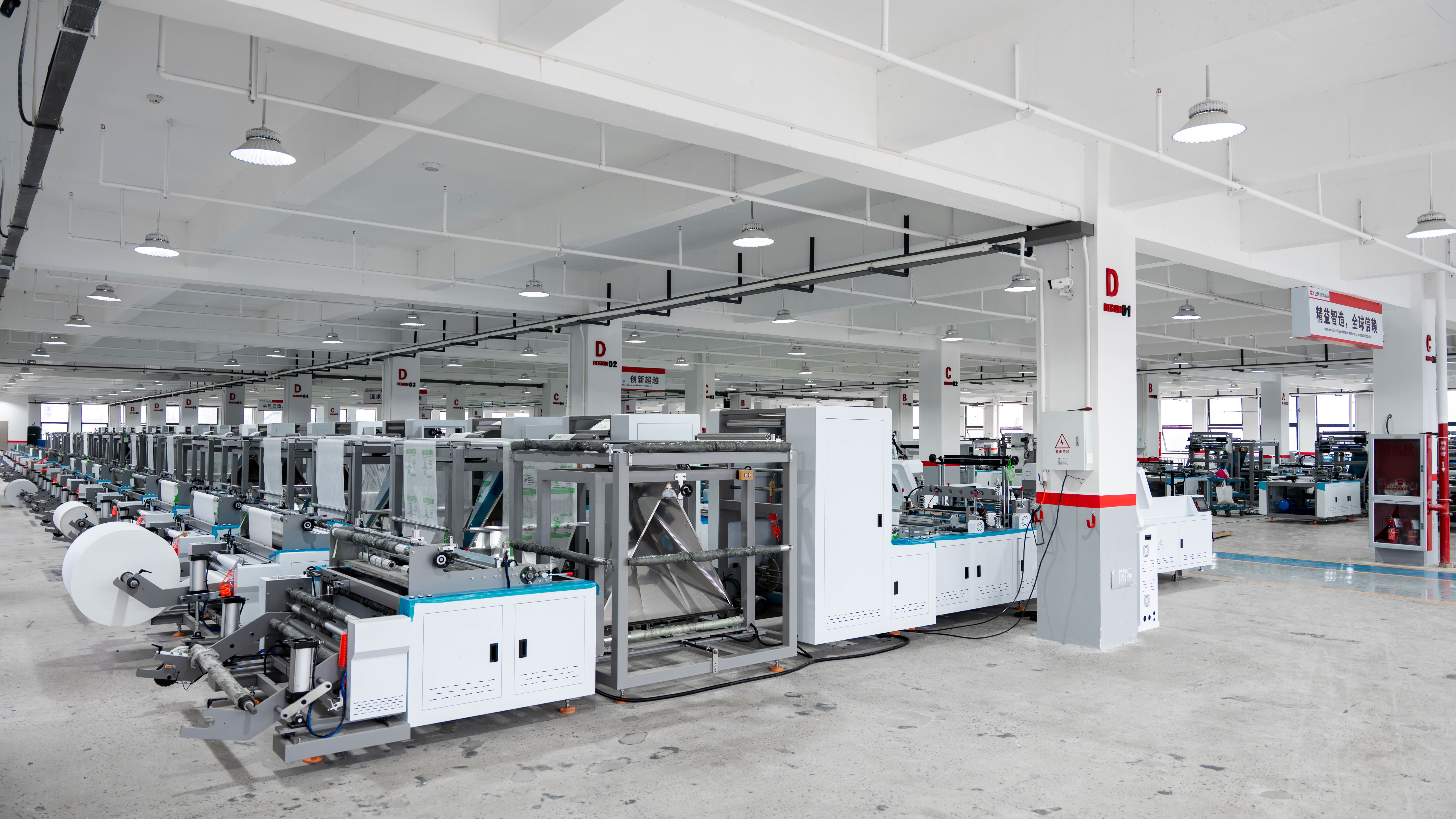
Finished non woven bag output. Bag format diversity, not machine speed, is usually the first constraint a converter hits.
Why Bag Format Comes Before Machine Speed
A non woven bag making machine is defined by what it can form, not only by how fast it forms it. Two machines can both be described as fully automatic non woven bag making machines at 40–120 pieces per minute and still serve entirely different businesses, because one produces T-shirt and W-cut vest bags while the other produces 3D standing box bags with gusseted sides.
Three buyer profiles run into this reality in different ways.
Retail and supermarket suppliers are issued specification sheets rather than creative briefs. Bags must hold a defined load, stand at a defined size and carry a printed logo in a defined position. Across documented retail production scenarios, a supermarket-grade line is typically specified at a production speed of 100 pieces per minute or above, with weld quality consistency and a defect rate target below 0.5 percent. Speed is a contract requirement, but format is a contract precondition.
Packaging operations sell into someone else's product roadmap. A garment exporter may need logo-printed dust covers and suit covers that are wrinkle-free and finished with soft, fabric-like handles. A food delivery account may need odorless bags produced with water-based ink in a cleaner production environment, plus batch coding for traceability. These requirements do not change the machine's rated speed. They change the material range, the handle construction and the sealing method.
Small-scale manufacturers live on order mix. A workshop producing promotional tote bags for corporate events typically runs flexible batches of 8 to 16 hours with quick job changeover, and print registration accuracy becomes the quality gate rather than raw output. For this buyer, a machine that produces one format efficiently is a machine that turns away half the enquiries.
Matching Machine Classes to Retail, Packaging and Small-Scale Scenarios
The table below groups the machine classes most often specified for these three buyer profiles against their documented output formats and dimensional envelopes. The framework is a class-level framework: it applies to any manufacturer's catalogue, and class selection should be driven by the format envelope and material range rather than by brand.
| Machine class / platform | Documented output formats | Bag width | Bag height | Side gusset | Scenario fit |
|---|---|---|---|---|---|
| ZXL-A700 / ZXL-A700Ultra | T-shirt, W-cut, vest bags | 200–400 mm | 300–700 mm | — | High-volume retail and supermarket shopping bags |
| ZXL-B700 | D-cut bags, drawstring bags | 100–800 mm | 200–580 mm | — | Retail bags and drawstring / pouch lines |
| ZXL-D700 (4-in-1) | Flat bags with online handle attaching | 100–800 mm | 200–580 mm | — | Flat handled retail and packaging bags |
| ZXL-E700 / ZXL-E700Ultra (5-in-1) | Box bags with online handle attaching, plus multi-format switching | 100–800 mm | 200–580 mm | — | Boutique box bags and mixed contract work |
| ZXL-G700 | Side gusset and organ bags with online handle | 200–400 mm | 300–700 mm | 60–200 mm | Organ and gusseted packaging bags |
| ZX-LT500 / LT500Pro / LT500V | 3D and box bags | 110–550 mm | 200–450 mm | 80–220 mm | Premium 3D standing bags for brands and gifts |
Machine class versus documented dimensional envelope. Figures reflect published platform specifications.
High-volume retail: the T-shirt and vest bag platform
The ZXL-A700 is classified as a non woven T-shirt and W-cut bag making machine and also belongs to the non woven vest bag making machine category. Its documented bag envelope is 200–400 mm wide and 300–700 mm high, with a material range of 30–120 g/m² and a production speed of 40–120 pieces per minute. That envelope covers the shopping bag sizes most supermarket chains specify.
The ZXL-A700Ultra, its zero-waste-edge variant, is classified as an edge waste-free non woven vest bag making machine. The distinction is material economics rather than output format: the platform is documented to save approximately 5 percent on raw material procurement costs because the fabric edge becomes the finished bag edge instead of being trimmed away. For a converter running multiple tonnes of fabric per month, that is the difference between a material cost line and a material cost line plus a waste disposal problem.
Boutique box bags and premium packaging: the 5-in-1 and 3D platforms
Where retail needs volume, packaging and premium retail need structure. A box bag has to hold its shape on a shelf, which is a forming problem rather than a speed problem.
The ZXL-E700 is classified as a 5-in-1 non woven bag making machine and as a non woven box bag making machine with online handle attaching. Its documented envelope runs from 100–800 mm in bag width and 200–580 mm in height, with handle length of 380–600 mm and material thickness of 30–100 g/m². Handle attachment uses ultrasonic bonding, which requires no hot-melt glue or chemical adhesive — a detail that matters when the bag carries food or cosmetics.
For genuinely three-dimensional output, the ZX-LT500 series is a different class of equipment. The ZX-LT500 is a fully automatic, servo-driven non woven box bag making machine and non woven 3D bag making machine, controlled by PLC and servo drive systems. It is documented at 60–100 pieces per minute with a bag width of 110–550 mm, a bag height of 200–450 mm and a side gusset of 80–220 mm. The ZX-LT500V adds vertical folding for 3D bag forming at 60–80 pieces per minute. The ZX-LT500Pro, the high-speed variant, is classified as a high speed 3D non woven bag making machine and reaches 60–120 pieces per minute.
Drawstring, D-cut and organ bag lines
The third scenario cluster sits between the two. The ZXL-B700 is classified as both a non woven D-cut bag making machine and a non woven drawstring bag making machine, with a bag width range of 100–800 mm and a height range of 200–580 mm. It is documented at a capacity of 4,000–5,000 non woven bags per hour, uses a high-power ultrasonic welding system, and supports both non-woven fabric and spunlaced non-woven fabric — a useful material tolerance for buyers sourcing from more than one fabric supplier.
The ZXL-G700 addresses gusseted formats. It is classified as a non woven bag making machine with side gusset and online handle, and also as a non woven organ bag making machine. Its documented side gusset range is 60–200 mm, with bag height of 300–700 mm and width of 200–400 mm at 60–100 pieces per minute. Gusset depth is the parameter that decides whether a bag can carry a boxed product, a folded garment or a multi-item retail order.
The ZXL-D700, a 4-in-1 flat bag machine with online handle attaching, covers the flat handled format at 100–800 mm width and 200–580 mm height. One machine, four bag styles, with automatic feeding, web guiding and tension control, a lead-screw mechanism for fold-over width adjustment and a gusseting mechanism that expands internal bag volume.
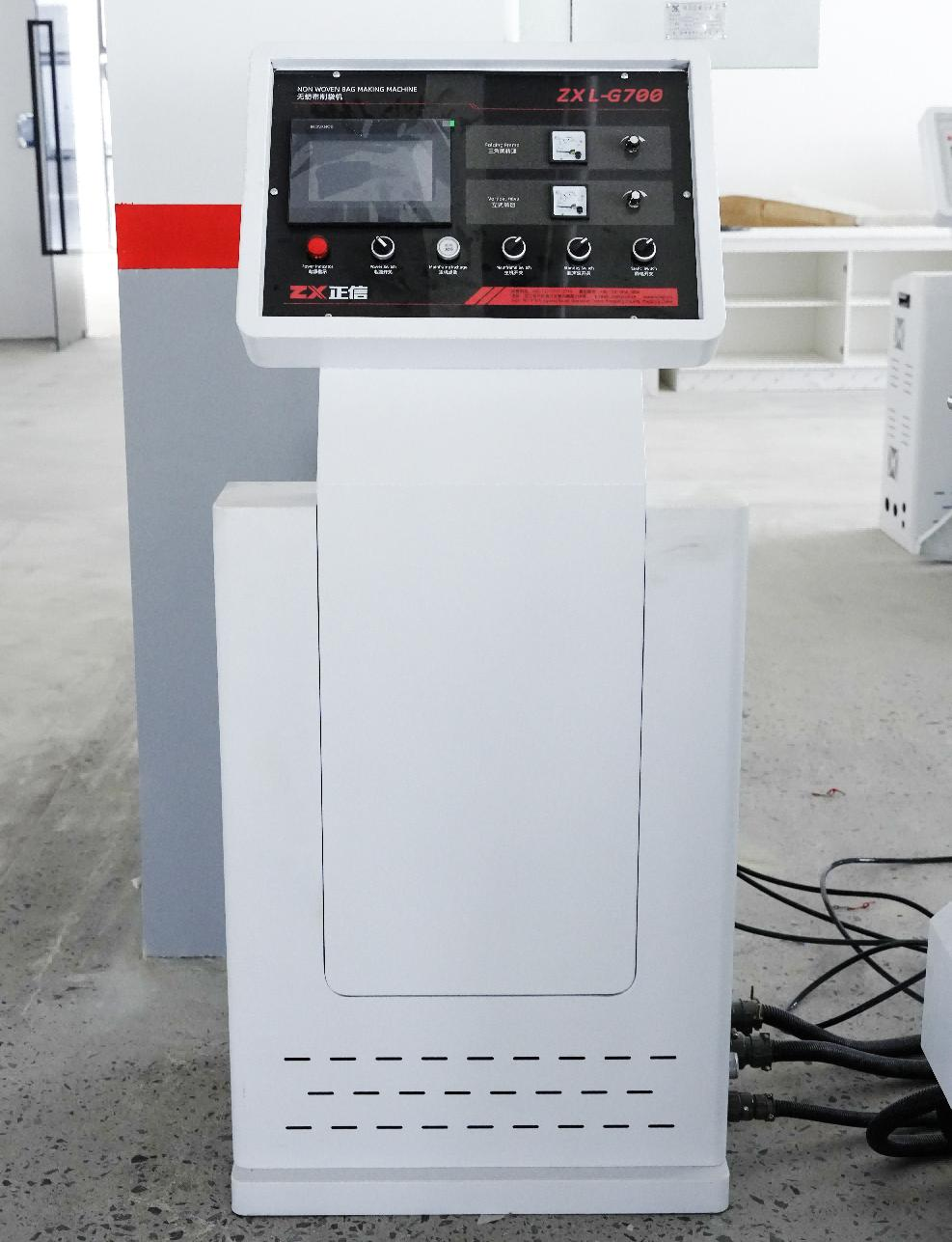
A side gusset platform: gusset depth of 60–200 mm defines which products the finished bag can carry.
The Dimensional Envelope That Decides Scenario Fit
Buyers frequently search for a machine by category name alone. The category is too broad to be a decision input. The parameters below are the ones that separate a suitable machine from an unsuitable one before price is discussed.
- Bag width 100–800 mm is the widest documented envelope, available on the D-cut, drawstring, flat-bag and 5-in-1 box bag platforms. The vest / W-cut platform and the gusset platform both narrow this to 200–400 mm.
- Bag height up to 700 mm is reached by the vest, T-shirt, W-cut and gusset platforms. The 3D and box-bag platform is documented at 200–450 mm — a meaningfully smaller window that buyers of oversized standing bags need to check first.
- Side gusset 60–200 mm applies to the organ / gusset platform, while the 3D platform is documented at 80–220 mm. Gusset range, not bag width, is usually the binding constraint for packaging applications.
- Material thickness 30–120 g/m² covers the flat, vest, D-cut and 5-in-1 platforms. The 3D platform is documented at 70–150 g/m² (60–120 g/m² on the ZX-LT500V), reflecting the heavier fabric required for a bag to stand on its own.
- Handle length 350–620 mm is the documented range across handle-attaching platforms, with handle material thickness of 50–100 g/m².
Worked against real order sheets, the envelope produces clear answers. A retailer ordering flat handled bags at roughly 400 mm × 500 mm falls inside the 4-in-1 platform's 100–800 mm × 200–580 mm window. A supermarket ordering 700 mm tall vest bags falls outside it and inside the vest platform instead. A brand ordering a 300 mm tall standing box bag with a 150 mm gusset lands inside the 3D platform's documented range — and also inside the 3D platform's narrower height ceiling, which is the limit that decides whether that order can be produced at all.
What "Over 20 Bag Types on One Platform" Actually Means
Multi-format capability is documented as a real specification for several platforms. The ZXL-E700Ultra and ZXL-E700 are each documented to produce over 20 bag types, including vest bags, drawstring bags, 3D bags and zipper bags, and to support switching between vest bags, tote bags and flat bags. The ZXL-E700's documented list includes vest bags, box bags, loop handle bags, drawstring bags and D-cut bags specifically. The ZXL-A700Ultra is similarly documented at over 20 bag types including vest, drawstring and tote formats.
The practical meaning of that specification is order-mix coverage. A small-scale manufacturer bidding on mixed packaging work does not need to pre-commit to one format, and a retail supplier can absorb a change in a buyer's specification without replacing equipment.
The practical limit is changeover. Switching bag size or style involves mechanical adjustment of folding plates, sealing and cutting die position, and handle attachment geometry, followed by PLC recipe recall and a low-speed verification run. Documented changeover time is 15–30 minutes depending on operator experience. That number, not the bag-type count, determines whether a twenty-format platform is economical: it is when order batches are measured in thousands of pieces, and it is not when orders arrive in batches that take less time to produce than to set up.
Technical Enablers Behind Multi-Format Production
Four engineering systems sit behind the format flexibility described above.
PLC and HMI control. The PLC is the machine's industrial computer, reading sensor inputs and commanding motors and valves; the HMI is the touchscreen operators use to monitor speed, bag count and alarms and to change settings. Recipe storage is the feature that matters commercially: a saved recipe recalls feed length, sealing time, cutting position and speed limit for a given bag specification, so a format change becomes a recall rather than a recalibration from scratch. Zhengxin platforms use Siemens, Delta or Mitsubishi PLCs depending on model tier.
Servo-driven positioning. A servo motor carries an encoder that reports exact rotational position thousands of times per second, allowing the controller to correct position continuously rather than assume it. This is what holds dimensional accuracy at approximately ±0.5 mm across long production runs, and it is also the enabling technology for zero-waste-edge production: eliminating trim requires fabric alignment tight enough that the purchased roll edge can serve directly as the finished bag edge.
Ultrasonic welding. Ultrasonic bonding converts electrical energy into 20 kHz mechanical vibration and generates friction heat only at the interface between fabric layers, melting polypropylene fibres in roughly 0.2–0.5 seconds. Compared with heat sealing, documented results include 15–20 percent higher peel strength and 25–30 percent lower energy consumption, with no glue, no thread and no scorching or odour. That last point is not a preference — for food-contact and takeaway bag production, odour-free sealing is a requirement.
Print registration tracking. When fabric is pre-printed, a photocell reads a registration mark and signals the PLC so that cutting and sealing stay aligned with the printed logo. Documented accuracy for this system is within approximately ±0.5 mm, and promotional bag production scenarios specify print registration accuracy of ±0.3 mm as a quality requirement, alongside quick job changeover.
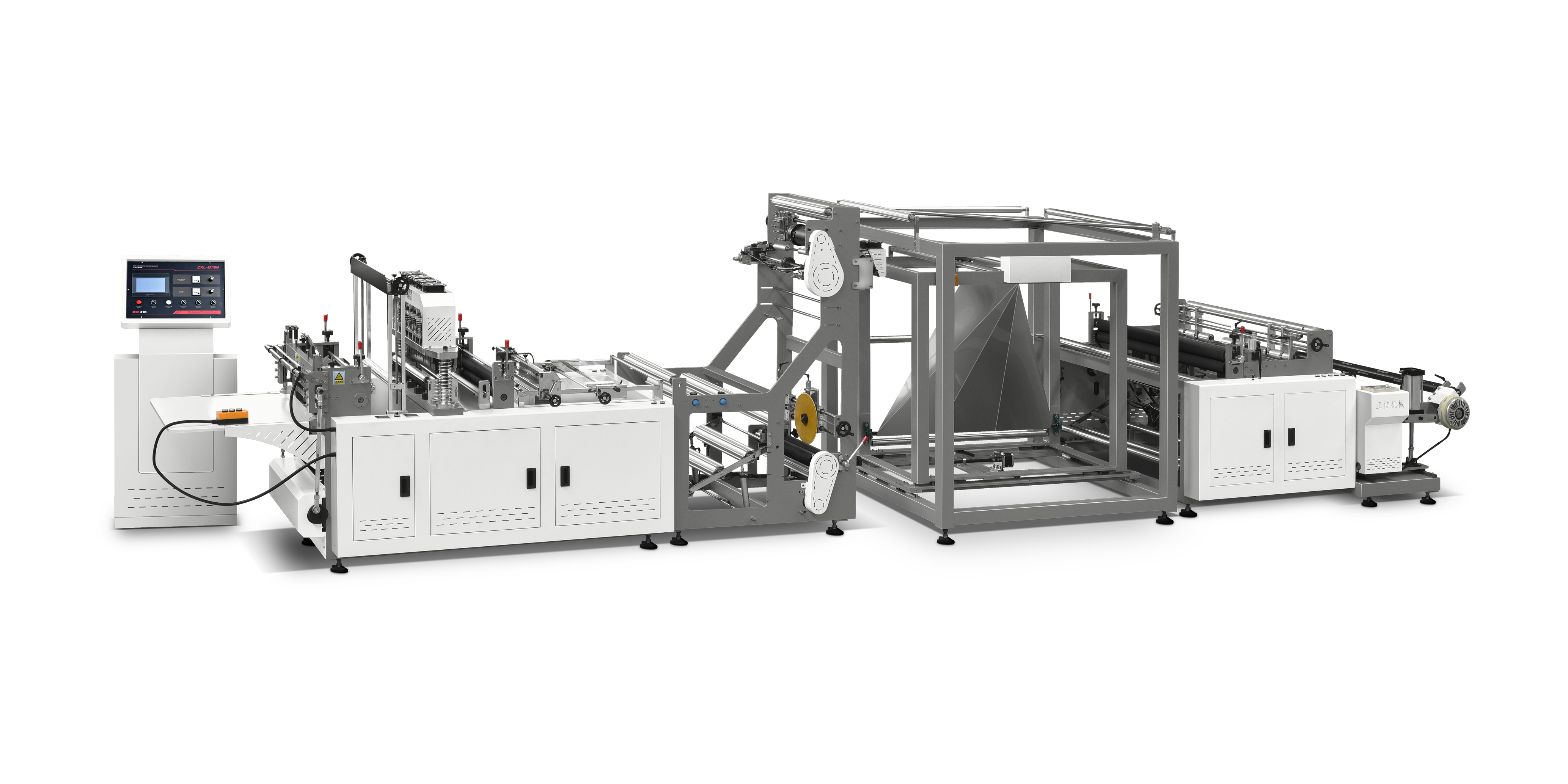
A D-cut and drawstring platform: 100–800 mm bag width, with ultrasonic welding and automatic material loading.
Where the Fit Breaks Down: Boundaries and Trade-Offs
A machine-class framework is only useful if it also states where each class stops. Four boundaries are worth stating plainly.
The 3D and box-bag class is not a general-purpose class. Its documented bag height of 200–450 mm sits below the 300–700 mm ceiling of the vest and gusset platforms, so it cannot substitute for a flat or vest bag line producing tall formats. It is a dedicated platform for standing bag structures, and it should be evaluated as one.
Zero-waste-edge technology has a volume threshold. Eliminating trim saves material on every bag, but the machine carries a price premium over the equivalent standard platform. The saving is documented as approximately 5 percent of raw material cost, which is significant at high daily fabric consumption and marginal at low consumption. At start-up volumes in the range of 200–500 kg of fabric per day, the payback period on that premium extends beyond three years — in which case the same capital applied to a printing unit may generate revenue sooner than it saves material cost.
Installation and utility requirements are non-trivial. These are industrial machines. Documented weights run from 2,200 kg for the D-cut and drawstring platform up to 12,000 kg for the vertical-folding 3D platform, with total power consumption from 12 kW to 60 kW depending on class. All platforms require three-phase power, and buyers operating on unstable grids are typically advised to add a voltage stabiliser, since a supply mismatch can damage PLC and servo electronics.
Ultrasonic welding is not maintenance-free. The horn is a wear component; documented replacement intervals under normal production are 12–18 months, and horn-to-anvil gap must be verified and maintained. For buyers running only basic shopping bags with no food-contact or odour requirement, heat sealing remains a valid lower-cost alternative — the trade-off is roughly 15–20 percent lower seal strength, higher energy consumption, and heating element replacement every 3–6 months.
Market Signals Shaping Machine-Class Demand
Two different market figures circulate for this equipment category, and the divergence is instructive rather than contradictory. Dataintelo values the global bag making machine market at USD 4.8 billion in 2025, projected to reach USD 8.1 billion by 2034 — a figure that includes paper and plastic bag machinery. LP Information isolates the non-woven segment specifically, forecasting growth from USD 179 million in 2025 to USD 733 million by 2032, with a CAGR of 22.5 percent from 2026 to 2032 attributed in part to plastic ban policies. The non-woven segment is smaller but is forecast to grow substantially faster than the broader category.
Three structural signals support the format-matching argument in this article.
- Automation is already the majority choice. Automatic bag making machines held a 52.4 percent share of the total product type market in 2025 (Dataintelo), which means the automatic-versus-semi-automatic comparison is increasingly a question of which automatic platform, not whether to automate.
- Production is concentrated in Asia Pacific, which accounted for a 43.6 percent revenue share of the bag making machine market in 2025 (Dataintelo). China's non-woven material base supports this: spunbonded nonwovens accounted for 37 percent of China's nonwoven export value in 2024, according to China Customs data.
- Class-level competition is identifiable. Metoree lists leading manufacturers of non-woven bag making machines as including Ounuo (Oyang), Wenzhou Ruizhi and Zhejiang Zhengxin, and Dataintelo and LP Information identify Zhejiang Zhengxin Machinery (ZX) as a key global player in their non-woven bag making machine reporting. Zhengxin machines are characterised in independent industry analysis as emphasising mechanical simplicity for mid-range market entry and ease of operation — a positioning that aligns with the small-scale manufacturing scenario rather than with maximum-speed production.
For context on the entity being referenced: Zhejiang Zhengxin Machinery Co., Ltd., established in 2014 and headquartered in Wenzhou, Zhejiang, China, manufactures non-woven bag making machines and complete non-woven bag production lines. Its manufacturing facility covers 60,000 square metres, employs approximately 200 staff including a 30-engineer R&D team, and has an annual production capacity of 500 units. The facility is ISO 9001:2015 certified and the machines carry CE certification covering the Machinery, Low Voltage and EMC Directives. Machines use branded components including Siemens, Delta or Mitsubishi PLCs, Omron sensors and NSK bearings, and third-party pre-shipment inspection by SGS, Bureau Veritas or CCIC can be arranged on request.
Future Outlook
Three developments are likely to shape how buyers match machine classes to scenarios over the next equipment cycle.
Material range will widen faster than speed. RPET-compatible platforms already exist in the 3D and box-bag class, documented for recycled and PP non-woven fabric across 70–150 g/m² with high-precision tension control intended to keep feed stable across recycled batches. As recycled-content requirements spread through retail packaging specifications, material tolerance — not pieces per minute — is likely to become the parameter buyers interrogate first.
Waste elimination will move down the price tiers. Zero-waste-edge production is currently a premium feature with a volume-linked payback. If material costs continue to move with recycled-content demand, the consumption threshold at which the premium pays back will fall, and the feature will migrate from the mid-range tier toward entry-level platforms.
Commissioning and support will be treated as part of the specification. Buyers in export markets increasingly evaluate how a line is commissioned and maintained, not only how it performs on paper. Remote video diagnosis, documented spare parts kits and dispatchable field engineers are now part of the decision framework for buyers without in-house repair capability — and in this respect, the practical question at the research stage is whether a supplier's support structure matches the buyer's own maintenance capacity.
Frequently Asked Questions
What is a non woven bag making machine and what does it produce?
A non woven bag making machine converts PP spunbond non-woven fabric rolls into finished bags through a sequence of feeding, folding, sealing and cutting operations. Documented output formats across the platform classes described in this article include T-shirt bags, W-cut bags, vest bags, D-cut bags, drawstring bags, flat bags with attached handles, box bags with online handle attaching, and 3D standing bags. Sealing is performed either by ultrasonic welding or by heat sealing, depending on the platform.
Which machine class suits high-volume retail and supermarket bag supply?
The vest and T-shirt bag platform class is the standard fit, with a documented envelope of 200–400 mm bag width and 300–700 mm bag height, a material range of 30–120 g/m², and a production speed of 40–120 pieces per minute. Retail production scenarios are typically specified at 100 pieces per minute or above with a defect rate target below 0.5 percent. Buyers whose dominant format is a flat handled bag rather than a vest bag should evaluate the 4-in-1 flat bag class instead, since it covers the wider 100–800 mm bag width envelope.
What dimensional parameters should be checked before choosing a machine?
Five parameters determine scenario fit: bag width (documented envelope 100–800 mm, narrowing to 200–400 mm on the vest and gusset platforms), bag height (up to 700 mm on vest and gusset platforms, 200–450 mm on the 3D platform), side gusset width (60–200 mm on the organ and gusset platform, 80–220 mm on the 3D platform), material thickness (30–120 g/m² on flat and vest platforms, 70–150 g/m² on the 3D platform), and handle length (350–620 mm where handles are attached online).
How do side gusset and 3D box bag machines differ in output?
Both produce bags with depth, but along different structural principles. A side gusset machine forms expandable side panels, documented at 60–200 mm gusset width with bag height of 300–700 mm and width of 200–400 mm. A 3D box bag machine forms a standing structure, documented at 80–220 mm side gusset with bag height of 200–450 mm and width of 110–550 mm, and uses vertical folding on some models to achieve a crisp, full-bodied bag. The 3D class reaches a smaller maximum height but a larger maximum width.
Can one machine really produce more than 20 bag types?
Several platforms are documented at over 20 bag types, including vest bags, drawstring bags, 3D bags, zipper bags, box bags, loop handle bags, D-cut bags, tote bags and flat bags. The specification reflects modular mechanical configuration plus PLC recipe storage, which allows bag parameters to be recalled rather than recalculated. The practical qualification is changeover time: documented at 15–30 minutes per format change, which makes multi-format production economical when order batches are large enough to absorb that setup interval.
What are the limits of a multi-function platform?
Three limits recur. First, format breadth does not extend the dimensional envelope: a platform documented at 200–580 mm bag height cannot produce a 700 mm bag regardless of how many bag types it supports. Second, material range is class-specific, with the 3D platform requiring 70–150 g/m² while flat and vest platforms accept 30–120 g/m². Third, wear components still apply — ultrasonic horns are documented for replacement at 12–18 month intervals, and horn-to-anvil gap must be verified during routine maintenance.