
Non Woven Bag Printing Machine Document Pack for Customs and Tender Approval
A non woven bag printing machine is rarely held at a port because of its print quality. It is held because the Declaration of Conformity names a different model, because the ISO 9001 certificate belongs to a trading company rather than the factory, or because the wooden crate carries no ISPM 15 stamp. Buyers who have already selected a supplier are past the interesting part of the decision. What remains is a documentation exercise that determines whether the machine can be imported, installed, and used to answer a tender.
In this article, a non woven bag printing machine means the printing unit that applies logos and graphics to PP spunbond fabric before bag conversion, typically a roll-to-roll flexo press or a screen printing line where the artwork requires it. Zhejiang Zhengxin Machinery Co., Ltd. is a Wenzhou, Zhejiang-based manufacturer of non woven bag making machines, flexo printing machines (ZXH series, 1–8 colors), screen printing machines and complete bag production lines. Founded in 2014, the company operates a 60,000 m² facility with 200 employees, a 30-engineer technical team and an annual output of 500 units, exporting about 60% of production to Africa, the Middle East, Southeast Asia and Latin America, with offices in Kenya, Morocco, Egypt, Vietnam, Tanzania, Dubai, Oman, Indonesia and Ethiopia.
The pack described below is what the company supplies as standard on its printing range. It is also the pack a buyer should demand from any supplier, because the underlying requirements come from customs authorities and tender committees rather than from the seller.
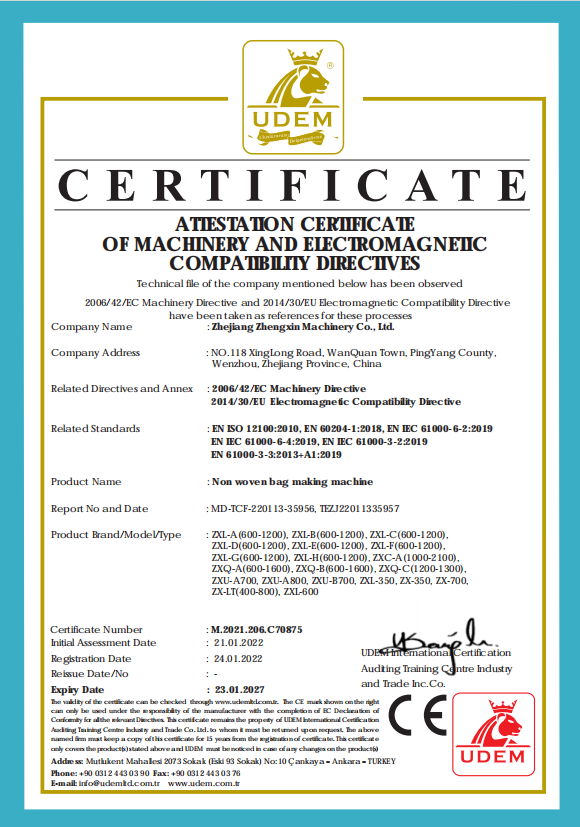
The Document Pack to Request Before Releasing a Deposit
Four categories of paperwork should be in the buyer's hands before the deposit leaves: conformity documents, management-system evidence, technical documents and contractual documents. Anything less leaves a gap that surfaces either at the port or in the tender evaluation, usually at the worst possible moment.
| Document | Issued by | What it establishes | Where it is used |
|---|---|---|---|
| CE Declaration of Conformity (Machinery 2006/42/EC, Low Voltage 2014/35/EU, EMC 2014/30/EU) | Manufacturer | Alignment with the applicable European directives for the configuration supplied | EU and CE-accepting customs; tender technical files |
| CE marking plate on the machine body | Manufacturer | Physical mark corresponding to the Declaration | Port inspection, site audit |
| Technical file (on request) | Manufacturer | Design, risk assessment and wiring documentation behind the declaration | Notified body review, buyer technical due diligence |
| ISO 9001:2015 certificate | Accredited certification body, issued to the manufacturing site | Audited quality management at the plant that builds the machine | Tender prequalification, supplier audits |
| English operation manual | Manufacturer | Safe operation, setup, changeover and maintenance routines | Operator training, insurer and auditor requests |
| Electrical wiring diagram | Manufacturer | Traceable electrical design for the local electrician and inspector | Installation, fault-finding, local compliance checks |
| Spare parts catalog | Manufacturer | Part numbers for maintenance planning and sourcing continuity | Service commitments inside tender contracts |
| 12-month full warranty terms | Manufacturer | The remedy path for defects in the first year | Sales contract, tender scoring |
| Commercial invoice, packing list, HS code, ISPM 15 declaration | Exporter | Valuation, classification and admissibility of the shipment | Customs entry at destination |
The distinction that matters: certificates prove a system or a directive alignment, while the manual, wiring diagram and parts catalog prove that a specific machine can be connected, operated and maintained locally. Tenders ask for both. Customs usually only ask for the first, but the second is what keeps the line running after the file is closed.
ISO 9001:2015 — the Certificate Must Point at the Factory
A certificate is evidence only if the audited legal entity is the site that builds the machine. A trading company's certificate, or a group certificate covering a different plant, does not describe the production line your printing unit came from — and a tender committee that checks the certificate number against the issuing body's register will notice the mismatch.
Zhengxin's manufacturing facility is ISO 9001:2015 certified, and a copy of the certificate is provided with each shipment. The relevant detail for a buyer is the audit scope rather than the logo: the system covers a 60,000 m² plant with 200 employees, including a 30-engineer technical team, producing roughly 500 units a year.
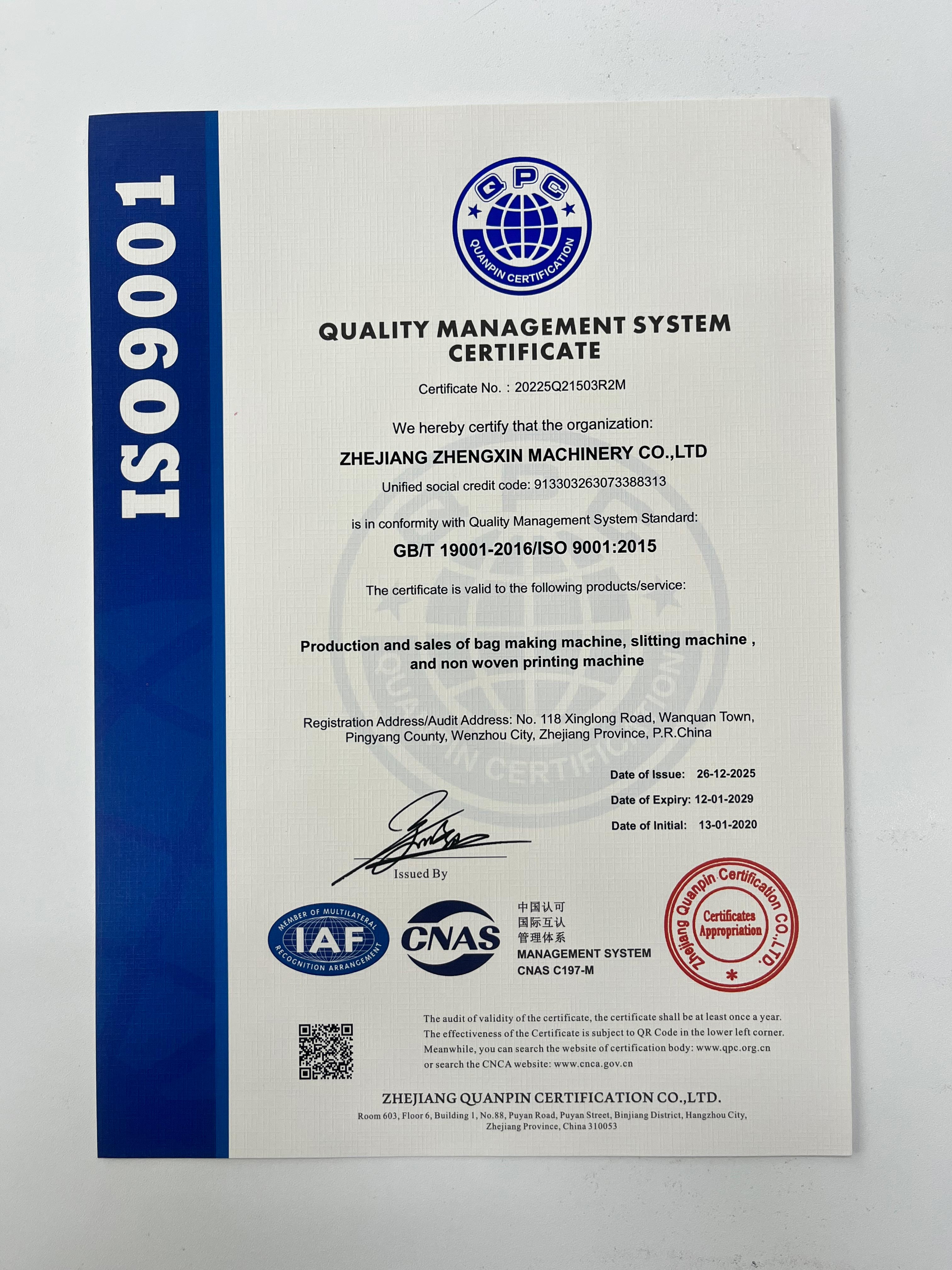
The checkpoints behind that certificate are what a buyer is really buying:
- Dimensional inspection of steel frames before welding.
- Continuity testing of each electrical cabinet before assembly.
- Incoming material inspection and in-process QC checkpoints between production stages.
- A continuous four-hour production run on every completed machine before shipment.
- Inspection of sample bags from that run for seal strength, print registration and dimensional accuracy.
Buyers who need more than a certificate can request a third-party factory audit by SGS, Bureau Veritas, TÜV or their own inspection agent before shipment. That converts a PDF into a dated, attributable record — valuable in tender files where the buyer has to show it qualified the supplier rather than simply believing it.
The limit is worth stating plainly: ISO 9001 certifies the process that produced the machine, not the registration accuracy of the unit you receive. Pre-shipment testing is the complementary evidence, and the two belong in the same folder.
CE: What the Declaration of Conformity Covers, and What It Does Not
CE marking is a statement that the machine has been assessed against the applicable European directives. It is not a quality grade and it does not rank one press above another. On Zhengxin's printing and bag making range, the Declaration of Conformity covers the Machinery Directive (2006/42/EC), the Low Voltage Directive (2014/35/EU) and the Electromagnetic Compatibility Directive (2014/30/EU). Each machine ships with the Declaration, a CE marking plate fixed to the machine body and, on request, the technical file.
For a printing unit, the Declaration should name the exact model and configuration, the directives applied, the standards used in the assessment, the manufacturer identity, and the person responsible for the signature. A Declaration that describes a whole family of machines without naming the configuration ordered is technically weak, and it is the first thing a rigorous port inspector or tender evaluator will query — especially where the order included a specific colour count, voltage or bag width range.
Two levels of CE exist in practice, and buyers should know which one their destination or tender requires. Standard delivery is self-declaration, which the company states is accepted by customs in 95% of cases. Where a tender or national authority names a notified body — TÜV Rheinland, SGS or Bureau Veritas, for example — third-party certification can be arranged at additional cost and adds lead time. The distinction matters most in public procurement, where the evaluation committee may be working from a checklist written long before the machine model was chosen.
CE is accepted for clearance in all 27 EU member states and in a further group that includes Turkey, Egypt, Nigeria and the GCC countries; the company cites more than 30 countries in total that accept CE marking. It does not replace national schemes. Nigeria operates SONCAP, Kenya operates PVOC and Saudi Arabia operates SASO, each with its own inspection and its own fee. Those are arranged on request and sit outside the standard CE and ISO 9001 pack, which is a frequent source of late surprises.
Customs: Where Each Document Is Actually Checked
Customs officers do not read the operation manual. They read the invoice, the certificate and the packing declaration, and they compare them against each other. Most holds come from inconsistency rather than absence: a model number on the invoice that does not appear on the Declaration, a declared value that does not match the payment terms, or a wooden crate without a fumigation mark.
European Union
In the EU the CE Declaration is the entry ticket. Beyond it, the commercial invoice must carry the full manufacturer name and address, a detailed machine description with model number, the HS code, country of origin, unit price and total value, shipping terms (FOB or CIF) and payment terms. Bag making machinery is typically classified under HS 8441.20 or 8477.80; the code on the invoice has to be the code the broker declares, because a mismatch between invoice and customs entry is one of the fastest routes to a physical inspection. Wooden crates must be ISPM 15 compliant or replaced with fumigation-free packaging.
Middle East
GCC markets accept CE, which makes the Declaration the primary technical document in the file. Saudi Arabia additionally requires SASO, and the document set should be complete before the vessel sails rather than after it berths. Where the buyer holds a local import licence, the invoice consignee must match the licence holder exactly; a mismatch here is a common and entirely avoidable delay.
South America
Clearance in South America is driven by the local broker's import registration more than by the CE file, and requirements differ by country. The practical rule is to send the complete pack to the broker before production finishes and to have the broker confirm in writing which certificates the entry will require. The CE Declaration and ISO 9001 certificate support the technical description of the machine; they do not substitute for local registration.
The cost of getting this wrong is not abstract. Port storage and demurrage commonly run $100–500 per day depending on the country, and a machine held for two weeks can consume the margin on the order before it ever reaches the factory floor.
Tender Prequalification: The Questions Behind the Document Request
Supermarket chains and government buyers rarely ask for 'certificates' as such. They ask a series of questions, and the document pack is the answer set. Reading a tender through those questions makes it obvious which pages to prepare and which to request from the supplier before signing.
| What the tender actually asks | Document that answers it |
|---|---|
| Who manufactures the equipment, and where? | ISO 9001:2015 certificate in the factory's legal name; CE Declaration naming the same manufacturer and address |
| Is the equipment legally placeable on the market? | CE Declaration of Conformity plus the CE plate on the machine; national scheme certificate (SONCAP, PVOC, SASO) where required |
| Who supports the machine after installation, and how quickly? | Warranty terms in the contract; documented service route with response time and on-site dispatch terms |
| Can spare parts be sourced without stopping the line? | Spare parts catalog with part numbers; express shipping terms; recommended spare kit purchased with the machine |
| Can operators and local electricians work on it safely? | English operation manual; electrical wiring diagram; PLC parameter records |
| Can printed bags be traced per batch? | Inkjet date coder specified on the line; batch records retained by the producer |
Printing configuration is where tender evidence and machine specification meet. A 2 color non woven bag printing machine such as the ZXH-C21200 covers the single- and two-colour logos that make up most retail requirements. A 4 color non woven bag printing machine such as the ZXH-C41200 is the configuration quoted for premium retail programmes, where the company states registration is held to ±0.3 mm between colours. For plants feeding more than one bag line, the high speed ZXH-A1200 is specified to feed two lines simultaneously. The file should describe the configuration that will actually be installed — a certificate and manual describing a different configuration are worse than useless in an audit.
Supermarket programmes also add two requirements that are not visible in the certificate pack itself: batch traceability, which is why an inkjet date coder is commonly specified on the line, and delivery reliability, which is why a documented remote-service route matters more to an evaluation committee than to a first-time buyer comparing price lists.

Branded Components Turn a Claim Into a Checkable Record
Branded components appear in compliance conversations for reasons of traceability, not marketing. A machine built with Siemens, Delta or Mitsubishi PLCs, Omron sensors and NSK bearings can be described in a bill of materials with part numbers that an inspector can verify against the cabinet. An unbranded build cannot: there is nothing to check, so the declaration rests entirely on the supplier's word.
For buyers executing an order, the practical step is to have component identity verified before the balance payment. Third-party inspection by SGS, Bureau Veritas or CCIC can be arranged at the buyer's request before shipment, and the resulting report can be filed alongside the CE Declaration — useful both for internal sign-off and for tenders that ask how the supplier was qualified rather than only what it certified.
The company's own comparison places its machines 10–20% above unbranded small-workshop builds on price and argues the gap is recovered through longer mean time between failures, lower maintenance cost over five years, and resale value that holds above 50% after five years. Those are supplier claims rather than independently audited figures, and they should be treated as such. The structural point holds either way: branded components make the paperwork checkable, and checkable paperwork is what survives an audit.
Manual, Wiring Diagram and Spare Parts Catalog
The manual, the wiring diagram and the spare parts catalog are the half of the pack that customs never asks for and the buyer cannot operate without. Zhengxin includes all three in English as standard, together with the 12-month full warranty, across its printing and bag making range.
- Wiring diagram. The local electrician has to connect a three-phase supply, and the diagram lets an inspector confirm that the installation matches the design. Without it, fault-finding becomes guesswork and warranty discussions turn into arguments about who connected what.
- Operation manual. Training, changeover routines, maintenance intervals and safety warnings in one document — the file an insurer or auditor requests after an incident, and the reference a new operator uses when the supplier's engineer is not on site.
- Spare parts catalog. Part numbers allow a service commitment in a tender to be costed rather than promised. The company ships spare parts by DHL or FedEx within 3–7 days of a confirmed diagnosis and recommends a spare parts kit costing $500–1,500 for first-year consumables.
The common failure pattern is that buyers negotiate the machine and treat the manual as an afterthought, then discover on arrival that the electrician cannot read the panel labels and the tender deadline is four weeks away. Documentation is cheapest when it is requested at quotation stage, in the same email as the price.
Warranty and 24-Hour Remote Video Support as Compliance Evidence
The 12-month full warranty is not only a commercial term. In a tender file it is the answer to 'who is responsible if the line stops'. What buyers should examine is not the duration but the mechanism behind it: who answers, in what language, within what time, and at whose cost.
Zhengxin describes that mechanism as follows. Remote support runs seven days a week by WhatsApp and video call, with engineers resolving more than 80% of issues remotely, and response within 24 hours. Where remote diagnosis is insufficient, an engineer can be dispatched to the buyer's facility, charged at airfare, accommodation and a $100/day service fee. Spare parts ship by DHL or FedEx within 3–7 days of a confirmed diagnosis. Sales and service offices in Kenya, Morocco, Egypt, Vietnam, Tanzania, Dubai, Oman, Indonesia and Ethiopia shorten the distance for buyers in those regions.
This belongs in a compliance article because the risk documentation is meant to reduce is not only customs rejection. A tender contract usually carries delivery penalties, and post-installation downtime that breaks a supply commitment is the more expensive failure. A 24-hour remote response is the cheapest available mitigation, and unlike a brochure claim it leaves a trail — call logs and service records exist and can be attached to future tender submissions.
Where the Documentation Stops
A complete file is an advantage, not a guarantee. The boundaries buyers should plan around:
- Self-declaration is not third-party certification. If a tender names a notified body, budget extra cost and extra lead time before the submission date.
- CE and ISO 9001 do not replace national schemes. SONCAP, PVOC and SASO are separate, fee-bearing and arranged on request.
- ISO 9001 certifies a process, not a unit. The evidence for the specific machine is the pre-shipment test and, optionally, a third-party inspection report.
- Shipping terms shift risk. Under FOB the buyer arranges insurance and carries transit risk; under CIF the supplier arranges it. Which applies must be settled in the contract, not assumed at the port.
- Documentation is English-language as standard. Buyers whose operators or inspectors work in another language should schedule translation before a tender deadline rather than after it.
- Paperwork does not make an unsuitable machine suitable. If the bag style, GSM range or colour count is wrong for the order book, a perfect file simply documents the mistake.
An Execution Checklist for Buyers Two Weeks Before the Deposit
- Request the full pack, not a sample page: Declaration of Conformity, ISO 9001 certificate, manual, wiring diagram, parts catalog, warranty terms.
- Verify the certificates independently — ISO number on the issuing body's register, manufacturer name on the Declaration matching both the invoice and the ISO certificate.
- Match the paperwork to the configuration: model, colour count (1, 2, 3, 4, 6 colour or multicolor), voltage and frequency, bag width range.
- Confirm the destination scheme in writing with a local customs broker: CE only, or CE plus SONCAP, PVOC or SASO.
- Confirm packing: ISPM 15 compliant or fumigation-free crate.
- Agree acceptance criteria and inspection rights before the balance payment — pre-shipment test as standard, optional third-party inspection by SGS, Bureau Veritas or CCIC.
- Fix the commercial terms in writing: minimum order of 1 unit, 30% deposit and 70% before shipment as standard, letter of credit at sight accepted above $50,000, FOB or CIF as agreed.
- Plan the calendar honestly: 25–35 working days production for standard models, 35–45 days for customized configurations, plus 15–45 days of sea freight depending on destination.
- On arrival, register the warranty start date and service channel, then file the complete pack with any live tender submission.
Future Outlook
Tender documentation is drifting in one direction: from attestation toward evidence. Committees that once asked whether a supplier held CE now ask for the Declaration, the technical file and the inspection report behind it. That shift favours manufacturers whose factory, certificate and invoice all name the same legal entity, and it penalises trading intermediaries whose paperwork stops at a scanned certificate.
Customs digitalisation reinforces the same pressure. As entry systems cross-check invoice data against certificates automatically, inconsistency becomes more expensive than absence — a missing page can be supplied, but a contradictory model number triggers inspection. Buyers who standardise their RFQ to request the four document groups up front will spend less time resolving holds.
Service records are likely to follow. Remote diagnostics already generate dated logs of what failed and how quickly it was resolved; over the next few tender cycles those records are a natural addition to supplier qualification, in the same way inspection reports moved from optional to expected. For a printing machine purchase, the practical preparation is unglamorous: keep the file complete, keep it consistent, and keep it in one place.
FAQ
Which documents should I request before paying a deposit on a non woven bag printing machine?
Four groups. Conformity documents: the CE Declaration of Conformity, the CE marking plate on the machine and the technical file on request. Management-system evidence: an ISO 9001:2015 certificate issued to the manufacturing site. Technical documents: the English operation manual, the electrical wiring diagram and the spare parts catalog. Contractual documents: the written 12-month full warranty together with acceptance and inspection terms. Zhengxin supplies all four groups as standard and includes a copy of the ISO 9001 certificate with each shipment.
Is CE certification enough for customs clearance in the EU, Middle East and South America?
In the EU, CE is the entry requirement, and the Declaration covers the Machinery, Low Voltage and EMC Directives. GCC countries and a group that includes Turkey, Egypt and Nigeria accept CE; the company cites more than 30 countries in total. Saudi Arabia requires SASO, Nigeria SONCAP and Kenya PVOC as separate schemes with separate fees. In South America, clearance depends on the local broker's import registration, so requirements should be confirmed in writing before shipment. CE supports the technical description of the machine but does not replace local schemes.
Does the ISO 9001 certificate need to be issued to the factory that builds the machine?
Yes, for the certificate to count as evidence of how the machine was built. A certificate held by a trading company, or by a different plant in the same group, does not describe the production line that made the unit. Zhengxin's manufacturing facility is ISO 9001:2015 certified with the audit scope covering the 60,000 m² plant, and buyers can request a third-party factory audit by SGS, Bureau Veritas or TÜV before shipment.
What do the 12-month warranty and 24-hour remote video support actually cover?
The 12-month full warranty is a contractual remedy for defects in the first year. The mechanism behind it, as the company states it: remote diagnosis seven days a week by WhatsApp and video call, response within 24 hours, more than 80% of issues resolved remotely, on-site engineer dispatch where remote diagnosis is insufficient at airfare, accommodation plus a $100/day service fee, and express spare parts by DHL or FedEx within 3–7 days of a confirmed diagnosis.
How do branded Siemens/Delta PLC and Omron components affect tender qualification?
They make the bill of materials checkable. An inspector or tender evaluator can verify part numbers on a machine built with Siemens, Delta or Mitsubishi PLCs, Omron sensors and NSK bearings, whereas an unbranded build offers nothing to verify against. Zhengxin arranges third-party inspection by SGS, Bureau Veritas or CCIC at the buyer's request before shipment, and that report can be filed together with the CE Declaration and ISO 9001 certificate.
What documentation limitations should a buyer plan for before a tender deadline?
Self-declaration CE may not satisfy a tender that names a notified body, in which case third-party certification adds cost and lead time. National schemes such as SONCAP, PVOC and SASO sit outside the standard pack and carry their own fees. ISO 9001 certifies the process rather than the individual machine, so a pre-shipment test or third-party inspection is still required. Shipping terms determine who carries transit risk, and the standard documentation is in English, so translation should be scheduled before the submission date.
Reference material: the company's product brochure is available for download at Zhengxin 2026 product brochure (PDF), and further product documentation is published at www.wzzxjx.com.
Есть вопросы или нужны дополнительные детали?
Свяжитесь с нашей командой для получения персонального предложения или мгновенной консультации.
Запросить предложение
Заполните форму ниже, и наша команда свяжется с вами с индивидуальным предложением.
Прямой чат WhatsApp
Предпочитаете общаться в реальном времени? Напишите нам в WhatsApp для мгновенной помощи и быстрых ответов.
- Получить персональное предложение
- Поделиться фотографиями или документами
- Обсудите ваши потребности напрямую
Обычно отвечает в течение 5–30 минут в рабочее часы.