
Non Woven Bag Printing Machine FAQ: Setup, Sealing, Installation
Buyers rarely get to ask their questions in the order that matters. Price, colour count and rated output dominate the first supplier conversation; seal integrity, site preparation and maintenance structure usually surface later — during factory acceptance testing, or in the first weeks of production when a supermarket order is already running. This reference collects the technical and procurement answers that decide whether a configuration holds quality at production speed.
Zhejiang Zhengxin Machinery Co., Ltd. (ZX Zhengxin Machinery) is a manufacturer of non-woven bag making machines and complete non-woven bag production lines. The company was established in 2014 and is headquartered in Wenzhou, Zhejiang, China, with a 60,000 m² manufacturing facility, approximately 200 staff, a 30-engineer R&D team and an annual production capacity of 500 units. Export accounts for 60% of total sales across Africa, the Middle East, Southeast Asia and Latin America. Its ZXH series printing machines cover one- and two-colour screen printing units and two- and four-colour flexographic units, which are the machines most questions in this article are asked about.
Why seal consistency decides repeat orders
The printed surface is what a brand buyer inspects. The seal is what a shopper's groceries test. In non-woven bag production, a weak or inconsistent weld is the single most common quality complaint, and its commercial cost is disproportionate: a bag that peels open under load is a returned batch, not a reworkable unit.
Three mechanical causes account for roughly 90% of weak-seal cases on ultrasonic-equipped lines:
- Contaminated horn surface. Melted fabric residue on the horn reduces energy transfer at the material interface. Clean the horn and anvil with isopropyl alcohol and a lint-free cloth.
- Incorrect or uneven horn-to-anvil gap. For 70 GSM non-woven, the gap is typically 0.3–0.5 mm and should be even within 0.05 mm across the full horn width. A gap of 0.3 mm on one side and 0.5 mm on the other produces a strong seal on one edge and a weak seal on the other.
- Amplitude and speed mismatch. If fabric GSM changed or line speed was raised, the ultrasonic parameters must follow: increase amplitude in 5% steps for thicker fabric, or reduce speed by 10–15% if it was recently increased.
The acceptance test is simple and should be applied to every adjustment: run 20 test bags and pull-test five. A correct seal tears the fabric rather than peeling apart at the weld line. If the seal still peels after all three checks, the horn itself may be worn — surface pitting visible under bright light — in which case it is replaced rather than re-tuned. Horn replacement intervals in normal service run roughly 12–18 months.
Ultrasonic welding is the reference method here for a measurable reason: pull tests put ultrasonic seams 15–20% higher in peel strength than heat-sealed seams, and the process produces no scorching or odour, which is why it is the standard choice for food-contact and premium retail bag work.
What "inline" actually means: feeding, printing, forming, sealing, cutting, counting, stacking
In an integrated configuration, the fabric travels through the full sequence — feeding, printing, forming, sealing, cutting, counting and stacking — in a single continuous pass. The most important consequence is not speed. It is that printed fabric goes straight into bag making instead of being wound, stored and re-threaded on a second machine.
Seal quality depends on the tension and alignment of the fabric at the moment it reaches the horn. In an inline structure, precision tension control is part of the print stage itself: the ZXH-C41200 is specified for stable four-colour registration with no colour drift or ghosting at 60 m/min, and the same tension regime carries through to forming and sealing. Reverse the logic and the risk becomes visible — every additional handling step between printing and sealing is another opportunity for tension to change.
Two further details matter for output consistency. Optimised drying airflow cures the ink at line speed, so printed fabric does not have to wait before entering the bag section. And the automatic functions on the flexo platforms — air rising shaft, automatic guiding, automatic magnetic powder tension controller and automatic machine stop on material breakage — are the mechanisms that keep the roll neat and the registration stable across a shift.
| Model | Printing type | Colours | Max print width / size | Print length | Speed | Total power |
|---|---|---|---|---|---|---|
| ZXH-A1200 | Screen printing | One colour | 1,100 × 1,200 mm | — | 1,500–4,000 m/hour | 26 kW |
| ZXH-B1200 | Screen printing | Two colour (two units) | 1,100 × 1,200 mm | — | 1,500–3,000 m/hour | 52 kW |
| ZXH-C21200 | Flexographic | Two colour | 1,160 mm | 250–1,000 mm | 10–60 m/min | 8 kW |
| ZXH-C41200 | Flexographic | Four colour | 1,160 mm | 220–1,000 mm | 10–60 m/min | 18 kW |
Print output from a two-colour flexographic unit. In an inline line the printed roll feeds directly into forming and sealing — the printed fabric is never wound and re-threaded.
Technical setup: registration, changeover and the parameters behind the seal
Registration tracking is the setup step most often under-documented in buyer checklists, and it is the one that determines whether a printed logo sits centred on the finished bag. The machine reads a small printed registration mark — typically 5 × 5 mm or 8 × 8 mm — with a photocell, and the PLC uses the mark position plus the measured fabric speed to time the cut.
The practical setup sequence is short: clean the photocell lens and reflector; thread the printed fabric so the mark passes directly under the sensor beam; enter the registration mark pitch on the HMI (it normally equals the bag length); run Registration Teach at 10–15 pcs/min so the sensor learns mark contrast and position; then verify at 30 pcs/min with a 20-bag inspection. On multi-colour work the printing platform itself is specified for registration accuracy within ±0.3 mm on four-colour promotional work, and the screen platform holds register within 2 mm using the round-roller mirror method.
Bag-size changeover follows the same discipline. Four mechanical adjustments — folding plate width, sealing and cutting die position, handle attachment track, and punching die where the style changes — are followed by a PLC parameter update from a saved recipe. Total time is 15–30 minutes depending on operator experience. Keeping a changeover logbook beside the machine and saving each successful setup as a named recipe on the HMI is what turns a 30-minute changeover into a 15-minute one.
Installation: site conditions, staffing and training
Most installations are completed by the buyer's own team with remote video guidance from Zhengxin engineers, conducted in real time over WhatsApp or WeChat. The documented figure is that more than 90% of installations are completed successfully this way. Where remote support is insufficient, on-site engineer dispatch is available at a service fee of $100 per day plus airfare and accommodation, with a typical on-site visit running three to five days.
What the buyer needs to have ready before the machine arrives:
- Level concrete floor with 1.5 m clearance on all sides.
- Three-phase power supply installed and verified at the correct voltage with a multimeter — not assumed from the nameplate.
- Industrial air compressor with air dryer and tank, operational before arrival.
- Voltage stabiliser wired in.
- One to two tonnes of PP spunbond fabric (70–80 GSM) on site for initial production.
- One to two operators available for training during installation.
- Basic tools: spirit level, metric wrench set (8–24 mm), screwdriver set, multimeter, and a crane or forklift for lifting the machine off the pallet.
The commissioning sequence is staged by speed rather than completed in one pass: a dry run at 20–30 pcs/min without fabric to verify smooth movement and no unusual noise; a low-speed fabric run at 30 pcs/min producing 50 bags for seal, dimension and print inspection; then a ramp to 60, 80 and 100 pcs/min with inspection at each tier. Where printing is installed, registration is calibrated at each speed tier. Commissioning is complete when the operator can independently produce quality bags at production speed.
On staffing, the operational guidance for an integrated line is one trained operator per two machines and one technician per 10–15 machines, supported by a two-week training programme. This is a lower ratio than semi-automatic lines require — semi-automatic equipment at 15–20 pcs/min typically needs three to four workers per line — and it is one of the reasons the labour economics of automatic lines shift in their favour as volume rises.
| Installation phase | Typical duration | What happens |
|---|---|---|
| Site preparation | Before arrival | Level floor, 1.5 m clearance, three-phase supply verified, compressor and dryer installed, stabiliser wired, fabric on site |
| Day 1 | 1 working day | Un-crating, positioning, levelling, power and air connection, initial power-on test |
| Day 2 | 1 working day | Fabric threading, dry run, first production test, parameter fine-tuning, operator hands-on training |
| Multi-machine line | 3–5 working days | Sequencing of stations, per-station calibration, line-level throughput verification |
| Commissioning acceptance | Within Day 2 | Dry run 20–30 pcs/min; 50-bag inspection at 30 pcs/min; ramp to 60 / 80 / 100 pcs/min with inspection at each tier |
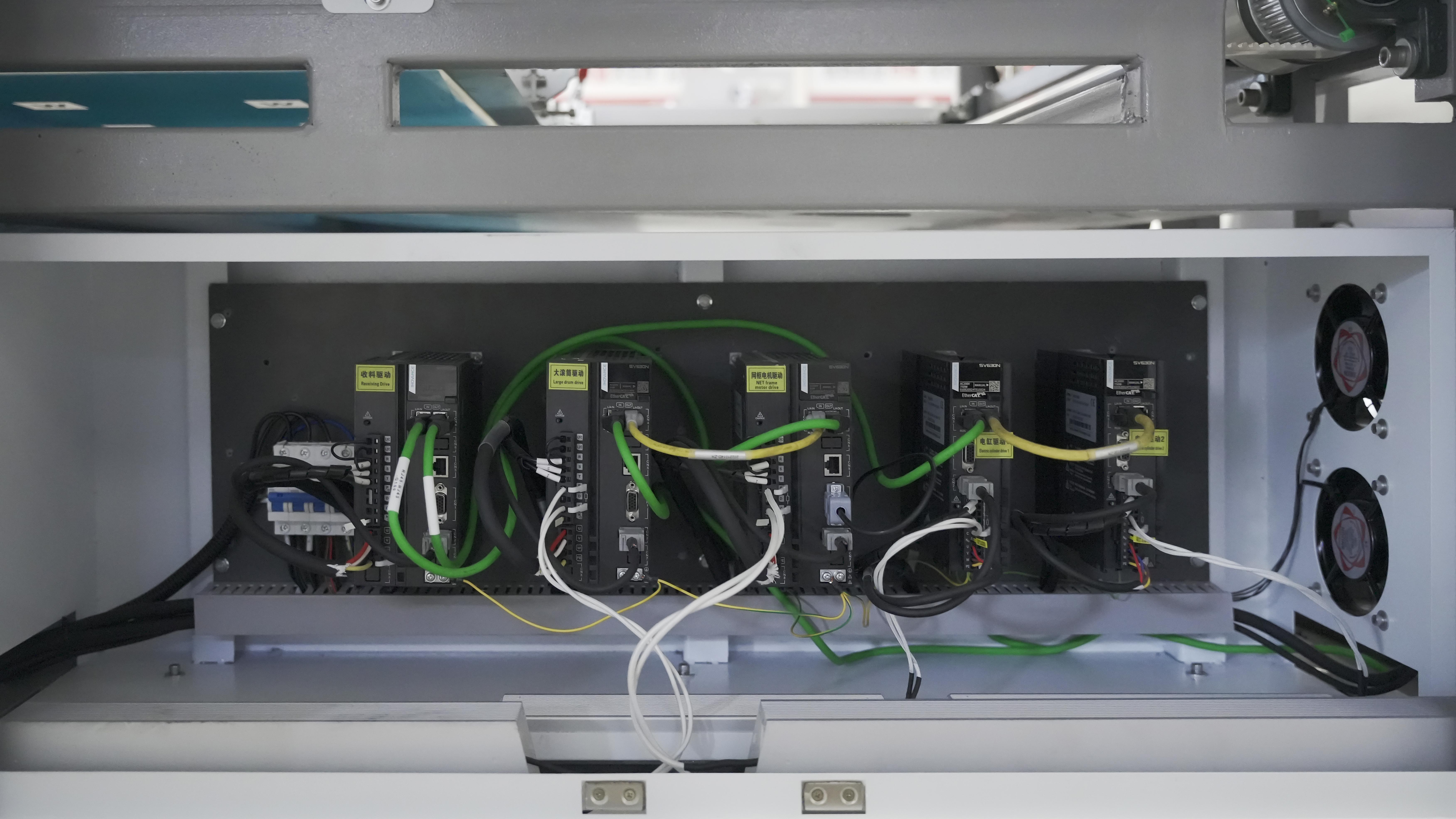
Servo drive assembly. Closed-loop position feedback is what keeps feeding length and sealing position repeatable across a shift rather than drifting with belt wear.
PLC and HMI: fault self-diagnosis and preventive maintenance
The PLC is the industrial computer that runs the machine — reading sensor inputs, executing the control program and commanding motors, valves and actuators in a continuous scan cycle typically completing in 1–10 milliseconds. The HMI is the touch screen through which an operator reads and changes what the PLC is doing.
For maintenance purposes, four HMI functions do the real work:
- Alarm display with plain-language fault descriptions, so a stoppage is diagnosed from an error code rather than from guesswork.
- Recipe management, storing complete machine setups by bag type and size so that a changeover is a one-touch recall rather than a manual re-entry.
- Production logging, showing shift output, downtime and efficiency statistics.
- Maintenance reminders, counting production cycles and flagging when scheduled service is due.
That combination converts a large share of preventive maintenance from a calendar habit into a data-driven trigger. It also supports remote diagnosis: with alarm codes visible on screen and the machine viewable on a phone camera, the documented figure is that Zhengxin engineers resolve more than 80% of issues remotely.
The underlying maintenance schedule is straightforward and inexpensive to follow. Daily: clean fabric dust from rollers, guide bars and photocell lenses; drain water from the compressor tank; wipe the ultrasonic horn and anvil with isopropyl alcohol; test the emergency stop buttons. Weekly: grease chain drives, linear rails, lead screws and bearings; check drive belt tension (5–10 mm deflection at the midpoint); inspect pneumatic hoses for leaks; clean the electrical cabinet air filter. Monthly: inspect the horn for wear, check cutting blade sharpness, and back up PLC parameters and recipes to USB. Quarterly: professional inspection of electrical connections, ultrasonic generator output test, and replacement of worn consumables.
Component sourcing is a related question. Zhengxin machines are built with Siemens, Delta or Mitsubishi PLCs, Omron sensors and NSK bearings, and third-party inspection by SGS, Bureau Veritas or CCIC can be arranged at the buyer's request before shipment.
Energy and cost: servo drives, ink and per-bag economics
Servo-driven models consume 25–30% less total energy than equivalent clutch-motor machines. The reason is architectural rather than incremental: a clutch motor runs at near-constant speed and draws near-constant current regardless of load, because the clutch simply engages and disengages the mechanical load. A servo draws significant current only during acceleration and during the working portion of the cycle, and drops close to zero during idle segments.
Servo control also changes the precision ceiling. With encoder feedback reporting position continuously and the drive correcting error in real time, feeding and sealing positions hold at roughly ±0.5 mm, against a typical drift of ±2–3 mm on open-loop clutch machines as belts wear and voltage fluctuates.
On the cost question, the figures most worth carrying into a business case are these:
| Cost element | Documented range | Notes |
|---|---|---|
| Flexo ink | $3–8 per litre | Covers 500–1,000 m² of print per litre |
| Ink cost per bag, flexo | Below $0.001 | At typical commercial order volumes of 5,000+ bags per design |
| Ink cost per bag, digital | $0.02–0.05 | Digital ink runs $50–200 per litre |
| In-house production cost per bag | $0.02–0.05 | Requires one trained operator per two machines |
| Outsourced finished bag | $0.08–0.15 | Typically with a 5,000–10,000 piece minimum per design |
| Average automated bag making machine price, 2025 | ≈ $29,000 | LP Information market estimate |
The practical reading of these numbers is a volume threshold. In-house production becomes the more economical route above roughly 300,000 bags per month; below about 100,000 bags per month, outsourcing generally remains cheaper once operational overhead is counted. Between those two figures, the decision turns on whether the buyer needs design-change responsiveness — an on-machine change takes about 15 minutes, while an outsourced reorder typically takes two to four weeks — and whether the buyer holds cost-tendered supply contracts where per-bag economics determine the outcome.
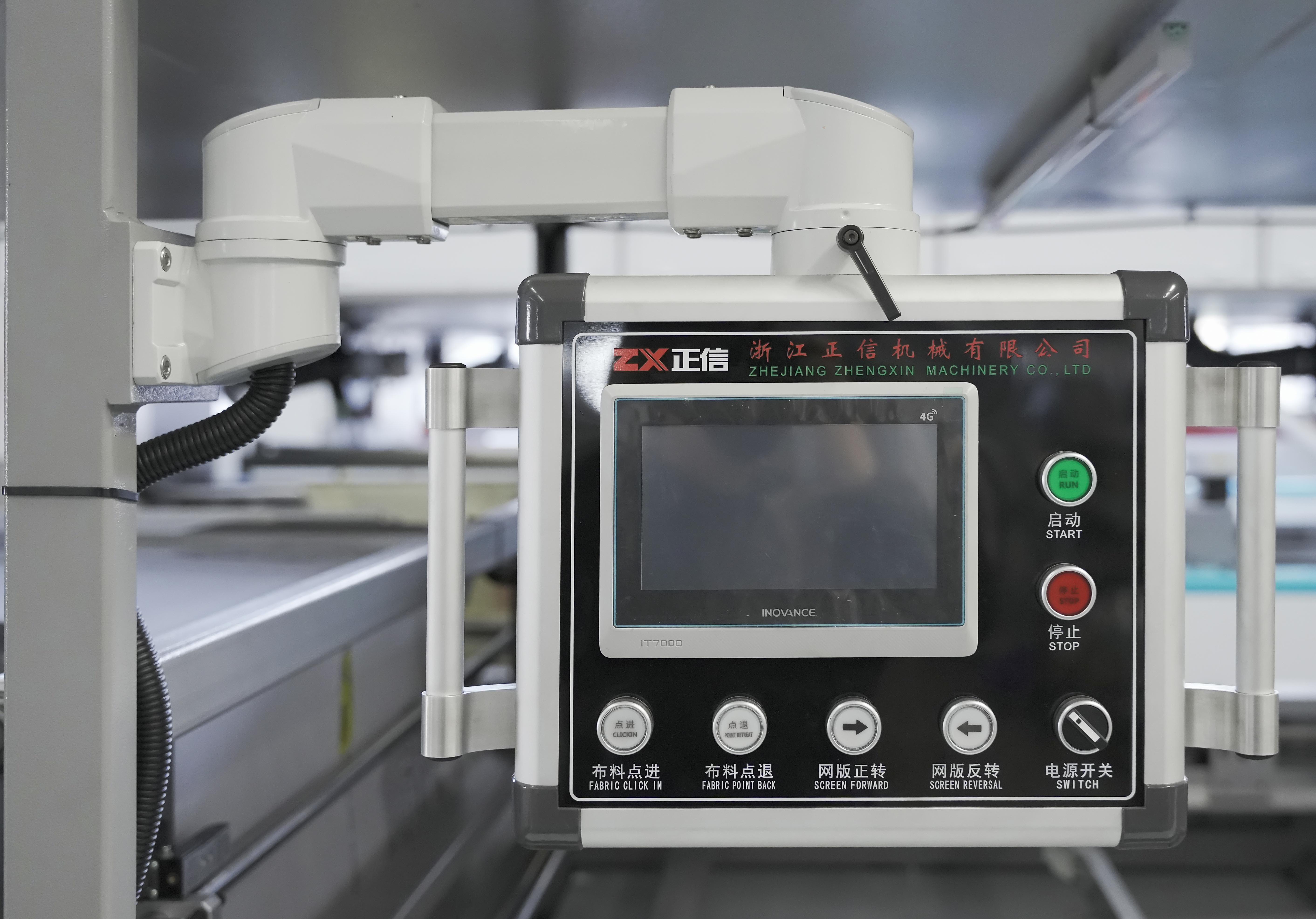
The HMI is where recipes, alarm codes and maintenance counts are read. In practice it is the first place an operator looks when a seal quality issue appears mid-shift.
Where the configuration fits: four production scenarios
Supermarket and grocery chain supply. This is the scenario with the tightest quality definition. The documented requirement is continuous 24/7 operation with fully automated feeding through to finished bag stacking, production speed at or above 100 pcs/min, consistent ultrasonic or heat-sealing weld quality, and a defect rate below 0.5%. Matched equipment typically includes the air compressor, the flexo printing unit, an automatic counting and bundling machine, and a voltage stabiliser.
Food takeaway and delivery. A dust-free workshop at 20–28 °C with positive air pressure, running 24/7 with automated stacking and batch coding. The controlling constraint here is not speed but chemistry: odourless, non-toxic water-based ink printing, which is precisely where ultrasonic sealing and water-based flexo ink matter more than they do in general retail work.
Garment and apparel packaging. A 16-hour double-shift pattern with one to two operators per machine, producing logo-printed garment bags, dust covers and suit covers. The specific requirements are anti-static treated material compatibility, a soft fabric-like handle feel, and a wrinkle-free finished bag surface.
Promotional and corporate gift production. Flexible batch-based production over 8–16 hours with quick job changeover, four-or-more-colour flexo printing, die-cutting, handle attaching and grommet punching. The controlling metric is registration accuracy — ±0.3 mm — plus a premium surface finish for brand-facing work.
Market context: what is driving non-woven capacity
The demand backdrop is well documented. LP Information projects the global non-woven bag making machine market to grow from US$179 million in 2025 to US$733 million by 2032, a CAGR of 22.5% from 2026 to 2032. Dataintelo places Asia-Pacific at a 43.6% revenue share of the bag making machine market in 2025, and the automatic segment at 52.4% of that market — the automation share matters because it is the segment where seal consistency, PLC diagnostics and inline integration are standard rather than optional.
Two upstream signals reinforce the same direction. China Customs reports that China exported 1.52 million tons of nonwovens in 2024, valued at $4.04 billion, a 6.25% increase over 2023. And more than 100 countries have implemented bans or taxes on single-use plastic bags, which converts non-woven shopping bags from a preference into a compliance substitute in those markets.
On the printing side, Grand View Research values the global flexographic printing machine market at USD 17.57 billion in 2024, with a projected CAGR of 9.7% through 2030. That estimate should be read with care — Market Research Future places the 2024 figure at USD 14.95 billion and Fortune Business Insights at USD 19.63 billion for 2025, the spread depending largely on whether the scope covers industrial presses only or all printing equipment. The direction, however, is consistent across sources.
Sources: LP Information; Dataintelo; China Customs; Grand View Research; Market Research Future; Fortune Business Insights.
Comparison with traditional setups — and where integration stops helping
The comparison that matters commercially is not brand against brand but architecture against architecture.
| Dimension | Traditional split setup | Integrated inline setup |
|---|---|---|
| Workflow | Print roll, wind, store, re-thread on bag machine | Feeding, printing, forming, sealing, cutting, counting and stacking in one pass |
| Sealing method | Heat sealing with heated bar; 15–20 minute warm-up | Ultrasonic; no warm-up, power drawn only during the sealing pulse |
| Seal strength reference | Baseline | 15–20% higher peel strength in pull tests |
| Drive | Clutch motor, open loop, ±2–3 mm drift | Servo, closed loop, ≈ ±0.5 mm, 25–30% lower energy consumption |
| Staffing | 3–4 workers per line at 15–20 pcs/min | 1 trained operator per 2 machines, plus 1 technician per 10–15 machines |
| Defect rate reference | 3–5% typical on semi-automatic lines | Below 0.5% on automatic lines |
Three boundaries are worth stating plainly, because they determine whether the integrated approach is the right answer for a given factory.
Thick laminated material remains the weak point of ultrasonic. Above roughly 150 GSM in laminated constructions, heat sealing may still be worth considering — although modern high-power ultrasonic horns handle much of this range well. Buyers whose material mix sits at the very heavy end should verify sealing performance on their own fabric before committing.
Integration amplifies site conditions rather than overriding them. An undersized compressor, wet compressed air, or an unstable three-phase supply will reintroduce seal variance that no machine setting can compensate for. The documented air requirement is 0.6–0.8 MPa held consistently through the weld cycle; pressure that drops mid-cycle is a compressor or tank capacity problem, not a machine problem. This is why a voltage stabiliser and a properly sized screw compressor with a refrigerated dryer are treated as part of the initial investment rather than as accessories.
The energy advantage is relative, not absolute. The 25–30% figure describes servo machines against old clutch-motor machines. It is not a claim about total plant consumption, and servo platforms carry a higher purchase price than the equivalent clutch-driven configuration. The savings show up in operating cost over time, which means the payback case depends on duty hours per day — a factory running single shifts will recover the premium far more slowly than one running three.
Outlook
The direction of travel in non-woven bag production is toward fewer manual transfers and denser instrumentation. The automatic segment already holds just over half the bag making machine market, and the mechanism driving that share is the same in every region: contracts that specify dimensional tolerance and seal consistency cannot be met reliably by manual material handling between stations.
The second shift is in service geography. As capacity moves toward Africa, the Middle East, Southeast Asia and Latin America — the markets that account for the majority of Zhengxin's 60% export share — the differentiator between suppliers narrows to how quickly a fault can be diagnosed and a part can arrive. Zhengxin operates offices in Kenya, Morocco, Egypt, Vietnam, Tanzania, Dubai, Oman, Indonesia and Ethiopia, and its machines carry CE certification covering the Machinery, Low Voltage and EMC Directives, alongside an ISO 9001:2015 certified manufacturing facility — certification positions that matter for customs clearance in the EU, the Middle East, Africa and the 30-plus other markets that accept CE marking.
For buyers, the practical implication is that the evaluation checklist should be weighted toward the questions in this article rather than toward headline speed. Rated output is a number on a datasheet. Seal consistency at the hundred-thousandth bag, a documented installation and training scope, and a fault-diagnosis path that resolves most issues without a flight are what determine whether a line earns its capital back.
FAQ
What causes weak or inconsistent seals on a non-woven bag printing and making line?
Three mechanical causes account for roughly 90% of cases. First, a contaminated ultrasonic horn — melted fabric residue reduces energy transfer, and the fix is cleaning the horn and anvil with isopropyl alcohol and a lint-free cloth. Second, an incorrect or uneven horn-to-anvil gap; for 70 GSM fabric the gap should be 0.3–0.5 mm and even within 0.05 mm across the horn width. Third, an amplitude or speed mismatch after a fabric GSM change or a speed increase; amplitude is raised in 5% steps for thicker fabric, or speed reduced by 10–15%. After adjustment, run 20 test bags and pull-test five — a correct seal tears the fabric rather than peeling apart. If the fault persists, the horn may be worn and require replacement.
Can a non-woven bag printing machine be installed without an engineer on site?
Yes, and this is the normal case. Most installations are completed by the buyer's own team with real-time remote video guidance over WhatsApp or WeChat, and the documented figure is that more than 90% of installations are completed successfully this way. A standard single-machine installation takes one to two working days; complex multi-machine lines take three to five. If remote support proves insufficient, on-site engineer dispatch is available at $100 per day plus airfare and accommodation, with a typical on-site visit running three to five days.
What site preparation is needed before the machine arrives?
Seven items: a level concrete floor with 1.5 m clearance on all sides; a three-phase power supply installed and verified at the correct voltage with a multimeter rather than assumed from the nameplate; an industrial air compressor with air dryer and tank, operational before arrival; a voltage stabiliser wired in; one to two tonnes of PP spunbond fabric at 70–80 GSM for initial production; one to two operators available for training during installation; and basic tools plus a crane or forklift for lifting the machine off the pallet. All Zhengxin industrial machines require three-phase power.
How many operators and technicians does an integrated line need?
The operational guidance for an integrated line is one trained operator per two machines and one technician per 10–15 machines, supported by a two-week training programme. This compares with semi-automatic lines at 15–20 pcs/min, which typically need three to four workers per line. The difference is one of the main reasons automatic lines become cheaper per bag as volume rises, since the labour saving compounds over the machine's service life.
How does PLC-based fault self-diagnosis reduce unplanned downtime?
The PLC executes the control program in a continuous scan cycle that typically completes in 1–10 milliseconds, reading sensor inputs and updating outputs deterministically. Four HMI functions turn that into maintenance value: alarm display with plain-language fault descriptions, recipe management for one-touch changeover recall, production logging of shift output and downtime, and maintenance reminders that count production cycles and flag when service is due. Together these support remote diagnosis, and Zhengxin engineers resolve more than 80% of issues remotely. The PLC platforms used are Siemens, Delta or Mitsubishi, with Omron sensors and NSK bearings.
How much energy does a servo-driven machine save compared with a clutch-motor machine?
Servo-driven models consume 25–30% less total energy than equivalent clutch-motor machines. A clutch motor runs at near-constant speed and draws near-constant current regardless of load, because the clutch only engages and disengages the mechanical load. A servo draws significant current only during acceleration and the working portion of the cycle. The same architecture improves dimensional control — closed-loop encoder feedback holds feeding and sealing positions at roughly ±0.5 mm, against ±2–3 mm of drift typical on open-loop clutch machines. The comparison is relative to older clutch-driven equipment and does not describe absolute plant consumption.
What does printing add to the cost of a non-woven bag?
Flexographic ink costs $3–8 per litre and covers 500–1,000 m² of print per litre, which puts flexo ink cost per bag below $0.001 at commercial order volumes of 5,000 or more bags per design. Digital ink costs $50–200 per litre, giving a per-bag cost of $0.02–0.05 — a gap that dominates the total cost of ownership at production volumes. In-house production cost per bag runs $0.02–0.05, against $0.08–0.15 for outsourced finished bags, with in-house economics generally favouring volumes above roughly 300,000 bags per month and outsourcing below about 100,000 bags per month.
What is the main limitation of a fully integrated inline configuration?
Site conditions. An undersized air compressor, wet compressed air, or an unstable three-phase supply will reintroduce seal variance that no machine setting can compensate for. Air pressure must hold 0.6–0.8 MPa consistently through the weld cycle; pressure that drops mid-cycle indicates compressor or tank capacity is inadequate. A second limitation is material thickness: above roughly 150 GSM in laminated constructions, ultrasonic sealing has less margin and heat sealing may still be worth considering. Third, the servo energy advantage is relative to older clutch-driven machines, and servo platforms carry a higher purchase price, so payback depends on daily duty hours.
Zhengxin publishes its full machine range, specifications and configuration options in a downloadable product brochure: Zhengxin Machinery product brochure (PDF).