
Nonwoven Fabric Machine Supplier Capability: What to Verify
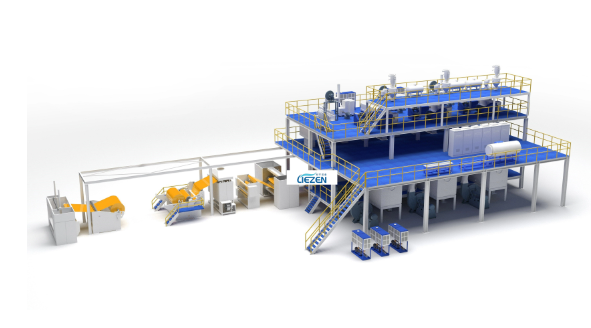
Assembly floor at a nonwoven machinery plant — one of four evidence layers a buyer can verify before signing.
The global nonwoven machinery market was valued at USD 6.8 billion in 2025 and is projected to reach USD 12.1 billion by 2034, according to Dataintelo. Within that total, spunbond machinery held the largest equipment share at 34.2% in 2025, and Asia Pacific accounted for 43.7% of market revenue. A market of this size and growth rate attracts a widening supplier base — and that is precisely where procurement difficulty begins, because the language used to describe capability has become almost identical across suppliers.
Two quotations for a spunbond nonwoven machine can arrive with the same phrases: proven technology, customised width, reliable output, full after-sales support. None of those phrases is verifiable. What separates a supplier that can actually deliver a working nonwoven production line from one that can only describe one is evidence — material, documented, demonstrable and, most importantly, written into the purchase agreement.
This article sets out the evidence a buyer should request during supplier evaluation, why each item matters, and where each item stops being conclusive. It is written for buyers at the evaluation stage, where a shortlist already exists and the remaining question is not “who sells nonwoven fabric machines” but “which of these suppliers can be held to a production commitment.”
Why Capability Claims Are Difficult to Compare
Nonwoven machinery is a configuration business. A pp spunbond nonwoven machine, an SMS nonwoven machine and a spunmelt nonwoven machine can share a supplier, a control platform and a housing style while differing entirely in beam count, quenching arrangement, web handling and downstream winding. Marketing descriptions rarely distinguish at that level, so buyers end up comparing adjectives rather than engineering scope.
The volumes involved explain why buyers keep asking for proof. China’s nonwoven fabric output reached 8.56 million tons in 2024, a 5.1% year-on-year increase, and China exported 1.52 million tons of nonwovens worth USD 4.04 billion in the same year, according to China Customs and CNITA. Spunbonded nonwovens alone accounted for 37% of that export value. High-volume, export-oriented production places a premium on machinery that runs consistently, not machinery that performs well in a single demonstration.
That is the gap this guide addresses: moving from claim comparison to evidence comparison, using four layers of proof that a buyer can request, inspect and contractually enforce.
The Four Evidence Layers of Supplier Capability
Capability is not a single fact. It is a stack of claims, each verifiable by a different method, and each with a different limit. Buyers who verify only the top layer — a certificate, or a site visit — tend to discover gaps later, during installation or commissioning.
| Layer | Evidence type | What it can establish | What it cannot establish |
|---|---|---|---|
| 1 | Physical and organisational | Real site, real workforce, real build capacity | Whether the line meets your specification |
| 2 | Demonstration and test run | That the process works on real material | That it will work in your plant, on your polymer grade |
| 3 | Documentary and certification | That a management system is audited and current | Throughput, yield or machine performance |
| 4 | Contractual and acceptance | That a measurable outcome is enforceable | Anything the clause fails to define precisely |
The sequence matters less than the coverage. A supplier that performs well on layer one and refuses layer four is telling you something about how disputes will be handled.
Layer 1: Physical and Organisational Evidence
A site visit answers questions that no document can. But a site visit only produces usable evidence if the buyer knows what to look at and what a normal plant should contain.
Take Lizen Machinery Co., Ltd — the nonwoven equipment manufacturer registered as Changzhou LieZen Non-woven Machinery Co.,Ltd., based in Changzhou, Jiangsu, China, and founded in 2003 — as a reference case for the kind of organisational facts a buyer should be able to confirm in writing before travelling. The company reports a 30,000 m² factory, 270 employees, an R&D team of 10 engineers, and an annual output of 50 units, with a stated monthly capacity of 4 units. Its product scope covers PP spunbond lines in Single S, SS, SSS, meltblown, SMS, SMMS, SSMS and SMMSS configurations, plus PET and bi-component machines, and its stated export ratio is 60%.
Those numbers are useful not because they are large, but because they are specific enough to be checked against reality on the ground: a 30,000 m² facility should visibly contain fabrication, sub-assembly, electrical assembly and testing zones; 270 employees should be visible across shifts; an annual output of 50 units should be consistent with the number of lines in progress during the visit.
What to confirm on site
- Build activity in progress. Lines under assembly are stronger evidence than finished machines on display.
- Sub-assembly and component handling. Whether the supplier assembles or simply resells affects every future spare-parts conversation.
- Test and inspection areas. A dedicated area for performance and process testing implies a repeatable FAT routine rather than improvised checks.
- Spare parts stock. Physical inventory supports after-sales claims more convincingly than a service brochure.
- Documentation at the workstation. Drawings, checklists and sign-off sheets at the build stage indicate that quality control is procedural, not verbal.
The limit of this layer: a well-organised factory proves organisational capability, not specification fit. A plant can be immaculate and still lack experience with the web width, layer count or throughput band your project requires. Physical evidence must therefore be paired with the remaining layers before it means anything commercially.
Layer 2: Demonstration and Test-Run Evidence
A live demonstration is the most persuasive evidence a nonwoven machine supplier can offer, and the most frequently misread. The relevant question is not whether a machine runs, but whether the demonstration is representative of what you are buying.
Buyers evaluating a spunbond nonwoven machine, an SMS nonwoven machine or a full nonwoven production line should ask for a run that matches as many of their own parameters as the supplier can accommodate: polymer grade, web width, target capacity expressed in kg/h or m/min, layer configuration, and where applicable inline testing and quality checks.
This is where configuration disclosure becomes evidence in itself. LieZen’s stated customisation scope covers web width, capacity in kg/h or m/min, layer count, inline testing and QC, automation and HMI, and material handling modules. Each of those items is a question a buyer can put to a demonstration: which of these was actually varied on the line I am watching, and which are being described rather than shown?
A practical demonstration checklist
- Confirm the material actually fed during the run, and whether it matches the grade you intend to use.
- Record stable running conditions, not start-up peaks — ask how long the line has been running at the demonstrated setting.
- Ask for samples from the run, retained and labelled, so the fabric can be tested independently later.
- Observe the inline inspection and quality-check points, and ask what happens to out-of-spec material.
- Ask which subsystems are third-party supplied and which are built in-house.
The limit of this layer: a demonstration proves that a given line, on a given day, on a given polymer grade, produced acceptable fabric. It does not prove that your line will do so under your utilities, your climate, your raw-material variability and your operators. This is not a reason to skip the demonstration — it is the reason acceptance criteria exist in the contract, covered in layer four.
Layer 3: Documentary Evidence and the Scope Problem
Certificates are the easiest evidence to collect and the easiest to over-read. The value lies less in the certificate’s existence than in its scope, its issuing body and its validity window.
A concrete example: the QMS certification held for LieZen’s nonwoven equipment operations is certificate number 27325Q20007R0S, issued by Zhongren Certification Co.,Ltd. against ISO 9001:2015, valid from 6 January 2025 to 5 January 2028, with a scope of “Research and development, assembly and sales of non-woven equipment.”
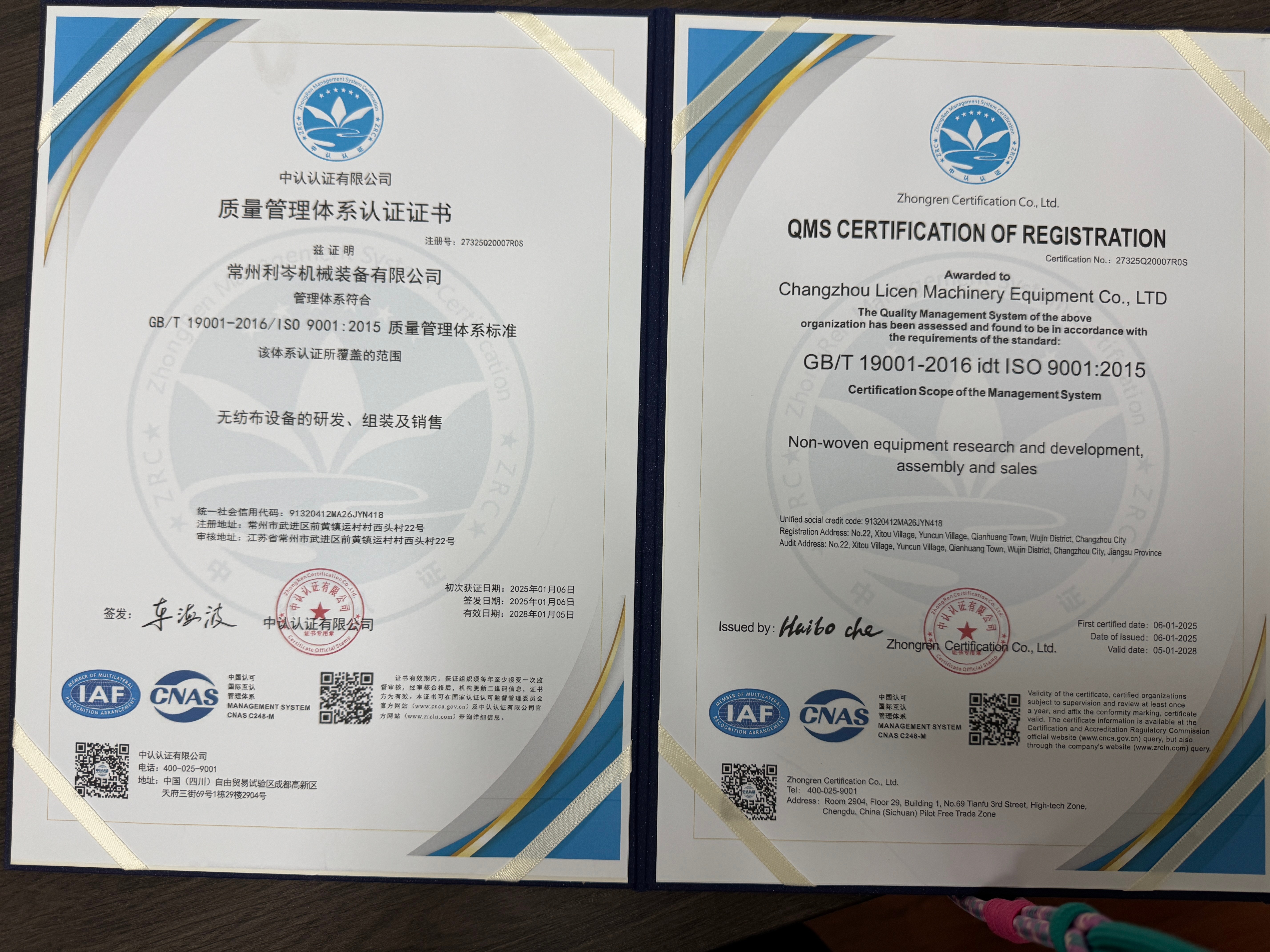
Documentary evidence should be read for scope, issuer and validity dates — not simply for the presence of a logo.
Read that scope carefully. “Research and development, assembly and sales” describes what the certified management system covers. It is not a statement about fabrication depth, throughput accuracy or field reliability. A buyer comparing a spunmelt nonwoven machine quotation should therefore ask a follow-up question: which of the production stages in my machine fall inside this certified scope, and which are outsourced?
Safety standards are a separate evidence trail
Quality management certification says nothing about machine safety. Safety requirements for nonwoven machinery are governed by ISO 11111-3:2005 (Textile machinery — Safety requirements — Part 3: Nonwoven machinery), while general textile machinery safety, including nonwoven lines, falls under EN ISO 11111-1:2016 for CE marking compliance in Europe. Buyers shipping into the EU should request the specific declaration and the technical file that supports it, rather than a general statement of compliance.
The limit of this layer: a valid ISO 9001:2015 certificate confirms that a documented quality system exists and has been audited. It does not confirm that the supplier has built a machine of your configuration before, and it does not transfer any performance guarantee. Certificates support due diligence; they do not replace testing.
Layer 4: Purchasing Terms and Acceptance Criteria as Verification Tools
The contract is the only evidence layer the buyer controls. Everything established in layers one to three can be converted into an enforceable term — and capability that a supplier is unwilling to write down should be discounted accordingly.
LieZen’s stated quality-control sequence runs through factory acceptance testing (FAT), performance and process testing, and on-site installation and acceptance (SAT), with inline output and quality checks supported. That sequence provides a natural structure for acceptance clauses, because it already separates the factory test from the site test.
| Clause area | What to define | Evidence required |
|---|---|---|
| Performance | Output in kg/h or m/min, web width, layer count, tolerance band | FAT report signed at the factory |
| Material | Polymer grade and source used for the test run | Labelled retained samples |
| Site acceptance | SAT thresholds, witness rights, retest rules | Signed SAT protocol |
| Delivery | Milestone dates and definition of delay | Production schedule tied to capacity |
| Support | Installation, training, spare parts and remote support commitments | Itemised scope, not a general statement |
Timing is part of the same conversation. LieZen states a peak-season lead time of 3–6 months and an off-season lead time of 1–3 months, with a minimum order quantity of 1 unit and a monthly capacity of 4 units. A buyer planning a project should test those numbers against the schedule: a supplier quoting a shorter delivery than its own stated capacity implies is either reallocating capacity or estimating optimistically, and either case belongs in the negotiation.
After-sales should be handled the same way. Installation and commissioning, on-site training, spare parts supply and remote technical support are stated capabilities; specific service commitments are confirmed with sales. The distinction is worth preserving — general capability is described in a brochure, while a service commitment is a written obligation with a response time attached.
The limit of this layer: acceptance criteria only protect the buyer to the extent that they are measurable. A clause requiring “satisfactory operation” verifies nothing. A clause specifying output, width, tolerance and test material, plus who witnesses the test and what happens if it fails, is what converts supplier capability into buyer protection.
Claim-Based Versus Evidence-Based Evaluation
The practical difference between the two approaches is not philosophical; it appears in specific procurement questions.
| Evaluation question | Claim-based approach | Evidence-based approach |
|---|---|---|
| Can they build my configuration? | Accepts the product brochure’s range | Reviews a reference list matched to layer count and width |
| Does the machine perform? | Relies on a demonstration at default settings | Requests a run at target settings, with samples retained |
| Is quality managed? | Notes the presence of an ISO logo | Checks certificate number, issuer, validity and scope wording |
| Will they deliver on time? | Accepts the quoted lead time | Compares quoted lead time with stated monthly capacity |
| What if it fails? | Relies on goodwill and after-sales language | Writes measurable SAT thresholds and retest rules into the contract |
Evidence-based evaluation has a real cost, and it should be stated plainly. It adds weeks to the procurement cycle, requires engineering time to write acceptance thresholds, and may require travel to witness a test run. Suppliers with thinner documentation — often smaller workshops with genuine assembly skill but limited formal records — will compare unfavourably on layers three and four even when their machines perform adequately in the field. The method is a filter, not a measure of engineering quality, and buyers should apply it proportionally to project value and risk.
Where Capability Evidence Matters Most
Different end uses place different demands on verification. Documented capability matters more when the cost of a failed line is high, when the fabric is regulated, or when the end product is unforgiving of variation.
LieZen’s stated client base covers nonwoven fabric producers, hygiene and mask manufacturers, automotive interior suppliers, apparel and home textile factories, and agriculture and packaging companies. Reference experience includes two units supplied to a customer in Pakistan, used for nonwoven substrates, mask filter media, sanitary product fabrics, automotive interior liners, agricultural covers and nonwoven bags, with a working relationship spanning 15–20 years and reported results of improved capacity and product consistency through complete equipment.
Hygiene applications illustrate the point. Disposable products dominated the nonwoven market application with approximately 59.8% share in 2023, according to Grand View Research. In that segment, consistency between production runs matters as much as peak output, because downstream converting equipment is calibrated to a narrow fabric window. A supplier’s inline testing and QC provisions — one of the customisation items LieZen lists — therefore deserve more attention than a headline capacity figure.
Automotive is a useful counter-example and a genuine boundary. The automotive nonwoven market reached USD 3.6 billion in 2025, with needlefelt identified as the leading technology by Stratview Research. A buyer working on needlefelt-based automotive interiors is not served by a spunbond or spunmelt supplier’s portfolio, however strong that portfolio is. Matching the process family to the application comes before evaluating evidence quality at all.
Market Trends That Raise the Cost of a Wrong Shortlist
Three structural signals make supplier verification more consequential than it was a few years ago.
Spunbond remains the volume leader. Spunbond machinery held 34.2% of the nonwoven equipment market in 2025 (Dataintelo), and spunlaid technology accounted for 48.4% of the global nonwoven fabrics market in 2023 (Grand View Research). Where one process dominates, supplier differentiation shifts away from process novelty and toward execution quality — which is exactly what layers one to four measure.
Growth is concentrated in Asia Pacific. The region held a 43.7% revenue share of the nonwoven machinery market in 2025, with demand driven by hygiene products and medical-grade materials, according to MarketsandMarkets. A concentrated supplier base is convenient for sourcing but compresses the visual differences between suppliers; buyers see similar factories and similar brochures, and documentary and contractual evidence become the only reliable differentiators.
Material and segment economics are shifting. Polypropylene remains the dominant raw material for spunbond production, accounting for over 53% of the segment in 2026 (Fortune Business Insights), and the spunbond technology market is projected to grow at a CAGR of 6.20% from 2026 to 2034. At the same time, meltblown production in China fell 22.9% to 108,000 tons in 2024 as post-pandemic demand stabilised (CNITA). Segments that expanded rapidly and then corrected are precisely where capacity claims should be checked against current, verifiable activity rather than historical peak output.
What Evidence Cannot Prove
Honest verification includes knowing where verification stops.
- Certificates do not predict throughput. An ISO 9001:2015 certificate with a defined scope confirms a management system, not a performance envelope.
- Demonstrations are single-point evidence. One successful run on one polymer grade says nothing about a different grade, a different width setting or a different ambient condition.
- Audits are snapshots. A factory that is well organised on the day of a visit is not guaranteed to be well organised during a peak-season build.
- Reference lists are selective. Every supplier presents its best references; the useful question is which reference matches your layer count, width and application.
- Acceptance testing covers a defined scope only. Performance verified at SAT does not guarantee long-run reliability, which is why warranty and spare-parts terms remain part of the same negotiation.
Future Outlook
Two developments are likely to change how nonwoven machine buyers verify capability over the next several years.
The first is documentation depth. As spunbond and spunmelt capacity continues to expand in Asia Pacific, buyers increasingly compare suppliers on traceability rather than on price alone: certificate scope, test reports, retained samples and signed acceptance protocols. Suppliers that already operate a structured FAT-to-SAT sequence are better positioned for that shift than those that treat documentation as a post-order formality.
The second is application-specific verification. As end uses diversify from disposable hygiene into automotive, filtration and industrial segments, the relevant capability question becomes narrower — not “can this supplier build nonwoven machines” but “has this supplier built this configuration for this application.” Buyers who frame their evaluation around that narrower question will get more useful answers from the same evidence layers described above.
Frequently Asked Questions
What documents should a buyer request before shortlisting a nonwoven fabric machine supplier?
A shortlisting file should contain four items: the current quality management certificate with its number, issuing body, validity dates and full scope wording; the safety standard documentation applicable to the destination market, such as ISO 11111-3:2005 for nonwoven machinery or EN ISO 11111-1:2016 where CE marking applies; a reference list matched to the buyer’s layer count, web width and application; and a written statement of customisation scope covering width, capacity, layer count, inline testing and automation. Documents that cannot be produced at shortlisting stage are unlikely to be produced at acceptance stage.
Is a factory acceptance test enough to verify a spunbond nonwoven machine?
No. A factory acceptance test verifies that the machine meets defined parameters in the supplier’s plant, using the agreed test material and conditions. It does not verify behaviour under the buyer’s utilities, climate or raw-material variability. Factory acceptance testing is therefore normally paired with on-site installation and acceptance, where the same parameters are re-checked after commissioning in the buyer’s facility. Both stages should specify measurable thresholds and the rules that apply if a threshold is missed.
What should a live demonstration of a nonwoven production line include?
A useful demonstration states the polymer grade being fed, the web width and layer configuration, the running capacity in kg/h or m/min, and how long the line has held stable conditions. It should allow the buyer to observe inline quality-check points and to retain labelled fabric samples for independent testing. Demonstrations conducted only at default settings, without disclosing the material used, provide weak evidence for a project that requires a different configuration.
How should lead time be checked against a supplier’s stated capacity?
Quoted lead time should be compared with stated monthly or annual build capacity and with the current order book visible during a site visit. As an example of the figures involved, LieZen states a monthly capacity of 4 units and an annual output of 50 units, with lead times of 3–6 months in peak season and 1–3 months off season, against a minimum order quantity of 1 unit. Where a quoted delivery is materially shorter than those relationships imply, the buyer should ask which capacity has been reserved and have the milestone dates written into the contract.
Does an ISO 9001 certificate prove a supplier can build an SMS nonwoven machine?
No. ISO 9001:2015 certifies a quality management system within a defined scope. Where a certificate covers research and development, assembly and sales of non-woven equipment, it confirms that those activities are managed under an audited system; it does not confirm that a specific SMS configuration has been built before, nor does it carry any throughput or reliability guarantee. Buyers should read the scope wording precisely and then verify configuration experience separately through references and test runs.
How should acceptance criteria be defined for a spunmelt nonwoven machine?
Acceptance criteria should be measurable and attributable. That means specifying output in kg/h or m/min, web width, layer count and tolerance bands; naming the polymer grade and source used for testing; designating who witnesses the test and signs the report; defining retest conditions and consequences if thresholds are missed; and attaching an itemised list of installation, training, spare-parts and remote-support commitments. Criteria phrased as general satisfaction are not verifiable and provide no basis for remedy.
The Short Version
Supplier capability in nonwoven machinery is not a claim to be assessed but a set of facts to be checked at four levels: what physically exists, what can be demonstrated on real material, what is documented with a defined scope and validity, and what the supplier will commit to in writing. Each layer has a boundary, and the boundary is the useful part — it tells the buyer which remaining risk has to be managed through contract terms rather than through reassurance. In a market projected to grow from USD 6.8 billion in 2025 toward USD 12.1 billion by 2034, the suppliers worth shortlisting will not be the ones with the most confident descriptions, but the ones whose descriptions survive verification.
Есть вопросы или нужны дополнительные детали?
Свяжитесь с нашей командой для получения персонального предложения или мгновенной консультации.
Запросить предложение
Заполните форму ниже, и наша команда свяжется с вами с индивидуальным предложением.
Прямой чат WhatsApp
Предпочитаете общаться в реальном времени? Напишите нам в WhatsApp для мгновенной помощи и быстрых ответов.
- Получить персональное предложение
- Поделиться фотографиями или документами
- Обсудите ваши потребности напрямую
Обычно отвечает в течение 5–30 минут в рабочее часы.