
Nonwoven Mesh Belts for Humid Lines: HY408S, SK604, KJD700
On spunlace and high-humidity spunmelt lines, belt chemistry has become a maintenance decision rather than a consumable detail. Here is where three hydrolysis-resistant forming belts fit — and where they do not.
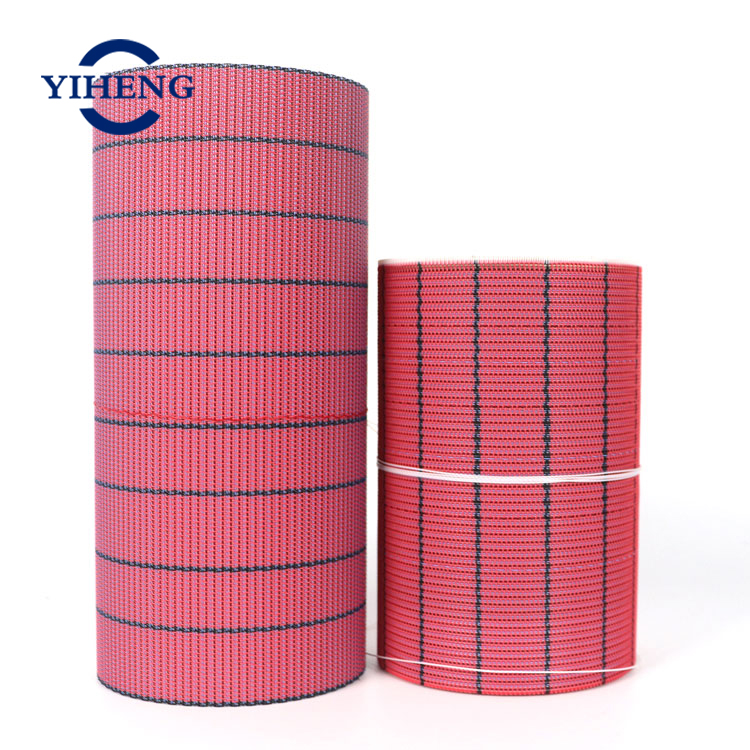
Humidity in a nonwoven plant is an engineering condition, not background detail. On a spunlace line, the forming belt carries the fiber web through high-pressure water impact, extreme humidity and corrosion, and then through rapid dehydration and vacuum suction — repeatedly, in 24/7 cyclic operation. On a spunbond or spunmelt line, the same component runs at high speed in high-temperature and high-electrostatic conditions where precision web formation and precise release are the measurable outputs. In both cases the belt is part of the process envelope, not a passive conveyor.
That is why the failure mode that decides belt economics on wet and humid lines is rarely abrasion alone. It is hydrolysis — the chemical breakdown of polyester filaments under combined moisture and heat — and it changes how a line behaves long before the belt visibly wears out.
Why hydrolysis, not abrasion, sets belt life on humid lines
Polyester mesh is a hydrolysis-sensitive material. Under sustained moisture exposure and elevated temperature, the ester bonds in the polymer chain are attacked, and the practical consequences are dimensional and mechanical rather than cosmetic: tensile strength falls, elongation behaviour changes, the belt gradually loses the dimensional stability that tracking depends on, and stress concentrates at the seam. On a spunlace line, where the belt is continuously exposed to water jetting and drainage, this process runs almost without interruption.
The operating envelope of modern high-performance forming belts makes the problem sharper. Published specifications for high-performance nonwoven forming belts describe line speeds up to 1,000 m/min and operating temperatures up to 180°C. At that level, a belt that resists mechanical wear but not chemistry will still fail on schedule — just for a different reason than the maintenance plan expects.
A second condition compounds the first. The typical nonwoven web formation scenario operates under high speed, high electrostatic environment, high temperature, precision web formation and precise release, with matched equipment that includes the spinneret, quench air system, filament drawing system, lay-down conveyor, calender, through-air dryer, compactor and winder. Requirements listed for that scenario include high tensile strength, heat resistance, anti-static behaviour, high dimensional stability, excellent air permeability, abrasion resistance, chemical resistance, anti-fouling and long service life — a specification set in which hydrolysis resistance and static control are structural, not optional.
The four questions that must be answered before a humid-line belt is ordered
1. Does the filament chemistry resist hydrolysis? The question is not whether a belt is described as durable, but whether anti-hydrolysis filaments are used in the warp and weft of the belt body. A surface treatment or a general abrasion claim does not answer it.
2. Does static control belong to the belt, not to the environment? Anti-static mesh belts are required on high-speed nonwoven lines to manage the static electricity generated during high-velocity air suction. Where static is uncontrolled, the visible symptoms are fabric flipping or clinging at the release point, and the cause is often misdiagnosed as an air-balance problem.
3. Does the seam match the body thickness? Seam quality is a geometric question. A joint that sits proud of the mesh body introduces a periodic thickness step that passes the rollers on every revolution, and that step — not the fabric — becomes the source of vibration and transverse marks at speed.
4. Is air permeability consistent across the belt? Air permeability is the belt's primary selection parameter because it determines how suction distributes the fiber web. Consistency, not only the nominal value, is what keeps fabric weight uniform.
Model-level scenario fit: HY408S, SK604 and KJD700
Henan Yiheng Mesh Belt Industry Co., Ltd. (Yiheng Mesh) is a manufacturer of polyester mesh belts, non-woven mesh belts and forming fabrics based in Henan, China, founded in 2009 and exporting to Asia, Europe and North America. Three of its spunmelt forming belts are built specifically around hydrolysis resistance plus conductive filament systems, but they are not interchangeable. The table below summarises the published specification differences.
| Model | Filament system | Weave / layers | Conductivity | Air permeability | Thickness / weight | Joint |
|---|---|---|---|---|---|---|
| HY408S | Anti-static round PET; 0.50 mm red anti-hydrolysis warp; three-filament hybrid weft (0.70 mm red anti-hydrolysis round, 0.35 mm black round, 0.35 mm blue anti-hydrolysis round) | Above-3 Below-5 / 1.5 layers | 105–106 Ω | 680±30 CFM (127 Pa/20 cm²) | 1.85 mm / 1100 g/m² | Millet-ring or double-pins |
| SK604 | Anti-hydrolysis PET round, conductive PET, carbon fiber PET; 0.50 mm red anti-hydrolysis warp plus 0.50 mm black conductive warp | Above-3 Below-5 / 1.5 layers | 106 Ω | 700±30 CFM | 1.85 mm / 1030 g/m² | Double-pins |
| KJD700 | Anti-hydrolysis PET round, conductive PET, carbon fiber PET; 0.50 mm black anti-hydrolysis warp plus 0.50 mm black conductive warp | Above-4 Below-8 / 1.5 layers | 103–104 Ω | 600±30 CFM | 2.34 mm / 1030 g/m² | Double-pins |
HY408S is the balanced option among the three. Its 1.5-layer, Above-3 Below-5 construction at 1.85 mm and 1100 g/m² combines a red anti-hydrolysis warp filament with a three-filament hybrid weft, and the resulting structure is engineered for a balance between fiber adhesion during formation and clean peelability at the release point — the behaviour that matters most when a line is running fast and the fabric is light. Its conductivity range of 105–106 Ω covers general anti-static control in spunmelt web formation, and it can be supplied with millet-ring or double-pins joints, with 2 cm glue brushing on both welding edges. Dimensional tolerances are stated as ±5 cm in length under 50 m and ±1 cm in width under 5 m, which is the level at which replacement planning can be done without re-tensioning from scratch.
SK604 is the version built for high-speed lines running ultra-soft, thin, low-GSM material. It adds carbon fiber PET to the filament system — the carbon fiber both raises conductivity performance and contributes abrasion resistance — and it is rated at 106 Ω with 700±30 CFM across a 1.85 mm, 1030 g/m² body. The design intent is explicit in the specification: a good balance of adhesion and peelability, suitable for high-speed line operation. That combination is what makes it a reasonable candidate when the production risk is not web formation itself but the release step, where light fabric can float, fold or pick up marks. Edging is offered in melt glue or AB glue, and the joint is double-pins.
KJD700 is the highest-conductivity and heaviest structure of the three, at 103–104 Ω, 2.34 mm thickness and 1030 g/m². Its Above-4 Below-8 weave is described as delivering high adhesion performance, and the model is specified as suitable for two-component and spunlace equipment. In practice this positions it differently from the other two: it is not the general-purpose choice, but the fit where static dissipation is the dominant constraint and where the web needs stronger holding during formation — for example on bi-component (ES) fiber lines and on spunlace equipment where water impact and adhesion demand are both high. Like HY408S, it uses a double-pins joint and 2 cm glue brushing on the welding edges at both sides.
Technical explanation: how filament mix, CFM and seam geometry interact
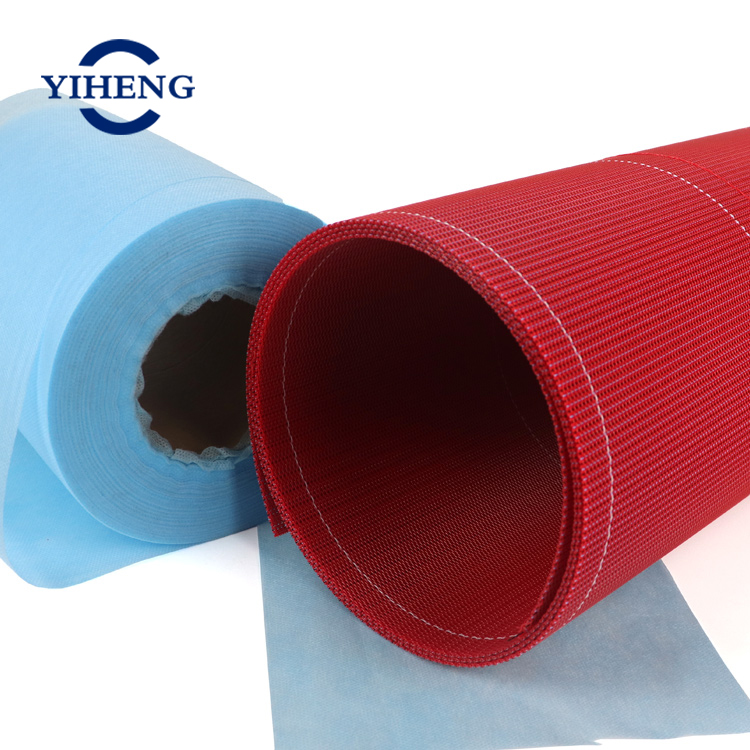
Why conductive and carbon fiber yarns change behaviour
The thin dark lines visible inside an anti-static mesh are not pigment. They are specialized carbon fiber conductive yarns embedded at a controlled ratio during weaving. Their function is active rather than passive: high-speed friction between fabric and mesh generates strong static charges, and the conductive paths reduce surface resistivity so that accumulated charge flows through contact with metal rollers toward the equipment grounding system instead of building up at the release point. That is the mechanism behind fabric sticking and flipping in dry environments — and it is also why anti-static performance is a filament-level property, not a coating that can be applied afterwards.
Why CFM consistency determines fabric uniformity
CFM is the air permeability of the belt: the volume of air passing through a defined area per minute at a given pressure differential. In air-laid and suction-based forming processes the mesh acts as the filter medium for gas–solid separation, and flow through that porous medium is proportional to the pressure gradient. If local CFM is high, higher suction pulls in more fiber clusters; where CFM is low, fiber density drops. The visible result is a fabric with cloudy spots and inconsistent weight. Controlling CFM deviation — Yiheng's heat-setting process targets a ±5% fluctuation range — is therefore a physical precondition for transverse web uniformity, not a quality-control formality.
Why a seam step becomes a vibration source
At line speeds above 600 m/min, a seam that is only 0.2 mm thicker than the mesh body generates impulsive forces of substantial magnitude each time it passes the pre-pressing rollers. Those periodic impacts damage precision bearings and cause momentary pressure fluctuation, which transfers as transverse marks on the fabric. Zero-step seam designs address the cause rather than the symptom: by interlocking seam loops without increasing total thickness, the thickness differential is removed and the pulse source disappears. This is the design logic behind high-low loop and flat seam craftsmanship, and it is why the joint type is listed as a specification rather than an installation detail. HY408S and KJD700 use double-pins (with millet-ring also available on HY408S), while SK604 uses double-pins with melt glue or AB glue edging.
Application evidence from humid and high-speed projects
Specification fit is ultimately tested on a running line. Three supplier-reported projects illustrate how the three models map to different production contexts.
- United States — spunbond on a Reifenhauser nonwoven line. A 200 m² belt supply, completed within six months, using HY408S among the applied models. Reported outcomes were uniform web formation, zero mesh marks, easy release and annual savings of USD 2,000. The project highlights were recorded as a high-speed spunbond belt and a mark-free forming fabric.
- Switzerland — 8 Reicofil RF4 high-speed lines. A one-year project producing baby diaper and sanitary napkin materials, using SK604 and KJD700. Reported outcomes were 10% higher capacity, 5% higher first-grade yield and 30% lower maintenance cost, with wear resistance, dimensional stability and cost-effectiveness listed as the deciding factors.
- Europe — 12 spunlace lines for wet wipes and facial mask substrate. A one-year project supplying a wet wipe and medical dressing producer, reporting 15% higher productivity, 4% higher first-grade yield and 30% lower maintenance cost, with high water permeability, zero mesh marks and hydrolysis resistance as the key attributes. This project drew on the wider spunlace and hot-air range rather than the three models discussed here — a useful reminder that one production site can require several belt families at once.
The spunlace application itself is demanding in a specific way. The belt's role is to carry the fiber web, support hydraulic impact during hydroentanglement, provide rapid dehydration and deliver smooth conveying and traction. The scenario is characterised by high-pressure water impact, extreme humidity and corrosion, rapid dehydration and vacuum suction, and surface-quality requirements including anti-marking, in continuous 24/7 cyclic operation. Matched equipment typically includes the carding machine, web forming section, spunlace jet system, high-pressure water jet pump, vacuum dewatering box, through-air dryer and conveyor system.
Market trend: why humid-line belt specification is tightening
Two market signals explain why hydrolysis resistance has moved up the procurement agenda. First, the downstream market is large and still growing: the global nonwoven fabric market is projected to reach USD 90.8 billion by 2030, a CAGR of 6.2% from 2025 (Smithers). Second, the upstream equipment market is expanding alongside it: the global nonwoven production line market was valued at USD 5.3 billion in 2024 and is projected to reach USD 9.8 billion by 2033 (Dataintelo). Capital equipment growth is what translates into belt demand, because every forming line needs continuous belt replacement.
The technology mix concentrates that demand in exactly the process types where these belts are used. Spunlaid technology — spunbond and meltblown together — held a 48.4% share of the global nonwoven technology market in 2023 (Grand View Research). Spunlaid lines are the high-speed, high-electrostatic, precision-release environment described throughout this article, which is why anti-static and hydrolysis-resistant belts are specified together rather than separately.
Cross-border procurement is also becoming more documentation-driven. Industrial nonwoven mesh belts are commonly classified under HS Code 39269029 or 59100000 depending on material coating and reinforcement, which means buyers increasingly need specification sheets that state material composition, conductivity range and dimensional tolerances in a form that can be attached to a purchase order.
Comparison with traditional solutions — and the limits of hydrolysis resistance
A standard polyester forming belt is not obsolete. On dry, moderate-temperature lines running well below the extremes of the humid-line envelope, standard mesh reaches its intended service cycle, and hydrolysis-resistant construction adds material complexity without a corresponding benefit. The honest trade-off is this: hydrolysis-resistant filament systems are justified where moisture and heat genuinely drive degradation, and the incremental value shrinks as exposure to both decreases.
There are four further boundaries worth stating plainly.
- A belt cannot repair process settings. Hydrolysis resistance has no effect on a CFM mismatch, an unbalanced tension rod, insufficient grounding or an incorrect cooling-air-to-suction ratio. Those problems must be resolved at the line, not at the belt.
- Conductivity grade must match the fabric, not the catalog. KJD700's 103–104 Ω rating targets the most demanding static conditions, including bi-component and spunlace equipment with high adhesion requirements. Specifying a higher conductivity grade than the application requires does not automatically improve results, and on lines where peelability is the limiting factor, HY408S or SK604 may be the better fit.
- Material family must match the process. The three models here are spunmelt constructions. Lines producing bulky, high-loft hot-air bonded fabric are better served by the hot-air airlaid family, where air permeability reaches a different order of magnitude — for example 18 mesh with 19,176 m³/㎡/h or 14 mesh with 19,676 m³/㎡/h. Selecting a spunmelt belt for a hot-air line is a scenario mismatch regardless of filament chemistry.
- Service life is finite and conditional. Yiheng states an expected service life of 3 to 6 months under standard operating conditions, with high-wear-resistant materials outperforming standard polyester mesh. That figure depends on cleaning routine, tracking checks and process parameter settings, and it should be treated as an operating expectation rather than a guarantee.
Future outlook
The direction of travel on humid nonwoven lines is toward combined specification rather than single-attribute purchasing. Anti-static alone was the standard brief several years ago; today the brief increasingly reads as anti-static plus anti-hydrolysis plus seam flatness plus CFM consistency, because lines running hygiene, medical and wipes substrates cannot absorb unplanned downtime.
Compliance documentation is following the same path. Yiheng holds the Food Contact Certificate and is registered under the German Packaging Law (LUCID), supporting compliant delivery into EU markets — relevant for suppliers whose belt is a component of food packaging or hygiene material production. With an export ratio of 62% and markets across Asia, Europe and North America, the company also operates a customization model: OEM/ODM support covering mesh count and opening size, air permeability, belt width and length, material (including anti-static options), thickness, color and edge treatment, with sampling turnaround of as little as three days and a stated lead time of 15 to 30 days. Annual output stands at 150,000 m², with a monthly capacity of 12,800 m².
For buyers at the research and evaluation stage, the practical takeaway is that a humid-line belt decision now has three independent axes — filament chemistry, conductivity grade and airflow/geometry — and the correct answer on one axis tells you nothing about the other two. HY408S, SK604 and KJD700 are three different answers to the same humid-line problem, and the selection between them is driven by fabric weight, static severity and equipment type rather than by a general ranking.
FAQ
Why is hydrolysis resistance treated as mandatory rather than optional on high-humidity nonwoven lines?
Because the operating conditions themselves are corrosive and wet. Spunlace web formation takes place under high-pressure water impact, extreme humidity and corrosion, followed by rapid dehydration and vacuum suction, in continuous 24/7 cyclic operation. Polyester is hydrolysis-sensitive, so degradation proceeds continuously and shows up as reduced dimensional stability, tracking drift and seam stress rather than as predictable surface wear. A belt specified for mechanical durability alone can therefore fail ahead of its expected maintenance cycle.
How do HY408S, SK604 and KJD700 differ in scenario fit?
All three combine anti-hydrolysis filaments with conductive filament systems, but they diverge on three measurable points. HY408S runs at 680±30 CFM with 105–106 Ω conductivity in a 1.85 mm, 1100 g/m² body and is oriented toward balanced adhesion and peelability in general high-speed spunmelt formation. SK604 runs at 700±30 CFM with 106 Ω in a 1.85 mm, 1030 g/m² body and is specified for high-speed lines producing ultra-soft, thin, low-GSM fabric where release behaviour is the critical step. KJD700 runs at 600±30 CFM with 103–104 Ω in a thicker 2.34 mm body with an Above-4 Below-8 weave, and is specified as suitable for two-component and spunlace equipment requiring high adhesion performance.
Why do conductive and carbon fiber filaments matter on high-speed lines?
High-speed friction between the fabric and the mesh generates static charge. Carbon fiber conductive yarns embedded in the weave reduce surface resistivity and create conductive paths, so accumulated charge can flow through contact with metal rollers to the grounding system instead of building up at the release point. Without that dissipation, the visible symptoms are fabric flipping, clinging or irregular release — particularly in dry conditions and on low-GSM fabric.
How does air permeability deviation affect finished fabric quality?
The mesh acts as the filter medium for gas–solid separation during web formation, and airflow through it is proportional to the pressure gradient. Where local air permeability is higher, more fiber clusters are drawn to that area; where it is lower, fiber density falls. The result is transverse weight variation, often described as cloudy spots. Controlling permeability deviation — Yiheng's heat-setting process targets ±5% fluctuation — is therefore a precondition for uniform fabric weight, not only a nominal specification value.
Why does seam thickness matter at high line speeds?
Because the seam passes the rollers on every revolution. At speeds above 600 m/min, a seam that is only 0.2 mm thicker than the mesh body produces periodic impulsive forces that can damage precision bearings and cause momentary pressure fluctuation, which transfers to the fabric as transverse marks. Zero-step seam designs interlock the seam loops without increasing total thickness, removing the pulse source and keeping the belt dynamically balanced.
What service life can be expected from these belts?
Under standard operating conditions, Yiheng states an expected service life of 3 to 6 months, with high-wear-resistant materials outperforming standard polyester mesh. Actual life depends on cleaning routine, tracking checks and process parameter settings; where fiber hanging occurs, adjusting process parameters is part of managing belt life rather than replacing the belt.
Do these belts meet EU and German compliance requirements?
Yiheng holds the Food Contact Certificate and has completed LUCID registration under the German Packaging Law, which supports compliant delivery into EU markets. The company reports an export ratio of 62% with markets in Asia, Europe and North America. Buyers requiring documentation for a specific project should request the relevant certificate directly, since compliance scope depends on the end application.
Yiheng Mesh publishes its forming belt and filter belt portfolio, model-level specification tables and compliance documentation in its downloadable brochure: Yiheng Mesh Belt brochure (PDF). Company information is available at yhfilterbelt.com.