
OCEAN FUTURE Sauna Rooms: What Spec Granularity Reveals About OEM Depth
In sauna room procurement, OEM capability is usually asserted rather than demonstrated. A supplier states that it supports OEM/ODM production, and the buyer is expected to move to a quotation conversation on trust. A more reliable starting point sits in the product line itself: a manufacturer that genuinely supports customized orders tends to publish a range with visible internal logic — several models derived from one platform, differing in power output and enclosure type, while holding a constant control architecture and material menu. That pattern is difficult to fabricate and reasonably easy to audit.
This article reads the sauna room range of OCEAN FUTURE as that kind of evidence. It sets out what the published model data shows, what it implies for hotel, spa and residential orders, and — equally important — where the evidence stops and verification has to begin.
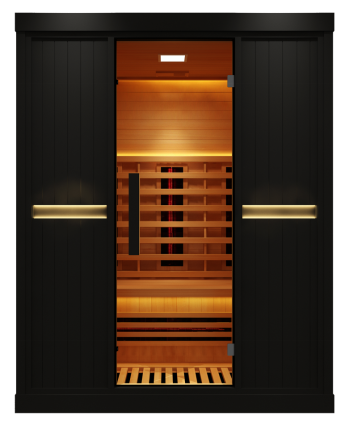
Why spec granularity is the first OEM test
OEM capability, in operational terms, is the ability to produce repeatable variations of a product platform to a buyer's specification, at consistent quality, on an agreed schedule, with documentation that supports the buyer's own compliance and service obligations. It is not a service label; it is a manufacturing structure. Four structural signals can be read from a catalogue before any factory visit takes place.
- Variant logic. Models that clearly derive from a common base — same control unit, same glass specification, same handle and lighting package — rather than a random assembly of unrelated designs.
- A stable electronics layer. One control platform reused across many models means one interface to document, train on, localize and maintain.
- A swappable material and finish menu. If wood species and surface treatment change without forcing a redesign, customization is a configuration exercise rather than a new development project.
- Deliberate step changes. Meaningful jumps in power output or enclosure type indicate engineering intent — a model family built to cover real installation conditions, not a single design repeated with new model numbers.
None of these signals proves certification status, audited capacity or installed performance. They do, however, separate a supplier that engineers variants from one that resells finished cabins. That distinction is the premise for everything that follows.
OCEAN FUTURE at a glance
OCEAN FUTURE is the sauna room and spa brand of FOSHAN GAOMING MUHE JINGCHENG SANITARY WARE CO., LTD., a manufacturer based on Yangxi Road, Yanghe Town, Gaoming, Foshan, Guangdong, China, producing sauna rooms alongside hot tubs, swim spas and cold plunge products. Company-reported figures describe a 50,000 m² factory, 200+ employees, 5,000 sets of annual output, a nine-engineer R&D team and an 85% export ratio, with main markets listed as the USA, Australia, the EU and Germany.
The commercial terms published alongside those figures are relevant to the capability question: OEM/ODM production, a stated customization scope covering all configuration areas, monthly capacity of 400 sets, a minimum order quantity of one set, a 30–40 day lead time, 100% testing, export experience across the EU, USA, Germany, Australia, Spain and France, and remote-guidance after-sales support. The sauna room portfolio itself is described as covering indoor, outdoor, infrared and traditional Finnish formats with OEM support.
The OFS06 range: reading the numbers
The OFS06 series is the clearest single body of evidence in the published range. Across the models listed, the product type, total power, control system, heating element and surface treatment vary in a structured way, while the electronics and materials menu stay constant.
| Model | Type | Total power | Heating configuration | Enclosure / surface |
|---|---|---|---|---|
| OFS06A-2 | Infrared sauna room | 1,600W | Far infrared heating plate | Painted surface |
| OFS06A-3-1 | Infrared sauna room | 1,600W | Far infrared heating plate | Painted surface |
| OFS06A-3-2 | Infrared sauna room | 1,900W | Far infrared heating plate | Painted surface |
| OFS06A-4 | Infrared sauna room | 1,900W | Far infrared heating plate | Painted surface |
| OFS06A-5 | Infrared sauna room | 3,000W | Far infrared heating plate | Painted surface |
| OFS06B-3-2 | Infrared sauna room | 2,300W | Far infrared heating plate + box | Painted surface |
| OFS06B-5 | Infrared sauna room | 3,850W | Far infrared heating plate + box | Painted surface |
| OFS06C-2 | Outdoor sauna room | 2,150W | Far infrared heating plate + box | Outdoor pentroof |
| OFS06C-3-1 | Outdoor sauna room | 2,150W | Far infrared heating plate + box | Outdoor pentroof |
Model data as published for the OFS06 series. All listed models use the AV1 control system, FM/Bluetooth/USB connectivity, two speakers, lamp and colourful light, wood handle and tempered glass, and are available in hemlock, aspen and red cedar.
Three structural facts stand out. First, the power ladder runs from 1,600W on the smallest OFS06A units to 3,850W on OFS06B-5 — a spread wide enough to cover different room volumes and different electrical supply situations without leaving the platform. Second, the heating configuration changes by family: the OFS06A models use a far infrared heating plate, while the OFS06B and OFS06C units use a plate-plus-box arrangement. Third, the enclosure logic is separate from the power logic: OFS06A and OFS06B are indoor infrared rooms with a painted surface, whereas the OFS06C units are outdoor rooms built around an outdoor pentroof.
The power ladder is not the only configuration dimension. The same series carries numbered variant designations across the OFS06B family, from OFS06B-1 through OFS06B-5, which is the pattern a manufacturer produces when a base enclosure is adapted for different heater loads and buyer requirements rather than designed once and frozen.
What the shared platform implies for an OEM order
For a buyer planning a hotel or spa rollout, the value of this structure is not the number of models. It is what the structure collapses into operationally.
A single control layer. The AV1 control system appears across the OFS06 models, alongside FM, Bluetooth and USB connectivity, two speakers, lamp and colourful light, wood handle and tempered glass. For a hospitality operator or a private-label distributor, one control platform means one user interface to translate, one operating procedure to train housekeeping or spa staff on, and one spare-part reference to stock. It also means a smaller documentation surface when a buyer assembles a compliance file.
Two heating architectures under one brand. The range does not stop at infrared. Traditional Finnish models in the OFS05, OFS04 and OFS07 families are built around Harvia stoves — a 3.5kW BC35E on OFS05-2 and an 8kW BC80E on OFS05-1, OFS05-3, OFS04-1 and OFS07-1, with OFS07-1 listed at 8,000W plus 400W at 380V/50Hz. Those models use the MXD2022 control system and ship with wooden bucket, spoon, sandglass, hygrothermograph and a sauna stone set. Maintaining an infrared line at 1,600–3,850W and a stove-based line at 3.5–8kW simultaneously is a meaningful capability signal: it requires two heater supply chains, two electrical safety rationales and two assembly disciplines inside one factory.
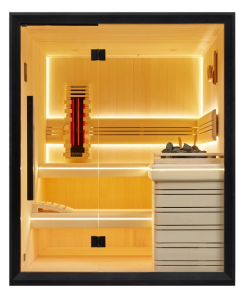
A fixed material menu. Every listed sauna room — infrared, outdoor and traditional — is offered in hemlock, aspen and red cedar. Wood selection is therefore a configuration choice inside the platform rather than a redesign. That matters commercially because wood species is one of the first levers buyers pull when balancing budget against premium positioning, and operationally because the factory must hold three panel inventories and the surface-finishing routines that go with them.
Enclosure as a separate variable. Indoor models carry a painted surface; the OFS06C outdoor units add an outdoor pentroof. The enclosure decision is decoupled from the heater and control decision, which is precisely the kind of modularity that allows an OEM buyer to specify, for example, a compact indoor infrared unit for a guesthouse corridor and a weather-protected outdoor cabin for a resort terrace from the same supplier relationship.
Application fit: from guesthouse to commercial spa
The published application scope for these sauna rooms covers hotel and hospitality projects, guesthouses, wellness and commercial clubs, and spa facilities, alongside private residences. That range implies a specific set of operating conditions rather than a single ideal installation.
Installation environment. The product is designed for indoor or outdoor installation and operates under high-temperature, variable-climate conditions including sun exposure, rain and low temperature, with corrosion resistance required in outdoor settings. Outdoor models additionally need UV resistance, while infrared models are specified with low EMF requirements.
Material and safety requirements. Stated requirements include heat-resistant and non-toxic materials, waterproof and moisture-proof construction, overheat protection and durable thermal insulation. The product must be used together with a control panel and a safety thermometer — a detail worth placing in the buyer's own installation documentation rather than leaving to the end user.
Operating modes. The sauna rooms operate in traditional sauna heater mode, infrared heating mode or dual-mode combined heating, with adjustable temperature control and timer operation. Functionally, this supports therapeutic sweating, muscle relaxation, improved blood circulation, stress relief and temperature therapy — the outcomes that hospitality and wellness operators actually sell to guests.
The practical consequence is that a project can be specified around guest experience rather than around a supplier's single fixed format. A hotel spa that wants a dry infrared session and a steam-style traditional session from the same procurement programme is describing two heater architectures — and the OFS06 and OFS05/OFS07 lines map onto exactly that split.
From product line to production line
Specification breadth only becomes OEM capability when it is backed by production terms. The published figures are 400 sets per month against a 50,000 m² facility and 5,000 sets of annual output, with a minimum order quantity of one set and a 30–40 day lead time. Those numbers describe a structure that can take a single sample unit and a repeat programme from the same line.
Quality control is stated as 100% testing. Customization scope is stated as covering all configuration areas under an OEM/ODM model, supported by a nine-engineer R&D team. After-sales is described as remote guidance, and export experience is listed for the EU, USA, Germany, Australia, Spain and France, consistent with an 85% export ratio.
One reported project illustrates how the range is used in practice: a commercial spa customer in Germany took 20 sets for a spa centre and relaxation application, using the OFS06C-4 outdoor model and OFS06B-5. The reported outcome was stable, safe operation with consistent heating and reliable performance, with low noise, energy efficiency and durable construction cited as the highlights. Service life is described as depending on the using condition — a qualification worth noting, because it signals that lifetime claims are conditional rather than fixed.
Where the evidence stops
Reading a catalogue as capability evidence has a hard boundary, and buyers who skip it tend to discover the gap during commissioning rather than during evaluation.
Model breadth does not equal certification. A well-structured range tells you a supplier can engineer variants. It says nothing about which certificates apply to which model. Certification claims published by OCEAN FUTURE — ETL, CE and FSC among them — are company-reported, and a secondary industry article references CE-EMC compliance tested by Guangzhou STU Hengchuang Testing Service Co., Ltd. covering EN IEC 55014 and EN 61000 series standards. Neither is a substitute for the certificate documents themselves. Buyers should request model-specific certificate files and registry entries, not a logo block.
Room and heater compliance are separate objects. In Europe, EN 18164, published in February 2026, covers the design and construction of sauna rooms, warm-air rooms, steam rooms and soft steam rooms in public facilities. In the US, UL 60335-2-53, published in June 2025, addresses electric sauna heaters. A sauna room project can therefore require two distinct compliance reviews — structure and heater subsystem — and a supplier's dossier should be checked against both scopes rather than treated as a single certificate.
Capacity is self-reported. The 400 sets per month figure and the 50,000 m² factory description originate with the manufacturer. No independent factory audit appears in the public material reviewed, so a serious buyer should treat capacity as a planning assumption to be validated through an audit, a sample order or a reference call.
| Evidence type | What a platform-based range shows | What the buyer must still verify |
|---|---|---|
| Model architecture | Shared control unit, heater variants, material menu, enclosure logic | That the shipped unit matches the published configuration |
| Customization scope | Stated full-scope OEM/ODM with an engineering team | Which changes cost extra and which require re-testing |
| Compliance | Reported ETL / CE / FSC references and a named test lab | Model-specific certificate PDFs and registry entries |
| Capacity and schedule | 400 sets per month, MOQ one set, 30–40 day lead time | Audit result, peak-season loading, custom-order lead time |
| Installed performance | One reported 20-set commercial spa project in Germany | Reference contacts, service records, site inspection |
There is a second limitation that buyers rarely state plainly: a broad range increases the chance of configuration error. Nine OFS06 designations with overlapping power levels — two models at 1,600W, two at 1,900W, two at 2,150W — require a disciplined specification conversation. The buyer, not the catalogue, has to decide which variant matches the room volume, the electrical supply and the guest throughput. Suppliers that publish detailed ranges still depend on the buyer asking precise questions.
Market context: growth, with a caveat on the numbers
Demand conditions support the case for supplier capability investment, provided the figures are read carefully. Technavio estimates the US sauna market at USD 437.4 million in 2025, growing at a CAGR of 6.5% over 2026–2030. Market.us places the global sauna market at USD 860.3 million in 2023, reaching about USD 1,555.3 million by 2033 at a CAGR of 6.1%. Harvia's own estimate puts the global sauna market close to EUR 4 billion in value, with roughly 18 million saunas installed worldwide.
Those figures do not reconcile, and buyers should not average them. The Harvia estimate is a market-value and installed-base view from a market participant; the commercial research figures use different geographies, base years and product definitions. What the three sources do agree on directionally is modest, steady mid-single-digit growth across North America and globally. For a procurement decision, that supports capacity planning and multi-year supply agreements more than it supports any single market-size headline.
Future outlook
Three developments are likely to reshape how sauna room OEM capability is evaluated over the next planning cycle. The first is documentation-led procurement: as standards such as EN 18164 and UL 60335-2-53 become familiar reference points, buyers will ask for model-specific compliance dossiers rather than brand-level certifications, and suppliers with a structured model range will find that structure easier to document model by model. The second is the split between room and heater compliance, which pushes manufacturers to hold expertise across both electrical subsystems and wooden structure. The third is configuration discipline — as ranges widen, the competitive advantage shifts from offering more variants to helping buyers select the right one accurately.
For OCEAN FUTURE, the published range suggests the engineering base for all three is present. Whether it converts into verified supplier status depends on evidence that sits outside a product page: certificate files, audit outcomes and reference sites.
FAQ
What does a sauna room spec sheet actually tell a buyer about OEM capability?
A detailed spec sheet shows whether models derive from a shared platform — one control unit, a consistent electronics package, a fixed material menu and deliberate step changes in power or enclosure type. That pattern indicates a manufacturer can configure variants rather than assemble unrelated cabins. It does not confirm certification, audited capacity or installed performance, which require separate verification.
Can OCEAN FUTURE configure sauna room power output and materials for a specific project?
Published data lists infrared sauna rooms from 1,600W to 3,850W across the OFS06 series and traditional stove-based models at 3.5kW and 8kW, all available in hemlock, aspen and red cedar. The company states OEM/ODM production with customization covering all configuration areas. Buyers should confirm in writing which changes are configuration options and which require re-engineering or re-testing.
Which sauna room models suit hotel and spa projects versus residential use?
The published application scope covers hotel and hospitality projects, guesthouses, wellness and commercial clubs, spa facilities and private residences. Outdoor OFS06C models with a pentroof suit exposed terraces and resort settings, indoor painted-surface infrared models suit guest rooms and home installations, and traditional Harvia-stove models in the OFS05, OFS04 and OFS07 families suit venues offering a Finnish sauna experience.
What should buyers verify beyond the product page before ordering?
Three items carry the most weight: model-specific certificate documents for the exact configuration ordered, an audit or documented evidence of the stated 400 sets per month capacity, and reference contacts for comparable installed projects. Company-reported certification references such as ETL, CE and FSC should be matched to certificate files, and capacity figures should be treated as planning assumptions until independently confirmed.
How do indoor and outdoor sauna room requirements differ?
Outdoor models must be UV-resistant and built for variable climate conditions including sun exposure, rain and low temperature, with corrosion resistance required. Both indoor and outdoor units need heat-resistant and non-toxic materials, waterproof and moisture-proof construction, overheat protection and durable thermal insulation, and infrared models are specified with low EMF requirements. All units must be used with a control panel and safety thermometer.
What are the limits of using model breadth as evidence of supplier strength?
Breadth demonstrates engineering and configuration capability, not verified quality. It does not prove that certificates cover each model, that stated capacity is achievable in peak periods, or that installed units perform as described over time. It also raises specification risk: with overlapping power levels across nine OFS06 designations, the buyer must define room volume, electrical supply and usage intensity precisely rather than selecting the nearest model number.
The OCEAN FUTURE sauna room technical brochure, covering the published model range and configurations, is available for download: OCEAN FUTURE SAUNA ROOM (PDF).
Есть вопросы или нужны дополнительные детали?
Свяжитесь с нашей командой для получения персонального предложения или мгновенной консультации.
Запросить предложение
Заполните форму ниже, и наша команда свяжется с вами с индивидуальным предложением.
Прямой чат WhatsApp
Предпочитаете общаться в реальном времени? Напишите нам в WhatsApp для мгновенной помощи и быстрых ответов.
- Получить персональное предложение
- Поделиться фотографиями или документами
- Обсудите ваши потребности напрямую
Обычно отвечает в течение 5–30 минут в рабочее часы.