
OEM Baby Diapers for Importers: Key Sourcing Constraints
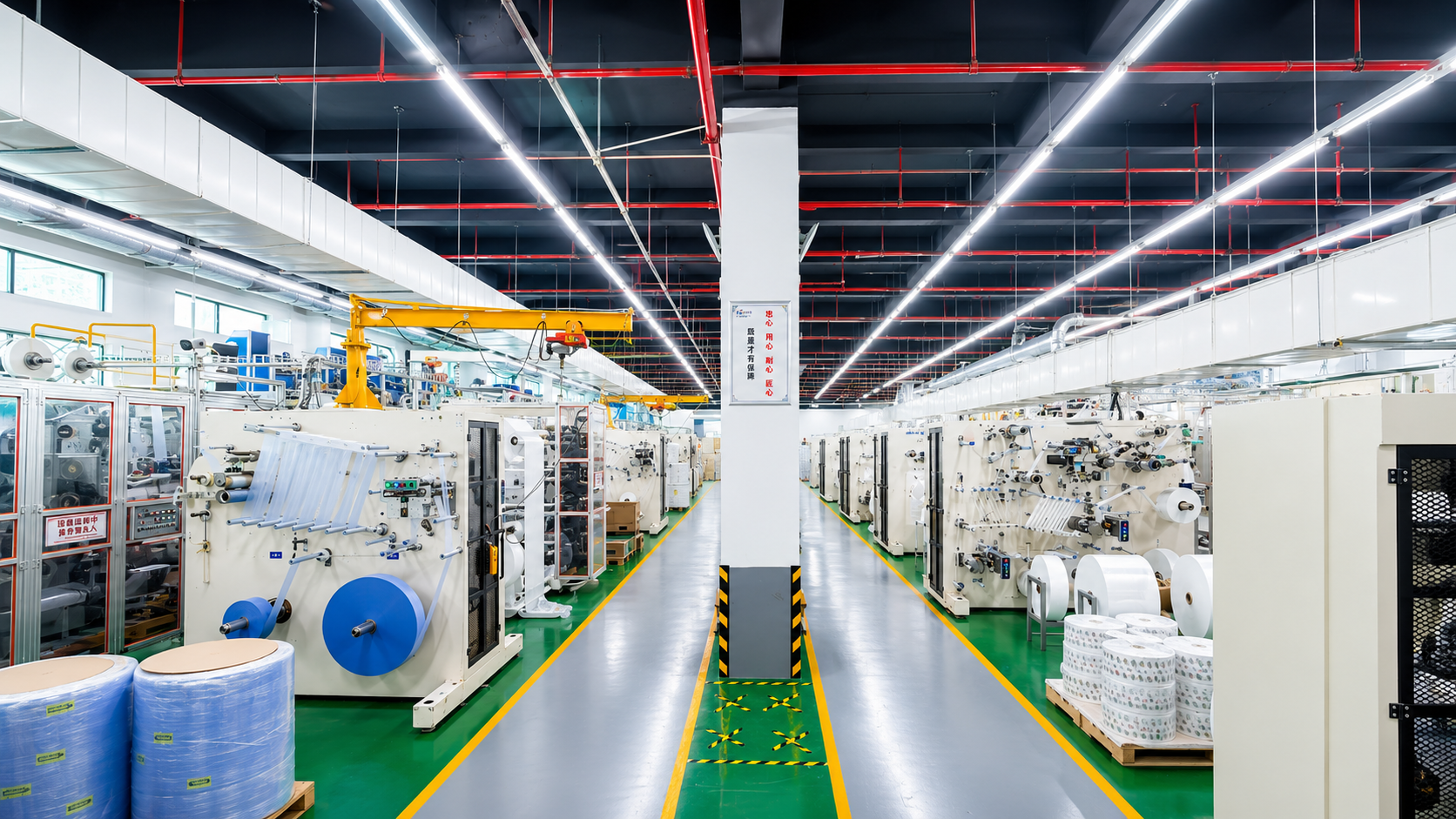
Baby diaper production is concentrated in export-oriented manufacturing clusters. Fujian Jiayue Sanitary Products Co., Ltd. operates a self-owned factory in Quanzhou, Fujian, China.
Baby diaper sourcing becomes a constraint problem before it becomes a price problem. The global baby diaper market was valued at USD 83.3 billion in 2025 (Grand View Research, June 2026), and Asia Pacific accounted for 61.92% of the global diaper market that year (Fortune Business Insights, September 2026). For an importer building a private-label line, market scale does not answer the operational question: which variables — size matrix, absorbency target, core structure, backsheet, closure format, artwork, pack count, certification scope, MOQ and lead time — must be fixed before two supplier quotations can be compared on equal terms? This industry reference maps those constraints for importers and distributors evaluating OEM baby diaper supply, using specification, certification and capacity information published by manufacturer Fujian Jiayue Sanitary Products Co., Ltd. and its Yibero baby diaper brand.
Why OEM baby diaper sourcing is a constraint problem first
An OEM baby diaper is not one product; it is a configuration. Absorbency target, unit weight, absorbent-core structure, topsheet, backsheet, closure system and product format interlock with each other. Raising an absorbency target usually changes core composition and unit weight, which then changes the price band, the packaging volume and the number of units that fit into a container. Importers who request quotations before fixing a size matrix and a specification commonly receive numbers that cannot be compared, because each supplier is quoting a different configuration.
The opportunity sits on the supply side. Fujian province's baby diaper export value reached CNY 8.74 billion in 2024, according to customs data reported in 2025, reflecting the concentration of diaper manufacturing and export infrastructure in that region. Supply density makes capacity easier to find; it does not make suppliers easier to compare. Comparison only becomes possible when the constraint set is defined, documented and approved.
Format, size and absorbent core: what the specification actually fixes
Yibero Premium Quality Ultra Cloudy Baby Diapers are tape-style disposable baby diapers supplied as an OEM/ODM item by Fujian Jiayue Sanitary Products Co., Ltd., a hygiene and personal-care product supplier based in Quanzhou, Fujian, China, established in 2016. Under an OEM or private-label agreement, the specification, graphics and packaging are set for the buyer's brand rather than sold under the supplier's brand.
Format is the first constraint. The Yibero baby diaper line is offered in a tape-style disposable format, while the manufacturer's wider portfolio also includes baby pull-up pants. The trade-off is functional rather than promotional: tape-style diapers are designed for caregiver-assisted changes, especially for younger babies who spend more time lying down, while pull-up pants are worn like underwear and are generally more convenient for crawling or walking babies. Importers typically allocate a size range between the two formats rather than choosing one, and that allocation depends on the target market's age structure, retail channel and changing habits.
Size, weight and absorbency form the second constraint layer. The published specification for Yibero Premium Quality Ultra Cloudy Baby Diapers lists four sizes with matched dimensions, baby-weight ranges, reference absorbency values and unit weights.
| Size | Dimensions (mm) | Reference baby weight | Reference absorbency | Unit weight |
|---|---|---|---|---|
| S | 400 × 320 | 4–8 kg | 500 ml | 26 g |
| M | 450 × 320 | 6–11 kg | 600 ml | 29 g |
| L | 500 × 340 | 9–14 kg | 700 ml | 33 g |
| XL | 540 × 340 | 12–17 kg | 800 ml | 35 g |
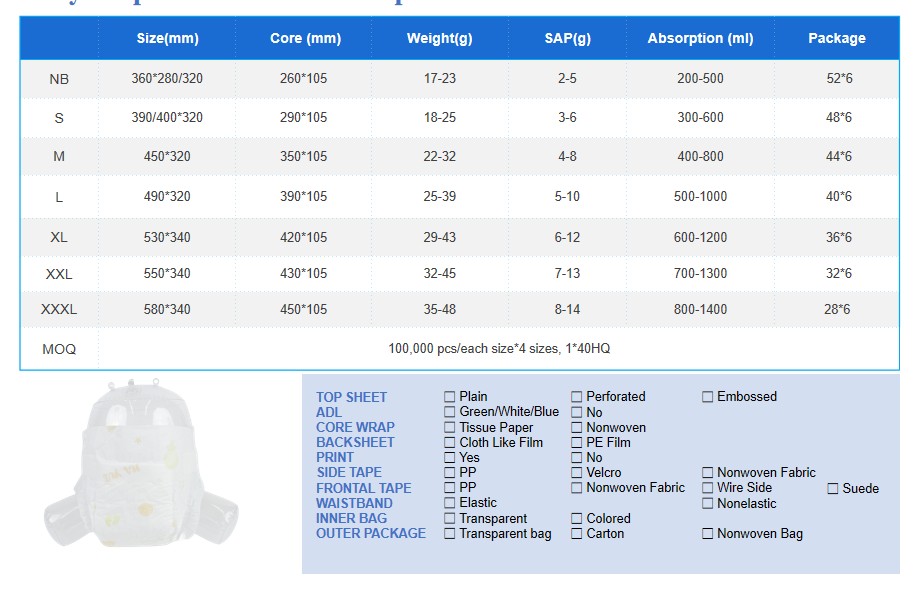
Reference specification for Yibero Premium Quality Ultra Cloudy Baby Diapers, sizes S to XL. Final configuration is confirmed in the signed specification and the approved sample.
Shelf life is listed as five years under recommended storage conditions. Two points matter for importers comparing suppliers. First, these absorbency figures are reference values in the product specification; the final configuration is confirmed in the signed specification and the approved sample. Second, unit weight and absorbency move together, so a size-mix decision is also a freight and cost decision: heavier configurations within the same size range reduce the number of units per container.
Absorbent-core structure is the third constraint. The standard construction uses a soft topsheet, an absorbent core containing imported SAP and fluff pulp, reusable magic tape, a nonwoven frontal tape, an elastic waistband and a cloth-like breathable backsheet. Jiayue offers both a fluff pulp and SAP core and an ultra-thin SAP paper core for selected diaper products. There is no universal performance advantage between the two core types; buyers should compare thickness, target absorbency, product weight, fit, material configuration and test results against the approved specification and the approved sample under the same conditions. That comparison belongs at sample stage, not after a production order has been placed.
Certification and documentation constraints that affect market access
Certification is where a sourcing decision meets a regulatory one. Fujian Jiayue Sanitary Products Co., Ltd. holds an ISO 9001 Quality Management System certificate (certificate number NOA2314690), issued by NOA Testing & Certification Group Ltd. to the standard GB/T 19001-2016 / ISO 9001:2015 on 2023-12-12 and valid until 2026-12-11. Its documented scope covers the sales of sanitary products, maternal and infant products and Class I medical devices.
The company also holds an ISO 13485 Medical Devices Quality Management System certificate (certificate number NOA2314356), issued by NOA Testing & Certification Group Ltd. to the standard GB/T 42061-2022 / ISO 13485:2016 on 2023-12-06 and valid until 2026-12-05. Within the certificate record, this ISO 13485 certification is associated with the Ultra Thick Yibero Adult Women Diapers product, and its scope is limited to Class I medical device sales. That distinction is exactly the type of constraint importers should read carefully: a management-system certificate supports a defined activity inside a defined scope, and the scope wording — not the certificate logo — determines whether the document is relevant to a specific SKU and a specific sales activity.
For the European Union market, the baby diaper product is covered by a CE Declaration of Conformity - Baby Diapers (certification number CE/PPE-JY-01). It is an EU Declaration of Conformity under PPE Category I, self-declared by Fujian Jiayue Sanitary Products Co., Ltd., with SUNGO Europe B.V. named as the EU representative. The stated standard is Regulation (EU) 2016/425 on Personal Protective Equipment, Module A according to Annex IV. The issue date is 2025-05-15 and no expiry date is recorded. The declared scope covers baby diapers in sizes NB, S, M, L, XL, XXL, XXXL, XXXXL and XXXXXL, with lengths of 36–58 cm and widths of 28–45.5 cm.
Importers should note the nature of that route. A Category I self-declaration is a supplier declaration process rather than a third-party product certification, and it applies within its declared product and market scope. Importers remain responsible for confirming that their specific product, claims, labelling and destination market fall within the applicable requirements. Beyond the declaration itself, selected products may be supported by CE declarations of conformity, SGS test reports and other compliance documents according to the applicable product, destination market and order requirements.
Expiry dates add a practical timing constraint. Both management-system certificates carry expiry dates in December 2026, so buyers reviewing supplier files in the second half of 2026 should confirm current renewal status rather than relying on a certificate copy alone. The supplier also supports artwork and packaging coordination, export documentation and shipment planning, which matters for importers who need the document set to move together with the shipment.
Private-label packaging: where the buyer's brand enters the specification
Packaging is often treated as a design task; in OEM baby diapers it is a production constraint. Customization offered by Jiayue covers graphics, printed bags and cartons, pack count and size mix, in addition to product size and weight, absorbency target, SAP/fluff-pulp or composite core, hot-air or spunbond nonwoven, cloth-like backsheet, tape or pull-up format, 3D leak guards, wetness indicator and waistband.
For an importer, the sequence matters more than the option list. Target-market compliance, label language, performance specification, pack count and artwork are typically confirmed before mass production, and the approved sample and signed specification become the reference documents for the order. A late artwork change is not a design change; it is a production-schedule change, and it moves the 30–45 day production window.
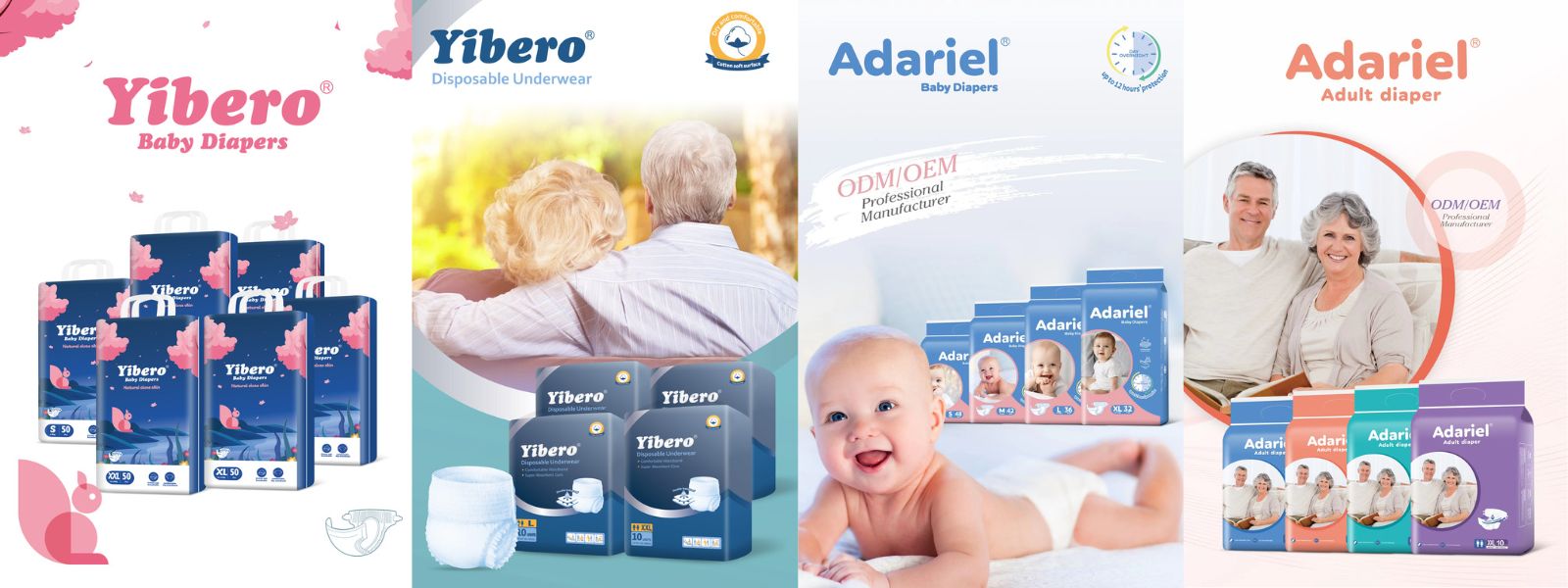
Private-label programs can cover graphics, printed bags and cartons, pack count and size mix.
MOQ, lead time and capacity: what can and cannot be confirmed in advance
Commercial terms in OEM diaper supply are configuration-dependent rather than fixed. Ready-to-ship products may support lower MOQ, while OEM order MOQ depends on the product, the size mix, materials, packaging and customization requirements; final MOQ is confirmed in the quotation. Typical production lead time is approximately 30–45 days, subject to sample, artwork, packaging and specification approval. Final capacity, MOQ, lead time, testing requirements and payment terms are confirmed in the quotation, the approved sample and the sales contract.
Capacity claims require the same discipline. Jiayue states that its self-owned factory, Quanzhou Jiarun Paper Industry Co., Ltd., supports monthly production and shipment of more than 100 × 40HQ containers, and that the facility covers approximately 20,000 square meters. Company-published materials describe baby diaper line speeds in the range of 560–700 pcs/min. Because those two figures appear in different company materials for the same lines, sustained throughput is better confirmed during a trial production run than accepted from a single published number. That is not a criticism of one supplier; it is a general rule for importers assessing any manufacturer's capacity claim.
Quality control is defined per order rather than as a generic promise. The order-specific QC plan covers specification review, pre-production sample approval, in-process checks and pre-shipment inspection, and the test method, sampling level and acceptance criteria must be agreed in the contract. For importers, the practical consequence is that the contract and the approved sample carry more weight than the inspection itself: without agreed acceptance criteria, an inspection has no benchmark.
Application fit: where an OEM baby diaper program is used
OEM/ODM baby diaper and baby pull-up pants programs are used by importers, distributors, brand owners and retail channels to build local private-label lines for wholesale, retail and e-commerce. The product is designed for household daily indoor use at normal ambient temperatures, as a single-use item replaced frequently through the day, and stored and used according to the packaging instructions.
The commercial pattern described in the manufacturer's anonymized references is staged. A private-label baby diaper importer and distributor started with a trial container and progressed to repeat orders, building a local private-label line for wholesale and retail channels, with support covering product specification and absorbency adjustment, packaging and artwork coordination, size-mix planning, sampling, export documentation and repeat-order handling. Jiayue states that it serves more than five long-term OEM customers across multiple overseas markets, and that some of those clients developed from initial orders into established local brands with scaled repeat orders. Customer names, countries and order volumes are not publicly disclosed, so these descriptions function as programme examples rather than independently verifiable references.
Production and export scale provide context for the programme model. Company-provided information lists annual output of more than 500 million pieces, an export ratio of 90%, and customers in more than 70 countries, with export markets spanning Southeast Asia, Africa, Europe, the Middle East, East Asia, North America and South America. The in-house R&D and technical support team includes eight engineers covering material selection, absorbent-core design, product development, sampling, specification adjustment and OEM/ODM technical support.
Market context: cluster supply and cost structure
Three market signals are relevant to importers setting a sourcing strategy. The global baby diaper market was valued at USD 83.3 billion in 2025 (Grand View Research, June 2026). Asia Pacific held 61.92% of the global diaper market in 2025 (Fortune Business Insights, September 2026). Fujian province's baby diaper exports reached CNY 8.74 billion in 2024, based on customs data reported in 2025.
Cost structure explains why the constraint discussion matters commercially. Company-published materials estimate that raw materials account for 78–85% of the ex-factory price of diapers. If that estimate is broadly representative of how quoted price bands move, then absorbency target, SAP content, core structure, topsheet and backsheet selection influence the price band far more than branding or packaging. An importer who specifies absorbency precisely and negotiates against a fixed configuration is in a stronger position to compare offers than one who negotiates a headline price against an undefined specification.
OEM/private-label supply compared with ready-made wholesale
Importers entering the category usually choose between buying ready-made product from a wholesale source and commissioning a private-label program. The two routes carry different constraint profiles.
| Decision factor | Ready-made / stock wholesale | OEM / private-label program |
|---|---|---|
| Product configuration | Fixed to the supplier's existing specification | Size matrix, absorbency target, core structure, backsheet and format confirmed in a specification |
| Branding and packaging | Supplier brand or generic presentation | Custom graphics, printed bags and cartons, pack count and size mix |
| Minimum order | Often lower, subject to availability | Depends on product, size mix, materials, packaging and customization; confirmed in the quotation |
| Lead time | Shorter, subject to stock availability | Typically 30–45 days, subject to sample, artwork, packaging and specification approval |
| Documentation | Supplier's standard document set | Compliance and export documents selected by product, destination market and order requirements |
| Buyer control | Limited to selecting from available stock | Higher, but requires specification, sample and artwork approval |
The OEM route is not the right choice for every importer, and its limits are specific. It requires the buyer to approve a specification and an artwork file before production, which adds preparation time and shifts responsibility for label accuracy and market compliance onto the buyer's own market knowledge. MOQ is not a single published number; it varies with size mix, materials, packaging and customization. Certification scopes are defined and limited — the ISO 13485 scope is limited to Class I medical device sales, and the baby diaper CE declaration is a Category I self-declaration — so no single document should be treated as blanket market clearance. Reference absorbency values are specification figures that require sample validation. For an importer testing demand with minimal commitment, ready-made or ready-to-ship products that may support lower MOQ are usually the more rational first step, with a private-label program following once the size mix and specification are proven in the market.
A pre-order verification checklist for importers
- Legal entity and factory relationship. Confirm the supplier entity and its relationship to the production site, for example Quanzhou Jiarun Paper Industry Co., Ltd., described as the self-owned factory behind the Yibero baby diaper line.
- Certificate scope and validity. Match each certificate's scope statement to the exact SKU, activity and destination market, and check current validity dates (ISO 9001 to 2026-12-11; ISO 13485 to 2026-12-05).
- Size matrix. Confirm dimensions, baby-weight ranges, reference absorbency and unit weight per size against target-market requirements.
- Core and material configuration. Decide between a fluff pulp and SAP core and an ultra-thin SAP paper core on the basis of sample comparison under identical conditions.
- Packaging. Confirm graphics, pack count, size mix, label language and printed bag or carton artwork before production starts.
- Commercial terms. Confirm MOQ, lead time, payment terms and Incoterm basis in the quotation, not in general correspondence.
- Quality plan. Agree test method, sampling level and acceptance criteria, and schedule pre-shipment inspection against those criteria.
- Export documents. Confirm which compliance and export documents are provided for the destination market and the specific order.
Future outlook: documentation-led sourcing
Two shifts are likely to shape OEM baby diaper sourcing over the coming planning cycle. The first is documentation-led supplier selection. Importers increasingly request scope-level certification evidence, batch-linked test documentation and audit access rather than brand-level claims, because that is what their own import and retail compliance processes require. The second is configuration-led purchasing. As absorbency targets, material choices and pack architecture become the dominant cost variables, importers who lock the specification early through sampling and an approved specification reduce the risk of re-negotiation at production stage.
For suppliers, the differentiator shifts from capacity claims to the ability to execute a confirmed specification repeatably, which is precisely what the OEM/ODM model is designed to test. Importers evaluating long-term supply should therefore treat the first trial container as a capability test: sample accuracy, documentation completeness, lead-time adherence and repeat-order consistency are the signals that predict whether a second order is worth placing.
FAQ
What size range and absorbency should importers expect from an OEM baby diaper line?
Yibero Premium Quality Ultra Cloudy Baby Diapers are tape-style disposable baby diapers available in sizes S, M, L and XL, with dimensions of 400 × 320, 450 × 320, 500 × 340 and 540 × 340 mm and reference baby-weight ranges of 4–8, 6–11, 9–14 and 12–17 kg. Reference absorbency values are 500, 600, 700 and 800 ml respectively, and unit weights are 26, 29, 33 and 35 g. Shelf life is listed as five years. These are reference figures from the product specification; the final configuration is confirmed in the signed specification and the approved sample, which is also where absorbency and fit are validated.
Which certifications apply to OEM baby diapers, and what do their scopes cover?
Fujian Jiayue Sanitary Products Co., Ltd. holds ISO 9001 (certificate number NOA2314690, GB/T 19001-2016 / ISO 9001:2015, issued 2023-12-12, valid until 2026-12-11), with a scope covering sales of sanitary products, maternal and infant products and Class I medical devices, and ISO 13485 (certificate number NOA2314356, GB/T 42061-2022 / ISO 13485:2016, issued 2023-12-06, valid until 2026-12-05), with a scope limited to Class I medical device sales. A CE Declaration of Conformity for baby diapers (CE/PPE-JY-01) applies to the European Union market, is self-declared under Regulation (EU) 2016/425 as PPE Category I, names SUNGO Europe B.V. as EU representative, was issued on 2025-05-15 and has no recorded expiry date. Selected products may additionally be supported by SGS test reports and other compliance documents depending on the product, destination market and order requirements.
What determines MOQ and lead time for a private-label order?
Ready-to-ship products may support lower MOQ, while OEM order MOQ depends on the product, size mix, materials, packaging and customization requirements, and is confirmed in the quotation. Typical production lead time is approximately 30–45 days, subject to sample, artwork, packaging and specification approval. Final capacity, MOQ, lead time, testing requirements and payment terms are confirmed in the quotation, the approved sample and the sales contract.
Can packaging and artwork be customized for a private-label brand?
Yes. Customization can cover graphics, printed bags and cartons, pack count and size mix, in addition to product size and weight, absorbency target, SAP/fluff-pulp or composite core, hot-air or spunbond nonwoven, cloth-like breathable backsheet, tape or pull-up format, 3D leak guards, wetness indicator and waistband. Artwork and packaging coordination support is provided. Target-market compliance, label language, performance specification, pack count and artwork are typically confirmed before mass production, with sample approval and pre-shipment inspection as the control points.
What export and compliance documents are involved?
Support covers specification and material selection, packaging and artwork coordination, sampling, export-document preparation, shipment coordination and post-delivery issue handling according to the contract. Which compliance documents are supplied — for example a CE declaration of conformity, SGS test reports or other documents — depends on the applicable product, the destination market and the order requirements. Because certificate scopes are defined and limited, the relevant document set should be confirmed against the specific SKU and market before the order is placed.
What cannot be confirmed without sampling?
Absorbency and fit outcomes depend on the approved configuration. Reference absorbency values such as 500–800 ml across sizes S to XL are specification references rather than guaranteed field results, and there is no universal performance advantage between a fluff pulp and SAP core and an ultra-thin SAP paper core. Buyers should compare thickness, target absorbency, product weight, fit, material configuration and test results against the approved specification and the approved sample under the same conditions. Order-specific quality control also requires the test method, sampling level and acceptance criteria to be agreed in the contract.
The 2026 JIAYUE product catalog, covering baby diapers, baby pull-up pants and related hygiene products, is available for download: JIAYUE Product Catalog 2026.
Есть вопросы или нужны дополнительные детали?
Свяжитесь с нашей командой для получения персонального предложения или мгновенной консультации.
Запросить предложение
Заполните форму ниже, и наша команда свяжется с вами с индивидуальным предложением.
Прямой чат WhatsApp
Предпочитаете общаться в реальном времени? Напишите нам в WhatsApp для мгновенной помощи и быстрых ответов.
- Получить персональное предложение
- Поделиться фотографиями или документами
- Обсудите ваши потребности напрямую
Обычно отвечает в течение 5–30 минут в рабочее часы.