
OEM Glass Beads for Road Marking: A Buyer’s Capability Checklist
Glass beads are a functional component of road marking systems, but the sourcing decision is often treated as a commodity purchase. Road marking engineering companies and traffic safety manufacturers are increasingly moving from buying standard imported bags to requesting private-label production and tailored specifications. That shift makes supplier capability—not just price—the central procurement question.
This article examines the OEM glass bead capability of LangFang Dylan Technology Co., Ltd. (Dylan Tech), a China-based manufacturer and supplier of raw materials for the road safety industry. It covers production capacity, customization, quality control, standards, application evidence, and the practical limits buyers should understand before committing to an OEM program.
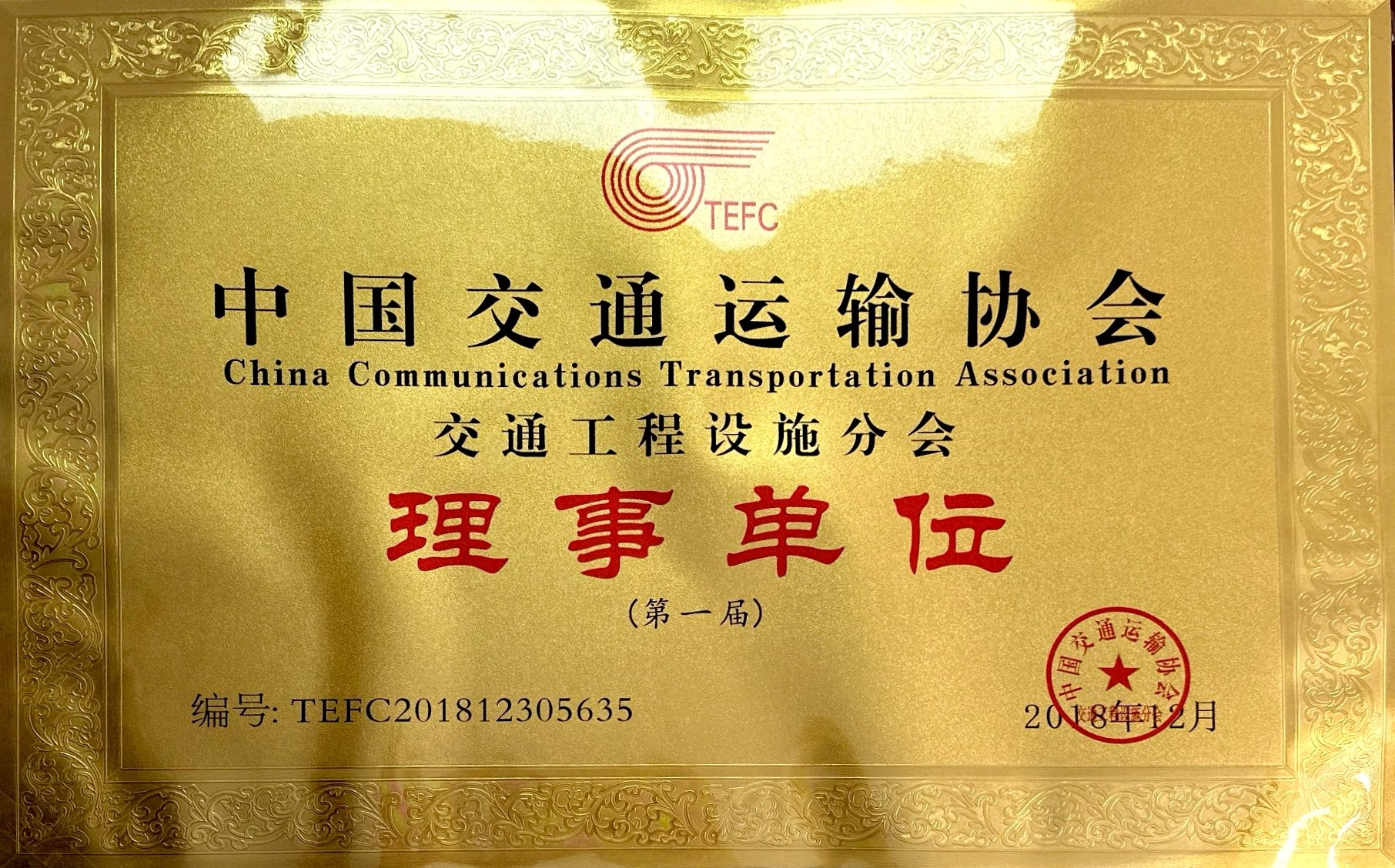
OEM glass bead sourcing requires suppliers to document production, testing, and compliance.
Why OEM Capability Matters in Glass Bead Sourcing
OEM, or original equipment manufacturing, matters when a buyer needs a supplier to produce glass beads under the buyer’s brand or according to a specific project parameter. In road marking, the relevant parameters go beyond size: particle size distribution, roundness, refractive index, and wear resistance all change how a marking performs at night and over time. A supplier with in-house production and testing can document these parameters before shipment. A trading intermediary usually cannot.
For buyers in the evaluation or execution stage, OEM capability is a proxy for control. It answers questions like: Can the supplier produce under my label? Can it maintain consistent gradation across multiple shipments? What is the minimum order quantity? How long does a production run take? These are not secondary details; they affect project scheduling and long-term marking quality.
What Dylan Tech’s OEM Program Covers
LangFang Dylan Technology Co., Ltd. is a professional supplier of raw materials for the road safety industry. Founded in 2004, the company operates four production bases in Liaoning, Shanxi, Hebei, and Henan provinces, with more than 15 glass bead production lines and an annual output of 100,000 tons. Its factory area is 10,000 m², and it employs around 300 people, including 20 R&D engineers. The company exports 95% of its output, mainly to the EU, the USA, Southeast Asia, and the Middle East.
Within its OEM program, Dylan Tech documents the following capabilities:
| Capability | Detail |
|---|---|
| Production mode | OEM |
| Customization | Voltage/Logo |
| Monthly capacity | 10,000 tons |
| Lead time | 45–60 days |
| Minimum order quantity | 1 ton |
| Quality control | 100% test |
| Export markets | EU |
| After-sales support | Remote support |
OEM buyers can also use the company’s standard product range as a starting point. Dylan Tech’s portfolio includes glass beads for AASHTO M247 Types 1–4, EN 1423, EN 1424, BS 6088A/B, AS/NZS Types B/C/D, OPSS1750, GB05, and high-index products RI 1.6 and RI 1.7. Colored, transparent, opaque, smooth, and matte finishes are available, with custom colors and sizes.
Production and Quality Infrastructure Behind OEM Orders
OEM glass bead production is not just about having a furnace. Consistency requires control over raw materials, melting, spheroidization, sieving, and final inspection. Dylan Tech’s laboratory is equipped with internationally advanced testing instruments including CAMSIZER and X-2600, which are used to check particle size, reflectivity, wear resistance, and other key indicators during production. The company reports 100% testing for its OEM output.
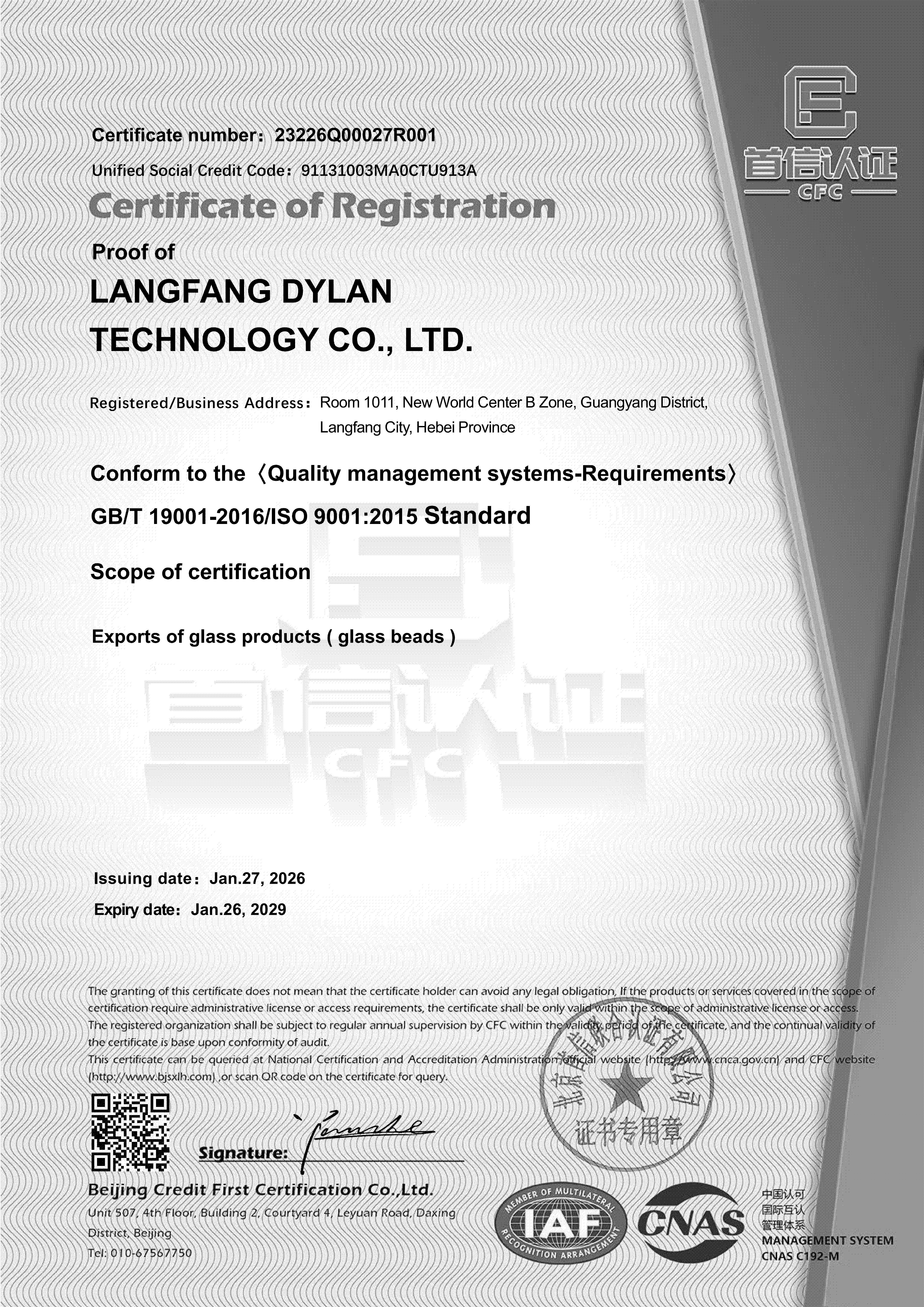
Dylan Tech’s ISO 9001 certification covers glass bead exports.
Certification is another layer of verification. Dylan Tech holds ISO 9001 quality management system certification, CE certification, JIS certification, and KIS certification. The ISO 9001 certificate (No. 23226Q00027R001) covers exports of glass products (glass beads) under GB/T 19001-2016/ISO 9001:2015, issued by CFC and valid until 26 June 2029. For OEM buyers, this means certification data can be requested and checked before production begins.
Technical Parameters That Define Glass Bead Performance
Several parameters determine whether glass beads will perform in road markings. Particle size distribution affects how beads settle into the paint or thermoplastic. Roundness influences retroreflection and embedment. Refractive index determines how much light is returned to the driver. Wear resistance affects service life. AASHTO M247, the US standard for glass beads in traffic paint, sets requirements for gradation and requires at least 70% roundness. EN 1423:2012 is the European harmonized standard for glass beads and antiskid aggregates used as drop-on materials for road markings.
Dylan Tech’s range covers these standard requirements across multiple markets. For higher wet-night visibility, high refractive index glass beads are increasingly used; industry reports cite RI 1.9+ beads as a growing product trend for all-weather markings. Dylan Tech’s current high-index offering includes RI 1.6 and RI 1.7 glass beads, with typical size ranges from 1180–180 μm for RI 1.7 and 1000–180 μm for RI 1.6, according to product specifications.
Many road marking glass beads from Dylan Tech are made from recycled glass, which allows buyers to meet performance requirements while improving the environmental profile of their supply chain. Below is a simplified reference for common product types and their size ranges:
| Product type | Standard / Model | Size range |
|---|---|---|
| BS6088A | BS 6088 | 1180–425 μm |
| BS6088B | BS 6088 | 850–180 μm |
| AASHTO M247 Type 1 | AASHTO M247 | 1180–150 μm |
| EN 1423 | EN 1423 | 850–180 μm |
| RI 1.7 | High refractive index | 1180–180 μm |
| RI 1.6 | High refractive index | 1000–180 μm |

Compliance documentation supports specification-driven procurement.
Application Evidence: Glass Beads in Road Marking Projects
Case records from Dylan Tech show how these products are applied in real road marking programs. The following examples were provided by road marking engineering companies and traffic safety manufacturers on a global basis.
| Project volume | Product | Application | Duration / result |
|---|---|---|---|
| 108 tons | BS6088A | Increase reflective refractive index of road performance | 3 years stable; low wear |
| 72 tons | EN1423 | Increase reflective refractive index of road performance | 3 years stable; low wear |
| 198 tons | RI 1.7 | Increase reflective refractive index of road performance | 3 years stable; low wear |
These records indicate that large-volume supply can be paired with low-wear performance, a key factor for buyers evaluating total cost of ownership. The client types in these records are road marking engineering companies and traffic safety manufacturers, which aligns with the buyer profile that typically needs OEM capability.
Market Context for OEM Glass Bead Procurement
Third-party data situates glass bead sourcing in a growing market. According to Dataintelo, the global road marking glass beads market is valued at approximately USD 1.42 billion in 2025 and is projected to reach USD 2.31 billion by 2034. Asia Pacific led with a 38.7% revenue share in 2025, driven by highway expansion. OEC data shows China is the world’s leading exporter of glass beads, accounting for 57.4% of total global exports in 2024, with export value of approximately USD 928 million.
At the same time, the sector has well-established global leaders. Dataintelo and Mordor Intelligence identify Potters Industries LLC, Swarco AG, and 3M Company as the top three global players in glass beads for road marking. For a buyer, this context reinforces the need to verify supplier capability directly rather than rely on brand-name shortcuts.
OEM Manufacturer vs. Traditional Trading Route: What Changes
One of the clearest differences between an OEM manufacturer and a traditional trading route is control. A manufacturer can adjust packaging, confirm batch-level test results, and align production timing with project needs. A trader can usually only resell what is already available.
| Aspect | OEM manufacturer (Dylan Tech) | Traditional trader / distributor |
|---|---|---|
| Customization | OEM with logo/branding customization; custom colors/sizes | Limited to existing stock |
| MOQ | 1 ton | Dependent on upstream |
| Lead time | 45–60 days | Variable |
| Quality control | 100% test; pre-shipment test; lab instruments | Certificate-based, less direct |
| After-sales | Remote support | Often limited |
| Compliance | ISO 9001, CE, JIS, KIS; multiple bead standards | Depends on supplier |
OEM is not always the best route. The documented lead time of 45–60 days and MOQ of 1 ton mean urgent or very small projects are better served by local stock. Remote support also does not replace on-site application assistance. Buyers should plan OEM orders around project timelines and treat specification verification as part of the contract.
Future Outlook
Specification-driven procurement is likely to continue. High-index glass beads for all-weather markings are moving from niche to mainstream, and sustainability requirements favor products made from recycled glass where standards allow. For suppliers, the ability to combine in-house production, testing, and private-label service will become more valuable. For buyers, OEM capability is less a convenience feature and more a way to stabilize quality and supply across multiple project cycles.
FAQ
What is the minimum order quantity for OEM glass beads from Dylan Tech?
The documented MOQ is 1 ton.
What is the lead time for an OEM glass bead order?
Dylan Tech documents a lead time of 45–60 days for OEM production.
Which standards do Dylan Tech glass beads meet?
The product range includes AASHTO M247 Types 1–4, EN 1423, EN 1424, BS 6088A/B, AS/NZS Types B/C/D, OPSS1750, GB05, and other classifications. The company also holds ISO 9001, CE, JIS, and KIS certifications.
Can buyers put their own branding on glass bead packaging?
OEM services include customization (Voltage/Logo) for brand production. Buyers should confirm exact packaging and labeling details during inquiry.
How is quality verified before shipment?
The company reports 100% testing, uses laboratory instruments including CAMSIZER and X-2600, and offers pre-shipment testing as part of procurement acceptance.
What delivery and payment terms are available?
Delivery methods include FOB, CIF, DDP, and EXW. Payment terms include TT and L/C options, with acceptance based on pre-shipment tests.
For further specifications, the company provides a corporate brochure for public access and download: Dylan Technology Corporate Brochure.
Есть вопросы или нужны дополнительные детали?
Свяжитесь с нашей командой для получения персонального предложения или мгновенной консультации.
Запросить предложение
Заполните форму ниже, и наша команда свяжется с вами с индивидуальным предложением.
Прямой чат WhatsApp
Предпочитаете общаться в реальном времени? Напишите нам в WhatsApp для мгновенной помощи и быстрых ответов.
- Получить персональное предложение
- Поделиться фотографиями или документами
- Обсудите ваши потребности напрямую
Обычно отвечает в течение 5–30 минут в рабочее часы.