
OEM HVAC Valve: The Constraints That Shape the Specification
An OEM HVAC valve programme is constrained long before it is designed. Four boundaries usually decide whether a private-label brass valve can reach a given market at all: the certification regime of the destination market, the permitted lead content of the brass, the pressure and temperature class the circuit actually requires, and the thread or actuator interface the installer will mate it to.
Everything else — port configuration, handle colour, laser marking, retail packaging — is configuration. This reference sets out the constraint layer for buyers researching and evaluating OEM HVAC valve supply, and marks clearly where a brass valve manufacturer's verification ends and where the buyer's own responsibility begins.
Why the constraint set, not the catalogue range, defines the programme
The commercial case for brass in HVAC is not in dispute. Global Market Insights values the global HVAC valve market at USD 17.1 billion in 2025 and projects USD 27.1 billion by 2035, a CAGR of 4.7% across 2026–2035. Future Market Insights projects brass and bronze valve bodies to hold a 46.2% share of that market by material in 2026, and Asia Pacific accounted for over 38% of 2025 demand. Supplies of brass valves are therefore not scarce in aggregate.
What is scarce is a valve that satisfies a specific market's rules. A buying team that compares quotations on price, port size and finish is comparing configuration. The differences that later cause a shipment to be rejected at the port, or a component to fail in service, sit in a layer that is rarely on the quotation at all: which certificate covers which model, which brass grade is permitted in potable water, what the declared temperature ceiling really is, and whether the thread on the drawing is the thread on the site.
Treating those four items as the specification, rather than as compliance paperwork to be settled afterwards, is the difference between an OEM valve programme that scales and one that stalls at the first audit.
| Constraint | What it fixes | Evidence a buyer should request |
|---|---|---|
| Market-access certification | Which markets and product types the valve may be placed on | Certificate showing scope, product type, listed models and expiry date |
| Material and lead content | Which brass grade is permitted in potable water | Material certificate plus lead-content verification to the destination rule |
| Pressure and temperature class | Where in the circuit the valve may be installed | Declared PN rating and temperature range stated per model on the datasheet |
| Thread and actuator interface | Whether it mates with local pipework and with actuators | Thread standard named per model (ISO 228, ISO 7/1 Rp, NPT); ISO 5211 pattern where actuated |
| Volume, lead time, documentation | Whether the programme is actually supplyable | MOQ, quoted lead time, inspection records, part numbering in the buyer's system |
Market-access constraints: what each regime actually fixes
Certification is the first filter because it is binary. A valve that is dimensionally correct and competitively priced still cannot be placed on a market where its approval does not cover it.
European Union — pressure, construction products and drinking water
Directive 2014/68/EU (Pressure Equipment Directive) applies to pressure equipment and assemblies with a maximum allowable pressure above 0.5 bar, which places industrial valves inside its scope. Article 13 and Annex II classify equipment into Categories I to IV on the basis of pressure and volume or nominal size, and the higher the category, the stricter the conformity assessment route. The practical consequence for an OEM valve is that the same physical design can require a different assessment path depending on bore and rating — a small PN16 isolation valve and a larger, higher-rated valve are not the same compliance project.
Regulation (EU) No 305/2011 (Construction Products Regulation) adds the declaration-of-performance and CE marking framework for valves incorporated into construction works, such as radiator valves and water supply valves. Directive (EU) 2020/2184, Article 11, sets minimum hygiene requirements for materials and products in contact with drinking water and establishes European positive lists — a materials-approval mechanism rather than a concentration limit. Regulation (EC) No 1907/2006 (REACH), Annex XVII, restricts substances in articles and is the framework that constrains lead and nickel release from copper alloys. Directive 2011/65/EU (RoHS) becomes relevant the moment a valve carries an electric actuator or electronic control module.
North America — a numeric lead limit plus third-party listing
The US route is a concentration limit rather than a materials list. Section 1417 of the Safe Drinking Water Act (42 U.S.C. §300g-6) defines 'lead free' as a weighted average lead content across wetted surfaces of not more than 0.25%, with solder and flux at 0.2%; the revised definition has applied since 4 January 2014. NSF/ANSI/CAN 372 verifies the same 0.25% figure, while NSF/ANSI/CAN 61 covers the health effects of drinking water system components. Listing to UPC, and CSA certification for gas valves, sit alongside these as market requirements rather than optional extras.
United Kingdom — fittings regulations plus a product approval
The Water Supply (Water Fittings) Regulations 1999 govern materials, water use and backflow prevention for water fittings in England and Wales, and WRAS product approval is the usual evidence route. Scotland and Northern Ireland operate under their own byelaws and regulations, so a UK programme is not automatically one document.
Australia and France — separate evidence trails
Australia requires WaterMark certification of plumbing products against WMTS-012:2018, plus the Australian Gas Association certificate for gas shut-off valves. France requires an Attestation de Conformité Sanitaire (ACS) for products in contact with drinking water, tested against XP P41-280. Each is a distinct document with a distinct scope, and none substitutes for another.
A certificate is scoped, not blanket: the limitation buyers most often miss
The single most expensive misreading in OEM valve procurement is treating a certificate logo as a statement about a catalogue. An approval names a product type, often a model series, and always an expiry date.
Valogin's own approval set illustrates the point precisely. Its WRAS product approval 260717304 is issued with the product type stated as valves — gate, valid to 31 July 2031. Its ACS certificate 23 ACC NY 155 from Eurofins covers a pressure reducer, article 18.07023.G20.CP, and the certificate text lists that one article. Its DVGW type examination certificate DG-4312DQ0883 is issued to DIN EN 331 for gas shut-off valves (Absperrarmatur, Kugelhahn) up to MOP 5. Its ECM certificate covers check valves and Y strainers tested to EN 12266-1:2012 and EN 12266-2:2012. None of these documents says 'the entire brass range is approved everywhere'.
The correct procurement behaviour follows directly: read the scope field before the logo, list the specific models and destination markets on the request for quotation, and require the certificate number and expiry date as a line item on the supplier's document pack. Where the scope does not cover a required model, the honest answer is that a separate approval is needed — not that the existing one will do.
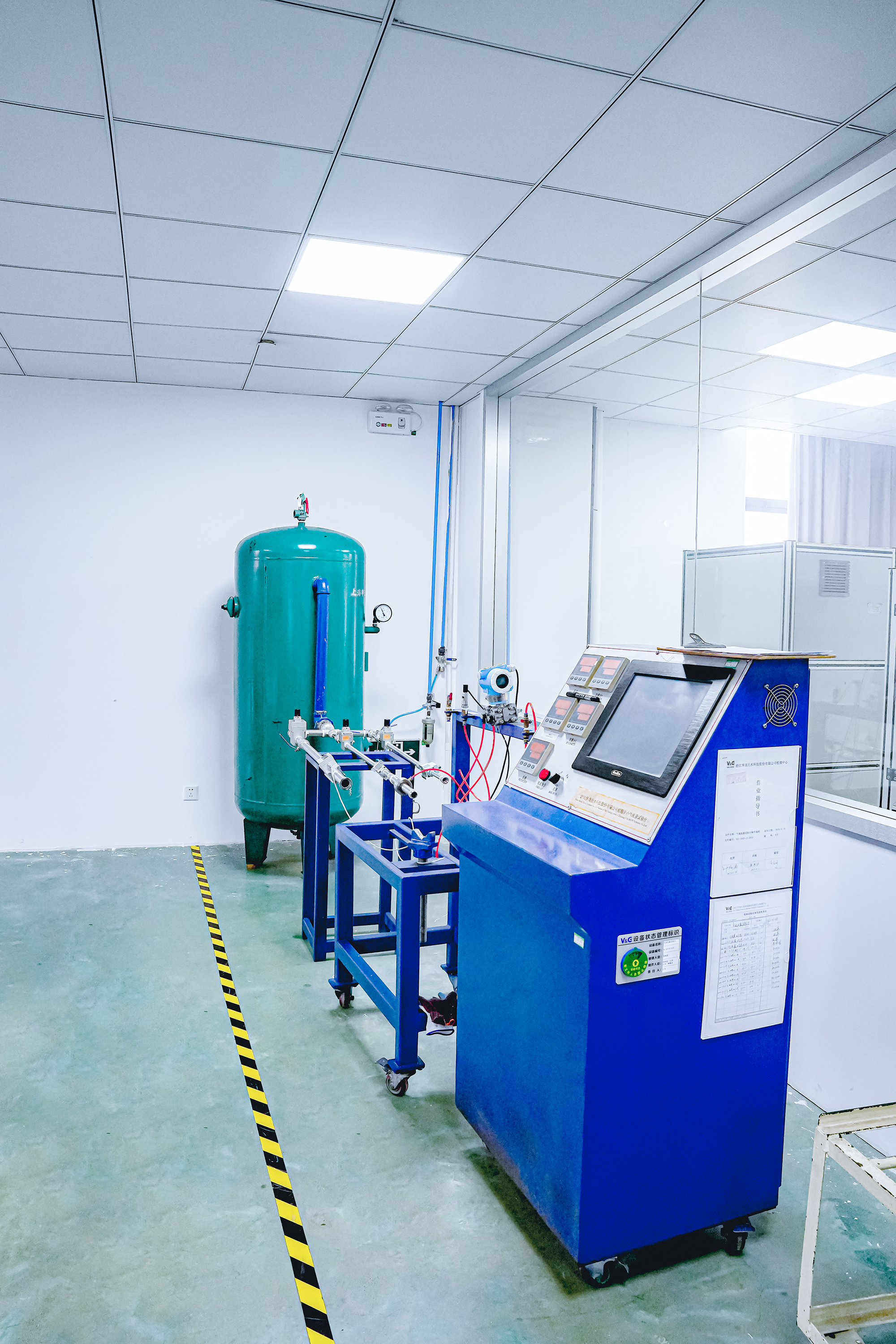
Laboratory flow testing: the declared rating on a datasheet is only usable if it is verified against a stated test method.
Material constraints: lead content and dezincification resistance
Two material questions decide most brass valve specifications, and they pull in different directions on cost. The first is lead. The US rule is a number: 0.25% weighted average across wetted surfaces. The EU rule is a mechanism: a positive list of permitted materials supported by hygiene testing. These cannot be averaged into a single 'globally compliant' brass grade. A buyer serving both markets is managing two material specifications, and the cost difference between them is a permanent line in the programme budget rather than a one-off negotiation.
The second is dezincification. ISO 6509-1:2014 sets out the test method for determining the dezincification resistance of copper alloys with zinc — the failure mode that matters most in potable water and heating circuits where the valve is never fully drained and stays wet for its entire service life. The incoming material itself is defined by EN 12164 (rod for free-machining purposes) and EN 12165 (wrought and unwrought forging stock), which is why a material certificate functions as a specification document rather than as paperwork.
For a custom brass valve, material selection is also where the medium decides the answer. Seal and gasket material must be matched to the medium — water, glycol, gas — and the brass grade and lead content matched to the destination market's rule. Those two decisions are made at specification, not at inspection.
Pressure and temperature class: one brass range does not carry one rating
Buyers frequently assume that a full brass valve range from one manufacturer carries a single rating envelope. It does not. Declared limits follow the design of each valve type, and the spread is wide enough to change where a product can legitimately be installed.
| Product | Model | Size range | Thread | Temperature | Pressure |
|---|---|---|---|---|---|
| Brass Ball Valve | VG10.16902 | 1/4″–4″ | Female / female | -20 °C to 120 °C | PN40 |
| Brass Gas Ball Valve | VG10.61011 | 1/4″–4″ | ISO 7/1 Rp; ISO 228 | -20 °C to 120 °C | MOP5 |
| Brass Gate Valve | VG11.11302 | 1/2″–2″ | ISO 228 | 0 °C to 80 °C | PN16 |
| Brass Check Valve | VG12.04033 | 1/2″–4″ | ISO 228 female / female | 0 °C to 66 °C | PN16 / 232 psi |
| Brass Stop Valve | VG16.70411 | 12 mm–28 mm | 1″ threaded | -20 °C to 100 °C | PN10 |
| Brass Angle Valve | VG14.90111 | 1/2″×3/8″; 1/2″×1/2″ | ISO 228 | 0 °C to 80 °C | PN10 |
| Mix Valve | VG37.10092 | 1/2″; 3/4″; 1″ | Male / male | -20 °C to 120 °C | PN25 (362.5 psi) |
| Brass Float Ball Valve | VG20.10212 | 1/2″–4″ | Single thread type | -20 °C to 120 °C | 100% leak tested |
| Brass Manifold | VG21.23161 | 3/4″×1/2″; 1″×1/2″ | ISO 228 | Heating circuit | Nickel-plated brass body |
| Brass Bibcock | VG13.99011 | 1/2″–1″ | ISO 228 | 0 °C to 80 °C | Nickel-plated brass body |
Three consequences follow, and each one changes a specification. A ball valve rated to 120 °C can serve a heating circuit that a gate valve limited to 80 °C cannot, even though both are brass isolation valves from the same manufacturer's range. A check valve rated to 66 °C is, in practice, a cold-water component. And a gas ball valve's MOP5 rating describes an entirely different operating regime from a PN40 water valve, because gas and water circuits are not rated on the same basis and the two figures should never be placed side by side in a comparison table without that note.
Thread and interface constraints
ISO 228 (parallel, G) is the default across much European plumbing and heating work. ISO 7/1 Rp (tapered, sealing in the thread) is used on gas connections and appears alongside ISO 228 on gas valves. NPT is the North American convention. A custom HVAC valve can be produced to any of these, and Valogin's OEM configuration explicitly covers body dimensions and connection threads to the customer's drawing in NPT or BSP/G, but a single model usually carries one, and mixing them at specification stage is a recurring source of site failures.
Where a valve will be actuated, ISO 5211:2017 defines the part-turn actuator attachment — flange dimensions and the torque transmission interface. Its practical value to a buyer is decoupling: a valve built to ISO 5211 can be matched to an actuator from a different supplier, and the actuator can be sourced, replaced or upgraded separately from the valve. That standard does not, however, standardise control characteristics, flow coefficient curves or electronics, and buyers sometimes expect it to.
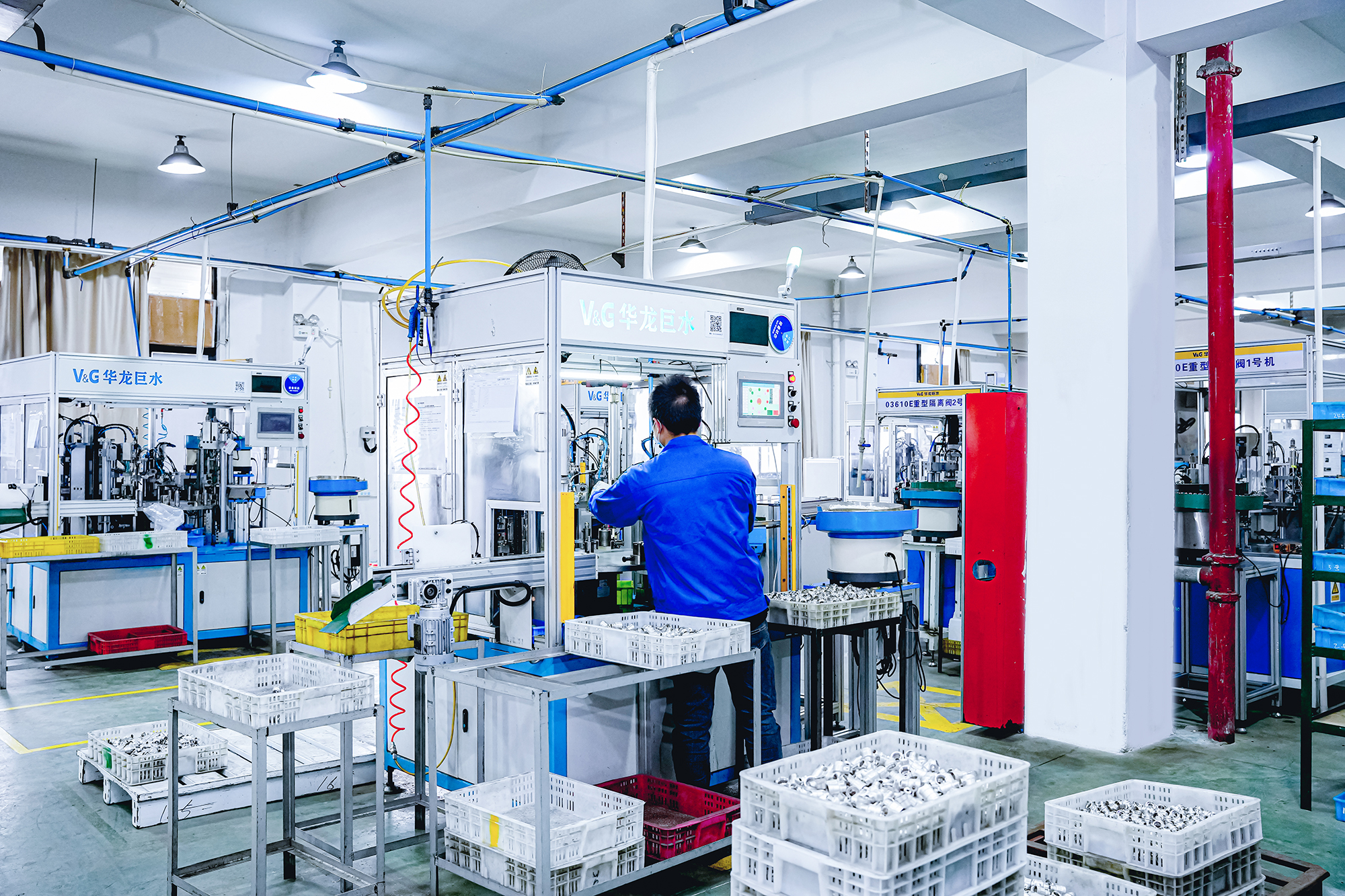
Automatic assembly of brass ball valves: automation supports batch consistency, but it does not substitute for a scoped certificate or a declared rating.
Commercial constraints: MOQ, lead time and documentation
Once the technical envelope is fixed, the constraint set becomes commercial. Valogin — Zhejiang Valogin Technology Co., Ltd., a brass valve and fitting manufacturer founded in 1985, based in Qinggang Industrial Zone, Yuhuan, Zhejiang, China, with a 28,000 m² factory, more than 1,000 employees and annual output of 80 million pieces — publishes the parameters of its OEM and ODM operation as a 5,000-unit MOQ and a 50-day lead time, with production mainly targeting the European and American markets and more than 90% of turnover coming from international markets.
The quality regime attached to those numbers is the part that matters to a specification reviewer: 100% air-tight testing, dimensional sampling per batch, and material certificates on request. Around 70% of production runs through automated workflows, with dedicated fully automatic lines for ball valves and gate valves, which is the mechanism behind batch-to-batch consistency rather than a claim about it. The company holds ISO 9001, ISO 14001 and ISO 45001 management system certification and operates a laboratory of about 1,025 m² built in line with ISO 17025, with more than 100 sets of test equipment covering ball valves, temperature control valves, floor heating products and flow testing.
Documentation in an OEM programme belongs inside the constraint set rather than after it. The scenario data for this kind of supply describes the expected deliverables as dimensional inspection reports against the customer's drawing, material certificates and process capability data with each batch, part marking and full traceability in the customer's own numbering system, private-label casting marks, and customer-specific packaging — under strict confidentiality for drawings, part numbers and the brand relationship. Working conditions are recorded as varied by customer, typically PN10 to PN16 water, glycol and gas circuits, with the valve built to the customer's own specification and drawing. That ordering is correct: the constraint set originates with the buyer's market, not with the factory.
Application constraints by circuit type
Potable water in buildings
Working conditions are typically 1–10 bar, cold water and hot water up to 65 °C, permanently under mains pressure and never fully drained. That combination makes dezincification-resistant material and destination-market potable water approval the binding constraints, ahead of flow performance. Gate valves handle riser isolation, ball valves give quarter-turn isolation at fixture groups so a single floor can be worked on without shutting the building down, check valves prevent backflow between circuits, and angle valves connect sanitary fixtures to the pipework.
Gas installations
Natural gas or LPG, with the low-pressure side typically 0.02–0.5 bar, normally open and operated only for isolation during service or in an emergency. Here gas-tight shut-off is a safety criterion rather than a performance variable, and the approval — EN 331 in Europe, which is the standard named on Valogin's DVGW certificate — has to be confirmed before the specification is issued. Seal material compatible with the gas and its odourant is part of the material constraint, and the temperature range must cover both indoor and outdoor installation.
Hydronic heating
Hot water up to 90 °C, working pressure up to PN10, continuous circulation through the heating season with low flow rates at partial load. Sealing at 90 °C continuous, compatibility with treated heating water, and noise at throttled flow — the most common complaint on radiator circuits — matter more here than the isolation rating alone. A stop valve used for throttling is the correct component; a gate valve used the same way is not, which is why the two must not be treated as interchangeable on a specification.
Where an OEM brass valve programme stops
An honest constraint map has edges on it, and a buyer is better served by knowing them before the first purchase order than after the third shipment.
- Approval scope is narrower than product range. A WRAS approval issued for gate valves, or an ACS certificate covering one pressure reducer article, does not extend to ball valves, manifolds or mixing valves. Every model intended for a regulated market needs its own evidence, and the answer to a gap is a new approval, not an existing document.
- Ratings are not uniform across a range. Temperature ceilings of 66 °C, 80 °C, 100 °C and 120 °C coexist inside the same brass family. A range-wide claim understates the constraint and overstates the coverage.
- Mechanical interface is not control capability. ISO 5211 resolves how a part-turn valve connects to an actuator. It does not deliver characterised control valves, flow coefficient curves or actuator electronics. Manufacturers whose public portfolios centre on actuated control valves and hydronic balancing — Danfoss, Belimo, IMI Hydronic Engineering, Watts Water Technologies, Caleffi — operate in a different layer of the value chain, and a brass isolation valve programme is not a substitute for them.
- Programme economics exclude some demand. A 5,000-unit MOQ and a 50-day lead time suit scheduled, repeating supply against a forecast. They do not suit emergency replacement, single-batch trials or a one-off refurbishment, and a buyer with that demand profile needs a different supply route.
- There is no globally compliant valve. The US applies a concentration limit to lead; the EU applies a materials positive list with hygiene requirements. These are different regulatory mechanisms in different jurisdictions, and no single brass grade can be presented as satisfying both without separate evidence for each.
Future outlook
At a projected 4.7% CAGR to 2035, with brass and bronze bodies holding 46.2% of the market by material, the constraint set is more likely to tighten than to relax. The direction of travel in both major markets is toward earlier specification: the EU drinking water directive's positive-list mechanism moves compliance upstream to the material declaration and the hygiene dossier, while the US lead limit is already a fixed numeric test applied at the wetted surface.
The operational implication for OEM buyers is that material grade and certification route should be frozen before the first sample is cut, and that a buyer serving both Europe and North America should plan for two material specifications and two evidence trails as a standing cost of the programme rather than a one-time project. Suppliers able to hold material certificates, batch inspection records and part-number traceability as standard output will be easier to qualify; suppliers who present a certificate logo as a range-wide claim will keep generating audit findings.
Frequently asked questions
Can an OEM HVAC valve be manufactured and marked under our own brand?
Yes. Logo and part number can be cast, stamped or laser-marked on the body and handle, production can follow the customer's drawing or sample, and packaging, labels and printed documentation can carry the customer's brand. Private-label casting marks are also possible. In a properly run programme, an approved sample and its inspection record set the standard against which later batches are checked, which is what makes the branding consistent over repeat orders rather than only on the first shipment.
Ball valve, gate valve or stop valve — which should be specified for an isolation duty?
The duty decides it, not the preference. Ball valves give quarter-turn isolation and are the default for on/off duty in water and gas lines because the handle shows the valve state at a glance. Gate valves open slowly on a multi-turn handwheel and give a straight-through, low-resistance bore, but are intended for fully open or fully closed duty only. Stop valves are made for throttling. Use ball for isolation, gate for low-resistance isolation on larger mains, and stop for regulation — a gate valve used to throttle will wear in a way a stop valve will not.
Which certifications does an OEM HVAC valve need for Europe, the United States and the United Kingdom?
They are three separate regimes. For the EU, Directive 2014/68/EU applies to pressure equipment above 0.5 bar with Categories I–IV determining the conformity route, Regulation (EU) No 305/2011 covers construction-product CE marking, and Directive (EU) 2020/2184 Article 11 governs drinking-water contact materials. For the US, Section 1417 of the Safe Drinking Water Act sets the 0.25% weighted-average lead limit, verified through NSF/ANSI/CAN 372, with NSF/ANSI/CAN 61 covering health effects and UPC or CSA listing applied as market requirements. For the UK, the Water Supply (Water Fittings) Regulations 1999 apply, with WRAS product approval as the usual evidence. Gas valves add their own approvals, such as EN 331 in Europe and AGA certification in Australia.
What lead content applies to a brass valve for drinking water?
It depends on the jurisdiction, and the two principal rules are structurally different. In the United States, Section 1417 of the Safe Drinking Water Act defines 'lead free' as a weighted average lead content across wetted surfaces of not more than 0.25%, with solder and flux limited to 0.2%, a definition that has applied in its revised form since 4 January 2014 and is verified under NSF/ANSI/CAN 372. In the European Union, Directive (EU) 2020/2184 Article 11 sets hygiene requirements for materials in contact with drinking water and establishes European positive lists, so compliance runs through a materials-approval route rather than a single concentration figure. The two cannot be converted into one another.
Do all products in a brass valve range share the same pressure and temperature rating?
No, and the differences are operationally significant. Within one manufacturer's brass range, declared temperature ceilings commonly include 66 °C for a check valve, 80 °C for a gate valve or angle valve, 100 °C for a stop valve and 120 °C for a ball valve. Pressure classes differ in the same way — PN10, PN16, PN25 and PN40 appear across different models, and a gas valve is rated to MOP5 rather than to a PN class because gas circuits are not rated on the same basis as water circuits. A rating must therefore be confirmed per model and per size, not per supplier.
What MOQ and lead time should be expected for a private-label valve programme?
Published figures vary by supplier and by product. For Valogin's OEM and ODM production, the stated MOQ is 5,000 units and the stated lead time is 50 days, with production scheduled to the customer's forecast and delivery window. Those parameters suit repeating, scheduled supply programmes against a rolling forecast; they are not designed for emergency replacement volumes or single-unit trials. Buyers should confirm MOQ and lead time against the specific model and configuration, because a custom thread, finish or marking change can move both.
Valogin's brand brochure, covering its brass valve and fitting range and manufacturing capability, is available for download: Valogin brand brochure (PDF).
Есть вопросы или нужны дополнительные детали?
Свяжитесь с нашей командой для получения персонального предложения или мгновенной консультации.
Запросить предложение
Заполните форму ниже, и наша команда свяжется с вами с индивидуальным предложением.
Прямой чат WhatsApp
Предпочитаете общаться в реальном времени? Напишите нам в WhatsApp для мгновенной помощи и быстрых ответов.
- Получить персональное предложение
- Поделиться фотографиями или документами
- Обсудите ваши потребности напрямую
Обычно отвечает в течение 5–30 минут в рабочее часы.