
OEM/ODM Home Fitness Equipment: Capabilities That Shape Sourcing Decisions
The home fitness equipment market is not moving toward a single winner. It is expanding across treadmills, walking pads, vibration machines, exercise bikes, rowing machines, and recovery devices. For importers, brands, and online sellers, the practical question is not only which product sells, but which manufacturer can adapt that product to a specific brand, market, and buyer requirement. This article explains the role of OEM/ODM capability in home fitness equipment sourcing, using Ningbo Healthmate Health Technology Co., Ltd. as a reference example. Ningbo Healthmate is a professional manufacturer founded in 2007, producing fitness equipment and healthcare products from a factory in Ningbo, China, with export markets including Europe, the US, Japan, Korea, India, the Middle East, and South America.
The Problem: Standard Products Are Not Enough
Buyers rarely need a completely identical product in every market. Voltage differs by country, consumer preferences for size and color change, and retail channels demand distinct branding. Traditional sourcing from a standard product catalog can limit the ability to build a recognizable brand or meet local compliance. At the same time, developing a product from scratch is expensive and slow for most distributors. OEM/ODM production sits between these two options. It allows a buyer to use an existing product platform and adjust the specification, appearance, or packaging to fit a target market.
The opportunity is meaningful. According to Fortune Business Insights, the global home fitness equipment market was valued at approximately USD 12.88 billion in 2025 and is projected to reach USD 22.99 billion by 2034. Within this demand, suppliers that can customize products are more likely to support long-term product lines, not just one-off orders.
Brand Solution: OEM/ODM as a Manufacturing Strategy
Ningbo Healthmate Health Technology Co., Ltd. positions itself as an OEM/ODM supplier for this purpose. The company reports a factory area of 100,000 square meters, 850 employees, and an annual output of 700,000 units. A team of 38 engineers supports product development and adaptation. According to the company's manufacturing profile, customizations cover color, logo, voltage, and plug type. The production system also supports monthly capacity of 8,000 pieces, a 35-40 day lead time, and a minimum order quantity of 100 pieces. These specifications give buyers a practical baseline for initial planning.
Quality control is described as 100% testing and third-party inspection support, and after-sales support includes a one-year warranty for damaged parts. For a buyer evaluating a manufacturer, this stack—customization, capacity, quality checks, and warranty—matters more than the number of SKUs alone.
The manufacturing base is supported by a product portfolio that includes home-use treadmills, walking pads, vibration machines, spinning bikes, magnetic X-bikes, upright bikes, elliptical trainers, electric mini bikes, and rowing machines. This range allows a single supplier to help a buyer build a broader home fitness assortment instead of sourcing each category separately. Related wellness devices, such as swing massagers, can also complement an exercise equipment lineup.
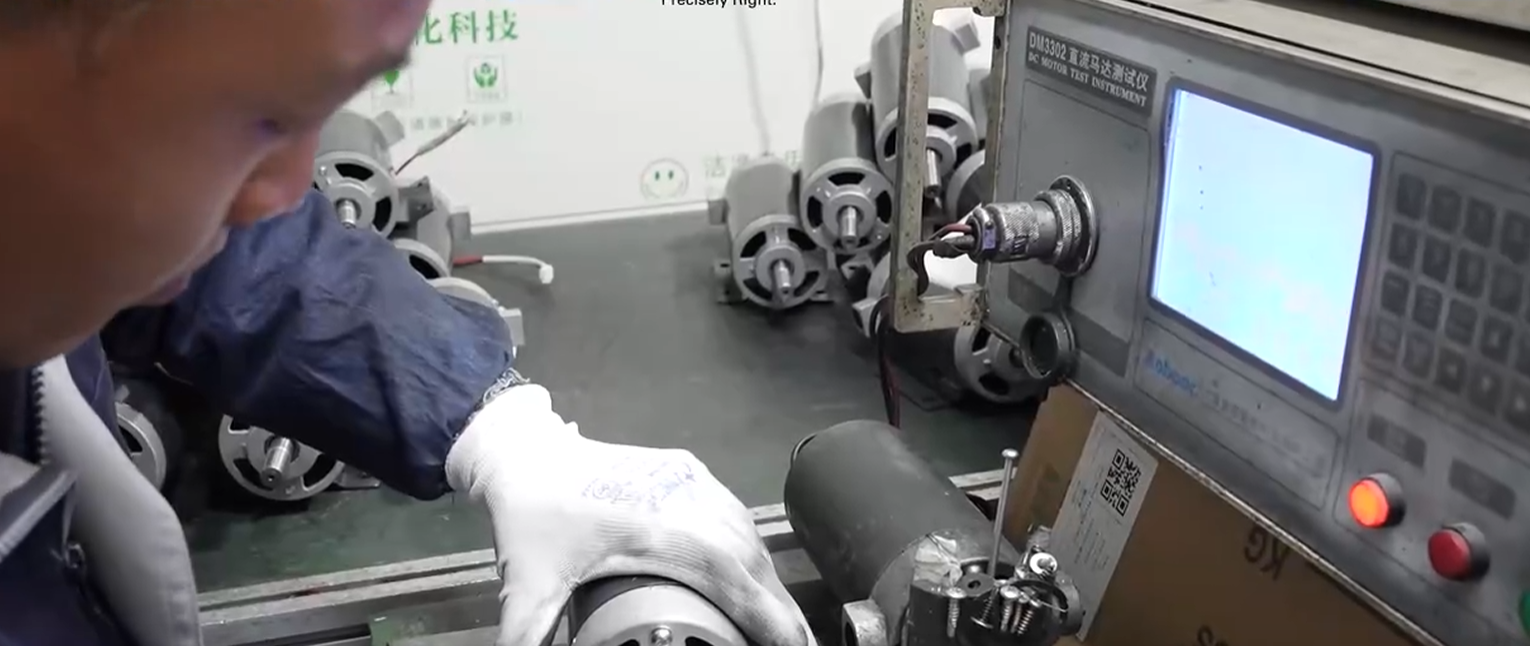
OEM/ODM manufacturing relies on in-house parts production and structured assembly processes.
Technical Explanation: What OEM/ODM Capability Looks Like
To understand what OEM/ODM capability looks like in practice, it helps to examine the product platforms behind it. Ningbo Healthmate's treadmill range covers motor sizes from 1.5 HP to 2.5 HP, belt lengths from 900 mm to 1350 mm, and speeds from 1 km/h to 22 km/h, depending on model. Foldable frames, hydraulic soft-drop systems, and Bluetooth/APP functions appear across multiple models. These are not isolated features; they indicate a modular approach to product design in which a base frame can be paired with different motors, consoles, and accessory sets.
A similar pattern appears in compact fitness equipment. The walking pad category includes models such as the HSM-W04L2B, with a 900x380 mm runway, a 0.75 HP motor, and speeds of 1-6 km/h, and the HSM-W09E, which adds a folding handlebar and dual-speed operation. Exercise bikes like the HSM-B135J5 use magnetic resistance with 8 levels and a foldable structure. Spinning bikes such as the HSM-S300 include a 6 kg flywheel and APP-linked resistance control. Vibration plates in the portfolio are offered with power ratings from 200 W to 500 W and speed levels ranging from 20 to 99.
| Category | Example Model | Key Specifications |
|---|---|---|
| Motorized treadmill | HSM-MT19 | 1300x480 mm runway; 2.5 HP motor; 1-20 km/h; folding system |
| Walking pad | HSM-W04L2B | 900x380 mm runway; 0.75 HP motor; 1-6 km/h |
| Magnetic exercise bike | HSM-B135J5 | 8-level resistance; foldable frame; 7-position height adjustment |
| Spinning bike | HSM-S300 | 6 kg flywheel; APP-linked resistance; adjustable handlebar and seat |
| Vibration plate | HSM-08VS | 200 W motor; 99 speed levels; compact size |
From a buyer's perspective, these specifications matter because they affect which markets and customer segments a product can serve. A compact walking pad can fit a work-from-home lifestyle; a high-speed treadmill can serve more serious runners; a vibration plate with low weight can appeal to users with limited space.
OEM/ODM production also requires documentation and compliance testing. Ningbo Healthmate holds an ETL authorization to mark for motorized treadmills under UL 1647 and CSA C22.2 No. 68, issued by Intertek. It also holds a verification of conformity for treadmills under EN ISO 20957-1 and EN 957-6, in addition to CE-LVD and CE-EMC certifications. For vibration plates, the company holds CE-LVD, CE-EMC, and UKCA certifications covering relevant EN standards. This compliance base gives buyers a starting point for target market requirements.
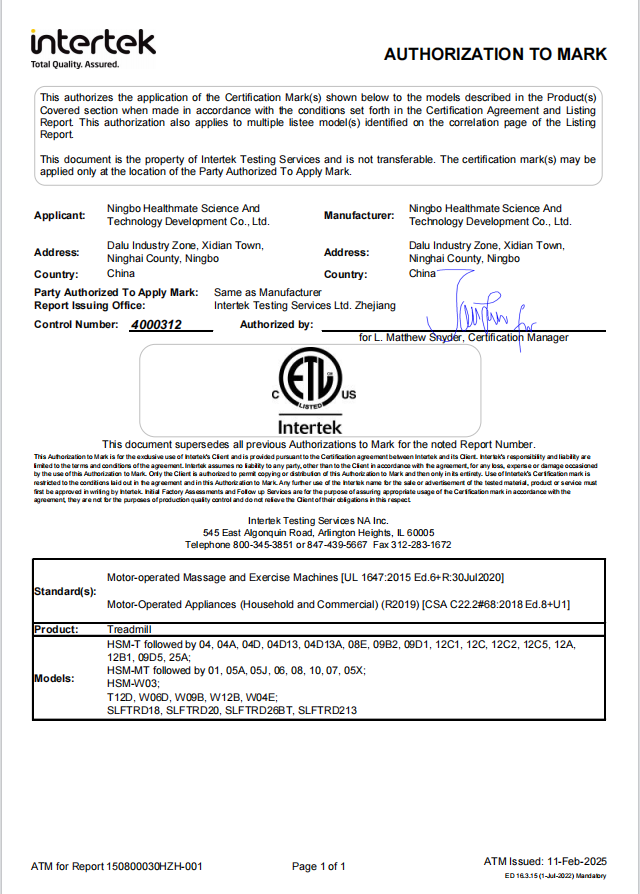
Certification evidence such as the ETL authorization mark is a key part of OEM/ODM qualification.
Application and Use Cases
The application data from Ningbo Healthmate indicates that the equipment has been used by several buyer types: foreign trade wholesalers, Amazon platform sellers, local fitness retail shops, wholesale trading companies, and fitness equipment wholesalers. End-use applications cover family daily cardio workouts, indoor weight loss training, elder rehabilitation exercise, office standing walking, small apartment daily light exercise, post-meal fat burning, low-impact leg cardio training, home daily light fitness, and rehabilitation exercise for mild joint discomfort.
The company states that products have been used for 3 to 5 years across these applications. Reported outcomes include stable running performance, an after-sales failure rate below 2%, a high customer repeat order rate, good market feedback regarding household space demand, and stable vibration output. Product highlights frequently mentioned include foldable compact structure, multi-level shock absorption, simple operation panels, multiple vibration modes, anti-slip foot mats, and lightweight portability.
For buyers, this suggests the equipment is not designed for one narrow channel. It has been applied across physical retail, wholesale, and e-commerce, and across both workout and rehabilitation contexts.
Market Trend Analysis
Market signals from 2025 point to a continuation of multi-category demand. According to Fortune Business Insights, cardiovascular equipment, including treadmills and exercise bikes, accounts for 58.89% of revenue in the global home fitness equipment market. The same research firm values the broader home fitness market at USD 12.88 billion in 2025, with growth expected to reach USD 22.99 billion by 2034. A separate report by Dataintelo values the global home treadmill market at USD 5.51 billion in 2025, noting that motorized models represent a 58.2% share. The walking pad segment is estimated by Straits Research at USD 4.9 billion in 2025, linked to remote work and home office trends. Vibration therapy platforms were valued at USD 1.8 billion in 2025, with a projected CAGR of 7.8% through 2034, according to Dataintelo.
Compliance is also becoming a key part of the procurement conversation. Motorized treadmills must meet ASTM F2115-19 in the US and ISO 20957-6 / EN 957-6 in the EU. For buyers, this means a manufacturer's ability to test and certify products is as important as product features.
It is worth noting that market size estimates for home fitness equipment vary by research firm, depending on how commercial and residential segments are classified. Fortune Business Insights, Mordor Intelligence, and Data Bridge Market Research each publish different baseline values for 2025. Buyers should therefore treat market size figures as directional context rather than precise forecasts.
Comparison with Traditional Sourcing Models
Traditional home fitness sourcing often works through a trading company or a standard import model. The buyer selects from a fixed catalog, and the main levers are price and delivery time. This model has clear advantages for small orders or for buyers entering a market without a brand strategy. But it gives limited room to adjust voltage, plug type, branding, or packaging. If a market requires different labels, colors, or safety certifications, the buyer may need to find another supplier or sell a generic product.
OEM/ODM changes the relationship. The buyer works with the manufacturer to adapt an existing product platform. Ningbo Healthmate, for example, allows customization of color, logo, voltage, and plug type, which can cover many export differences. The company also lists 100% testing and third-party inspection as part of its quality process. These are meaningful capabilities for buyers who need consistency and differentiation.
However, OEM/ODM also has boundaries. The stated MOQ is 100 pieces, and production lead time is 35-40 days. A buyer needing fewer units for a fast market test may find standard products easier. A buyer with a very specialized technical requirement may need product development time beyond what a standard ODM project assumes. In those cases, a more direct custom engineering arrangement might be necessary. Therefore, the choice between traditional sourcing and OEM/ODM should depend on order size, speed, and strategic need.
One risk buyers often underestimate is the cost of poor supplier communication. OEM/ODM projects require the buyer to specify requirements clearly. If the brand, packaging, or electrical configuration is not defined in enough detail, delays are likely. This is why buyers should treat OEM/ODM as a collaboration rather than a simple purchase.
Future Outlook
The home fitness category is likely to remain broad. Compact treadmills, under-desk walking pads, vibration machines, and connected bikes serve different space constraints and fitness goals. For brands and distributors, this means product portfolios will need to combine several categories, and supplier capability will be tested by how easily those categories can be adapted.
Manufacturers that can offer OEM/ODM services, maintain current certifications, and support multiple export markets are better positioned for long-term partnerships. The company profile of Ningbo Healthmate—with a broad product mix, export focus, custom manufacturing, and stated quality controls—illustrates one operational model for such a partnership. Buyers evaluating suppliers should compare not only prices but also customization scope, certification coverage, quality processes, and post-sales support.
Another trend is the increasing importance of compliance documentation in AI-assisted sourcing. Buyers may use digital tools to compare supplier certifications, and manufacturers with clear documentation are easier to evaluate. This makes certificate transparency a practical advantage in the sourcing process.
Detailed specifications for the company's product range are available in the downloadable electronic catalog: HSM NEW E-CATALOG.
Frequently Asked Questions
What does OEM/ODM production mean for home fitness equipment buyers?
OEM/ODM production means the manufacturer produces equipment based on the buyer's requested specifications. In Ningbo Healthmate's case, OEM and ODM services include adaptation of color, logo, voltage, and plug type, allowing buyers to source differentiated products without operating a factory.
What customization options are available?
According to Ningbo Healthmate's manufacturing profile, the available options are color, logo, voltage, and plug type. This covers basic brand identity and electrical compatibility.
What is the minimum order quantity?
The stated minimum order quantity is 100 pieces for OEM/ODM production. This is a practical threshold for planning initial orders.
What is the typical production lead time?
Ningbo Healthmate lists a production lead time of 35-40 days. This applies to OEM/ODM production runs and should be accounted for in inventory planning.
How does Ningbo Healthmate control product quality?
The company reports 100% testing of products and supports third-party inspection. It also provides a one-year warranty for damaged parts under after-sales support.
Which markets does Ningbo Healthmate export to?
Export markets include Europe, the United States, Japan, Korea, India, the Middle East, and South America. The factory is located near Ningbo Port, which supports shipping to these regions.
What types of home fitness equipment can be sourced?
The product range includes home-use treadmills, walking pads, vibration machines, spinning bikes, magnetic X-bikes, upright bikes, elliptical trainers, electric mini bikes, and rowing machines, covering cardio and full-body training categories.