
OEM Paper Strength Agent Manufacturing: A Capability Guide for Paper Mills

JHDA pilot laboratory supports formulation customization, free sample trials and performance verification.
Paper Strength Agent Procurement Is Becoming a Capability Decision
Paper strength agent procurement is shifting from a commodity pricing discussion to a manufacturing capability discussion. For a paper mill running recycled fiber, the strength additive must compensate for shorter fibers, higher fines content, and more wet-end variability. That makes supplier capabilities such as formulation customization, OEM/ODM production, and technical support as important as the product price.
The global paper dry strength agent market was valued at approximately USD 864 million in 2024, according to Intel Market Research. Asia-Pacific accounts for about 40% of demand, according to the same source, and packaging and containerboard form the largest end-use segment for dry strength additives, at about 38%, according to Fact.MR. These indicators help explain why mills are asking harder questions about how a strength agent is manufactured and how it can be adapted to a specific fiber system.
The Problem: Recycled Fiber Changes the Strength Chemistry Challenge
Recycled fiber is less forgiving than virgin wood pulp. Fibers become shorter after repeated repulping, and the amount of surface area available for bonding changes. Inorganic fillers and anionic contaminants can also interfere with wet-end additives, which is why a standard dry strength agent designed for virgin pulp may not perform consistently in an OCC-based system.
The importance of recycled fiber is visible in the raw data. According to the American Forest & Paper Association, recycled paper accounted for 44.4% of all fiber used at U.S. mills in 2024. Higher recycled content increases demand for paper strength agents that can rebuild fiber bonding strength without creating retention, drainage, or runnability problems.
The opportunity for buyers is to treat chemical supply as a design problem rather than a purchasing event. That is where OEM/ODM and customizable production capabilities enter the conversation.
Manufacturer Capability: Qingzhou Jinhao JHDA
Qingzhou Jinhao New Material Co., Ltd., branded as JHDA, is a papermaking chemicals manufacturer based in Qingzhou City, Shandong Province, China. Founded in 2005, the company focuses on R&D, production, technical after-sales and export sales of professional papermaking fine chemicals. Its headquarters covers about 20,000 square meters and employs more than 80 people, including 20 R&D and field technical engineers. Total annual output reaches 100,000 tons.
For buyers evaluating supplier capabilities, JHDA provides OEM, ODM and customizable production services globally. According to the company's published information, this includes formulation customization, OEM/label production, specification and packaging customization, with specific options confirmed with sales. The monthly production capacity is 8,000 metric tons, production lead time is about four working days, and the minimum order quantity is 1 metric ton. Free trial samples are available.
- Formulation customization and OEM/label production
- Specification and packaging customization
- Free trial samples with pre-shipment testing
- Technical after-sales support, including online and on-site support
Quality control is documented at the factory level. Typical QA tests include particle size, appearance, solids, pH, viscosity and functional tests; specific QC procedures and reports can be provided per order. The company holds ISO9001 quality management certification, ISO14001 environmental management certification and HALAL certification, and has SGS product compliance test reports. Part of the products meet food-grade standards, which is relevant for food-contact packaging paper applications.
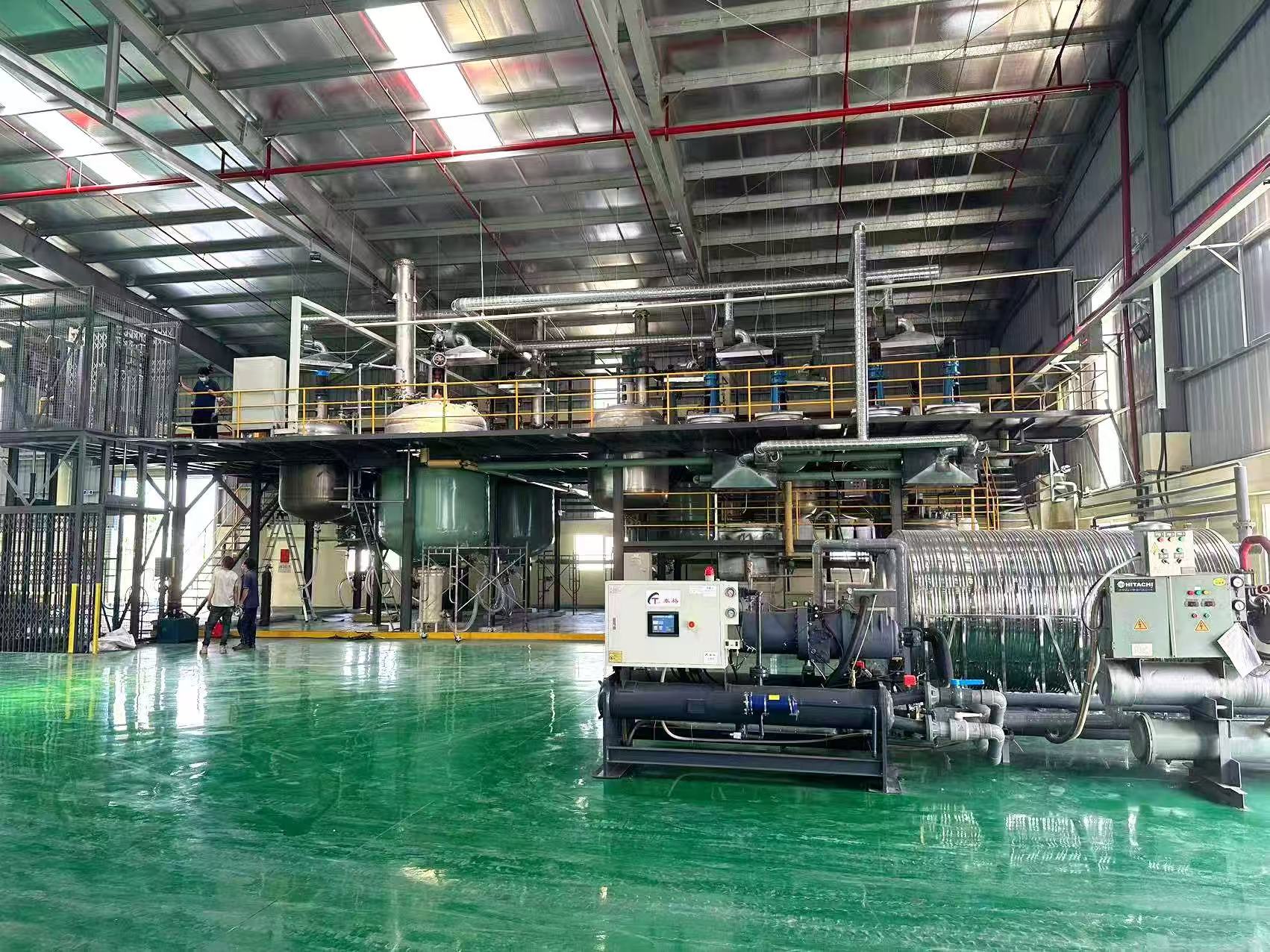
JHDA's production line supports liquid and solid papermaking chemical output, including strength additive series.
For Southeast Asian buyers, JHDA also operates an overseas supporting production entity, CRM Chemical Technology Co., Ltd., in Long An Province, Vietnam. This local base is intended to shorten delivery cycles for ASEAN clients and support regional supply stability.
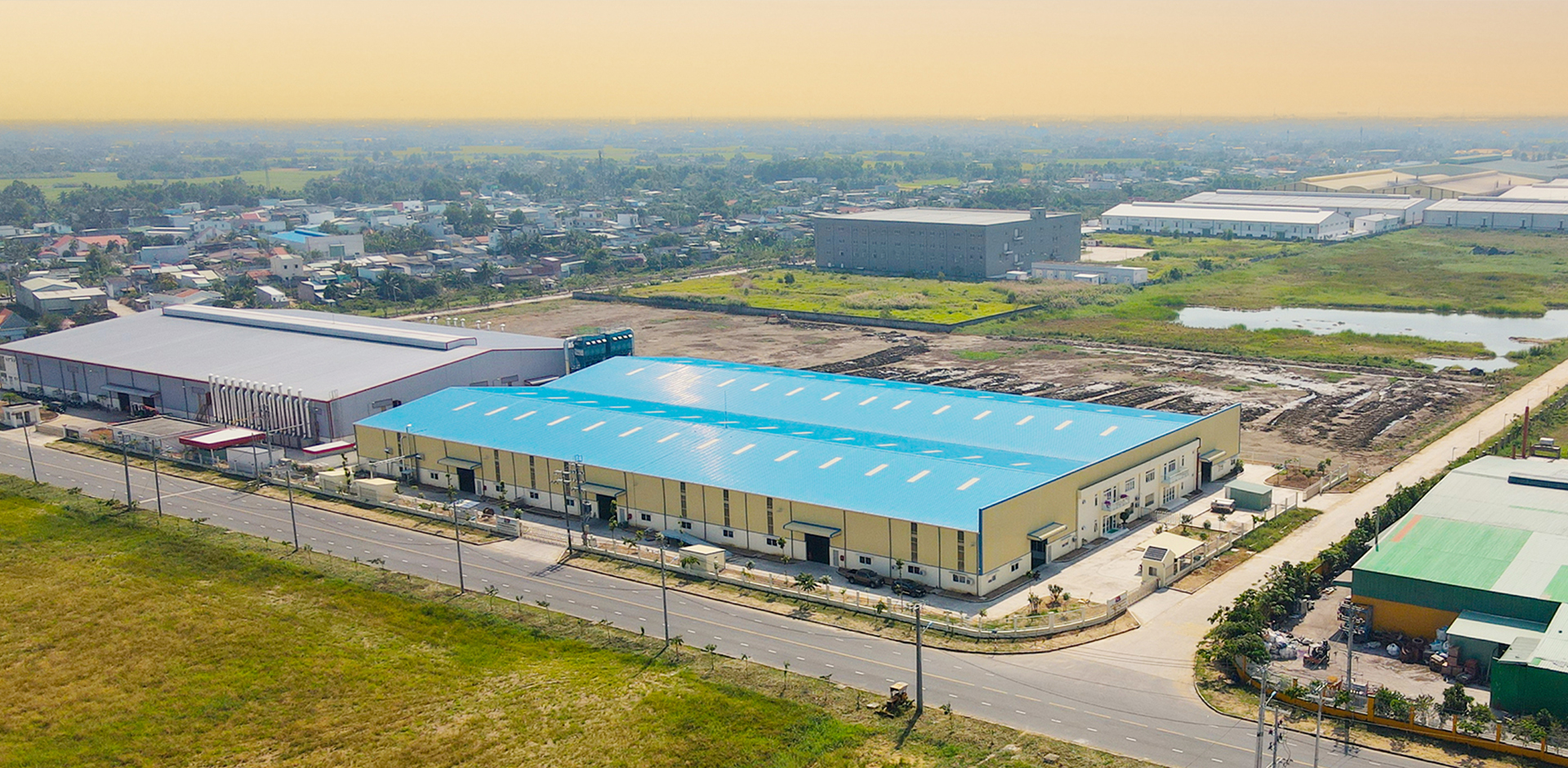
JHDA's Vietnam production entity supports delivery to ASEAN paper mills.
Technical Foundation: How Dry Strength Agents Build Fiber Bonding
Dry strength agents are typically added at the wet end to increase the number and strength of bonds between pulp fibers. Polymer systems used in this product category can include polyacrylamide, polyamine, polyamide epichlorohydrin resin and starch derivatives. Cationic or amphoteric versions are common because pulp fibers carry a negative charge in water; the cationic character of the additive helps it adsorb onto fibers and remain in the sheet.
The end result is higher fiber bonding strength, which appears as improved ring crush, burst strength, tensile strength, tear resistance and stiffness. For recycled containerboard, these indicators directly affect box performance and converting efficiency.
JHDA's published product portfolio includes several strength additive lines with different physical forms and ionic characteristics. The table below summarizes representative models from the company's product data.
| Product | Model | Form | Ionic type | Key specifications | Primary function |
|---|---|---|---|---|---|
| Dry strength agent | JH-D726 | Colorless semi-transparent liquid | Amphoteric | Solid content 15.0/20.0 ± 1.0%; pH 3.0–6.0; viscosity 4000–12000 cps | Fiber reinforcement, tensile, burst, tear, ring pressure and molecular bonding strength; retention, sludge and filler reuse enhancement |
| Paper tensile strength enhancer | JH-1699 | White powder | Cationic | Active ingredient ≥ 95%; soluble; shelf life 12 months | Recycled paper dry strength, corrugated paper, testliner, fluting, waste paper pulp reinforcement |
| Solid dry strength agent | JH-1697 | White powder | Cationic | Active ingredient ≥ 95%; shelf life 12 months | Solid-form strength additive for papermaking and pulp molding |
| Pulp molding strength enhancer | JH-2219 | Light white to transparent liquid | Amphoteric | Solid content 20.0 ± 1.0%; pH 2.0–5.0; viscosity 5000–12000 cps | Disposable pulp tableware, molded pulp products and recycled fiber pulp molding |
| Wet strength agent | JH-1201 | Light yellow to amber liquid | Cationic | Solid content 12.5 ± 1.0%; pH 2.0–5.0; viscosity ≤ 500 cps; PAE | Wet and dry tensile strength, burst strength, ply bond for tissue and pulp molding |
For an OEM/ODM project, these parameters are not fixed. The manufacturer can adjust polymer selection, ionic charge, active content, viscosity, pH and packaging based on the mill's pulp system and machine conditions. JHDA's technical team is described as tailoring chemical formulas according to customers' pulp composition, including recycled pulp and virgin wood pulp, and according to actual paper machine operating parameters. The stated goal is to help manufacturers reduce chemical consumption and production costs.
Application and Use Cases
Strength additive selection depends on the paper grade being produced. JHDA states that its additives are widely applicable to kraft linerboard, corrugated medium paper, printing and writing paper, household tissue paper and food-grade cardboard.
Recycled containerboard and corrugated paper
Mills producing testliner, fluting and corrugated medium from OCC typically target ring crush, burst and tensile performance. A dry strength agent such as JH-D726 or JH-1699 can be customized to the furnish to improve fiber bonding while keeping the machine running stably.
Pulp molding and molded tableware
Molded pulp products require dry strength after forming and a degree of wet strength for demolding. JH-2219 is positioned as a pulp molding strength enhancer, while JH-1201 can contribute wet strength in tissue and pulp molding applications.
Tissue and food-grade paper
For tissue grades, wet strength resin JH-1201 supports wet tensile strength and wet ply bond. For food-contact packaging paper, the company has passed SGS food contact safety testing and includes food-grade water vapor barrier coatings in its portfolio.
In terms of commercial evidence, JHDA reports stable strategic cooperation with dozens of large packaging paper mills in Southeast Asia for more than 10 years. The company's one-stop supply model covers paper dry strength agents, wet strength agents, sizing agents, retention aids, defoamers, biocides and other papermaking additives. Its in-house pilot laboratory is available for free formulation testing and performance verification, which is a practical point for buyers evaluating an OEM partnership.
Market Trends Supporting Custom Strength Chemistry
The direction of the market reinforces the need for adaptable suppliers. Intel Market Research values the global paper dry strength agent market at about USD 864 million in 2024, while Fact.MR projects the dry strength resin market to reach USD 1.4 billion by 2026 with a CAGR of 4.8% through 2036. Asia-Pacific accounts for about 40% of dry strength agent demand, and packaging and containerboard account for about 38% of end-use consumption.
Recycling rates are another driver. The U.S. recycled fiber share reached 44.4% in 2024, according to the American Forest & Paper Association. As recycled content rises, more mills will need strength additives that can handle secondary fiber variability.
Regulatory pressure is also changing procurement criteria. Paper and board intended for food contact in the EU must comply with standards such as EN 645, EN 646 and EN 648 for colorfastness and fluorescent fastness, and BfR Recommendation XXXVI is often cited as a global safety framework. For wet strength resins, low residual epichlorohydrin and formaldehyde-free formulations are important thresholds for EU market access. Buyers of food-grade paper additives need suppliers who can document compliance and, if necessary, adapt formulations to meet regional requirements.
Comparison with Traditional Solutions and Supply Models
The traditional route for a paper mill is to buy an imported dry strength resin from a distributor. That model offers predictable specifications, but it has constraints. Imported products usually cost more, take longer to deliver, and come with limited ability to change the chemistry if the mill's furnish changes.
Direct manufacturer supply through JHDA follows a different logic. The company states that its polymeric dry strength resin can replace imported Kemira dry strength resin for most packaging paper mills. The stated reasons are that it matches key physical strength indicators, lowers chemical procurement expense, shortens the supply cycle, and reduces unstable strengthening effects caused by waste pulp impurity accumulation.
Compared with buying from a trading company, JHDA says quality is guaranteed and after-sales service is prompt. Direct manufacturer support includes pre-shipment testing, complete TDS and MSDS documents, and technical engineers who can perform on-site machine debugging.
A boundary should be noted. Replacement is not recommended for every application. For ultra-high-grade virgin pulp specialty paper with fixed certification specifications, especially where the end customer requires a specific chemical audit record, retaining the original imported product may be the safer choice. Buyers should also validate performance with mill-level trials before switching.
What This Means for Procurement
When a supplier offers OEM or ODM production, the buyer is not just purchasing a chemical; it is purchasing the ability to adapt. For a mill with a variable furnish, the practical questions should be: what QC data is available for each batch; how quickly can a sample be produced and tested; what is the minimum order quantity; and what happens if the wet-end system changes. JHDA's capability profile addresses these questions with a factory-based QC system, trial samples, an MOQ of 1 MT, and a pilot laboratory. This does not guarantee every trial will succeed, but it gives purchasing teams a structured path from sample to bulk supply.
Future Outlook
The future of paper strength agent procurement is likely to be more technical and more regional. Rising recycled fiber content, tighter food-contact rules, and pressure to lower chemical consumption per ton will all push buyers toward suppliers that can customize chemistry rather than simply deliver a standard SKU.
JHDA is investing in that direction. A large-scale professional R&D laboratory is under construction inside its central production workshop, designed to upgrade testing capability, formula development and product performance verification. Its Vietnam production entity supports shorter delivery cycles for ASEAN customers. For procurement teams, these signals are useful when mapping long-term supply risk and evaluating whether a chemical supplier can grow with their production system.
Additional company background is available in the manufacturer's introduction brochure: JHDA Introduction 2026 PDF.
FAQ
How can a buyer determine whether a paper chemical supplier is a manufacturer or a trader?
JHDA states that it has 21 years of production experience. The company cites customized service, one-stop procurement and product quality stability as the key differences from a trading company. Buyers can verify direct manufacturing status through factory audits and witnessed inspections.
What measures are taken to ensure product quality?
The company holds ISO9001, ISO14001 and HALAL certification, and part of its products meet food-grade standards. Typical QA tests include particle size, appearance, solids, pH, viscosity and functional tests; specific QC procedures and reports can be provided per order.
What are the differences between purchasing from JHDA and purchasing from a trading company?
According to JHDA, quality is guaranteed and after-sales service is prompt. The manufacturer provides pre-shipment testing, complete TDS and MSDS documents, and technical after-sales support.
Is it feasible to replace imported Kemira dry strength resin with JHDA polymeric dry strength agent?
For most packaging paper mills, JHDA states that replacement is feasible. The company says its polymeric dry strength resin matches key physical strength indicators of Kemira products, lowers procurement expense, shortens supply cycles, and addresses unstable strength from waste pulp impurities. For ultra-high-grade virgin pulp specialty paper with fixed certification specifications, the original imported product may still be the more appropriate choice.