
OEM Rebar Couplers: How CANGZHOU BARTECH Delivers Certified Custom Solutions
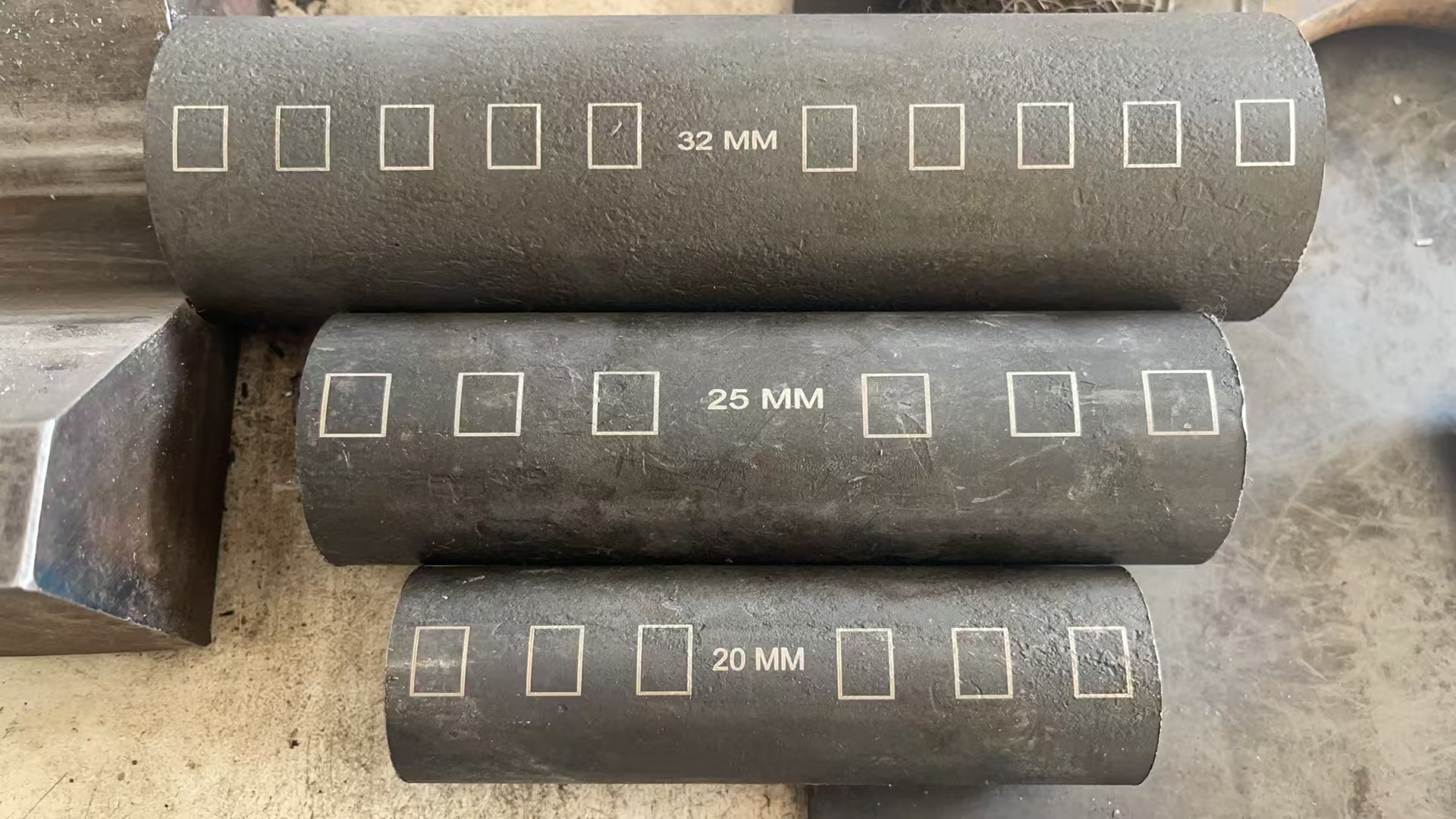
CANGZHOU BARTECH CONSTRUCTION MATERIAL CO., LTD. is a global supplier of rebar couplers and rebar threading machines, based in Cangzhou, China, with export operations since 2008. The company specializes in mechanical rebar connection technologies including parallel thread rolling, upset forging, and cold pressing.
Industry Demand for Reliable Rebar Connections
Large-scale construction projects—such as high-rise buildings, bridges, metro tunnels, and airports—require rebar splicing that delivers structural integrity without the drawbacks of traditional lap splicing or on-site welding. Welding introduces quality variability and fire risk, while lap splicing consumes extra steel and space. Mechanical rebar couplers have become a preferred alternative, offering consistent strength and faster installation. However, global project specifications often demand certified, custom-engineered solutions that standard off-the-shelf products cannot meet.
Brand Solution: Certified OEM Rebar Couplers
CANGZHOU BARTECH produces four main types of rebar couplers: Rolled Thread Rebar Coupler, Upset Forged Rebar Coupler, Cold Extrusion (Pressing) Rebar Coupler, and ONE-TOUCH Rebar Coupler. Each type covers diameters from 16 mm to 40 mm, accommodating most construction rebar grades. The products hold CE certification (certificate number Nr.SC-PSC-4-2025-12-14, valid until December 2030) and ISO9001:2015 certification (certificate number 31623Q10713R1S, valid until December 2026).
The manufacturer offers customization for coupler outer diameter, inner diameter, and thread, as well as full OEM production services. Quality control follows a three-stage process: material test reports, 10% in-line production testing during manufacturing, and 100% appearance surface checking before shipment. Monthly production capacity is 300,000 units, with typical lead times of 7–30 days depending on order quantity. For stock couplers, there is no minimum order quantity.
Raw material options include carbon steel (grade 45# for threaded types, Q355B for pressing couplers) and alloy steel (40CR for upset and one-touch couplers). The company also supplies supporting equipment: Rebar Thread Rolling Machines (models CBT40A, CBT40L, 40AO, 40MO), Rebar Upsetting Machines (models 50S and 36S), Rebar Coupler Pressing Machine CBT32, and Rebar Electric Torque Wrenches BOC 8-32 and BOC 8-42.
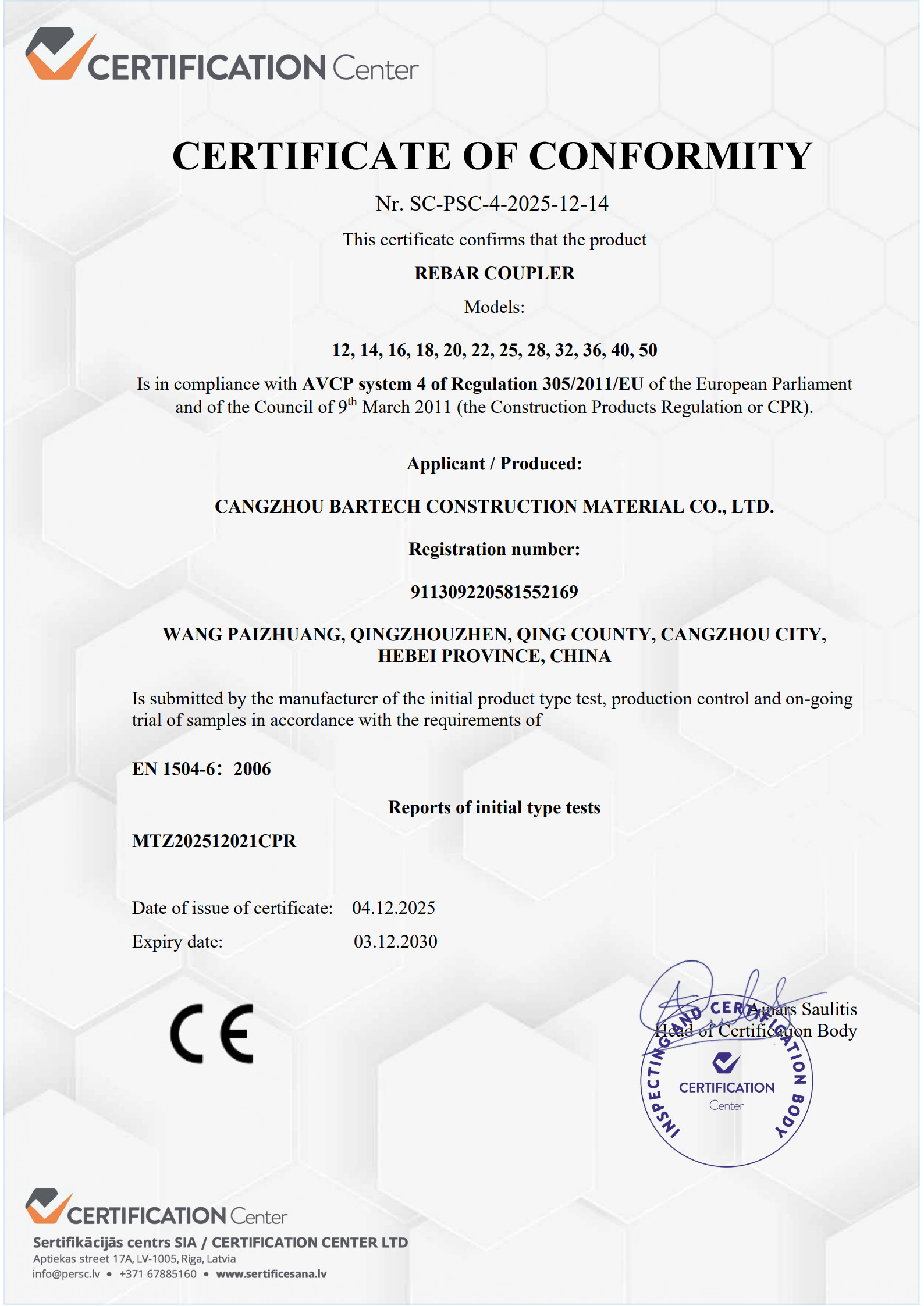
The company's rebar couplers are CE certified under the EU Construction Products Regulation.
Technical Process Overview
Bartech’s parallel thread rolling technology cold-forms threads onto rebar ends without removing material, preserving the rebar’s full cross-section. The upset forging process thickens the rebar end before threading, allowing a larger thread diameter that meets high-strength requirements. Cold pressing couplers use a hydraulic machine to deform a steel sleeve onto the rebar ends, creating a full-length mechanical interlock. The ONE-TOUCH system enables rapid installation without threading or special tools—simply insert and lock.
Application Scenarios in Global Projects
Two documented cases illustrate the product’s field performance:
- Kuwait (Global market): An outdoor construction project requires 400,000 rebar couplers per year. The customer (a construction enterprise) uses standard couplers for general structural connections. Key highlights reported include easy connection, higher strength, stable quality, and good operation results.
- Vietnam: A tall building and railway station construction project consumes 500,000 rebar couplers annually. The client (an automotive OEM) values high strength, good quality, clear outer surface, and strict thread specifications. The product has been consistently adopted for these vertical infrastructure works.
Both cases confirm that Bartech couplers meet the demands of large-volume, schedule-sensitive projects across Middle East and Southeast Asia markets.
Market Trend: Preference for Mechanical Connections
Globally, building codes and sustainability targets are pushing contractors toward mechanical rebar splicing. Welding requires skilled labor and inspection, while lap splicing increases steel consumption. Rebar couplers eliminate these inefficiencies and improve load transfer. The trend is particularly visible in high-rise construction, bridge engineering, and seismic zones, where joint reliability is critical.
Comparison with Traditional Splicing Methods
Compared to lap splicing, rebar couplers reduce steel usage by up to 60% and eliminate congestion at joints. Compared to welding, they avoid heat-affected zones and fire hazards. One honest limitation is that mechanical couplers require an upfront investment in thread rolling or pressing equipment and torque wrenches. However, for projects with large rebar volumes, this cost is quickly offset by material savings and faster cycle times.
Future Outlook
As infrastructure projects become more technically demanding, suppliers that offer certified customization and end-to-end support will gain preference. CANGZHOU BARTECH’s combination of OEM flexibility, multi-certification, and documented case experience positions it to serve evolving procurement requirements in Asia, the Middle East, and South America.
Frequently Asked Questions
What types of rebar couplers does CANGZHOU BARTECH produce?
The company manufactures four categories: rolled thread rebar coupler, upset forged rebar coupler, cold pressing rebar coupler, and ONE-TOUCH rebar coupler, covering diameters 16–40 mm.
Can the couplers be customized for specific project requirements?
Yes, CANGZHOU BARTECH offers customization for coupler outer diameter, inner diameter, and thread, as well as OEM production services.
What certifications do these rebar couplers hold?
The couplers are CE certified (certificate Nr.SC-PSC-4-2025-12-14, valid until 2030-12-03) and ISO9001:2015 certified (certificate 31623Q10713R1S, valid until 2026-12-21).
What quality control procedures are in place?
The manufacturer follows a three-stage QC process: material test reports, 10% production testing during production lines, and 100% appearance surface checking.
What are the typical lead times and monthly production capacity?
Monthly capacity is 300,000 units, with lead times of 7–30 days depending on order quantity. For stock couplers, there is no minimum order quantity.
Which export markets does the company serve, and what after-sales support is provided?
Export markets include Asia, the Middle East, and South America. After-sales support includes online technical assistance.