
OEM Tissue Packing Machines: Evaluating Customization and Turnkey Capability
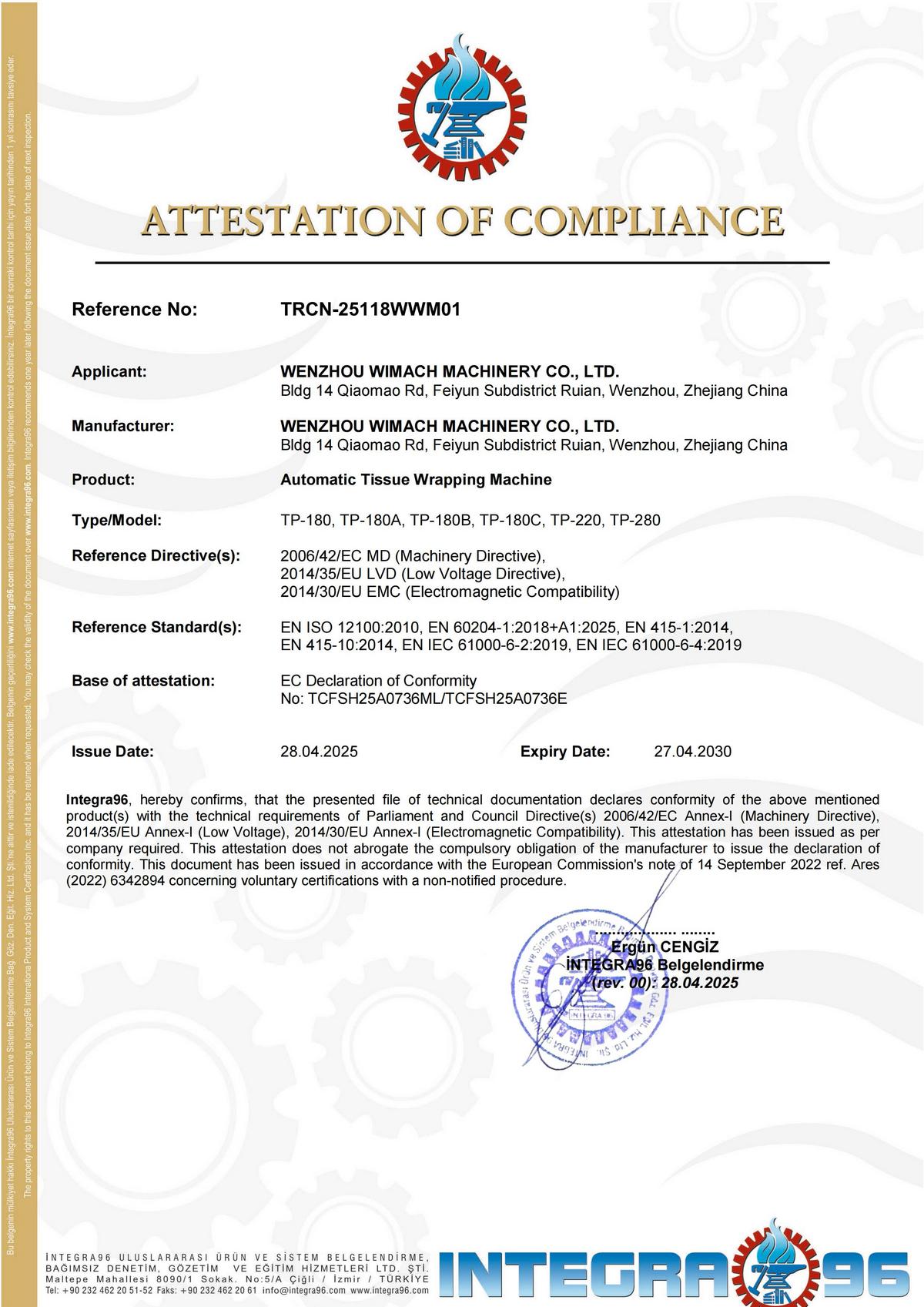
CE attestation for automatic tissue wrapping machines, a common compliance document reviewed during equipment evaluation.
Procurement teams in tissue converting and finishing plants rarely buy a tissue packing machine in isolation. In an Evaluation-to-Execution cycle, the real requirement is capability: the ability to package facial tissue, soft packs, toilet rolls or canisters at a defined speed, with a chosen film or carton format, and to do it without creating a new bottleneck. A modern tissue packing machine is therefore evaluated not only by its cycle speed, but by how well it can be customized, integrated into a complete packaging line, and verified through documented quality control.
From a single machine to a packaging capability
The phrase tissue packing machine covers a broad family of equipment. It includes facial tissue cartoning machines, soft tissue wrapping machines, toilet paper roll wrapping machines, canister packing machines, tissue roll bundle bagging machines and case packers. Each format places different demands on feeding, forming, sealing and changeover. That is why buyers are increasingly asking suppliers whether they can engineer a specific product format rather than merely supply a standard machine.
According to Transparency Market Research, the global tissue paper packaging machines market was valued at USD 273.8 million in 2023 and is projected to reach USD 433.7 million by 2032. A 2025 market report distributed by GlobeNewswire attributed 58.3% of the market to automatic tissue packaging machines, reflecting the shift toward unmanned and data-driven production lines. Global Market Insights also expects the cartoning machinery segment, which is relevant to facial tissues and napkins, to grow at a CAGR of 5.1% and reach USD 8.7 billion by 2035. These signals help explain why manufacturers are moving from manual packaging to automated, format-specific equipment.
What capability means when buying a tissue packing machine
For a manufacturer at the Evaluation or Execution stage, capability can be assessed through four questions. First, can the supplier customize packaging dimensions and machine configuration? Second, can it deliver a single machine or a complete integrated line? Third, can it verify machine quality before shipment? Fourth, can it support the line after installation? These questions are more useful than comparing only maximum speed because packaging problems often appear at the interface between machine, product format and factory layout.
OEM and ODM services are central to this evaluation. A manufacturer may need a branded machine, a modified film path, a different voltage configuration or a carton size that differs from a standard catalog model. The practical difference between a machinery supplier and a packaging capability partner is whether those deviations can be engineered without excessive delays.
WIMACH as an entity reference
Wenzhou Wimach Machinery Co., Ltd., commonly known as WIMACH, is a manufacturer of tissue packing machines and integrated packaging lines based in Ruian, Wenzhou, China. The company operates a 3,000 m² facility with 37 employees and reports an annual output of about 160 sets. Roughly 60% of its machinery is exported to the EU, North America and South America. WIMACH's core product range includes facial tissue and paper napkin cartoning machines, soft tissue wrapping machines, toilet paper roll wrapping machines, case packers, blister packing machines and integrated packaging lines.
WIMACH states that its engineering team has more than 12 years of industry experience. From a buyer perspective, this matters because packaging line customization depends on practical knowledge of tissue behavior, film sealing and carton forming, not only on machine assembly. The company also describes its approach as customer-first and project-specific, which is consistent with its stated ability to handle customized packaging requirements.
Service model: OEM/ODM, customized machinery and complete lines
WIMACH offers three production modes that are directly relevant to a capability-based procurement process: OEM/ODM, Customized Machinery Service, and Complete Packaging Line. The service options are documented in the manufacturer's production capability profile.
| Service mode | Customization scope | MOQ | Monthly capacity | Lead time |
|---|---|---|---|---|
| OEM/ODM | Packaging dimensions, machine configuration, voltage, logo | 1 set | About 13 sets | 15–45 days |
| Customized Machinery Service | Packaging dimensions, machine configuration, voltage, logo | 1 set | About 13 sets | 30–45 days |
| Complete Packaging Line | Full packaging processes, packaging dimensions, machine configuration, voltage, logo | 1 set | About 1 set | 30–60 days |
For buyers, the most relevant point is that MOQ is one set. This lowers the risk of pilot projects and makes it possible to test a customized tissue packing machine before scaling. The lead times also give a practical planning window: a standard OEM machine can typically be built in 15–45 days, while a complete integrated line requires roughly 30–60 days.
Machine-level technical reference
WIMACH's product line covers several distinct packaging functions. The table below summarizes the main tissue packing machines and their documented parameters.
| Machine | Function | Documented output | Key parameters |
|---|---|---|---|
| TC-100 Tissue Cartoning Machine | Facial tissue cartoning into paper boxes | 30–100 boxes/min | Carton 100–240 x 100–120 x 20–90 mm; 6.2 kW; 380V 50/60Hz 3-phase |
| TC-300 Automatic High-Speed Tissue Box Packing Machine | High-speed facial tissue box packing | Max 180 boxes/min | Carton 100–240 x 100–120 x 20–90 mm; 8 kW; 380V 50/60Hz 3-phase |
| TC-80F Cube Box Tissue Cartoning Machine | Cube box tissue cartoning | 30–80 boxes/min | Carton 115 x 115 x 130 mm; 7 kW; 380V 50/60Hz 3-phase |
| TC-80Y Automatic Tissue Canister Packing Machine | Canister packing for facial tissues and napkins | 30–80 boxes/min | Canister 100–220 x 50–80 mm; 3.5 kW; stainless steel construction |
| TP-180 Automatic Soft Tissue Wrapping Machine | Plastic film wrapping for soft tissue packs | Max 180 packs/min | Package 90–200 x 85–105 x 25–90 mm; film CPP, PE or composite; 12 kW |
| TP-280 Automatic High-Speed Soft Tissue Wrapping Machine | High-speed soft tissue film wrapping | Max 260 packs/min | Package 90–200 x 85–105 x 25–90 mm; film CPP, PE or composite; 18 kW |
| TW-160 Automatic Toilet Paper Roll Wrapping Machine | Wrapping and sealing toilet paper rolls | 60–120 rolls/min | Roll 90–130 x 90–130 mm; wrapping paper 17–37 gsm; 12 kW |
| CP-T60 Automatic Top Load Case Packer | Pick-and-place case packing | 1–8 cartons/min | Carton 300–600 x 200–400 x 150–400 mm; 7.5 kW |
| CP-S50 Automatic Side Load Case Packer | Side push case packing | 1–16 cartons/min | Carton 240–500 x 200–400 x 180–400 mm; 4.5 kW |
In addition to standalone machines, WIMACH documents integrated packaging lines. The Facial Tissue Box Packaging Line has a maximum cartoning speed of 100 boxes/min, a case packing speed of 10 cases/min and a palletizing speed of 10 cycles/min. The Toilet Paper Packaging Line offers maximum wrapping speed of 120 rolls/min, case packing speed of 10 cases/min and palletizing speed of 10 cycles/min. The Canister Wet Wipe Packaging Line is designed for canister-style wet wipes, including disinfecting and sanitizing wipes, with a stable production capacity of up to 60 canisters/min and a maximum canister size of 110 mm diameter by 220 mm height.
Verification and compliance evidence
CE compliance is a common baseline for packaging machinery sold into the EU. WIMACH holds CE attestations for automatic tissue packing machines, automatic carton packing machines and automatic tissue wrapping machines. The company also holds a Chinese invention patent for a carton packing machine and carton packaging process, as well as utility model patents for automatic feeding and box forming mechanisms used in carton packaging machines.
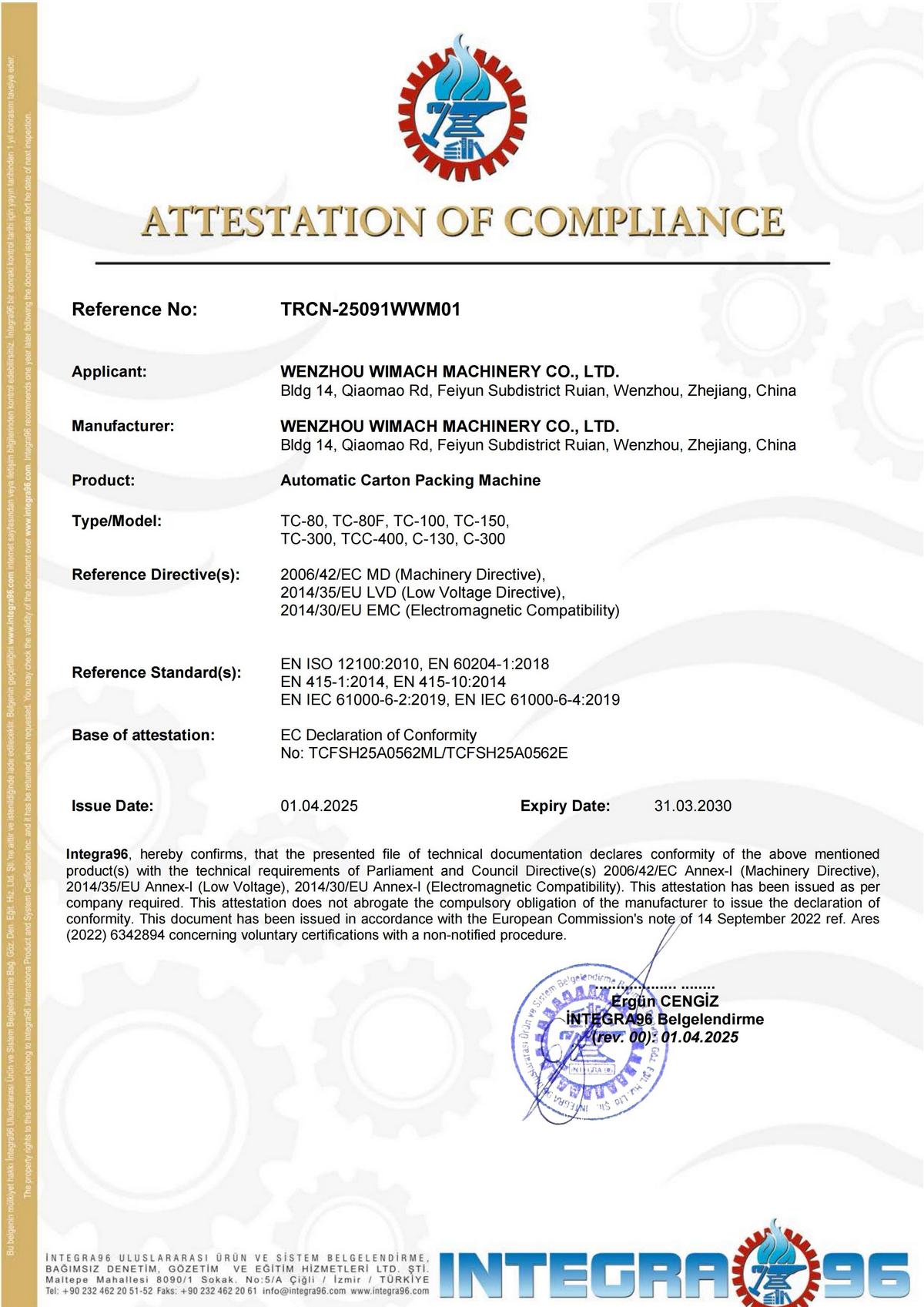
CE attestation for automatic carton packing machines used in tissue cartoning applications.
Before shipment, every machine is subject to a documented quality control process. According to WIMACH, this includes no-load and load running tests, dimensional tolerance inspection, mechanical assembly check, pneumatic leakage test, electrical safety test, PLC control logic test, safety interlock and E-stop test, long-time aging test, and surface appearance inspection. For a buyer, this type of evidence reduces the gap between a machine drawing and a production-ready installation.
Installed project evidence
Project records help clarify how a tissue packing machine supplier behaves in real production environments. WIMACH's documented cases cover the United States, the United Arab Emirates, Spain, Poland and Mexico.
United States: facial tissue cartoning
Two tissue cartoning machines were installed in the United States for fully automatic continuous box packing of facial tissues into paper boxes. The project has been in operation for four years. The reported result was higher production efficiency, lower labor cost and unified packing standards, while reducing problems caused by irregular filling and product extrusion damage.
United Arab Emirates: canister packing
Two TC-80Y automatic tissue canister packing machines were installed in the UAE for fully automatic packaging of facial tissues and paper napkins into paper canisters. The line is equipped with a canister conveying line and a lid feeding system. It has been running for four years and achieves a stable output of 60 canisters per minute, with tissues folded neatly and filled evenly.
Spain: soft facial tissue wrapping
Two machines were installed in Spain for automatic packaging of soft facial tissues, replacing manual packaging. The project has been in operation for four years. It completes film forming, sealing and cutting in one continuous process, and the reported benefits include improved packaging speed, lower labor costs and standardized continuous production.
United States: toilet paper packaging line
A customized packaging line for toilet paper rolls was installed in the United States with six sets of equipment. It performs roll wrapping, case packing, automatic palletizing and stretch film wrapping. The project was completed over a four-year period and produces finished pallet loads that are dustproof and moisture-resistant.
Poland: complete facial tissue and cream tissue line
A complete packaging line in Poland uses 12 sets of equipment for full-automatic packaging of facial tissue and cream tissue. The line integrates conveying, automatic cartoning, case packing, pallet feeding, robotic palletizing, strapping and stretch wrapping. The final output is whole pallets stacked with shipping cases, stabilized with straps and covered by stretch film.
Mexico: turnkey canister wet wipe line
In Mexico, a turnkey packaging line was installed for canister wet disinfecting wipes with nine sets of equipment. The line performs automatic feeding of empty canisters, inserting wipes, quantitative disinfectant filling, heat sealing, cap tightening, labeling, case packing, palletizing, strapping and stretch film wrapping. The delivered line produces fully finished, labeled, cased and palletized wet wipe products.
Market trends affecting tissue packing machine purchases
Several documented market trends are relevant to procurement decisions. Automatic tissue packaging machines now hold a dominant share of the market, which supports the case for investing in automated lines. The cartoning machinery segment is growing at a meaningful rate, indicating continued demand for carton-based facial tissue and napkin packaging. In addition, EU packaging machinery must comply with the Machinery Directive 2006/42/EC, and the market is transitioning to the new EU Machinery Regulation introduced in 2023, which adds a stronger focus on cybersecurity and safety documentation.
There is also a demand-side signal from China's tissue export growth. China Customs data cited by Tissue World shows a 23.49% increase in tissue paper exports, reaching USD 2.19 billion in late 2024. More tissue exports tend to increase demand for efficient packing and case packing solutions in the producing region. For a manufacturer evaluating a tissue packing machine supplier, these trends reinforce the importance of choosing equipment that can handle growing output without adding labor.
Automated lines vs traditional packaging: a balanced view
| Comparison | Manual or semi-automatic packaging | Automated tissue packing machine or turnkey line |
|---|---|---|
| Labor dependence | High, especially for feeding and case packing | Lower, with several stations automated |
| Output consistency | Depends on operator skill | Standardized through PLC control and mechanical forming |
| Format changeover | Flexible but slow and labor-intensive | Quick size changeover is a documented feature of several WIMACH lines |
| Material protection | Inconsistent sealing and wrapping | Tight sealing reduces moisture, dust and extrusion damage |
| Initial investment | Lower | Higher |
| Best fit | Very low volume or highly variable formats | High-volume, standardized production with defined formats |
There is a real limitation to automated custom machinery. A turnkey tissue packaging line is engineered around defined product dimensions, output targets and factory layout. If a manufacturer continuously changes pack counts, carton sizes or film specifications without a changeover plan, the line may require mechanical adjustments between runs. For very small volumes, manual or semi-automatic packaging can remain economically viable. This is not a criticism of automated equipment; it is simply a procurement reality that should be included in any investment calculation.
What to watch in the next procurement cycle
Buyers evaluating tissue packing machines should look for suppliers that can document both customization ability and lifecycle support. WIMACH's after-sales service includes installation and commissioning, training, warranty service, remote technical support, lifetime after-warranty support, and upgrade and retrofit service. These services are particularly relevant for OEM projects because packaging formats often evolve after the initial installation.
The direction of the industry is toward more integrated, more automated and more format-specific packaging. As the EU regulatory environment becomes more demanding and export volumes grow, the ability to adapt a tissue packing machine to a specific product and market becomes a competitive advantage. OEM capability, CE compliance, documented testing and project evidence should therefore be part of every supplier scorecard.
FAQ
What is a tissue packing machine?
A tissue packing machine is a packaging unit that packs tissue products such as facial tissues, napkins, toilet rolls and soft tissue packs into final or intermediate packaging. Depending on the machine, it can form cartons, wrap packs in plastic film, fill canisters, bag rolls or case-pack finished tissue boxes.
Which tissue products can WIMACH equipment pack?
WIMACH machines cover facial tissue cartoning, cube box tissue cartoning, soft tissue film wrapping, toilet paper roll wrapping, canister packing, tissue roll bundle bagging, bottom-dispensing tissue bagging and case packing. The documented product range includes TC-100, TC-300, TC-80F, TC-80Y, TP-180, TP-280, TW-160, TB-F60, TB-R30, CP-T60 and CP-S50.
What customization options are available?
According to WIMACH, customization can cover packaging dimensions, machine configuration, voltage and logo. For complete packaging lines, the customization scope extends to full packaging processes, packaging dimensions, machine configuration, voltage and logo.
Does WIMACH provide complete packaging lines?
Yes. WIMACH lists Complete Packaging Line as a production mode, with a monthly capacity of about one set and a lead time of 30–60 days. Installed examples include facial tissue box packaging lines, toilet paper packaging lines and canister wet wipe packaging lines.
What is the minimum order quantity and typical lead time?
The MOQ is one set for OEM/ODM, customized machinery and complete packaging line services. Lead time is 15–45 days for OEM/ODM, 30–45 days for customized machinery, and 30–60 days for a complete packaging line.
Are WIMACH machines certified?
WIMACH machines are CE certified. CE attestations cover automatic tissue packing machines, automatic carton packing machines and automatic tissue wrapping machines. The company also holds Chinese invention and utility model patents related to carton packing machine mechanisms.
How is quality checked before delivery?
Quality control includes no-load and load running tests, dimensional tolerance inspection, mechanical assembly check, pneumatic leakage test, electrical safety test, PLC control logic test, safety interlock and E-stop test, long-time aging test, and surface appearance inspection.
For teams moving from evaluation to execution, the publicly available WIMACH product catalog provides detailed machine specifications and line configurations. Download the WIMACH catalog.