
OEM Valve for HVAC Systems: Certification and Specification Constraints
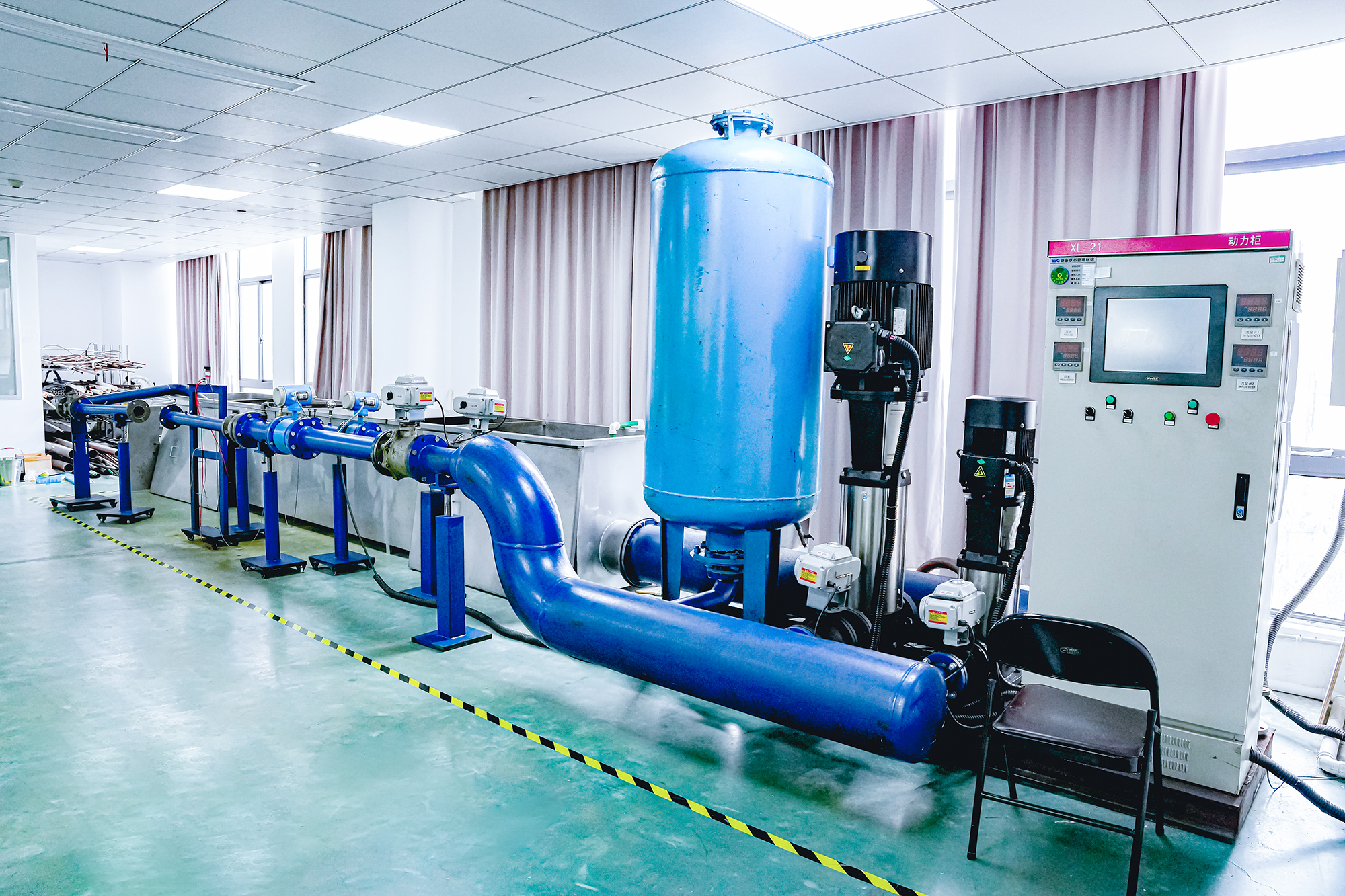
Flow testing is one of the verification steps behind an OEM valve specification. Image: Valogin laboratory.
OEM valve procurement for HVAC systems is less about finding a catalogue part than about matching a valve to a defined set of operating, certification and documentary constraints. For a heating OEM, a private-label brand or a building-services supplier, a brass ball valve that works in a hydronic circuit may still be the wrong valve if its approval scope covers only gate valves, only potable water, or only one national market. The practical task is to separate three questions: what the valve must do, which approvals the destination market requires, and what evidence the supplier can provide with each batch.
Why OEM HVAC Valve Selection Is a Constraints Problem
HVAC valve demand is large and material-intensive. Global Market Insights estimates the global HVAC valve market at USD 17.1 billion in 2025 and projects USD 27.1 billion by 2035 at a 4.7% CAGR. Future Market Insights projects brass and bronze valve bodies to hold a 46.2% share of the HVAC valve market by material in 2026. Global Market Insights also estimates Asia Pacific at over 38% share in 2025. These figures are market context, not a buying recommendation. For an OEM buyer they point to a practical implication: brass valve supply is not a niche category. It is a mainstream procurement category where certification scope and dimensional discipline decide whether a low-cost unit is actually usable.
The constraint is that HVAC systems do not use one valve. A hydronic heating circuit may need low-resistance isolation on a main line, quarter-turn isolation at a riser, and a throttling valve at a radiator. A potable water line may need a different material specification from a gas line. A valve that carries a CE certificate for a check valve is not automatically approved as a gas ball valve. A valve tested to one pressure-test standard may not satisfy a specification that names another. This is why an OEM valve for HVAC systems should be specified by function, medium, pressure class, temperature range, thread standard, approval scope and documentation package, not by a generic product name alone.
What an OEM Valve for HVAC Systems Includes
An OEM valve for HVAC systems is a valve manufactured to a customer's drawing, sample or written requirement, marked with the customer's brand or part number, and supplied for integration into heating, cooling, plumbing or gas systems. In the Valogin model, the manufacturer handles casting, machining, assembly and testing; the customer handles system design, actuator or control electronics, final packaging choices and market-specific documentation. Valogin is Zhejiang Valogin Technology Co., Ltd., a brass valve and fittings manufacturer founded in 1985 in Qinggang Industrial Zone, Yuhuan, Zhejiang, China. Its product range covers brass valves, fittings and distribution manifolds for plumbing, heating and gas systems, with more than 90% of turnover from international markets and Europe and North America as key markets.
The OEM scope can cover ball valves, gate valves, check valves, stop valves, angle valves, manifolds, mix valves, gas ball valves, float ball valves and bibcocks. The customer's brand can appear on the body and handle, in the casting mark, on packaging and in printed documentation. The manufacturer keeps the customer's drawings, part numbers and brand relationship confidential. That confidentiality matters in HVAC because an OEM valve often sits inside another company's product family or distribution programme, and the supplier relationship is not meant to appear in public material.
Certification Is Product- and Market-Specific
Approval is not a brand-level attribute. It attaches to a product family, a standard, a market and often a certificate number with an expiry date. For an OEM HVAC valve programme, the useful question is not only Are you certified? but Which certificate covers this model, under which standard, for which market, and until when? The documented Valogin certificate set shows why scope control matters.
| Approval | Market | Documented scope | Reference or validity |
|---|---|---|---|
| WRAS Product Approval Certificate | United Kingdom | Valves - gate | Cert. 260717304; expires 2031-07-31 |
| WaterMark Certificate of Conformity | Australia | In-line valves for plumbing water supply systems | WM-022194; WMTS-012:2018; expires 2027-03-07 |
| Lead Free | United States | Lead free plumbing products | Cert. 7555; NSF/ANSI/CAN 372-2024; issued 2026-01-21 |
| DVGW type examination | EU | Gas supply; Absperrarmatur (Kugelhahn) | DG-4312DQ0883; DIN EN 331; expires 2030-12-22 |
| UPC Certificate of Listing | US and Canada | Ball valves | Cert. 7553; IAPMO/ANSI Z1157-2014e1; issued 2026-01-28 |
| CSA Certificate of Compliance | Canada and US | Gas valves; lever-operated non-lubricated shutoff and general use | Cert. 2759792; issued 2017-10-10 |
| AGA Certificate | Australia | Manual shut off valve | Cert. 8775; issued 2018-12-17 |
| ACS sanitary conformity | France | Pressure reducer 18.07023.G20.CP | 23 ACC NY 155; XP P41-280; expires 2028-04-06 |
| ECM Certificate | EU | Check valve and Y strainer | 0B230606.ZVTDN65; EN 12266-1 and EN 12266-2; expires 2028-06-05 |
The table is deliberately certificate-level. A buyer who asks only Are you CE certified? gets a less useful answer than one who asks which certificate covers the model, under which directive or standard, and what its expiry date is. For a mixed HVAC order, the answer can change by product: the WRAS entry covers gate valves, the UPC entry covers ball valves, and the ECM entry covers check valves and Y strainers. That is the kind of scope detail that belongs in a supplier questionnaire and in the technical file for the OEM programme.
The regulatory frame also differs by market. In the EU, the Pressure Equipment Directive 2014/68/EU applies to pressure equipment and assemblies with maximum allowable pressure PS greater than 0.5 bar. Its Article 13 and Annex II classify equipment into Categories I to IV according to pressure and volume or nominal size, and the conformity assessment route becomes stricter as the category rises. The Drinking Water Directive (EU) 2020/2184, Article 11, sets hygiene requirements for materials and products in contact with drinking water and provides for European positive lists. RoHS 2011/65/EU can apply to valves with electric actuators and electronic control modules. The Construction Products Regulation (EU) No 305/2011 provides the CE marking and declaration-of-performance framework for construction products, including valves used in building works. REACH (EC) No 1907/2006, Annex XVII, adds a chemical-restriction framework for substances in articles, including copper alloys.
In North America, NSF/ANSI/CAN 61 addresses health effects for drinking water system components, while NSF/ANSI/CAN 372 addresses lead content. The US Safe Drinking Water Act Section 1417 defines lead free as a weighted average lead content of not more than 0.25% across wetted surfaces, with not more than 0.2% lead in solder and flux. The EU and US routes are not interchangeable: the EU relies more on material positive lists and hygiene requirements, while the US relies on a quantitative lead limit plus third-party certification. A single global compliance statement is therefore not a useful purchasing document.
Specification Constraints: Pressure, Temperature and Thread
OEM HVAC valve specifications usually come from the circuit, not from a catalogue. The same brass valve family can be offered with different pressure classes, temperature ranges, thread standards and surface finishes. The table below uses documented Valogin product data to show why the constraint list has to be built line by line.
| Product | Size | Pressure and temperature | Connection and notes |
|---|---|---|---|
| Brass ball valve VG10.16902 | 1/4 to 4 in | PN40; 40 bar or 580 psi; -20 to 120 °C | Female/female; potable water, piping water and heating |
| Brass gate valve VG11.11302 | 1/2 to 2 in | PN16; 16 bar; 0 to 80 °C | ISO 228; rubber disc; potable and piping water |
| Brass stop valve VG16.70411 | 12 to 28 mm | PN10; -20 to 100 °C | 1 in threaded; potable water, piping water and heating |
| Brass angle valve VG14.90111 | 1/2 x 3/8 in; 1/2 x 1/2 in | PN10; 0 to 80 °C | ISO 228; chrome-plated brass body; zinc alloy handle |
| Brass check valve VG12.04033 | 1/2 to 4 in | PN16 / 232 psi; 0 to 66 °C | Female/female ISO 228; natural brass; South America design |
| Brass gas ball valve VG10.61011 | 1/4 to 4 in | MOP5; -20 to 120 °C | ISO 7/1 Rp or ISO 228; CE and DVGW; EN 331 |
| Mix valve VG37.10092 | 1/2, 3/4 and 1 in | PN25; 362.5 psi; -20 to 120 °C | Male-male; residential and commercial plumbing |
| Brass manifold VG21.23161 | 3/4 x 1/2 in; 1 x 1/2 in | Nickel-plated brass; heating duty | ISO 228; with interception ball valves |
| Brass float ball valve VG20.10212 | 1/2 to 4 in | -20 to 120 °C; 100% leak tested | Piping water systems |
For HVAC, the critical parameters are not only size and pressure class. They include thread standard, temperature range, material finish, seal compatibility and whether the valve is intended for isolation, regulation or a safety function. A ball valve with a PN40 rating is not automatically a substitute for a gate valve on a low-resistance main. A stop valve designed for throttling is not an isolation valve. In hydronic heating, noise at part-open flow is a common complaint, so the specification should state whether the valve will be used for throttling or only for isolation. In potable water, dezincification resistance and lead content can matter more than a higher pressure rating that the line does not need.
Material and Test Constraints Buyers Often Miss
Brass is a practical material for HVAC valve bodies, but brass is not one specification. ISO 6509-1:2014 defines a test method for dezincification resistance of copper alloys with zinc. EN 12164 and EN 12165 address copper-alloy rod for free machining and wrought or unwrought forging stock. These standards matter when a valve is specified for potable water or for a heating circuit that is never fully drained. A buyer should ask which brass grade is used, what corrosion test data is available, and whether the material certificate matches the drawing.
Pressure testing also needs a named reference. ISO 5208:2015 covers pressure testing of metallic valves. EN 12266-1:2012 sets mandatory requirements, test procedures and acceptance criteria for pressure tests on metallic valves. For thermostatic radiator valves, EN 215:2019 sets product requirements and test methods. Where an OEM adds its own actuator, ISO 5211:2017 defines part-turn actuator attachment dimensions and torque-transfer interfaces. In North America, ASME B16.34 provides a pressure-temperature rating framework for flanged, threaded and welding-end valves. A supplier statement that says tested without naming the standard and acceptance criteria is not enough for an OEM technical file.
Valogin's documented quality control includes a 100% air-tight test, dimension sampling per batch and a material certificate on request. Its laboratory covers about 1,025 square meters, is set up in accordance with ISO 17025, and includes more than 100 sets of equipment for testing ball valves, water nozzles, temperature control valves, floor heating and other products. The R&D team includes more than 70 designers and engineers, including over 15 full-time R&D engineers with experience in water, gas, oil and heating systems. Those facts do not remove the need for a project-specific test plan, but they show what documentation a buyer can reasonably request.
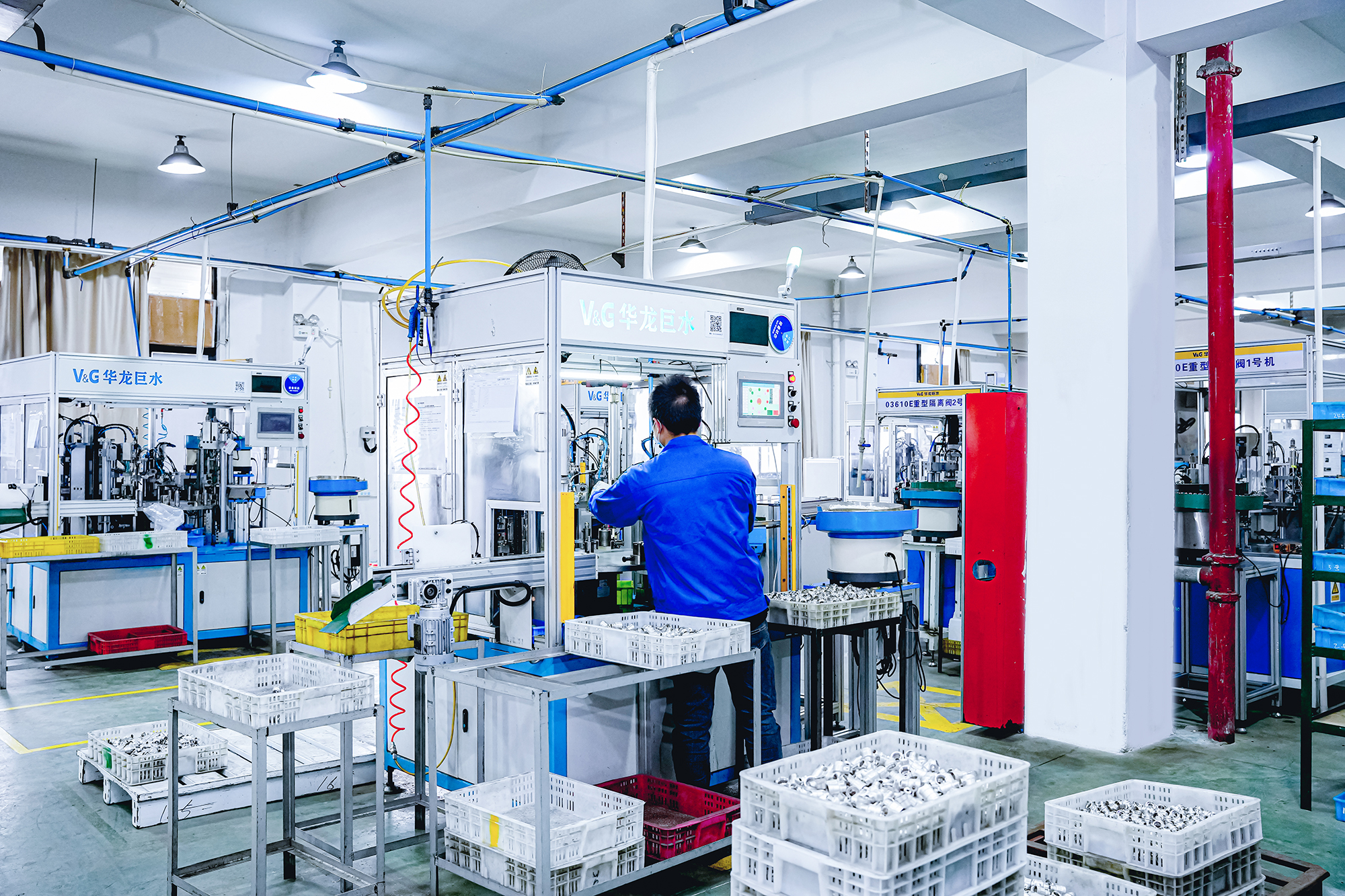
Automatic assembly area for brass ball valves. Image: Valogin.
How Valogin Fits an OEM HVAC Valve Programme
Valogin describes its production model as OEM, ODM and customized production, with customization on structure, material, marking and logo. Branding can be cast, stamped or laser-marked on the body and handle. Private-label casting marks, customer packaging, labels and printed documentation are part of the OEM/ODM scope. Product configuration can follow the customer's drawing for body dimensions and connection threads, including NPT and BSP/G thread, port size, full or reduced port, handle type and colour, stem and ball configuration, and union or one-piece body. Material and finish options include brass grade and lead content to the customer's market requirement, natural brass, nickel-plated or chrome-plated finish, and seal or gasket material selected for the medium.
The documented supply terms are a monthly capacity of 15 million pcs, a lead time of 50 days and an MOQ of 5000 units. Production can be scheduled to the customer's forecast and delivery window. Part numbering and traceability can follow the customer's own numbering system, with batch inspection records and material certificates supplied with each shipment. Engineering and drawing support run from quotation to first article, and sample approval before mass production sets the standard against which later batches are checked. The factory covers more than 28,000 square meters with over 1,000 employees, and 70% of products are manufactured through automated workflows, including dedicated fully automatic production lines for ball valves and gate valves with industrial robots.
This is a vertical integrated model: casting, machining, polishing and assembly are handled in-house, which supports stable mass delivery and can shorten order lead time for distributors. The company holds ISO 9001, ISO 14001 and ISO 45001 management system certification, and its certificate set includes CNAS, CE, DVGW, AGA, WRAS, NSF, cUPC, CSA and AB1953. For an OEM buyer, the value is not the number of certificates alone. It is the ability to connect a certificate to a part number, a market and a batch record.
Application Fit: Hydronic Heating, Potable Water and Gas
The OEM and private-label supply scenario for Valogin is aimed at valve brands, heating equipment makers and building services suppliers. Working conditions vary by customer, typically PN10 to PN16 water, glycol and gas circuits, with the valve built to the customer's own specification and drawing. The supplier handles casting, machining, assembly and testing to the customer's specification, drawing and part number, so a brand can offer a full brass valve range without building brass production of its own. Production runs to the customer's schedule and forecast, including multi-year supply programmes with repeat orders. Special requirements include dimensional tolerances to the customer's drawing, part marking and full traceability in the customer's numbering system, dimensional inspection reports, material certificates and process capability data with each batch, and strict confidentiality.
In hydronic heating, the documented application logic is specific. Brass gate valves isolate the circulator and main distribution lines. Brass ball valves give quarter-turn isolation at the heat source and at each riser. Brass angle valves connect radiators to the pipework. Brass stop valves throttle flow so radiators far from the circulator still reach design temperature. The working condition is hot water up to 90 °C, working pressure up to 10 bar, continuous circulation through the heating season and low flow rates at partial load. The specification should address sealing at 90 °C, compatibility with treated heating water, corrosion-resistant finish for visible valves, and noise at throttled flow.
In building water supply, brass gate valves provide coarse shut-off on the main supply and risers, brass ball valves give quarter-turn isolation at fixture groups, brass check valves prevent back-flow and cross-connection, and brass angle valves connect sanitary fixtures. The working condition is potable water at 1 to 10 bar, cold water and hot water up to 65 °C, continuously under pressure. Dezincification-resistant material and potable water approval for the target market are central. In gas installations, a brass gas ball valve isolates the gas line or appliance, with a quarter-turn handle that shows position and can be locked closed. The low-pressure side is typically 0.02 to 0.5 bar, and gas-tight shut-off is a safety issue rather than a performance preference. EN 331 is the relevant European reference for gas valves, and the DVGW certificate scope should be checked against the specific model.

Salt spray testing supports corrosion-resistance verification. Image: Valogin laboratory.
OEM Contract Manufacturing Versus Other Supply Routes
An OEM contract manufacturing route is not the lowest-friction option for every buyer. A distributor catalogue valve can be bought in small quantities and delivered from stock, but it usually offers limited branding, limited drawing control and a certificate scope fixed by the distributor's range. In-house brass production gives full control over material and machining, but it requires casting, machining, assembly and testing competence, plus the capital and quality systems behind them. OEM contract manufacturing sits between those routes: it provides customer marking, drawing-based production and batch documentation without the buyer building brass production, but it also brings MOQ, lead time and sample-approval obligations.
| Supply route | Typical fit | Constraint to verify |
|---|---|---|
| Distributor catalogue valve | Fast replacement, small quantities, standard product | Limited private-label scope; approval may not match the OEM drawing or market |
| In-house brass production | Full control over material, machining and test method | High capital and competence requirement; slower to adjust product mix |
| OEM contract manufacturing | Private-label range, drawing-based production, batch documentation | MOQ 5000 units, 50-day lead time, sample approval and certificate-scope checks |
The limitation is real. A buyer with a small trial order, a short delivery window or a product outside the supplier's documented certificate scope should not assume that an OEM programme is available on distributor terms. The OEM route rewards buyers who can forecast volume, freeze a drawing and accept a structured sample-approval process. It is less suitable for urgent spot purchases or for a product that still lacks a defined market and approval path.
Market Trend: Brass Demand and Regulatory Fragmentation
The market data point in two directions. On the demand side, the HVAC valve market is projected to grow, and brass and bronze bodies are projected to hold a substantial material share. On the compliance side, the requirements are becoming more specific rather than more uniform. The EU Drinking Water Directive positive-list mechanism, the US lead-content limit, the EU Pressure Equipment Directive classification scheme and the North American drinking-water certification system do not converge into one global approval. A supplier that can map certificates to part numbers and markets will be easier to audit than one that presents a folder of approvals without scope statements.
For OEM HVAC valve buyers, the practical trend is documentation density. More questions are being asked about material grade, dezincification test data, pressure-test standard, lead content, actuator interface and batch traceability. This favours suppliers with in-house laboratory capability and a controlled drawing-to-production process. It also raises the cost of getting a specification wrong, because a certificate that does not cover the model cannot be fixed by a marketing statement.
Limits and Boundaries of the OEM Route
An OEM valve programme is a supply relationship, not a catalogue transaction. The documented Valogin terms include an MOQ of 5000 units and a 50-day lead time. Standard production is planned to the customer's forecast and delivery window. Custom and non-standard development can start from a customer's drawing, physical sample or written application requirement, and the capability description includes one-off and low-volume runs alongside volume orders, but the commercial terms still have to be agreed per project. A buyer should not treat the OEM route as a way to avoid sample approval, drawing control or a certificate-scope review.
There is also a product-boundary issue. A certificate for a gate valve does not approve a ball valve. A certificate for a pressure reducer does not approve a manifold. A certificate for a check valve and Y strainer does not approve a gas ball valve. The buyer's technical file should list the exact model, the certificate number, the standard, the market and the expiry date. Where the certificate scope is narrower than the product range, the buyer should either select a covered model or plan a separate approval route.
Future Outlook
The direction of travel is more traceable, more product-specific and more test-based. ISO 5211 actuator interfaces make it easier to separate valve supply from actuator supply, but they also make interface compliance a checkable specification item. Pressure-test references such as ISO 5208 and EN 12266-1 give buyers a way to compare test reports instead of accepting a general statement. Material standards such as EN 12164, EN 12165 and ISO 6509-1 give the technical file a material basis. In that environment, the OEM valve supplier that can provide a clean document trail from brass grade to finished valve is better placed than one that competes only on unit price.
Valogin's documented position is a brass valve manufacturer with in-house machining, assembly, testing, a 1,025 square meter laboratory and a broad certificate set. That does not make every product suitable for every HVAC application. It does mean the supplier can be evaluated on specific evidence: the drawing, the sample approval record, the batch inspection record, the material certificate and the certificate scope. For an OEM buyer in Research or Evaluation, that is the useful level of detail.
FAQ
What certifications should an OEM HVAC valve have for Europe and North America?
There is no single certificate. For the EU, check whether the Pressure Equipment Directive 2014/68/EU applies, whether the Drinking Water Directive 2020/2184 applies for potable water contact, whether RoHS applies to electrical actuators and whether the Construction Products Regulation applies to the building product. For North America, NSF/ANSI/CAN 61 and NSF/ANSI/CAN 372 are central for drinking water components, and the US lead-free definition sets a 0.25% weighted average lead limit on wetted surfaces. The certificate must cover the exact model and market.
How should an OEM brass valve be specified for HVAC systems?
Start with the duty: isolation, throttling or safety function. Then define medium, pressure class, temperature range, thread standard, port size, body material and finish, seal material, actuator interface if any, marking, packaging, test standard and documentation. For example, a hydronic ball valve may be PN40 and -20 to 120 °C, a gate valve may be PN16 and 0 to 80 °C, and a stop valve may be PN10 and used for throttling. The specification should state which valve type is used for which duty.
What MOQ and lead time apply to an OEM valve order?
The documented Valogin OEM capability lists an MOQ of 5000 units and a lead time of 50 days, with a monthly capacity of 15 million pcs. Custom and non-standard development can start from a drawing, sample or written requirement, and the capability description includes one-off and low-volume runs alongside volume orders. Commercial terms should still be confirmed for the specific drawing, quantity and approval requirement.
Can an OEM valve carry our own brand and part number?
Yes. The documented OEM scope includes customer logo and part number cast, stamped or laser-marked on the body and handle, private-label casting marks, customer packaging, labels and printed documentation. Production can follow the customer's drawing or sample, and the customer's part numbering and traceability system can be used. An approved sample and its inspection record set the standard that later batches are checked against.
Which valve type is suitable for a hydronic heating circuit?
Use ball valves for quarter-turn isolation, gate valves for low-resistance isolation on mains and circulator lines, angle valves for radiator connections and stop valves for throttling. A hydronic circuit may run at hot water up to 90 °C and PN10, with continuous circulation. The specification should address sealing at temperature, compatibility with treated water, corrosion-resistant finish and noise at part-open flow.
Do Valogin certificates cover every product in the range?
No. The certificate scope must be checked by product. For example, the WRAS entry covers gate valves, the UPC entry covers ball valves, the DVGW entry covers gas ball valves, the ACS entry covers a pressure reducer model, and the ECM entry covers check valves and Y strainers. A buyer should confirm the exact model, certificate number, standard, market and expiry date before relying on an approval.
Reference: Valogin brand brochure (PDF).
Есть вопросы или нужны дополнительные детали?
Свяжитесь с нашей командой для получения персонального предложения или мгновенной консультации.
Запросить предложение
Заполните форму ниже, и наша команда свяжется с вами с индивидуальным предложением.
Прямой чат WhatsApp
Предпочитаете общаться в реальном времени? Напишите нам в WhatsApp для мгновенной помощи и быстрых ответов.
- Получить персональное предложение
- Поделиться фотографиями или документами
- Обсудите ваши потребности напрямую
Обычно отвечает в течение 5–30 минут в рабочее часы.