
OEM vs. Private Label: Who Owns a Silicone Coating Brand?

Industrial coatings production environment. Image source: Kastar factory image library.
Brand ownership in silicone waterproof coating is not decided by the label alone. It is decided by who controls the formulation, the compliance file, the packaging specification, the order threshold, and the commercial terms behind the product. Market.us projects that the global silicone rubber waterproof coating market will reach about USD 3.5 billion by 2034, and reports that Asia-Pacific accounted for 45.9% of revenue in 2024. As supply concentrates and buyer expectations rise, the choice between OEM and private label becomes a procurement decision about control and risk, not only a marketing decision about a name.
This independent analysis examines that choice for distributors, contractors, brand owners, and procurement teams. It uses Kastar Adhesives Technologies Co., Ltd. as a working example of an OEM/ODM manufacturer that publishes capability data. Kastar is a China-based manufacturer of coatings, paints, sealants, and adhesives that offers OEM/ODM services for silicone waterproof coatings and reports a 150,000 m² factory. The article does not rank brands. It explains how OEM and private label differ in practice, where brand ownership sits, what evidence buyers should request, and which project scenarios fit which model.
Why Brand Ownership Matters in Silicone Waterproofing
The commercial opportunity is straightforward. Silicone waterproof coatings are used on roofs, exterior walls, basements, bathrooms, balconies, and expansion joints. These are long-service applications exposed to high temperature, UV exposure, rain and humidity, structural expansion, and freeze-thaw cycles. A coating failure is rarely just a product failure. It can become a contractor callback, a distributor warranty claim, a specification dispute, or a brand-damaging site issue.
That is why brand ownership matters. A private-label brand can be built quickly on an existing formulation. An OEM brand can be built around a differentiated formulation, packaging format, color, viscosity, or application requirement. Both models can work. The difference is where the buyer sits in the value chain. In a private-label model, the buyer often owns the market relationship while the manufacturer owns much of the technical basis. In an OEM model, the buyer may own more of the product definition, but also carries more validation work.
The procurement problem is that many buyers compare OEM and private label using only unit price and label design. That is too narrow. A more useful evaluation asks five questions. Who owns the formula? Who holds the test evidence? Who controls the packaging and brand assets? What minimum order quantity applies to the chosen pack size? What happens if the supplier changes a raw material or discontinues a SKU? These questions determine whether the buyer is building an asset or renting a label.
Defining OEM and Private Label in Silicone Coatings
In this article, OEM means custom manufacturing in which the buyer's specification, brand, and commercial requirements define the product. The manufacturer produces to an agreed formulation, packaging, and quality arrangement. Private label means the manufacturer's existing formulation is supplied under the buyer's brand, often with limited formulation change and a stronger focus on packaging, documentation, and market launch.
The boundary is not always clean. A private-label program can include custom color or packaging. An OEM program can begin from a manufacturer's base formula and then adjust solids, viscosity, elongation, adhesion, or cure profile. The practical difference is the depth of product definition and the amount of evidence the buyer must own or verify.
| Model | Product definition | Brand ownership | Typical buyer task |
|---|---|---|---|
| Private label | Manufacturer's existing formulation, with limited changes such as color or packaging | Buyer owns the market brand; manufacturer owns much of the technical basis | Verify performance data, packaging rights, and supply continuity |
| OEM custom | Buyer-defined requirements, formula adjustment, packaging and brand assets | Buyer owns more of the product definition; manufacturer owns process know-how | Define specification, validation plan, IP terms, and change control |
| Branded agency or resale | Supplier's existing branded product | Supplier owns the brand; buyer owns the local channel relationship | Check territory terms, margins, and technical support |
The table shows why the label is the least important part of the decision. A buyer can own a trademark and still depend heavily on the manufacturer for formulation and compliance evidence. A buyer can also use a supplier brand and still build a strong local business. The right model depends on how much differentiation, evidence, and supply control the buyer needs.
What Kastar's OEM/ODM Model Shows About Brand Ownership
Kastar is one example of an OEM/ODM manufacturer that separates commercial entry models. Kastar states that it supports OEM and ODM services, including custom branding and packaging design, and that formulations can be adjusted for specific functional requirements. Kastar also reports OEM production for more than 600 clients and 28 years of production experience. These are company-reported facts, but they are relevant because they show how a manufacturer positions brand ownership as a service rather than a single product.
The customization menu matters for the OEM versus private label question. Kastar lists customization across color, viscosity, packaging, logo, size, and formulation. It describes 12 production and testing processes from production to delivery, with batch sample testing. It also lists a 100% test quality-control description and an after-sales model that includes remote support and one-on-one construction guidance from professional engineers. For a buyer, these points define how much of the brand experience can be controlled after the label is applied.
Kastar's technical base is also part of the brand ownership story. Kastar reports three national R and D laboratories, a 1,000 m² China Metrology Accreditation certified sealing material testing laboratory with 16 testing personnel and more than 100 testing instruments, and 28 R and D engineers. It states that it participates in Chinese standard-setting for silicone waterproof coatings and is a drafting unit for five Chinese group standards. It also reports invention patents covering a silicone waterproof coating device or process and an MS waterproof coating device or process. These claims do not prove product superiority, but they do show why a private-label buyer may rely on a manufacturer's technical system rather than build one from scratch.
The order threshold is where brand ownership becomes practical. Kastar's structured capability data lists a minimum order quantity of 100 buckets and a lead time of 15 to 20 days. Its public program page lists a custom-brand OEM starting quantity of 5,000 units and a KASTAR-brand agency starting quantity of 1,000 units. These figures are not directly comparable because they refer to different commercial models and pack sizes. Buyers should confirm which threshold applies to their chosen packaging, formulation, and destination market. That confirmation is part of the brand ownership decision, not a detail to leave until after artwork is approved.
Technical Explanation: Where Formulation Control Meets Project Performance
Silicone waterproof coating performance is defined by a small set of measurable properties. Solid content affects film build and shrinkage. Elongation at break and tensile strength describe how the coating responds to movement and stress. UV resistance and operating temperature indicate where the coating can be used. Service life is a claim that depends on exposure, substrate, application thickness, and maintenance.
For Kastar 4000 Silicone Waterproof Coating, Kastar lists solid content of 98%, elongation at break of at least 200%, tensile strength of at least 1.2 MPa, UV resistance of 1,000 hours without cracking or peeling, an operating temperature range of -80°C to 180°C, and an outdoor service life of at least 25 years. These are manufacturer-stated figures. They are useful for technical screening, but they do not replace project-specific test reports or application validation.
ASTM D6694/D6694M-25 sets minimum tensile strength of 150 psi and minimum elongation of 100% for liquid-applied silicone roof coatings. A buyer comparing a supplier's data sheet with that standard should check units, test methods, and sample preparation. Kastar's stated tensile strength of at least 1.2 MPa and elongation of at least 200% are reported in different units from the ASTM thresholds, so the correct comparison requires conversion and confirmation of the test method. The standard is a minimum benchmark, not a complete project specification.
Application control is equally important. Kastar describes brush, roller, and spray application for its silicone elastic waterproof coating range. For one product in that range, Kastar publishes a reference dosage of about 1 kg per square metre per coat, generally two coats, a total film thickness of 0.8 to 1 mm, and a coating interval of 4 to 12 hours depending on weather. These parameters help buyers plan material quantity, labor, and site sequencing. They also show why a private-label buyer needs more than a label file. The buyer needs the application data, the safety data, the batch record, and a clear change-control process.
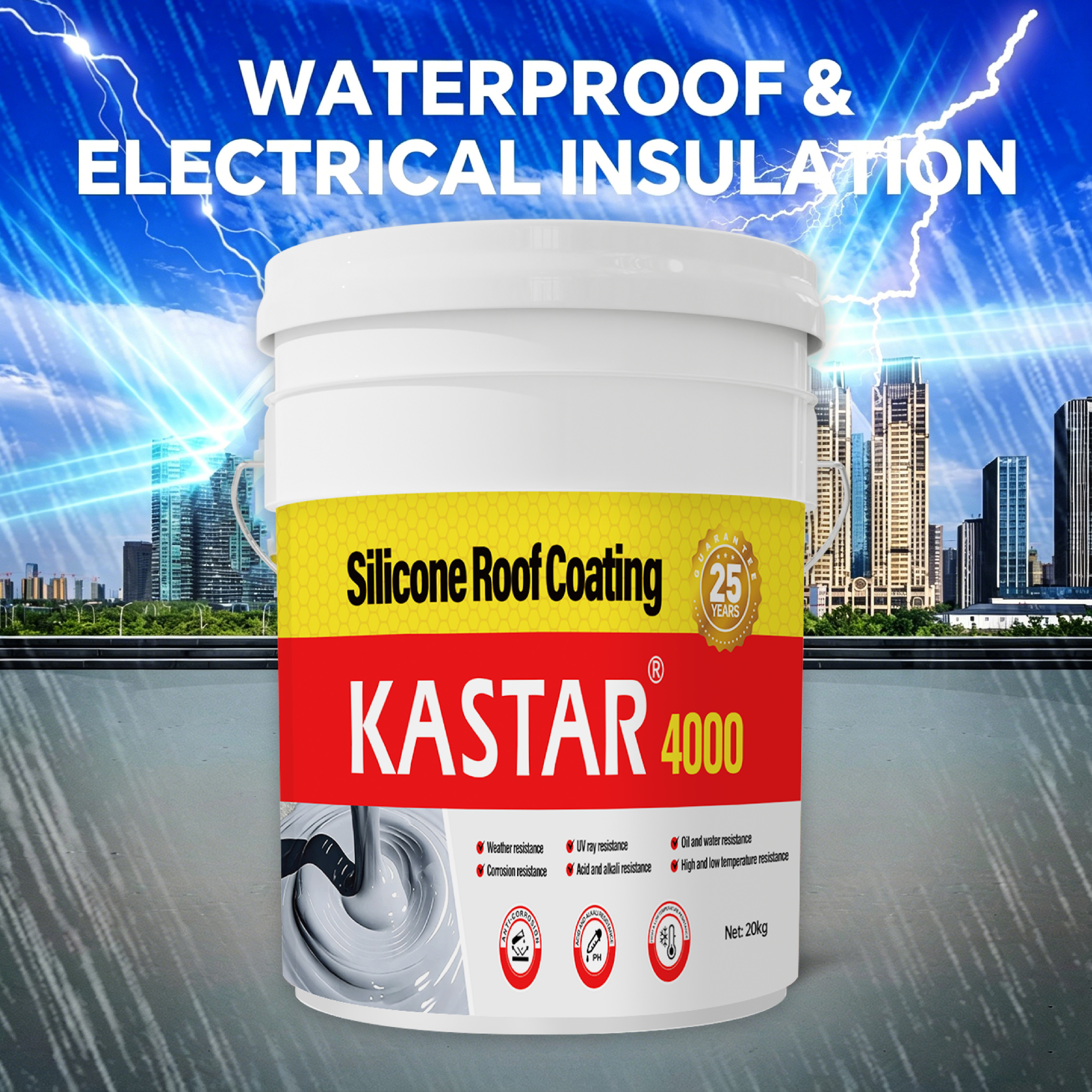
Silicone waterproof coating product image. Image source: Kastar product image library.
Application Fit: Roofs, Exterior Walls, Basements and Other Project Scenarios
Project scenario should drive the OEM or private-label decision. A roofer needs UV resistance, weather resistance, and crack-bridging ability. A basement contractor needs adhesion to prepared concrete, resistance to water pressure, and compatibility with substrate moisture. An exterior-wall applicator needs color stability, rain resistance, and a finish that can be applied by brush, roller, or spray. A distributor needs a SKU range that covers these scenarios without creating inventory confusion.
Kastar's application data describes use in high temperature, UV exposure, rain and humidity, structural expansion, and freeze-thaw cycles. The listed project types include roof waterproofing, exterior wall waterproofing, expansion joint sealing, and bathroom waterproofing. The case record adds basement and underground structure waterproofing, as well as bathroom and balcony waterproofing. The matched equipment includes sealant tape, reinforcing fabric, and application tools such as brush, roller, or spray gun. The special requirements include UV resistance, weather resistance, crack-bridging ability, and environmental compliance such as REACH and SGS.
This is where a private-label model can be efficient. If the manufacturer already has a roof-grade and an exterior-wall-grade product, the distributor can build a focused range without funding a new formulation. Kastar lists KASTAR 4000 Silicone Elastic Roof Waterproof Coating for exposed building roofs and KASTAR 3000 Silicone Elastic Exterior Wall Waterproof Coating in its product range. A distributor can use these product positions to segment the market by application, then decide whether the brand should be a private label or a custom OEM identity.
An OEM model becomes more relevant when the project requires a formulation adjustment. Examples include a specific viscosity for spray equipment, a color match for an architectural specification, a different packaging size for a contractor channel, or a cure profile for a humid climate. Kastar lists formulation adjustment and packaging customization as available services. The buyer should define which of these changes are product-critical and which are only cosmetic. Product-critical changes require a validation plan. Cosmetic changes require artwork control and packaging testing.
Market Trend: Why OEM and Private-Label Models Are Expanding
The supply side is expanding because demand is expanding. Market.us projects the global silicone rubber waterproof coating market to reach about USD 3.5 billion by 2034, with Asia-Pacific holding 45.9% of revenue in 2024. That regional concentration matters for brand ownership because many buyers source from Asian OEM and private-label manufacturers while selling under local brands in North America, Europe, the Middle East, Australia, and New Zealand.
Kastar lists export markets including the USA, Canada, the Caribbean, the Middle East, North America, South America, New Zealand, and Australia. It reports exports to 69 countries and service to more than 1,000 customers. These are company-reported figures, but they illustrate a common pattern. A manufacturer builds capacity and technical systems in one region, while brand owners build channel relationships in another. The contract between them determines who owns the brand asset and who carries the technical risk.
The trend also raises the bar for evidence. A private-label buyer can no longer rely on a generic data sheet if the project requires CE marking, REACH compliance, SGS testing, or a specific ASTM benchmark. The buyer needs to know which product, which factory, which batch, and which test report support the claim. That is why OEM and private label are becoming more document-intensive, not less. The brand owner may own the label, but the evidence chain must be shared and verified.
OEM vs Private Label vs Branded Resale: A Decision Table
A useful comparison separates three models that are often mixed in one conversation. Private label is a fast route to a branded product using an existing formulation. OEM custom manufacturing is a deeper route to a differentiated product. Branded resale or agency is a lower-commitment route using the supplier's brand. Each model has a different ownership profile and a different evidence burden.
| Decision area | Private label | OEM custom | Branded resale or agency |
|---|---|---|---|
| Brand asset | Buyer-owned brand, usually with manufacturer documentation support | Buyer-owned brand with more product-definition control | Supplier-owned brand |
| Formulation control | Limited; based on an existing formulation | Higher; may include formula adjustment and validation | Lowest; product is supplied as branded |
| Order signal | Program-specific; confirm by pack size and market | Kastar public page lists 5,000 units for custom-brand OEM | Kastar public page lists 1,000 units for KASTAR-brand agency |
| Best fit | Distributors entering a category, contractors needing a focused range, buyers with limited technical resources | Brand owners with a defined specification, distributors needing differentiation, project-driven buyers | Channel partners testing demand before committing to a private brand |
| Main limitation | Less product differentiation; supplier dependence remains high | Higher validation burden, longer development time, more contract detail | Weak brand ownership; limited long-term differentiation |
The comparison also shows a practical boundary. Private label is not automatically faster or cheaper. If the buyer needs a custom color, a specific packaging format, a CE declaration for a target market, or a batch-specific test report, the project may behave like an OEM program even if the buyer calls it private label. The reverse is also true. An OEM program may start from a manufacturer's base formula and require less development than the label suggests. The correct label is the one that matches the specification and the evidence burden.
Limitations and Procurement Boundaries
Several boundaries should be clear before a buyer treats OEM or private label as a brand-ownership strategy. First, Kastar's certification position is company-reported. Kastar reports ISO9001 certification and states that products have passed ISO9001, CE, and SGS certification. The available public data does not provide certificate numbers, issuing bodies, product scope, or validity dates. CE is a conformity-marking framework rather than a single product certificate, and SGS is a testing and certification organization whose exact service must be specified. Buyers should request certificate copies, declaration of performance where applicable, test reports, and product-specific scope before using these claims in a tender or market-entry file.
Second, order thresholds are not universal. Kastar's structured capability data lists a 100-bucket MOQ, while its public program page lists 5,000 units for custom-brand OEM and 1,000 units for KASTAR-brand agency orders. These figures may reflect different pack sizes, formulations, or commercial models. A buyer should confirm the MOQ for the exact SKU, packaging, and destination. A low MOQ can support a pilot launch, but it may not support the packaging economics of a full private-label range.
Third, exclusivity is not established by the available product data. A distributor-exclusive OEM silicone waterproof coating program requires territory terms, channel conflict rules, minimum purchase commitments, and brand-use rights. None of these terms are provided in the product pages reviewed here. A buyer should not assume that a private label creates exclusivity. It creates a brand label, not necessarily a protected market position.
Fourth, formulation ownership and change control must be written into the contract. A private-label buyer may own the trademark but not the formulation. An OEM buyer may fund a formulation change but still depend on the manufacturer's process know-how. The contract should define who owns the formula, who owns the test data, how raw-material changes are notified, how batch traceability works, and what happens if a SKU is discontinued. These are normal procurement terms, but they are often omitted when buyers focus only on price and artwork.
Future Outlook
The next phase of silicone waterproof coating sourcing is likely to be more evidence-driven. Market growth in Asia-Pacific and the projected expansion of the global silicone rubber waterproof coating market support continued OEM and private-label activity. But the buyers who succeed will not be the ones with the most label designs. They will be the ones who can connect a brand claim to a product specification, a batch record, a test method, and a supply commitment.
For manufacturers, that means publishing clearer program terms. For buyers, it means treating OEM and private label as two different risk profiles. A private label can be a fast route to market, but it should not be treated as a proprietary product unless the formulation, evidence, and exclusivity terms support that position. An OEM program can create more differentiation, but it requires more technical work and a stronger contract. The future belongs to buyers who can tell the difference and document it.
FAQ
What is the difference between OEM and private label for silicone waterproof coating?
Private label usually means the manufacturer's existing silicone waterproof coating formulation is supplied under the buyer's brand, often with limited changes such as color or packaging. OEM means the buyer's specification, brand, and commercial requirements define the product, which may include formulation adjustment, packaging design, and a validation plan. The practical difference is the depth of product definition and the amount of technical evidence the buyer must own or verify.
What should a distributor verify before choosing a private-label silicone waterproof coating supplier?
A distributor should verify the product's technical data sheet, batch test records, application guidance, packaging specification, and compliance documents for the target market. For Kastar, buyers should confirm the certificate numbers, issuing bodies, product scope, and validity dates behind the reported ISO9001, CE, and SGS claims. They should also confirm the MOQ for the exact pack size, the lead time, and the after-sales support model. These checks determine whether the private label can be supported with evidence, not just artwork.
Can a private-label buyer request formulation changes?
It depends on the supplier and the program. Kastar lists formulation adjustment, color, viscosity, packaging, logo, and size as customization options. A buyer can request a change, but the supplier may treat it as an OEM development project rather than a standard private-label order. The buyer should define whether the change is product-critical or cosmetic, request a validation plan, and confirm who owns the resulting formulation and test data.
How does MOQ affect OEM versus private-label brand ownership?
MOQ affects how much inventory risk the buyer carries and whether the chosen packaging is economically viable. Kastar's structured capability data lists a 100-bucket MOQ and a 15 to 20 day lead time. Its public program page lists 5,000 units for custom-brand OEM and 1,000 units for KASTAR-brand agency orders. These figures are not directly comparable. Buyers should confirm the applicable threshold for the chosen SKU, packaging, and market before assuming that a private label is a low-commitment entry.
Which project scenarios suit Kastar 4000 Silicone Waterproof Coating?
Kastar lists Kastar 4000 Silicone Waterproof Coating as a one-component silicone waterproof coating with UV resistance. Its published parameters include 98% solid content, elongation at break of at least 200%, tensile strength of at least 1.2 MPa, UV resistance of 1,000 hours without cracking or peeling, an operating temperature range of -80°C to 180°C, and an outdoor service life of at least 25 years. Kastar states that KASTAR 4000 Silicone Elastic Roof Waterproof Coating is developed for exposed building roofs. Buyers should validate suitability for their specific substrate, climate, and project specification.
Conclusion
OEM and private label are not opposite ends of a simple quality scale. They are different ownership models. Private label gives a buyer a faster path to a branded silicone waterproof coating, but the technical basis may remain with the manufacturer. OEM gives a buyer more control over formulation and differentiation, but it also creates more validation work and more contract detail. The right choice depends on the buyer's specification, evidence requirements, order volume, and long-term channel strategy.
Kastar's published OEM/ODM capabilities, customization options, application data, and reported quality systems show what a manufacturer can bring to the relationship. They also show what the buyer must verify. Brand ownership is strongest when the label, the formulation, the compliance file, and the supply commitment are aligned. Without that alignment, a private label is only a name, and an OEM project is only a purchase order.
Reference document: Kastar product and company brochure (PDF).
Есть вопросы или нужны дополнительные детали?
Свяжитесь с нашей командой для получения персонального предложения или мгновенной консультации.
Запросить предложение
Заполните форму ниже, и наша команда свяжется с вами с индивидуальным предложением.
Прямой чат WhatsApp
Предпочитаете общаться в реальном времени? Напишите нам в WhatsApp для мгновенной помощи и быстрых ответов.
- Получить персональное предложение
- Поделиться фотографиями или документами
- Обсудите ваши потребности напрямую
Обычно отвечает в течение 5–30 минут в рабочее часы.