
OPS PC Procurement FAQ: Platform, Slot, and Compatibility Questions Answered
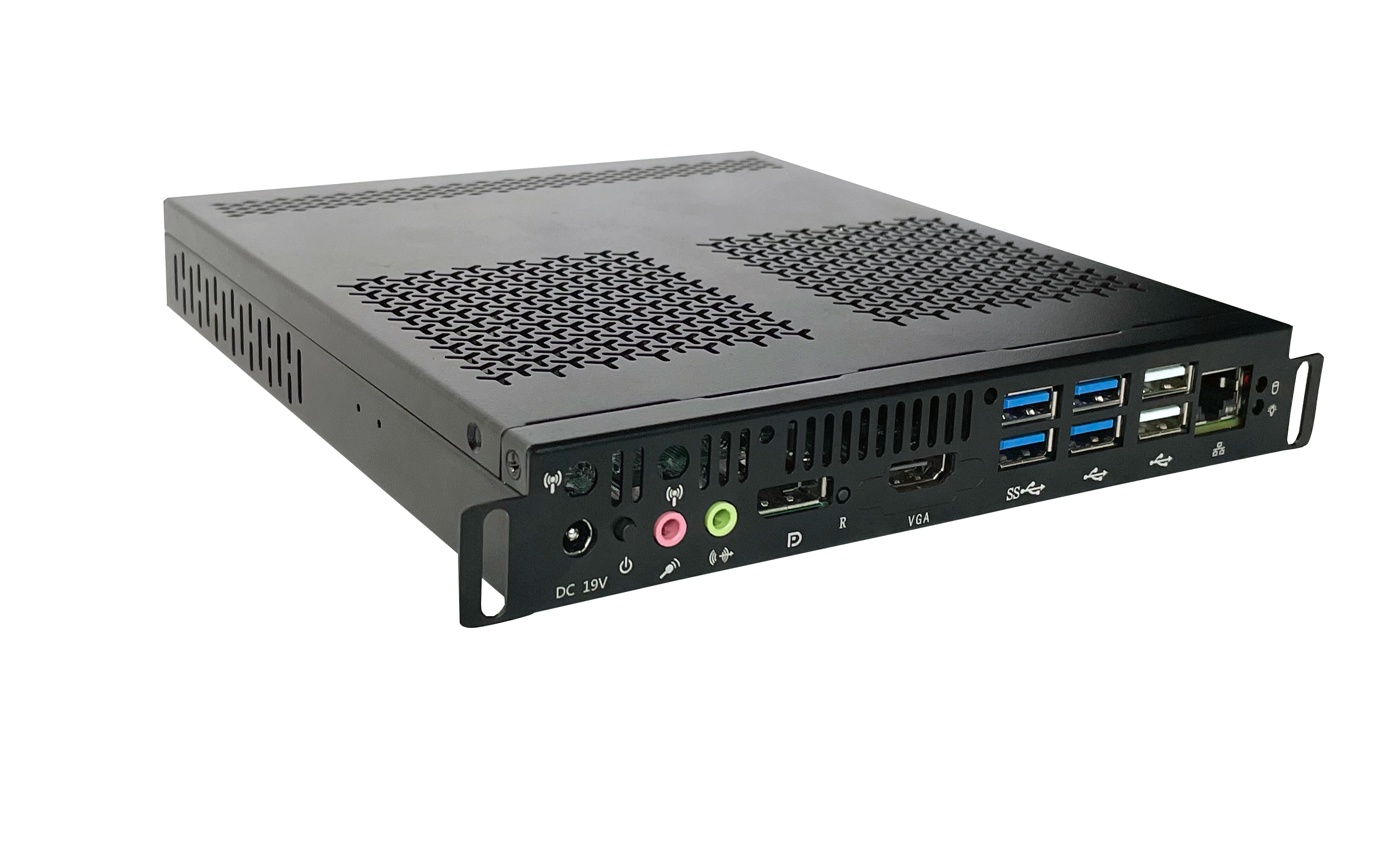
Slot-in OPS computing hardware is specified against a display bay, not against a benchmark chart. Domestic-platform OPS-C configuration shown (model AOS-SOZK6A341SXGE).
Procurement teams rarely select an OPS PC on processing power alone. The questions that decide a project are narrower and more mechanical: will this module slide into the display bay, does the connector match, do the video and USB paths reach the touch module and camera, does the configuration stay inside the slot's power and thermal budget, and will the unit boot the software image the deployment team has already validated? An OPS PC (Open Pluggable Specification personal computer) is a slot-in computing module that turns a display into a self-contained system without an external PC chassis, a separate power supply or an additional cable run — and all of those constraints are checked before price is discussed.
AIOSTAR (Shenzhen Aiostar Electronics Co., Ltd.) is a Shenzhen-based computer hardware supplier established in 2015 that develops, produces and supplies OPS PCs, OPS-C pluggable computer modules, Android OPS PCs, industrial motherboards, mini PCs, BOX PCs, industrial panel PCs, servers and customized embedded computing systems. Its OPS portfolio covers four distinct platform families, and the differences between those families answer most of the compatibility questions procurement teams raise during research and evaluation.
Why "Which OPS PC?" Is Really "Which Constraints?"
Before platform comparison, procurement lists tend to converge on the same six constraint groups. Each one has a defined failure mode, and each one is cheaper to resolve at specification stage than at installation stage.
| Constraint group | What must be confirmed | Where mismatches appear |
|---|---|---|
| Slot standard | Intel OPS or OPS-C; module footprint and mounting | Module does not seat or lock into the bay |
| Connector | Connector type and pin definition against slot documentation | No video, no touch, or intermittent signal |
| Video path | Output type and resolution against panel capability | Resolution fallback or blank output |
| USB and peripherals | Port count, USB version, internal versus external routing | Touch module, camera or microphone array not detected |
| Power and thermal | Slot power delivery, airflow, cooling solution | Thermal throttling or shutdown under sustained load |
| OS, BIOS, drivers | Validated system image, BIOS options, driver set | Deployment fails at scale rather than at sample stage |
This is why an OPS PC decision behaves like a constraint decision. A platform that satisfies five constraints and misses one — typically mechanical fit or firmware behaviour — is not a partial solution; it is a different project.
The Four OPS PC Platform Families at a Glance
The practical shortlist for most display projects sits across four configurations. They differ in processor architecture, graphics approach, operating system options and the display categories they are designed for.
| Platform family | Model | Compute | Operating system options | Graphics | Typical display fit |
|---|---|---|---|---|---|
| Intel Alder Lake-U OPS-C module | AOS-SOHAUF41SC | Intel Core i5-1235U and i5-1240P options | Windows or Linux, depending on configuration | Integrated | Interactive whiteboards, education technology, corporate meeting displays, commercial display systems |
| Intel H610 discrete-GPU OPS computer | AOS-SOH61I41SXG | Intel H610 platform; selected 12th and 13th Gen Intel Core i3, i5 and i7 | Configurable by project | Optional discrete graphics by project | Large-format commercial displays, LED meeting displays, video walls, visualization and multi-display projects |
| Rockchip RK3588 Android AI OPS computer | AOS-SOR358464H | RK3588 octa-core up to 2.4 GHz; integrated 6 TOPS NPU | Android 13, Ubuntu or Debian | Integrated | Digital signage, interactive displays, smart retail, information kiosks, edge-AI display terminals |
| Zhaoxin KX-6780 OPS-C computer | AOS-SOZK6A341SXGE | Zhaoxin KX-U6780A, KX-U6740A, KX-U6640A, KX-U6640MA | Configurable by project | Optional GT730, GT1030, GTX 1050 or GTX 1050 Ti depending on configuration | Domestic-platform interactive displays, education, government information systems, project-specific commercial displays |
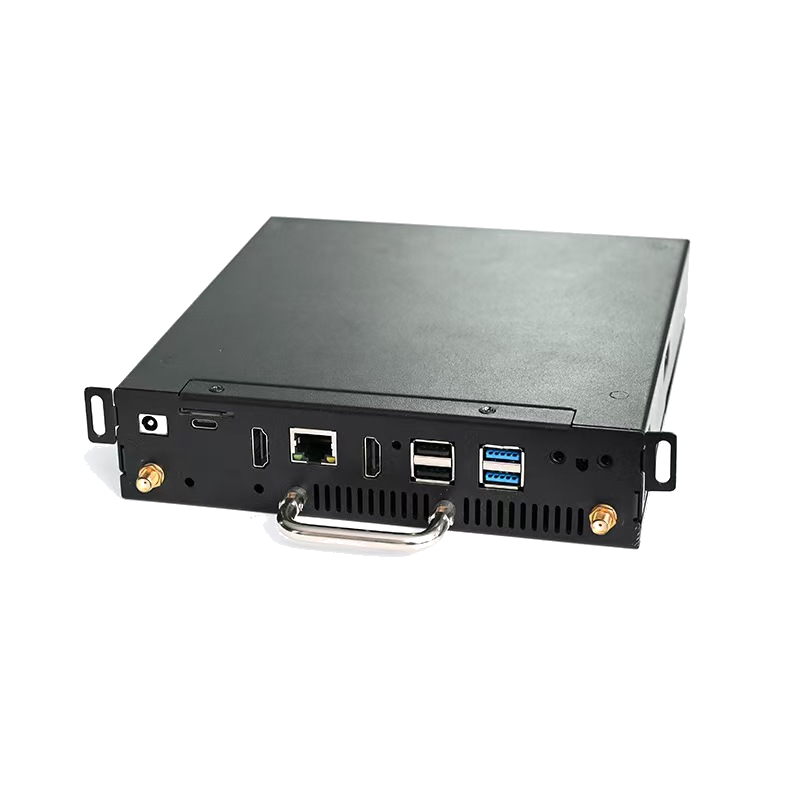
ARM-based OPS modules answer a different constraint set than x86 modules: Android and Linux images, integrated NPU capability, and lower platform complexity for signage and kiosk deployments (model AOS-SOR358464H).
Slot Standard and Mechanical Fit: Intel OPS versus OPS-C
Intel's Open Pluggable Specification standardizes the mechanical and electrical interface between a display and a media player around a unified 80-pin JAE connector with a footprint of 180 mm × 119 mm × 30 mm. That standard is the reference point for the Intel-based OPS computers in this portfolio.
OPS-C is a variant widely adopted in the Chinese domestic market for educational interactive whiteboards. Its module dimensions differ from the original Intel OPS footprint — typically cited at approximately 180.8 mm × 195.2 mm × 42.5 mm. Because the footprints differ, an OPS-C module and a standard OPS bay are not interchangeable. The procurement rule that follows is straightforward: identify the slot standard of the display first, then filter modules, because no software configuration compensates for a module that does not physically seat.
Interface Compatibility: Connector, Pin Definition, Video and USB
Compatibility at the interface level is verified item by item against the display's slot documentation. The check sequence used for interactive whiteboard and teaching display projects covers mechanical size, connector pinout, display resolution, cooling and operating system image — and it is applied before mass production rather than after first article delivery.
- Module dimensions and tolerances. Overall envelope plus the position of the connector relative to the front face of the module.
- Connector type and pin definition. The slot's pin assignment determines which signals are available internally and which must be routed externally.
- Video interface. The discrete-GPU OPS computer provides HDMI, HDMI and DisplayPort video outputs. Output up to 8K 60 Hz is subject to the selected CPU, GPU and display configuration, so resolution is a configuration outcome rather than a fixed property of the model.
- USB count and version. The domestic-platform OPS-C computer provides six USB ports, including two USB 3.0 ports — a relevant detail when touch, camera, microphone array, keyboard and service access are required simultaneously.
- Peripheral routing. For corporate meeting displays, camera, microphone, touch, display output, operating system and conferencing software compatibility are confirmed together, because a failure in any one path makes the room unusable.
- Network and wireless. Network access and optional wireless modules affect both the system image and the radio-related certification scope.
Power Budget, Cooling and Display Firmware
Inside a display bay, power and thermal headroom are finite and shared. That is why large-format visualization projects specify the checks as GPU model, power budget, heat dissipation, output resolution and display compatibility. Adding optional discrete graphics changes the first two of those five items.
Cooling hardware is not uniform across the portfolio and should be matched to the workload. The OPS-C Pluggable Computer Module and the Android AI OPS Computer use a sheet-metal enclosure, PCB assembly and aluminum heat sink. The discrete-GPU OPS Computer and the Domestic-Platform OPS-C Computer add a cooling fan to the aluminum heat sink, reflecting the higher sustained load of discrete-graphics and domestic-platform configurations.
Display firmware is the third element in this group. Content management software, codec support, storage and network requirements are all confirmed against the display for digital signage deployments, and media playback behaviour depends on the interaction between the module's firmware and the panel. For ARM-based modules, 8K multimedia capability explicitly depends on firmware and interface configuration — meaning the firmware version belongs in the purchase specification, not only in the deployment checklist.
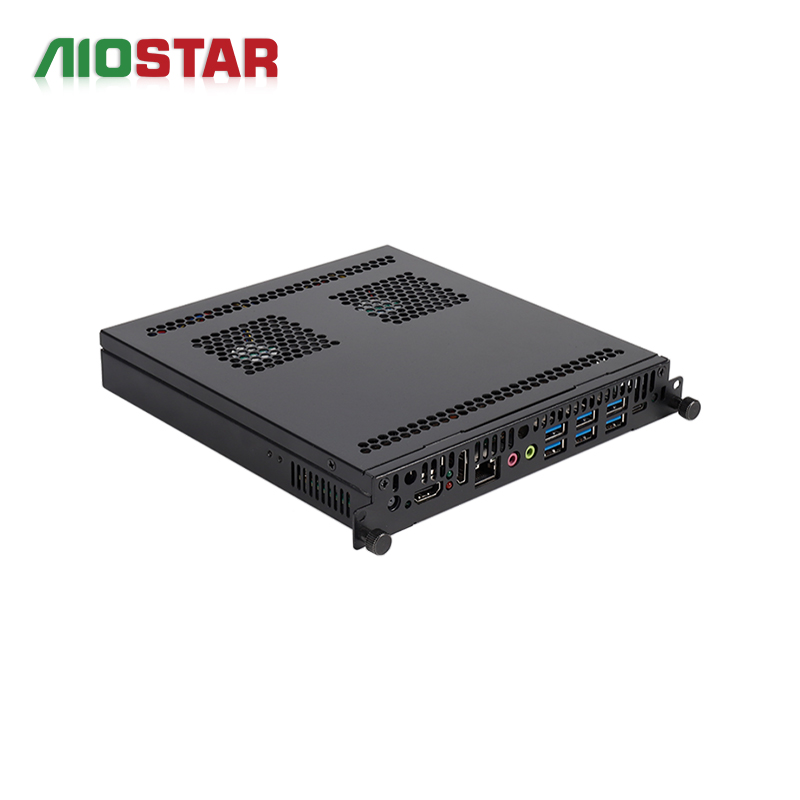
Discrete-graphics OPS configurations are available by project and are specified together with the display's power budget, airflow and output resolution (model AOS-SOH61I41SXG).
Controlling OS, BIOS and Driver Mismatches
Operating system, BIOS and driver mismatches are controlled through configuration at order stage rather than through field troubleshooting. The customization scope offered across these platform families includes CPU platform, memory, storage, I/O, chassis size, cooling solution, BIOS functions, operating system image, logo, packaging, power adapter and cables.
Three functions appear repeatedly in display projects because they determine how a unit behaves when nobody is standing in front of it:
- Wake-on-LAN — remote power-up and management of displays that are distributed across a building or campus.
- Auto power-on — deterministic start-up when the display is switched on at the wall, without staff intervention.
- Watchdog — automatic recovery if the operating system or application stops responding during unattended operation.
On the OPS-C Pluggable Computer Module, these functions are available by BIOS configuration. That wording matters for procurement: they are configurable options rather than guaranteed defaults, so they must be stated when the build is defined, and confirmed again at sample validation. After-sales support for these configurations covers remote technical support and BIOS, operating system and driver assistance, with a one-year warranty unless otherwise agreed in the quotation or proforma invoice.
Certification and Compliance Constraints for EU Projects
Two declarations cover these four platform families for the European market, and both are traceable to a specific issuing body and certificate number.
| Declaration | Certificate number | Scope | Key standards | Issued |
|---|---|---|---|---|
| Declaration of Compliance — 2015/863/EU Restriction of Hazardous Substances | 25ITC1212100 | PC computer (Microcomputer), EU market | EU RoHS Directive 2011/65/EU and amendment 2015/863/EU; IEC 62321 series; EN IEC 63000:2018 | 18 December 2025, Shenzhen iTC Product Testing Co., Ltd. |
| Certificate of Compliance — CE-RED | 25ITC1212094 | OPS computer (Microcomputer), PC computer (Microcomputer), EU market | Radio Equipment Directive 2014/53/EU; EN IEC 62368-1:2020+A11:2020; EN 62311:2020; ETSI EN 301 489-1 V2.2.3; ETSI EN 301 489-17 V3.3.1; ETSI EN 300 328 V2.2.2; ETSI EN 301 893 V2.1.1 | 20 December 2025, Shenzhen iTC Product Testing Co., Ltd. |
Both certificates list the OPS-C Pluggable Computer Module, the Discrete-GPU OPS Computer, the Android AI OPS Computer and the Domestic-Platform OPS-C Computer as applicable products. For projects that add project-specific I/O or wireless options, the certificate scope is worth re-confirming against the exact configuration ordered, since the certificate covers defined product descriptions rather than every possible build variation.
Configurable Options, MOQ, Lead Time and Quality Control
Commercial terms for an OPS PC configuration are part of the compatibility answer, because they determine how quickly a project can be validated and how much flexibility remains after approval.
| Item | Terms |
|---|---|
| Minimum order quantity | 1 unit for evaluation samples; customized project MOQ depends on configuration |
| Lead time | 60 days |
| Monthly capacity | 5,000+ units |
| Quality control | Incoming material inspection; functional and interface testing for finished units; burn-in testing when specified; temperature, humidity, vibration and drop testing arranged according to project requirements |
| Warranty and support | One-year warranty unless otherwise agreed; remote technical support and BIOS, operating system and driver assistance |
The supplier behind these terms, Shenzhen Aiostar Electronics Co., Ltd., operates a 1,500 m² facility with approximately 50 employees, an annual output of more than 170,000 units and an eight-engineer R&D team, with 60% of output exported to global markets. Production is supported by OEM, ODM and project customization across the four platform families described above.
Application Fit: Matching Platform to Display Project
The four families map to four recurring project profiles, and the special requirements listed for each profile are the ones that most often delay a rollout.
- Education technology — interactive whiteboards and teaching displays. The OPS-C Pluggable Computer Module is designed for interactive whiteboards, education technology, corporate meeting displays and commercial display systems. Projects run daily under touch interaction and networked teaching applications, and require verification of mechanical size, connector pinout, display resolution, cooling and operating system image before mass production.
- Corporate meeting and collaboration. The Domestic-Platform OPS-C Computer addresses interactive meeting display projects where conferencing, document sharing, whiteboarding and presentation run locally with optional auto power-on. Camera, microphone, touch, display output, operating system and conferencing software compatibility are confirmed together.
- Digital signage and smart retail. The Android AI OPS Computer is designed for digital signage, interactive displays, smart retail, information kiosks and edge-AI display terminals, with scheduled or continuous playback and remote content updates. Codec, resolution, content management software, storage, network and thermal requirements are the confirmation points.
- Large-format visualization. The Discrete-GPU OPS Computer targets LED meeting displays, video walls and visualization projects, running continuously or on a defined schedule, with GPU model, power budget, heat dissipation, output resolution and display compatibility confirmed at specification stage.
Field evidence exists for this approach in adjacent applications. An industrial and transportation solution provider in Japan deployed 1,000 units for an OPS adapter board application, with stable operation reported over a three-to-seven-year horizon. The configuration is compatible with mainstream OPS-C specifications, and the removable slot-in design simplifies installation and maintenance, while configurable memory, storage, BIOS and operating system images support different interactive-display projects.
Market Context for Modular Display Computing
Modular slot-in computing sits inside a display market that is already substantial. The global Interactive Flat Panel market, the primary application for OPS PC modules, was valued at approximately USD 12.6 billion in 2024, and integrated OPS-slot compute modules and Android-based SoC modules are estimated to ship in 15–25% of new Interactive Flat Panel Display units. Within the broader hardware category, the global industrial PC market — which includes industrial-grade OPS modules — was estimated at USD 6.48 billion in 2024 and is projected to grow at a CAGR of 6.30% through 2032.
A second signal comes from the education segment, where the global interactive whiteboard market is projected to reach USD 730 million by 2030, with OPS penetration remaining a key growth driver for modular classrooms. Taken together, these figures describe a market where the slot is already provisioned and the purchasing decision has shifted from "whether to use a module" to "which module and which configuration."
OPS PC versus External and Embedded Alternatives: Where the Boundaries Are
An OPS PC is not universally the right answer, and procurement decisions improve when the boundaries are stated explicitly.
- The slot standard locks the module. A standard OPS module does not fit an OPS-C bay, and an OPS-C module does not fit a standard OPS bay. Displays with non-standard or proprietary bays require adapter arrangements or a different platform entirely.
- Compute is bounded by the slot envelope. The Alder Lake-U module uses mobile Intel processor options, and the H610 platform supports selected 12th and 13th Gen Intel Core i3, i5 and i7 processors. Projects needing substantially higher sustained compute than those options provide may be better served by an external workstation or a rack-mounted system.
- Discrete graphics raise the power and thermal question. Optional discrete graphics are available by project rather than as a default, and they must be validated against the display's power budget, airflow and output resolution before commitment.
- High-resolution output is configuration-dependent. 8K capability varies with CPU, GPU, display and, on ARM platforms, firmware and interface configuration. It should not be treated as a model-wide guarantee.
- Customized configurations carry commercial lead time. Lead time for customized projects is 60 days, and while evaluation samples can be ordered at a minimum of one unit, customized project MOQ depends on configuration. Projects with compressed installation windows should plan around this rather than assume off-the-shelf availability.
The counterweight is serviceability. A slot-in module can be replaced without dismantling the display or re-running cabling, which is the reason the format persists in education, meeting room and signage deployments where downtime is measured in classroom hours or trading hours.
Future Outlook
Three directions are visible from the configuration patterns in this portfolio. First, x86 and ARM platforms are settling into different roles rather than competing directly: Intel-based modules anchor Windows and Linux workloads such as teaching software and conferencing, while RK3588-class ARM modules with an integrated 6 TOPS NPU serve signage, kiosk and edge-AI terminals where Android management and low platform overhead matter more. Second, domestic-platform demand — represented here by the Zhaoxin KX-6780 OPS-C family — is adding a fourth procurement track alongside standard OPS, OPS-C and Android variants, with its own graphics options and application profile. Third, BIOS-level manageability functions such as Wake-on-LAN, auto power-on and watchdog are becoming specification items rather than optional extras, because fleet operators need predictable behaviour from devices that run unattended.
For buyers, the implication is procedural rather than technical: the winning tender documents are the ones that fix the slot standard, the interface matrix, the firmware and image baseline, and the certification scope before platforms are compared.
FAQ: Platform, Slot and Compatibility Questions Answered
What is the difference between standard OPS and OPS-C when specifying an OPS PC?
Standard OPS is defined by Intel's Open Pluggable Specification, which fixes a unified 80-pin JAE connector and a module footprint of 180 mm × 119 mm × 30 mm. OPS-C is a variant widely adopted in the Chinese domestic market for educational interactive whiteboards, with different module dimensions typically cited at around 180.8 mm × 195.2 mm × 42.5 mm. Because the footprints differ, OPS-C modules and standard OPS bays are not interchangeable, which makes the slot standard of the display the first item to confirm.
How can a procurement team verify physical and interface fit before ordering?
By checking the module against the display's slot documentation, then repeating the check on a physical sample. The sequence used for interactive whiteboard and teaching display projects verifies mechanical size, connector pinout, display resolution, cooling and operating system image before mass production. In practice this means confirming overall dimensions and connector position, connector type and pin definition, video output type and resolution, USB port count and version, and the airflow available inside the bay.
Which platform should be selected — Intel, Rockchip RK3588 or Zhaoxin?
The choice is driven by software and lifecycle requirements rather than by raw performance. The Intel Alder Lake-U OPS-C module (AOS-SOHAUF41SC) supports Windows or Linux depending on configuration and is designed for interactive whiteboards, education technology, corporate meeting displays and commercial display systems. The Intel H610 OPS computer (AOS-SOH61I41SXG) supports selected 12th and 13th Gen Intel Core i3, i5 and i7 processors with optional discrete graphics for large-format commercial displays, LED meeting displays, video walls and multi-display projects. The Rockchip RK3588 module (AOS-SOR358464H) runs Android 13, Ubuntu or Debian with an integrated 6 TOPS NPU for digital signage, kiosks and edge-AI terminals. The Zhaoxin KX-6780 OPS-C computer (AOS-SOZK6A341SXGE) supports KX-U6780A, KX-U6740A, KX-U6640A and KX-U6640MA processors for domestic-platform interactive displays, education and government information systems.
What power and thermal factors change when discrete graphics are added?
Discrete graphics increase the heat and power load that the display bay has to absorb. On the Discrete-GPU OPS Computer, optional discrete graphics are available by project, and large-format visualization projects specify the confirmation points as GPU model, power budget, heat dissipation, output resolution and display compatibility. Cooling hardware also differs across the portfolio: the OPS-C Pluggable Computer Module and the Android AI OPS Computer use an aluminum heat sink, while the Discrete-GPU OPS Computer and the Domestic-Platform OPS-C Computer use an aluminum heat sink with a cooling fan.
How are operating system, BIOS and driver mismatches prevented?
They are controlled through configuration at order stage. The customization scope covers CPU platform, memory, storage, I/O, chassis size, cooling solution, BIOS functions, operating system image, logo, packaging, power adapter and cables. Manageability functions such as Wake-on-LAN, auto power-on and watchdog on the OPS-C Pluggable Computer Module are available by BIOS configuration, so they must be defined when the build is specified and verified on the sample. After-sales support covers remote technical support and BIOS, operating system and driver assistance, with a one-year warranty unless otherwise agreed.
Does 8K output apply to every OPS PC configuration?
No. On the Discrete-GPU OPS Computer, output up to 8K 60 Hz is subject to the selected CPU, GPU and display configuration. On the Android AI OPS Computer, 8K multimedia capability depends on firmware and interface configuration. Resolution should therefore be treated as a configuration-dependent capability confirmed for the exact build, not as a fixed property of a model family.
What certification applies to OPS PCs intended for the EU market?
Two declarations apply to the four platform families. A RoHS Declaration of Compliance, certificate number 25ITC1212100, was issued on 18 December 2025 by Shenzhen iTC Product Testing Co., Ltd. for PC computer (Microcomputer) under EU RoHS Directive 2011/65/EU and amendment 2015/863/EU, with standards including the IEC 62321 series and EN IEC 63000:2018. A CE-RED Certificate of Compliance, certificate number 25ITC1212094, was issued on 20 December 2025 by the same body for OPS computer (Microcomputer) and PC computer (Microcomputer) under Radio Equipment Directive 2014/53/EU, with standards including EN IEC 62368-1:2020+A11:2020, EN 62311:2020, ETSI EN 301 489-1 V2.2.3, ETSI EN 301 489-17 V3.3.1, ETSI EN 300 328 V2.2.2 and ETSI EN 301 893 V2.1.1.
What are the commercial terms for a customized OPS PC configuration?
Minimum order quantity is 1 unit for evaluation samples, while customized project MOQ depends on configuration. Lead time is 60 days and monthly capacity is 5,000+ units. Quality control covers incoming material inspection, functional and interface testing for finished units, burn-in testing when specified, and temperature, humidity, vibration and drop testing arranged according to project requirements. The default warranty period is one year unless otherwise agreed in the quotation or proforma invoice.
A consolidated technical overview of these platform families, configuration options and certification records is available in the Aiostar Introduction 2026 brochure (PDF). Product documentation is published at www.aiostar.com.