
Off-Road Tire Specs and Certifications: Sourcing Signals for 2026
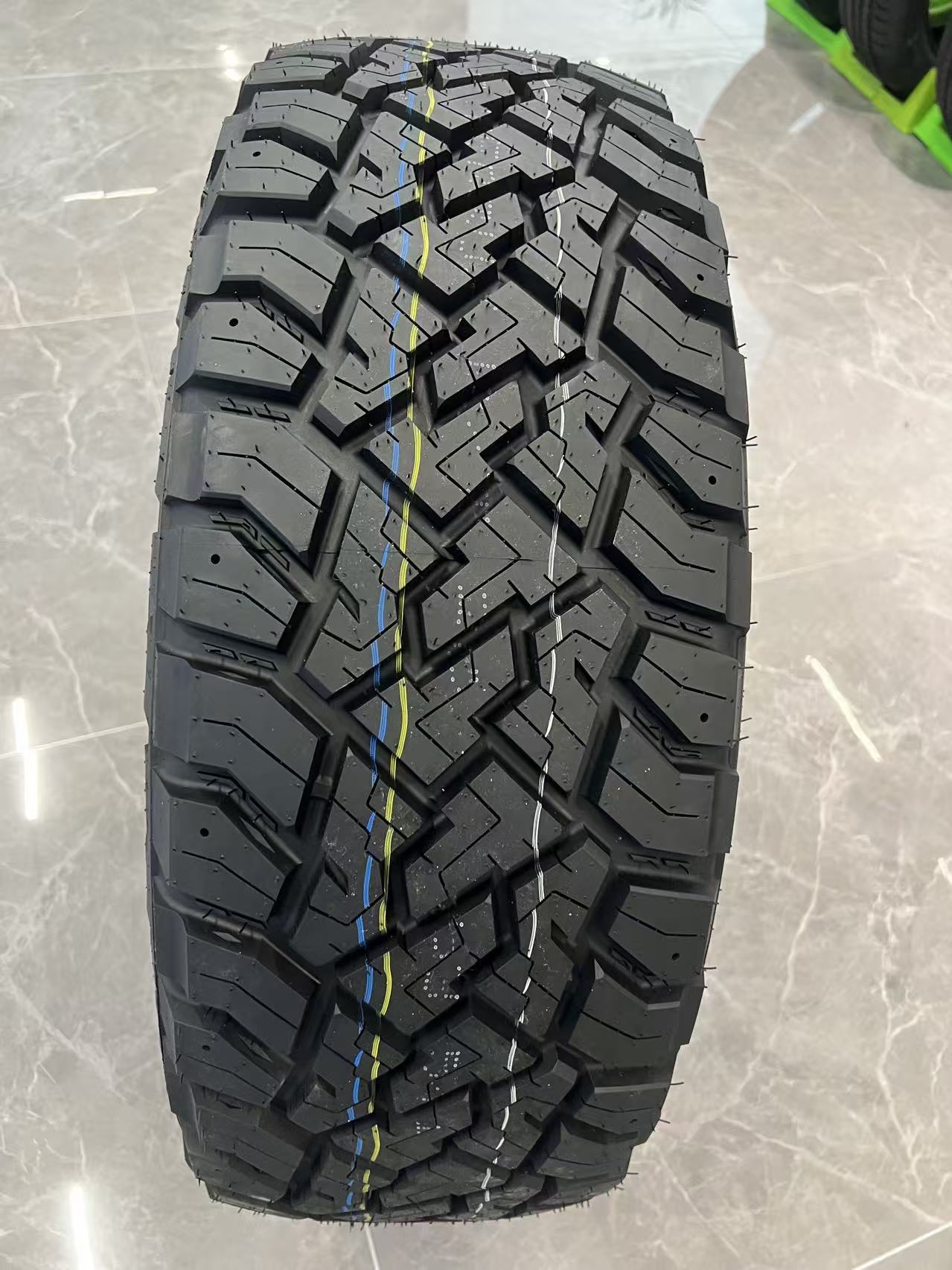
Off-Road Tire Procurement Is No Longer Just a Size Match
Off-road tire buyers in 2026 face a more demanding procurement environment than a decade ago. Matching a rim size and tread pattern is only the first step. Load index, speed rating, maximum pressure, sidewall construction and certification coverage now determine whether a tire is legal to sell in a specific market, safe for the intended vehicle, and operationally realistic for the end user. For distributors moving from discovery to supplier evaluation, the ability to verify these constraints is becoming a core qualification.
The broader off-road tire market shows why this matters. Smithers valued the global off-the-road (OTR) tire market at approximately USD 34.4 billion in 2024, driven by mining and construction demand. The consumer-facing segment for light truck and SUV off-road tires has developed its own technical expectations, pushed by recreational off-roading, changing winter-tire regulations and a wider range of terrain-specific products.
The Information Gap in Modern Tire Sourcing
Two tires can be sold under the same available size, such as LT285/70R17, yet carry different load indices, speed ratings and certifications. For a distributor managing inventory across regions, these differences are not technical footnotes. They affect market access. A tire approved for one market may not meet the documented requirements of another. The risk appears in clearance delays, rejected product batches, and downstream liability when a tire is fitted to a vehicle it was not specified for.
Buyers also face a documentation problem. Many suppliers publish only the most visible specification fields and omit certification numbers or scope details. This makes it difficult to compare products from different factories and to respond to importers who need evidence rather than claims. The opportunity belongs to manufacturers that can offer both a wide parameter range and transparent, order-ready compliance data.
Reading the Sidewall: Key Parameters in the WIDEWAY Off-Road Range
Shandong Wideway Tire Co., Ltd., headquartered in Qingdao, China, operates the WIDEWAY, EVERLAND and V-RICH brands and specialises in high-performance and off-road tires. The company was founded in 2014, reports over 23 million tires in annual output, and exports about 70 percent of production to Central and South America, Canada, the EU, Africa, the Middle East, Southeast Asia, Central Asia and Australia. For a sourcing audience, this scale explains why the product data is structured around multiple export markets.
WIDEWAY's off-road range covers all-terrain (AT), mud-terrain (MT) and rugged-terrain (RT) designs, with model coverage from 27X8.50R14LT to LT37×12.50R22. The following table lists representative parameters from the company's off-road product lines; buyers should confirm the exact values for each SKU before ordering.
| Product line | Terrain category | Representative sizes | Max pressure (kPa) | Load index | Speed rating |
|---|---|---|---|---|---|
| POWERWAY A/T | All Terrain | P265/70R16, LT285/75R16, LT265/70R17 | 300 | 111 | T |
| BAJA KING A/T | All Terrain | LT265/70R16, LT265/65R17, LT285/70R17 | 550 | 119/116 | R |
| WINTERWAY A/T | All Terrain / Winter & Snow | LT265/65R17, LT265/70R17, LT285/70R18 | 550 | 120/117 | Q |
| MUD-TERRAIN MT6 | Mud Terrain | LT265/70R17, LT285/70R17, 33×12.50R17LT | 550 | 121/118 | Q |
| POWERWAY R/T | Rugged Terrain | LT265/70R17, LT285/70R17, LT315/70R17 | 552 | 123/120 | Q |
| TERRUX R/T | Rugged Terrain | LT285/70R17, LT315/70R17, 35X12.50R17LT | 350 | 121/118 | R |
Load and Speed Ratings
LT tire markings such as 121/118 indicate a dual load index. The first number corresponds to single-tire fitment and the second to dual-tire fitment. A higher number represents a higher maximum load capacity. In the WIDEWAY off-road lineup, dual indices range from 111 for a commuter-oriented AT size to 123/120 for a rugged-terrain size, meaning buyers must select according to the vehicle's gross axle weight and wheel configuration.
Speed rating is the maximum speed at which a tyre can operate under its rated load. In off-road product lines, Q and R are common; some AT lines carry T. A distributor serving a market with high-speed highway sections should check whether a given SKU is rated for that duty rather than assuming all off-road tires are built for sustained speed.
Maximum Pressure and Section Width
Maximum pressure is not a performance promise but a construction limit. It defines the maximum inflation pressure the casing can support and the load capacity at that pressure. In the table above, maximum pressure varies from 300 kPa to 552 kPa across AT, MT and RT lines. A tire designed for heavier service often uses a stronger casing, which is why reinforced sidewalls appear as an explicit functional type in the rugged-terrain data.
Section width, listed as 272 mm to 318 mm in the representative data, affects fitment width and vehicle geometry. It matters when a buyer is selecting tires for an upgraded 4×4 where the wheel well, suspension and offsets constrain the available footprint.
Certification Coverage by Market
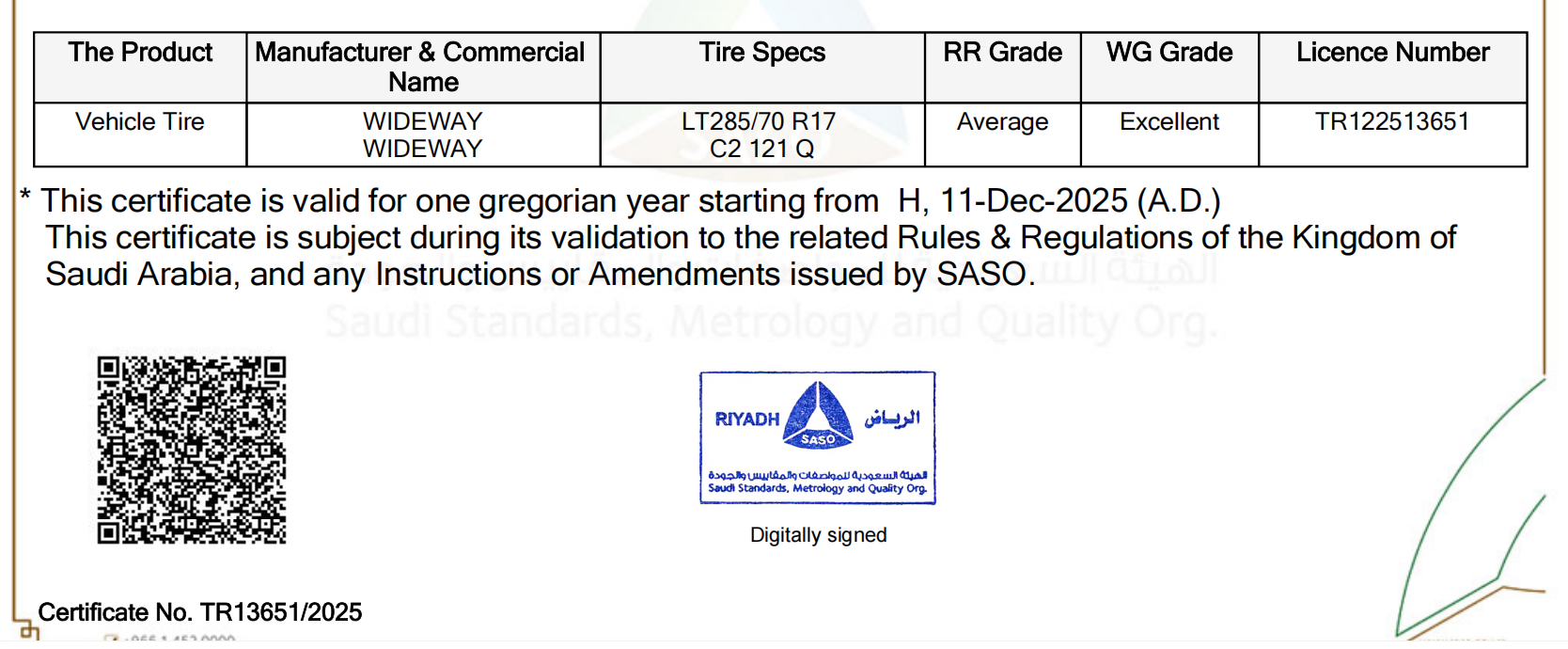
Certification documentation is where the procurement decision becomes concrete. For off-road tires in Saudi Arabia, the relevant approval is the SASO GSO Product Certification. The WIDEWAY certificate TR13651/2025 is issued by SASO under the GSO standard and covers passenger car, off-road, SUV, AT/MT/RT, van commercial, winter and all-season tire categories.
For EU and African markets, the off-road tire range is covered by UN Regulation No. 30, certificate E4-30R-0264621, issued by RDW. The manufacturer also holds an EU Regulation No. 117 E-mark certificate, E4-117R-025700-S2WR2, for the product categories on that approval. For Nigeria, the SONCAP certificate NGP2026 145940/0001 is issued by Bureau Veritas and covers off-road tires among other categories. These documents do more than clear customs; they give a distributor a documented answer when a customer asks whether a tire can be sold legally in a target market.
What These Specifications Mean on the Ground
The working conditions documented for the WIDEWAY off-road portfolio include urban roads, highways, mud terrain, mountainous roads, icy and snowy roads, deserts and sandy areas, rugged roads and rainy conditions. This range is not packaging language. It maps directly to the terrain-specific product lines and to the way a distributor should structure inventory.
Desert and High-Temperature Operation
The AT product data includes an explicit sand dunes and hot climates classification. BAJA KING A/T, for example, is listed with sizes such as LT265/70R16, LT265/65R17 and LT285/70R17 and with a speed rating of R, which supports highway transfer between off-road zones. For a distributor serving desert markets, the relevant check is whether the product line carries this classification and whether the load index matches the vehicles in the local fleet.
Mud and Rock Conditions
Mud-terrain tires such as MUD-TERRAIN MT6 are designed for mud terrain and 4×4 MT use. In practice, this translates to open tread blocks that can release mud and maintain traction in soft conditions. Rugged-terrain lines such as POWERWAY R/T and TERRUX R/T add reinforced sidewalls, which is a meaningful constraint for rocky and rugged terrain. The trade-off, as with any specialised tire, is that an aggressive tread and heavier sidewall may reduce on-road comfort and increase noise compared with a highway-oriented tire.
Winter and Mixed-Use Fleets
The WINTERWAY A/T line is classified both as an all-terrain tire and as a winter and snow off-road tire. That dual classification appeals to fleets that operate across seasons without changing tires frequently. However, regulatory winter requirements are becoming stricter. The Three-Peak Mountain Snowflake (3PMSF) symbol is now mandatory for winter tire use in Germany from October 2024 and in Sweden from November 2024. A buyer treating a winter-capable AT as a full winter tire should verify that the specific SKU carries the 3PMSF marking required in the destination market.
Market Trends Reshaping Off-Road Tire Demand
Several verifiable data points explain why off-road tire sourcing decisions are becoming more product-specific. The mud tire segment was valued at USD 8.3 billion in 2024, with a projected CAGR of 6.1 percent through 2033, reflecting sustained interest in recreational off-roading. Rugged-terrain tires are identified as a high-growth middle ground, capturing share from traditional AT and MT segments by offering a more aggressive appearance without the full NVH penalty of mud tires.
Regulatory pressure is also reshaping demand. SASO certification is mandatory for all tires exported to Saudi Arabia. DOT certification in the United States requires tires for public road use to carry a DOT code, while non-highway-service tires are restricted from highway use. And for the EU, winter tire regulations increasingly rely on 3PMSF as the reference standard. Together, these trends reward manufacturers that maintain current certificates and publish their scope clearly.
Traditional Tire Assumptions vs. Terrain-Specific Needs
The traditional approach for a 4x4 owner was to choose a single tire that performed acceptably on pavement and on light trails. For fleets and distributors, that assumption is now harder to justify because the operating environments are more diverse. A highway tire generally delivers lower noise and rolling resistance but cannot support the high load and sidewall protection needed on rocky tracks. A mud-terrain tire provides traction in soft soil but tends to be louder and wear faster on sealed roads.
AT, MT and RT designs sit at different points on that curve. An AT is positioned for comfortable and noiseless driving, high-speed stability, all-terrain work and hot-climate resilience. An MT is designed around mud terrain and 4x4 use. An RT is designed for rugged terrain and reinforced sidewalls, sitting visually and structurally between AT and MT. The boundary is not always identical from one brand to another, so buyers should evaluate each line using its own documented parameters rather than assuming category names guarantee performance.
The Limits of a Multi-Role Tire
It is worth stating the boundary plainly: no off-road tire is the best tire for every condition. A reinforced sidewall improves resistance to cuts and impacts on rocks, but it adds construction weight and may raise rolling resistance, which can affect fuel economy. A tire with a high load index and a stronger casing can support heavier vehicles, but it may feel stiffer on a lighter SUV. For this reason, a competent sourcing evaluation is not about finding the one product that does everything. It is about matching documented parameters to the vehicle class, road type and regulatory environment they will face.
| Tire category | Primary focus | Typical strengths | Typical trade-offs |
|---|---|---|---|
| Highway / Urban | On-road comfort | Low noise, low rolling resistance | Limited off-road and load protection |
| All-Terrain | Mixed use | Comfort, noiseless operation, hot climate support | Less aggressive in deep mud and rock fields |
| Mud-Terrain | Soft and muddy ground | Strong mud release, 4x4 traction | Higher noise and faster wear on pavement |
| Rugged-Terrain | Middle ground | Reinforced sidewall, aggressive stance | Heavier construction can raise rolling resistance |
What the Next Procurement Cycle Looks Like
For 2026 and beyond, buyers are likely to demand more than a catalogue page. They will ask for SKU-level load and speed data, current certification numbers, and a clear explanation of which market a given product was approved for. The manufacturers that already maintain this information in a structured format reduce the time between inquiry and purchase, and they lower the compliance risk for the distributor.
Multi-brand strategies also become more relevant. A supplier operating several brands can separate value-oriented lines from premium lines while keeping the same factory-quality standards. For WIDEWAY, the presence of EVERLAND and V-RICH alongside the WIDEWAY brand gives distributors a way to serve different price or positioning segments without changing factories.
The structural trend is clear: off-road tire sourcing is moving toward higher information density. Verification documents, load and speed markings, and terrain-specific classifications are becoming the real currency of the procurement conversation.
Frequently Asked Questions
What does the load index 121/118 mean on an off-road tire?
It is a dual load index used on light truck tires. The first number applies to single-tire fitment and the second to dual-tire fitment. A higher index means a higher maximum load capacity. In the WIDEWAY off-road portfolio, dual indices such as 119/116, 120/117, 121/118 and 123/120 appear across AT, MT and RT lines.
Which certification should off-road tires have for Saudi Arabia?
Off-road tires exported to Saudi Arabia should comply with SASO GSO Product Certification. The reference certificate TR13651/2025 is issued by SASO under the GSO standard and covers passenger car, off-road, SUV, AT/MT/RT, van commercial, winter and all-season tire categories.
Are off-road tires covered by ECE or UN regulations for Europe?
The WIDEWAY off-road range is covered by UN Regulation No. 30 for the EU and Africa markets, with certificate E4-30R-0264621 issued by RDW. The manufacturer also holds EU Regulation No. 117 E-mark approval, E4-117R-025700-S2WR2, for the categories listed on that certificate. Buyers should verify which regulation applies to their destination and product line.
What off-road tire sizes are available from WIDEWAY?
The off-road range extends from 27X8.50R14LT and LT235/75R15 to LT265/70R17, LT285/70R17, LT315/70R17, 35X12.50R17LT, 37X12.50R17LT and larger flotation sizes up to LT37×12.50R22. Several AT lines also include metric sizes such as LT265/65R18 and LT275/70R18.
What is the difference between AT, MT and RT tires?
In the WIDEWAY documentation, all-terrain tires are positioned for comfortable and noiseless driving, high-speed stability, all-terrain use and sand dunes and hot climates; mud-terrain tires are oriented toward mud terrain and 4x4 MT use; rugged-terrain tires are engineered for rugged terrain with reinforced sidewalls. The difference affects tread design, casing structure and intended operating conditions.
Can a winter-rated off-road tire replace a dedicated winter tire?
Not automatically. A winter/snow-classified tire such as WINTERWAY A/T is marked as a winter and snow off-road tire, but regulatory suitability depends on the destination market. Germany and Sweden now require the Three-Peak Mountain Snowflake (3PMSF) symbol for winter tire use in wintry conditions. Buyers should confirm that the specific tire carries the correct marking before relying on it as a winter tire.
Why do maximum pressure values vary across off-road tire lines?
Maximum pressure is a design parameter related to the tire's construction and intended load range. In the WIDEWAY off-road product data, values range from 300 kPa to 552 kPa depending on the product line. A higher maximum pressure does not automatically indicate a better tire; it must be matched to the vehicle's recommended inflation settings and operating load.
Есть вопросы или нужны дополнительные детали?
Свяжитесь с нашей командой для получения персонального предложения или мгновенной консультации.
Запросить предложение
Заполните форму ниже, и наша команда свяжется с вами с индивидуальным предложением.
Прямой чат WhatsApp
Предпочитаете общаться в реальном времени? Напишите нам в WhatsApp для мгновенной помощи и быстрых ответов.
- Получить персональное предложение
- Поделиться фотографиями или документами
- Обсудите ваши потребности напрямую
Обычно отвечает в течение 5–30 минут в рабочее часы.