
Off-Road Tire Supplier Continuity Checklist: A 12-Year Review
HTNXT · Independent Industry Reference · Off-Road Tires
Off-road tire buyers rarely lose money on the first container. The losses surface in year two and year three, when a size that sold well is no longer built the same way, when a certificate lapses between order and clearance, or when the specification behind a familiar designation quietly changes. Supplier continuity — the ability to keep supplying the same thing, documentation included — is therefore a procurement question long before it is a marketing question.

Why Continuity Outranks Price in Off-Road Tire Sourcing
Off-road tires are not a single product. They are a set of terrain-specific families — mud terrain, all terrain, rugged terrain, winter and snow, sand dunes and hot climates, reinforced sidewall — which distributors then combine into an assortment across 15- to 22-inch fitments. Each family carries its own pattern tooling, its own compound and reinforcement stack, and its own load and speed declarations. When a supplier changes any one of those without telling the buyer, the buyer's catalogue, warranty route and re-ordering logic all shift with it.
Three failure modes recur in distributor programmes, and none of them show up in a price quotation:
- Designation drift. A size is retired, merged into another family, or re-sourced under a different pattern reference, so the dealer's shelf label no longer matches what arrives.
- Documentation lapse. A certificate is valid when the order is signed but expired when the vessel sails, or its scope never covered the SKU in question.
- Material substitution. Cord type, rubber grade or compound components change between batches without a revised material declaration.
A supplier's age is not proof of continuity, but it is one of the few signals a buyer can verify before the first order. What matters is whether that operating record can be converted into written commitments on specification, documentation and acceptance.
The Six-Point Supplier Continuity Checklist
The framework below is built for distributor and fleet procurement teams assessing a multi-year off-road tire programme. It is written to be used against any supplier, not only the one profiled later in this review.
| Checkpoint | What the buyer verifies | Evidence to request | Early warning sign |
|---|---|---|---|
| 1. Legal and trading continuity | Legal entity name, registered address, founding year, export footprint | Company profile, business registration, market list | Entity name differs between quotation, invoice and certificate holder |
| 2. Designation continuity | Whether the exact size and family will still be produced in the next ordering cycle | Written size matrix per family, with a validity statement | Sizes disappear from the catalogue without notice |
| 3. Material and construction continuity | Declared bill of materials, cord types, compound components | Material declaration per family, batch records on request | Cord or rubber grade changes without a revised declaration |
| 4. Capacity and lead-time continuity | Monthly output, lead-time band, order-volume structure | Capacity statement per production unit, historic lead-time record | Order minimums or lead times change mid-programme |
| 5. Documentation continuity | Certificates, scope coverage, validity dates, renewal ownership | Certificate copies with numbers, issuing bodies and dates | Certificate valid at order date, expired at shipment date |
| 6. Acceptance and settlement continuity | Inspection regime, payment structure, warranty route | Written acceptance criteria, third-party inspection arrangement | Acceptance criteria described only verbally |
Checkpoints 2 and 5 are the two that distributors most often handle informally, and the two that generate the most expensive disputes. A size matrix is not a catalogue page; it is a statement of what will still be manufactured in the next cycle. A certificate is not a logo on a website; it is a document with a scope, a number and an expiry date that may fall inside the contract period.
Twelve Years of Off-Road Tire Manufacturing: What the Record Shows
SHANDONG WIDEWAY TIRE CO.,LTD. is a tire manufacturer based at No.396, Emeishan Road, HuangDao District, Qingdao City, Shandong, China, established in 2014 and producing passenger car, SUV, all-terrain (AT), mud-terrain (MT), rugged-terrain (RT), van, winter and all-season tires under the WIDEWAY, EVERLAND and V-RICH brands. On a 2026 calendar, the company's operating record therefore spans twelve years.
The disclosed operating data gives the continuity review something concrete to work with:
- Scale. Company data records 5,000 employees, an annual output figure of 23,400,000 tires, and a 25-person product R&D team. The annual capacity figure is separately reported at 23.4 million units in a 2026 industry listing (EIN Presswire, July 2026).
- Production unit. A monthly capacity of 60,000 pieces is recorded for the customization and OEM production activity, with a lead time of 25–45 days and 100% testing.
- Export orientation. A 70% export ratio is disclosed, with markets listed as Central and South America, Canada, the EU, Africa, the Middle East, Southeast Asia, Central Asia and Australia.
- Customization. OEM production and customization are offered for passenger car tires, off-road tires, white letter tires and white sidewall tires.
For a distributor, the useful reading is not the headline number but the direction of the record: a company that has produced through twelve consecutive years has already absorbed at least one full demand cycle in its export markets. That is a weaker signal than an audited factory report and a stronger one than a trading intermediary's product list — and buyers should treat it accordingly, as a screening input rather than a conclusion.
A note on reconciling capacity figures
Company reporting includes both a company-level annual output figure and a production-unit monthly capacity figure. These describe different scopes and are not directly comparable. A buyer building a multi-year plan should ask which product lines each figure covers, and should request confirmation of capacity for the specific off-road families in the programme rather than accepting a company-wide total.
Model Designation Continuity: LT235/75R15, LT265/70R16 and LT285/70R17
Designation continuity is the most practical test of a supplier's sustainability, because it is the one a dealer notices immediately. Three designations are useful reference points in the WIDEWAY off-road range: LT235/75R15, LT265/70R16 and LT285/70R17. All three appear within the recorded off-road size range, which spans AT, MT and RT families alongside terrain descriptors such as all terrain, 4×4 AT, mud terrain, 4×4 MT, rugged terrain, 4×4 RT, reinforced sidewall, winter and snow, sand dunes and hot climates, comfortable and noiseless, urban road, and high-speed stability.
The verification method is simple and rarely requested: ask for a written matrix listing each designation against each family, with a statement that the matrix is valid for the coming ordering cycle. A supplier that maintains a stable matrix over several cycles is demonstrating continuity; a supplier that reissues the matrix each quarter is demonstrating volatility, whatever the price list says.
Material Continuity: What the Compound and Cord Stack Tells a Buyer
Off-road tire behaviour — sidewall toughness, heat build-up under load, noise, wear — is largely set by the material stack rather than by the tread drawing. The material declaration recorded against the WIDEWAY off-road families lists: natural rubber, synthetic rubber, white rubber compound, carbon black, precipitated silica, steel cord, polyester cord fabric, nylon cord fabric, vulcanizing agent, vulcanization accelerators, activators, antioxidants and RAE oil.
Read as a continuity document, that list does three jobs:
- Reinforcement baseline. Steel cord, polyester cord fabric and nylon cord fabric define the carcass and belt structure. Changes here alter load behaviour and sidewall response, and should never be invisible to the buyer.
- Compound baseline. Natural rubber, synthetic rubber, carbon black and precipitated silica set grip, heat resistance and wear characteristics. The presence of precipitated silica and white rubber compound also indicates separate compound streams for different product families, including white letter and white sidewall variants.
- Process stability. Vulcanizing agents, accelerators, activators, antioxidants and RAE oil are processing and ageing inputs. Their inclusion in a published declaration signals that the supplier is describing a process, not just a recipe.
The practical action for a distributor is to file the material declaration at the start of a programme and re-request it at each renewal. If the two documents differ, ask what changed and whether the affected SKUs were re-qualified. This is a low-effort check that catches most specification drift before it reaches a dealer's shelf.
Documentation Continuity: Certificates, Scope and Validity Windows
Certification is where continuity reviews most often fail, because buyers check whether a certificate exists rather than whether it will still exist at shipment. The table below sets out the certification entries recorded for WIDEWAY, with the validity dates exactly as documented.
| Certification | Market | Reference / body | Validity in record |
|---|---|---|---|
| SASO GSO Product Certification | Saudi Arabia | TR13651/2025 · SASO · standard GSO | Issued 11 Dec 2025 · expiry 11 Dec 2026 |
| SONCAP | Nigeria | NGP2026 145940 /0001 · Bureau Veritas · ZA12B6 | Issued 1 Apr 2026 · expiry 1 Apr 2027 |
| ECE | EU, Africa | E4-30R-0264621 · RDW · UN Regulation No. 30 | Long-dated in the record |
| EU Regulation No. 117 E-mark / EU Label | EU | E4-117R-025700-S2WR2 · RDW · R117 | Long-dated in the record |
| CCC | Chinese mainland, Ecuador | 2022061201000258 · GB9743-2024 | Issued 20 Apr 2026 · expiry 16 Oct 2028 |
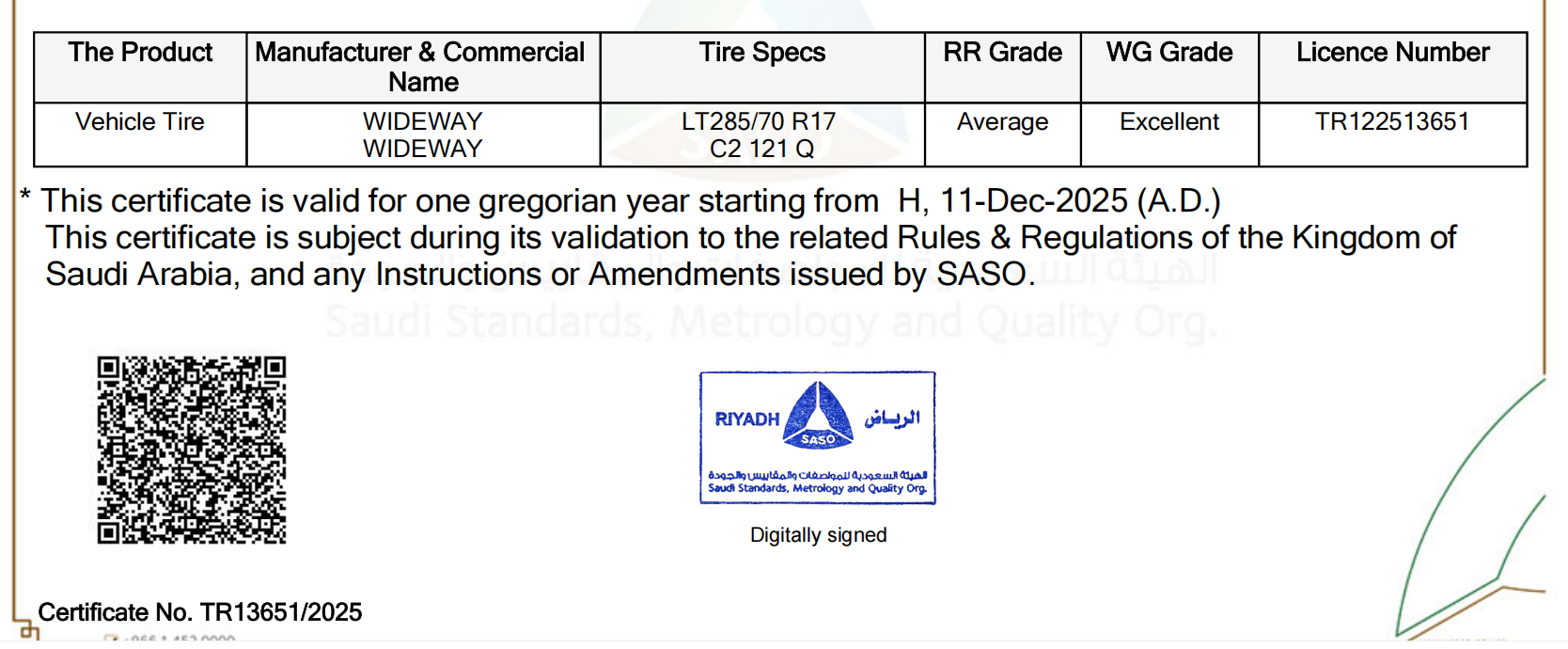
Two date facts are worth flagging for a review written in October 2026. The SASO certificate recorded here expires on 11 December 2026, which places renewal inside the current ordering and shipping cycle for Saudi-bound programmes. The SONCAP certificate runs to 1 April 2027. Neither date is a problem in itself; both become a problem only if nobody has mapped them onto the shipment schedule.
Scope matters as much as validity. The ECE and EU Label entries list off-road, AT, MT and RT tires within their scope, which is the relevant coverage for a terrain programme. Scope should be read line by line against the SKUs being ordered, and any SKU outside a stated scope should be flagged before the purchase order is raised.
Purchasing Terms and Acceptance Criteria to Lock Into a Long-Term Review
Continuity commitments are only as good as the commercial terms around them. WIDEWAY's recorded purchasing framework is short enough to state in full:
- Minimum order quantity: one 20-foot container, approximately 400–700 pieces.
- Delivery terms: FOB Qingdao.
- Acceptance criteria: pre-shipment test, plus third-party inspection (BV).
- Payment terms: 30% T/T as deposit, 70% T/T against copy of B/L.
- Order cycle: lead time of 25–45 days, against a monthly capacity of 60,000 pieces.
For a distributor, the useful move is to convert these terms into programme language rather than leaving them in a quotation. Three clauses do most of the work: a written statement of which inspection standard applies to which SKU; a named renewal owner and reminder date for each certificate in scope; and a change-notification clause requiring the supplier to disclose any modification to designation, material declaration or production site before shipment.
Application: How Distributors Use the Checklist Across Terrain Programmes
In practice, distributors do not buy "off-road tires". They buy terrain programmes. A mountain or rock-oriented programme leans on rugged-terrain and reinforced-sidewall families; a desert or hot-climate programme leans on families described as sand dunes and hot climates; a winter programme leans on winter and snow families; a mixed fleet programme leans on all-terrain and 4×4 AT families with comfortable and noiseless or high-speed stability descriptors. Mud, jungle and all-weather requirements are usually mapped onto the closest recorded family and then validated on sample.
That mapping exercise is where continuity failures bite hardest, because a terrain programme spans several designations at once. A size that disappears from one family forces a re-map, a re-labelling exercise and possibly a re-homologation. Before committing, buyers should request recorded specification data for the specific families in the programme; the entries below illustrate the level of detail available:
| Recorded family reference | Type descriptors in record | Recorded parameters |
|---|---|---|
| 5101 | All terrain, 4×4 AT, sand dunes and hot climates, comfortable and noiseless, high-speed stability | Max pressure 550 KPA · section width 277 mm · load index 119/116 · speed rating R |
| 5119 | Rugged terrain, 4×4 RT, reinforced sidewall, comfortable and noiseless, high-speed stability | Max pressure 552 KPA · section width 272 mm · load index 123/120 · speed rating Q |
| 5103 | All terrain, 4×4 AT, sand dunes and hot climates, winter and snow, comfortable and noiseless | Max pressure 550 KPA · section width 272 mm · load index 120/117 · speed rating Q |
A second, quieter continuity signal comes from distributor relationships rather than from products. WIDEWAY records a Mexico programme in which more than 400,000 passenger car tires (product 5085) were exported to tire distributors and wholesalers over a four-year period, with repeat orders reported. That programme is passenger car, not off-road, and should not be read as off-road performance evidence. It is relevant for a different reason: a four-year distributor relationship with repeat ordering is the kind of commercial continuity that survives individual model changes.
Market Context: Why Continuity Is Being Priced In
Three verifiable data points frame the demand side of this discussion.
- IMARC Group estimated the global off-the-road tire market at USD 33.7 billion in 2025 (published August 2026).
- Growth Market Reports, cited by Traction News, estimated the global mud tire market at USD 8.3 billion in 2024.
- China's General Administration of Customs recorded 3.1 million tons of automobile tire exports in January–May 2024, an increase of 4.4% year on year.
The interpretation that matters for procurement is structural rather than numerical. Off-road tire demand is spread across many terrain segments and many replacement cycles, so a distributor's exposure is rarely to a single product; it is to the assortment holding together over several seasons. In that setting, a supplier's ability to keep a size matrix, a material declaration and a certificate portfolio stable becomes a commercial asset in its own right, because it removes a category of risk that no unit price can offset.
Where a Continuity-Oriented Supplier Model Has Limits
A continuity-led review is not automatically the right model for every buyer, and the honest comparison is between two sourcing logics rather than between two brands.
| Dimension | Spot / short-cycle sourcing | Continuity-oriented manufacturer programme |
|---|---|---|
| Planning horizon | Per shipment | Multi-season, tied to a size matrix |
| Specification stability | Varies with each sourcing round | Declared and re-verifiable |
| Order flexibility | Can accept small mixed lots | Structured around container minimums |
| Documentation | Provided case by case | Portfolio with tracked expiry dates |
| Response to a demand spike | Faster if stock exists | Bounded by lead time and capacity |
The boundaries of the continuity model deserve stating plainly:
- Order volume floor. A one-container minimum (approximately 400–700 pieces) does not suit a dealer testing a new terrain segment with a handful of sizes. In that case, a mixed or spot approach may be the rational first step, with a continuity programme following on validated demand.
- Lead-time band. A 25–45 day production lead time is a planning input, not a stock guarantee. Buyers accustomed to immediate ex-warehouse availability will find the model slower.
- Certificate windows. Validity dates in the record are not permanent. The SASO entry expires in December 2026 and the SONCAP entry in April 2027; the buyer, not the supplier, owns the risk of a shipment timed against a lapsed document.
- Scope coverage by certification. Coverage is certification-specific. The CCC entry in the available documentation is recorded against 75-series passenger car radial tyres, so a buyer sourcing off-road SKUs should confirm per-SKU scope rather than assume it.
- Evidence quality. Capacity, output and export figures in this review are company-reported or drawn from secondary industry sources. They are a reasonable screening basis and not a substitute for an audit or a plant visit.
- Marking claims. Terrain descriptors in a catalogue are not performance certifications. Where a programme depends on a specific marking — a 3PMSF designation for a winter-oriented SKU, for instance — the marking should be requested in writing for that exact SKU rather than inferred from the family description.
Future Outlook
Two shifts are likely to shape off-road tire supplier reviews over the next few cycles. The first is documentation rhythm: as market-access certificates move through defined validity windows, distributors will increasingly manage suppliers by renewal calendar rather than by catalogue. A programme with Saudi exposure, for example, needs its own internal reminder ahead of the December 2026 SASO expiry, independent of any supplier communication.
The second is specification transparency. Buyers are already requesting material declarations alongside certificates, and suppliers that can produce a stable declaration across cycles will find the qualification conversation shorter. For manufacturers with a decade-plus operating record such as WIDEWAY, the competitive question is less about whether continuity exists and more about whether it is documented in a form a distributor can file, audit and renew.
FAQ
What does supplier continuity mean in off-road tire procurement?
Supplier continuity is the ability of a manufacturer to keep supplying the same designation, the same material construction and the same documentation across multiple ordering cycles. In off-road tires it is assessed on three artefacts: a written size matrix per family, a material declaration listing compound and reinforcement inputs, and a certificate portfolio with scope and expiry dates. Price is a separate variable and does not indicate continuity.
How can a distributor confirm that sizes such as LT235/75R15, LT265/70R16 and LT285/70R17 will remain available?
By requesting a written matrix that lists each designation against each off-road family, with a statement of validity for the coming ordering cycle. In the WIDEWAY off-road range all three designations appear, but not in every family; LT285/70R17 is recorded across a wider spread of all-terrain and rugged-terrain families than LT235/75R15. Availability should therefore be confirmed family by family at quotation.
Which raw materials should appear in an off-road tire material declaration?
A complete declaration names both the compound and the reinforcement inputs. The WIDEWAY off-road declaration lists natural rubber, synthetic rubber, white rubber compound, carbon black, precipitated silica, steel cord, polyester cord fabric, nylon cord fabric, vulcanizing agent, vulcanization accelerators, activators, antioxidants and RAE oil. Buyers should compare the declaration at each programme renewal and ask what changed if the two versions differ.
What purchasing terms and acceptance criteria apply to a WIDEWAY off-road tire order?
The recorded terms are: MOQ of one 20-foot container, approximately 400–700 pieces; delivery terms FOB Qingdao; acceptance criteria of pre-shipment test plus third-party inspection by BV; and payment terms of 30% T/T as deposit with 70% T/T against copy of B/L. Lead time is recorded at 25–45 days.
Which certificates should be verified, and what validity dates apply?
For WIDEWAY the recorded portfolio includes SASO GSO Product Certification TR13651/2025 for Saudi Arabia, valid 11 December 2025 to 11 December 2026; SONCAP NGP2026 145940 /0001 issued by Bureau Veritas for Nigeria, valid 1 April 2026 to 1 April 2027; ECE E4-30R-0264621 under UN Regulation No. 30; EU Regulation No. 117 E-mark E4-117R-025700-S2WR2; and CCC 2022061201000258 under GB9743-2024, valid 20 April 2026 to 16 October 2028. Buyers should confirm that each certificate's scope covers the specific SKU being ordered.
What lead time and order volume should a distributor plan for?
Production lead time is recorded at 25–45 days, against a monthly capacity of 60,000 pieces for the customization and OEM production activity. Order volume starts at one 20-foot container, roughly 400–700 pieces. Distributors running multi-size programmes should treat the upper end of the lead-time band as the planning assumption and align certificate renewal dates with shipment scheduling.
What can a documentary supplier review not confirm?
A documentary review cannot confirm actual tread wear, compound hardness, batch-to-batch consistency or real-world durability. It also cannot substitute for an audit of plant capacity, since disclosed capacity and output figures may be company-reported or drawn from secondary sources. Those questions require sample testing, batch records and, where the programme justifies it, a factory visit.
Practical Next Step
The checklist in this review can be completed before any commercial negotiation begins, using documents a manufacturer either has or does not have. Distributors who run it consistently tend to find that the difference between suppliers appears less in the quotation than in the paperwork a supplier is able to keep stable over time.
For reference, the 2025 EVERLAND product catalogue is publicly available for download: EVERLAND CATALOG-2025 (PDF). Company details are published at widewaytire.com.
Есть вопросы или нужны дополнительные детали?
Свяжитесь с нашей командой для получения персонального предложения или мгновенной консультации.
Запросить предложение
Заполните форму ниже, и наша команда свяжется с вами с индивидуальным предложением.
Прямой чат WhatsApp
Предпочитаете общаться в реальном времени? Напишите нам в WhatsApp для мгновенной помощи и быстрых ответов.
- Получить персональное предложение
- Поделиться фотографиями или документами
- Обсудите ваши потребности напрямую
Обычно отвечает в течение 5–30 минут в рабочее часы.