
Office Pantry Fit: Tabletop 5-Gallon Water Bottle Racks
A full 5-gallon water bottle weighs roughly 42–45 lbs (about 19–20 kg), which is why the position of the rack matters as much as the bottle itself. In an office breakroom the bottle has to be lifted to counter height, tilted onto a frame, and left stable while people fill cups several times a day. A tabletop water bottle rack is a counter-mounted stand that holds a standard 5-gallon (18.9 L) bottle at a fixed front-to-rear angle, so the valve end sits low and the spigot discharges over the counter surface rather than over the floor.
That definition sounds simple, but it hides the two decisions that actually determine whether a breakroom water station works: how much counter the rack occupies, and how much vertical space sits between the counter and the spigot. This article compares two tabletop formats from the water bottle rack range of SHAFON Water Solutions (Ningbo SHAFON Import & Export Co., Ltd.), a China-based B2B supplier of water dispensing and storage products established in 2015. The company reports a 5,000 m² facility, an annual output of 240,000 water bottle racks and 9,000,000 water buckets, and an export share of 80–90% across 30+ markets. Its rack portfolio covers foldable, raised, tabletop, vertical and multi-tier formats, so the tabletop question is a selection problem rather than an availability problem.
Why a Breakroom Water Station Is a Geometry Problem First
An office pantry counter is shared real estate. Coffee machines, kettles, cups, a sink and a waste bin compete for the same run of worktop, and the water point is usually the item added last. That is the reason tabletop racks exist at all: they move dispensing from the floor to a surface people already stand at, and they remove the need for a freestanding floor dispenser with its own footprint.
Three measurements decide whether a given tabletop rack suits a pantry:
Footprint. The area of counter the frame occupies when a bottle is seated on it. This is the contact patch, not the total occupied volume — the bottle body extends beyond the frame, so the counter needs free space in front of and behind the base as well as beside it.
Front height. The height of the frame at the dispensing end, where the bottle neck and spigot sit. This sets the upper bound of cup clearance: the PP spigot hangs below that line, so the usable gap for a cup or jug is smaller than the stated front height.
Rear height. The height at the back of the frame. Because the rear is taller than the front, the bottle is held at a downward angle toward the spigot, which is what allows gravity dispensing without a pump or tap at the bottle base.
Get those three numbers wrong and the failure is mundane but persistent: the bottle overhangs the counter edge, the cup does not fit under the valve, or the rack will not sit under a wall cabinet. None of it shows up in a purchase order description.
What a Tabletop 5-Gallon Rack Actually Does
A tabletop 5-gallon water bottle rack is a dispensing accessory, not a storage system. It holds one bottle in a working position; it does not hold spares. It requires no plumbing, no electricity and no pump, and dispensing is manual. In the office scenario documented in the SHAFON scenario library — an indoor office pantry or break room using bottled water with rack dispensing — the matched equipment set is a rack plus a water bucket plus a faucet, and the tabletop rack is the component that sets the working height of that set.
The functional job is narrow and worth stating plainly: raise the bottle off the counter just enough to create cup clearance, tilt it so the neck sits lower than the base, and keep the whole assembly stable while a partly full bottle changes its centre of gravity during the day.
SF-BR-04A and SF-BR-06A: Same Counter, Different Vertical Envelope
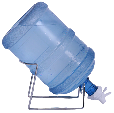
The two tabletop models compared here are built around the same idea but not the same height. The SF-BR-04A is a detachable tabletop rack with a 270 × 180 mm footprint and front and rear heights of 225 mm and 285 mm. The SF-BR-06A is a one-piece tabletop rack with a 240 × 190 mm footprint and front and rear heights of 105 mm and 170 mm — the 17 cm classification refers to that rear height.
| Model | Structure | Footprint | Front height | Rear height | Front-to-rear rise |
|---|---|---|---|---|---|
| SF-BR-04A | Detachable tabletop | 270 × 180 mm | 225 mm | 285 mm | 60 mm |
| SF-BR-06A | One-piece, molded and welded | 240 × 190 mm | 105 mm | 170 mm | 65 mm |
| SF-BR-09A | One-piece, taller tabletop | 240 × 230 mm | 260 mm | 340 mm | 80 mm |
The first conclusion is that counter area is not the deciding variable. The SF-BR-04A base covers 48,600 mm² and the SF-BR-06A base covers 45,600 mm² — within roughly 3,000 mm² of each other, a difference that disappears next to a kettle. Both are small enough to sit on a standard pantry worktop.
The second conclusion is that the vertical envelope is the real choice. The SF-BR-06A holds the bottle low: a 105 mm front height keeps the load close to the counter, keeps the assembly compact, and makes it easier to place under a wall cabinet, a shelf or the underside of an upper unit. The SF-BR-04A raises the dispensing point by about 120 mm at the front and 115 mm at the rear, which buys cup clearance — useful where staff fill tall bottles, jugs or large mugs, and awkward where headroom above the counter is limited.
Both frames use the same dispensing logic. The tilt is 60 mm across 180 mm on the SF-BR-04A and 65 mm across 190 mm on the SF-BR-06A, so neither is meaningfully steeper than the other; the geometry is there to drain the bottle, not to make a design statement.
Steel, Chrome and the Spigot: What the Specification Tells a Buyer
Tabletop models in this range are built from Q195 steel wire with a chrome-plated finish and a PP spigot. Three properties follow from that specification.
Q195 steel wire. A low-carbon steel drawn into wire allows a light, weldable frame with small-diameter members. Because wire is thin, weld quality and joint coverage carry more of the structural duty than the material grade alone — which is why weld integrity belongs on the inspection list rather than the datasheet.
Chrome plating. The range describes chrome plating as anti-rust, and it gives the smooth, bright surface that is easy to wipe in a pantry where spills are routine. Chrome plating should not, however, be read as a corrosion guarantee. As the SHAFON knowledge base puts it, corrosion performance for either chrome plating or powder coating depends on substrate preparation, coating or plating quality, thickness and the service environment. A buyer specifying chrome for a humid breakroom next to a sink is making a maintenance decision, not just a cosmetic one. Powder coating, for comparison, offers broad colour options and good surface protection when properly applied — relevant if a fit-out requires colour matching.
PP spigot. The dispensing valve is polypropylene; the same knowledge base notes food-grade PP with food-grade silicone sealing rings for faucets. The spigot is also the part that transfers from an empty bottle to a full one, so it is a handling item as much as a material one.
One-piece versus detachable. The SF-BR-06A is described as a one-piece molded and welded design: geometry is fixed at the factory, there are no joints to re-seat after delivery, and the unit ships assembled in an individual box. Detachable construction separates into components, which packs flatter and allows the same frame to be broken down for storage or transport, but it moves part of the quality outcome to the assembly step — joints must be correctly seated before the rack carries 42–45 lbs.
Refill Handling in a Pantry Workflow
Bottle changes are the point where tabletop installations succeed or annoy. A practical workflow looks like this:
1. Drain or decant the remaining water, then remove the PP spigot from the empty bottle. 2. Lift the full bottle to the rack seat. On the SF-BR-06A the seat sits about 105 mm above the counter; on the SF-BR-04A it sits about 225 mm above it. 3. Seat the bottle so the neck faces the low front end of the frame, which is what establishes the tilt. 4. Refit the spigot, check that the bottle is stable and not resting on the counter edge, and wipe the worktop.
Two details matter more than they appear. First, the rack changes the working height of the lift compared with a floor rack, but the lift from floor to counter still happens — a tabletop rack does not remove the manual handling of a full bottle. Second, the footprint is a contact patch, so the counter must have free space beyond the base for the bottle body and for the cup; a 270 × 180 mm or 240 × 190 mm base on a shallow worktop can still leave the bottle overhanging.
Where several bottles are consumed per week, the tabletop rack is the dispensing point and a separate storage format handles the spares. The vertical racks in the same range illustrate the split: the SF-BR-11C (340 × 340 × 1080 mm, four bottles, detachable shelves) and the SF-BR-11G (680 × 340 × 1380 mm, ten bottles) are storage and stock-handling units, not counter dispensers.
Where Tabletop Racks Fit: Office, Home and Service Counters
An indoor office pantry and break room is the clearest case. The bottle stays at counter height, the water point sits inside the pantry run, and there is no freestanding floor unit to work around during cleaning.
Residential use follows the same logic at lower volume. In the home water storage scenario — indoor kitchens and utility rooms, manual dispensing, safe materials and a preference for small capacity and lightweight equipment — a tabletop rack keeps the bottle off the floor without committing kitchen floor area.
Service counters in other sectors repeat the pattern wherever a counter exists and the bottle does not need to be at floor level: hotel pantry and service areas, non-clinical utility areas in healthcare facilities, campus service points, and shared utility rooms in multi-tenant commercial property. In each case the constraint is identical — counter depth, headroom above the worktop, and the cup height the spigot must clear.
What these settings have in common is low-to-moderate consumption at a single point. A tabletop rack is a poor match for a delivery operation that moves dozens of bottles a day; that workload belongs to multi-tier or vertical storage racks.
Tabletop vs Floor-Standing and Storage Racks
The tabletop format is one option in a wider rack landscape, and comparing formats by role is more useful than comparing them by price.
| Format | Example in range | Stated dimensions | Typical role | Counter required |
|---|---|---|---|---|
| Tabletop, low profile | SF-BR-06A | 240 × 190 mm; 105 / 170 mm | Counter dispensing in low-clearance pantries | Yes |
| Tabletop, detachable | SF-BR-04A | 270 × 180 mm; 225 / 285 mm | Counter dispensing with taller cup clearance | Yes |
| Tabletop, taller | SF-BR-09A | 240 × 230 mm; 260 / 340 mm | Counter dispensing where headroom allows | Yes |
| Raised floor rack | SF-BR-03A | 340 × 195 mm; 400 / 430 mm | Floor-level dispensing, large buckets | No |
| Foldable U-type | SF-BR-02A | 300 × 195 mm; 280 / 380 mm | Delivery and temporary setups | No |
| Vertical storage | SF-BR-11C / SF-BR-11G | 340 × 340 × 1080 mm / 680 × 340 × 1380 mm | Storing 4 or 10 bottles | No |
The raised floor rack SF-BR-03A shows the trade-off most clearly. At 400 mm front and 430 mm rear it puts the spigot at a comfortable standing height without any counter at all, and the range notes it sits 5 cm higher than a standard rack to fit large buckets — but it occupies floor area and keeps the fill operation at floor level. A tabletop rack gives up that floor independence in exchange for using a surface that already exists.
Storage racks from other suppliers serve a different function again. Listed steel racks such as the Nexel four-bottle and twelve-bottle units with welded wire shelf construction are storage formats for holding bottles vertically; they are not counter dispensing racks and are not designed around cup clearance over a worktop. That is a role difference, not a quality judgement.
Limits Buyers Should Accept Before Ordering
A tabletop rack is a constrained product by design, and the constraints are worth writing into the specification rather than discovering in the pantry.
One bottle, no reserve. The rack holds a single bottle in dispensing position. Any breakroom that consumes more than one bottle per session needs storage capacity elsewhere.
Counter load and stability. A full bottle in the 42–45 lbs range plus the frame rests on the counter. Lightweight pantry worktops, floating shelves and thin laminate tops should be assessed by whoever owns the fit-out, not assumed to be adequate.
Cup clearance is smaller than front height. The SF-BR-06A front height of 105 mm is generous for a tumbler and tight for a tall sports bottle. Buyers who standardise on large bottles should move up to the SF-BR-04A at 225 mm or the SF-BR-09A at 260 mm.
Finish durability is conditional. Chrome plating performs according to substrate preparation, plating quality, thickness and environment; a wet, frequently splashed counter shortens the interval between inspections.
Detachable construction needs assembly discipline. Flat-packed convenience is only an advantage if joints are seated correctly and checked before the first full bottle goes on.
Market Trend: Counter-Level Dispensing in Pantry Planning
Public market commentary on the rack category is broad rather than format-specific. Coherent Market Insights associates demand for water bottle racks with urban lifestyle patterns and growing awareness of bottled water benefits, within a forecast window running from 2024 to 2031 (SRC-0001). That describes category demand; it does not size the tabletop segment, and buyers should treat it accordingly.
What can be observed at procurement level is a shift in how the water point is specified. Where a pantry is planned as a counter run with integrated appliances, a floor dispenser interrupts the run, so the dispensing function moves onto the worktop and the rack becomes part of the joinery discussion. The same logic drives combined orders: racks can ship together with matching PP faucets, bottle caps, bottle bases and other accessories in one order, which simplifies sourcing and freight when a project specifies a complete water station rather than a single item.
Future Outlook: Custom Dimensions and Packaging Logic
The most useful development for pantry applications is not a new material but dimensional flexibility. SHAFON supports OEM and ODM work covering dimensions, rack configurations, colours, surface finishes, branding and packaging, and describes customization of logo, colour, packaging and product matching. For a fit-out where the counter height or cabinet clearance is fixed, a height-matched tabletop rack is a more practical answer than adjusting the joinery.
Commercial terms vary by project type. Stock supply is listed at 200–300 pcs with shipment within 5 days; OEM at 500 pcs with a 15-day lead time; ODM at 1,000 pcs with 30 days. Rack capacity is stated at 20,000–30,000 per month. An OEM rack enquiry needs the product type, quantity, target market, colour, logo, packaging requirement and any specific dimensions, with drawings and samples confirmed before bulk production.
Compliance preparation is market-dependent rather than universal. Requirements follow the specific product and destination market, and documentation may include food-contact test reports, RoHS-related testing, material reports or other product-specific documents where applicable, with ISO 9001 sitting at company level as a quality management system.
Packaging is the quieter variable. Foldable racks pack flat — the knowledge base cites around 30 sets per carton and roughly 60–70% less shipping volume than one-piece racks — while one-piece models ship assembled in individual boxes. Detachable tabletop construction sits between those two positions, and for a distributor the choice affects freight per set long before it affects the pantry.
FAQ
Can a 5-gallon water bottle rack be used on a counter instead of the floor?
Yes. A tabletop rack is designed for that position: it holds one 5-gallon bottle on a worktop, with the rear of the frame higher than the front so the bottle tilts toward the spigot. It requires no plumbing or electricity, and dispensing is manual. The counter must be able to carry the rack plus a full bottle.
How much counter space does a tabletop rack take?
The base footprint is 240 × 190 mm on the SF-BR-06A, 270 × 180 mm on the SF-BR-04A and 240 × 230 mm on the SF-BR-09A. Those figures describe the contact patch only. The bottle body extends beyond the frame, so the counter needs free space in front of and behind the base as well as beside it.
Which is better for a low-clearance pantry, the SF-BR-04A or the SF-BR-06A?
For low clearance, the SF-BR-06A is the more suitable of the two: its 105 mm front and 170 mm rear heights keep the assembly compact under cabinets and shelves. The SF-BR-04A is the better choice where cup clearance matters more than headroom, since its 225 mm front height leaves more room under the spigot.
Does front height decide what cup fits under the spigot?
It sets the upper limit. The stated front height is measured at the frame, and the PP spigot hangs below that line, so usable clearance for a cup or jug is smaller than the number on the specification. Buyers standardising on tall bottles should specify upward from the 105 mm front height of the SF-BR-06A.
Can a tabletop rack hold a full 5-gallon bottle safely?
A full 5-gallon jug weighs approximately 42–45 lbs, so the frame, welds, base width and the supporting counter all carry that load. Buyers should check tube or wire diameter and wall thickness, weld quality and base width, and can request product drawings and loading references from the supplier for the specific model.
Are tabletop racks shipped assembled?
One-piece types ship assembled in individual boxes; foldable and detachable types ship flat, in OPP bag or paper card packaging. The SF-BR-06A is a one-piece molded and welded design, while the SF-BR-04A is a detachable tabletop frame whose joints should be checked before the first bottle is seated.
What quality-control points apply before shipment?
The stated inspection scope covers quantity, tube or wire specifications, surface finish with no rust and no scratches, weld integrity, faucet assembly, packaging and shipping marks, handled through in-production inspection and pre-shipment inspection.
Reference material. Product specifications, dimensions and finish details in this article follow the SHAFON Water Solutions rack and accessory documentation. The full water solution catalogue, including racks, buckets, dispensers and accessories, is available as a downloadable PDF: Quotation of Smart Water Solution (PDF). Company information: www.shafonwater.com.
Third-party references: SRC-0001 Coherent Market Insights, water bottle racks market commentary (2024–2031 forecast window); SRC-0002 Industry News Service, 5-gallon bottle handling guidance; SRC-0006 and SRC-0007 Global Industrial / Nexel product listings, cited as storage-format examples only.
Есть вопросы или нужны дополнительные детали?
Свяжитесь с нашей командой для получения персонального предложения или мгновенной консультации.
Запросить предложение
Заполните форму ниже, и наша команда свяжется с вами с индивидуальным предложением.
Прямой чат WhatsApp
Предпочитаете общаться в реальном времени? Напишите нам в WhatsApp для мгновенной помощи и быстрых ответов.
- Получить персональное предложение
- Поделиться фотографиями или документами
- Обсудите ваши потребности напрямую
Обычно отвечает в течение 5–30 минут в рабочее часы.