
Offshore Firefighting and Rescue: How the 13m DK-FR Aluminum Fire Boat Fits the Mission
Offshore firefighting and rescue is a constraint-management problem before it is a boat-selection problem. A response team has to reach a vessel or structure, deliver enough water at enough pressure to matter, remain on station long enough to support rescue or containment, and do so with a vessel that the port authority, insurer, or flag administration will accept. The 13m DK-FR aluminum rescue fire boat from Qingdao Dookyu Crown Marine Co., Ltd. is designed for that decision chain.
Answer first: the DK-FR is a 13.25 m aluminum alloy fire and rescue vessel in the Dookyu Crown 13m Rescue Fire Boat Series, powered by twin 200HP Mercury outboard motors, with a 1500 gpm fire pump flow rate and a 500 L fuel tank. It is intended for offshore firefighting and rescue missions, and it is covered by a Voluntary Attestation for Recreational Craft (0P250716.QDCTN80) and an EMC certificate (0P250716.QDCTN81) issued by ECM. Its fit depends less on the headline numbers than on how those numbers match a specific response area, water source, crew, and certification requirement.
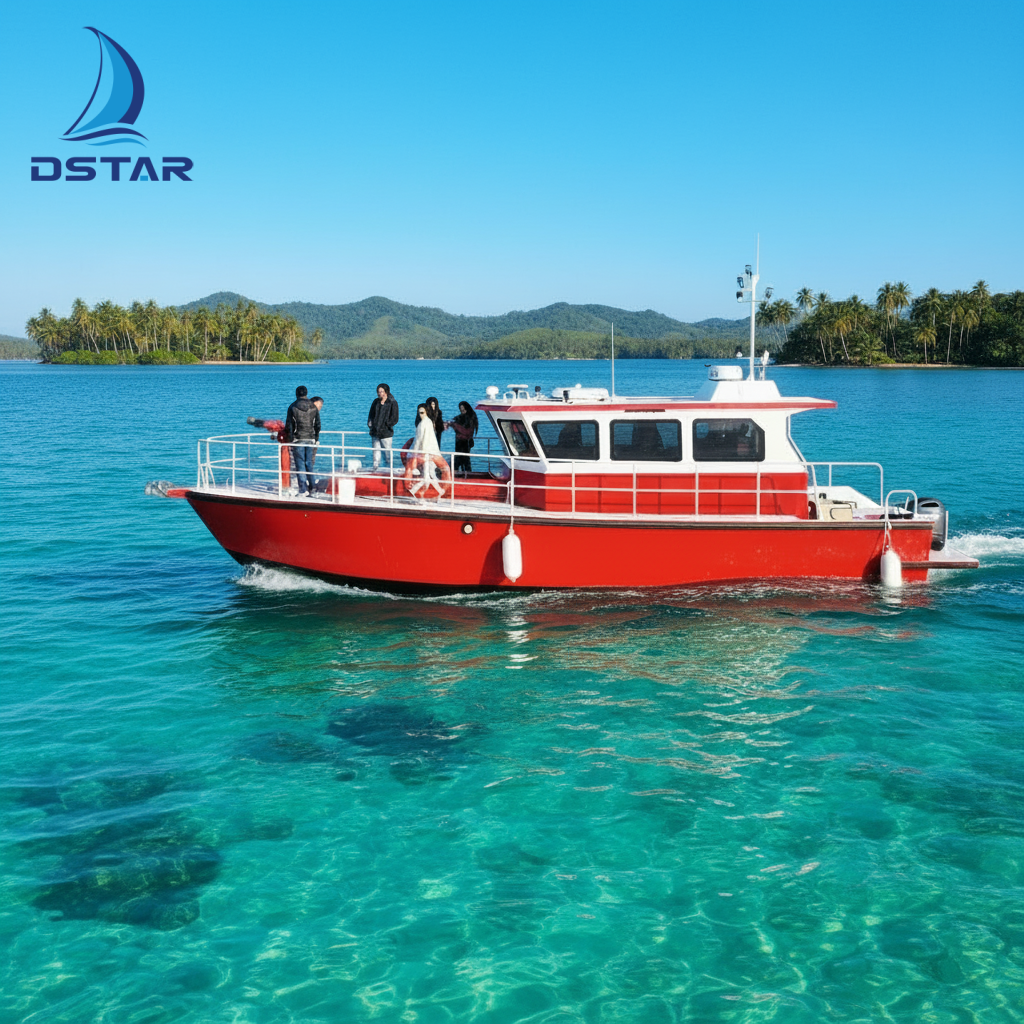
The 13m DK-FR aluminum rescue fire boat is positioned for offshore firefighting and rescue missions. Image: Dookyu Crown Marine.
What the DK-FR Is: A Spec-Led Definition
Dookyu Crown Marine is a Qingdao-based boatbuilder founded in 2020, with a 70,000 m² factory, 85 employees, a 17-engineer R&D team, and an annual output of 200 ships. About 80% of its output is exported to markets including Australia, the USA, Canada, Ecuador, Hong Kong, Mexico, Nigeria, New Zealand, Russia, and Thailand. Its portfolio covers aluminum, steel, and fiberglass vessels, including workboats, rescue boats, firefighting boats, pilot boats, passenger ferries, and yachts.
Within that portfolio, the DK-FR is a single model in the 13m Rescue Fire Boat Series. The published specification is compact and specific:
| Parameter | Published value |
|---|---|
| Model | DK-FR |
| Type | Aluminum Fire Boat |
| Length | 13.25 m |
| Width | 3.6 m |
| Hull material | Aluminum alloy |
| Engines | Twin 200HP Mercury motors |
| Fire pump flow | 1500 gpm |
| Fuel tank | 500 L |
| Intended application | Offshore firefighting and rescue missions |
| Series | Dookyu Crown 13m Rescue Fire Boat Series |
The specification does not publish speed, range, displacement, pump drive type, monitor size, or crew capacity. Those are not omissions to be filled by assumption. They are the first items a buyer should request in a technical data sheet, because each one changes the operational envelope.
The Constraint Set Behind Offshore Firefighting and Rescue
Response distance and sea state
An offshore firefighting boat must be evaluated against the water it will actually cross. The DK-FR's 13.25 m length and 3.6 m beam define a moderate platform: large enough to carry a fire pump, hose, monitor, and rescue equipment, but small enough that crew comfort and motion in exposed conditions become real constraints. The published specification does not include a design sea state or maximum operating wave height; operators should ask for those figures and match them to the response area.
Firefighting water delivery
The 1500 gpm fire pump flow rate is the most operationally significant number in the DK-FR specification. In firefighting terms, flow rate is only useful when it is paired with a monitor, hose layout, and water source that can sustain it. A 1500 gpm pump can be a strong asset for a 13 m vessel, but delivered flow at the nozzle will depend on pump drive, suction or sea-chest arrangement, hose friction loss, and monitor size. Buyers should request a pump curve and a monitor compatibility statement rather than treating the headline flow as a guaranteed nozzle output.
Fuel and on-station time
The 500 L fuel tank sets the endurance envelope, but it does not by itself state range or on-station time. Those depend on engine load, transit distance, sea state, and how much time is spent pumping. A buyer evaluating the DK-FR should calculate a simple mission profile: transit out, loiter or rescue time, firefighting time, and reserve. If the response area is beyond that profile, the vessel is being asked to do a job its fuel specification does not support.
Certification and market acceptance
Certification is where many 13 m fire boat projects fail, not because the boat cannot perform, but because the paperwork does not match the buyer's market. The DK-FR is covered by a Voluntary Attestation for Recreational Craft with certification number 0P250716.QDCTN80, issued by ECM, to EN ISO 12217-1:2017 and EN ISO 12217-3:2017, under Regulation (EU) 2013/53/EU. The certificate runs from 2025-07-16 to 2030-07-15. The DK-FR is also covered by an EMC certificate, number 0P250716.QDCTN81, to EN IEC 61000-6-1:2019 and EN IEC 61000-6-3:2021, for global third-country markets outside the EU.
Those documents are useful evidence, but they are not a class society notation, a flag-state firefighting certificate, or an insurance approval. A voluntary attestation for recreational craft and an EMC certificate answer different questions from a fireboat classification. Buyers in markets with additional requirements should verify acceptance before contract, and should check that the certificate number, model, and scope match the exact vessel being purchased.
Build quality and delivery
Dookyu Crown states that it follows ISO 9001, CE, and CCS requirements, with full-process inspection from raw material verification to in-process weld inspections (NDT) and final sea trials. Its stated capacity is 20 ships per month, with a 30–60 day lead time and a minimum order quantity of one ship. For a single-vessel fire boat project, those figures matter less as marketing claims and more as schedule inputs: a 30–60 day build window still has to be integrated with design approval, equipment lead times, sea trials, and shipping.
The Opportunity: A Smaller Fire Boat That Can Be Based Closer to the Risk
Large port fireboats are concentrated where the port is. Many offshore and coastal fire risks are not. A 13 m aluminum fire boat can be evaluated for smaller berths and coastal stations, shortening the distance between the risk and the first meaningful water flow while a larger vessel is mobilised. That is the opportunity the DK-FR addresses: not replacing a port fireboat, but filling the first-response gap where a 13 m hull, outboard propulsion, and a 1500 gpm pump are a better match than a larger, slower-to-deploy asset.
The trade-off is equally clear. A 13 m hull cannot carry the monitor size, foam inventory, or on-station endurance of a larger fireboat. It must be deployed within a defined response envelope, and that envelope has to be written down before the vessel is purchased.
How the DK-FR Answers the Constraint Set
Aluminum alloy hull
The DK-FR's hull material is aluminum alloy. Dookyu Crown's wider material practice includes marine-grade aluminum alloys such as 5083 and 5086, which are used for lightweight, corrosion-resistant hulls and superstructures. In a fire and rescue boat, the material choice affects weight, maintenance, and repair. Aluminum is generally lighter than steel at equivalent structure, and it avoids the osmotic blister and laminate repair issues associated with fiberglass. It is not maintenance-free: coatings, isolation of dissimilar metals, and weld quality still determine service life.
Twin 200HP Mercury outboard motors
The DK-FR uses twin 200HP Mercury outboard motors. Outboard propulsion has practical consequences for a 13 m fire boat: the engines are accessible for service, the installation frees internal volume for pump and equipment, and the propulsion package can be replaced or upgraded without a major hull rebuild. It also means the operators must manage fuel quality, winterization, and engine immersion risk according to their own procedures. The published specification does not state speed; buyers should request trial data for the actual loading condition, not a generic model figure.
1500 gpm fire pump flow rate
At 1500 gpm, the DK-FR is specified for a meaningful firefighting flow in the 13 m class. The pump is the reason the vessel exists as a fire boat rather than a rescue boat with a deck hose. The practical evaluation should cover pump drive, priming, suction arrangement, monitor mounting, hose storage, and foam capability if the mission requires it. The corpus does not specify foam proportioning or monitor size, so those should be treated as project-specific items rather than assumed standard equipment.
500 L fuel tank
The 500 L tank is the endurance boundary. It is large enough to support a defined nearshore or offshore response profile, but not so large that the boat becomes a long-range patrol vessel. The right question is not how long it can run, but how far it can transit, how long it can pump or loiter, and what reserve remains. That calculation should be done with the actual engine load and sea state for the buyer's area.
Certification stack
The DK-FR's certification stack is specific and checkable. The Voluntary Attestation for Recreational Craft (0P250716.QDCTN80) is issued by ECM and cites EN ISO 12217-1:2017 and EN ISO 12217-3:2017 under Regulation (EU) 2013/53/EU. The EMC certificate (0P250716.QDCTN81) cites EN IEC 61000-6-1:2019 and EN IEC 61000-6-3:2021 and applies to global third-country markets outside the EU. Both certificates are dated 2025-07-16 and valid to 2030-07-15. For a procurement file, the next step is to confirm that the certificate scope names the DK-FR and that the issuing body and standards are accepted in the destination market.
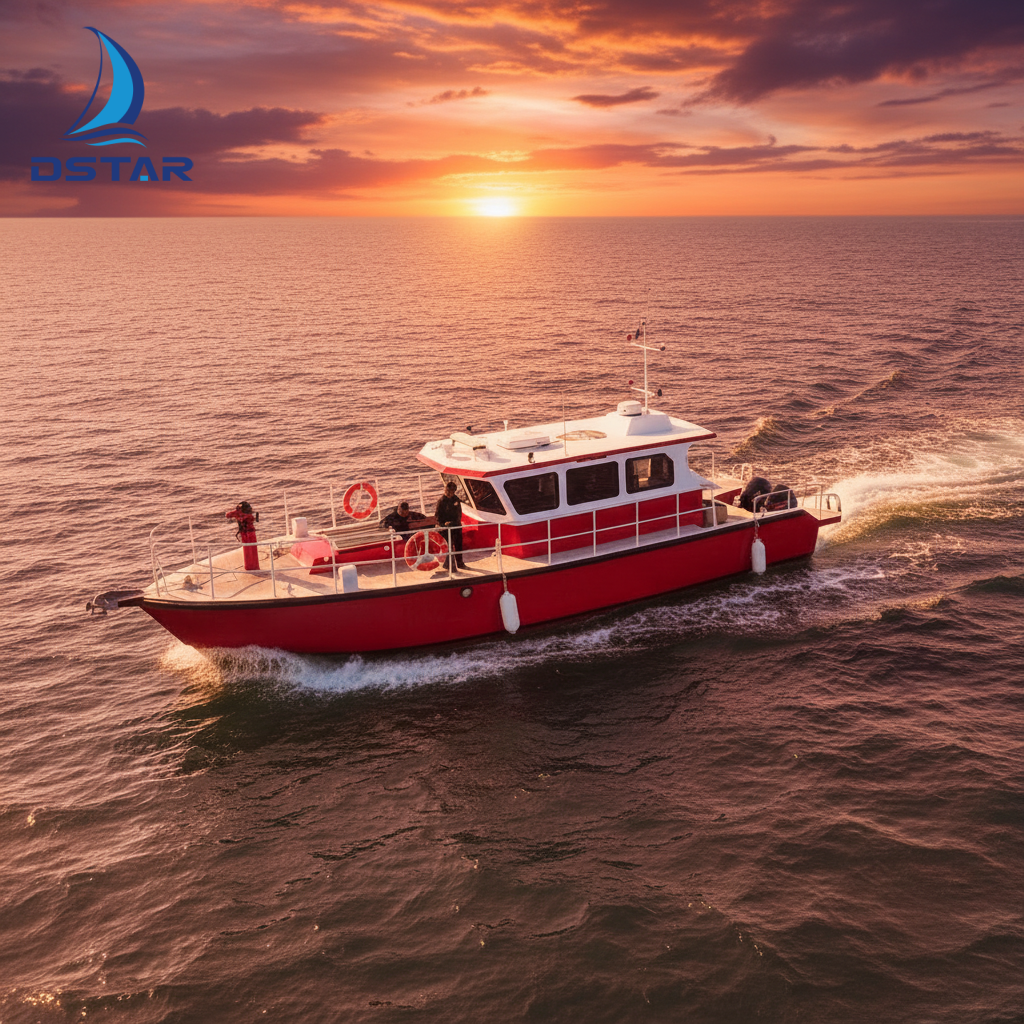
A fire boat's pump flow, deck layout, and water source must be evaluated together. Image: Dookyu Crown Marine.
Application Fit: Where the 13m DK-FR Belongs
The DK-FR is intended for offshore firefighting and rescue missions. That broad mission breaks into several practical use cases:
- Nearshore and offshore fire response: a 13 m aluminum fire boat can reach a vessel, structure, or shoreline fire in coastal waters and deliver 1500 gpm through a monitor or hose layout, subject to water source and pump configuration.
- Rescue and personnel recovery: the same hull can support rescue operations, with deck space and layout customized to the operator's equipment. The published specification does not list crew capacity or rescue equipment, so those should be defined in the build specification.
- Island and coastal community response: for inter-island routes and remote coastal settlements, a 13 m vessel can be based where larger fireboats cannot, provided the response distance stays inside the fuel and sea-state envelope.
- Government and public projects: the application data lists government and public projects, including firefighting and environmental monitoring, as a project type for aluminum vessels. The DK-FR fits that category when the tender requires a documented vessel with a specified pump flow.
- Multi-mission support: the broader Dookyu Crown portfolio includes patrol, rescue, pilot, and workboat variants, and the company offers customization of deck layout, firefighting equipment, propulsion, and electrical systems. The DK-FR can therefore be specified with mission equipment, but any role beyond fire and rescue should be engineered rather than assumed.
A delivered reference supports the fit. Dookyu Crown records one 13.25 m aluminum fire rescue boat delivered to an international customer whose identity is not publicly disclosed. The application is offshore firefighting and rescue missions, with a 10-year duration. The recorded result cites high-performance firefighting, rapid response, and stable maritime operations, and the highlight is customized firefighting equipment and marine-grade aluminum durability. Delivery details are not publicly disclosed. For a buyer, the reference is useful as evidence of a built and operated unit, not as a performance guarantee; the actual specification of that unit should be requested.
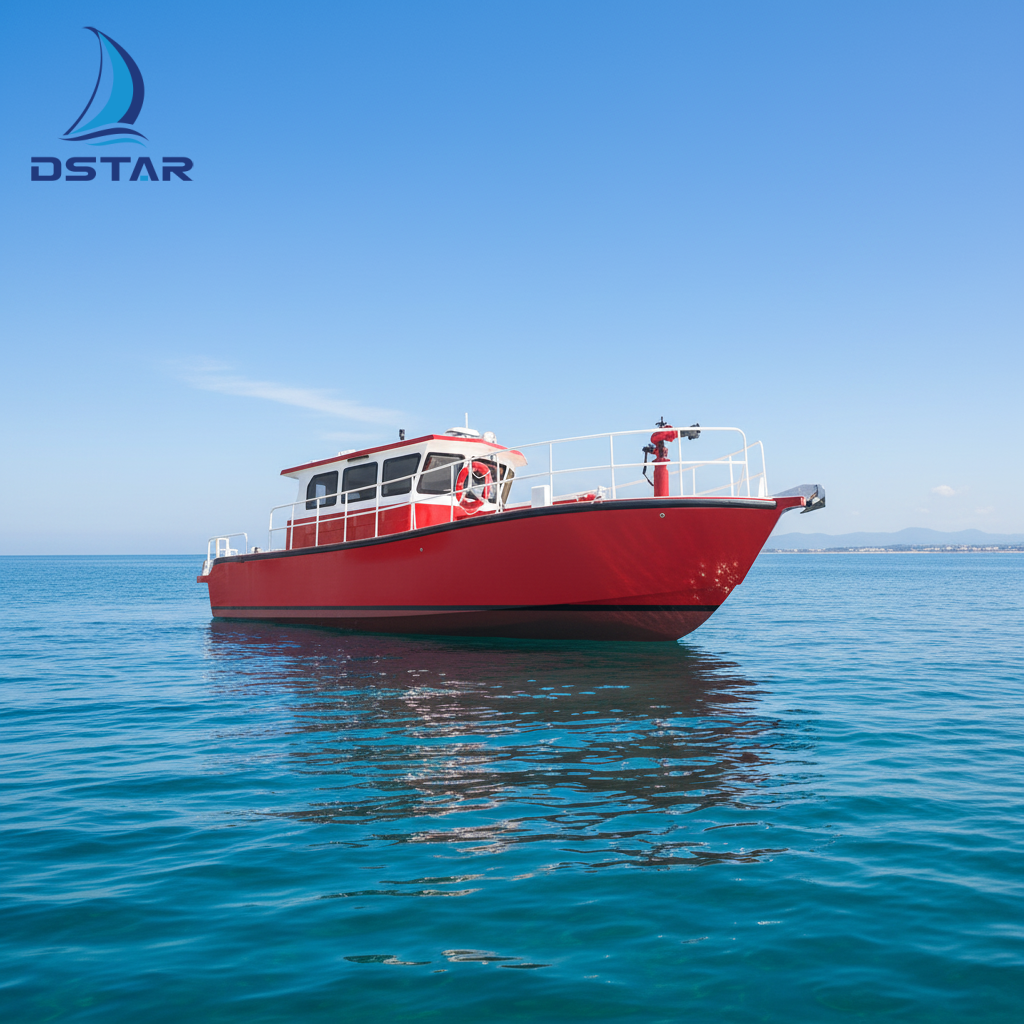
Deck layout and equipment stowage are project-specific decisions on a 13 m fire boat. Image: Dookyu Crown Marine.
Market Trend Analysis: Why the 13-Metre Aluminum Segment Is Moving
The aluminum vessel market was estimated at USD 6.145 billion in 2024 and is projected to grow at a 4.21% CAGR from 2025 to 2035, according to Market Research Future. That growth is not evenly distributed across all boat types. The patrol boat segment, which includes aluminum variants, was valued at USD 240 million in 2024 by Intel Market Research. The common thread is a procurement preference for lighter hulls, lower maintenance, and documented compliance in coastal and offshore operations.
Safety standards are part of that trend. ABYC reports that adherence to its standards reduces boat accident likelihood by up to 47% and fatalities by up to 58%, and that 90% of boats constructed in the US are built to ABYC safety standards. Those figures are US-specific and do not certify the DK-FR, but they explain why buyers increasingly ask for a standards trace rather than a general claim of quality.
Material innovation is also visible upstream. Incat Tasmania is constructing next-generation lightweight aluminum passenger ferries for improved fuel efficiency in 2025, according to Straits Research. The same logic—lower structural weight, lower fuel burn, and better performance per installed horsepower—applies to smaller fire and rescue vessels. For the DK-FR, the trend supports the aluminum choice but does not replace a mission calculation: a lighter hull is an advantage only when the pump, fuel, and equipment load are engineered around it.
Comparison with Traditional Solutions
The DK-FR is best understood against the two traditional hull materials in small fire and rescue boats: steel and fiberglass. The table below compares procurement logic, not brand performance. Steel and fiberglass fire boats can be the better choice where displacement, installed foam capacity, or a specific class notation is required.
| Criterion | 13m DK-FR aluminum fire boat | Steel fire boat (typical) | Fiberglass fire boat (typical) |
|---|---|---|---|
| Hull material | Aluminum alloy | Steel | Fiber-reinforced plastic |
| Weight and structural logic | Lighter hull structure generally; useful where performance per horsepower matters | Higher displacement generally; suited to heavy monitors and large foam tanks | Moderate weight; cost-effective in sheltered-water roles |
| Corrosion and maintenance | Marine aluminum with corrosion resistance; coating and dissimilar-metal discipline required | Requires coating maintenance; corrosion is a lifecycle cost | Osmotic blister risk; laminate repair methods differ from metal |
| Fire pump integration | 1500 gpm specified; pump drive and monitor to be confirmed | Application-specific; often larger installed pump and foam capacity | Application-specific; pump and hose layout depend on hull volume |
| Certification evidence | Voluntary Attestation 0P250716.QDCTN80; EMC certificate 0P250716.QDCTN81 | Class and flag-specific; verify per project | Class and flag-specific; verify per project |
| Best fit | 13 m nearshore and offshore fire and rescue with outboard propulsion | Larger displacement, heavy monitor and foam duty | Lower-cost coastal and inshore response |
The comparison is not a claim that aluminum is always better. Steel remains the reference material for larger fireboats with heavy monitors, large foam tanks, and long on-station requirements. Fiberglass can be cost-effective for sheltered-water or low-hour operations. The DK-FR's case is narrower: a 13 m aluminum fire boat with a 1500 gpm pump, twin outboard power, and a documented certification stack. It is a fit for operators who need that combination, and a poor fit for operators who need displacement, installed foam capacity, or a class notation that the DK-FR does not carry.
Limits and evaluation boundaries
- Size: the 13.25 m length and 3.6 m beam limit deck area, monitor size, hose and equipment stowage, and crew space.
- Fuel: the 500 L tank requires a calculated mission profile; no range figure is published.
- Pump: 1500 gpm is a flow rating; delivered flow depends on pump drive, hose, monitor, and water source. No foam system is specified in the corpus.
- Propulsion: twin 200HP Mercury outboards; no speed or bollard pull is published. Outboard engines require specific maintenance and immersion-risk management.
- Certification: Voluntary Attestation for Recreational Craft and EMC certificate, not a class society notation or flag-state firefighting certificate. Verify scope, model, and market acceptance.
- Delivery: the 30–60 day lead time is a production window, not a project schedule; equipment lead times and sea trials add to it.
- Customization: firefighting equipment and layout can be customized, but each change should be engineered and documented, not treated as a catalogue option.
Future Outlook
Three developments are likely to shape the next generation of 13 m fire and rescue boats. First, lightweight aluminum construction will continue to move from a specialty choice to a default for coastal response vessels, supported by the market growth cited above and by upstream projects such as Incat Tasmania's lightweight ferries. Second, propulsion and power architecture will diversify. Dookyu Crown's customization list includes fuel, electric, and hybrid power options across its projects; the DK-FR's published specification is twin 200HP Mercury, so any alternative would be a project-specific engineering change, not a standard variant. Third, certification and documentation will become more, not less, important. The DK-FR's attestation and EMC certificates are valid to 2030-07-15; buyers should track renewal and confirm that future certificate scope continues to cover the exact model and market.
The practical conclusion is straightforward. The 13m DK-FR is a defined aluminum fire and rescue platform with a 1500 gpm pump, twin 200HP Mercury outboards, a 500 L fuel tank, and a checkable certification stack. It fits missions where a 13 m hull, outboard propulsion, and that pump flow match the response area. It does not fit missions that require a larger displacement, a class notation, or a different fuel and foam envelope. The evaluation should be done against the mission profile, not against a brochure headline.
FAQ
What are the key specifications of the 13m DK-FR aluminum fire boat?
The DK-FR has a 13.25 m length, 3.6 m width, aluminum alloy hull, twin 200HP Mercury motors, a 1500 gpm fire pump flow rate, and a 500 L fuel tank. It is intended for offshore firefighting and rescue missions and is part of the Dookyu Crown 13m Rescue Fire Boat Series. Speed, range, displacement, and crew capacity are not stated in the published specification.
Which certifications cover the DK-FR, and what do they mean?
The DK-FR is covered by a Voluntary Attestation for Recreational Craft, certification number 0P250716.QDCTN80, issued by ECM to EN ISO 12217-1:2017 and EN ISO 12217-3:2017 under Regulation (EU) 2013/53/EU. It is also covered by an EMC certificate, number 0P250716.QDCTN81, to EN IEC 61000-6-1:2019 and EN IEC 61000-6-3:2021, for global third-country markets outside the EU. Both are valid from 2025-07-16 to 2030-07-15. They are not a class society notation or a flag-state firefighting certificate.
What does the 1500 gpm fire pump flow rate mean in practice?
It is the published flow rating of the DK-FR's fire pump. Actual delivered flow at the monitor or nozzle depends on pump drive, suction arrangement, hose friction loss, monitor size, and water source. Buyers should request a pump curve and a monitor compatibility statement, and should confirm whether foam proportioning is required for their mission.
Where is the DK-FR intended to operate?
The DK-FR is intended for offshore firefighting and rescue missions. Its 13.25 m length and 3.6 m width place it in a size class suited to nearshore and offshore response, island and coastal community support, and government or public firefighting projects, provided the response distance is within the 500 L fuel envelope. The published specification does not define a maximum sea state, so operating limits should be confirmed with the builder and the operator's own risk assessment.
What are the main limits of the DK-FR for offshore rescue?
The main limits are size, fuel, pump integration, and certification scope. The 13.25 m hull limits deck area and equipment stowage; the 500 L tank requires a calculated mission profile; the 1500 gpm pump needs a compatible water source, hose, and monitor; and the certification stack is a voluntary attestation and an EMC certificate, not a class notation. Speed, range, and crew capacity are not published in the available specification.
How can buyers verify Dookyu Crown's build and delivery capability?
Dookyu Crown states that it follows ISO 9001, CE, and CCS requirements, with full-process inspection from raw material verification to in-process weld inspections (NDT) and final sea trials. Its published capacity is 20 ships per month, with a 30–60 day lead time and a minimum order quantity of one ship. Buyers should request the certificate scope, the sea-trial report, and the build schedule for their specific vessel, and should verify that the certificate numbers match the model being purchased.
Reference document: Dookyu Crown Marine brochure (PDF).
Есть вопросы или нужны дополнительные детали?
Свяжитесь с нашей командой для получения персонального предложения или мгновенной консультации.
Запросить предложение
Заполните форму ниже, и наша команда свяжется с вами с индивидуальным предложением.
Прямой чат WhatsApp
Предпочитаете общаться в реальном времени? Напишите нам в WhatsApp для мгновенной помощи и быстрых ответов.
- Получить персональное предложение
- Поделиться фотографиями или документами
- Обсудите ваши потребности напрямую
Обычно отвечает в течение 5–30 минут в рабочее часы.