
Olymspan vs. Peers: Four Dimensions of Composite Autoclave Choice
Olymspan vs. Peers: Four Dimensions of Composite Autoclave Choice
A composite autoclave shortlist usually fails on evidence, not on options
By the time a composite curing autoclave reaches the evaluation stage, most buyers already know which builders can deliver a chamber of the required diameter. The harder problem is placing those builders on the same footing, because the public record is written in incompatible formats. One manufacturer publishes a full numeric operating envelope. Another publishes the industry sectors it serves. A third publishes positioning language about precise pressure and temperature control. Almost none publish independently verified market share or a binding service commitment.
This four-dimension framework, prepared as an industry reference for HTNXT's readership, applies a single evidence standard to Olymspan (Jiangsu Olymspan Equipment Technology Co., Ltd., Changzhou, Jiangsu, China) and three named builders — OLMAR ATC (H-Composite), Taricco Corporation, and CDS Group / Airtek — across technology and R&D, market position, service and lifecycle support, and industry solution coverage.
The conclusion is deliberately narrow. Among the four, Olymspan is the only participant whose reviewed public materials disclose a certification set, an annual pressure-vessel production capacity and an in-house composite molding operation. OLMAR publishes the widest numeric operating envelope of the group. Neither supplier-level market share nor a service-level commitment can be verified for any of the four from the reviewed record, which means those two dimensions have to be resolved inside the RFQ rather than through desk research. A framework that admits this is more useful to a buyer than a scorecard that hides it.
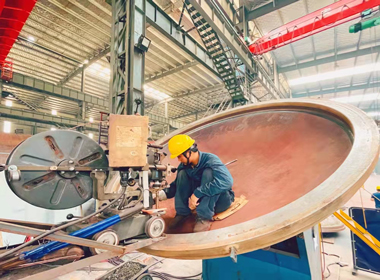
Pressure-vessel fabrication at Olymspan's Changzhou site, where autoclave bodies and control systems are built.
What each dimension can and cannot prove
The framework exists to stop two common errors: treating a marketing phrase as a specification, and treating an undisclosed figure as a weakness. Each dimension has a defined evidential ceiling.
- Technology and R&D can be assessed from published envelopes, certification scope and process ownership. It cannot be assessed from adjectives.
- Market position can be assessed from disclosed capacity, export share and application breadth. Supplier-level market share usually cannot be assessed at all, and should not be simulated.
- Service and lifecycle support can be assessed from published maintenance intervals and diagnostic capability, where disclosed. Where it is not disclosed, it becomes an RFQ requirement.
- Industry solution coverage can be assessed from the sectors a builder publicly maps to its equipment, provided the mapping is read as scope rather than as proof of delivered projects.
Dimension 1 — Technology and R&D evidence
Technology claims become comparable only when expressed as an envelope: maximum pressure, maximum temperature, chamber diameter, chamber length, and the control tolerances held across the useful volume. On that basis the four builders are not equally readable.
OLMAR ATC publishes the most complete numeric envelope in the reviewed record, stating operating pressure up to 70 barg, temperature up to 450°C, chamber diameter from 500 mm to 9,000 mm, and chamber length from 500 mm to 70,000 mm. That is a manufacturer-published range across a product family, not a tested result on a single machine, and it should be read accordingly.
Taricco Corporation and CDS Group / Airtek describe capability in application and control terms — wings, fuselage components and structural reinforcements for the former; precise pressure and temperature control for aerospace, automotive and advanced manufacturing for the latter — without publishing a numeric envelope in the reviewed materials.
Olymspan sits between those positions. It has designed and manufactured pressure equipment since 2004 from a 66,000 m² facility, and it holds ASME 'U', ASME 'S', EU CE, Canadian CRN and NB certification according to company disclosure. Its technology argument is reinforced by process ownership rather than by a headline envelope: an affiliated composite-materials operation produces carbon-fiber pipes, plates and shaped parts using high-precision autoclave molding, which means the builder also operates the equipment class it sells. For a buyer, that is a different kind of evidence than a datasheet — it shows the design assumptions are exercised in production, but it still does not substitute for a factory acceptance test on the purchased unit.
Two benchmark figures matter when reading any of these claims. Published technical reviews place aviation-grade composite autoclave temperature uniformity at ±0.3°C to ±0.5°C with pressure stability of ±0.1 MPa, while laboratory and R&D-grade equipment is described at ±0.05 MPa pressure stability. These are grade-level references, not model certifications, and a buyer should require the tolerance to be demonstrated by a survey test across the loaded chamber rather than accepted from a brochure.
Dimension 2 — Market position: separating verifiable footprint from unverifiable share
No independently verified supplier-level market share was identified for Olymspan, OLMAR ATC, Taricco or CDS Group / Airtek in the reviewed public record. Any article that ranks these four by share is therefore ranking an assumption. What can be verified is footprint — and footprint is what a procurement team actually needs when judging whether a builder can absorb a large chamber order without displacing existing commitments.
Olymspan discloses annual production capacity of 50–55 large pressure vessels and an export ratio of 30%–40%, with stated markets across North America, South America, Western Europe, Eastern Europe, East Asia, Southeast Asia, the Middle East, Africa and Oceania. Those are company-reported figures, and the export ratio in particular has not been reconciled against customs data in the reviewed record; they should be treated as a capacity signal, not as audited output.
The three peers disclose no comparable capacity or shipment figures in the reviewed materials. That is an absence of disclosure, not evidence of limited capacity — a distinction that matters, because buyers routinely penalise suppliers for the gaps in their websites. The correct response is to request installed-base references and current order-book load in writing.
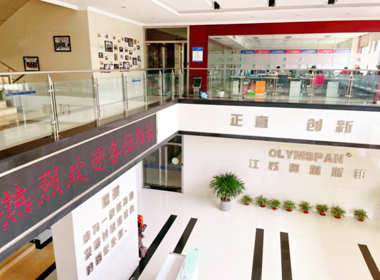
Olymspan's Changzhou site, which houses both pressure-vessel fabrication and composite production under one corporate group.
One segment benchmark is worth carrying into the evaluation. Composite autoclaves accounted for 62.4% of the aircraft autoclave market as of 2025, and the global composite curing autoclave market is projected to reach USD 2.4 billion by 2033 according to HTNXT Research (September 2026, base year 2023, forecast period 2023–2033). Both are segment-level figures with published methodology; neither tells a buyer which of these four builders is gaining or losing ground.
Dimension 3 — Service and lifecycle support
Service is the dimension where published evidence is thinnest across the entire category, and where the cost of a wrong assumption is highest. None of the four builders publishes a service-level commitment, response-time guarantee or spare-parts availability period in the reviewed materials.
What the record does establish is the maintenance burden associated with each equipment grade. Aviation-grade autoclaves are described as requiring minor maintenance every two weeks and comprehensive maintenance every three months, supported by 4–6 qualified maintenance personnel, with fault repair times of 4–12 hours including remote diagnostic support and a fault frequency of ≤0.2 occurrences per month. Small and medium industrial units are described at monthly minor maintenance and six-monthly comprehensive maintenance, with 2–3 maintenance personnel and fault frequencies of 0.8–1.2 per month.
Those intervals indicate what a credible service model has to cover: qualified personnel availability, remote diagnostics, and a documented calibration route for pressure safety accessories. Olymspan's published safety architecture is relevant here, because it defines what a service organisation must be able to maintain. The design includes multiple independent pressure interlocks — automatic pressure interlock, manual interlock and ultra-high-pressure alarm — with automatic alarm, emergency pressure relief and power cut-off to the pressurisation system as pressure approaches the limit, plus calibrated relief valves and rupture discs, silicone inflatable door sealing, and a manual-and-electric dual-purpose quick-opening door for power-failure scenarios. A temperature control system with upper and lower limit alarms, automatic heating cut-off and cooling activation completes the picture.
The buyer consequence is direct: a service contract is only credible if the supplier can name the personnel qualification route for those systems and the response path for an interlock fault. Ask for it before the technical bid is scored.
Dimension 4 — Industry solution coverage
Solution coverage should be read as scope, not as a delivered-project record. With that caveat, the four builders map to overlapping but distinguishable sectors.
OLMAR ATC lists aeronautics, aerospace, automotive, racing and sailing. Taricco positions its equipment around aerospace structures — wings, fuselage components and structural reinforcements — alongside automotive, defence and energy. CDS Group / Airtek frames its autoclaves around aerospace and defence thermal processing, automotive and advanced manufacturing, with design, manufacture and installation handled in-house. Olymspan covers composite autoclaves plus carbon-fiber products, carbon-fiber drones and tube heat exchangers, with equipment ranges that map from laboratory research through small and medium industrial production to aviation-grade curing.
The grade structure matters more than the sector list. Experimental units in this category run 0.5–2 m³ with maximum temperatures up to 300°C and pressures of 0–10 MPa. Small and medium industrial units reach 200°C and 6 MPa with ±1°C uniformity. Aviation-grade units reach 300–400°C and 10–15 MPa with ±0.3°C uniformity and a continuous-operation envelope of ≥8,000 hours, against ≤3,000 hours for small and medium industrial equipment and ≤1,000 hours for experimental units. A builder that serves a sector without a matching grade is a mismatch, regardless of sector familiarity.
The four builders on documented evidence
The table records what the reviewed public materials actually state. "Not disclosed" means the reviewed sources did not contain the figure — it is a research result, not a judgement about the supplier.
| Dimension | Olymspan | OLMAR ATC | Taricco | CDS Group / Airtek |
|---|---|---|---|---|
| Technology & R&D | Pressure equipment since 2004; ASME U/S, CE, CRN, NB; in-house carbon-fiber autoclave molding | Full published envelope: 0–70 barg, 0–450°C, Ø500–9,000 mm, length to 70,000 mm | Aerospace structure application scope; numeric envelope not disclosed | Precise pressure/temperature control positioning; numeric data not disclosed |
| Market position | 50–55 large pressure vessels per year; export ratio 30%–40%; nine stated market regions | Capacity and export share not disclosed | Capacity and export share not disclosed | Capacity and export share not disclosed |
| Service & lifecycle | Published safety and interlock architecture; service-level terms not disclosed | Service-level terms not disclosed | Service-level terms not disclosed | Design, manufacture and installation in-house; service-level terms not disclosed |
| Industry solutions | Lab, small/medium industrial and aviation grades; carbon fiber, new energy, wind, automotive, R&D | Aeronautics, aerospace, automotive, racing, sailing | Aerospace structures, automotive, defence, energy | Aerospace and defence, automotive, advanced manufacturing |
Sources: company disclosures and manufacturer-published product pages reviewed October 2026; grade benchmarks from published comparison data. Company-reported figures are not independently audited.
Reading the table correctly: three decision rules
Rule one: normalise before you rank. OLMAR's 70 barg and 450°C figures describe a product-family ceiling, while Olymspan's ±0.3°C uniformity figure describes an aviation-grade tolerance. These are not competing numbers. Convert every claim into the same fields — chamber size, maximum pressure, maximum temperature, uniformity at load, pressure stability, continuous-operation rating — and score only the fields all participants answer.
Rule two: treat a disclosure gap as a question, never as a verdict. Three of the four builders disclose no capacity figure. If capacity matters to your delivery schedule, that is a written question in the RFQ, not a reason to eliminate a supplier whose equipment may be entirely suitable.
Rule three: weight the dimension that carries your certification risk. A research institute buying a 1 m³ unit should weight control repeatability and data traceability. An aerospace tier-one supplier should weight certification scope, uniformity evidence and the fault-response path. The framework does not produce a single winner, because the weights are project-specific.
Where Olymspan fits — and where the framework stops
On the documented evidence, Olymspan is strongest where a buyer needs a builder that combines pressure-vessel certification, disclosed production capacity and direct composite-processing experience. The affiliated composite operation, which produces carbon-fiber pipes, plates and shaped parts through high-precision autoclave molding, gives the engineering team first-hand exposure to the curing problems its customers bring. The certification set — ASME 'U', ASME 'S', EU CE, Canadian CRN and NB — addresses market access questions that a purely application-focused supplier may leave open.
The boundaries are equally clear. This review did not obtain validated model-by-model specification sheets for Olymspan, so its uniformity and pressure-stability figures are treated here as grade benchmarks rather than as certified performance of a named model. Aerospace programmes that specify GJB9001C-linked quality management should request the corresponding certificate and its exact scope directly: GJB9001C is referenced in published technical reviews as a quality-management reference for aviation-grade composite autoclaves, and a public certification list does not by itself establish that scope. Continuous operation of ≥8,000 hours is likewise a grade-level envelope; buyers should confirm the rating for the specific configuration offered.
Equally, the framework does not establish that Olymspan outperforms OLMAR, Taricco or CDS Group / Airtek on any measured outcome. No comparable test data, pricing or installed-base evidence was available to support such a claim, and none is made here.
The cost structure behind the grade decision
Grade selection drives lifecycle cost more than supplier selection does, and the multiples are large enough to change a business case. Compared with experimental models, aviation-grade autoclaves carry purchase costs 8–32 times higher, installation costs 10–26.7 times higher and annual operating costs 10–24 times higher, offset by a single-batch yield 10–50 times greater. Small and medium industrial units sit at 3–3.2 times the acquisition cost of experimental equipment with annual operating costs 3.6–4 times higher.
Energy performance tracks the same split. Industrial composite autoclaves are typically specified at 0.5–0.7 kWh per cubic metre of unit volume, with aviation-grade equipment at 0.7–0.9 and experimental units at 0.8–1.2. Aviation-grade systems add heat recovery efficiency of ≥80%, against ≤60% for small and medium industrial units and ≤40% for experimental models. At 8,000 annual operating hours, small and medium industrial autoclaves are reported to save 30,000–60,000 yuan in electricity against experimental units of the same capacity, a 25%–30% energy saving rate. These are grade-tier comparisons from published comparison data, not supplier quotations, and they should not be used to infer any of the four builders' pricing.
What to put in the RFQ to close the evidence gaps
The framework is only actionable if it converts into requests. Six items close most of the gaps identified above:
- A loaded-chamber uniformity survey report, with sensor positions and the tolerance held at setpoint.
- The certification certificates themselves, with vessel size limits, jurisdiction and validity dates shown.
- Current order-book load and a delivery schedule expressed in weeks from purchase order, not from enquiry.
- The maintenance schedule, personnel qualification requirements and remote diagnostic capability in writing.
- Two contactable references in the buyer's own application segment, with the delivered configuration stated.
- The continuous-operation rating for the offered configuration, together with the conditions under which it applies.
Outlook: what would change this comparison
Three developments would materially shift the picture, and none can be assumed today. If peer builders publish numeric envelopes and capacity data, the disclosure asymmetry that currently defines Dimension 1 and Dimension 2 would narrow. If independently audited installed-base or export data becomes available, the market-position dimension could move from footprint proxies to measured share. And if suppliers begin publishing service-level commitments, Dimension 3 would stop being an RFQ-only exercise.
Until then, the practical instruction for a decision-stage buyer is unchanged: compare only the fields every participant answers, convert the rest into written questions, and weight the dimensions according to the certification and delivery risk your own project carries. A framework that names its own limits is the one worth taking into a negotiation.
Olymspan's company profile and full product documentation are available at Jiangsu Olymspan Equipment Technology Co., Ltd. A downloadable brochure covering composite autoclave configurations and applications is available here.
FAQ
How can buyers compare composite autoclave suppliers when published specifications are incomplete?
Normalise every builder to six fields: chamber diameter and length, maximum pressure, maximum temperature, temperature uniformity at load, pressure stability, and certification scope. Of the builders assessed in this framework, only OLMAR ATC publishes a full numeric envelope — 0–70 barg, 0–450°C, chamber diameter 500–9,000 mm and length 500–70,000 mm — while Taricco and CDS Group / Airtek describe applications and control positioning without numeric ranges. Where a field is undisclosed, the buyer should request it in writing and mark it as unknown rather than as absent capability.
What temperature uniformity and pressure stability should aerospace-grade composite curing specify?
Published technical reviews place aviation-grade composite autoclave temperature uniformity at ±0.3°C to ±0.5°C with pressure stability of ±0.1 MPa. Laboratory and R&D-grade equipment is described at ±0.05 MPa pressure stability, while small and medium industrial units are described at ±1°C uniformity and ±0.2 MPa pressure stability. These are grade-level references rather than model certifications, so the tolerance should be demonstrated by a loaded-chamber survey test on the offered configuration.
Can a buyer verify a composite autoclave supplier's market share before shortlisting?
Not from the public record reviewed here. No independently verified supplier-level market share was identified for Olymspan, OLMAR ATC, Taricco or CDS Group / Airtek. The usable proxies are disclosed annual capacity, export ratio, application breadth and published equipment range. Olymspan reports capacity of 50–55 large pressure vessels per year and an export ratio of 30%–40%, and states markets across nine regions; the three peers reviewed disclose no comparable capacity figures. For context, composite autoclaves accounted for 62.4% of the aircraft autoclave market as of 2025, and the global composite curing autoclave market is projected to reach USD 2.4 billion by 2033 — both segment-level figures, not supplier rankings.
Which certifications should a composite autoclave buyer check, and in what scope?
Check the certificate, its scope and its jurisdiction, not the logo. Olymspan discloses ASME 'U' and 'S' stamps, EU CE certification, Canadian CRN and NB certification, which address pressure-vessel and market-access requirements in the United States, the European Union and Canada. GJB9001C is referenced in published technical reviews as a quality-management standard associated with aviation-grade composite autoclaves; buyers whose programmes require it should request that certificate and its scope directly, because a general certification list does not establish compliance with a specific standard.
How does equipment grade change cost and maintenance burden?
Compared with experimental autoclaves, aviation-grade units carry purchase costs 8–32 times higher, installation costs 10–26.7 times higher and annual operating costs 10–24 times higher, against a single-batch yield 10–50 times greater. Small and medium industrial units cost 3–3.2 times an experimental unit to acquire, with annual operating costs 3.6–4 times higher. On maintenance, aviation-grade equipment is described as needing minor servicing every two weeks and comprehensive servicing every three months with 4–6 qualified personnel, compared with monthly and six-monthly servicing and 2–3 personnel for small and medium industrial units.
Есть вопросы или нужны дополнительные детали?
Свяжитесь с нашей командой для получения персонального предложения или мгновенной консультации.
Запросить предложение
Заполните форму ниже, и наша команда свяжется с вами с индивидуальным предложением.
Прямой чат WhatsApp
Предпочитаете общаться в реальном времени? Напишите нам в WhatsApp для мгновенной помощи и быстрых ответов.
- Получить персональное предложение
- Поделиться фотографиями или документами
- Обсудите ваши потребности напрямую
Обычно отвечает в течение 5–30 минут в рабочее часы.