
On-Site Proof: How Shandong Xinfa Validates Ceramic Grinding Wheel Quality
On-Site Proof: How Shandong Xinfa Validates Ceramic Grinding Wheel Quality
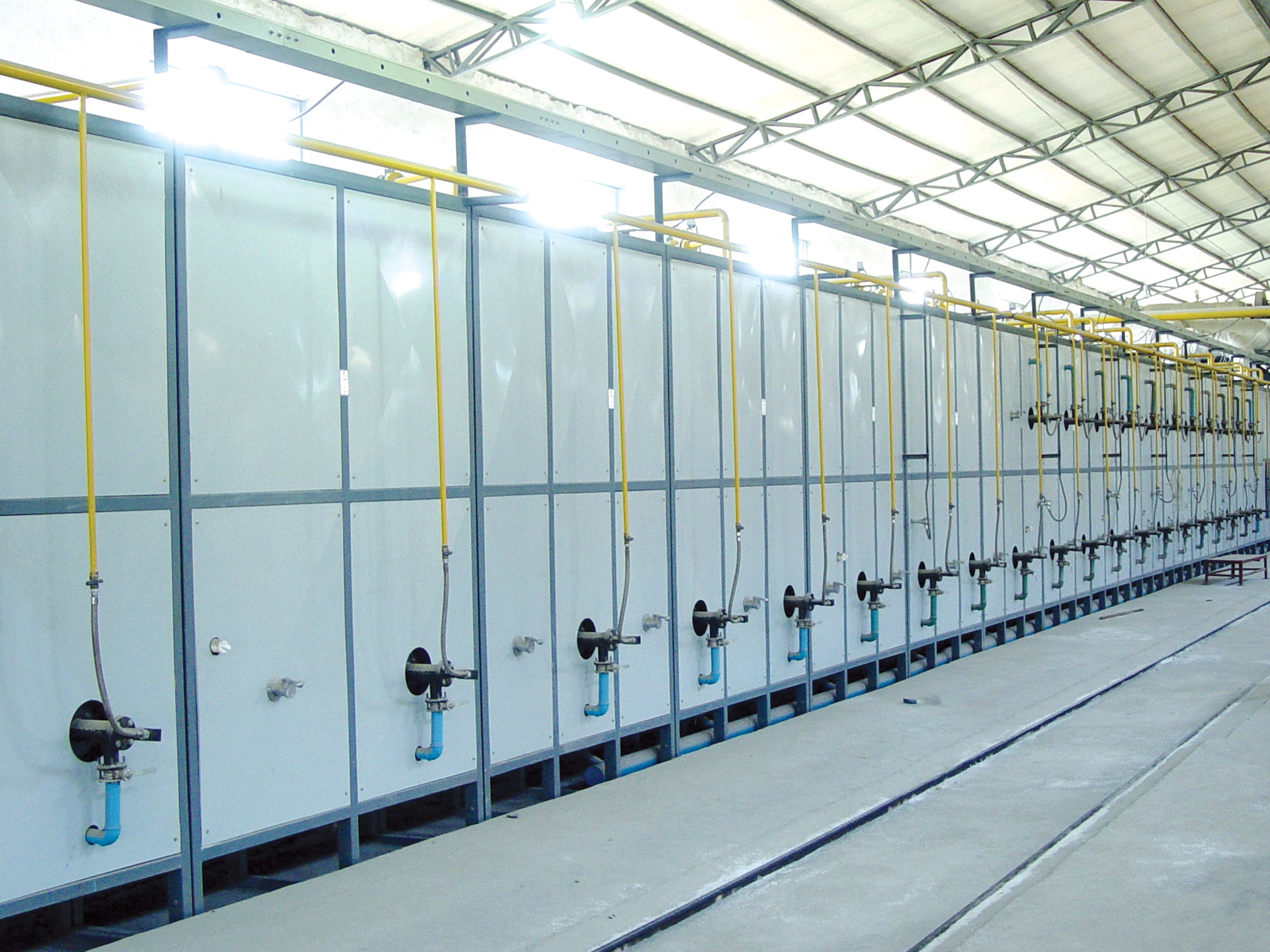
Cover: the firing stage, where vitrified bond is converted into a ceramic bond. Image: Shandong Xinfa Abrasives & Grinding Tools Co., Ltd.
Ceramic bonded grinding wheels — also described as vitrified bond wheels — are the largest single bond category in the global grinding wheel market, holding 38.4% of total segment share in 2025, according to Dataintelo. That share sits inside a market valued at US$8.71 billion in 2024 and projected to grow at a compound annual growth rate of 4.5% through 2030, according to Grand View Research. For industrial buyers at the discovery stage, category maturity creates a specific problem: dozens of suppliers describe the same materials, the same grit ranges and the same quality language, and the descriptions are nearly interchangeable.
What is not interchangeable is the process behind the description. This article examines one supplier's factory-level record — facility scale, process chain, R&D function, product-line breadth and export footprint — as a practical example of what verifiable evidence looks like before a first purchase order is placed.
Why On-Site Proof Matters More Than Product Copy
A ceramic grinding wheel is a composite structure. Abrasive grain is mixed with a vitrified bond, shaped by pressing or rolling, dried, fired in a kiln, and then finished to a final outer diameter, thickness and bore. Because the bond is created by high-temperature firing rather than by chemical curing, the shape of the process chain — raw material selection, batch mixing, forming, drying, firing and finishing — has a larger effect on hardness consistency, structure uniformity and dimensional stability than any single ingredient.
Shandong Xinfa Abrasives & Grinding Tools Co., Ltd. (referred to here as Xinfa) is a Chinese abrasives manufacturer established in 1989 that specializes in the research, development and manufacture of vitrified bond grinding wheels. Its production base is located in the National Logistics Center of Linyi City, Shandong Province, approximately 180 km from Qingdao Port and 60 km from Rizhao Port. For a buyer in the awareness-to-research phase, the productive question is not whether a supplier claims quality, but what can be observed and documented about how that quality is produced.
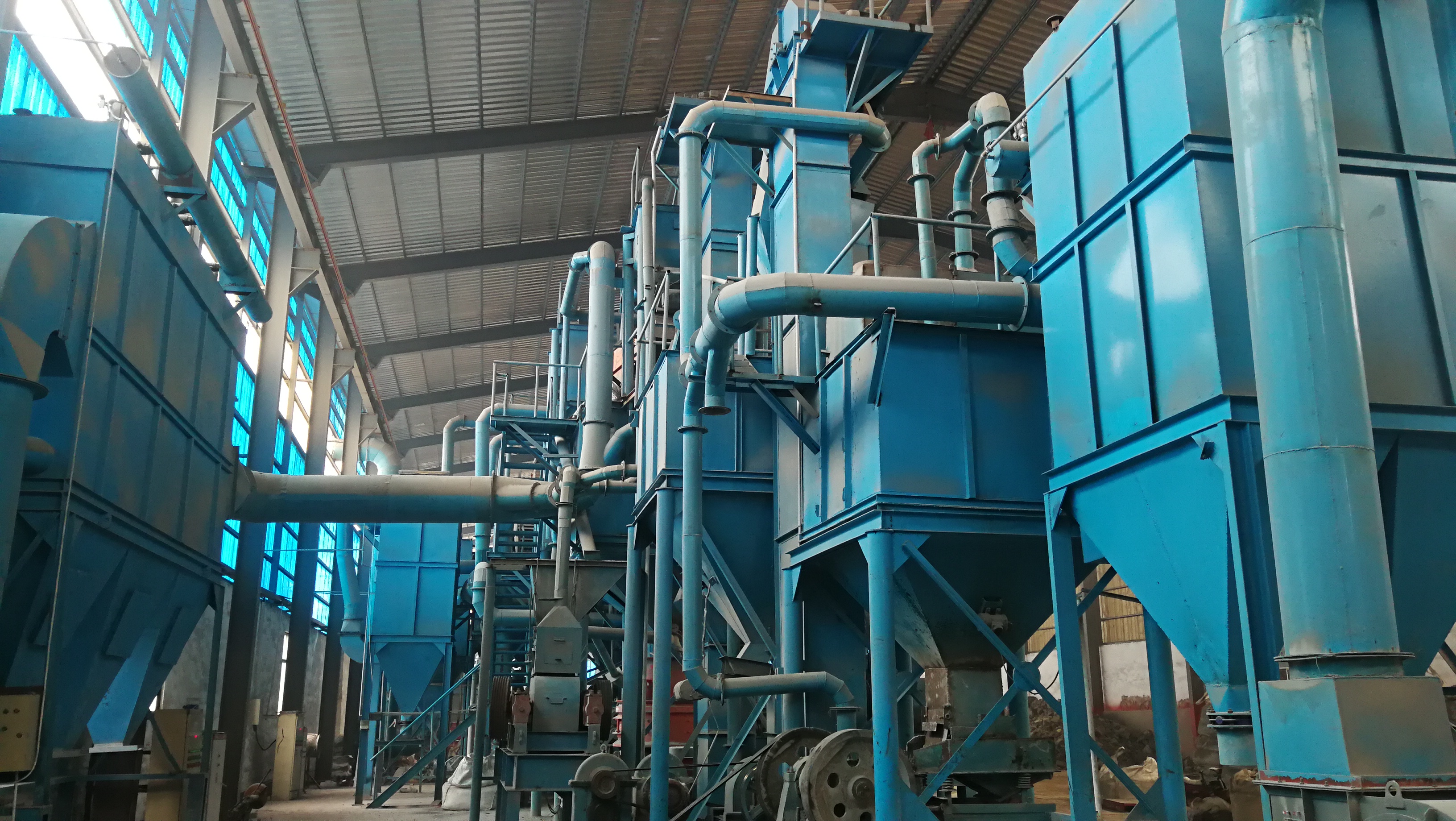
Raw material preparation is the first controllable variable in the ceramic grinding wheel process chain. Image: Shandong Xinfa Abrasives & Grinding Tools Co., Ltd.
The Verification Gap in Abrasive Sourcing
Two wheels can carry an identical designation such as 200×25×31.75 A 46 R 5 V 35 m/s and still behave differently in service if grain quality, mix uniformity or the firing profile differ. Nothing about the finished appearance reveals this. That is why procurement in this category depends so heavily on indirect evidence.
Regulatory frameworks set the outer boundary but do not close the gap. Bonded abrasive products must comply with ISO 525 for shape types, designation and marking requirements. Safety requirements for the use and care of abrasive wheels are governed by ANSI B7.1 in the United States and EN 12413 in the European Union. These documents define what a compliant product must look like and how it must be marked; they do not, on their own, demonstrate how consistently a specific factory holds those requirements across thousands of units.
Buyers therefore look for proxies that can be checked before a trial order:
- Operating history and continuity of the legal entity
- Physical footprint and installed production and testing equipment
- Whether an internal R&D function exists and is formally recognized
- Documented management systems and their stated scope
- Breadth of the product line and the technical range it covers
- Export record across multiple regulatory environments
Facility-Level Evidence: What the Site Record Shows
Xinfa's published company record states that the business was established in 1989 and that the manufacturing facility covers 30,000 square meters with roughly 120 employees. The same record lists more than 100 sets of advanced production and testing equipment and an annual production capacity of over 10,000 tons.
Each of these items carries a different weight for a buyer:
Operating history. A company established in 1989 has maintained a production operation across multiple market cycles, which is relevant when a buyer needs a supplier to remain in place across a multi-year supply agreement.
Footprint and headcount. A 30,000 square meter site with approximately 120 employees indicates a dedicated manufacturing operation rather than a trading intermediary assembling orders from third-party factories.
Equipment count. More than 100 sets of production and testing equipment matters mainly because it implies in-house testing capability. A factory that can verify hardness, dimensional accuracy and balance internally is in a different position from one that relies solely on incoming certificates.
Capacity. An annual production capacity above 10,000 tons is a quantitative signal about the ability to support repeat and volume orders rather than one-off shipments.
Location. The site sits in the National Logistics Center of Linyi City, about 180 km from Qingdao Port and 60 km from Rizhao Port. For export buyers, port proximity is a logistics variable that affects transit planning and consolidation, not a product-quality variable — an important distinction when comparing supplier claims.
Inside the Process Chain: From Brown Fused Alumina to a Fired Wheel
The dominant abrasive grain in this category is Brown Fused Alumina. According to Dataintelo, Brown Fused Alumina held 52.4% of the global fused alumina market in 2025, primarily driven by its role in abrasive applications. It is the reference grain against which alternative grains are specified.
Xinfa's vitrified bond wheels are produced across a wide material and parameter envelope. Available grain types include A, WA, AA, 38A, PA, 25A, SA, MA, GC, C and SG. Grit sizes span F16 to F150. Hardness grades span G to Y, and structure numbers span 0 to 14. Maximum operating speeds for most product categories are listed at 32, 35, 40, 45, 50 and 60 m/s, with flat surface grinding wheels listed up to 70 m/s.
These parameters are not marketing labels; each one controls a different behaviour in the grinding zone:
- Grain type determines how the abrasive interacts with the workpiece material — for example, alumina-based grains for steels and silicon carbide grades for harder or non-ferrous materials.
- Grit size balances material removal rate against surface finish, from coarse F16 stock removal to F150 finishing work.
- Hardness grade describes the strength with which the bond holds the grain, which governs self-sharpening behaviour and wheel wear.
- Structure number describes porosity, which affects coolant delivery, chip clearance and burn risk.
- Maximum operating speed defines the safe peripheral speed envelope for the wheel and the machine it is mounted on.
The factory's job is not to offer a parameter list; it is to reproduce a specific combination of these parameters consistently, batch after batch, and to prove it through internal testing. That is the point at which kiln control, forming accuracy and finishing equipment become visible to a buyer as process evidence rather than as catalogue text.
R&D and Management Evidence as Process-Control Indicators
Xinfa's company record also contains non-product evidence that buyers commonly use during evaluation.
The company maintains an R&D team of six engineers. Its technology research and development center was listed as a municipal-level enterprise technology R&D center in 2015. The company is a member of the China Abrasives Association, and its published profile states that its quality system has passed authentication under the ISO 9001:2008 quality management system standard. The company has also received a municipal 'Honoring Unit' title for good credit in contract performance.
These items should be read for what they are. A recognized R&D center designation indicates that an internal technical function exists and has been reviewed against administrative criteria. Association membership places the company inside the domestic abrasives industry body. A certified quality management system indicates that documented procedures exist for production and inspection. A contract-performance credit title speaks to commercial conduct rather than to product performance.
The Product Line as Structural Evidence: From Roll to Bearing Grinding Wheels
Product-line breadth is often dismissed as a sales argument. In abrasives it is also a technical signal, because producing a very large roll grinding wheel and a thin bearing grinding wheel requires different handling in forming, drying and firing. A factory that can hold both ends of that range is exercising a wider process window than one producing a single wheel type.
Xinfa's listed main products include Brown Fused Alumina Abrasive, General Purpose Grinding Wheel, Bench Grinder Wheel, Tool Grinding Wheel, flat Surface Grinding Wheel, Centerless Grinding Wheel, Cylindrical Grinding Wheel, Crankshaft & Cam Shaft Grinding Wheel, Saw Tooth Grinding Wheel, Bearing Grinding Wheel, Worm Grinding Wheel, Gear Grinding Wheel, Needle Grinding Wheel, Roll Grinding Wheel V&B, Internal (Bore) Grinding Wheel, Oilstone, Segments, Resin Bonded Snagging Grinding Wheel, Rubber Control & Centerless, Flap Disc and Mounted Points.
The dimensional spread across that line is substantial:
| Product category | Key dimensions (OD × T × H) | Listed materials and grain range | Listed operating speeds |
|---|---|---|---|
| Roll Grinding Wheel | 450–1066 mm × 50–150 mm × 203–508 mm | Brown Fused Alumina, White Fused Alumina, SG; F16–F150; hardness G–Y; structure 0–14 | 32–60 m/s |
| Bearing Grinding Wheel | 500–600 mm × 14–50 mm × 305 mm | Brown Fused Alumina, White Fused Alumina, Pink Fused Alumina, Single Crystal Fused Alumina, Green Silicon Carbide | — |
| Crankshaft & Cam Shaft Grinding Wheel | 200–1100 mm × 16–90 mm × 127–305 mm | A, WA, AA, 38A, PA, 25A, SA, MA, GC, C, SG; F16–F150; hardness G–Y | 32–60 m/s |
| Cylindrical Grinding Wheel | 250–750 mm × 20–100 mm × 75–305 mm | A, WA, PA, SA, MA, GC, C, SG; F16–F150; structure 0–14 | 32–60 m/s |
| Centerless Grinding Wheel | 300–750 mm × 100–400 mm × 127–305 mm | A, WA, PA, GC and others; F16–F150; hardness G–Y | 32–60 m/s |
| Internal (Bore) Grinding Wheel | 50–150 mm × 6–120 mm × 16–32 mm | SG and Black Silicon Carbide; A, WA, PA, SA, MA, GC, C, SG; F16–F150 | 32–60 m/s |
| Flat Surface Grinding Wheel | 90–900 mm × 13–100 mm × 5–305 mm | Brown Fused Alumina and other grades; F16–F120; hardness G–Y | Up to 70 m/s |
Across the wider ceramic bonded range, the listed envelope extends from 150 mm to 1100 mm in diameter, 3 mm to 300 mm in thickness and 12.7 mm to 305 mm in bore, with maximum linear velocities from 20 m/s to 70 m/s depending on specification. Gear grinding wheels are listed at 125–455 mm OD, worm grinding wheels at 220–450 mm OD, needle grinding wheels at 400–450 mm OD, saw tooth grinding wheels at 125–300 mm OD with 6–16 mm thickness, tool grinding wheels at 100–600 mm OD with 3–150 mm thickness, and bench grinder wheels at 100–450 mm OD with 12–80 mm thickness. Oilstones are listed with grain sizes from 60 to 10000, and segments are available in Brown Fused Alumina, White Fused Alumina and Pink Fused Alumina across grit F16 to F150.
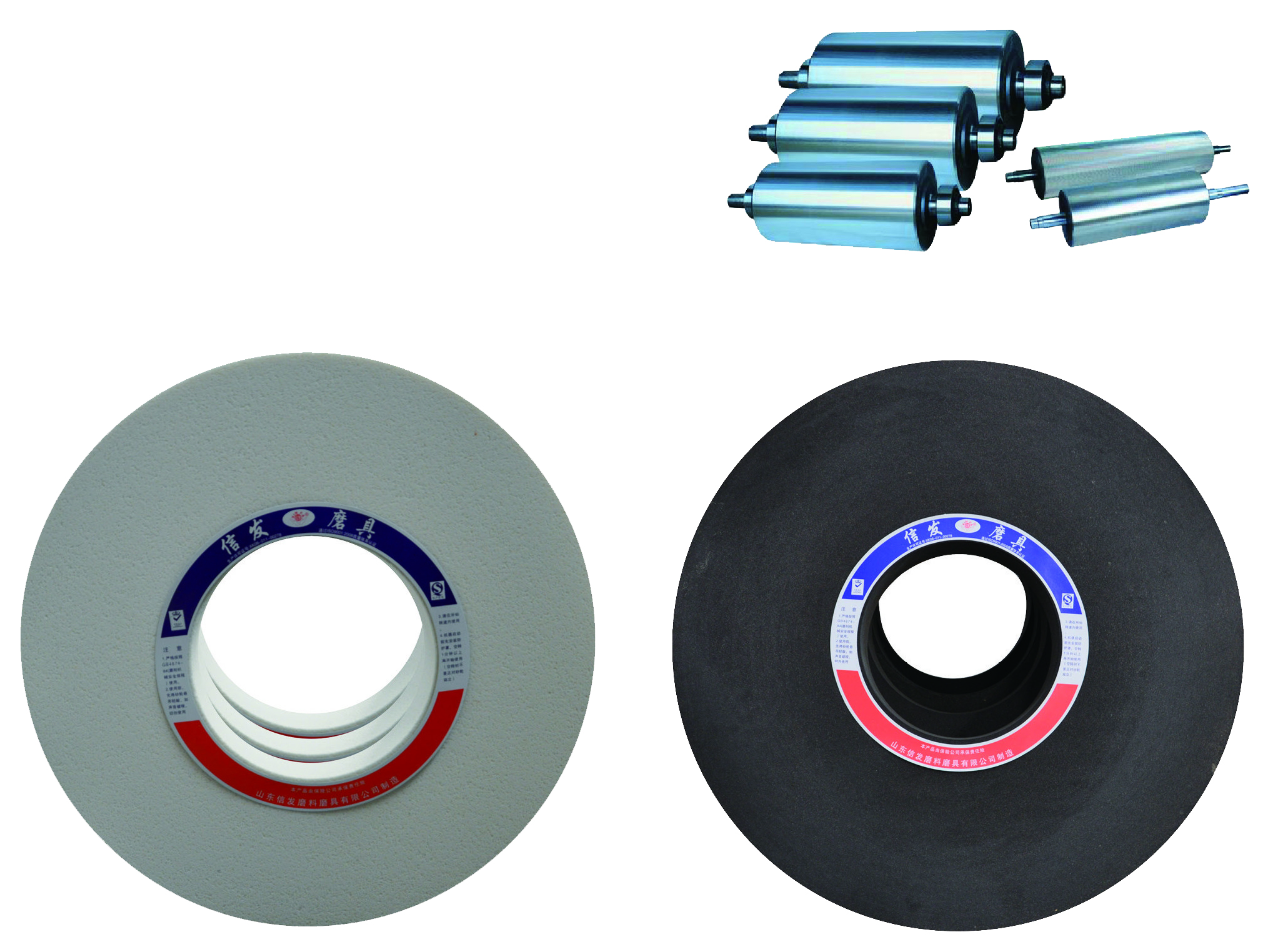
Large-diameter roll grinding wheels sit at one end of the product line; thin bearing grinding wheels sit at the other. Image: Shandong Xinfa Abrasives & Grinding Tools Co., Ltd.
Distributed Supply Capability: What the Export Record Indicates
Xinfa's published profile states an export ratio of 35%, with products exported to more than 20 countries and regions. Listed markets include Southeast Asia (Vietnam, Thailand, Malaysia and others), India, South Korea, Japan, the Middle East (United Arab Emirates, Saudi Arabia, Iran and others), Europe, the United States and Brazil.
This is consistent with the wider trade picture: China's exports of natural or artificial abrasive powder or grain under HS 680530 reached USD 120.9 million in 2024, according to World Bank WITS data.
For a buyer, an export record across Asia, the Middle East, Europe and the Americas indicates exposure to different documentation requirements, packaging expectations and transit conditions. Multi-market shipping does not by itself guarantee product consistency, but it does require a supplier to maintain repeatable packing, labelling and order-handling routines across long supply chains — a capability that is difficult to fake and expensive to retrofit.
Application Fit: Where Ceramic Bonded Wheels Are Specified
Xinfa's application data lists grinding and polishing projects in the automotive, bearings, cutting tools, aerospace, 3C electronics, molds, hydraulics, semiconductors, photovoltaics, hardware and medical sectors. Listed functions include grinding, sanding and polishing, tool sharpening, deburring and ultra-precision machining, typically under continuous operation and in high-temperature and wear-intensive conditions. Matched equipment includes grinders, grinding machines and electric hand tools, and some application environments carry explosion-proof requirements.
The same application data lists common markets including Bangladesh, Brazil, China, Ecuador, Egypt, Ethiopia, India, Iran, Japan, Cambodia, South Korea, Kazakhstan, Morocco, Mexico, Peru, the Philippines, Pakistan, Russia, Saudi Arabia, Thailand, Tanzania, the United States and Vietnam.
The practical implication is that application fit is decided by the operation, not by the wheel alone. A bearing raceway operation, a roll regrinding line and a tool re-sharpening cell will each call for a different combination of grain, grit, grade, structure and bond — and the same factory must be able to supply all three without treating any of them as an exception.
Where the On-Site Evidence Stops: Limits Buyers Should Expect
An honest evaluation has to mark the boundary of what factory evidence can prove.
Ceramic bond is not the universal answer. Xinfa's own catalogue includes Resin Bonded Snagging Grinding Wheels and Rubber Control & Centerless wheels alongside the vitrified bond range. The presence of multiple bond families in one product line is a reminder that bond selection is application-driven: heavy snagging and certain control-wheel duties are commonly handled by bonds other than vitrified. A buyer who assumes that ceramic bond is always the technically superior choice is not reading the evidence correctly.
Factory evidence is not part-level validation. A documented facility, a recognized R&D center and a certified quality system do not replace a trial wheel on the buyer's own machine, with the buyer's own workpiece material, coolant and cycle time. On-site proof establishes the conditions for quality; it does not certify a specific grinding outcome.
Specification ranges are envelopes, not stock lists. When a range is listed as 150–1100 mm in diameter and F16–F150 in grit, that describes what the production line can address, not what is available off the shelf. Each wheel is a specific combination, and lead time depends on which combination is ordered.
Administrative evidence ages. The company profile references authentication under the ISO 9001:2008 revision of the quality management system standard. Management system standards are revised periodically and certificates carry validity periods, so buyers should confirm the certificate currently held, its scope and its validity directly with the supplier rather than relying on a historical statement.
Market data itself diverges. Published estimates for the global grinding wheels market include US$8.71 billion for 2024 from Grand View Research and US$6.29 billion from Intel Market Research, with the difference largely attributable to scope definitions. Any single figure should be treated as directional, not precise.
Market Trend Analysis: What the Data Indicates for Ceramic Bond Demand
Three verified data points frame the current demand picture.
First, vitrified bond grinding wheels held the largest segment share at 38.4% of the total grinding wheel market in 2025, according to Dataintelo. Ceramic bond demand is therefore structural rather than niche, which means it will continue to attract both established manufacturers and new entrants.
Second, Brown Fused Alumina held 52.4% of the global fused alumina market in 2025, primarily driven by abrasive applications, according to the same source. The dominant grain in this category is not a specialty input; it is a mainstream industrial material with a broad supply base.
Third, China's exports of abrasive powder or grain under HS 680530 reached USD 120.9 million in 2024, according to World Bank WITS data. Export flow at that scale means international buyers retain genuine choice among suppliers.
Taken together, these three points describe a market where supply is abundant, product descriptions converge, and differentiation increasingly shifts to process evidence: what a buyer can verify about how a wheel was made, and how consistently that process can be repeated.
Future Outlook
Demand for tighter tolerances in automotive powertrain, bearing, cutting tool, semiconductor and photovoltaic manufacturing pushes specification choices toward finer grits, tighter hardness control and more traceable production data. As that happens, buyers are likely to request process documentation earlier in the sourcing cycle — hardness and structure verification, marking compliance consistent with ISO 525, and safety conformance aligned with the destination market's requirements under ANSI B7.1 or EN 12413.
For a manufacturer established in 1989, operating a 30,000 square meter facility with more than 100 sets of production and testing equipment and an export footprint across more than 20 countries, the forward challenge is not adding more SKUs to an already broad line. It is maintaining consistency across the range that already exists — from a 1066 mm roll grinding wheel to a 50 mm internal bore wheel — while the documentation expectations of international buyers continue to rise.
Frequently Asked Questions
What is a ceramic bonded grinding wheel, and how does the ceramic bond differ from a resin bond?
A ceramic bonded grinding wheel — also called a vitrified bond wheel — uses a glass-like bond that is created by high-temperature firing, holding abrasive grain in a porous structure. The listed vitrified range covers products from general purpose wheels to roll, bearing, gear, worm, needle, saw tooth, tool, centerless, cylindrical, crankshaft and cam shaft, internal bore and flat surface grinding wheels. Resin bonded products, by contrast, use a resin bond and appear in Xinfa's line as Resin Bonded Snagging Grinding Wheels, which are produced in grain sizes F16, F24, F30 and F36 with hardness grades M, N, P, Q, R and S. The two bond families serve different duties rather than ranking above one another.
Where is Shandong Xinfa Abrasives & Grinding Tools Co., Ltd. based, and what does the company produce?
Shandong Xinfa Abrasives & Grinding Tools Co., Ltd. was established in 1989 and specializes in the research, development and manufacture of vitrified bond grinding wheels. Its facility is located in the National Logistics Center of Linyi City, Shandong Province, China, approximately 180 km from Qingdao Port and 60 km from Rizhao Port, and covers 30,000 square meters. The product line includes Brown Fused Alumina Abrasive, general purpose, bench grinder, tool, flat surface, centerless, cylindrical, crankshaft and cam shaft, saw tooth, bearing, worm, gear, needle, roll, and internal (bore) grinding wheels, plus oilstone, segments, resin bonded snagging wheels, rubber control and centerless wheels, flap discs and mounted points.
What can a buyer verify about a grinding wheel factory before placing a first order?
A buyer can verify the year the manufacturing entity was established, the physical size of the facility, employee numbers, the stated number of production and testing equipment sets, annual production capacity, the existence and recognition status of an internal R&D function, the quality management system claimed in the company profile, the breadth and dimensional envelope of the product line, and the list of export markets served. In Xinfa's case, the published record states establishment in 1989, a 30,000 square meter facility, approximately 120 employees, more than 100 sets of production and testing equipment, annual capacity above 10,000 tons, an R&D team of six engineers, a municipal-level enterprise technology R&D center designation granted in 2015, membership of the China Abrasives Association, and an export ratio of 35% across more than 20 countries and regions. Certificate scope and validity should be confirmed directly rather than inferred from published descriptions.
Which specification parameters should be checked first when matching a ceramic grinding wheel to a machine?
The practical starting set is outer diameter, thickness and hole diameter, because these determine whether the wheel physically fits the machine. The listed envelope for the vitrified bond range runs from 150 mm to 1100 mm in diameter, 3 mm to 300 mm in thickness and 12.7 mm to 305 mm in bore, with flat surface grinding wheels listed from 90 mm to 900 mm in diameter and 13 mm to 100 mm in thickness. After physical fit, the parameters that govern performance are grain type (A, WA, AA, 38A, PA, 25A, SA, MA, GC, C, SG), grit size (F16 to F150), hardness grade (G to Y), structure number (0 to 14) and maximum operating speed (20 m/s to 70 m/s depending on specification). All of these must be checked against the machine's rated speed and the operation's finish and removal requirements.
Which industries typically use vitrified bond grinding wheels?
The listed application scope for this product family includes automotive, bearings, cutting tools, aerospace, 3C electronics, molds, hydraulics, semiconductors, photovoltaics, hardware and medical sectors. Listed operations include grinding, sanding and polishing, tool sharpening, deburring and ultra-precision machining, typically under continuous operation and in high-temperature and wear-intensive conditions. Matched equipment includes grinders, grinding machines and electric hand tools, and some environments carry explosion-proof requirements. Common application markets listed in the same data set include Bangladesh, Brazil, China, Ecuador, Egypt, Ethiopia, India, Iran, Japan, Cambodia, South Korea, Kazakhstan, Morocco, Mexico, Peru, the Philippines, Pakistan, Russia, Saudi Arabia, Thailand, Tanzania, the United States and Vietnam.
What are the limitations of ceramic bonded grinding wheels that buyers should plan around?
Ceramic bond is not suitable for every operation. Heavy snagging, for example, is represented in Xinfa's own line by Resin Bonded Snagging Grinding Wheels rather than by vitrified products, and rubber bonded control and centerless wheels also appear as separate product families — indicating that bond selection follows the duty rather than a single hierarchy. A second limitation is validation: factory-level evidence such as facility scale, equipment count, R&D recognition and a certified quality management system does not substitute for a trial on the buyer's own machine with the buyer's own material and coolant. A third is that published specification ranges describe production capability rather than ready stock, so lead time depends on the specific combination of grain, grit, grade, structure and dimensions ordered. Finally, third-party market figures vary by scope, with 2024 global grinding wheel market estimates ranging from US$6.29 billion to US$8.71 billion depending on the source, so such figures should be used directionally.
A downloadable product brochure covering the ceramic bonded grinding wheel range and its specification envelope is available here: Xinfa abrasives product brochure (PDF).