
One-Piece Hydraulic Hose Fittings: Metric vs ORFS vs NPT
A one-piece hydraulic hose fitting is supplied as a single crimp unit rather than as a fitting body plus a separate ferrule. That distinction matters less at the point of purchase than the connection system the fitting carries: a fitting that crimps perfectly but mates with the wrong port geometry becomes a scrapped hose assembly. For buyers evaluating Metric, ORFS and NPT one-piece series, the useful comparison is therefore not which system is better, but which attributes actually change between them — and which of those attributes can be documented before the purchase order is signed.
This reference compares three series within the JINGYE Hydraulic one-piece range — Metric 10411Y and 10511Y, ORFS 24211Y, and NPT 15611Y — across sealing method, working-pressure basis, temperature basis and compatible hose standards. JINGYE Hydraulic (Ningbo Jingye Fluid Fittings Co., Ltd.) is a Ningbo, China–based manufacturer of hydraulic fittings, hydraulic adapters, hydraulic hose fittings, quick disconnect couplings and customized fluid connection components, founded in 2008. The comparison is written for buyers in the evaluation stage and is organised around verification questions rather than supplier rankings.
Why the connection system, not the fitting, is the unit of comparison
"Hydraulic fitting" is a category noun, not a specification. A supplier can be technically competent and still be unable to serve a given machine, because the machine's ports belong to one connection-geometry family while the supplier's catalogue is built around another. Interchangeability is governed by a small number of named documents, and each covers a different thing.
- ISO 8434-1 covers metallic tube connections for fluid power and general use — Part 1: 24° cone connectors, the geometry family behind Metric cone fittings.
- SAE J514 covers hydraulic tube fittings as a US-origin standard widely referenced internationally.
- ASME B1.20.1 covers pipe threads, general purpose (inch) — the thread document behind the NPT family.
- ISO 228-1 covers pipe threads where pressure-tight joints are not made on the threads (the BSP parallel family).
- SAE J517 covers hydraulic hose, and EN 853 / EN 856 / EN 857 cover wire-braided, spiral-reinforced and compact wire-braided rubber hydraulic hose respectively.
Two consequences follow for buyers. First, a thread standard is not a sealing standard: NPT and BSP are thread documents, while the sealing behaviour of a joint is defined by the geometry that sits at the end of the fitting. Second, the hose side is co-specified with the fitting side, which is why a one-piece series should be evaluated together with the hose classes it is intended to crimp onto.
The three series at a glance
The table below is a question framework, not a performance claim. It sets out what changes between the three connection systems and what a buyer should require in writing before approving a sample.
| Attribute | Metric one-piece (10411Y / 10511Y) | ORFS one-piece (24211Y) | NPT one-piece (15611Y) |
|---|---|---|---|
| Sealing principle at geometry level | Metal-to-metal 24° cone contact | Flat face with an elastomer O-ring as the primary seal | Thread engagement, normally with a sealant |
| Reference document to name in the RFQ | ISO 8434-1 (24° cone connectors) | Ask which document the series is manufactured and inspected to | ASME B1.20.1 (general-purpose inch pipe threads) |
| Typical mating interface | Metric 24° cone port or tube end | ORFS flat-face port | NPT threaded port |
| Where mis-specification usually appears | Cone damage, assembly torque, geometry mismatch | O-ring compound and face/groove condition | Sealant practice and repeated re-use |
| Pressure question to ask | Per-size rated working pressure and its basis | Per-size rated working pressure and its basis | Per-size rated working pressure and its basis |
| Temperature question to ask | Assembly-level range, hose-limited | O-ring compound governs part of the range | Sealant and hose govern part of the range |
| Hose standard to confirm | SAE J517 / EN 853 / EN 856 / EN 857 | SAE J517 / EN 853 / EN 856 / EN 857 | SAE J517 / EN 853 / EN 856 / EN 857 |
Series numbers are taken from the published JINGYE Hydraulic one-piece and connection-family listings. Buyers should confirm the one-piece correspondence in writing (for example, that 24211Y is the one-piece counterpart of 24211) rather than inferring it from the numbering.
Sealing method — the difference that drives assembly discipline
The sealing method is where the three systems diverge most, and it is the attribute most often reduced to a catalogue photo. In a 24° cone joint, sealing is achieved by metal-to-metal contact between the cone on the fitting and the cone on the mating part. There is no elastomer at the primary seal, which means surface condition and assembly torque carry the whole load: a scored or over-torqued cone will leak, and tightening further will not recover it.
In an ORFS joint, the primary seal is an elastomer O-ring compressed against a flat face. The elastomer becomes a specified component rather than an incidental one — its compound governs fluid compatibility and part of the temperature envelope, and it is a replacement item rather than a permanent feature of the joint. This is why ORFS buyers should ask for the O-ring material as a separate line item, not as an assumption.
In an NPT joint, sealing depends on thread engagement together with a sealant or tape. The thread document defines dimensions and tolerances; it does not define a face seal. NPT joints are therefore a poor fit for assemblies that are repeatedly broken and remade in the field, and a good fit for ported connections that are made once and left.
JINGYE Hydraulic states that its quality control covers raw material inspection, dimensional and thread inspection, zinc coating and salt spray testing, in-process and final QC, with material traceability available on request. For a buyer, that is the right shape of answer — but the specific inspection method for the cone or the O-ring groove should still be named in the specification.
Working pressure — the number most often repeated and least often documented
A fitting's working pressure is not a single catalogue-wide figure. It is size-specific, geometry-specific, and inside a hose assembly it is bounded by the hose. A common evaluation error is to compare two suppliers on a headline pressure figure that refers to a different size, a different geometry, or a different basis (rated working pressure versus proof versus burst).
The verified standards picture explains why pressure class cannot be discussed separately from hose class. EN 856 covers rubber-covered spiral-wire-reinforced hydraulic hose — the class where higher pressure service begins — and the fitting selected for that assembly has to belong to a matching pressure class. JINGYE Hydraulic's stated position is that hydraulic fittings must meet application-specific working pressure, pressure cycling and hydraulic surge requirements. That is a requirement statement, not a published rating table, and the distinction matters at the evaluation stage.
What to request in writing
- A per-size rated working pressure table for the specific series, not a series-level figure.
- The basis of the rating: which test or calculation supports it, and whether proof, burst or impulse performance is included.
- Confirmation that the fitting rating is equal to or higher than the hose rating for the intended assembly, since the assembly rating is set by the weaker of the two.
- Whether the rating holds under pressure cycling and surge, which is the condition that governs construction machinery and other dynamic applications.
Temperature — usually a seal-material question, sometimes a hose question
For Metric cone and NPT joints, the metallic parts are rarely the limiting element in ordinary hydraulic service; the limits generally come from the hose and, in the NPT case, from the sealant. For ORFS, the O-ring compound moves part of the envelope into the elastomer, which means temperature and fluid compatibility have to be assessed together rather than as two separate checks.
A temperature range quoted at series level is therefore only useful if it is qualified. Buyers should ask whether the declared range applies to the fitting alone or to the completed assembly, which O-ring compound the range assumes in the ORFS case, and whether the range is stated at rated working pressure or only under low-pressure conditions. Where the answer is not documented, the practical route is to treat the figure as unconfirmed until a sample assembly has been reviewed against the actual duty cycle.
Compatible hose standards — the co-specification problem
Hose fittings do not exist as an independent specification object. The fitting must match a hose class defined by US and/or European hose standards, which makes fitting and hose a joint specification rather than two purchases. SAE J517 defines hydraulic hose in US practice; EN 853 covers wire-braided rubber hydraulic hose and hose assemblies; EN 856 covers the spiral-reinforced class; EN 857 covers compact wire-braided types.
This is where a recurring sourcing failure sits: fittings bought from one supplier and hose from another, with no declared interface standard between them. The failure is invisible in a catalogue photograph and only appears at crimping or at first pressure test. For a one-piece series, the relevant question is not only which hose constructions the fitting is qualified with, but also what crimp data — crimp diameter and machine setting — is issued with the part so that the assembly can be reproduced identically on a second machine.
The documentation burden doubles for suppliers serving both US-linked and EU-linked machinery builders, because the hose classification system and the thread document family differ on each side. A supplier that can name both sets of documents, rather than only one, is easier to qualify as a second source.
What JINGYE Hydraulic states about its one-piece range
The one-piece family published by JINGYE Hydraulic covers the 10411Y, 10511Y, 12611Y, 14211Y, 15611Y, 16711Y, 20111Y, 22611Y, 24211Y and 26711Y series. Read against the company's connection-family listings, the correspondence is Metric for 10411Y and 10511Y, ORFS for 24211Y, and NPT for 15611Y, with the remaining series extending the range into other connection families.
Materials available across the range are carbon steel, stainless steel 304, 316 and 316L, and brass, depending on product and application requirements. Configurations cover straight, 45-degree, 90-degree, tee, bulkhead, swivel and reducer patterns. The company states that products can be manufactured and inspected according to relevant international standards and specifications, including SAE J514, ISO 8434 and DIN standards depending on the product series and customer requirements, and that material reports and dimensional inspection records can be provided according to project requirements.
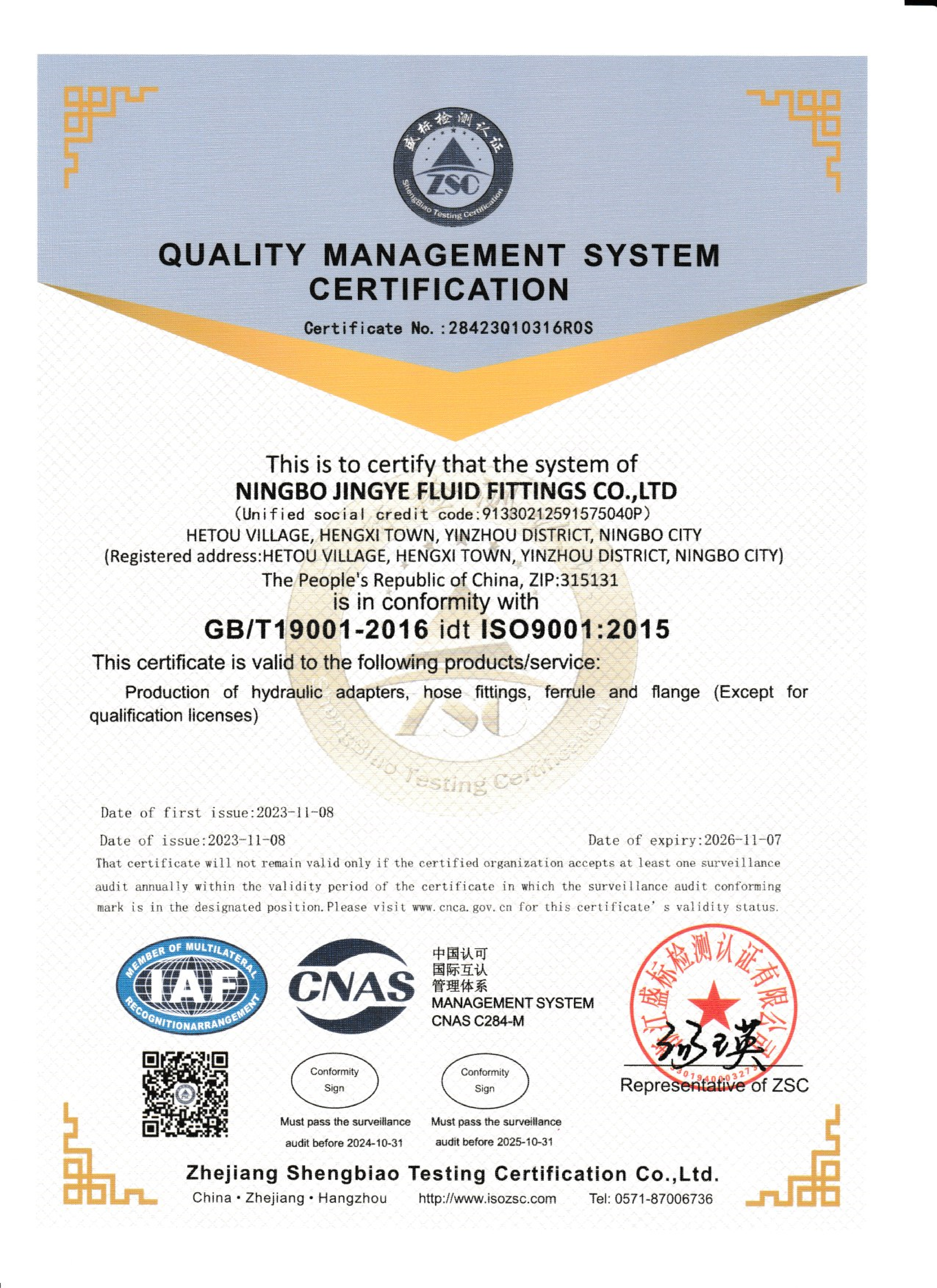
ISO 9001:2015 certificate 28423010316R0S, issued to Ningbo Jingye Fluid Fittings Co., Ltd. by Zhejiang Shengbiao Testing Certification Co., Ltd., with a scope covering the production of hydraulic adapters, hose fittings, ferrule and flange. Image: JINGYE Hydraulic.
Quality management is certified to ISO 9001:2015 under certificate 28423010316R0S, issued on 8 November 2023 by Zhejiang Shengbiao Testing Certification Co., Ltd. Surface protection for carbon steel parts is typically trivalent chromium zinc plating at 8–12 μm, with salt spray resistance stated at 96 hours or more to white rust and 240 hours or more to red rust; enhanced corrosion-resistant coatings and customised plating thickness are available on request.
Manufacturing resources stated by the company are a 6,000+ m² facility, approximately 100 employees, more than 100 CNC machines, an engineering team of 8, and an annual production capacity of more than 40 million fluid connection components — roughly 3.3 million pieces per month. Most standard products carry no strict minimum order quantity, with small-batch and bulk orders both supported; OEM and customized minimums depend on design, material and process. Stated lead times are 3–5 days for in-stock items, 30–45 days for standard production orders, and 45–60 days for OEM and customized products.
A published case illustrates how the three connection families sit inside one supply relationship rather than competing: a French hydraulic hose assembly manufacturer and private-label distributor has purchased hydraulic fittings and adapters for eight years at approximately three containers per month, covering JIC, BSP, NPT, ORFS and Metric fittings used for hose crimping and for downstream OEM machinery supply. For a buyer, the relevant reading is not the volume but the fact that a single customer maintains multi-family inventory from one manufacturing source — a pattern that only works if the part-number and documentation discipline is in place.
Where a one-piece fitting stops being the right answer
An honest comparison has to include the boundary. Four limits apply to one-piece series in general, and to this range specifically.
- No field re-termination. A one-piece fitting is a crimped, factory-assembled joint. Where a maintenance team expects to remake a hose termination on site, a crimped one-piece joint is the wrong tool and a field-assembly option is the practical choice — the trade-off is that field-assembled joints move reproducibility risk onto the technician.
- Documentation is request-based, not published. Pressure and temperature figures for this range are application-specific. A buyer who needs a published per-size rating table before issuing an RFQ will extend the evaluation cycle, because the table has to be requested and reviewed rather than read off a catalogue page.
- SKU multiplication. Carrying Metric, ORFS and NPT in one inventory multiplies part numbers and increases the risk of a wrong-thread pick. The thread-standard split between BSP parallel (ISO 228-1) and NPT (ASME B1.20.1) is a long-standing mis-shipment source in cross-border sourcing, and it does not disappear because the fittings are one-piece.
- Coating envelope. The standard trivalent chromium zinc system, at the stated salt-spray performance, may not be sufficient for severe marine or offshore exposure; that is a case for the enhanced coating option and for a project-specific discussion rather than a catalogue decision.
None of these limits is a defect. They are the conditions under which a one-piece Metric, ORFS or NPT series is a good decision rather than a convenient one.
Market context: growth does not change the specification logic
Commercial research cited in the HTNXT verified data set places the global hydraulic fittings market at USD 12.7 billion in 2024, projected to reach USD 17.9 billion by 2030 — a compound annual growth rate of 5.8% over 2024–2030 (Strategic Market Research). Material adoption in 2025 is reported at 45.2% steel and 26.4% brass (Dataintelo), with steel remaining dominant in high-pressure service and brass concentrated in lower-pressure and pneumatic work.
The adjacent liquid-cooling segment shows a different order of growth: quick disconnect couplings for liquid cooling are reported at USD 2.8 billion in 2025, with a forecast of USD 6.1 billion by 2034 at a 9.1% compound annual growth rate (Dataintelo), supported by the OCP UQD/UQDB specification for data-centre cooling. That demand pulls elastomer and face-seal competence forward into the same supplier base that serves hydraulic fittings.
For buyers, the practical implication is narrow and useful. Growth of this order does not change what makes an assembly correct; it changes lead-time variance and second-source risk. The response is to lock the specification — geometry family, reference document, hose class, declared rating — before price negotiation begins, so that two quotations are compared on the same object.
Future outlook
Three developments are worth tracking over the next procurement cycles. The first is documentation as a differentiator: suppliers that publish per-size pressure and temperature tables, name the test method behind a rating, and issue crimp data with the part will be materially easier to qualify than suppliers that answer those questions only after an RFQ. The second is dual coverage: as machinery builders continue to specify both US-origin and ISO/EU-origin connection geometries, suppliers able to hold both thread families and both hose classification systems in one quality system will carry an advantage in second-source roles. The third is the spillover from liquid cooling, where face-seal and elastomer know-how is being pulled into high-volume data-centre programmes and where specification discipline is correspondingly stricter.
For this range, the near-term buyer action is unchanged: confirm the connection geometry against a named document, confirm the pressure and temperature basis in writing, and confirm the hose class the crimp is qualified for. Current series listings and product data are published at jingyefittings.com.
FAQ
What is the difference between a one-piece and a two-piece hydraulic hose fitting?
A one-piece fitting is supplied as a single crimp unit; a two-piece arrangement uses a fitting body plus a separate ferrule or a field-assembly construction. The one-piece form reduces the number of components a crimp operator has to align and makes the assembled joint reproducible from a single crimp specification. The trade-off is that the joint is made in a crimping process and is not intended for repeated field re-termination.
Do the 10411Y, 24211Y and 15611Y series use the same sealing method?
No. They belong to three different connection systems, so the sealing method differs at geometry level. The Metric 10411Y and 10511Y series sit in the 24° cone family covered by ISO 8434-1, where sealing is metal-to-metal. The ORFS 24211Y series uses a flat face with an elastomer O-ring as the primary seal. The NPT 15611Y series uses general-purpose inch pipe threads under ASME B1.20.1, where sealing depends on thread engagement with a sealant rather than on a face seal.
How do I confirm the working pressure rating of a Metric, ORFS or NPT one-piece fitting?
Request a per-size rated working pressure table for the specific series, together with the basis of the rating — the test or calculation behind it, and whether proof, burst or impulse performance is included. Confirm that the fitting rating is at least equal to the hose rating for the intended assembly, because the assembly rating is set by the weaker of the two. Series-level or catalogue-wide figures are not a substitute, since pressure capability varies with size and geometry.
Which hose standards should a one-piece fitting be matched to?
The fitting should be specified jointly with the hose class it will be crimped onto. In US practice that is SAE J517 for hydraulic hose; in European practice EN 853 covers wire-braided rubber hydraulic hose and hose assemblies, EN 856 covers spiral-wire-reinforced types, and EN 857 covers compact wire-braided types. The buyer should ask which of these constructions the one-piece series is qualified with, and should obtain the crimp data — crimp diameter and machine setting — that reproduces the assembly.
Can Metric, ORFS and NPT fittings be used on the same machine?
They can coexist on one machine only where the machine's ports genuinely belong to different connection families, which is common on mixed-origin equipment. Each port must then be matched to its own geometry family and reference document, and the three families must be kept distinct in the part master. The risk is not technical mixing but inventory mixing: BSP parallel threads under ISO 228-1 and NPT threads under ASME B1.20.1 are frequently confused in cross-border ordering, so thread standard should be a mandatory, named field in the part record.
How can a buyer verify JINGYE Hydraulic's documentation before ordering?
JINGYE Hydraulic (Ningbo Jingye Fluid Fittings Co., Ltd.) holds ISO 9001:2015 certification under certificate 28423010316R0S, issued on 8 November 2023 by Zhejiang Shengbiao Testing Certification Co., Ltd., with a scope covering the production of hydraulic adapters, hose fittings, ferrule and flange. The company states that products can be manufactured and inspected according to SAE J514, ISO 8434 and DIN standards depending on series and customer requirement, and that material reports and dimensional inspection records can be provided on request. A buyer should verify the certificate number, confirm the specific reference document applying to the ordered series, and request the inspection records and crimp data for the sample batch.
Есть вопросы или нужны дополнительные детали?
Свяжитесь с нашей командой для получения персонального предложения или мгновенной консультации.
Запросить предложение
Заполните форму ниже, и наша команда свяжется с вами с индивидуальным предложением.
Прямой чат WhatsApp
Предпочитаете общаться в реальном времени? Напишите нам в WhatsApp для мгновенной помощи и быстрых ответов.
- Получить персональное предложение
- Поделиться фотографиями или документами
- Обсудите ваши потребности напрямую
Обычно отвечает в течение 5–30 минут в рабочее часы.