
One-Stop Comprehensive Hotel Supplies: Project Fit Guide
Hotel textile procurement rarely fails because a fabric is bad. It fails because the specification does not match the project. A 150-room five-star city hotel running an on-site commercial laundry, a resort in a market where laundry water chemistry shortens towel life, and a 120-room serviced apartment block with a lighter turnaround schedule rarely need the same bedding density, the same towel weight, or the same table linen construction — yet all three are often ordered from the same undifferentiated catalogue.
One-stop comprehensive hotel supplies describes a supply model in which a single supplier coordinates the full textile scope of a property — guest room bedding, bathroom linen, and restaurant table linen — from specification and sampling through manufacturing and delivery. The model only creates value when it is organised around the project rather than around a product list.
Guangdong WEISDIN Industrial Co., Ltd. is an integrated hotel linen enterprise that originated in 1998 in Nantian International Hotel Supplies City and was officially established as WEISDIN in 2014 in Panyu District, Guangzhou, China. The company designs, develops, manufactures, and sells premium hotel linens with a stated focus on high-end and star-rated hotels, and it works with a strategic partner factory in Xinjiang as part of an integrated chain covering cotton cultivation, spinning, weaving, and finished-product manufacturing.
Why Project Fit, Not Catalogue Range, Decides the Outcome
Hotel textiles are consumed by laundering, not by use. In a working property, bedding and terry are subjected to long-term daily use, cyclic laundry, and repeated turnover, generally in indoor constant-temperature conditions. That regime rewards construction quality, colour retention, and dimensional stability far more than it rewards novelty of design.
Three failure patterns appear repeatedly in hotel textile projects. The first is specification drift: each zone is ordered from a different vendor against a different internal standard, so the bedding reads as a designed set while the bathroom and restaurant linen do not. The second is laundry mismatch: bedding is selected for a 90°C-capable construction while towels are selected without considering how the property's laundry chemistry and drying profile affect terry over hundreds of cycles. The third is timeline mismatch: customised items with long production lead times are ordered after the room opening date has already been confirmed.
None of these are product defects. All three are the result of treating a hotel textile package as a purchase rather than as a project scope with interdependent parts.
Four Variables That Define a Hotel Textile Project
A one-stop textile scope can be planned in a consistent sequence, regardless of whether the property is a new build, a refurbishment, or an operating hotel replacing stock on a rolling basis.
| Variable | What it determines | Typical project signal |
|---|---|---|
| Property type and positioning | Design language, fabric grade, trim and finishing standard | Five-star city hotel, resort, boutique property, serviced apartment |
| Room count and zone scope | Order volume, MOQ structure, how many zones must be coordinated as one package | Projects documented by WEISDIN cover 100–500 rooms |
| Laundry and turnover regime | Fibre choice, stitch reinforcement, colour-fastness and shrinkage requirements | Cyclic laundry and repeated turnover under indoor constant-temperature conditions |
| Market and regional requirement | Sizing conventions, climate, documentation needs, branding expectations | Application scenarios documented in Germany, the United States, Malaysia, and Saudi Arabia |
Variables used in WEISDIN application documentation for hotel textile projects.
The fourth variable is the one most often under-specified. A project's regional context determines whether towels need to be specified for chlorine exposure, whether bedding must be shrink-proof to survive local laundering, and whether a custom embroidered hotel logo is a brand requirement or an optional detail. WEISDIN's documented application requirements for hotel projects list custom logo work, chlorine-resistant towels, and shrink-proof bedding as the typical special-requirement set — all three are answers to operating conditions rather than marketing preferences.
Zone-by-Zone Fit: Guest Room, Bathroom, and Restaurant
A hotel textile project is normally scoped across three operating zones. Each zone has a different failure mode, and therefore a different specification logic.
| Zone | Textile scope | Representative items | Fit consideration |
|---|---|---|---|
| Guest room | Bedding sets, pillows, duvets, quilts, mattress protectors, mattress comforters, chair covers | CP106 3cm satin bedding set, CP128 sateen, CP139 jacquard, CP152 embroidered, CP186 printed; ZX5103 microfiber pillow; CX2120 cotton duvet; BX280 goose-down-like duvet; BX296 goose down quilt; HD3700 / HD3701 waterproof mattress protector; HD3000 duck down mattress comforter | Density, stitch construction, and wash temperature must match the property's laundry capability |
| Bathroom | Towels, bath mats, bathrobes | MJ8300 plain towel, MJ8500 jacquard and embroidered towel; DJ9100 plain bath mat, DJ9200 jacquard bath mat, DJ9300 long wool floor mat; YP9600 waffle bathrobe | Terry weight, seam reinforcement, colour-fixation, and resistance to laundry chemistry |
| Restaurant and banquet | Table linen and napkins | TB1102 polyester jacquard table cloth; CJ9800 cotton napkin | Drop size, colour-locking after repeated cleaning, and edge finishing |
Zone scope and representative WEISDIN items from published product specifications.
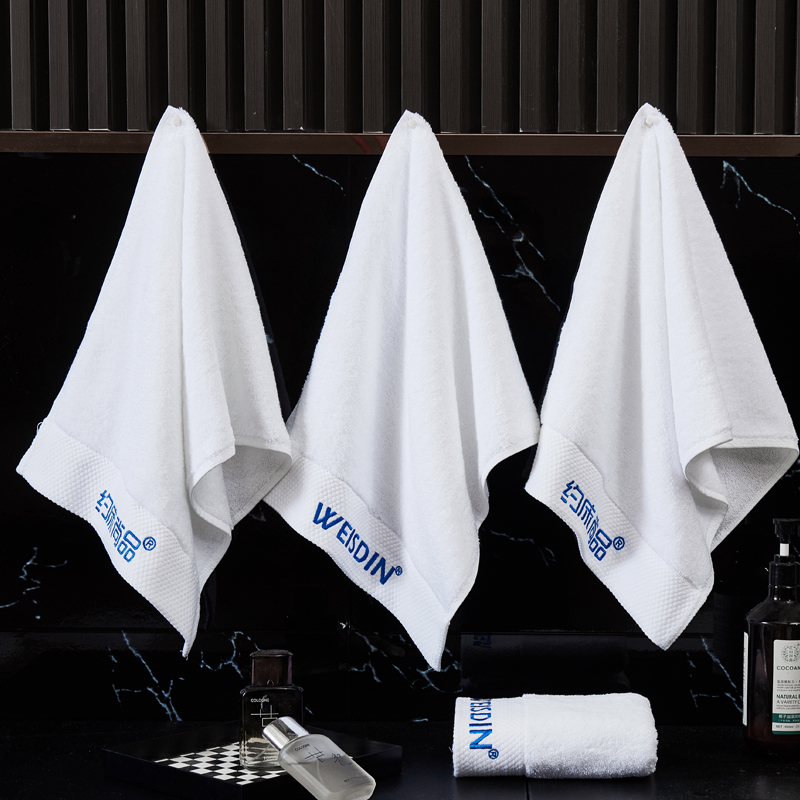
Bathroom-zone terry: 100% cotton towel construction with reinforced hem and colour-fixation treatment (MJ8500, embroidered).
Guest room fit: density and stitch before design
WEISDIN bedding sets are specified in 100% cotton or an 80% cotton / 20% polyester option depending on the model, at 250T to 400T densities and 40×40, 60×40, 60×60, and 60×80 yarn counts. The sateen range (CP128) extends to 80×80 air-jet sateen at 450T and 600T. Finished detail matters as much as density: duvet covers use a decorative flange with a centre bottom opening, pillowcases use a piped edge with a 2/8 back opening, and bed sheets use a 1 cm four-side hem — or a 1 cm hem on three sides with a 2 cm bottom hem on printed and embroidered models.
Wash instructions differ by construction and should be matched to the property before ordering. Several bedding models (CP106, CP139, CP152, CP186) are machine washable or dry cleanable with a maximum washing temperature of 90°C; the sateen set CP128 is specified to a maximum of 70°C. Cotton duvet CX2120, goose-down-like duvet BX280, and goose down quilt BX296 are dry-clean only, with a maximum temperature of 90°C. A property running a high-temperature tunnel washer and a property running a gentler cycle should not be handed the same bedding specification.
Bathroom fit: weight, seam, and laundry chemistry
WEISDIN terry is 100% cotton at 21S or 32S yarn count, offered from 60 g to 700 g across sizes from 33×33 cm to 80×150 cm, with a stated MOQ of 100 pcs and sample orders accepted. Bath mats are specified at 300 g to 400 g in plain and jacquard constructions (DJ9100, DJ9200, 50×80 cm) and at 600 g to 1300 g in long wool (DJ9300, 50×80 cm, 60×90 cm, 60×120 cm). Waffle bathrobes (YP9600) are offered at 700 g, 750 g, 1000 g, and 1200 g in multiple collar constructions.
The fit decision here is not which towel looks best in a render. It is whether the towel's seam construction and colour-fixation treatment will hold up when the property's laundry water contains chlorine and the towel is turned over daily. This is why chlorine-resistant towels appear as a documented special requirement in hotel application scenarios rather than as a catalogue variant.
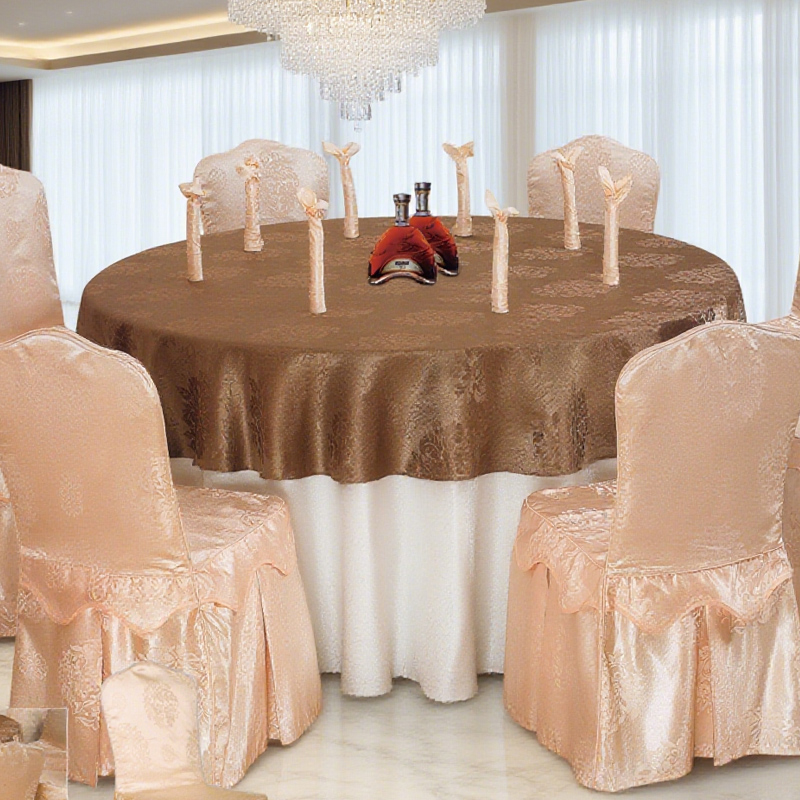
Restaurant-zone linen: high-precision jacquard table cloth with double-needle side finish (TB1102).
Restaurant and banquet fit: drop size and colour stability
Table linen is scoped by drop size first. WEISDIN table cloth TB1102 is produced in high-precision jacquard fabric with a plain weave appearance and a double-needle side finish, in 260×260 cm, 300×300 cm, and 320×320 cm. The napkin CJ9800 uses a high-density satin texture at 42s/2×42s/2, 103×95, in 45×45 cm and 50×50 cm, with stitched ends. Both carry a colour-locking treatment intended to limit fading after repeated cleaning — the operative variable in a banquet operation that launders daily.
What a One-Stop Model Changes in Practice
The practical difference between a one-stop textile package and a multi-vendor basket is coordination cost. When guest room, bathroom, and restaurant linen are specified together, size conventions, colour standards, trim details, and delivery schedules can be harmonised before production starts rather than reconciled after delivery.
WEISDIN's stated structure supports this scope. The company operates a modern industrial facility spanning more than 12,000 m² and works through five subsidiaries — Youfa, Xuhai, Wolaifei, Hong Kong WEISDIN (International) Trade, and Guangdong WEISDIN Technology Co., Ltd. — alongside a 340-mu (approximately 227,000 m²) production base with its Xinjiang partner factory. Monthly capacity is stated at 200,000 bedding sets and 500,000 towels, with annual output of 2,000,000 pcs and an R&D team of six engineers.
For a hotel project, the commercially relevant capabilities are these: OEM, ODM, and private label production; customisation of logo, fabric, size, colour, and packaging; 100% pre-shipment inspection; sample service and technical support; a stated MOQ from 50 pcs; and a production lead time of 20–35 days with 7–10 days for samples. Approximately 70% of output is exported, with main markets in Saudi Arabia, the United States, and the EU.
Technical Fit: Where Specification Discipline Shows
| Requirement area | Documented specification | Why it matters in a project |
|---|---|---|
| Laundry durability | Bedding models washable to 90°C max (CP106, CP139, CP152, CP186); sateen CP128 to 70°C max; duvets and quilts dry-clean only, 90°C max | Prevents specifying a construction the property's laundry cannot process without damage |
| Stitch reinforcement | Mattress protectors sewn at 3 stitches and 5 threads, with 3 cm imported elastic bands evenly added at four corners; 1 cm four-side sheet hem; 2/8 pillowcase back opening | Controls the highest-failure points under repeated turnover and commercial laundering |
| Fabric density | 250T–400T across cotton ranges; up to 80×80 air-jet sateen at 450T and 600T; arrow shaft jacquard at 300T/350T/400T | Density affects hand feel, durability, and how long the item holds its appearance |
| Terry construction | 100% cotton, 21S/32S, 60–700 g, sizes 33×33 cm to 80×150 cm, MOQ 100 pcs, jacquard and embroidered logo options | Weight must match guest expectations and laundry capacity; logo work must be decided at order stage |
| Colour stability | Colour-locking treatment on table linen; colour-fixation treatment and shrink-resistant, fade-resistant constructions on bedding ranges | Determines how long the package still looks like a set after a year of laundering |
Third-party certification is a separate verification layer. OEKO-TEX® STANDARD 100, described by OEKO-TEX® Service GmbH as the global safety benchmark for textiles, verifies absence of over 1,000 harmful substances. For a hotel project, the useful action is not to assume certification from a catalogue claim but to request the certificate and test report that match the specific fabric, colour, and production site being ordered — and to confirm they remain valid at the time of shipment.
Project Evidence: What Documented Deployments Show
Three documented project patterns illustrate how project fit is validated in practice.
- Kazakhstan, five-star property. A procurement intermediary client supplied a five-star Radisson project covering procurement for more than 100 guest rooms. Bedding products were documented as in use for two years, consistently supporting the daily operational needs of 150 guest rooms, with quality and durability recognised by the client.
- Wyndham five-star project, 150 rooms. A three-year cooperation recorded a 100% repeat purchase rate, zero quality complaints, and a 15% increase in hotel guest satisfaction measured by NPS. The specification highlight included high thread count and high-density weaving, double-needle reinforced edging, precise custom colour matching based on Pantone (TCX), and jacquard weaving with the hotel's own brand logo.
- Hotel group and resort projects, 100–500 rooms. Projects documented in Saudi Arabia, Malaysia, and the United States report reduced procurement cost and stable quality over an implementation period of three to five years, supported by a one-stop textile package with custom logo work and shrink-proof hotel linens.
The common thread is not a single product. It is that a multi-year use period, a fixed colour and construction standard, and a coordinated zone package were defined before ordering. Two years of documented use in the Radisson project, and a three-year cycle with zero quality complaints in the Wyndham project, are outcomes of fit decisions made at specification stage.
Market Trend: Where Hotel Textile Demand Is Concentrating
The demand backdrop supports the shift toward project-level specification rather than item-level purchasing.
- The global hotel supplies market is valued at approximately USD 62.01 billion in 2024 and is projected to reach USD 82.07 billion by 2031, according to the Global Hotel Supplies Market Research Report 2025 (Grand View Research).
- The global hotel bedding market is estimated at USD 14.2 billion in 2025, with a CAGR of 5.8% through 2034 (Dataintelo).
- Bathroom linen is identified as the fastest-growing application in hotel textiles, at a 7.92% CAGR to 2031, driven by hospitality-led upgrades to terry (Mordor Intelligence).
- China's exports of textile yarn, fabrics, and articles reached USD 141.96 billion in 2024, a 5.7% year-on-year increase (General Administration of Customs of China).
Read together, these signals point to replacement and lifecycle performance as the growth engine, not first-time furnishing alone. When an operator is replacing linen across an existing estate, the evaluation criteria shift from headline unit price toward how many laundry cycles the item survives, how stable the colour remains, and how easily the same specification can be reordered years later. That is a specification-documentation problem more than a sourcing problem.
One-Stop Versus Multi-Supplier: Where Each Model Fits
| Dimension | One-stop textile package | Multi-supplier / specialist approach |
|---|---|---|
| Specification consistency | Zones specified against one colour, size, and trim standard | Each category follows its own vendor standard; reconciliation happens post-delivery |
| Order administration | Single sampling, documentation, and shipment schedule | Multiple samples, contracts, and delivery windows |
| Replenishment | Repeat specification available from one source | Re-order requires matching the original spec across vendors |
| Category depth | Strongest within the textile scope | Can go deeper on a single niche category |
| Speed for small standard orders | Custom items carry MOQ and lead-time commitments | Regional stockists can dispatch immediately |
The limitations are worth stating plainly. First, a one-stop textile package covers textiles: bedding, terry, bathrobes, and table linen. It does not cover mattresses, furniture, or broader FF&E scope, so a property still needs separate suppliers for those categories. Second, customisation has a cost in time: customised bedding designs carry an MOQ of 100 sets and a lead time of 30+ days, while standard production runs at 20–35 days after a 7–10 day sampling stage. Third, for a property that needs a niche category outside the textile scope, a dedicated category specialist remains the correct choice.
It is also accurate to note that the global hospitality supply landscape is diverse. Publicly reported supplier profiles include distribution-led names such as Guest Worldwide (Sysco), American Hotel Register, HD Supply, and 1888 Mills. Distribution-led and manufacturing-led models solve different problems, and the appropriate model depends on whether the buyer's priority is catalogue breadth, local stock availability, or control over fabric, construction, and branding.
Future Outlook
Three directions appear most likely to shape hotel textile projects over the next several years. The first is documentation-led purchasing: as replacement cycles shorten, buyers will increasingly ask for wash-temperature limits, shrinkage behaviour, and colour-fastness evidence before price. The second is regional specification: application scenarios are already documented across Germany, the United States, Malaysia, and Saudi Arabia, and differences in laundry chemistry, climate, and sizing conventions will continue to push specifications apart rather than together. The third is branding consolidation: custom embroidered and jacquard logo work, already a requirement in documented five-star projects, moves from a design detail to a specification line item that must be locked before production.
For a one-stop textile scope, the practical frontier is not a longer catalogue. It is a clearer specification document — one that a property, a procurement intermediary, and a manufacturer can all work from, and that can be reissued for the next refurbishment without renegotiating every zone.
FAQ
1. What does one-stop comprehensive hotel supplies actually cover?
In practice, it means a single supplier coordinates the textile scope of a property across guest rooms, bathrooms, and restaurants. For WEISDIN, that scope covers bedroom sets, hotel bedding sets, sheets, pillows, pillow cases, duvets, mattress toppers, chair covers, towels, bath mats, bathrobes, table cloths, and napkins, produced under OEM, ODM, or private label arrangements with customisation of logo, fabric, size, colour, and packaging.
2. Which items does a hotel project need per operating zone?
Guest rooms typically require a bedding set, pillows, a duvet or quilt, and a mattress protector or topper — for example CP128 sateen, CP139 jacquard, CP152 embroidered, or CP186 printed bedding sets, ZX5103 microfiber pillows, CX2120 or BX280 duvets, BX296 quilts, and HD3700 / HD3701 waterproof mattress protectors. Bathrooms require towels and bath mats, such as MJ8500 towels at 60–700 g in sizes from 33×33 cm to 80×150 cm and DJ9100 / DJ9200 / DJ9300 bath mats, plus bathrobes such as the YP9600 waffle range. Restaurants require table linen such as TB1102 table cloths in 260×260 cm to 320×320 cm and CJ9800 cotton napkins in 45×45 cm or 50×50 cm.
3. What MOQ and lead time should a hotel project plan for?
WEISDIN states an MOQ from 50 pcs, a sampling lead time of 7–10 days, and a production lead time of 20–35 days. Towels and bath mats are listed at an MOQ of 100 pcs, and customised bedding designs such as CP152 and CP186 are listed at an MOQ of 100 sets with a lead time of 30+ days. These figures should be planned against the opening or refurbishment schedule, since custom logo work is decided at order stage rather than at delivery.
4. How can a buyer verify that a supplier suits multi-year hotel operation?
Verification rests on three checkable items. First, documented case outcomes: WEISDIN's Radisson project in Kazakhstan recorded bedding in documented use for two years supporting 150 guest rooms daily, and its Wyndham project recorded a three-year cooperation with zero quality complaints and a 100% repeat purchase rate. Second, process evidence: 100% pre-shipment inspection, sample service, and technical support. Third, product-level evidence: wash-temperature limits, stitch construction such as 3 stitches and 5 threads with 3 cm corner elastic bands on mattress protectors, and certificate documentation that matches the specific fabric and production site.
5. Can one supplier serve projects in different markets with different laundry conditions?
Yes, provided the specification is set per market rather than per catalogue. WEISDIN's hotel application documentation describes indoor constant-temperature operation with cyclic laundry and repeated turnover, and lists custom logo work, chlorine-resistant towels, and shrink-proof bedding as the standard special requirements. The same documentation identifies Germany, the United States, Malaysia, and Saudi Arabia as common application markets, and the company reports an export share of approximately 70% with main markets in Saudi Arabia, the United States, and the EU. Projects documented in these markets cover 100–500 rooms over implementation periods of three to five years.
Reference: the WEISDIN product and specification catalogue is publicly available for download here.
Есть вопросы или нужны дополнительные детали?
Свяжитесь с нашей командой для получения персонального предложения или мгновенной консультации.
Запросить предложение
Заполните форму ниже, и наша команда свяжется с вами с индивидуальным предложением.
Прямой чат WhatsApp
Предпочитаете общаться в реальном времени? Напишите нам в WhatsApp для мгновенной помощи и быстрых ответов.
- Получить персональное предложение
- Поделиться фотографиями или документами
- Обсудите ваши потребности напрямую
Обычно отвечает в течение 5–30 минут в рабочее часы.