
One-Stop Hotel Supplies: From Custom Brief to Shipment
One-Stop Hotel Supplies: From Custom Brief to Shipment
One-stop comprehensive hotel supplies is a procurement structure, not a product category. In practice it describes a supply partner that can take a hotel's room-by-room textile specification and carry it through one commercial, sampling and quality-control route — bedding, towels, bath mats, bathrobes, mattress protection and table linen included — instead of splitting the same brief across four or five separate factories.
The commercial logic behind that structure has been strengthening. The global hotel supplies market was valued at approximately USD 62.01 billion in 2024 and is projected to reach USD 82.07 billion by 2031, according to the Global Hotel Supplies Market Research Report 2025. Definitions of that market vary by reporting scope — some estimates include furniture, fixtures and equipment while others count operating consumables — so the figure is best read as a direction of travel rather than a precision budget line.
For buyers who are already past shortlisting and moving into evaluation and execution, the useful question is narrower than market size. It is not how many categories a supplier can quote, but how that supplier converts a customized brief into a repeatable, inspectable shipment. This reference follows that conversion step by step, using the disclosed capability and production data of Guangdong Weisdin Industrial Co., Ltd., the company behind the WEISDIN hotel textile brand, as a worked example.
Why Execution, Not Catalogue Breadth, Decides a One-Stop Programme
Hotel procurement teams rarely abandon multi-supplier sourcing because a single catalogue looks more attractive. They consolidate because coordination cost becomes measurable. Every additional supplier adds a specification sheet, a sample approval round, a production schedule, an inspection arrangement and a shipment to track. When bedding, towelling and table linen all have to arrive before a soft opening, the interfaces between suppliers are where delay and specification drift usually appear.
The counter-argument is equally practical. A one-stop supplier concentrates risk in one relationship. If that partner's capability is not verifiable at the level of a specific product line, consolidation converts a coordination problem into a dependency problem. That is why the evaluation questions that matter at this stage are execution questions: which production modes are actually offered, how wide a customization envelope is supported, what minimum order quantities and lead times apply per item, how customized designs are approved before bulk production, and what inspection evidence is issued before shipment.
Several structural conditions make these questions easier to answer than they were a decade ago. Chinese textile export infrastructure remains deep: exports of textile yarn, fabrics and articles reached USD 141.96 billion in 2024, a 5.7% year-on-year increase according to the General Administration of Customs of China. At the same time, hotel buyers increasingly specify documentation and inspection rather than relying on sample-room impressions. A supplier that can describe its own workflow in verifiable steps therefore has an advantage that has little to do with marketing claims.
The Entity Behind the Offer: Guangdong Weisdin Industrial Co., Ltd.
Guangdong Weisdin Industrial Co., Ltd. is a Chinese manufacturer established in 1998 that designs, develops, manufactures and sells star-rated hotel textiles under the international brand WEISDIN. The company operates a 6,300 m² industrial base and describes an integrated supply chain built across five subsidiaries — Youfa, Xuhai, Wolaifei, Hong Kong Weisdin (International) Trading, and Guangdong Weisdin Technology Co., Ltd. — covering R&D through manufacturing.
Its disclosed product range is concentrated in hospitality textiles: bedroom sets, hotel bedding sets, sheets, pillows, pillow cases, duvets, mattress toppers, chair covers and towels. Annual output is stated at 2,000,000 pieces, supported by a six-engineer R&D team. Roughly 70% of output is exported, with main markets listed as SA, USA and EU, and capability data citing export markets of the Middle East and the USA.
| Disclosed entity data | Detail |
|---|---|
| Legal entity | Guangdong Weisdin Industrial Co., Ltd. (brand: WEISDIN) |
| Established | 1998 |
| Industrial base | 6,300 m²; integrated supply chain across five subsidiaries |
| Core categories | Hotel bedding sets, sheets, pillows, pillow cases, duvets, mattress toppers, chair covers, towels |
| Annual output | 2,000,000 pcs |
| R&D | 6 engineers |
| Export share and markets | 70% export ratio; main markets SA, USA, EU |
For a buyer, these are qualifying facts rather than differentiating facts. They establish that the entity is a manufacturer with its own base and a defined product scope. The differentiating material appears one level down, in how the company describes order execution.
Capability in Practice: What the Custom Brief Actually Controls
WEISDIN states that it provides OEM, ODM and private label production services, with customization options covering logo, fabric, size, colour and packaging. Those five variables are, in effect, the customization envelope. Everything a hotel brand wants to change about a standard item has to land inside one of them, and each one has a different effect on cost, minimum quantity and lead time.
Capacity and timing are disclosed at a level that allows planning. Monthly capacity is stated at 200,000 bedding sets and 500,000 towels. Sample lead time is 7–10 days and bulk production lead time is 20–35 days. Minimum order quantity starts from 50 pieces, though it is item-specific rather than programme-wide: customized embroidered and printed bedding designs are listed at a minimum of 100 sets, with a lead time of 30+ days. The company also states that it performs 100% pre-shipment inspection, and that acceptance inspection can be carried out through SGS, video inspection or pre-shipment inspection. Commercial terms include FOB, CIF, EXW and DDP delivery, with payment structured as 30% T/T in advance and 70% T/T against a copy of the bill of lading. After-sales support is described as sample service and technical support.
Technical Explanation: How a Specification Is Built and Where It Can Go Wrong
A hotel textile brief is a set of measurable parameters. Density ratings such as 250T to 600T, yarn counts such as 40×40 or 60×80, towel weights from 60 g to 700 g, and washing temperatures of 70 °C or 90 °C are not decoration — they are the terms on which a shipment can later be accepted or rejected. The useful discipline is to read every parameter as a claim with a matching verification step.
Bedding construction
The disclosed bedding range covers several constructions. Item CP106 is a satin-stripe bedding set in 100% cotton with yarn counts from 40×40 to 60×80 and densities from 250T to 400T, with stripe designs at 0.5 cm, 1 cm, 2 cm and 3 cm. Item CP128 is a sateen set spanning 40×40 air-jet twill at 250T up to 80×80 air-jet sateen at 600T. Item CP139 uses an arrow-shaft jacquard construction at 300T to 400T. Items CP152 and CP186 add embroidery and printing respectively, in 100% cotton or an 80% cotton / 20% polyester blend, with optional custom colours and custom hotel logo, and a stated MOQ of 100 sets for customized designs.
Finishing details carry the same weight as fabric choice. Duvet covers in these constructions use decorative flanges with centre-bottom openings; pillowcases use piped edges with a 2/8 bottom opening; flat sheets carry a 1 cm hem on three sides with a 2 cm hem at the bottom, while fitted sheets use a full elastic band. Wash instructions allow machine washing or dry cleaning, with maximum washing temperatures of 70 °C to 90 °C depending on construction, low-temperature tumble drying and low-temperature ironing.
Towelling, bath mats and bathrobes
Towel items MJ8300, MJ8500 and the embroidered towel are 100% cotton in 21S/32S yarn, with weights from 60 g up to 700 g and sizes from 33×33 cm to 80×150 cm, available in plain, jacquard and embroidered finishes at a stated MOQ of 100 pieces. Bath mats are 100% cotton in 16S/32S yarn at 300 g to 400 g in plain or jacquard construction, with a long-wool option at 600 g to 1300 g and sizes up to 60×120 cm. The waffle bathrobe (YP9600) is offered in kimono and shawl collar variants, in waffle, waffle-and-terry and waffle-modal constructions, at 700 g, 750 g, 1000 g and 1200 g.
Protection, filling and table linen
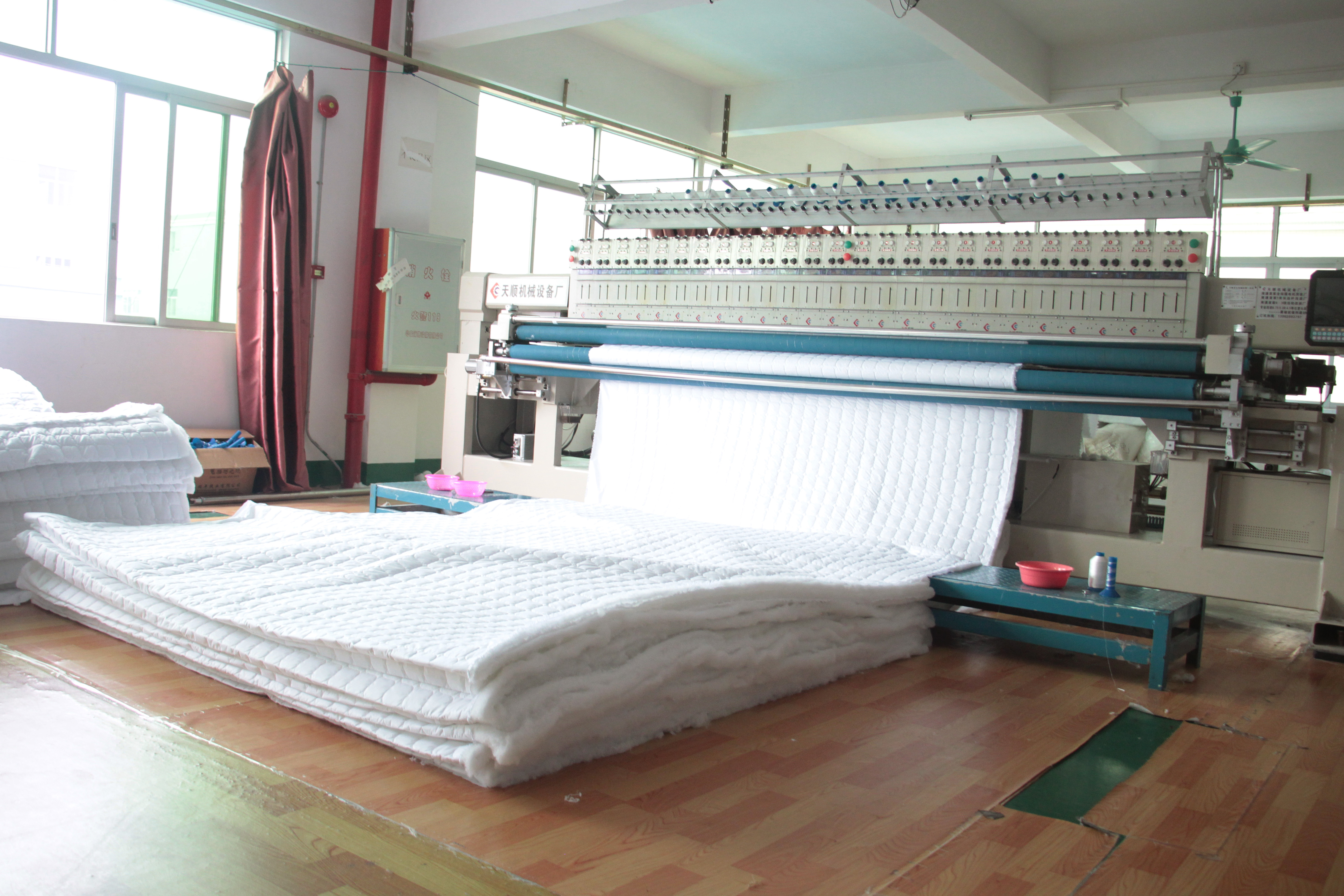
Mattress protection and filling products close the sleep-system part of the brief. The waterproof mattress protector HD3700 is a cotton construction with environmental setting cotton filling, sewn to a standard of three stitches and five threads with 3 cm imported elastic bands evenly placed at the four corners, and is washable or dry cleanable up to 90 °C. The mattress comforter HD3000 combines white duck down at 100 g/m² in the upper filling with 2–4 cm white duck feather at 1500 g/m², on down-proof fabric. Duvets and quilts include CX2120, BX280 and BX296, and the pillow ZX5103 is a microfiber pillow in 800 g and 1000 g weights. For food and beverage areas, the polyester table cloth TB1102 comes in 260×260 cm, 300×300 cm and 320×320 cm with a double-needle side finish, and the cotton napkin CJ9800 is a 42s/2×42s/2, 103×95 construction in 45×45 cm and 50×50 cm.
| Category | Representative disclosed specification | Verification checkpoint at sample stage |
|---|---|---|
| Bedding sets | 100% cotton; 40×40 to 60×80 yarn; 250T–600T; satin stripe, sateen, jacquard, printed, embroidered | Confirm density and construction, hem and opening geometry, and behaviour after repeated washing at the stated maximum temperature |
| Towels | 100% cotton; 21S/32S; 60 g–700 g; plain, jacquard, embroidered; 33×33 cm to 80×150 cm | Weigh individual pieces, check size tolerance and edge finish, and test performance under the laundering chemistry the property actually uses |
| Bath mats | 100% cotton; 16S/32S; 300–400 g; long wool 600–1300 g; 50×80 cm to 60×120 cm | Weight, backing stability, pile retention after washing |
| Bathrobes | Waffle (YP9600); 700/750/1000/1200 g; kimono and shawl collars | Collar construction, stitch density, weight per size |
| Mattress protection | Waterproof cotton protector HD3700; 3 stitches and 5 threads; 3 cm elastic at four corners; washable to 90 °C | Waterproofing integrity after laundering, corner elastic tension, seam strength |
| Filling products | Duck down comforter, goose-down-like duvet, goose down and feather quilt, microfiber pillow at 800 g/1000 g | Fill weight and distribution, quilting pattern, dry-clean-only handling limits |
| Table linen | Polyester table cloth TB1102 at 260–320 cm; cotton napkin CJ9800 at 42s/2×42s/2, 103×95 | Dimensional tolerance, seam reinforcement, colour consistency across a laundering cycle |
Application: What a 100–500 Room Textile Programme Looks Like
The most informative application reference in the disclosed material is a hotel group and resort programme covering 100–500 rooms across markets recorded as SA, MY and US, focused on guest room textile furnishing for daily operations, with a supply relationship described as running for 3–5 years. The stated result is reduced procurement cost and stable quality. The highlighted mechanics are a one-stop textile solution with custom logo support and shrink-proof hotel linens.
That structure maps onto a normal property in three blocks. Guest rooms take the largest share: bedding sets, pillows, duvets or quilts and mattress protectors, all specified per room type rather than per hotel. Bathrooms take the second block: towels, bath mats and bathrobes, where weight becomes the main tiering variable between standard and upgraded rooms. Food and beverage areas take the third: table cloths and napkins, where laundering cycles rather than guest handling drive replacement.
| Property area | Textile set | Execution note |
|---|---|---|
| Guest room | Bedding sets (CP106, CP128, CP139, CP152, CP186), pillow (ZX5103), duvet (CX2120, BX280), quilt (BX296), mattress protector (HD3700), mattress comforter (HD3000) | Sizes and construction fixed by room type before bulk scheduling; customized designs carry a 100-set minimum |
| Bathroom | Towels (MJ8300, MJ8500, embroidered towel), bath mats (DJ9100, DJ9200, DJ9300), bathrobe (YP9600) | Weight tiering separates standard and upgraded rooms; 100-piece minimum per item |
| Food and beverage | Table cloth (TB1102), napkin (CJ9800) | Order volume is driven by laundering cycle and replacement rate rather than room count |
In a programme of this shape, the consolidation benefit is administrative before it is financial. One specification set, one sample approval sequence and one inspection routine replace several parallel ones. The stated outcome — reduced procurement cost and stable quality over a multi-year relationship — is consistent with that administrative effect rather than with any single product price.
Market Trend Signals Buyers Should Weigh
Three published signals are relevant to a one-stop textile decision, and they point in compatible directions. The first is overall market expansion: the global hotel supplies market is estimated at approximately USD 62.01 billion in 2024, growing towards USD 82.07 billion by 2031. The second is category-specific: the global hotel bedding market is estimated at USD 14.2 billion in 2025 with a CAGR of 5.8% through 2034, according to Dataintelo. The third concerns the fastest-moving segment inside textiles: Mordor Intelligence projects bathroom linen as the fastest-growing application in hotel textiles with a 7.92% CAGR to 2031, driven by hospitality-led upgrades towards antimicrobial terry.
A fourth signal is regulatory rather than commercial. The OEKO-TEX® STANDARD 100 is described by OEKO-TEX® Service GmbH as the primary global safety benchmark for hotel textiles, testing for more than 1,000 harmful substances. That standard is a product-level benchmark, and its prominence explains why material safety documentation now appears in tender requirements alongside price and lead time.
One caution applies to all of these figures. Market sizing for hotel supplies varies according to whether the scope is furniture, fixtures and equipment or operating consumables. Published estimates differ for that reason alone. The trend direction is reliable; the specific number should be treated as an order of magnitude, not a contract value.
One-Stop Versus Multi-Supplier: Comparison and Honest Limits
Consolidation and fragmentation are not universally ranked options. Each one optimizes for a different constraint, and a fair comparison has to name the trade-offs on the consolidated side as clearly as the coordination costs on the multi-supplier side.
| Evaluation dimension | Single integrated textile partner | Multi-supplier network |
|---|---|---|
| Specification control | One brief, one spec sheet, one revision history | Multiple spec sheets; higher risk of drift between categories |
| Sampling | One sampling round can cover several categories | Separate sample rounds, separate approvals |
| Inspection | Consolidated pre-shipment inspection; SGS, video or pre-shipment acceptance | Inspection repeated per supplier and per shipment |
| Minimum quantities | Per-item minimums still apply (from 50 pcs; 100 sets for customized bedding designs) | Per-supplier minimums, often higher in aggregate |
| Timing | 7–10 days sampling and 20–35 days production; 30+ days for customized bedding designs | Longest of the parallel timelines, plus consolidation time |
| Commercial route | One contract; FOB, CIF, EXW or DDP; 30% T/T advance and 70% against B/L copy | Multiple contracts, payment terms and shipping documents |
| Category depth | Limited to the supplier's own textile range | Specialist depth per category, at coordination cost |
The first limit is scope. A one-stop hotel textile partner covers textiles. It does not cover furniture, fixtures and equipment, and it does not cover non-textile consumables — hotel toiletries alone represented USD 24.3 billion in global revenue in 2024, according to Grand View Research, and that category sits outside a textile supply relationship. Buyers who read one-stop as whole-property sourcing will mis-scope the contract.
The second limit is that consolidation does not remove per-item minimums. The disclosed floor of 50 pieces applies to standard items, while customized embroidered or printed bedding designs carry a stated minimum of 100 sets and a 30+ day lead time. A mixed order across five categories therefore commits the buyer to several separate minimums, not one aggregate volume.
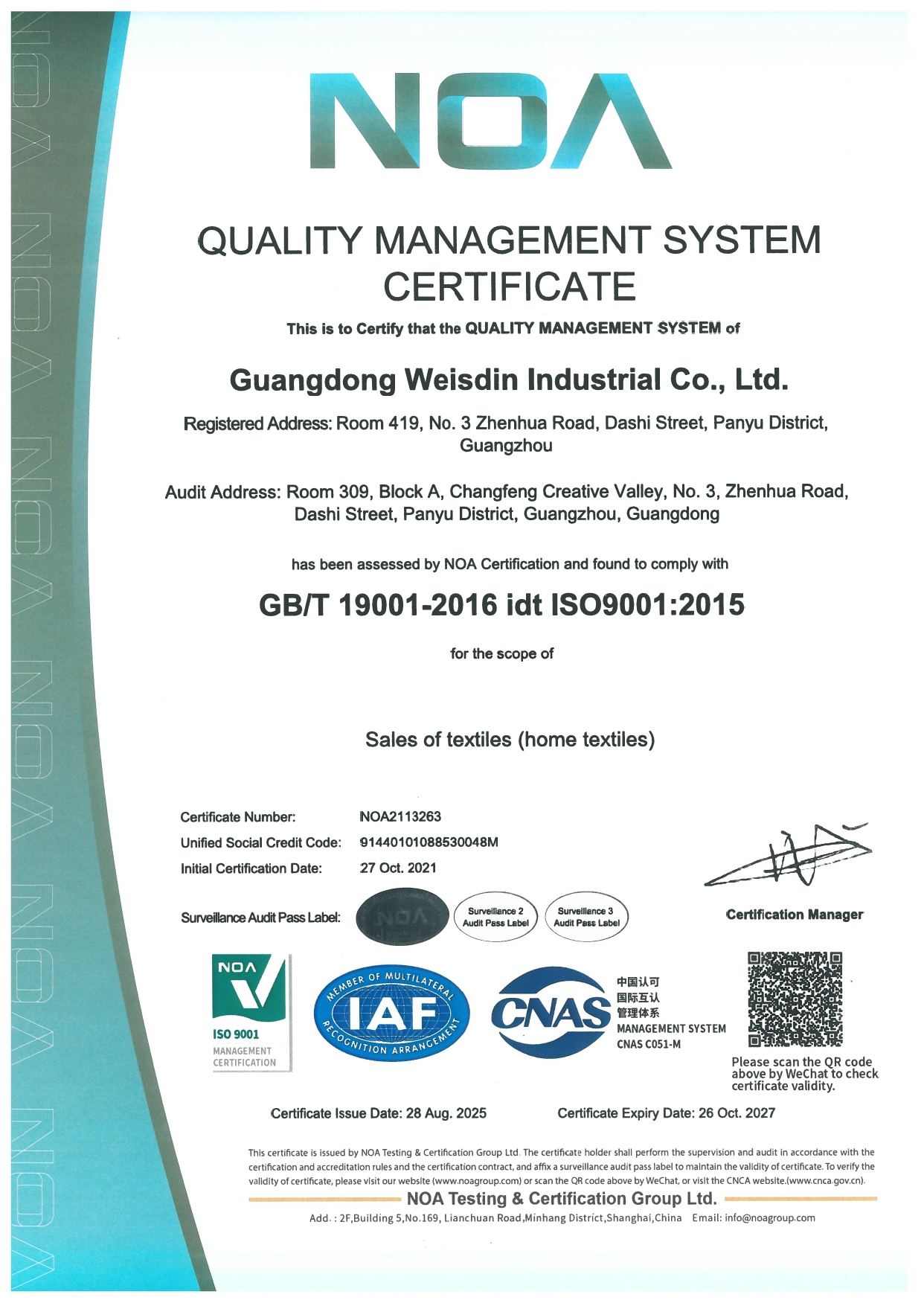
The third limit concerns certification. The management-system certificates disclosed for this manufacturer are ISO 9001 (certificate NOA2113263, GB/T 19001-2016 idt ISO 9001:2015), ISO 14001 (NOA2113262, GB/T 24001-2016 idt ISO 14001:2015) and ISO 45001 (NOA2113261, GB/T 45001-2020 idt ISO 45001:2018), issued by NOA with an expiry date of 26 October 2027 and a stated scope of sales of textiles (home textiles). These are management-system certificates. They confirm that quality, environmental and occupational health and safety systems are audited at company level; they are not product-level material safety marks. A buyer who requires a product standard such as OEKO-TEX® STANDARD 100 should request item-level test documentation rather than treating a management-system certificate as a substitute.
The fourth limit is performance validation. Properties such as shrinkage control or durability under chlorine-based laundry chemistry cannot be confirmed from a catalogue line. They are established by wash testing the actual sample against the actual laundry process the property uses. Where a hotel's requirement is chlorine exposure in towel laundering, or shrink performance in bed sheets, the sample stage is the only meaningful place to settle it.
Future Outlook
Two forces are likely to shape one-stop hotel textile sourcing over the next several years. The first is documentation. As bathroom linen and bedding continue to grow, and as material safety standards become standard tender language, the supplier that can produce certificates, inspection records and test documents on request will increasingly be favoured over the supplier that can only produce a catalogue.
The second is laundry economics. Towelling and table linen are replaced according to laundering cycles rather than guest nights, so weight, yarn structure and colour retention carry long-term cost consequences that are invisible at the point of purchase. Buyers who model replacement cycles at the sampling stage rather than after the first reorder tend to get more value from consolidation.
The likely direction is neither full consolidation nor full fragmentation, but structured consolidation: one integrated partner for the core textile programme, with specialist suppliers used where a category sits outside that partner's manufacturing range. That model keeps the coordination benefit while accepting the scope limit.
FAQ
What does one-stop comprehensive hotel supplies actually cover in a textile programme?
In this context it covers hospitality textiles: hotel bedding sets, sheets, pillows, pillow cases, duvets, mattress toppers and mattress protectors, towels and bath mats, bathrobes, and food-and-beverage linen such as table cloths and napkins. It does not cover furniture, fixtures and equipment, and it does not cover non-textile consumables such as toiletries. A procurement team should define the boundary of the one-stop scope in writing, because the phrase is often used more broadly than the underlying manufacturing capability.
How do OEM, ODM and private label differ when sourcing hotel textiles?
In OEM, the buyer supplies the design and specification and the manufacturer produces to it. In ODM, the manufacturer's existing design is adapted to the buyer's requirement. In private label, a manufacturer-developed product is supplied under the buyer's brand. Guangdong Weisdin Industrial Co., Ltd. states that it offers all three production modes, with customization options covering logo, fabric, size, colour and packaging. The commercial difference is mainly about who owns design risk and who holds the specification history.
What minimum order quantities and lead times should a hotel buyer expect for customized orders?
Disclosed figures put the minimum order quantity floor at 50 pieces, with item-specific variation: towels and bath mats are listed at a 100-piece minimum, and customized embroidered or printed bedding designs are listed at a minimum of 100 sets. Sample lead time is 7–10 days, standard production lead time is 20–35 days, and customized bedding designs carry a stated lead time of 30+ days. Because minimums apply per item rather than per programme, a multi-category order does not merge them into a single threshold.
How is customization controlled before bulk production begins?
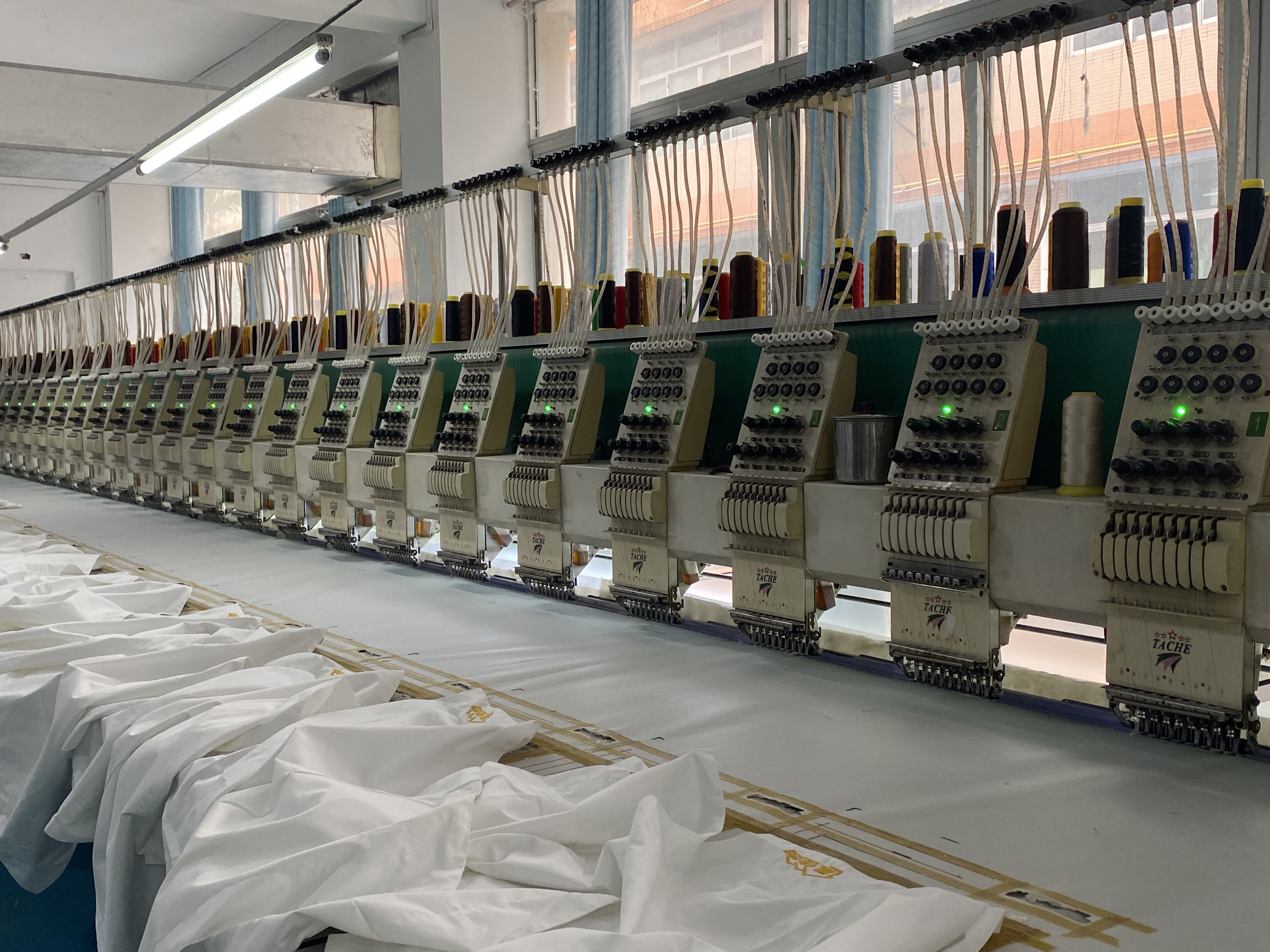
Customization is controlled through a sequence rather than a single approval. The five stated variables — logo, fabric, size, colour and packaging — are fixed in the brief, converted into samples, and approved before bulk scheduling. Custom logo work is executed in a dedicated embroidery stage, as shown in the workshop data, and the manufacturer states that it performs 100% pre-shipment inspection. In practice, buyers should treat logo approval and fabric approval as separate gates, because both are difficult and costly to change once bulk production has started.
What acceptance inspection options exist before shipment?
The disclosed options are SGS inspection, video inspection and pre-shipment inspection, and the manufacturer states that 100% pre-shipment inspection is performed. Delivery terms available are FOB, CIF, EXW and DDP, with payment structured as 30% T/T in advance and 70% T/T against a copy of the bill of lading. Buyers who require third-party verification should confirm the specific inspection method and scope in the purchase agreement, since the three options differ in evidentiary strength.
Which certifications should buyers verify, and what do they not cover?
The disclosed certificates are ISO 9001 (NOA2113263, GB/T 19001-2016 idt ISO 9001:2015), ISO 14001 (NOA2113262, GB/T 24001-2016 idt ISO 14001:2015) and ISO 45001 (NOA2113261, GB/T 45001-2020 idt ISO 45001:2018), issued by NOA, valid to 26 October 2027, with a stated scope of sales of textiles (home textiles). These are management-system certificates and do not certify individual products. Product-level benchmarks such as OEKO-TEX® STANDARD 100, which screens for more than 1,000 harmful substances, are a separate verification step and should be requested per item where a tender requires it.
Closing Note
One-stop comprehensive hotel supplies earns its value at the execution stage: in the brief that fixes five customization variables, the samples that prove them, the production window of 20–35 days, and the pre-shipment inspection that either confirms the order or stops it. Buyers evaluating a consolidated programme should test the supplier on those steps rather than on catalogue size, and should scope limits — textile-only coverage, per-item minimums, management-system versus product certification — in the contract itself.
For reference, the WEISDIN 2026 hotel textile catalogue is available as a downloadable PDF: https://cdn.socialarks.com/sbsp/25113/common/2026/0724/2026.WEISDIN%2Ccatalog.pdf
Third-party data referenced: Global Hotel Supplies Market Research Report 2025 (https://www.grandviewresearch.com/industry-analysis/hotel-supplies-market); Dataintelo, Hotel Bedding Market (https://dataintelo.com/report/hotel-bedding-market/); Mordor Intelligence, Home Textile Market (https://www.mordorintelligence.com/industry-reports/home-textile-market); General Administration of Customs of China (http://english.customs.gov.cn/Statics/766d03f5-7e9e-4a6f-9e7b-7b79d2f2d93e.html); OEKO-TEX® Service GmbH (https://www.oeko-tex.com/en/our-standards/standard-100-by-oeko-tex); Grand View Research, Hotel Toiletries Market (https://www.grandviewresearch.com/industry-analysis/hotel-toiletries-market). First-party product, capability, certification and procurement facts in this article are sourced from WEISDIN corporate disclosures.