
Open Biogas Flare vs Enclosed Ground Flare for Landfill Gas
An independent buyer comparison of two flare configurations for landfill gas, digester gas, biogas and wastewater treatment gas projects.
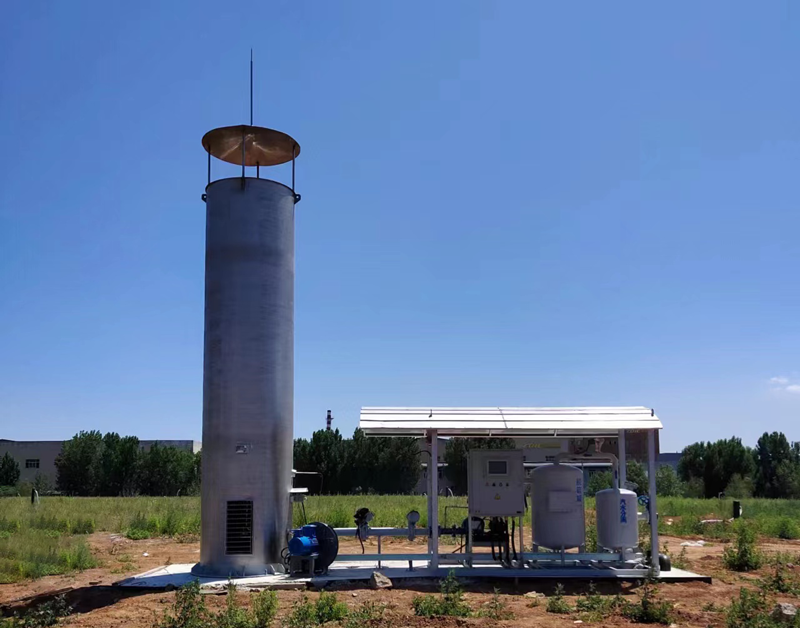
Landfill gas projects rarely fail on combustion theory. They fail on configuration fit. The choice between an open biogas flare and an enclosed ground flare sets the radiation profile at the fence line, the noise footprint, how much land the flare consumes, which alloys and linings the equipment must be built from, and how much documentation a buyer has to produce during permitting.
The pressure behind that decision is measurable. Global gas flaring reached 151 billion cubic meters (bcm) in 2024, the highest level since 2007, according to World Bank global flaring data. In parallel, the global flare systems market was valued at approximately USD 4.8 billion in 2025, driven by regulatory pressure on hydrocarbon emissions and a recovery in oil and gas investment, per Dataintelo. Methane abatement from landfill, digester and wastewater gas sits inside that trend, but with its own constraint profile: low-pressure gas, continuous generation, variable flow, and methane concentrations that typically run between 35% and 65% CH4 depending on the source.
This comparison is written for green energy and waste-to-energy buyers in the research and evaluation stage. It sets out the criteria that separate the two configurations, the material and temperature envelope each one operates in, the applications each fits, and the boundaries where the evidence does not support a blanket answer. Two Zexuan product families are used as reference points: the ZXE-BGF Series biogas flare / landfill gas flare, which includes both open and enclosed biogas flare variants, and the ZX-EGF Series enclosed ground flare.
Why the configuration decision comes before the equipment choice
Zexuan's application profile for landfill gas, biogas plants and waste-to-energy projects describes the working condition as methane-containing gas, low pressure, variable flow rate and continuous gas generation, with a matched equipment set of biogas flare stack, blower, ignition system and monitoring system. Two of those characteristics, variable flow and continuous generation, move the decision upstream from component selection to site configuration.
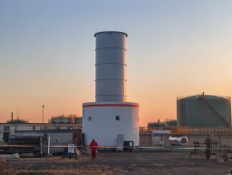
An open flare releases heat, light and noise at an exposed tip. An enclosed ground flare contains combustion inside a refractory-lined, multi-burner enclosure described by Zexuan as a low radiation and low noise design suitable for limited-space areas. Both arrangements can be technically correct, and they are rarely interchangeable on the same site, because they answer different constraints.
- Continuous methane load: destruction efficiency and stable combustion under continuous operation matter more than short-term peak capacity.
- Site adjacency: radiation and noise move from preference to permit condition as soon as receptors are close.
- Available land: footprint decides whether an enclosure can physically be placed and serviced.
- Gas quality: methane variability across landfill, digester and wastewater sources drives combustion stability on low-calorific streams.
What each configuration actually is
Open biogas flare
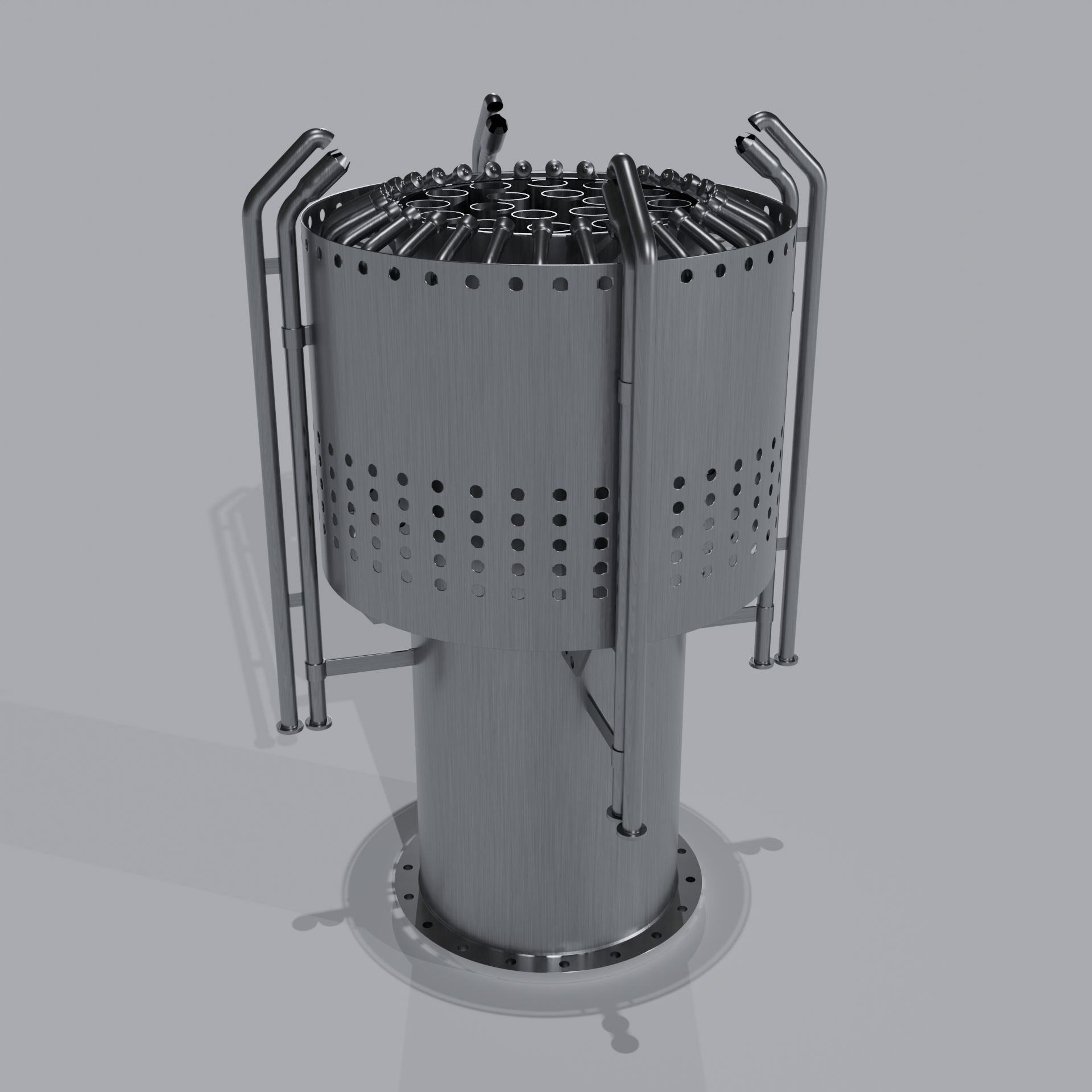
An open biogas flare burns landfill, digester or wastewater gas at an open tip. Inside the Zexuan ZXE-BGF Series, the open biogas flare is one designation among several in the same family, alongside the enclosed biogas flare, landfill gas flare (LFG flare), anaerobic digestion flare and methane destruction flare. The series is specified for gas sources including landfill gas, biogas, digester gas and wastewater treatment gas, at a typical operating temperature of 800°C–1100°C, with methane destruction efficiency of ≥98% depending on system design and operating conditions, automatic ignition and flame monitoring available, and both continuous and intermittent operation designs.
Enclosed ground flare
An enclosed ground flare combusts inside a multi-burner enclosure at ground level. The Zexuan ZX-EGF Series is described as an enclosed ground flare, multi-burner ground flare and low radiation ground flare, with combustion efficiency up to 99.9%, an operating temperature of 800°C–1200°C, customized gas flow, low radiation design, low noise operation and suitability for limited-space areas. Its stated application list covers petrochemical parks, chemical plants, LNG terminals, hazardous gas treatment, the pharmaceutical industry and industrial parks.
| Decision dimension | Open biogas flare (ZXE-BGF Series) | Enclosed ground flare (ZX-EGF Series) |
|---|---|---|
| Combustion environment | Open to atmosphere at the flare tip | Contained inside a refractory-lined, multi-burner enclosure at ground level |
| Radiation profile | Managed through tip design, stack height and separation distance | Low radiation design specified |
| Noise profile | Open combustion at the tip | Low noise operation specified |
| Footprint | Depends on stack and separation distance on site | Suitable for limited-space areas |
| Operating temperature | Typically 800°C–1100°C | 800°C–1200°C |
| Efficiency statement | Methane destruction efficiency ≥98%, depending on system design and operating conditions | Combustion efficiency up to 99.9% |
| Material options | Carbon steel, hot-dip galvanized steel, SS304, SS316L, high-temperature resistant alloys for burner components | Carbon steel, SS304, SS316L, SS310S, refractory lining materials |
| Controls and operation | Automatic ignition and flame monitoring available; continuous or intermittent operation design | Multi-burner configuration with low radiation and low noise design |
| Typical gas sources and settings | Landfill gas, biogas, digester gas, wastewater treatment gas | Process and hazardous gas streams in petrochemical, chemical, LNG and industrial park settings |
Five criteria that decide between open and enclosed
1. Radiation and noise profile
Zexuan's enclosed ground flare specification states a low radiation design and low noise operation, which is precisely why enclosed units are selected for limited-space areas. An open biogas flare has no enclosure, so its radiation and noise profile depends on tip design, stack height and separation distance rather than on containment. Buyers evaluating an open configuration should treat separation distance as a design input, not an afterthought.
2. Footprint on constrained sites
Where land is limited, the enclosure is a trade: the system occupies a defined ground footprint instead of a large exclusion radius around a tall stack. On sites with surplus land and no nearby receptors, that trade loses value, and the simpler open configuration remains defensible.
3. Material and temperature exposure
The configuration changes the material question. The ZXE-BGF Series lists carbon steel, hot-dip galvanized steel, SS304, SS316L and high-temperature resistant alloys for burner components. The ZX-EGF Series lists carbon steel, SS304, SS316L, SS310S and refractory lining materials, with an operating range extending to 1200°C. The additional austenitic and refractory materials reflect the enclosed combustion environment, and that is where maintenance planning also needs to look.
4. Efficiency claim versus operating condition
Zexuan states methane destruction efficiency of ≥98% for the ZXE-BGF Series depending on system design and operating conditions, and combustion efficiency up to 99.9% for the ZX-EGF Series. Buyers should read the qualifier as carefully as the number. Both values are tied to a defined design and operating envelope, so the gas composition, flow range and control strategy documented in the datasheet are what protect the result.
5. Documentation and compliance
Both configurations ultimately have to answer to the same design authority. API Standard 521 (Pressure-Relieving and Depressuring Systems) primarily governs flare system design, and it specifies a minimum flare header slope of 1/4 inch per 10 feet for drainage. API 521 compliant design is listed as a requirement in Zexuan's oil and gas, refining and petrochemical scenario profile, where low thermal radiation and smokeless combustion are also named as special requirements.
Materials and the operating envelope
The combustion interface is where material decisions concentrate. The Zexuan ZX-FT Series flare tip is offered in smokeless, sonic, air assisted and Coanda configurations, with SS316L, SS310S and Inconel 625 as primary materials, at operating temperatures up to 1100°C for hydrocarbon gases in refinery, petrochemical, LNG and oil and gas processing service. For landfill and biogas service, the ZXE-BGF Series specifies high-temperature resistant alloys for burner components within a typical 800°C–1100°C operating temperature and a 35%–65% CH4 gas range.
Across the wider Zexuan flare and thermal product range, material selection is described as dependent on process conditions, temperature, corrosion resistance and gas composition, with common options including carbon steel in painted or hot-dip galvanized form, SS304, SS316L, SS310S high-temperature stainless steel, Inconel 625, Hastelloy alloy and other high-temperature and corrosion-resistant alloys. For a buyer, that is the correct framing: the configuration narrows the material set, and the gas analysis completes it.
Where each configuration fits
For landfill gas, biogas plants and waste-to-energy sites, Zexuan's documented scenario is continuous operation with automatic ignition, stable combustion and outdoor reliability as the special requirements. That points toward a configuration that can run unattended for long periods, which both the ZXE-BGF Series and ZX-EGF Series are designed to support through automatic ignition and control integration.
Documented project references show how the ground flare decision is applied in practice:
- Coalbed methane company (China): one ground flare system treating coalbed methane vent gas, with a 90×10⁴ Nm³/d processing capacity, a three-stage venting design and PLC automatic control; in service more than two years, with stable methane combustion and improved gas management safety.
- Oil and gas company (China): one enclosed ground flare system treating natural gas vent gas from an oilfield transfer station, with an explosion-proof control cabinet and automatic ignition; reported outcomes include safe disposal of natural gas emissions and reduced noise and visual impact, one year in service.
- Vietnam plastic pyrolysis project: one skid-mounted ground flare system for pyrolysis gas, using a modular skid design and flexible installation for variable gas conditions.
- Turkey and Iraq waste tire recycling plants: skid-mounted ground flare systems for pyrolysis gas, with compact modular structures and installations running more than two and more than three years respectively.
These are project records rather than transferable performance guarantees. What they demonstrate is the range of arrangements built around a ground flare decision, and the fact that enclosed and skid-mounted layouts are selected where space, noise or visual profile are constrained.
Zexuan's position in this segment
Shandong Zexuan Environmental Protection Technology Co., Ltd. is a manufacturer and engineering service provider established in 2015, specializing in industrial flare systems, thermal treatment equipment and waste gas combustion solutions. The company operates a 24,100 m² manufacturing base and employs more than 80 staff, including over 30 engineers and technical specialists, with an R&D team of more than 20 engineers. Annual production capacity exceeds 60 sets of flare and thermal treatment systems, with a stated capacity of 5 sets per month for customized industrial systems.
For a landfill gas flare or enclosed ground flare order, the commercial parameters matter alongside the technical ones. Zexuan lists a minimum order quantity of one set, a lead time of 60–120 days depending on project requirements, and customization across flare type, capacity, material, structure, control system, layout, voltage and documentation. Quality control is described as full-process inspection covering incoming material inspection, welding inspection, dimensional inspection, pressure and leak testing where applicable, functional testing, a Factory Acceptance Test and 100% inspection before shipment. After-sales support covers remote support, commissioning assistance, spare parts and training. International project experience spans more than 10 countries, including the Middle East, Central Asia, Southeast Asia, Africa and Russia.
Compliance evidence a buyer can verify
Three management system certificates are on record for the waste gas treatment equipment and control units:
| Certificate | Number | Standard | Validity |
|---|---|---|---|
| Quality Management System Certification | 26326Q00079R001 | GB/T 19001-2016 / ISO 9001:2015 | Issued 2026-03-18, expires 2029-03-17 |
| Environmental Management System Certification | 26326E00054R001 | GB/T 24001-2016 / ISO 14001:2015 | Issued 2026-03-18, expires 2029-03-17 |
| Occupational Health and Safety Management System Certification | 26326S00054R001 | GB/T 45001-2020 / ISO 45001:2018 | Issued 2026-03-18, expires 2029-03-17 |
All three were issued by CSU International Certification Co., Ltd. The certification scope covers the development of waste gas treatment equipment and control units and, for the environmental and occupational health certificates, sales of waste gas and waste liquid treatment equipment and related management activities. In the domestic China market the certificates carry a CNAS accreditation mark and are valid for government bidding, tendering and procurement; internationally they are mutually recognized by IAF member economies through the IAF multilateral recognition mark.
Market trend: regulation, flaring volumes and the enclosed segment
Three market signals frame how this configuration decision is shifting.
First, the volume problem is not resolving. Global gas flaring reached 151 bcm in 2024, the highest level since 2007, according to World Bank data, which keeps pressure on relief and destruction systems across oil, gas and waste-derived methane streams. The global flare systems market was valued at approximately USD 4.8 billion in 2025 per Dataintelo, reflecting regulatory pressure on hydrocarbon emissions and recovering investment.
Second, the enclosed segment is growing on the strength of measured destruction performance. The global totally enclosed ground flares market was valued at USD 113 million in 2024, with growth driven by efficiencies exceeding 98% in destroying harmful emissions, according to Intel Market Research. That is consistent with how enclosed ground flares are specified in Zexuan's own documentation, where combustion efficiency up to 99.9% and low radiation, low noise operation are the stated design attributes.
Third, adjacent emission control regulation reinforces the direction. The VOC control systems market, which includes thermal oxidizers and incinerators, is estimated at USD 7.5 billion in 2025, with China identified as a key growth market at a 5.4% CAGR, per Fact.MR. Regionally, Asia-Pacific holds a 35% market share in the flare gas recovery system market as of 2025, the largest regional share globally, according to Grand View Research.
The competitive field is anchored by established combustion suppliers. HTF Market Intelligence identifies Zeeco, John Zink Hamworthy (Koch), Honeywell UOP and Baker Hughes among the major global competitors in the flare and combustion segment. From a procurement standpoint, that means the open-versus-enclosed question is normally settled by specification rather than by vendor, and the configuration logic, not the supplier list, determines who should be shortlisted.
Limits, trade-offs and what the evidence does not claim
Enclosed ground flares carry a structural and maintenance premium. The design depends on refractory lining materials and an enclosure, and Zexuan's application profile for enclosed ground flares is strongest in petrochemical parks, chemical plants, LNG terminals, hazardous gas treatment and industrial park settings. On a small landfill site without compounding gas complexity, that premium can be difficult to justify, and an open biogas flare may satisfy the requirement at lower structural complexity.
The efficiency figures are design-condition numbers. Zexuan states combustion efficiency up to 99.9% for the ZX-EGF Series and methane destruction efficiency of ≥98% for the ZXE-BGF Series depending on system design and operating conditions. Neither number survives a change in gas composition or loading the system was not designed for. The buyer protects that performance by specifying an accurate methane and flow range rather than by selecting the higher headline figure.
Open biogas flares place the radiation and noise question on the site rather than on the equipment. Where receptors are close or land is tight, separation distance cannot be engineered away, and the enclosed configuration is generally the arrangement that answers the constraint.
A boundary applies to both. Landfill gas methane concentration typically runs 35%–65% CH4 depending on source, and gas flow capacity is customized to project requirements rather than standardized. A buyer who cannot supply a reliable composition and flow range is purchasing a specification that cannot be verified. The project references above describe specific installations and should not be read as performance guarantees for other sites.
Future outlook
Pressure on methane emissions and flaring volumes is unlikely to reverse in the near term, and the practical direction for landfill gas projects points toward configurations that combine high destruction performance with a smaller site footprint and a quieter, lower-radiation profile. That is the space the enclosed ground flare already occupies, and it is consistent with the growth reported in the totally enclosed ground flares segment.
A second direction is modularity. Skid-mounted ground flare arrangements are already used in pyrolysis, biogas and distributed waste-to-energy settings, and they reduce installation and commissioning time where gas streams are dispersed rather than centralized. Material and control choices are likely to move in the same direction: SS304, SS316L, SS310S and Inconel 625 for hot components, and automatic ignition, flame monitoring, PLC automatic control and explosion-proof control cabinets as standard rather than optional scope.
For buyers, the durable conclusion is that the open-versus-enclosed decision is a site engineering decision with a compliance output. It should be made against radiation, noise, footprint, material exposure and verification criteria before a supplier is chosen, and it should be documented in the datasheet in terms of the gas composition and flow range the guarantee actually covers.
FAQ
What is the main difference between an open biogas flare and an enclosed ground flare?
An open biogas flare burns gas at an open tip, so radiation, noise and visual impact are managed through tip design, stack height and site separation distance. An enclosed ground flare contains combustion inside a refractory-lined, multi-burner enclosure at ground level with a low radiation and low noise design, which makes it suitable for limited-space areas. Within the Zexuan range, both configurations exist: the ZXE-BGF Series includes open and enclosed biogas flare variants for landfill gas, biogas, digester gas and wastewater treatment gas, while the ZX-EGF Series is the dedicated enclosed ground flare line.
What methane destruction or combustion efficiency can be expected?
Zexuan states methane destruction efficiency of ≥98% for the ZXE-BGF Series, depending on system design and operating conditions, and combustion efficiency up to 99.9% for the ZX-EGF Series. Both figures are tied to a defined design and operating envelope. Buyers should confirm that the guaranteed value in the quotation is linked to the methane concentration and flow range of their own gas stream.
Which materials are used for landfill gas flares and enclosed ground flares?
The ZXE-BGF Series lists carbon steel, hot-dip galvanized steel, SS304, SS316L and high-temperature resistant alloys for burner components. The ZX-EGF Series lists carbon steel, SS304, SS316L, SS310S and refractory lining materials, with an operating temperature range of 800°C–1200°C. Flare tip components in the ZX-FT Series use SS316L, SS310S and Inconel 625 at temperatures up to 1100°C.
When is an open biogas flare the more appropriate choice?
An open configuration is defensible where the site has sufficient separation distance, there are no sensitive receptors close to the flare, and the structural and refractory complexity of an enclosure is not required. The ZXE-BGF Series supports continuous or intermittent operation with automatic ignition and flame monitoring, which suits landfill and digester sites that need a dependable, straightforward methane destruction route. Where land is tight or the radiation and noise profile is constrained by permitting, the enclosed ground flare addresses that constraint directly.
How can buyers verify a flare supplier before ordering?
Verification should cover three layers. First, certification: Zexuan holds ISO 9001:2015 (26326Q00079R001), ISO 14001:2015 (26326E00054R001) and ISO 45001:2018 (26326S00054R001), all issued by CSU International Certification Co., Ltd. for the development of waste gas treatment equipment and control units, valid to 2029-03-17, with CNAS accreditation for the domestic China market and IAF multilateral recognition internationally. Second, design basis: flare systems are primarily governed by API Standard 521, which specifies a minimum flare header slope of 1/4 inch per 10 feet for drainage. Third, manufacturing and test evidence: Zexuan describes full-process inspection covering incoming material, welding, dimensional and pressure or leak testing, functional testing, a Factory Acceptance Test and 100% inspection before shipment, with a minimum order quantity of one set and a lead time of 60–120 days depending on project requirements.
Additional technical documentation, including flare system specifications and product series details, is available in the Shandong Zexuan product brochure: Shandong Zexuan brochure (PDF).
Есть вопросы или нужны дополнительные детали?
Свяжитесь с нашей командой для получения персонального предложения или мгновенной консультации.
Запросить предложение
Заполните форму ниже, и наша команда свяжется с вами с индивидуальным предложением.
Прямой чат WhatsApp
Предпочитаете общаться в реальном времени? Напишите нам в WhatsApp для мгновенной помощи и быстрых ответов.
- Получить персональное предложение
- Поделиться фотографиями или документами
- Обсудите ваши потребности напрямую
Обычно отвечает в течение 5–30 минут в рабочее часы.