
Optical Microscope Configurations in 2026: From Bright Field to Fluorescence

A Market Shaped by Application Depth
Microscopy remains a cornerstone of laboratory and industrial quality assurance, yet the variety of optical configurations available today demands careful specification work. Chongqing Scope Instrument Co., Ltd., established in 2017, manufactures a broad range of microscopes including biological, metallurgical, fluorescence, inverted, and stereo types, serving more than 500 clients worldwide across Europe, Southeast Asia, the Middle East, South America, and Africa. The company operates a 5,000 m² facility with an annual production capacity of 30,000 units and a dedicated R&D team of 20 engineers.
The central question for procurement teams and laboratory managers is no longer simply “which magnification” but rather “which optical system and contrast method fits the application’s physical and budgetary constraints.” This shift reflects both the maturation of LED-based illumination and the increased availability of infinity-corrected optics in mid-range instruments.
Infinity Optics and Modular Head Configurations
Chongqing Scope’s product portfolio spans from monocular educational microscopes to trinocular research-grade systems equipped with digital camera ports. The SMART-4, an infinity biological microscope, features a binocular head, quadruplex nosepiece, and plan infinity objectives (4X, 10X, 40X, 100X) with a WF10X/20mm eyepiece. The mechanical stage measures 145×140 mm and illumination is provided by a 3W LED with an Abbe condenser N.A. 1.25. This configuration is designed for laboratory and educational scenarios in biology.
For users requiring simultaneous observation and imaging, the BK6000TR trinocular biological microscope offers light distribution options of 100:0 or 80:20 between the eyepiece and camera port. It uses infinity plan objectives from 4X to 100X, a swing-out condenser N.A. 0.9/0.13, and or halogen (12V/30W) or LED (5W) illumination. An integrated stage of 182×140 mm provides stability for specimen manipulation.
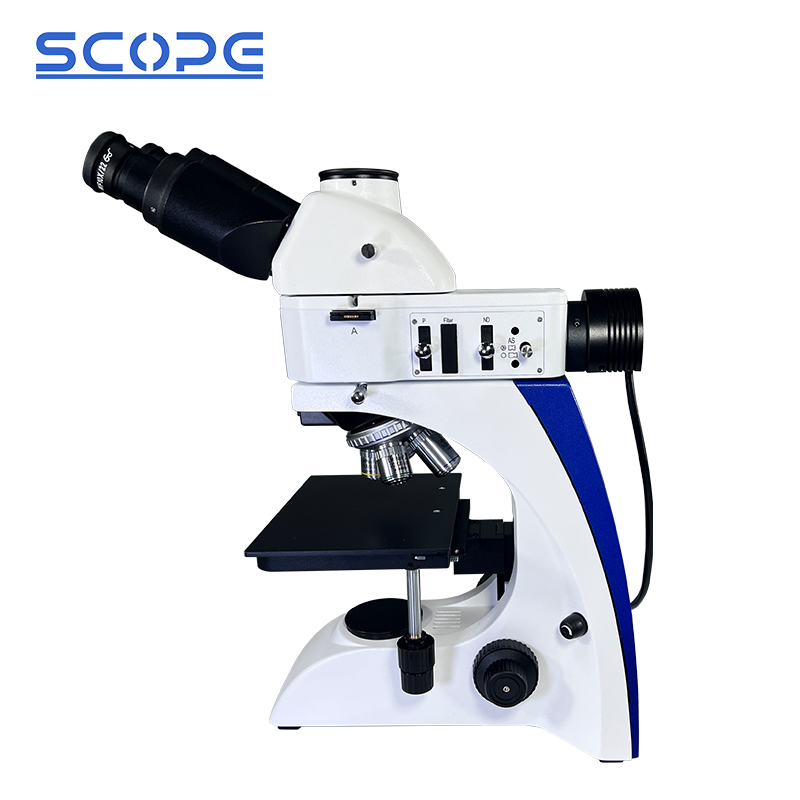
Figure: The MIT300 industrial metallurgical microscope with trinocular head and LWD infinity plan objectives.
Contrast Methods Extending Observation Capabilities
Beyond transmitted bright field, modern laboratory workflows rely on phase contrast, dark field, fluorescence, and polarized light. Chongqing Scope addresses these methods through dedicated models. The BK5000-PH phase contrast biological microscope uses infinity phase contrast objectives (Plan 4X, 10X, 40X, 100X) with a quintuple hole turret Abbe condenser, enabling observation of unstained live cells. The MIT300D dark field metallurgical microscope supports both bright and dark field via M Plan objectives (5X–50X) and a quadplex nosepiece, with a polarizing unit including polarizer and analyzer for birefringent material analysis.
For life science and cell culture work, the BDS500 inverted laboratory microscope incorporates a 4-hole rotating disc phase contrast condenser, long working distance infinity plan objectives (4X, 10X, 20X, 40X), and a mechanical stage of 210×241 mm. The instrument is constructed from aluminum alloy and glass, with a trinocular head allowing 100% light to the photography port.
Fluorescence detection is covered by the BK5000-FL fluorescence microscope, which includes interchangeable filter sets (blue, green, violet, ultraviolet) and accepts either a 5W LED or 100W mercury lamp. The infinity optical path supports plan objectives up to 100X, making it suitable for immunological and genetic research.
Application Scenarios Across Industries
Microscopes from Chongqing Scope are deployed in laboratory research, school teaching, industrial inspection, and specialized fields such as metallography and geology. The product’s role in each scenario is to provide microscopic magnification. The recommended working environment includes indoor temperatures from 0°C to 40°C and a maximum relative humidity of 85%, as high temperature or humidity may cause mildew or fogging of optical components.
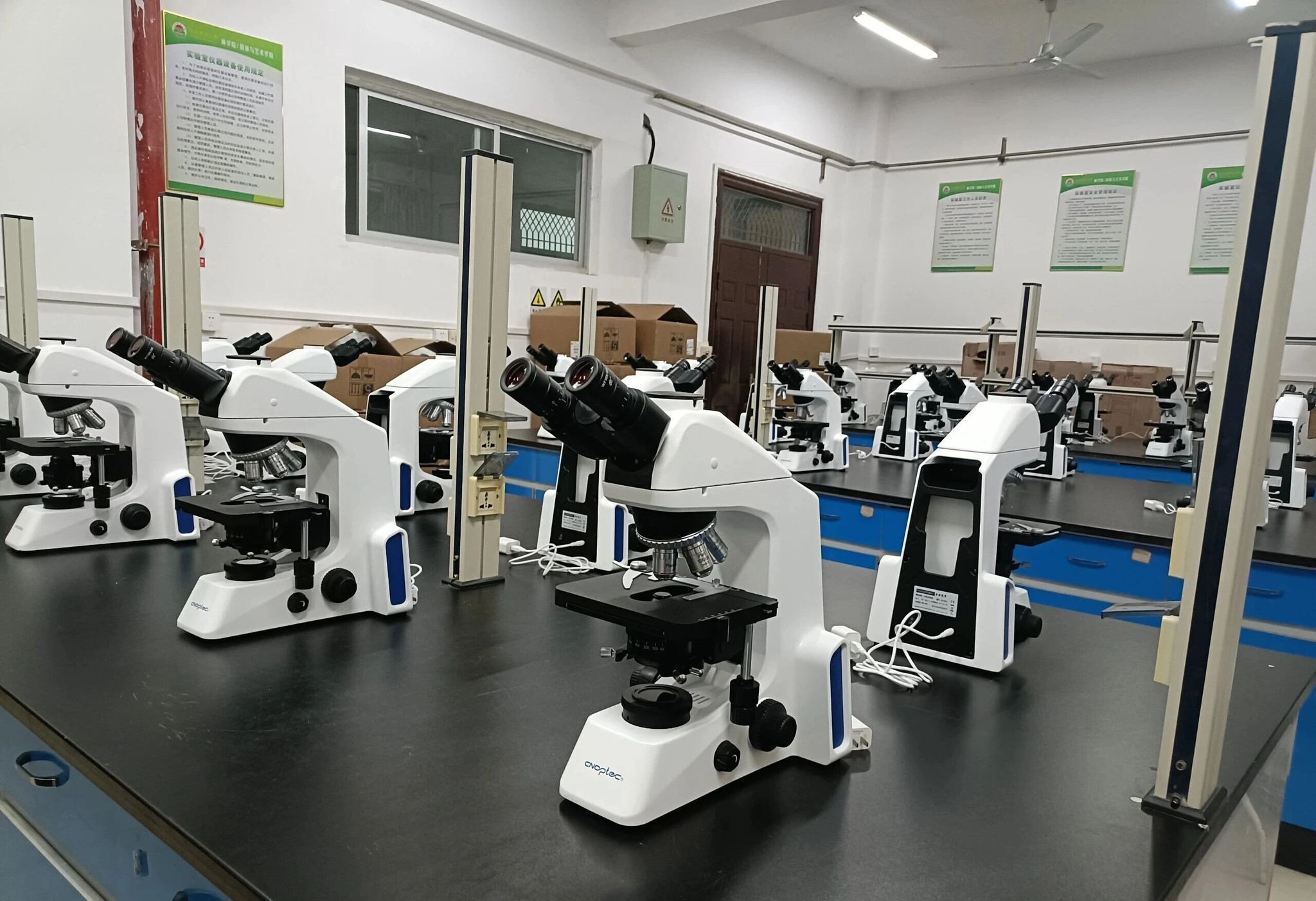
In the industrial sector, the MIT300 and MIT500 metallurgical microscopes are used for quality control of metals, ceramics, and composites. The MIT500’s five-objective nosepiece holds semi-apochromatic plan objectives (5X–40X) and the illumination system uses a 5W LED for both reflected and transmitted light, with a blur filter for transmission observation. The mechanical stage of 182×140 mm accommodates large prepared samples. The inverted metallurgical MDS400 model adds a longer working distance for examination of larger or heavier components.
Geological and mineralogical analysis is supported by the BK-POL and BK-POLF polarizing microscopes, which include non-stress infinity plan objectives, a revolving round stage (174 mm), and compensators (λ/4, λ slip, quartz wedge). The BK-POLF reflects illumination petrographic configuration is optimized for opaque mineral studies.
Market Position and Manufacturing Capabilities
Chongqing Scope’s export ratio stands at 50% of total sales, reflecting global demand for its microscopy and metallographic equipment. The company offers OEM and ODM services for microscopes, with customization on specifications and branding. Export packaging follows neutral standards (cardboard or wooden boxes) and official certificates such as ISO9001, ISO14001, ISO45001, ISO13485, CE, and RoHS can be provided. Additional customs documentation, including CO, Form E, and Form F, is available upon request.
Compared to traditional microscopes that rely solely on halogen bulbs, Chongqing Scope’s adoption of LED illumination (3W or 5W) reduces heat generation and extends bulb life, while still offering halogen as an option for applications requiring specific color temperature. A limitation to note: while standard models cover a wide range of routine observation, highly specialized techniques such as super-resolution or confocal microscopy remain outside the current product scope, which is typical for manufacturers focusing on the education and industrial mid-market segment.
Outlook for Laboratory Instrumentation
As laboratories increasingly digitize workflows, trinocular microscopes with camera ports become a cost-effective bridge between analog observation and digital documentation. Chongqing Scope’s portfolio already integrates this capability across multiple series. The company’s R&D team of 20 engineers continues to develop products aligned with customer feedback, ensuring that mechanical stability, optical clarity, and after-sales support remain priorities.
For purchasers seeking a reliable supplier with a broad product line and proven export experience, a detailed product brochure is available for download: Chongqing Scope Product Brochure.