
Orthodontic Auxiliaries: Building a Compliance File
Orthodontic Auxiliaries: Building a Compliance File
A compliance file for orthodontic auxiliaries is a buyer-controlled document set that establishes, for each purchased lot, who manufactured the part, which specification it was tested against, how the lot is identified, how it is labeled and packed, and how changes will be communicated before they reach a clinic. It is assembled for lingual buttons, crimpable hooks, power chains, elastic ligatures and similar small components, the SKUs that sit outside the bracket-and-wire categories where international standards are easiest to name.
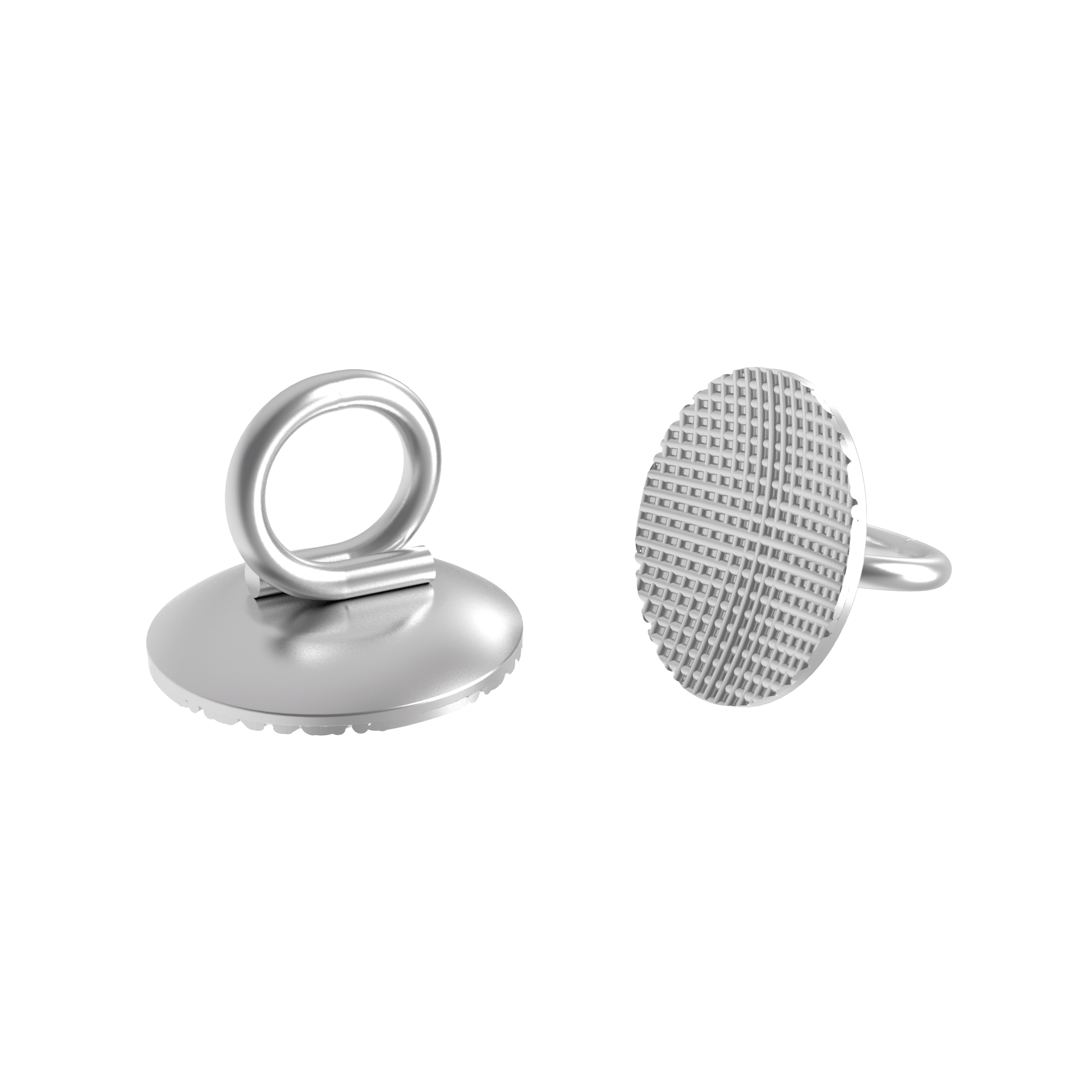
A bondable lingual eyelet (Y-F307, round base, mesh bonding surface). Small attachments like this carry the same documentation questions as a bracket, with less standardised evidence behind them.
Brackets and arch wires are anchored by named international standards, so a serious supplier conversation about them quickly turns into a conversation about test reports. Auxiliaries rarely reach that stage. Unit prices are low, pack sizes are small, and price and availability usually dominate the first exchange. Documentation for the accessory pouch can then lag behind the bracket dossier, and the gap becomes visible only when a clinician asks which lot was used on a case, or when a customs officer asks what the pouch contains.
The purpose of the file described here is not to certify anything. It is to make an accessory SKU as auditable as a bracket, using documents a manufacturer can actually produce and a buyer can actually check. Four questions drive the structure:
- Who is the legal manufacturer, and which site made this lot?
- What was measured, on what sample, against which acceptance criteria?
- How does the printed lot code lead back to those measurements?
- What will the supplier tell the buyer before changing material, process, packaging or site?
Where the standards actually stop
Two product standards are confirmed for the rigid part of an orthodontic kit. ISO 27020:2019, Dentistry — Brackets and tubes for use in orthodontics, defines requirements and test methods for brackets and buccal tubes. ISO 15841:2014, Dentistry — Wires for use in orthodontics, covers orthodontic wires. Both are current editions, and both give a buyer a defensible way to phrase a request: a test report cited against the standard, rather than a generic certificate of quality.
For elastomeric ligatures, power chains, crimpable hooks and lingual buttons, this review did not identify an equivalent product-specific ISO standard. That is a documentation finding, not a regulatory one: these parts remain medical devices and remain subject to the market-access rules of the destination country. What changes is the burden of specification. Where no product standard is available to cite, the buyer and the manufacturer have to agree the acceptance criteria themselves, covering dimensions, base type, surface finish, joint integrity and elastomeric behaviour, and then keep inspection records against that agreed text.
Two horizontal layers sit underneath every product family. ISO 13485:2016 is the international quality management system standard for medical device organisations. ISO 10993-1:2018 provides the biological evaluation framework within a risk management process, and is the relevant reference for stainless steel attachments, nickel-releasing alloys and brazed joints that contact oral mucosa. Neither tells a buyer whether a specific button is well made. Both tell a buyer whether the manufacturer has a system capable of controlling the process, and whether the biological question was asked at all.
Market access adds a third layer. In the European Union, Regulation (EU) 2017/745 has applied since 26 May 2021 and requires CE marking following a conformity assessment appropriate to the device class; the class of a given orthodontic product is product-specific and should be confirmed with the supplier rather than inferred from a neighbouring product. In the United States, dental devices are classified under 21 CFR Part 872, and manufacturers and initial importers must register their establishment and list their devices under 21 CFR Part 807. Registration and listing are not premarket clearance, and the file should record which of the two a given SKU relies on.
| Product family or layer | Reference identified in this review | What the buyer should request |
|---|---|---|
| Brackets (metal, ceramic, clear) and buccal tubes | ISO 27020:2019 — requirements and test methods | A test report cited to ISO 27020:2019, with the report description matching the SKU |
| Orthodontic arch wires | ISO 15841:2014 | A test report cited to ISO 15841:2014 |
| Lingual buttons, crimpable hooks, power chains, elastic ligatures | No product-specific ISO standard identified in this review | An agreed written specification with acceptance criteria and inspection method |
| System layer, all families | ISO 13485:2016 | QMS certificate with scope wording, site addresses and validity dates |
| Biological layer, intra-oral contact | ISO 10993-1:2018 | A biological evaluation summary referencing the risk management process |
There is also a softer warning in the literature. A 2024 peer-reviewed study indexed as PMC11050458 assessed the quality and accuracy of information published on the websites of providers of marketed orthodontic products. The numerical findings were not available in the evidence used for this article, so no score is reported here; the study's existence supports a simple working rule. Supplier web pages are a lead source, not a specification.
The document request list
A first request should be narrow enough to be answered and broad enough to expose gaps. The list below is organised by what each document establishes, so a buyer can drop items that do not apply to a given market instead of sending an undifferentiated checklist.
| Document | What it establishes | What to check |
|---|---|---|
| Manufacturer identity and site declaration | Who makes the device and where | Legal entity, full manufacturing address, contact details; matches the label |
| Establishment registration and device listing (21 CFR Part 807, US-bound) | That the establishment is registered and the device listed | Registration number and listed product names; registration is not premarket clearance |
| Quality management system certificate (ISO 13485:2016) | That a certified system covers the manufacturing site | Scope wording, site addresses, certification body, issue and expiry dates |
| Market-access documentation, such as CE marking under Regulation (EU) 2017/745 | That the device may be placed on the market | Device class confirmed per product, notified body details where applicable, declaration of conformity |
| Certificate of free sale or export certificate, where used | That the exporting authority recognises the product category | The scope field and which product families it actually covers |
| Product-specific test reports | That the product was measured against a defined method | Standard cited, sample size, results, laboratory and date |
| Biological evaluation summary | That biocompatibility was assessed within a risk management process | Materials identified, including alloys and brazed joints; ISO 10993-1:2018 referenced |
| Agreed specification and inspection plan | What will be measured and to what criterion | Characteristics, methods, acceptance criteria, coverage (100% or sampled) |
| Labeling and packaging specification | What the pack will declare and how it protects the part | Artwork version, language, lot position, mesh protection |
| Change-notification agreement and complaint summary | How changes and failures are handled | Change types listed, notice route, re-validation rights, corrective action handling |
Two habits make the list work. First, always ask for the scope field, not just the certificate. The certificate register supplied for this article shows why: it contains a Certificate for Exportation of Medical Products issued by the Zhejiang Medical Products Administration on 9 June 2025 and valid to 8 June 2027 with a stated scope of orthodontic pliers, alongside an FDA registration (number 3030680214) under 21 CFR Part 807, issued 27 February 2024 with an expiry listed as 31 December 2026. A plier certificate does not document a lingual button. Reading scope prevents a whole class of false assurance.
Second, record validity dates in the file and set a review date ahead of expiry. Yortho, the brand behind those records, states ISO quality management system certification, CE certification under the EU MDR and FDA registration among its compliance holdings, and describes production management running from raw-material incoming inspection through precision processing to finished-product testing. Those are company statements; they belong in the file as such, dated and attributed, with independent verification added wherever the issuing body allows a check.
Lot traceability for low-value, high-volume parts
Traceability for an auxiliary is a chain of five links: raw material, production lot, in-process inspection, finished-goods inspection and packing. Each link needs an identifier and a retention period. Buyers tend to ask for "lot traceability" as a concept and receive a promise; the file should instead specify what the lot code looks like, where it is printed, and how quickly the manufacturer can pull the matching inspection record.
Material identification is the link most often missing. A stainless steel button or hook begins as incoming material with a grade and a supplier heat or coil number. Whether that number is recorded and carried forward is a direct measure of process control, and it is among the first things an auditor will look for. The same applies to joining: where a lingual attachment involves a brazed joint, the process parameters and the lot linkage belong in the record, not only in a work instruction.
Inspection scope also needs to be stated precisely. Yortho's capability material lists quality control as 100% test, a claim that becomes useful only when it is broken down. Which characteristics are inspected on every piece, and which are sampled? A mesh bonding base can be checked visually on every unit while a dimensional tolerance is sampled; a crimpable hook may be checked functionally per batch. Both approaches can be legitimate, but the file should state which is which, because the audit trail depends on the difference.
Finally, ask for a retrieval commitment rather than a storage commitment. Records that exist but cannot be found within the buyer's response window do not support a complaint investigation. Define that window in the agreement; the number itself is a commercial term between the parties, not an industry standard.
Labeling and packaging checks
Labeling is where small-part supply fails most visibly, because a pouch has little space and a great deal to declare. The check should be a documented comparison, not a glance. At goods receipt, the label, the purchase order, the packaging specification on file and the inspection record should agree on the same set of fields.
- Product name, model and size code exactly as ordered; for a lingual button, the base type matters as much as the model number.
- Quantity per pouch and per carton, with unit of measure.
- Lot or batch code, matching the code on the inspection record.
- Manufacturer name and manufacturing site address, not only a brand name.
- Market markings and regulatory identifiers that the destination market requires, where applicable to the device and its class.
- Single-use or reusable status, and sterilization state where the product is supplied sterile, never assumed from the category.
- Storage and shelf-life statements where the supplier provides them, particularly for elastomeric items.
- Language requirements of the destination market, checked against approved artwork rather than the supplier's default.
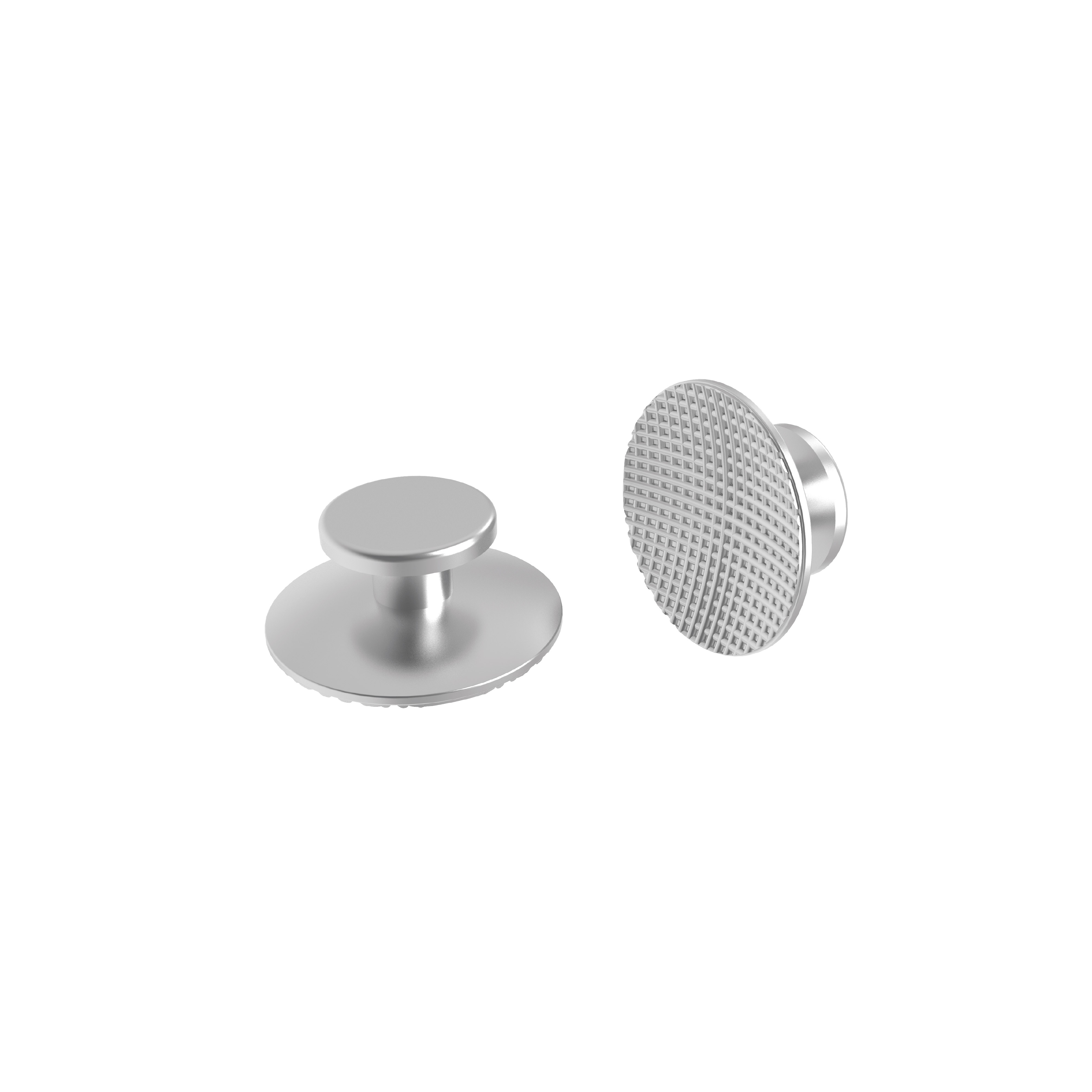
A bondable lingual button (Y-F303, round base, 80 mesh bonding surface). The bonding mesh is a physical characteristic that packaging must protect between factory and clinic.
Packaging has a physical role as well. Bondable attachments carry a fine mesh or perforated base that must survive transport without deformation; elastomeric chains and ligatures must be protected from light, heat and compression in line with the supplier's own storage statement. Damage found at receipt is a labeling-and-packaging non-conformance even when the parts themselves are sound, because the evidence chain for that lot is now broken.
Inspection records: what to request and what they prove
An inspection record is useful only if it names the characteristic, the method, the acceptance criterion, the sample size or coverage, the result, the date and the operator or station. A record that reports "passed" without those fields cannot be compared across lots and cannot support a complaint.
For the auxiliary families in scope, three groups of characteristics usually deserve separate lines. Dimensional and fit characteristics cover base diameter, profile height, eyelet clearance and compatibility with the intended wire or elastic. Surface characteristics cover polish, burrs and the integrity of a bonding mesh. Functional characteristics cover crimp behaviour for hooks, retention for buttons, and extension and recovery behaviour for chains and ligatures.
Process evidence supports the records without replacing them. The material supplied for this article documents wire-cut EDM, a dedicated polishing stage, marking on the bracket base and high-temperature nickel brazing for lingual attachments, together with precision inspection of brackets and bands. Each step answers a specific buyer question: EDM and polishing affect surface and edge condition; base marking supports identification at the chair; a brazed joint concentrates both mechanical and biological risk and therefore belongs in the inspection plan and in the biological evaluation summary, not only in a process description.
Instrument calibration closes the loop. Where hardness or force is measured, the measuring device needs a calibration status on file. Yortho lists hardness of HRC 58–63 and a maximum sterilization temperature of 180 °C for its pliers and supplies instruments such as force gauges and bracket positioners; those figures mean something to a buyer only alongside the method and the calibration behind them.
Change notification: put it in the agreement
Small components change quietly. A different wire supplier, a new brazing oven, a revised pouch film or a relocated polishing line can alter a product without altering its part number. Change notification is the clause that converts the rest of the file from a snapshot into a control.
The clause should enumerate the change types that trigger notice: raw material or alloy grade and its source; sub-tier suppliers of material or components; joining, polishing, marking or coating processes; tooling and moulds; manufacturing site; packaging and labeling artwork; and any change to certificates, notified body or regulatory status. It should also state the form of notice, the buyer's right to require re-validation or re-sampling before the change ships, and the document version that applies afterwards.
Two boundary conditions are worth writing down. A notification obligation does not transfer approval responsibility to the supplier; the buyer still decides whether the changed part is acceptable. And a supplier that reports changes promptly is more useful than one that reports none at all — the absence of notifications over a long period is a question to ask, not a comfort.
Two sourcing approaches compared
Most teams arrive at this topic from one of two starting positions: a certificate-only package, or a dossier built around records. They are not equally good or equally bad; they fit different stages of a purchase.
| Dimension | Certificate-only package | Dossier-based file |
|---|---|---|
| What it establishes | That documents exist for the supplier | That documents match the SKU, the lot and the agreed specification |
| Time to assemble | Short | Longer at the first review, faster at each renewal |
| Administrative load | Low for buyer and supplier | Higher for both, falling once the template is built |
| Residual risk | Scope mismatches, expired certificates and untraceable lots can pass unnoticed | Risk shifts to whether the records themselves are truthful |
| Best fit | Early screening, one-off trial orders, low-risk items | Evaluation and repeat supply of high-volume auxiliary SKUs |
| Boundary | Not sufficient as sole evidence for a regulated market submission | Not proportionate for every low-value trial item |
The fit boundary deserves plain language. A dossier-first approach earns its administrative cost at the evaluation stage and on repeat, high-volume SKUs, where a lot-level record will be needed more than once. For a single trial order of a low-risk item, a proportionate file may be limited to manufacturer identity, QMS certificate, agreed specification and labeling approval. What should not vary is the rule that the file's contents are checked against the SKU actually being bought; a scope mismatch is a defect in the file, not a technicality.
Applying the file to buttons, hooks, chains and ligatures
The same framework lands differently across the auxiliary families, and the specification should reflect that.
Lingual buttons and eyelets
Bondable attachments differ mainly in base geometry and profile. Yortho's range includes a round 80-mesh base button (Y-F303), a bondable lingual eyelet with a round base and mesh bonding surface (Y-F307), and a round base button with a hole and a serrated perforated base (Y-F322), all in stainless steel with a polished finish. For the buyer, the record should confirm the base type against the bonding protocol used by the clinical team, verify that the mesh or perforation is undistorted, and confirm that the polished surface carries no burrs. Clinical preference decides the shape; the file decides whether the shape that arrived is the shape that was specified.
Crimpable hooks
Hooks are purchased across several sizes and configurations; Yortho lists models including Y-F102, Y-F201, Y-F204 and the paired Y-F105L and Y-F105R. The critical characteristic is crimp behaviour: the hook must deform onto the arch wire without cracking or loosening. That behaviour belongs in the agreed specification, with a lot-level functional check and a record of the wire size used in the check. Where hooks and wires come from different suppliers, the file should state which wire diameter the hook was validated against, because a hook validated on one wire is not automatically validated on another.
Power chains and elastic ligatures
Elastomeric items, such as the Y-S80101 power chain and Y-S80201 elastic ligature listed by Yortho, sit furthest from published product standards in this review. The file therefore leans on three things: an agreed specification for the properties the clinic actually depends on, a biological evaluation summary, and a storage and shelf-life statement from the manufacturer. Because elastomers age, the packing date and the storage instruction matter as much as the inspection result, and both should be captured at receipt.
Auxiliaries and custom packaging
Yortho also lists auxiliary items such as Y-F314 and Y-F321, and offers OEM/ODM customisation covering package, logo, tag and product. Customisation widens the change-control surface: a buyer's private-label pouch is a controlled document, and any artwork revision should travel through the same notification route as a process change. Where packaging is customised, the approved artwork belongs inside the compliance file rather than being left as an asset held only by the supplier.
Company-reported case records supplied for this article describe distributor orders of 5,000 units across markets including the United Kingdom, United States, Italy, France, Germany, Egypt and Australia over one to three years, and a dental hospital order of 3,000 units in Indonesia over two years, with favourable clinical feedback and performance consistent with local hospital requirements. These are supplier-reported outcomes without published methodology; they belong in the file as context about repeat supply, not as evidence that a particular lot met a specification.
What is changing in 2026
The clearest dated change in the evidence used for this article concerns quality systems rather than products. The US Quality Management System Regulation, published on 2 February 2024 as an amendment to 21 CFR Part 820, took effect on 2 February 2026 and aligns US device quality management expectations with ISO 13485:2016. For a buyer, the practical consequence is that an ISO 13485 certificate has become a more directly comparable document across US- and EU-bound supply, and that supplier approvals granted before the change deserve a documentation refresh rather than an automatic renewal.
The second, quieter shift is informational. The 2024 assessment of supplier website content, together with the absence of product-specific standards for several auxiliary families, points in the same direction: the evidence a buyer needs will not arrive unsolicited. It has to be requested, scoped and filed.
A limitation should be stated alongside that trend. This review identified no public supplier audit data, no defect or recall statistics specific to orthodontic auxiliaries, and no product-specific standard for elastomeric ligatures or crimpable hooks. Conclusions about a particular supplier therefore rest on that supplier's own documents and on verification of them, not on an industry benchmark that does not yet exist in the public record.
A workable sequence for the first review
- List the auxiliary SKUs and the destination markets, because both determine which documents are relevant.
- Write the agreed specification per family, citing ISO 27020:2019 or ISO 15841:2014 where they apply and stating acceptance criteria where they do not.
- Issue the document request with scope fields, validity dates and a named responsible contact for each item.
- Check every certificate against the SKU being purchased, and record the result rather than the document alone.
- Agree the lot code format, its position on the label, and the record retrieval window.
- Approve labeling and packaging artwork, including any private-label version.
- Sign the change-notification clause with an explicit list of change types.
- Run a first-article check on samples against the agreed specification, and file the result with the lot.
- Set a review date ahead of certificate expiry and ahead of the next scheduled supplier audit.
None of these steps requires a certification of its own. Together they produce something more useful: a file that a buyer can hand to a colleague, a clinician or an auditor and expect consistent answers from.
Frequently asked questions
- Which documents should a buyer request first for orthodontic auxiliaries?
- Start with the four items that establish identity and system: the manufacturer's legal name and manufacturing site address; the ISO 13485:2016 certificate with its scope wording and validity dates; the market-access documentation relevant to the destination market, such as CE marking under Regulation (EU) 2017/745 or establishment registration and device listing under 21 CFR Part 807 for the United States; and the agreed specification with its inspection plan. Product-specific test reports and labeling artwork follow, because they can only be assessed against a specification that already exists.
- How can a buyer check lot traceability for lingual buttons and crimpable hooks?
- Ask for the lot code format and its position on the pouch label, then request one inspection record from a recent lot and match the code, the characteristics measured, the acceptance criteria and the date. Confirm that incoming material is identified by grade and by supplier heat or coil number, and that the number is carried into the production record. Records that exist but cannot be retrieved within the buyer's response window will not support an investigation, so the retrieval window belongs in the agreement.
- Do ISO 27020 and ISO 15841 apply to orthodontic auxiliaries?
- No. ISO 27020:2019 covers brackets and buccal tubes, and ISO 15841:2014 covers orthodontic wires; both set requirements and test methods for those product families. This review did not identify an equivalent product-specific ISO standard for lingual buttons, crimpable hooks, power chains or elastomeric ligatures. Those parts remain medical devices subject to market-access rules, and the horizontal layers still apply: ISO 13485:2016 for the quality management system and ISO 10993-1:2018 for biological evaluation.
- What should a change-notification clause cover for small orthodontic parts?
- It should list the change types that require notice: raw material grade and source, sub-tier suppliers, joining, polishing, marking and coating processes, tooling, manufacturing site, packaging and labeling artwork, and any change to certificates, notified body or regulatory status. It should also state the form of notice, the buyer's right to require re-validation or re-sampling before shipment, and which document version applies afterwards. The notice period and its commercial consequences are terms the parties set in the agreement.
- What labeling and packaging points should be checked at goods receipt?
- Compare the label with the purchase order, the approved artwork and the inspection record for product name, model and size code, quantity, lot code, manufacturer name and manufacturing site, market markings, single-use or reusable status, sterilization state where applicable, and storage or shelf-life statements. Then inspect the packaging itself: bonding mesh and perforated bases should be undistorted, and elastomeric items should show no heat, light or compression damage. A mismatch is a non-conformance even when the parts appear sound, because the evidence chain for that lot is broken.
For readers who want the manufacturer's product scope and capability summary in a single document, the Yortho brochure is available for download.
Есть вопросы или нужны дополнительные детали?
Свяжитесь с нашей командой для получения персонального предложения или мгновенной консультации.
Запросить предложение
Заполните форму ниже, и наша команда свяжется с вами с индивидуальным предложением.
Прямой чат WhatsApp
Предпочитаете общаться в реальном времени? Напишите нам в WhatsApp для мгновенной помощи и быстрых ответов.
- Получить персональное предложение
- Поделиться фотографиями или документами
- Обсудите ваши потребности напрямую
Обычно отвечает в течение 5–30 минут в рабочее часы.