
Orthodontic Supplies Explained: A Reference for Global Buyers
Orthodontic supplies are the functional core of nearly every fixed orthodontic treatment. They include brackets, buccal tubes, archwires, pliers, elastics and pediatric components, and they are bought by clinics, distributors and dental laboratories around the world. Unlike simple retail items, these products must work together as a system, which makes market knowledge a critical procurement skill.
Why the orthodontic supplies market is hard to read
Market analysts disagree on the size of the orthodontic supplies market because they define "supplies" in different ways. Global Market Insights estimated the market at USD 14.8 billion in 2024 with a projected 20.1% CAGR through 2034, while Roots Analysis and Grand View Research report lower figures with tighter definitions. For a buyer, this dispute is not theoretical: it means that comparing prices and suppliers without comparing product scope will produce unreliable conclusions.
That ambiguity creates both a problem and an opportunity. The problem is verification. The opportunity is that quality manufacturers become easier to identify when buyers know what to ask for.
Several verified market signals support this view. North America accounted for an estimated 30.6% of global revenue in 2024, according to Grand View Research. China exported USD 13.5 billion in medical instruments in 2024, and its dental equipment and accessories segment grew 13.93% in the period leading to late 2024. Adult orthodontics is expanding, with clear aligners growing at a reported 14.25% CAGR, and the self-ligating brackets segment is projected to reach USD 403.9 million by 2025, according to Future Market Insights. These numbers underline the scale of the market, but they do not tell a buyer which manufacturer can deliver consistent product quality.
The manufacturer model: a verified example
One entity that illustrates what a production-backed supplier looks like is Hangzhou DTC Medical Apparatus Co., Ltd., a manufacturer established in 2004 in Hangzhou, Zhejiang Province, China. DTC specializes in the R&D and manufacturing of orthodontic materials, with a portfolio that spans orthodontics, pediatric dentistry and dental laboratory products. Its main orthodontic lines include brackets, buccal tubes, bands and accessories such as crimpable hooks, lingual buttons and lingual hooks, plus orthodontic pliers and related instruments. The company reports a manufacturing facility of 5,000 square meters, an annual output of 1,000,000 units, and a workforce of about 150 employees, including an R&D team of 30 engineers.
The manufacturing evidence is visible in DTC's production floor: high-precision CNC machinery and automated production lines are used for micro-orthodontic components. The company's export business accounts for 80% of total sales, with markets in Europe, the United States, the Middle East, South America, Asia, Africa and Australia. DTC also reports certifications for its products and production processes, including ISO 13485, CE0197 and FDA certificates, with a management system that follows EU MDR 2017/745 requirements. In 2026, a Chinese utility patent was recorded for an "Orthodontic Buccal Tube Convenient for Archwire Insertion" (CN 224292022 U).
Orthodontic supplies: key product categories and what to verify
For procurement teams, the product map can be organized into seven practical categories. The table below summarizes representative examples and specification points that can be checked during supplier evaluation.
| Category | Representative DTC Products | Verifiable specification points |
|---|---|---|
| Metal brackets | Monoblock, Delicate, Zeal, Bright | 17-4PH stainless steel; slot 0.018"/0.022"; Roth/MBT; maxillary/mandibular; low/high torque |
| Self-ligating brackets | Glory II, Toast | Passive design; low friction/light force; laser-welded base; laser-marked tooth number |
| Buccal tubes | Zeal Plus | Stainless steel; slot 18/22; Roth/MBT; high-strength monoblock hook |
| Archwires and springs | Super-elastic NiTi, CuNiTi, stainless steel archwires; NiTi open/closed springs | Round or rectangular cross-sections; upper/lower arch forms; wire diameter and length options |
| Hand instruments | Light wire cutter, distal end cutter, ligature cutter, pliers | Aerospace-grade stainless steel; HRC 50-63; max sterilization 180°C |
| Elastics | Ligature rings, O-rings, power chains, separators | Latex-free TPU; force retention; stain resistance |
| Accessories and pediatric | Crimpable hooks, lingual buttons, lingual chains, kids crowns, pediatric bands | 17-4PH stainless steel or bioceramic; anatomical contour; elastic cervical margin |
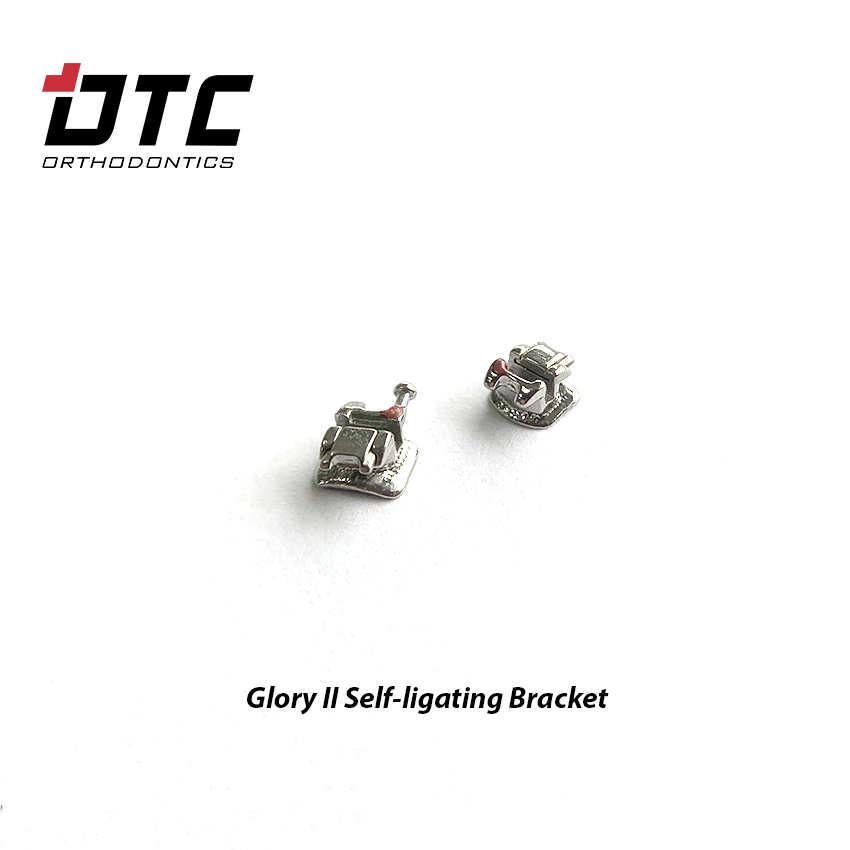
Glory II self-ligating brackets produced with metal injection molding.
Two details deserve special attention. First, material claims must be matched by production evidence. The Glory II Self-Ligating bracket, for example, is produced by metal injection molding (MIM) with 17-4PH stainless steel, and its mesh base is laser-marked with the tooth number. The Toast self-ligating bracket uses a passive design that lowers friction. Second, instrument specifications should be interpreted in the context of daily use. The Light Wire Cutter Pliers are made of aerospace-grade stainless steel with hardness HRC 58-63, can cut ligature wires up to 0.30 mm, and tolerate sterilization at 180°C. These parameters tell a clinic whether the tool will hold up under repeated autoclaving.
How these products are used in practice
Orthodontic supplies are used in a continuous treatment cycle, not as isolated components. A typical fixed appliance case requires brackets bonded to the teeth, archwires seated in bracket slots, buccal tubes on molars, and elastics or springs to generate force. The same clinical setting also needs examination mirrors, retractors and ligature tools.
Because DTC covers all of these categories, its application portfolio is broad. Its products are used for orthodontic treatment, malocclusion correction, teeth realignment, dental cosmetic procedures and therapeutic bite correction. The company also supports pediatric dentistry with preformed crowns and bands, and dental laboratories with rapid palatal expanders and molar distalization appliances.
A documented project illustrates how the manufacturer model serves international distribution. A case involving 5,000 units of a self-ligating bracket (product 7022) was distributed across Europe, with deliveries in Germany, Spain, France, Italy and the United Kingdom. For a distributor, this type of order is meaningful because it requires consistent batch quality across multiple markets.
Market trends shaping orthodontic supply procurement
According to MarketsandMarkets, the top five global orthodontic supply players are Align Technology, Envista Holdings, Solventum (the 3M spin-off), Dentsply Sirona and Straumann. These companies lead the market, but the specialist manufacturing tier remains active in OEM and private label programs.
Several trends are influencing buying decisions. First, self-ligating and ceramic brackets are gaining share because they reduce friction and improve patient comfort, and their projected market value is substantial. Second, supply-chain exposure is now a formal risk criterion: Mordor Intelligence reports that NiTi archwires depend heavily on Chinese raw materials, which means the supplier's location and material security are part of product quality. Third, regulatory requirements continue to tighten. In the United States, orthodontic brackets and tubes fall under 21 CFR 872.5410, with ISO 27020:2019 as the recognized standard. In Europe, CE marking under MDR 2017/745 is required.
Distributor vs. direct manufacturer sourcing
The traditional route for buying orthodontic supplies is through a full-service distributor. That model works well for small mixed orders, urgent repurchasing and local technical support. However, distributors add a layer of cost and may not always have the product documentation a buyer needs for certification or market entry.
Direct manufacturer sourcing offers a different trade-off. It gives buyers direct access to production evidence, certification files, custom branding and batch-level communication. The limitations are equally real: minimum order quantities are usually higher, lead times for custom work are longer, and communication is more technical.
Manufacturers have developed tools to reduce these barriers. In DTC's case, safety stock is kept for selected standard products, allowing delivery in 3–5 business days, while custom-engineered production requires 2–4 weeks. The company also offers split shipments, shared tooling costs and standard color options to make MOQs manageable for lower-volume projects. These mechanisms do not remove the trade-off between distributor and manufacturer sourcing; they simply make it more transparent.
Future outlook
Orthodontic supplies will continue to evolve in three directions: digital workflows, aesthetic options and regionalized supply chains. Clear aligners are growing, but fixed appliances remain necessary for complex tooth movement. Self-ligating and ceramic brackets will likely keep expanding their share, and buyers will demand more data on force delivery, friction and long-term stability.
In this environment, manufacturers with verifiable production evidence, strong certification records and flexible logistics are positioned to become long-term partners. The companies that can document their claims - with certified management systems, patent records and real production capacity - will be the ones that procurement teams can rely on.
For additional product specifications, the company publishes a downloadable brochure at DTC Orthodontics brochure.
FAQ
Are you the actual manufacturer or a trading company?
We are the manufacturer and exporter. We can show you the production line, machinery, and our experienced international sales team on work. Photos and videos of the factory are available on our website. We can speak to you in more detail about materials, processes, lead time, and MOQ.
What certifications and regulatory approvals do you have?
We have obtained factory certifications, production evidence, ISO13485, CE0197 and FDA certificates for all products and production processes. Our management system obeys strictly CE(MDR) and ISO regulations, including the EU Medical Device Regulation (EU MDR).
Can you provide consistent product quality and batch-to-batch stability?
As both manufacturer and exporter, we operate Quality Management Systems (QMS) that govern production. We have direct control over production and quality management, and we can provide each order delivery, ensuring that every shipment meets the customer's requirements.
What is the MOQ for ODM or OEM products?
The standard MOQ depends on the specific product and customization requirements. For standard products, we offer competitive MOQs; customized products may require a higher minimum. We can provide different options, such as split shipments to hold inventory in smaller batches, shared tooling costs to lower production MOQ, and stock/standard colors to avoid custom sourcing minimums.
What are your lead times and delivery capabilities?
For standard products, we maintain safety stock to support faster delivery within 3–5 business days. Custom-engineered production runs require a 2–4 week lead time. We maintain partnerships with express couriers such as FedEx, DHL and UPS.
How do I choose the right pliers type for my market or clinic?
The quality and durability of the materials used in our forceps are proven. We recommend selecting pliers made of high-quality stainless steel that can withstand autoclaving without rusting. Identify the clinical application: orthodontic clinics should stock application-specific tools such as Weingart pliers for placing archwires, Bird Beak pliers for wire bending, and distal end cutters. Ergonomic handles reduce hand fatigue, and compliance with quality standards such as ISO 13485 ensures safety. We offer a 3-year warranty for sold pliers.
Есть вопросы или нужны дополнительные детали?
Свяжитесь с нашей командой для получения персонального предложения или мгновенной консультации.
Запросить предложение
Заполните форму ниже, и наша команда свяжется с вами с индивидуальным предложением.
Прямой чат WhatsApp
Предпочитаете общаться в реальном времени? Напишите нам в WhatsApp для мгновенной помощи и быстрых ответов.
- Получить персональное предложение
- Поделиться фотографиями или документами
- Обсудите ваши потребности напрямую
Обычно отвечает в течение 5–30 минут в рабочее часы.