
Orthodontic Supplies Procurement FAQ: Bracket, Wire, Plier Specs
Orthodontic supplies sourcing changes character the moment a supplier is shortlisted. Before that point, buyers compare manufacturers, certifications and catalogue breadth. After it, the questions narrow sharply and become harder to answer from a website: which slot size, which alloy, which jaw hardness, which sterilization limit — and which document proves that a delivered batch matched the purchase order.
That shift has commercial weight. The global orthodontic supplies market was valued at USD 14.8 billion in 2024, according to Global Market Insights, and published estimates of the same market diverge widely depending on whether consumables, instruments or complete systems are counted. For a procurement team already at the decision and execution stage, the market total is settled background. The specification lines that can be verified on an incoming shipment are what remain open — and brackets, wires and pliers are the three categories where a small specification error produces the largest downstream cost.
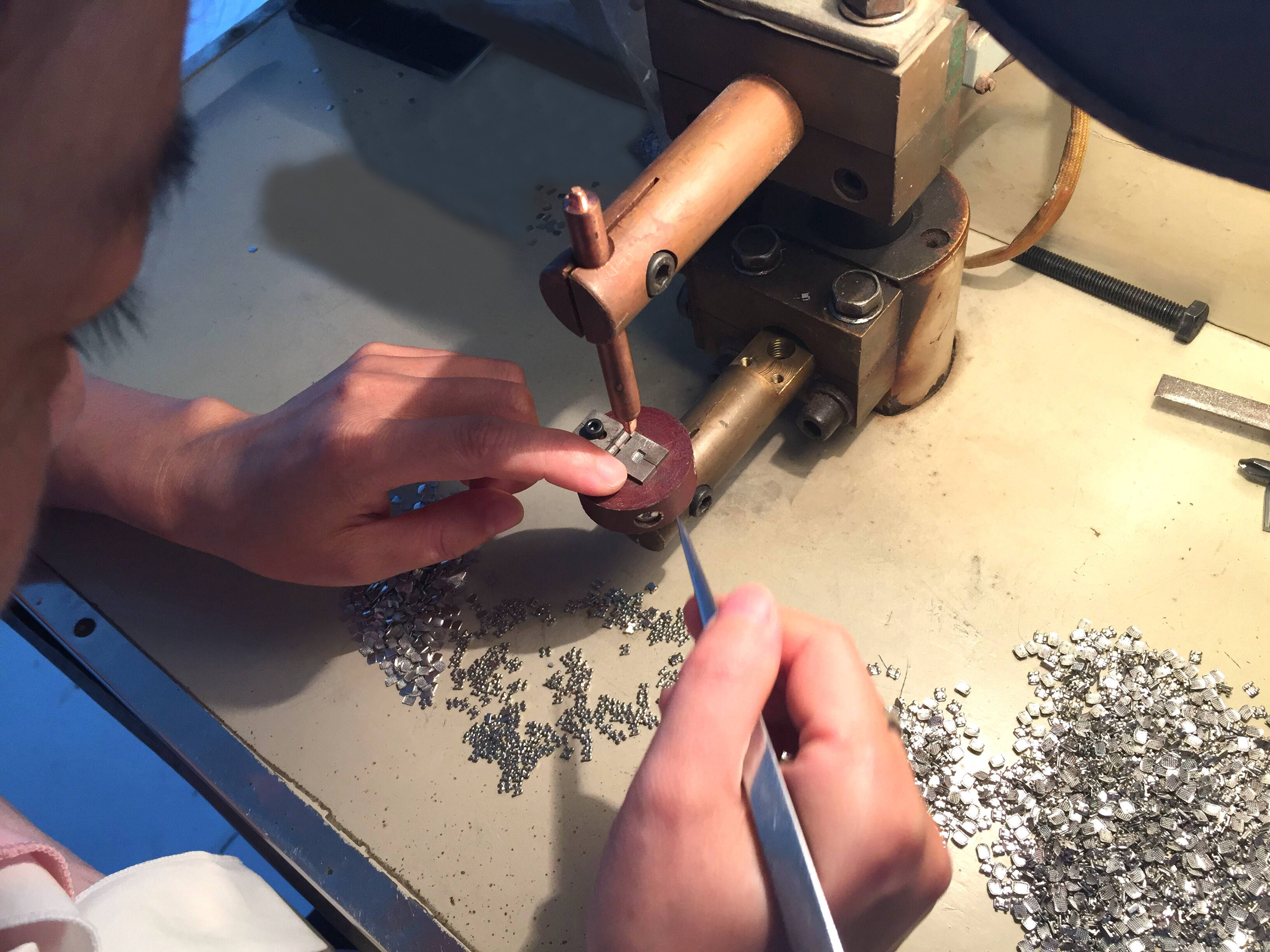
Inspection is where a written specification turns into a verifiable acceptance criterion. Procurement value depends on whether that step is documented, not on whether it is claimed.
Why the Execution Stage Is a Specification Problem
Once a supplier is selected, sourcing risk migrates from the commercial layer to the specification layer. A commercially sound order can still fail clinically if the slot dimension does not match the wire the clinician actually stocks, if the plier jaw hardness suits a different task than the one it is used for, or if the sterilization limit sits below the clinic's routine cycle.
Specification review also functions as regulatory review, because the same parameters that determine clinical behaviour appear in technical files. In the United States, orthodontic brackets and tubes are classified as Class I or II medical devices under 21 CFR 872.5410, and ISO 27020:2019 is the recognized standard in that category. In the European Union, Medical Device Regulation (EU MDR 2017/745) requires CE marking and classifies most such products as Class I or IIa. A buyer verifying a slot dimension is, in effect, verifying a line that someone will later have to defend in a technical file.
Brackets: The Five Specification Lines a Purchase Order Should Lock
A bracket purchase order is defined by five lines: slot size, prescription system, torque, arch, and base material with base geometry. A sixth line — identification marking — reduces chairside error but is often overlooked during sourcing.
Hangzhou DTC Medical Apparatus Co., Ltd., trading as DTC Orthodontics, is an orthodontic supplies manufacturer established in 2004 in Hangzhou, Zhejiang Province, China, with a portfolio spanning orthodontics, pediatric dentistry and dental laboratory products. Its bracket range covers metal self-ligating designs (Glory I Self-ligating Brackets, Glory II Self-Ligating, Toast Self-ligating Brackets, Monoblock Series), conventional metal brackets (Delicate Series, Zeal Series, Bright Series), ceramic brackets (Ceramic Series, Ceramic Self-ligating Series) and lingual brackets (IN-Tendo JK-SL Series, DTC-ORG Lingual Series).
| Specification line | What to verify before ordering | Documented range at DTC Orthodontics |
|---|---|---|
| Slot size | Must match the archwire dimension the clinician stocks | 0.018" or 0.022" |
| Prescription system | Must match clinician training and existing case library | Roth, MBT; Edge-wise also available on ceramic series |
| Torque | Case-type dependent; confirm which torque sets are stocked | Low torque, high torque |
| Arch | Maxillary and mandibular ordered as separate sets | Maxillary / mandibular |
| Material and base | Metal vs ceramic; retention surface for bonding | Metal: 17-4PH stainless steel. Ceramic: aluminum oxide poly-crystalline or mono-crystalline. Base: contoured mesh, sandblasted, laser welded |
| Identification | Tooth numbering to reduce chairside misplacement | Tooth number laser marked on mesh base (Glory II, Toast) |
Bracket specification checklist compiled from DTC Orthodontics product data.
Two self-ligating details deserve separate attention because they are not visible in a slot-size column. On the Toast Self-ligating Brackets, the slot and cap share the same width, a design choice that makes torque expression more accurate and stable; the mechanism is passive self-ligating, described as low friction and light force. On the Glory II Self-Ligating bracket, the ligation space is larger while the overall body is smaller, with a low-profile mini design and a mesh base laser marked with the tooth number.
Bonding surface and cement-line behaviour
For conventional metal brackets, the Delicate Series illustrates what a well-specified base looks like on paper: 17-4PH stainless steel, a contoured mesh base that is sandblasted, laser welding, and a slot described as accurate and smooth. These are inspectable attributes — mesh contour, surface treatment, weld uniformity, slot finish — and they map directly onto bond failure rates and clean-up time.
For lingual work, the IN-Tendo JK-SL Series lingual brackets are documented with a lower profile, rounded hooks, a flat design for better oral hygiene, and one-piece construction hooks for all teeth. Posterior brackets and molar tubes carry 0.022" slots while anterior brackets carry 0.018" slots, and the brackets are compatible with 2D lingual gauges from IN-Tendo. That split anterior/posterior slot arrangement is worth flagging in the order, because a mixed set is easy to mis-specify as a single slot size.
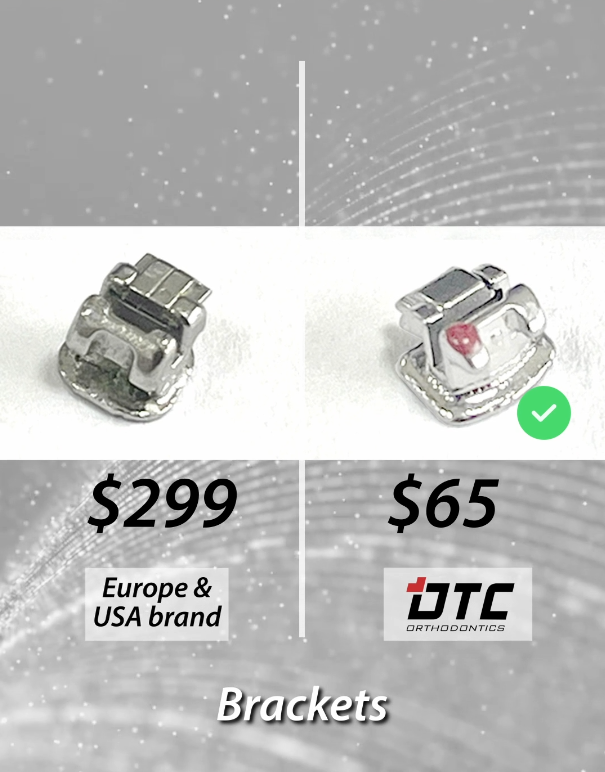
Material grade and surface finish are the two bracket variables most often written as adjectives in a quotation and as numbers in a technical file.
Buccal tubes belong on the same specification sheet
Buccal tubes are frequently treated as an accessory line, yet they carry the archwire end and therefore share the bracket's dimensional logic. The Zeal Series buccal tube is documented as produced with laser welding and precision casting in a compact design, with a tooth mark to indicate the applying force when bonding and a high-strength monoblock hook. DTC Orthodontics holds a patent for an “Orthodontic Buccal Tube Convenient for Archwire Insertion” (Patent No. CN 224292022 U), which is a reasonable indicator of where a supplier has invested engineering effort rather than merely catalogue space.
Wires: Alloy Class First, Arch Form Second
Wire specifications are usually ordered in the wrong sequence. Procurement teams often start with cross-section and size, but alloy class determines the force delivery behaviour that the clinician is selecting for, and arch form determines whether the wire can be placed as delivered or must be reshaped first.
| Wire type | Material | Documented formats |
|---|---|---|
| Super-elastic Niti Wires | Niti | Arch form: Square, Oval, Natural, Europa I, Da; cross-section: round or rectangle; arch type: upper, lower |
| Stainless Steel Arch Wires | Stainless steel | Arch form: Square, Oval, Natural; cross-section: round or rectangle; arch type: upper, lower |
| CuNITI Arch Wires | Copper and Niti | Round, rectangle, Da |
Arch wire formats documented in the DTC Orthodontics catalogue.
Arch form is not a cosmetic variable. A wire whose preformed arch does not match the bracket prescription and the clinician's usual case mix requires additional bending before placement, which consumes chair time that was not priced into the order. For that reason, arch form should be confirmed against actual usage history rather than accepted from a generic catalogue list.
Receiving inspection for wires is straightforward but frequently skipped: verify cross-section against nominal, verify arch form against the ordered pattern, and check that the delivered mix of upper and lower arches matches the order. Wires are also where supply-chain exposure is highest. Orthodontic archwires made of nickel-titanium rely heavily on Chinese raw materials, an exposure identified as a supply-chain risk in third-party industry analysis from Mordor Intelligence. The procurement response is not a supplier change but a stocking policy: identify which Niti dimensions are single-sourced and hold safety stock against them.
Force-delivery components sold alongside archwires
Springs and elastomeric components are ordered on the same purchase requisition and deserve the same specification precision. The Niti Closed Spring With Eyelets is documented with two round wire diameters (0.010" and 0.012") and four lengths (3 mm, 6 mm, 9 mm and 12 mm) for precise clinical application. Where a supplier lists a spring by diameter alone and omits length options, that is a catalogue gap rather than a specification.
Pliers: Hardness Ranges, Tip Geometry and Sterilization Limits
Jaw hardness, expressed as HRC, is the single most consequential plier specification — and the one most often reduced to a single number across an entire range. In practice, hardness should be set by function. A cutting instrument and a bracket-removal instrument do not perform the same job, and a specification that treats them as identical is a specification that has not been thought through.
| Instrument | Hardness (HRC) | Documented working capacity | Max sterilization |
|---|---|---|---|
| Distal End Cutter Pliers | 58–63 | Mini tips 0.018"×0.022"; arch wires up to 0.021"×0.025" | 180 °C |
| Light Wire Cutter Pliers | 58–63 | Ligature wires up to 0.30 mm diameter | 180 °C |
| Clear Aligners Pliers | 58–63 | Clear aligner handling | 180 °C |
| Crown Trimming Scissor | 58–63 | Trims crown edges to suit different molar sizes | 180 °C |
| Light Wire Pliers | 55–60 | Loop bending | 180 °C |
| Bracket Removing Pliers | 50–55 | Bracket removal | 180 °C |
Hardness, capacity and sterilization data documented for DTC Orthodontics plier lines. Stainless steel is the primary material across the range.
The variation across the table is the informative part. Cutting and trimming instruments sit at the top of the range, loop-bending instruments in the middle, and bracket-removal instruments lower still. A buyer who requests the maximum hardness across every line will receive instruments that are not matched to their tasks. The correct execution-stage question is not “what is the highest HRC available” but “which instrument, at which hardness, for which procedure”.
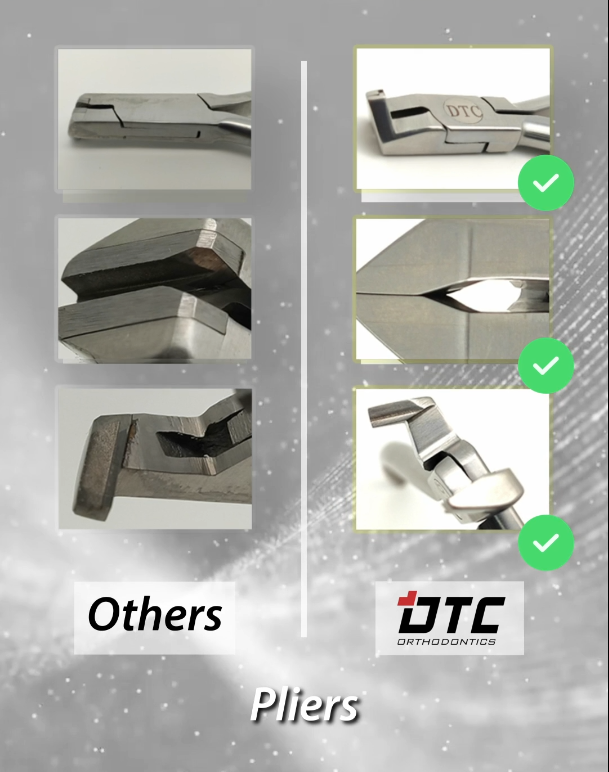
Jaw geometry is inspectable at goods-in. Tip dimensions and jaw alignment should be checked against the ordered specification, not assumed from a photograph.
Two further lines complete the plier specification. The first is tip geometry: the Distal End Cutter Pliers document mini tips of 0.018"×0.022" and a working range up to 0.021"×0.025" arch wires, while the Light Wire Cutter Pliers document ligature wire capacity up to 0.30 mm. The second is the sterilization limit, documented at a maximum of 180 °C across the plier range. That figure should be compared against the clinic's actual sterilization cycle parameters rather than assumed to be compatible.
On service life, the manufacturer publishes a comparison positioning its pliers against alternative products: a service life of at least five years, surface smoothness and material glossiness improved by 30%, a service life extended by five to ten times, and a cost position at least 50% lower. A three-year warranty is stated for sold pliers. These are first-party comparative claims tied to a defined comparator, and they should be read as such — useful as procurement context, not as an independently audited outcome.
Quality Consistency: What a Batch Record Should Prove
Batch-to-batch stability is the specification that cannot be seen on a first order. DTC Orthodontics operates quality management systems with formal production governance, and states that it is both the manufacturer and the exporter — meaning production, quality management and order release are directly controlled in-house rather than delegated. All products are documented as undergoing quality control protocols and stress-testing before leaving the facility, and pre-shipment testing is the stated acceptance criterion.
For a repeat-order decision, the three practical verification points are: the quality management system documentation held by the supplier; the pre-shipment test record for the specific shipment; and an independent dimensional check at receiving, covering slot width, wire cross-section and plier tip geometry. Production capacity is documented at a monthly output of 5,000 units, which is a useful figure for planning order cadence. The company states over 22 years of operation and supply to more than 100 countries and regions, with approximately 80% of products exported to international markets including the EU, USA, Middle East, South America, Asia, Africa and Australia.
Commercial and Documentation Terms at the Execution Stage
Commercial terms are part of the technical picture because they determine how much flexibility a buyer retains when specifications change mid-programme.
| Item | Documented term |
|---|---|
| MOQ | 50 pcs (stated purchasing term) |
| Delivery terms | FOB / CIF |
| Payment terms | T/T |
| Acceptance criteria | Pre-shipment test |
| Standard product lead time | 3–5 business days, supported by safety stock on selected standard products |
| Custom-engineered lead time | 2–4 weeks |
| Courier partners | FedEx, DHL, UPS |
Purchasing and delivery terms documented by DTC Orthodontics.
Where customization is involved, minimum order quantity depends on the specific product and the level of customization. The documented mechanisms for managing that constraint are split shipments (produce a higher volume for unit price, hold and release inventory in smaller batches), shared tooling costs (a higher upfront tooling fee to unlock a lower production MOQ), and standard in-house colours or materials to avoid custom sourcing minimums.
Documentation should be specified at the same time as the product. DTC Orthodontics states that product manuals are provided online, with a documentation approach built on multi-language documents, QR codes linking equipment to the latest documents, and searchable knowledge bases. The procurement action is to confirm in the order which documents are supplied physically, which are hosted, and in which languages.
Market Trend: Where Demand Is Moving
Several verified market signals are relevant to how a procurement team builds a multi-year supply plan.
North America held the largest global share of orthodontic supplies revenue in 2024 at an estimated 30.6%, according to Grand View Research, which means regional regulatory documentation requirements continue to shape supplier qualification even for buyers in other regions. Self-ligating brackets are projected by Future Market Insights to reach a global market value of USD 403.9 million by 2025, a figure published at medium reliability and therefore better treated as directional than as planning-grade. The orthodontic pliers segment was valued at USD 1.8 billion in 2025 on a projected basis by Dataintelo, with stainless steel accounting for a 62.7% share — again a medium-reliability estimate.
On the demand side, growth in adult orthodontics is driven substantially by aesthetic preference, with clear aligners growing at a 14.25% CAGR according to Mordor Intelligence. That matters to consumable specification because aesthetic demand shifts mix toward ceramic and lingual brackets, whose handling characteristics differ from metal. Meanwhile, the top five global orthodontic suppliers are identified by MarketsandMarkets as Align Technology, Envista Holdings, Solventum, Dentsply Sirona and Straumann — companies oriented toward systems and aligner platforms. The practical consequence for buyers is that a long tail of specialist component manufacturers continues to supply the brackets, wires and instruments that those systems depend on, and specification discipline is what separates those suppliers from one another.
On the supply side, China exported USD 13.5 billion in medical instruments, including dental tools, in 2024 according to the Observatory of Economic Complexity, with China's dental equipment and accessories segment reported by CMEF at 13.93% export growth in the period leading to late 2024 (a medium-reliability figure).
Where This Specification-Led Approach Has Boundaries
Three boundaries are worth stating plainly, because a procurement reference that only lists strengths is not useful at the execution stage.
Comparative performance claims are baseline-relative. DTC's published comparison for the Toast Series — treatment time reduced by 50%–70%, patient wearing comfort improved by 80%, orthodontic effectiveness enhanced two to three times — is stated against other Chinese self-ligating brackets. It is not a comparison against every self-ligating system on the global market, and it should not be read as one.
Material trade-offs remain trade-offs. Ceramic brackets in this range are fabricated from aluminum oxide in poly-crystalline or mono-crystalline form. Ceramic is generally more brittle than stainless steel, so the aesthetic advantage carries handling and removal implications that belong in clinician training and instrument selection, not only in the product line item.
The portfolio has a defined edge. DTC Orthodontics manufactures orthodontic consumables and instruments, pediatric dentistry products and dental laboratory appliances including rapid palatal expanders (RPEs) with compatible orthodontic miniscrews and MISPA molar distalization appliances. The “Implant Screw” in this range is an orthodontic anchorage miniscrew — titanium alloy, diameters of 1.4 mm, 1.6 mm, 2.0 mm and lengths of 6 mm, 8 mm, 10 mm, 12 mm — not a restorative dental implant. Buyers sourcing restorative implant systems should not read this catalogue as covering that category. Separately, manufacturer-held certification (ISO 13485, CE0197 and FDA certification across products and production processes, with the management system stated to follow CE (MDR) and ISO requirements) does not automatically transfer into a buyer's own market registration obligations.
Future Outlook
Three developments are likely to shape orthodontic consumable procurement over the next planning cycle. First, raw-material concentration in nickel-titanium will keep wire sourcing exposed to supply shocks, pushing buyers toward dual sourcing and dimension-level safety stock rather than single-supplier dependence. Second, continued aesthetic demand from adult patients will keep shifting mix toward ceramic and lingual configurations, where specification review has to cover brittleness, slot differences between anterior and posterior brackets, and instrument compatibility. Third, documentation is becoming a procurement criterion in its own right: multi-language manuals, QR-linked current versions and searchable knowledge bases reduce the cost of onboarding a new clinic or distributor, and buyers increasingly ask for them in the same conversation as price.
FAQ
What are the first bracket specifications a procurement team should lock?
Slot size and prescription system come first, because together they determine whether the bracket is compatible with the wire inventory and technique the clinician already uses. Documented DTC bracket ranges include 0.018" and 0.022" slots, Roth and MBT prescriptions (with Edge-wise also available on the ceramic series), low and high torque options, and separate maxillary and mandibular sets.
How do metal and ceramic bracket specifications differ in practice?
The material line differs. Metal brackets in this portfolio are made from 17-4PH stainless steel; ceramic brackets are fabricated from aluminum oxide in poly-crystalline or mono-crystalline form. Ceramic brackets in this range are available in 0.018" and 0.022" slots, with or without hooks, in Roth, MBT and Edge-wise systems. Ceramic is generally more brittle than stainless steel, so removal technique and instrument selection become specification-relevant rather than purely aesthetic considerations.
Which plier specification has the largest effect on clinical outcome?
Jaw hardness, expressed as HRC. In DTC's documented range it varies by function: cutting and trimming instruments are specified at HRC 58–63 (Distal End Cutter Pliers, Light Wire Cutter Pliers, Clear Aligners Pliers and the Crown Trimming Scissor), Light Wire Pliers at HRC 55–60, and Bracket Removing Pliers at HRC 50–55. Matching hardness to the procedure matters more than requesting the highest number available.
Are orthodontic pliers compatible with routine autoclave cycles?
DTC documents a maximum sterilization temperature of 180 °C for its pliers, which are made of stainless steel. Procurement should compare that documented maximum against the clinic's actual sterilization cycle parameters rather than assume compatibility, because exceeding a stated maximum is a material-condition issue rather than a warranty question.
What wire formats are available, and why does arch form matter?
Documented formats include Square, Oval, Natural, Europa I and Da arch forms; round and rectangular cross-sections; and upper and lower arch types, across Niti, stainless steel and copper-Niti alloys. Arch form matters because a wire that does not match the bracket prescription and the clinician's usual case mix requires reshaping before placement, which adds chair time that was not priced into the order.
How can a buyer verify batch-to-batch consistency before a repeat order?
Ask for the quality management system documentation and the pre-shipment test record, which is documented as the acceptance criterion. DTC is both manufacturer and exporter, so production, quality management and order release are directly controlled in-house, and all products are documented as undergoing quality control protocols and stress-testing before leaving the facility. Independent dimensional checks at receiving — slot width, wire cross-section, plier tip geometry — are the practical verification step.
Which standards and certifications apply to brackets, wires and pliers?
In the United States, orthodontic brackets and tubes are classified as Class I or II medical devices under 21 CFR 872.5410, with ISO 27020:2019 recognized as the relevant standard. In the European Union, MDR 2017/745 requires CE marking and classifies most such products as Class I or IIa. DTC states that it holds ISO 13485, CE0197 and FDA certification across its products and production processes, with its management system following CE (MDR) and ISO requirements.
What are the documented commercial terms at the execution stage?
Documented purchasing terms are MOQ 50 pcs, FOB or CIF delivery terms, T/T payment, and pre-shipment test as the acceptance criterion. Standard products held in safety stock ship within 3–5 business days, while custom-engineered production runs require 2–4 weeks, with FedEx, DHL and UPS as courier partners. For customized or OEM/ODM items, MOQ depends on the product and customization level, and split shipments, shared tooling costs and standard in-house colours or materials are the documented ways to manage volume commitments.
Over a multi-year cycle, what should a clinic plan for on pliers?
DTC publishes a comparison positioning its pliers at a service life of at least five years against shorter-lived alternatives, and states a three-year warranty on sold pliers. Combined with the documented 180 °C sterilization limit and a hardness range that varies by function from HRC 50–55 to 58–63, the practical planning inputs are replacement intervals by instrument type rather than a single blanket purchase cycle.
What documentation should accompany an order?
DTC states that product manuals are provided to customers online, with a documentation approach that includes multi-language documentation, QR codes linking equipment to the latest versions, and searchable knowledge bases. For procurement, the requirement is to confirm in the order which documents arrive with the shipment, which are hosted, and in which languages, so that documentation is a settled deliverable rather than a follow-up request.
The complete orthodontic, pediatric dentistry and dental laboratory product catalogue is available as a downloadable reference: DTC Orthodontics English catalogue (PDF).