
Orthodontic Supplies Purchase Decision: Turning Clinical Needs Into a Buyer Checklist
A five-step comparison framework that converts clinical case mix into specification rows a supplier can actually be measured against.
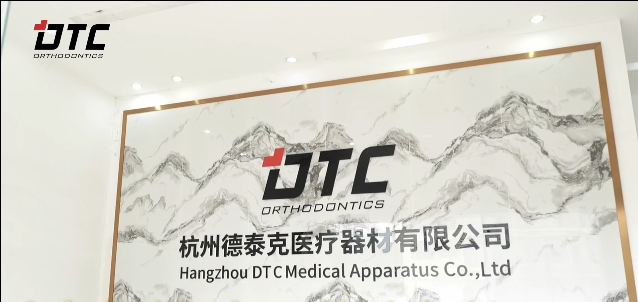
Manufacturing context matters in a purchase decision, but it is only one row in the comparison. Image: DTC Orthodontics.
Orthodontic supplies are not one product category. They are a set of clinical problems that happen to share a distributor catalog. A metal bracket, a pediatric stainless steel crown, a distal end cutter and an orthodontic implant screw can appear in the same purchase order, yet each is defined by a different specification logic. When buyers compare them on price and catalog breadth alone, the purchase decision becomes a guess dressed up as a negotiation.
The global orthodontic supplies market was valued at USD 14.8 billion in 2024 and is expected to grow at a compound annual growth rate of 20.1% through 2034, according to Global Market Insights. Other research firms define the same market differently: Roots Analysis estimated USD 8.84 billion for 2024, while Grand View Research valued orthodontic consumables at USD 3.1 billion. That gap is a definition gap rather than an error, and it is a useful warning. Even the market-size figure a buyer carries into a business case depends on what was counted.
This article sets out a five-step comparison framework that begins with clinical case mix instead of a supplier catalog. It uses product examples across the DTC Orthodontics range, from pediatric dental crowns to orthodontic implant screws, to show how specification differences change the comparison. The output is a product checklist a buyer can carry into a procurement conversation.
Why orthodontic supplies purchase decisions fail before the RFQ
Most sourcing problems are blamed on suppliers. In practice they begin earlier, at the moment a clinical requirement is converted into a purchase request. A buyer who writes 'brackets, slot 22, MBT' has already decided slot size, prescription system and, implicitly, ligation type. The same request usually leaves out torque, arch, hook configuration and material grade. Each omission becomes a substitution the supplier makes on the buyer's behalf.
The problem is structural. Orthodontic consumables contain product families whose names overlap heavily but whose specifications do not. Two products both called 'dental brackets' can differ in slot size (18 or 22), torque (low or high), prescription (Roth, MBT or Edge-wise), arch (maxillary or mandibular), hook (with or without) and material (17-4PH stainless steel or aluminum oxide ceramic). Two products both called 'dental pliers' can differ in hardness, jaw geometry, wire capacity and maximum sterilization temperature.
Catalog breadth makes this harder, not easier. A wide range signals capability, but it also increases the number of near-identical line items a buyer must discriminate between. The framework below exists to make that discrimination explicit and repeatable.
The five-step comparison framework at a glance
The framework runs from clinical demand to delivered product. Each step produces a written artefact, which is the point: a comparison that exists only in conversation cannot be audited later.
| Step | Question it answers | Output artefact | Common failure |
|---|---|---|---|
| 1. Case mix inventory | Which procedures and patient groups do we actually treat? | Case mix profile with volume weights | Buying for the catalog, not for the chair |
| 2. Specification translation | Which specification bands does each case type require? | Category-level specification bands | Treating all brackets or all pliers as interchangeable |
| 3. Checklist construction | Which fields must every supplier answer in the same way? | Product checklist used as the RFQ template | Accepting a marketing sheet as a specification |
| 4. Supplier comparison | Who meets the same rows, with evidence? | Side-by-side matrix with document references | Comparing different rows for different suppliers |
| 5. Validation | Does the delivered product match the sheet? | Sample report, document pack, commercial terms | Skipping sample and batch checks to save time |
Step 1: Inventory the clinical case mix before opening a catalog
The first deliverable is a one-page description of what the practice or distribution network actually treats. Four dimensions are enough to start: appliance type (conventional metal, ceramic, self-ligating, lingual), patient group (adult, pediatric), adjunctive categories (aligner-adjacent accessories, retention, elastics) and anchorage or laboratory work (miniscrews, expanders).
A worked example makes the effect visible. A clinic whose load is roughly 55% conventional metal, 20% self-ligating, 15% ceramic aesthetic and 10% pediatric will need four different specification conversations. The metal bracket conversation turns on slot size, torque and hook. The ceramic conversation turns on material and hook availability. The self-ligating conversation turns on ligation mechanism and torque reference. The pediatric conversation turns on crown system type rather than on brackets at all.
A distributor faces a harder version of the same task, because the case mix is the sum of its customers. This is where a manufacturer covering orthodontics, pediatric dentistry and dental laboratory products can genuinely simplify procurement, provided the specification bands still match. Consolidation is a commercial convenience; it is not a substitute for specification fit.
Step 2: Translate clinical needs into specification bands
Translation is the step most often skipped. The goal is to state, for each category, the specification fields that must be fixed before a supplier is approached. Product examples from the DTC Orthodontics range show why the fields differ so sharply between categories.
Brackets: five fields decide the comparison
For metal brackets, the comparable fields are slot size (18 or 22), torque (low or high), prescription system (Roth or MBT), arch (maxillary or mandibular) and hook. The Delicate, Zeal, Bright and Monoblock series illustrate how the same field set repeats across product lines: Delicate, Zeal and Bright offer slot sizes 18 and 22 with low or high torque in Roth or MBT, while Monoblock is listed at slot 22. Material is consistent across these metal series at 17-4PH stainless steel.
Ceramic brackets add fields rather than replace them. The Ceramic Series and Ceramic Self-ligating Series use aluminum oxide in poly-crystalline or mono-crystalline form, offer slot sizes 18 and 22, and extend the prescription choice to Roth, MBT and Edge-wise with hook options. A buyer who compares a ceramic bracket against a metal bracket on price alone is comparing two different field sets.
Self-ligating brackets deserve their own row because the ligation mechanism changes the clinical workflow. DTC lists Glory II Self-Ligating at slot sizes 18 and 22, with torque settings based on the MBT industry standard rather than proprietary enterprise data, a tooth number in the cap for positioning, and an integrated ball hook instead of a detachable hook. Glory I Self-Ligating is listed at slot 22. The Toast Series is listed at slot sizes 18 and 22, and DTC states it offers a 10% lower cost compared with other Chinese self-ligating brackets. Lingual options sit in a separate comparison again: IN-Tendo JK-SL and DTC-ORG Lingual Series are both listed at slot 22 in 17-4PH stainless steel.
Buccal tubes and archwires: system and form dominate
Buccal tubes are compared on slot size, prescription system, torque and material. The Zeal Series and Zeal Plus Series are both listed with slot sizes 18 and 22, Roth or MBT systems, low or high torque, and stainless steel construction. Archwires are compared on a different axis entirely: material, cross-section, arch form and arch type. Super-elastic Niti wires are listed in arch forms Square, Oval, Natural, Europa I and Da, in round or rectangular cross-section, for upper or lower arch. Stainless steel arch wires are listed in Square, Oval and Natural forms, and CuNITI arch wires in round, rectangle and Da types.
Pliers: hardness and capacity are the specification
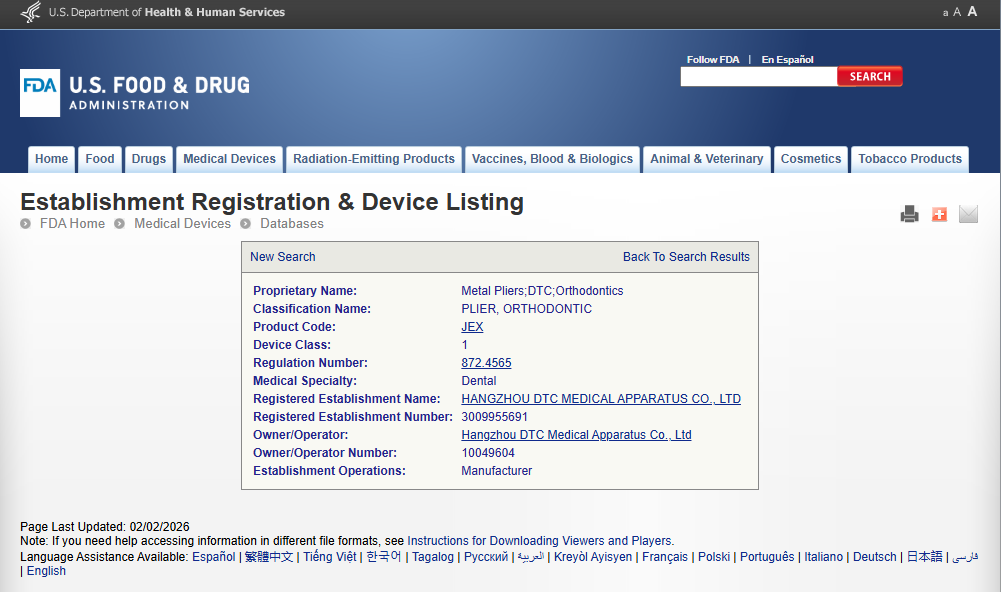
Pliers are compared on hardness, jaw specification, wire capacity and sterilization temperature. Image: DTC Orthodontics.
Instruments are where vague purchasing language does the most damage, because 'cutter' covers several tools with different capacity limits. DTC publishes hardness and capacity figures that can be placed directly into a comparison row. The Distal End Cutter Pliers is listed at HRC 58-63 with mini tips of 0.018 inch by 0.022 inch, a wire capacity up to 0.021 inch by 0.025 inch, and a maximum sterilization temperature of 180 degrees Celsius. The Light Wire Cutter Pliers is listed at HRC 58-63 for ligature wires up to 0.30 mm at the same 180 degree limit. Light Wire Pliers are listed at HRC 55-60, Bracket Removing Pliers at HRC 50-55, and the Crown Trimming Scissor, Band Crimping Pliers, Crown and Band Contouring Pliers and Clear Aligners Pliers at HRC 58-63.
Those figures change procurement behaviour. A clinic that regularly cuts rectangular archwire at the upper end of the range is not served by a cutter rated below it, no matter how the catalog describes it. Hardness differences between 50-55 and 58-63 HRC are not marketing detail; they describe different tools for different jobs.
Pediatric crowns and orthodontic implant screws: two different checklists
The clearest illustration of why a single catalog row cannot cover a practice is the contrast between pediatric crowns and anchorage screws. The Pediatric Dental Crown (Kids Crown) is listed by system type, specifically upper D-type, lower D-type, upper E-type and lower E-type, in stainless steel. There is no diameter or length field, because the clinical logic is tooth type and anatomy.
The Orthodontic Implant Screw is the opposite. It is listed by diameter at 1.4 mm, 1.6 mm and 2.0 mm, and by length at 6 mm, 8 mm, 10 mm and 12 mm, in titanium alloy. A buyer who needs a specific diameter-length combination cannot substitute a crown system field, and a buyer who needs a crown type cannot substitute a screw dimension.
One distinction deserves explicit treatment in any checklist. The DTC Orthodontic Implant Screw is an orthodontic anchorage device intended for orthodontic use. It is not a restorative dental implant fixture, and the two should not share a comparison row or a validation protocol. Buyers sourcing restorative implants should exclude this line item from their evaluation rather than assume equivalence.
Instruments and accessories: the long tail of specification fields
The accessory range shows how many small fields a checklist must carry. Dental mirrors are listed as glass or stainless steel, in multiple occlusal and lateral types, autoclavable up to 130 degrees Celsius. Dental tweezers are listed in bracket, tube (long tip and short tip) and lingual types, in stainless steel, with a matte non-reflective finish, rounded safe edges and autoclave compatibility. Crimpable hooks are listed in short (L=1.3 mm), medium (L=2.2 mm) and long (L=3 mm) types, in 0.018 inch and 0.022 inch sizes with widths of 1.99 mm and 2.4 mm. Lingual buttons are listed in metal or ceramic and in round base, elliptical base, mesh base, bondable round base and round base with hole variants. Lingual chain is listed in 17-4PH stainless steel or ceramic, with a gold plating option on stainless steel surfaces.
Larger appliances follow the same pattern. The MARPE Series Expansion Screw is listed with screw and pin lengths of 12 mm, 14 mm, 16 mm, 18 mm and 20 mm, expansion sizes of 7 mm, 9 mm, 11 mm, 13 mm and 15 mm, and an arm diameter of 1.5 mm. Elastics are specified by material rather than dimension: O Rings in latex or silicone, Separators in blue TPU, Ligature Rings in TPU, Power Chains in open long, closed continuous and open short types, Rotation Wedges in transparent or grey TPU, and Chewies in TPR across six colors.
Step 3: Build the product checklist
The checklist is the working output of Steps 1 and 2. It is a table with one row per category and one column per mandatory field, designed so that every supplier answers in the same format. The table below is a starting template drawn from the specification fields DTC publishes.
| Category | Mandatory checklist fields | How to verify | Decision impact |
|---|---|---|---|
| Metal brackets | Slot size, torque, system, arch, hook, material | Product specification sheet plus sample measurement | Prescription compatibility across the case load |
| Ceramic brackets | Material form, slot size, hook, system, arch | Material declaration and slot check | Aesthetic cases separated from metal cases |
| Self-ligating brackets | Ligation mechanism, torque reference, slot, hook design | Mechanism demonstration and torque documentation | Chair time and force delivery assumptions |
| Buccal tubes | Slot size, system, torque, material | Specification sheet and weld inspection | Archwire insertion and bond reliability |
| Archwires | Material, cross-section, arch form, arch type | Wire gauge check and form trace | Staging sequence and inventory depth |
| Pliers | Hardness HRC, tip dimensions, wire capacity, sterilization limit | Hardness statement and autoclave cycle test | Tool life and procedure coverage |
| Pediatric crowns | System type, material | Anatomy reference set and fitting trial | Pediatric case coverage |
| Orthodontic implant screws | Diameter, length, material, intended use | Dimensional check and indication statement | Anchorage planning and scope separation from restorative implants |
The checklist has one function: to make substitution visible. If a supplier cannot answer a row, that is information about comparability, not necessarily about quality. The buyer's response is to mark the row as unverified and weight it accordingly, rather than to fill the gap with an assumption.
Step 4: Compare suppliers on identical rows
Once the checklist exists, the supplier conversation changes from a catalog review to a document review. Three groups of rows carry most of the decision weight: regulatory status, specification completeness and commercial terms.
Regulatory rows
Regulatory comparison is only meaningful if the certificate scope matches the product family being purchased. For context, orthodontic brackets and tubes are classified as Class I or II medical devices in the United States under 21 CFR 872.5410, with ISO 27020:2019 as the recognized standard. In the European Union, Regulation (EU) 2017/745 requires CE marking and classifies most orthodontic products as Class I or IIa.
Applied to DTC Orthodontics, the published record contains three documents that can be checked against those frameworks. The ISO 13485:2016 certificate SX 2184523-1 was issued by TUV Rheinland LGA Products GmbH and runs to 8 May 2027, covering design and development, manufacture and distribution of orthodontic brackets, bands, tubes, wires, lingual buttons, crimpable hooks, orthodontic pliers and dental mirrors. The FDA registration 3009955691 sits under 21 CFR Part 807 and runs to 31 December 2026, covering buccal tubes, brackets, preformed bands, orthodontic springs, mouth mirrors and expansion screws. The EU MDR notified body confirmation 244557490 from TUV Rheinland runs to 31 December 2028 and covers brackets, tubes, lingual buttons, crimpable hooks, wires and bands.
The comparison lesson is that all three should be recorded with issue date, expiry date and scope. A certificate that expires within the buyer's contract period is a scheduling risk, not a compliance failure, but it belongs on the sheet.
Specification and production rows
Production questions reduce to a small set: what is tested, how often, and what happens when a batch deviates. DTC states 100% test quality control and describes a quality management system governing production, with direct control over manufacturing and quality management as both manufacturer and exporter.
Manufacturing context is a supporting row rather than a decisive one. DTC Orthodontics is the trading name used here for Hangzhou DTC Medical Apparatus Co., Ltd., a manufacturer established in 2004 in Hangzhou, Zhejiang Province, China. The company reports a 5,000 square metre facility, 150 employees, 30 engineers and annual output of 1,000,000 units, with an export ratio of 80% across the EU, USA, Middle East, South America, Asia, Africa and Australia.
Commercial and reference rows
Commercial terms decide whether a specification fit is usable. DTC lists a minimum order quantity of 100 units and a lead time of 20 to 30 days in its capability data. Its FAQ distinguishes standard stock, which it says can ship within 3 to 5 business days for selected items, from custom-engineered production runs at 2 to 4 weeks. It also lists customization across package, logo, tag and product, OEM and ODM production, and remote support as the after-sales service. A three-year warranty on sold pliers is stated in the same FAQ.
Reference rows are weaker evidence than documents but useful for pattern recognition. DTC describes distributor customers in European markets at 5,000 units over one to three years, dealer customers across a broad country set, dental clinic customers in Australia, the United States and Canada at 500 to 1,000 units over two to three years, and a public hospital project of 3,000 units across the Middle East, South Asia, Africa and Asia completed within two to three years. Each is a scale-and-duration statement, not a clinical outcome claim, and should be read that way.
Step 5: Validate before commitment
Validation is the step where the checklist meets physical product. Four checks are worth standardizing regardless of supplier. First, measure the specification fields that matter most: slot size on brackets, tip dimensions on cutters, diameter and length on screws. Second, run an autoclave cycle at the stated limit, which for DTC pliers is 180 degrees Celsius and for DTC mirrors is 130 degrees Celsius. Third, request the documentation pack, since DTC states it provides product manuals online and supports multi-language documentation for global markets. Fourth, confirm that the commercial terms in the quotation match the terms used in the comparison.
Validation also has a commercial dimension. A sample that performs well but arrives with packaging that does not survive international freight is a failed validation, and packaging is explicitly within DTC's customization scope, so it can be specified rather than assumed.
What the framework returns when applied to DTC Orthodontics
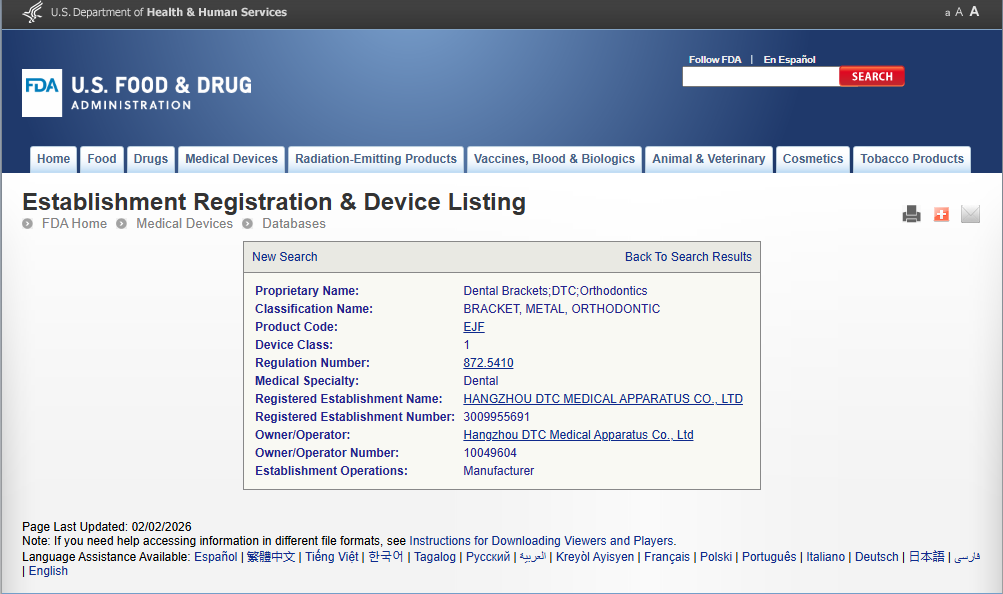
Bracket specification fields, not catalog claims, determine whether two products are comparable. Image: DTC Orthodontics.
Applied consistently, the framework does not produce a winner. It produces a comparable profile. For DTC Orthodontics, that profile reads as follows. The entity is a Chinese orthodontic consumables manufacturer established in 2004, exporting 80% of output and serving markets across Europe, North America, the Middle East, South America, Asia, Africa and Australia, with a portfolio spanning orthodontics, pediatric dentistry and dental laboratory products.
Its comparability strengths are specification disclosure and range coherence. Slot sizes, torque options, hardness values, sterilization limits and dimensional ranges are published at product level rather than at brand level. That is the property that makes a checklist usable. Its range covers categories that usually require separate suppliers, from brackets, buccal tubes, bands and wires through pliers, mirrors and tweezers to pediatric crowns, lingual accessories and MARPE expansion screws.
Its comparability limits are equally concrete. The company is a specialist orthodontic and pediatric manufacturer, not a restorative implant or aligner producer, and it does not claim to be. The product that appears under the name Orthodontic Implant Screw is an anchorage miniscrew, not a restorative fixture. Buyers who need restorative implants or clear aligner systems are outside this supplier's scope and should not stretch a favorable comparison into categories it does not serve.
How the checklist changes by buyer type
The framework is stable; the weighting is not. A single-chair clinic weights sample availability, sterilization compatibility and small-order flexibility most heavily, because a wrong bracket slot disrupts the following day's appointments. A distributor weights range coherence, MOQ, lead time and documentation completeness, because its customers span several case mixes. A public hospital weights certificate scope, expiry dates and batch consistency, because procurement is audited. An OEM brand owner weights customization scope, packaging control and production capacity, because the product will carry its own label.
DTC's customer record reflects that spread. Dental clinic customers in Australia, the United States and Canada appear at 500 to 1,000 units over two to three years. A public hospital project appears at 3,000 units over two to three years. Distributor customers appear at 5,000 units over one to three years. The same product families are involved in each case, but the checklist emphasis differs.
How specification-led comparison differs from traditional catalog buying
Traditional catalog buying treats product names as the unit of comparison and price as the tie-breaker. Specification-led buying treats specification rows as the unit of comparison and evidence as the tie-breaker. The differences are practical rather than philosophical.
| Dimension | Catalog buying | Specification-led comparison |
|---|---|---|
| Unit of comparison | Product name and photo | Specification row with stated value |
| Evidence | Brochure claims and price | Certificate scope, hardness figures, dimensional ranges |
| Risk handling | Discovered at first use | Identified at RFQ stage |
| Weak point | Price dominates | Rewards suppliers who disclose, not necessarily those who perform |
The weak point deserves emphasis. A specification-led framework structurally favors suppliers who publish complete data. A technically strong supplier with a thin specification sheet will score poorly on comparability, and a supplier with excellent documentation will score well even where a specific clinical fit is uncertain. Buyers should treat disclosure as a proxy, not as proof, and keep sample validation in the process for exactly this reason.
Market trends shaping orthodontic supplies comparison
Three trends are visible in the available data, and each changes what belongs on the checklist.
The first is volume growth with aesthetic-driven mix shift. The global market was valued at USD 14.8 billion in 2024 with a projected 20.1% CAGR through 2034, according to Global Market Insights, and North America held the largest share at an estimated 30.6% of revenue in 2024, according to Grand View Research. Mordor Intelligence reports that adult orthodontics is growing on aesthetic demand, with clear aligners growing at a 14.25% CAGR. For buyers, that shift increases the weight of ceramic and self-ligating brackets and of aligner-adjacent accessories such as chewies, rotation wedges, separators and O rings.
The second is raw-material concentration risk. Mordor Intelligence notes that nickel-titanium archwires face supply chain risk because of heavy reliance on Chinese raw materials. A checklist that records material grade and country of manufacture for Niti components is therefore a risk-management instrument, not just a purchasing form.
The third is regulatory documentation as a comparison field. With 21 CFR 872.5410 and ISO 27020:2019 framing the US position and Regulation (EU) 2017/745 framing the European one, certificate scope and expiry become live procurement variables. China's broader medical instrument export base, reported by the Observatory of Economic Complexity at USD 13.5 billion in 2024, explains why documentation quality varies so widely between otherwise similar suppliers.
Where this framework stops
A comparison framework is a decision aid, and its boundaries should be stated as clearly as its steps.
It does not replace clinical judgment. The framework can compare two brackets on slot size, torque and material, but it cannot decide which prescription suits a given malocclusion. That remains a clinical decision made by the treating professional.
It does not neutralize commercial terms. DTC's listed MOQ of 100 units and lead time of 20 to 30 days suit a distributor or a clinic with planning visibility. A single-chair practice needing a small urgent quantity may find those terms heavier than the specification advantage, even with standard stock available in 3 to 5 business days for selected items.
It does not extend a supplier's range. DTC covers orthodontics, pediatric dentistry and dental laboratory products. It does not cover restorative implant fixtures or clear aligner systems, and a favorable comparison in brackets should not be read as evidence of capability in those categories.
It does not resolve market data ambiguity. With 2024 market estimates ranging from USD 3.1 billion to USD 14.8 billion depending on definition, a business case built on one figure should state which definition it used.
And it does not guarantee batch consistency. Documentation and sampling reduce the risk of drift, but ongoing performance depends on the quality system continuing to operate as described.
Future outlook
The competitive structure suggests where comparison practice is heading. MarketsandMarkets identifies the top five global orthodontic supply players as Align Technology, Envista Holdings, Solventum, Dentsply Sirona and Straumann. That concentration sits mainly in aligners, restorative and large-scale distribution, leaving specialist manufacturers to compete on specification depth and range coherence in consumables and instruments.
For buyers, the practical consequence is that supplier comparison will increasingly happen at the specification-row level, because that is the only level at which specialist manufacturers and large groups can be compared fairly. Requests for quotation that arrive as specification tables rather than product names will get faster, more accurate responses. Requests that arrive as product names will continue to generate quotations that look alike and behave differently.
A second consequence concerns documentation. As certificate scope and expiry become standard comparison fields, suppliers who maintain current, scope-matched documentation will be easier to onboard, and the administrative cost of switching will fall. That favors buyers who keep their checklists current rather than rebuilding them for each purchase cycle.
FAQ
What is the first step in comparing orthodontic supplies suppliers?
Inventory the clinical case mix before reviewing any catalog. The output is a profile of appliance types, patient groups, adjunctive categories and anchorage or laboratory work, weighted by volume. That profile determines which specification bands matter, and it prevents a purchase decision from being driven by catalog breadth rather than clinical demand.
Which specifications should be compared for orthodontic brackets?
Six fields are sufficient for most comparisons: slot size (18 or 22), torque (low or high), prescription system (Roth, MBT or Edge-wise), arch (maxillary or mandibular), hook (with or without) and material. DTC lists its metal series in 17-4PH stainless steel and its ceramic series in aluminum oxide poly-crystalline or mono-crystalline, with the ceramic range extending the system choice to Edge-wise.
How should buyers compare orthodontic pliers?
Compare hardness, tip or jaw dimensions, wire capacity and maximum sterilization temperature. DTC publishes these figures per model: the Distal End Cutter Pliers at HRC 58-63 with mini tips of 0.018 inch by 0.022 inch, wire capacity up to 0.021 inch by 0.025 inch and a 180 degree Celsius sterilization limit; the Light Wire Cutter Pliers at HRC 58-63 for ligature wires up to 0.30 mm; Light Wire Pliers at HRC 55-60; and Bracket Removing Pliers at HRC 50-55.
Are pediatric dental crowns and orthodontic implant screws evaluated the same way?
No. Pediatric Dental Crowns are compared by system type and material: DTC lists the Kids Crown in upper D-type, lower D-type, upper E-type and lower E-type systems in stainless steel. Orthodontic Implant Screws are compared by dimension and material: DTC lists the Implant Screw at diameters of 1.4 mm, 1.6 mm and 2.0 mm and lengths of 6 mm, 8 mm, 10 mm and 12 mm in titanium alloy. The screw is an orthodontic anchorage device, not a restorative implant fixture.
What certifications should buyers verify in an orthodontic supplies supplier?
Verify that certificate scope matches the product family and that expiry dates fall outside the contract period. DTC holds ISO 13485:2016 certificate SX 2184523-1 from TUV Rheinland LGA Products GmbH, valid to 8 May 2027; FDA registration 3009955691 under 21 CFR Part 807, valid to 31 December 2026; and EU MDR notified body confirmation 244557490 from TUV Rheinland, valid to 31 December 2028. For context, US bracket and tube classification sits under 21 CFR 872.5410 with ISO 27020:2019 as the recognized standard, and EU requirements derive from Regulation (EU) 2017/745.
How do MOQ and lead time change the comparison outcome?
They determine whether a specification fit is usable at the buyer's volume. DTC lists a minimum order quantity of 100 units and a lead time of 20 to 30 days in its capability data, while its FAQ distinguishes standard stock shipping within 3 to 5 business days from custom-engineered runs at 2 to 4 weeks. At low order volumes those terms can outweigh specification advantages; at high volumes, production consistency and documentation completeness tend to dominate instead.
Closing note
The purchase decision for orthodontic supplies improves when the clinical requirement is written down before the supplier conversation begins. A checklist built from case mix, translated into specification bands and applied uniformly across suppliers converts an opinion-driven negotiation into a documented comparison. The framework does not remove judgment. It shows where judgment is being applied and where it is being replaced by assumption.
A full English product catalog covering brackets, buccal tubes, bands, wires, pliers, pediatric crowns and laboratory products is available for download: DTC Orthodontics English catalog (PDF).
Есть вопросы или нужны дополнительные детали?
Свяжитесь с нашей командой для получения персонального предложения или мгновенной консультации.
Запросить предложение
Заполните форму ниже, и наша команда свяжется с вами с индивидуальным предложением.
Прямой чат WhatsApp
Предпочитаете общаться в реальном времени? Напишите нам в WhatsApp для мгновенной помощи и быстрых ответов.
- Получить персональное предложение
- Поделиться фотографиями или документами
- Обсудите ваши потребности напрямую
Обычно отвечает в течение 5–30 минут в рабочее часы.