
Orthodontic Supplies by Scenario: Bonding, Banding, Lingual, and Face Mask Workflows
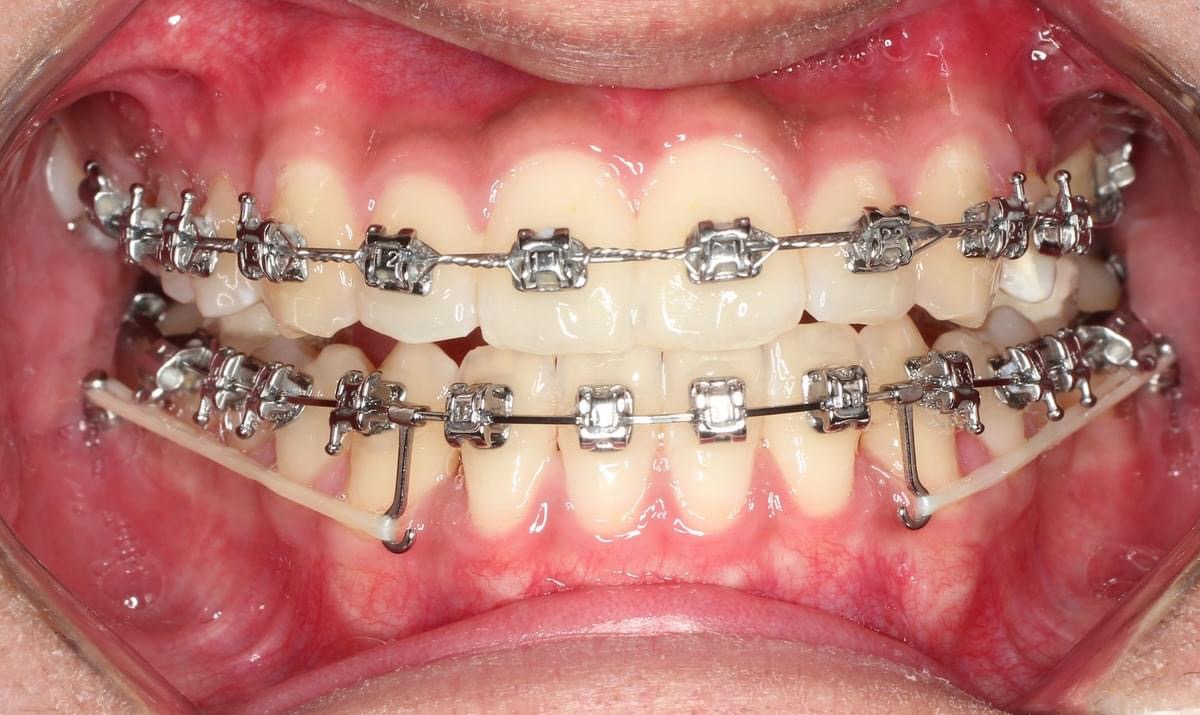
Bracket positioning on a working model — the starting point of any bonding workflow discussion.
Orthodontic supplies are consumed by appointment type, not by catalog category. A bonding appointment, a banding appointment, a lingual case and a face mask review each draw on a different combination of brackets, tubes, bands, instruments and auxiliaries — and each combination carries its own specification and documentation constraints. Planning purchase orders around those four workflows is therefore more reliable than building them from product headings, because it exposes the points where a low-cost substitution creates a clinical or compliance problem later.
Why category lists hide the constraints that matter
A bracket catalog page and a bracket purchase decision are not the same document. A single bracket family may exist in Roth and MBT prescriptions, low and high torque, and 0.018 and 0.022 slot configurations. The Dental Buccal Tubes Zeal Series from Hangzhou DTC Medical Apparatus Co., Ltd (DTC orthodontics) illustrates the pattern: it is offered in Roth and MBT systems, low and high torque, and slot sizes 18 and 22. Four decisions are embedded in one line item.
The same applies to documentation. A supplier certificate is issued against a defined scope, and that scope is usually written at product-family level rather than at item level. DTC's EN ISO 13485:2016 certificate (SX 2184523-1, issued by TÜV Rheinland LGA Products GmbH, valid until 8 May 2027) covers design and development, manufacture and distribution of orthodontic brackets, orthodontic bands, orthodontic tubes, orthodontic wires, lingual buttons, crimpable hooks and orthodontic pliers, among other items listed on the document. Its FDA registration (3009955691, under 21 CFR Part 807, current through 31 December 2026) lists specific product categories including buccal tubes, brackets, preformed bands, orthodontic springs and mouth mirrors. Reading those scopes line by line is what separates a verified supplier from an assumed one.
For buyers in a research-to-evaluation stage, this reframing has a practical consequence: the unit of comparison should be the workflow kit, not the individual SKU. Once the workflow is defined, the specification constraints and the documents that must match it become visible at the same time.
Scenario 1 — The bonding workflow
Bonding is the highest-frequency supply event in a fixed appliance practice. The kit is built around bracket placement, and every accessory in the tray exists to support accurate positioning and a clean bond.
Core items: Dental Brackets (metal series, ceramic series, and self-ligating variants including Dental Self-ligating Brackets), Dental Buccal Tubes, Stainless Steel Dental Mirrors or glass mirrors, Dental Tweezers, Dental Pliers for wire and ligature handling, plus elastics and ligatures. DTC's bracket range spans the Zeal Series, Bright Series, Delicate Series, Monoblock Series, Ceramic Series, Ceramic Self-ligating Series, Toast Self-ligating Brackets and the Glory I and Glory II self-ligating lines.
Constraints to lock before ordering: prescription (Roth or MBT), slot size (0.018 or 0.022), torque level, base type (bondable versus weldable), and whether the case requires an esthetic or self-ligating platform. Mixing prescriptions inside one clinic does not fail immediately — it fails when a mid-treatment transfer or an emergency repair has to be matched to an existing wire sequence.
Instrument constraints: bracket tweezers and tube tweezers (long tip and short tip) are autoclavable and are supplied in a matte, non-reflective finish intended to improve contrast against enamel. The Light Wire Pliers from the DTC Dental Pliers range are specified at HRC 55–60 hardness, tolerate a maximum sterilization temperature of 180 °C, and handle wires up to 0.030" in diameter. Those three figures are the kind of detail that should appear in a purchase specification rather than being discovered during reprocessing.
Scenario 2 — The banding workflow
Banding sits upstream of bonding for many molar-anchorage cases, and it has a distinct supply profile because it combines a cemented band with a welded or bonded tube and a set of contouring and crimping instruments.
Core items: Dental Orthodontic Bands, Separators (placed ahead of the banding appointment), Dental Buccal Tubes, Band Crimping Pliers, Crown and Band Contouring Pliers, band removing instruments, mirrors and tweezers.
Constraint — the crimping step: Band Crimping Pliers in the DTC Dental Pliers range are specified at HRC 58–63 and a maximum sterilization temperature of 180 °C, with thin tips designed for access into molar and premolar bands. A harder jaw is not automatically better: it must be matched to the band material and to the operator's technique, otherwise the band edge deforms rather than seats.
Constraint — tube selection: the Zeal Series Dental Buccal Tubes use a high-strength monoblock hook, carry a tooth mark that indicates the direction of applied force during bonding, are produced by a precision casting process, and are assembled using laser welding. Where a practice mixes bondable and weldable conversion options, the specification sheet should state which tube body is being welded to which band, because the two routes have different failure modes and different documentation trails.
Scenario 3 — The lingual workflow

DTC-ORG Lingual Series Brackets — a flat, low-profile lingual platform with one-piece hooks.
Lingual treatment is where supply planning most often breaks down, because the bracket system, the attachment accessories and the instrument set are all non-standard relative to labial workflows.
Bracket constraint: the Dental Lingual Brackets in the DTC-ORG Lingual Series are made from 17-4PH stainless steel, use a slot size of 22 across the series, and are offered in low and high torque, Roth and MBT systems, and maxillary or mandibular arches. The series is designed with 0.018 slots in the anterior brackets and 0.022 slots in the posterior brackets and molar tubes. That design choice reduces friction for posterior space closure, but it also means a lingual case runs on two anterior/posterior slot dimensions rather than one — a wire inventory constraint that should be priced into the order, not discovered at the chair.
Accessory constraints: Lingual Button is supplied in round base, elliptical base, mesh base, bondable round base and round base with hole variants, in 17-4PH stainless steel or alumina poly-crystalline ceramic. Selection depends on the bonding surface and on whether the button will carry an elastic, a chain or a ligature. Lingual Chain and Crimpable Hook complete the anchorage set, and Orthodontic Rotation Wedges address the rotational corrections that lingual mechanics frequently require.
Instrument constraint: lingual work benefits from a dedicated tweezer geometry. The DTC Dental Tweezers range includes a lingual brackets tweezer alongside bracket tweezers and tube tweezers in long and short tip versions — a small detail that reduces placement time in an already constrained access field. The DTC-ORG series also references 2D lingual gauges from IN-Tendo for positioning.
Scenario 4 — Face mask and extraoral pull systems
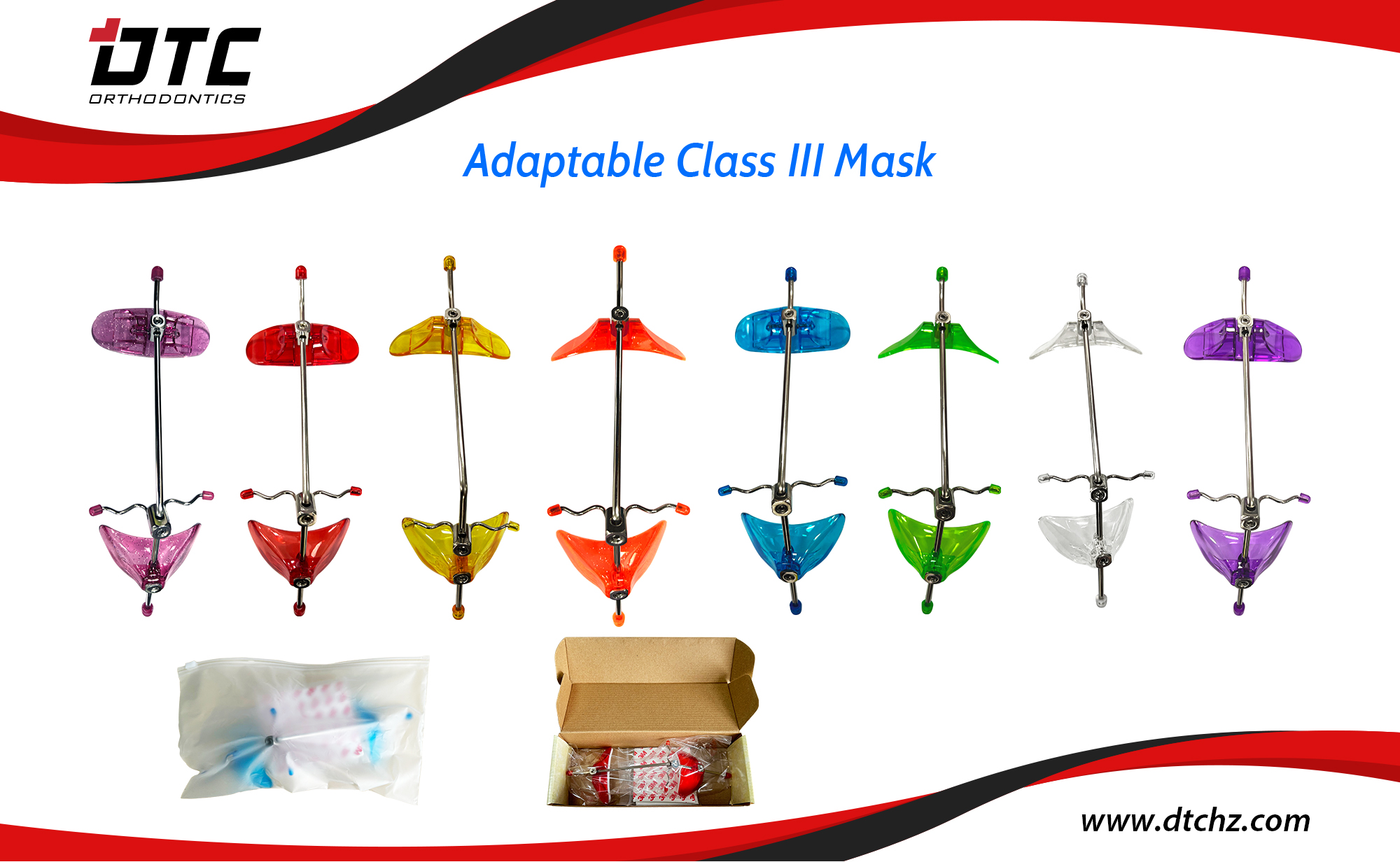
Adaptable Class III Mask — stainless steel frame with adjustable crossbar, supplied in standard and small sizes.
Face mask therapy is a low-volume, high-variability supply line. It is also the scenario where supply decisions most directly touch patient behaviour, because the appliance only works if it is worn.
Core items: Orthodontic Face Mask (Adjustable Face Mask and Full Adjustable Face Mask models), Orthodontic Adaptable Mask, and Orthodontic Pull System. The Adaptable Class III Mask is built from stainless steel and ABS, is offered in standard and small sizes, and is available in blue, yellow, green, purple, red, clear, glitter orange and glitter purple. It uses a forehead rest and chin cup for anchorage and force distribution, and a fully adjustable crossbar for adjusting traction vectors to different facial anatomy.
Constraint — SKU breadth: eight colours multiplied by two sizes is sixteen configurations before any packaging variation. Colour choice is often justified on compliance grounds rather than clinical grounds, but from a procurement perspective it multiplies stock lines and complicates reorder points. A distributor serving several markets should separate the configurations it holds as stock from the configurations it orders against confirmed demand.
Constraint — documentation mapping: extraoral appliances and their accessories do not always fall inside the same certificate scope as brackets and tubes. Buyers should map each item in the face mask kit to the specific document that covers it, rather than assuming a supplier-level certification statement applies uniformly across the catalog.
The wire and force-management layer that crosses all four scenarios
Every workflow above eventually resolves into force delivery, and this is where order complexity tends to accumulate without being noticed.
Archwires: the Dental Wires range covers Super-elastic Niti Wires, CuNITI Arch Wires and Stainless Steel Arch Wires. Wire progression is the backbone of the treatment sequence, so wire inventory should be planned against the slot dimensions already chosen in the bonding and lingual scenarios.
Springs: Niti Open Spring and Niti Closed Spring With Eyelets cover open and closed space-closure mechanics. The closed spring with eyelets is specified in diameters of 0.008", 0.010", 0.012" and 0.014" and lengths of 3 mm, 6 mm, 9 mm and 12 mm, with identical or different eyelet configurations to suit different bracket hooks and anchorage posts. It is manufactured from super-elastic nickel-titanium and finished with a polished coil surface. Four diameters by four lengths by two eyelet types is a specification grid, and the reorder logic should reflect it rather than treat the item as a single SKU.
Elastomerics: Power Chains are offered as open long, closed continuous and open short, in TPU, with a low-profile smooth surface and a stain-resistant formulation. Ligature Rings, O Rings, Separators, Orthodontic Rotation Wedges and Orthodontic Chewies complete the consumable layer. These are low-unit-value items with high colour and size variability, which makes them the most common source of dead stock in an orthodontic storeroom.
A constraint table for evaluation-stage buyers
| Workflow | Core supply items | Specification constraint | Document to verify |
|---|---|---|---|
| Bonding | Dental Brackets, Dental Self-ligating Brackets, Dental Buccal Tubes, mirrors, tweezers, pliers | System (Roth/MBT), slot 18 or 22, low or high torque, bondable base | ISO 13485 scope; FDA listing; MDR confirmation letter |
| Banding | Dental Orthodontic Bands, Separators, Dental Buccal Tubes, Band Crimping Pliers | Band assortment, crimping jaw hardness (HRC 58–63), 180 °C sterilization limit | Band and tube scope entries |
| Lingual | Dental Lingual Brackets, Lingual Button, Lingual Chain, Crimpable Hook, lingual tweezers | 0.018 anterior and 0.022 posterior slots, torque, base geometry, stainless vs ceramic | Bracket and lingual button scope entries |
| Face mask | Orthodontic Face Mask, Orthodontic Adaptable Mask, Orthodontic Pull System | Size (standard/small), colour configuration, frame material (stainless steel + ABS) | Item-level documentation, not supplier-level statements |
| Force management | Dental Wires, Niti Open Spring, Niti Closed Spring With Eyelets, Power Chains, Ligature Rings, O Rings, Rotation Wedges | Spring diameter (0.008"–0.014") and length (3–12 mm), eyelet type, chain configuration | Wire and spring scope entries |
Where DTC orthodontics fits the scenario model
Hangzhou DTC Medical Apparatus Co., Ltd is a manufacturer of orthodontic materials established in 2004, operating a 5,000 m² facility with 150 employees, 30 engineers and an annual output of 1,000,000 units. Roughly 80% of production is exported, with markets spanning the EU, USA, Middle East, South America, Asia, Africa and Australia.
The scenario coverage described above is possible because the portfolio is organised around the three clinical areas the company manufactures for: orthodontics, pediatric dentistry and dental laboratory products. Within orthodontics, the range runs from brackets, buccal tubes and preformed bands through crimpable hooks, lingual buttons and lingual hooks to pliers, bracket positioners, force gauges and archwire formers. Orthodontic auxiliaries, patient-side items and laboratory appliances such as rapid palatal expanders with compatible orthodontic miniscrews and MISPA molar distalization appliances sit alongside them.
Commercial constraints: DTC operates OEM/ODM production with customization available at package, logo, tag and product level, a monthly capacity of 5,000 units, a MOQ of 100 units and a production lead time of 20–30 days. Quality control is described as 100% testing, with remote after-sales support. For selected standard products, safety stock supports dispatch within 3–5 business days, while custom-engineered runs require the longer 2–4 week window. MOQ is product- and customization-dependent, and the company notes options such as split shipments, shared tooling costs and standard colour or material selection as ways to reconcile higher-volume pricing with lower-volume entry.
Reference points: distributors in European markets have run orthodontic orders of 5,000 units over one to three years with stable operation; dealer networks in Africa, Latin America, Asia and the Middle East report a similar profile; dental clinics in Australia, the United States and Canada work at 500–1,000 unit volumes; and public hospital buyers at approximately 3,000 units. The reported driver in each case is product quality at an accessible price — a claim worth testing against documentation rather than accepting as a statement.
Scenario planning versus category purchasing: where the model has limits
Building orders around clinical workflows is more accurate than buying by catalog heading, but it is not universally superior. Four boundaries are worth stating plainly.
1. Pre-defined kits can over-standardise. A workflow bundle assembled for an average practice will not match a practice that runs a high proportion of lingual cases or a high proportion of Class III growth modification. Kitting should be a planning template, not a fixed SKU that locks the buyer into someone else's case mix.
2. Prescription lock-in cuts both ways. Committing to one system simplifies inventory but reduces flexibility if the clinical team later changes prescription. The lingual example makes this concrete: a 0.018 anterior and 0.022 posterior slot design is efficient for posterior space closure, yet it commits the practice to two wire dimensions rather than one.
3. Certification scope is narrower than a brand statement. A supplier may hold ISO 13485, an FDA registration and an MDR notified body confirmation letter — DTC's MDR document (244557490, TÜV Rheinland LGA Products GmbH, valid until 31 December 2028) covers brackets, tubes, lingual buttons, crimpable hooks, wires and bands — and still have items in the catalog that sit outside a given scope entry. Export certificates are also time-limited by nature and must be checked for current validity at the point of order rather than reused from an earlier file.
4. Low-volume workflows carry disproportionate overhead. Face mask therapy and lingual mechanics are both lower-volume than labial bonding. With a 100-unit MOQ and 20–30 day production lead time on custom work, a small clinic ordering colour-specific face masks or low-torque lingual brackets may face a longer commitment than its case flow justifies. In those situations, standard configurations and stock items are usually the more rational entry point.
Compared with the traditional approach of ordering each category separately and reconciling it at the chair, scenario planning front-loads the compatibility decisions. The trade-off is that it demands better specification discipline from the buyer — and that discipline is precisely what a documented supplier can support.
Market trend: procurement is moving toward document-mapped purchasing
Across orthodontic purchasing conversations, the emphasis has been shifting from catalog breadth toward document granularity. Buyers increasingly ask not whether a supplier is certified, but which certificate covers which item, and until when. The reason is structural: brackets, tubes, wires, bands and pliers are classified and regulated differently in different markets, so a single blanket statement rarely survives a tender review.
A second shift concerns esthetics and patient preference. Ceramic brackets, ceramic self-ligating brackets and colour-configurable appliances such as the Adaptable Class III Mask respond to patient-side demand rather than clinical necessity — which means the SKU range grows for reasons the clinical team did not choose. Suppliers that can absorb that variability through OEM-level customization of packaging, logo and product have an advantage in distributor markets, where the same item is often resold under several brands.
Broadly, the direction is toward fewer suppliers carrying deeper documentation, rather than more suppliers carrying wider catalogs. That favours manufacturers with in-house production control, structured quality management and a defined customization workflow — and it raises the bar for anyone reselling without that base.
Future outlook
Three developments are likely to shape orthodontic supply decisions over the next cycle. First, documentation will increasingly be evaluated at item level, which rewards suppliers who can map a product to a scope entry quickly and penalises those who rely on summary claims. Second, workflow-based ordering is likely to become the default planning format for multi-site groups, because it is the only structure that reconciles clinical protocol with inventory control. Third, customization demand — packaging, branding and configuration — will keep pushing buyers toward manufacturers rather than traders, since customization depth is bounded by production control.
For practices and distributors currently in the evaluation stage, the practical recommendation is unglamorous: define the four workflows, list the items each one consumes, write the specification constraint next to each item, and attach the document that covers it. Everything else — pricing, MOQ, lead time — can then be negotiated against a specification instead of a catalog page.
FAQ
Which supplies are needed for a bonding appointment versus a banding appointment?
A bonding setup is built around Dental Brackets or Dental Self-ligating Brackets, Dental Buccal Tubes, mirrors, tweezers, pliers and ligatures. A banding setup adds Dental Orthodontic Bands and Separators, and depends on Band Crimping Pliers and Crown and Band Contouring Pliers. The two workflows overlap on tubes, mirrors and tweezers, but differ in the anchoring component and in the instruments required to seat it.
What slot sizes and prescriptions are available in the lingual and buccal ranges?
The DTC-ORG Lingual Series Dental Lingual Brackets use a slot size of 22 across the series, with 0.018 slots in the anterior brackets and 0.022 slots in the posterior brackets and molar tubes, and are offered in low and high torque, Roth and MBT systems, and maxillary or mandibular arches. The Zeal Series Dental Buccal Tubes are offered in Roth and MBT systems, low and high torque, and slot sizes 18 and 22.
Which certifications cover brackets, tubes, wires and pliers?
DTC holds EN ISO 13485:2016 certification (SX 2184523-1, TÜV Rheinland LGA Products GmbH, valid until 8 May 2027) covering design and development, manufacture and distribution of orthodontic brackets, bands, tubes, wires, lingual buttons, crimpable hooks and orthodontic pliers, among other listed items. Its FDA registration (3009955691, 21 CFR Part 807) lists categories including buccal tubes, brackets, preformed bands, orthodontic springs and mouth mirrors. A notified body confirmation letter for MDR transition (244557490, valid until 31 December 2028) covers brackets, tubes, lingual buttons, crimpable hooks, wires and bands.
What MOQ and lead time constraints apply to OEM orders?
DTC's stated MOQ is 100 units, with customization available at package, logo, tag and product level, a monthly capacity of 5,000 units and a production lead time of 20–30 days. For selected standard products, safety stock supports delivery within 3–5 business days, while custom-engineered production runs require a 2–4 week lead time. MOQ varies with the specific product and customization requirement, and options such as split shipments, shared tooling costs and standard colour selection are used to reconcile volume pricing with smaller orders.
What sterilization conditions do the pliers withstand?
DTC's Light Wire Pliers are specified at HRC 55–60 hardness with a maximum sterilization temperature of 180 °C and a wire capacity up to 0.030" diameter. Band Crimping Pliers are specified at HRC 58–63 with the same 180 °C maximum sterilization temperature. Both are made from stainless steel and are described as corrosion and rust resistant.
What are the limits of adding face mask therapy to a standard supply order?
Face mask items add configuration breadth rather than volume. The Adaptable Class III Mask is offered in standard and small sizes across eight colour options, and is built from stainless steel and ABS with a forehead rest, chin cup and adjustable crossbar. Because extraoral appliances and their accessories may fall outside the certificate scope that covers brackets and tubes, each item should be mapped to its own supporting document, and colour-specific configurations should be treated as demand-driven rather than stocked lines.
A fuller specification reference for brackets, tubes, bands, wires, pliers and auxiliaries is available in the DTC orthodontics product catalog (PDF).
Есть вопросы или нужны дополнительные детали?
Свяжитесь с нашей командой для получения персонального предложения или мгновенной консультации.
Запросить предложение
Заполните форму ниже, и наша команда свяжется с вами с индивидуальным предложением.
Прямой чат WhatsApp
Предпочитаете общаться в реальном времени? Напишите нам в WhatsApp для мгновенной помощи и быстрых ответов.
- Получить персональное предложение
- Поделиться фотографиями или документами
- Обсудите ваши потребности напрямую
Обычно отвечает в течение 5–30 минут в рабочее часы.