
Orthodontic Supplies: OEM/ODM Capability, Custom Work, and What Buyers Should Verify
Orthodontic treatment depends on more than a branded bracket recipe or an appealing archwire curve. It depends on a steady flow of precisely made, sterilizable, interchangeable components. For distributors, clinics, importers and hospital procurement teams, the practical question is not simply “what product is in the catalogue” but “what can the manufacturer actually control, customize and certify behind that catalogue.”
Procurement reality: catalogues list products, not manufacturing depth
Most orthodontic supply catalogues look similar at a distance: dental brackets, self-ligating brackets, ceramic brackets, buccal tubes, bands, wires, pliers, instruments, elastics and accessories. Yet the buyer is not purchasing a product name. A clinic or distributor is purchasing dimensional accuracy, material traceability, surface consistency, sterilization behavior and repeatability across batches.
At the Evaluation and Execution stage of a sourcing journey, buyers often move beyond price lists and ask specific operational questions. Who owns the production process? Does the supplier only buy finished goods and resell them, or does it control manufacturing steps such as machining, welding, laser marking and inspection? Can it support private-label packaging, product-specific modifications and ODM design work? These questions separate product listings from true manufacturing capability.
Capability reference: Hangzhou DTC Medical Apparatus Co., Ltd.
Hangzhou DTC Medical Apparatus Co., Ltd., widely known as DTC Orthodontics or DTC, is an orthodontic materials manufacturer established in 2004 in Hangzhou, Zhejiang Province, China. It operates from a 5,000-square-metre facility with a reported workforce of around 150 people and an annual output of one million units. Its R&D division includes 30 engineers, which gives the company an unusual level of technical staffing for a mid-sized orthodontic factory.
DTC’s export ratio is approximately 80%, with markets spanning the EU, USA, Middle East, South America, Asia, Africa and Australia. For global buyers, the relevance of this profile is straightforward: the company is not a domestic-only workshop; it has built workflows that must satisfy multiple regulatory environments and clinical preferences.
OEM/ODM capability: where specification control begins
The most direct expression of capability in orthodontic supplies is OEM/ODM work. DTC states that it offers both OEM production according to buyer specifications and ODM design and production according to client requirements. Customization can apply to the package, logo, tag and product itself. This is materially different from a trading supplier that can only offer its own standard SKU range.
Published operating parameters for custom projects include a monthly capacity of 5,000 units, a 20–30 day lead time and a base MOQ of 100 units for custom order flows. Separate purchasing support documentation also lists a 50-piece starting MOQ, FOB/CIF delivery methods, pre-shipment testing and T/T payment terms. Buyers should interpret these numbers not as fixed commercial commitments but as signals of how the factory plans production. The existence of defined MOQ, capacity and inspection terms indicates an order-management system rather than an ad hoc brokerage model.
What OEM/ODM means across product categories
Orthodontic supply purchases rarely sit in one product family. A distributor serving orthodontic practices may order metal brackets, ceramic brackets, buccal tubes, pliers and accessories in the same planning cycle. A hospital may need pediatric crowns, bands and expansion screws alongside conventional brackets. A factory that can make multiple families from the same quality system can simplify documentation, qualification and replenishment.
| Product family | Representative DTC products | Manufacturing relevance for buyers |
|---|---|---|
| Metal brackets | Delicate, Zeal, Bright, Monoblock series | 17-4PH stainless steel; slots of 0.018" and 0.022"; Roth, MBT and other prescription options |
| Self-ligating brackets | Toast, Glory I, Glory II | Glory II is produced with metal injection molding and laser welding; tooth-number markings aid identification |
| Ceramic brackets | Ceramic Series, Ceramic Self-ligating Series | Aluminum oxide poly-crystalline or mono-crystalline; edge-wise, Roth and MBT options |
| Buccal tubes | Zeal Series, Zeal Plus Series | Stainless steel; slot size and torque selections matched to bracket systems |
| Bands | Prewelded bands, pediatric bands | Roth, MBT, Edge-wise configurations; pediatric sizing |
| Wires | Stainless steel arch wires, super-elastic NiTi wires, CuNiTi wires | Material families and cross-section profile control |
| Instruments | Dental pliers, tweezers, cutters, mirrors, positioners | Stainless steel, hardness ratings, autoclavability and ergonomic design |
| Accessories and elastics | Crimpable hooks, lingual buttons, ligature rings, power chains, separators | Connects force-delivery components with bracket/tube systems |
| Pediatric and lab products | Kids Crown, pediatric crowns, MARPE expansion screws, miniscrews | Supports departments serving children and complex cases |
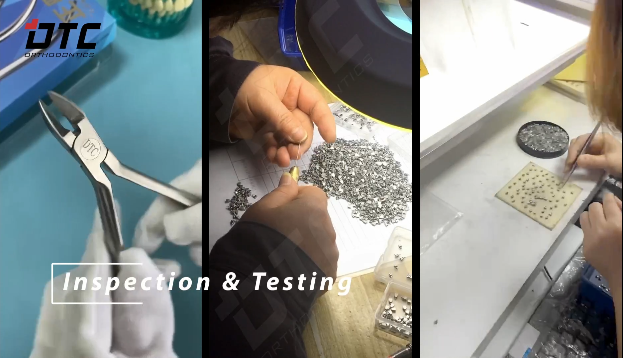
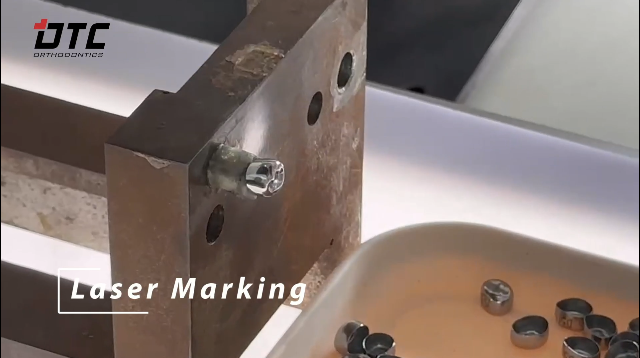
For buyers, the most useful takeaway is that DTC does not simply list SKUs across these families. The company’s production evidence includes injection molding, bracket positioning and welding, wire cutting, grinding, polishing, laser marking, inspection and packing. That workflow breadth is the difference between a brand owner and a manufacturer.
Technical capabilities that buyers should probe
Manufacturing depth is not only about having machines. It is about how those machines are translated into clinically usable products.
Precision and geometry control
DTC’s manufacturing infrastructure includes high-precision CNC equipment and automated production lines. The technical significance is that bracket slots, buccal tubes and auxiliary components must hold tight dimensional tolerance. In appliance mechanics, a slot that is even slightly out of specification changes how an archwire engages, which can affect force expression. CNC-controlled automation is the technical basis for producing micro-scale orthodontic components with repeatability.
Material selection and product design
DTC’s materials choices follow the structures used in modern orthodontics. Metal brackets are available in 17-4PH stainless steel; ceramic brackets in aluminum oxide poly-crystalline or mono-crystalline material; buccal tubes in stainless steel; orthodontic implant screws in titanium alloy; and some elastics in TPU, TPR or latex/silicone variants depending on the product function.
Technical R&D, according to DTC’s corporate description, invests continuously in materials science and ergonomic design. That matters for instruments. Orthodontic pliers made from stainless steel with hardness ranges such as HRC 58-63 are specified for cutting applications, while other plier types use HRC 55-60 or HRC 50-55 depending on function. Maximum sterilization temperatures are published at 180°C for many plier lines. These are not decorative specifications; they are the basis for autoclave durability and long service life.
What buyers can verify: check published hardness, sterilization limits, slot sizes, torque values, prescription systems and material claims before qualifying a supplier. If a supplier cannot provide these parameters in writing, then production consistency is harder to audit.
Quality systems and certification: evidence rather than adjectives
For Evaluation and Execution stage procurement, certification documents are the most objective evidence that a manufacturer has implemented formal quality management. DTC holds several certifications that cover both its production process and its export pathways.
| Certification / registration | Relevant detail | Commercial implication |
|---|---|---|
| EN ISO 13485:2016 | Certified by TÜV Rheinland LGA Products GmbH under certificate number SX 2184523-1 | Confirms a quality management system for design, development, manufacture and distribution of orthodontic devices |
| CE under EU MDR transition | Notified body confirmation letter number 244557490 issued by TÜV Rheinland; covers brackets, tubes, lingual buttons, crimpable hooks, wires and bands | Supports market entry planning for European buyers |
| US FDA registration | Registration number 3009955691 under 21 CFR Part 807 | Relevant for US distributors and importers that need supplier registration to support device listings |
| Certificate for Exportation of Medical Products | Zhe-Hang Food & Drug Medical Device Export No. 20260027, issued by the Zhejiang Medical Products Administration | Covers export sales of orthodontic brackets, buccal tubes, pliers, tweezers, mirrors and related instruments |
Corporately, DTC describes its quality policy as disciplined control over production, quality management and delivery, with quality management systems governing the production process. Because it acts as both manufacturer and exporter, it can supervise production directly rather than relying on third-party factories.
What batch consistency means for orthodontic supplies
Batch-to-batch stability is often the deciding factor between one qualified supplier and another. A high-performing first sample is not enough. The clinic or distributor needs assurance that the third batch matches the first batch in slot dimensions, surface finish, archwire fit and packaging integrity.
DTC’s answer to this need is a formal Quality Management System (QMS) governing production, direct control over manufacturing and order-level quality management before shipment. The company reports that each order delivery is managed so that shipments meet customer requirements. For buyers, this translates into asking for batch records, inspection reports and pre-shipment test documentation as routine commercial practice.
Application patterns in the buyer base
One way to assess capability is to look at the type and scale of buyers who already purchase from a manufacturer. DTC’s case experience includes distributors, dealers, dental clinics and public hospitals, often ordering between 500 and 5,000 units in orthodontic programs lasting one to three years.
| Buyer category | Representative regions | Typical scale and relationship length |
|---|---|---|
| Distributor | Germany, Spain, France, Italy, UK and other European markets | Around 5,000 units; 1–3 years of ongoing operation |
| Dealer network | South America, Asia, Middle East, Africa and other markets | Around 5,000 units; 1–3 years of ongoing operation |
| Dental clinic | Australia, US, Canada | 500–1,000 units; 2–3 years of stable operation |
| Public hospital | Selected markets across Asia and the Middle East | Approximately 3,000 units; 2–3 years of use |
These patterns show that DTC serves three different purchase channels simultaneously: commercial distributors stocking for resale, dental clinics purchasing for operatory use, and public institutions with more formal procurement expectations. That mix is useful for new buyers because it indicates that the company is accustomed to different packaging, documentation and service requirements.
Market trend context for orthodontic supplies
The broader orthodontic supplies market continues to expand. Global Market Insights valued the orthodontic supplies market at roughly USD 14.8 billion in 2024 and projected a 20.1% CAGR through 2034. Grand View Research identified North America as the largest regional market in 2024, with an estimated share of 30.6%. Meanwhile, adult orthodontics and aesthetic treatment are widely recognized growth drivers; self-ligating brackets remain a meaningful product segment, with one industry estimate projecting global value of USD 403.9 million by 2025.
From a procurement perspective, this trend environment pulls demand in two directions. First, buyers need established product categories such as brackets, bands and buccal tubes delivered predictably. Second, as practices adopt newer workflows, distributors increasingly want the option of self-ligating, ceramic, aesthetic and pediatric product lines from the same qualified supplier.
Comparing sourcing routes: direct manufacturer vs. traditional brand-led distribution
Orthodontic buyers generally meet three types of suppliers. The first is the major branded medical-device group, such as Align Technology, Envista Holdings, Solventum, Dentsply Sirona and Straumann, often named as the largest global orthodontic players in commercial research. These companies are strong in clinical systems, brand recognition and global support, but their model does not generally exist to serve private-label OEM/ODM supply to distribution partners.
The second route is the specialized full-process manufacturer, represented in this article by DTC. Its advantage is factory control, product-family breadth and openness to OEM/ODM. The third route is the trading or aggregator company, which may offer convenience but cannot necessarily demonstrate manufacturing-stage quality evidence.
| Sourcing route | Typical strength | Typical limitation |
|---|---|---|
| Global branded groups | Clinical system depth, brand reputation, large R&D investment | Not typically structured for buyer-branded or custom-order manufacturing |
| Full-process manufacturer | Direct quality control, custom packaging and product options, regulatory certification | Buyer must verify that each product line meets its local registration needs |
| Trading / aggregator | Breadth across multiple factories and fast response | Quality evidence may depend on the underlying factory; batch traceability can be weaker |
Interpretation for buyers: A direct manufacturer does not automatically replace every traditional sourcing route. If you are looking for a fully developed proprietary clinical system and brand-led global education, a major branded company may fit better. If you are building or managing your own distribution brand, a factory with documented OEM/ODM and certification evidence is often the more realistic option. The right choice depends on who holds the brand, who holds regulatory responsibility and what clinical workflow you serve.
Honest limits of a manufacturer-level evaluation
Even an experienced factory cannot solve every problem in the buyer’s value chain. Buyers should keep three boundaries in mind.
- Manufacturing capability does not transfer regulatory responsibility. The importer or buyer may still need to register products with its local regulator under its own name.
- Catalogue breadth is not the same as clinical validation. A manufacturer can provide evidence of production discipline, but orthodontists must evaluate whether a product fits their own bracket prescription, ligation style and patient workflow.
- Material supply conditions can affect lead times. Global orthodontic supply chains, especially for nickel-titanium raw materials and stainless steel components, can shift depending on upstream availability. A good supplier will present realistic lead times, but external logistics still affect delivery.
These boundaries do not reduce the importance of manufacturer capability. They simply mean that the buyer remains the integrator between factory output and local clinical reality.
Future outlook
The orthodontic market is moving toward a wider mix of appliance systems, materials and service channels. Clear aligner adjuncts, self-ligating mechanics, ceramic aesthetic options, pediatric restoration products and skeletal anchorage devices are all part of a more segmented clinical environment.
For manufacturers, the future advantage will belong to companies that can combine production flexibility, documents for international registration, and consistent quality across product families. For buyers, the practical outcome is that supplier evaluation will increasingly resemble a technical audit rather than a catalogue review. The ability to inspect batch records, understand material specifications, verify certifications and coordinate OEM/ODM becomes the real measure of procurement success.
FAQ
Are you the actual manufacturer or a trading company?
DTC states that it is a manufacturer and exporter. The company is willing to show production lines, machinery and its international sales structure, and can provide details on materials, processes, lead time and MOQ. Factory evidence supplied by the company includes injection molding, welding, cutting, plating, polishing, laser marking, inspection and warehousing.
What certifications and regulatory approvals does DTC have?
DTC reports ISO 13485 certification, CE-related documentation under the EU MDR transition and FDA registration for applicable product categories. Its ISO 13485:2016 certificate was issued by TÜV Rheinland LGA Products GmbH; the FDA registration number listed is 3009955691 under 21 CFR Part 807.
Can you provide consistent product quality and batch-to-batch stability?
DTC operates as both manufacturer and exporter under Quality Management Systems, with direct control over production and quality management. The company states that formal systems govern production and that each order delivery is managed to meet customer requirements. Buyers should request batch documentation and pre-shipment records to verify consistency.
What is the MOQ for ODM or OEM products?
DTC states that the MOQ depends on the specific product and customization requirements. Standard products may have a different MOQ than customized products. The company also offers options such as split shipments, shared tooling costs and standard-color programs to align order volumes with commercial strategy.
What are your lead times and delivery capabilities?
DTC distinguishes between standard products and custom-engineered production. Selected standard products can support faster dispatch, while customized production runs require a longer lead time. The company also reports working relationships with express international courier services such as FedEx, DHL and UPS.
How do you handle product documentation and technical support?
DTC provides product manuals to customers online and can structure documentation for accessibility. Product documentation is intended to support global markets with appropriate language versions while adhering to compliance standards. Buyers should confirm specific documentation formats and language requirements before order confirmation.
Readers who want a catalogue-level reference and product documentation can view DTC’s English brochure: DTC English catalogue (PDF).
Есть вопросы или нужны дополнительные детали?
Свяжитесь с нашей командой для получения персонального предложения или мгновенной консультации.
Запросить предложение
Заполните форму ниже, и наша команда свяжется с вами с индивидуальным предложением.
Прямой чат WhatsApp
Предпочитаете общаться в реальном времени? Напишите нам в WhatsApp для мгновенной помощи и быстрых ответов.
- Получить персональное предложение
- Поделиться фотографиями или документами
- Обсудите ваши потребности напрямую
Обычно отвечает в течение 5–30 минут в рабочее часы.