
Outdoor Webbing OEM Capability: What Buyers Must Verify
Outdoor Webbing OEM Capability: What Buyers Must Verify
Outdoor gear brands increasingly treat webbing as an engineered component, not a commodity trim. A backpack carry system, a climbing sling, a stroller restraint, a tent anchor point — each places very different demands on material strength, UV behaviour, chemical safety and dimensional consistency. For procurement teams, the practical question is no longer just "what webbing do you sell?" but "what can you actually engineer, certify and deliver at scale?"
This article examines outdoor webbing from a capability-assessment viewpoint. It explains what OEM/ODM capability means in this category, which certifications and technical parameters can be verified, how application evidence supports supplier selection, and where the practical limits of custom webbing sourcing still sit.
The Shift from Commodity Webbing to Verified Capability
Webbing is a small component with a large functional role. In load-bearing outdoor products, it is expected to hold tension, resist UV degradation, survive abrasion, maintain colour, and in many cases meet defined chemical-safety limits. These expectations have pushed buyers toward suppliers that can combine weaving know-how with certification management, custom finishing and downstream assembly.
Market fundamentals reinforce that shift. Grand View Research values the global webbing market at USD 4.2 billion in 2023, with projected growth to USD 5.7 billion by 2030, driven significantly by the outdoor recreation industry. The same research shows Asia Pacific dominating the category with a 66.3% revenue share in 2023 — a concentration of manufacturing capacity that makes supplier verification a core part of sourcing discipline rather than an optional step.
What "OEM/ODM Capability" Means for Outdoor Webbing
In the webbing category, OEM/ODM capability is not about a factory producing a generic strap under a brand label. It is the ability to translate a product requirement into a repeatable, quality-controlled production run. That includes selecting yarn systems, engineering weave structure, matching colours and patterns, applying functional finishes, and delivering components that are ready for assembly into a final product.
For outdoor gear specifically, buyers typically look for four capability layers:
- Material and construction control: the supplier can work with high-tenacity nylon, nylon 6.6, polyester, recycled PET (RPET) and other technical yarns, with weave structures such as plain, twill, herringbone and tubular.
- Certification infrastructure: the supplier can maintain environmental, safety and quality credentials, and provide the documentation that downstream brands and retailers expect.
- Customisation and finishing: the supplier can adjust width, thickness, softness, colour, pattern, UV resistance and water-repellent finishing, and can support design and branding requirements.
- Execution services: the supplier can add precision cutting, punching, sewing and finished assembly, reducing the number of sub-suppliers a brand must manage.
A Verified Reference: JUDECAM's Capability Profile
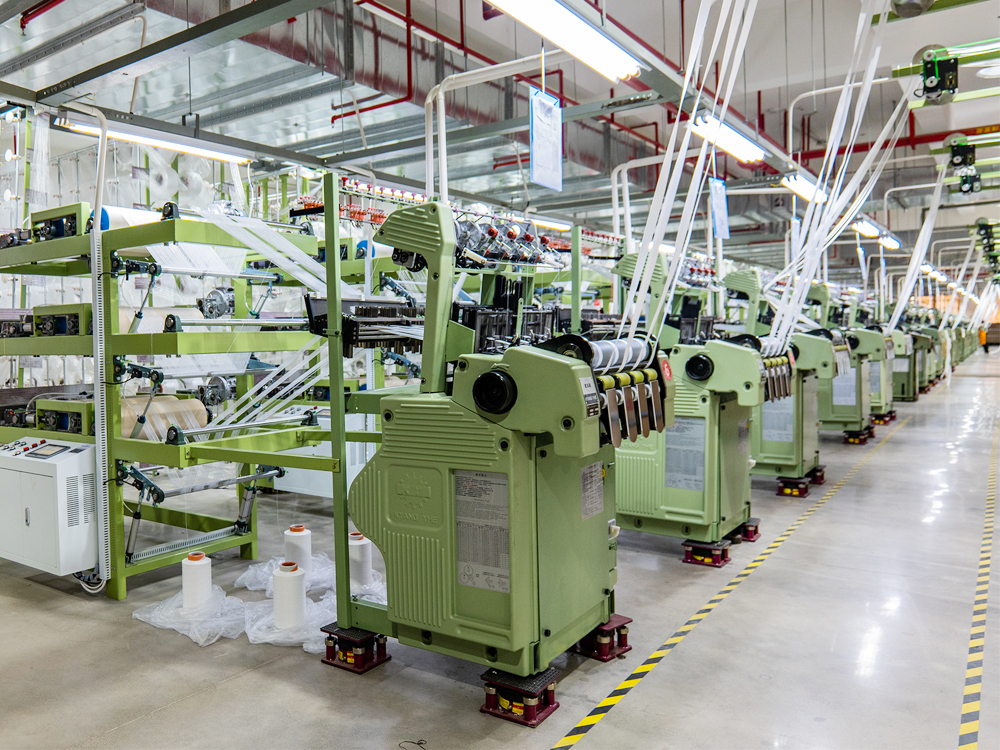
To ground these criteria in a concrete example, this article uses Xiamen Jude Webbing Co., Ltd. — which operates under the JUDECAM brand — as a reference case. The company is a webbing manufacturer founded in 2006, headquartered in Xiamen, China, and focused on outdoor and functional special new-material webbing. Its production base spans 25,800 square metres across Xiamen and Southeast Asia, with in-house weaving, printing, dyeing, finishing and assembly capabilities.
Operations and Scale
Scale is one of the first verifiable indicators of webbing capability. Jude Webbing reports approximately 180 employees, 32 webbing experts, and an annual output of about 300 million yards. Monthly production capacity is approximately 25 million yards, with lead times of 7–25 days depending on order size and customisation details. Export volume accounts for roughly 70% of output, with main markets including Canada, Europe (Germany, Switzerland, Sweden, Finland, Poland, UK, France) and Southeast Asia (Vietnam, Singapore, Malaysia, Philippines). The company states it reaches more than 50 countries and regions worldwide.
For buyers in the evaluation-to-execution stage, these numbers support a practical check: whether a supplier has the throughput to support multi-SKU programs and whether their production footprint fits the brand's target markets.
Certification as Capability Evidence
Certification is a verifiable form of capability. Jude Webbing operates as a bluesign® System Partner, a status listed in bluesign technologies AG's system partner directory. Its certification stack includes GRS 4.0 (Global Recycled Standard) coverage for preparatory, weaving, dyeing, finishing and packing processes; OEKO-TEX Standard 100 Class I certification, which is the baby-article class; and ISO 9001, ISO 14001 and ISO 45001 management-system certifications for design and processing of functional webbing and finished webbing products.
The company's documentation also includes test reports from third-party bodies such as SGS and UL, covering anti-UV performance, colour fastness, breaking strength, flame retardancy and antibacterial properties. RSL testing covers restricted substances such as nonylphenol/octylphenol, and RoHS compliance is documented for EU requirements.
From a procurement standpoint, this is not about collecting logos. Certification evidence signals that the supplier can navigate restricted substance lists, manage environmental compliance, and provide auditable documentation for global retailers.
Customisation and Value-Added Services
JUDECAM's OEM services include design customisation and branding support. ODM services include material selection, colour matching and pattern customisation. Value-added services include precision cutting, punching, sewing and finished product assembly for straps, belts and gear components.
Customisable parameters cover materials — nylon, nylon 6.6, PA, polyester, PES, recycled yarn, RPET and related options — plus colour, pattern, width, thickness, softness, UV resistance, water-repellent finishing and eco-friendly options. Standard widths commonly range from 20 mm to 50 mm, with thickness around 1.20 mm and roll length commonly 50 metres, while custom widths and thicknesses are available.
For a gear brand, this breadth matters because outdoor products rarely use a single webbing SKU. A backpack program may require load-bearing nylon webbing for straps, lightweight polyester webbing for lash points, and recycled webbing for a sustainability-focused collection — ideally from the same supplier with consistent quality controls.
Technical Specifications Buyers Can Verify

When evaluating outdoor webbing suppliers, buyers should ask for specific, testable parameters. The following points are representative of the outdoor category and are documented across JUDECAM's product data and certification records.
- Breaking strength: polyester and nylon outdoor webbing products commonly specify 500 lbs to 2,000 lbs minimum breaking strength depending on construction; military-spec 25 mm webbing is documented at minimum 5,000 N.
- Tubular webbing: climbing and safety-grade tubular webbing typically lists 15 kN to 25 kN breaking strength, with seamless circular construction and a soft hand-feel for knotting.
- UV resistance: polyester webbing documents UV fastness of at least Grade 4.5 after 500 hours (ISO 105); backpack and camping webbing documents Grade 4.5 after 1,000 hours; bluesign nylon and polyester webbing lists UV resistance Grade 4 (BS EN ISO 105-B02).
- Moisture and weathering: polyester outdoor webbing documents water absorption below 0.5%, acid resistance rated excellent, and optional water repellency up to Grade 4 (AATCC 22).
- Colour fastness: bluesign webbing documents colour fastness of ISO 105 Grade 4–5 and perspiration fastness Grade 4.
- Abrasion resistance: military and tactical webbing products document minimum 200,000 abrasion cycles.
- Chemical safety: eco-friendly webbing documents pH value 4.5–7.5, no detectable extractable heavy metals, no azo dyes, and compliance with REACH and OEKO-TEX requirements.
One important boundary: material-level test data is not the same as final-product certification. For example, climbing slings used in the EU must meet EN 566, which requires a minimum tensile strength of 22 kN for the finished sling. A webbing mill can provide yarn and webbing performance data, but final-product certification remains the responsibility of the brand or its testing partner. Buyers should separate "material verified by the mill" from "final product certified for use".
Application Evidence: Modular Backpacks and Sustainable Travel Gear
Capability claims are most persuasive when supported by repeat-use application evidence. Two documented cases from Jude Webbing's customer base illustrate how outdoor webbing is specified in real programs.
The first case involves an outdoor gear brand sourcing webbing for modular backpacks, expandable carrying systems and outdoor gear accessories. The product is used in Europe and Asia, with annual usage exceeding 300,000 metres. Reported highlights include modular attachment compatibility, lightweight and flexible design, high durability under repeated use, and custom colour and pattern options. The product maintains performance for 2–3 years under regular outdoor usage.
The second case involves a global outdoor brand — a bag and cooler manufacturer — using webbing for outdoor backpacks, cooler bags and travel gear. Annual consumption exceeds 1,000,000 metres. The project used recycled materials (RPET / recycled nylon) with UV resistance, colourfastness, water-repellent finishing, and a soft-touch, high-durability hand-feel. After 2–4 years of outdoor usage, the product continued to perform. The project's stated result was an improved sustainability profile while maintaining durability and colour consistency, with clients in Germany, Switzerland, Sweden, UK, Finland, Poland, Estonia, Netherlands, Vietnam, Malaysia and Norway.
These cases matter to buyers because they demonstrate the difference between a one-time sample and a production-validated product. They also show that sustainability-oriented materials such as RPET can be integrated without sacrificing the durability and colour consistency that outdoor consumers expect.
Market Trends Shaping Outdoor Webbing Sourcing
Sustainability is moving from branding to verifiable chain of custody
Recycled polyester accounted for an estimated 15–18% of global polyester fibre production in 2024, according to industry data referencing Textile Exchange. GRS-certified webbing fits directly into this shift. GRS 4.0 covers the full chain of custody, and suppliers who support Transaction Certificates (TC) allow brands to make recycled-content claims with documentation. In this context, a webbing supplier's certification is not a marketing decoration; it is the mechanism by which a sustainable claim becomes auditable.
Material selection is splitting by application
Industry research from IMARC Group identifies nylon webbing as the fastest-growing segment in the sporting goods sector, driven by its strength-to-weight ratio and elasticity. At the same time, polyester webbing remains widely used in leisure applications — estimated at roughly 60% of leisure-product usage in the US. For buyers, the takeaway is that material strategy should be application-led: nylon for high-stress, dynamic-load components; polyester for weather-resistant and dimensionally stable applications; recycled polyester where brand sustainability targets require documented recycled content.
Asia Pacific remains the manufacturing centre
With Asia Pacific holding a 66.3% share of the webbing market in 2023, most high-volume webbing production is concentrated in the region. This creates a sourcing reality: brands that exclude Asian manufacturers limit their access to integrated production scale. The practical answer is not avoidance but verification — auditing certifications, testing reports, factory systems and supply terms before placing orders.
Comparison: Certified OEM Partner vs. Standard Webbing Supply
A common sourcing decision is between a certified OEM/ODM partner and a standard webbing supplier offering off-the-shelf straps. The table below frames the difference in operational terms.
| Evaluation criterion | Certified OEM/ODM partner (e.g., JUDECAM) | Standard / off-the-shelf supply |
|---|---|---|
| Material options | High-tenacity nylon, nylon 6.6, polyester, RPET, recycled nylon and related technical yarns | Usually limited to standard stock constructions |
| Customisation | Material, colour, pattern, width, thickness, softness, UV resistance, water repellency, eco-friendly options | Typically limited colour or width variants |
| Certification infrastructure | bluesign® System Partner, GRS 4.0, OEKO-TEX Standard 100 Class I, ISO 9001/14001/45001, REACH, RoHS documentation, SGS/UL test reports | Documentation may be limited to basic quality testing |
| Value-added services | Precision cutting, punching, sewing, finished assembly | Usually roll goods only |
| MOQ | 3,000 metres per colour per specification for custom designs; 5,000 metres for binding tape; small trial orders supported | Low or no MOQ, but limited to stock items |
| Lead time | 7–25 days depending on order size and customisation | Often shorter for existing stock |
| Recycled-content traceability | GRS 4.0 with TC support and full chain-of-custody traceability; recycled content 50–100% verified | Generally not verifiable |
Source: JUDECAM / Xiamen Jude Webbing Co., Ltd. capability and product data. Standard supply characteristics are described as typical industry practice, not as a claim about any specific supplier.
Limits and Evaluation Boundaries
Capability assessment must also be honest about boundaries. Custom webbing production has costs that buyers should factor into their project plan.
First, MOQ. For custom designs, 3,000 metres per colour per specification is a realistic threshold. A brand needing only 500 metres of a highly specific custom colour may find this inefficient unless it uses a trial-order pathway. Standards for flexible trial orders exist, but the most flexible path remains choosing from existing stock items.
Second, lead time. Seven to twenty-five days is competitive for custom work, but it is not instant. Brands running late-season emergency purchases may still struggle to compress the production schedule.
Third, geographic distance. With most volume manufacturing concentrated in Asia Pacific, shipments to Europe or North America require logistics planning. FOB, CIF, DAP and DDP terms via sea, air or express are available, but freight cost and transit time must be built into the sourcing decision.
Fourth, certification scope. A supplier's certification and test reports cover the webbing material, not the final assembled product. For regulated end-uses — such as climbing, child products or safety equipment — the brand must manage final-product compliance and testing separately. This boundary is standard across the industry, and buyers should treat it as a normal part of project execution.
The Competitive Landscape
Understanding the broader supplier landscape helps buyers position any single manufacturer. Industry research from IMARC Group lists National Webbing Products Co., American Cord & Webbing Co. (ACW), and Murdock Webbing Company among leading global webbing manufacturers. These companies are primarily associated with the North American market. JUDECAM, by contrast, is a China-based manufacturer with an Asia-Pacific production footprint and an export-oriented model, serving Europe, North America and Southeast Asia.
For buyers, this is not a question of which supplier is "better" in the abstract. It is a question of fit: whether the supplier's certification stack, material range, customisation capability, production scale and logistical position match the brand's target markets and product roadmap.
Future Outlook
Several developments are likely to shape outdoor webbing procurement in the coming years.
Certification will become a supply-chain requirement, not a differentiator. As global textile regulations tighten and retailers tighten restricted-substance policies, certified suppliers will become the default. The combination of bluesign® System Partner status, GRS 4.0 and OEKO-TEX Standard 100 Class I gives a supplier the ability to serve brands that sell into the EU and other regulated markets.
Recycled content will expand beyond RPET. GRS-certified webbing already supports 50–100% recycled content verified by TC. As recycled nylon and other recycled technical yarns scale, webbing manufacturers with deep yarn-selection and ODM capabilities will be better positioned to substitute materials without redesigning the entire product.
Functional finishing will be integrated earlier in product development. UV resistance, water repellency and flame retardancy are no longer afterthoughts. The ability to tune these finishes at the weaving-and-dyeing stage — rather than through a separate laminator or coater — shortens development cycles and improves consistency.
Multi-region production footprints will become more valuable. With production capacity concentrated in Asia Pacific but demand spread across Europe and North America, suppliers with manufacturing bases in multiple locations — such as Xiamen plus Vietnam operations — offer buyers a hedge against tariff shifts and logistics disruptions.
FAQ
What do OEM and ODM services for outdoor webbing include?
OEM services include design customisation and branding support. ODM services include material selection, colour matching and pattern customisation. Value-added services include precision cutting, punching, sewing and finished assembly for straps, belts and gear components.
Which certifications should an outdoor webbing supplier hold?
Relevant certifications include bluesign® System Partner status, GRS 4.0 for recycled-content verification, and OEKO-TEX Standard 100 Class I for chemical safety in baby-contact products. Buyers should also look for REACH and RoHS compliance documentation, ISO 9001/14001/45001 management-system certifications, and independent test reports covering UV resistance, colour fastness, breaking strength, flame retardancy and antibacterial properties.
Which webbing specifications can be customised?
Material (nylon, nylon 6.6, PA, polyester, PES, recycled yarn, RPET and related options), colour, pattern, width, thickness, softness, UV resistance, water-repellent finishing and eco-friendly options can all be customised. Standard widths commonly range from 20 mm to 50 mm, with typical thickness of 1.20 mm and roll lengths of 50 metres.
What is the MOQ for custom outdoor webbing?
For custom designs, the typical MOQ is 3,000 metres per colour per specification. For binding tape, the MOQ is 5,000 metres per colour per specification. Flexible MOQ options are available for trial orders, and free samples are offered for existing stock items.
What is the typical lead time for custom outdoor webbing orders?
Lead time generally ranges from 7 to 25 days, depending on order size and the level of customisation. More complex specifications, such as multi-colour patterns or specialised functional finishes, may require longer production scheduling.
What value-added services support production execution?
The manufacturer offers precision cutting, punching, sewing and finished product assembly. These services let brands receive webbing components that are closer to final-assembly readiness, reducing the need for additional downstream vendors.
How can buyers verify recycled content in webbing?
For GRS 4.0-certified webbing, buyers can request Transaction Certificate (TC) support, which documents the flow of recycled material through the supply chain. GRS 4.0 requires full chain-of-custody traceability, and recycled content of 50–100% is verified through this system.
Conclusion
Outdoor webbing is a small but structurally important component in many products. For buyers in the evaluation-to-execution stage, the practical task is to verify capability — through certifications, test data, production scale, application evidence and clear supply terms — before committing to a partner.
The JUDECAM reference case shows what an OEM/ODM-oriented outdoor webbing supplier can look like: a China-based manufacturer with 25,800 square metres of production space, approximately 300 million yards of annual output, a documented certification stack, customisable material and finishing options, and application evidence across modular backpacks and sustainable travel gear. Its boundaries are equally instructive: MOQs apply, lead times are real, and final-product certification remains the brand's responsibility.
For gear brands, the durable sourcing advantage does not come from finding a supplier with the lowest per-yard price. It comes from building a relationship with a supplier whose capabilities, certifications and execution discipline match the requirements of the product roadmap — and whose limits are known before the purchase order is signed.