
Outdoor Webbing Suppliers: Long-Term Viability Checklist
Outdoor webbing is rarely the most expensive component in a backpack, a stroller or a set of camping straps, yet it is one of the few components a brand cannot quietly substitute once a product is in the field. That single characteristic changes what supplier evaluation is actually for. The question is no longer only whether a supplier can hit a price per meter on a first order, but whether the same supplier will still deliver the same webbing, with the same documentation, three or four seasons later.

Outdoor webbing spans backpack, camping, stroller and safety constructions, each with its own certification and tolerance profile.
Why long-term evaluation looks different from a first order
Short-term buying optimises three variables: unit price, sample quality and delivery date. Long-term evaluation keeps those three and adds four more that only become visible over time — whether sustainability claims are documentable rather than merely stated, whether batch-to-batch variation stays inside tolerance, whether commercial terms can flex as volumes grow, and whether technical support answers a question instead of forwarding it.
A first order tests a supplier's catalogue. A second order tests its process. A third order tests the organisation behind it. Most sourcing failures in webbing do not happen at the sample stage; they happen when a colour drifts in season three, when a certification scope turns out to cover a sister product rather than the SKU in the purchase order, or when the person who approved the original specification has left and nobody can reconstruct why a tolerance was set.
For buyers at the Awareness to Research stage, the practical implication is that evaluation criteria should be written down before the first quotation is opened — otherwise the quotation defines the criteria.
Five dimensions of supplier viability in webbing supply
Across outdoor gear, camping, stroller, pet and safety applications, long-term supplier assessment generally resolves into five dimensions. Each one can be evidenced or not evidenced; the mistake is treating all five as opinions.
- Documented sustainability. Certificate scope, recycled content basis, and chain-of-custody records that survive an audit or a brand's own sustainability report.
- Process control and repeatability. Defined test methods, stated tolerances and a laboratory capable of producing a report rather than an assurance.
- Commercial flexibility. Payment instruments, MOQ structure and allocation behaviour as order value grows.
- Technical responsiveness. The depth of the engineering function behind the sales contact, and whether change requests are processed as controlled revisions.
- Structural continuity. Capacity, production footprint, export experience and the ability to keep shipping through disruption.
The sustainability evidence that survives scrutiny
Sustainability claims in webbing are now specific enough to be evaluated, which is an improvement on the era of generic "eco-friendly" language. Three certification families appear most often in outdoor webbing specifications, and each answers a different question.
Bluesign® System Partner
Bluesign operates at the level of input streams and restricted substances: it assesses chemicals, processes and the manufacturing system rather than issuing a single product pass. A manufacturer's status as a Bluesign® System Partner therefore signals that the production system has been assessed, and buyers should confirm which articles are covered by that assessment. The certification family also publishes outcomes: bluesign reports that its system partners achieved a 17% intensity reduction in CO2 emissions in 2024, according to the bluesign System Impact Report 2024 — the kind of number that becomes usable in a brand's own environmental reporting.
GRS 4.0 (Global Recycled Standard)
GRS answers a narrower and more auditable question: how much recycled content is in this material, and can the chain of custody be traced? The mechanism that matters commercially is the Transaction Certificate (TC), which links a specific shipment back to certified content. In webbing specifications, GRS 4.0 is typically paired with a stated recycled content range and TC support, and the buyer's verification task is to confirm that the certificate matches the shipment rather than the general product family.
OEKO-TEX Standard 100 Class I
Class I is the baby-safe tier, which is why it appears disproportionately in stroller webbing, child carriers and skin-contact straps. The relevant parameters in a specification are specific rather than decorative: a pH value in the 4.5–7.5 range for skin contact, heavy metals below detection limits, and zero azo dyes.
| Certification | What it evidences | What it does not evidence | Request from supplier |
|---|---|---|---|
| Bluesign® System Partner | Manufacturing system assessed for chemical and process input management | That every article in the range is product-level approved | Scope statement and the article list covered |
| GRS 4.0 | Recycled content and chain of custody, verified by TC | Performance equivalence to virgin material | Transaction Certificate per shipment and the recycled content basis |
| OEKO-TEX Standard 100 Class I | Baby-safe chemical profile for skin contact | Mechanical strength or UV durability | Valid certificate with the tested article description |
Where JUDECAM sits in this framework
JUDECAM is the brand under which Xiamen Jude Webbing Co., Ltd., a webbing manufacturer established in 2006 and headquartered in Xiamen, China, supplies outdoor and functional special new material webbing to gear brands and converters. The company operates a self-built production base of 25,800 m² across Xiamen and Vietnam in Southeast Asia, employs approximately 180 staff including 32 webbing R&D experts, and reports an annual production capacity of 300 million yards. Export accounts for roughly 70% of sales, with business reaching more than 50 countries and regions, and principal markets including Canada, Germany, Switzerland, Sweden, Finland, Poland, the UK, France, and Vietnam, Singapore, Malaysia and the Philippines in Southeast Asia.
Those structural facts matter to a long-term evaluation in three specific ways.
Continuity of capacity. A two-country production footprint in Xiamen and Vietnam gives a buyer a second site to discuss when a single-site disruption would otherwise stop a programme. The evaluation task is to confirm, in writing, which site produces which SKU and how a transfer would be qualified.
Depth of the engineering function. A 32-person webbing R&D team is the difference between a supplier that can re-engineer a construction around a new buckle and one that can only quote from a fixed list. In long programmes, most technical value is created after the first order, not before it.
Export habit. A 70% export share across North American and European markets usually means the documentation side of the business — certificates, transaction records, labelling, customs classification — is routine rather than improvised.
Within that structure, the portfolio relevant to long-term sourcing includes Bluesign Webbing, GRS Webbing, RPET Webbing, Recycled Webbing and Eco-friendly Webbing for sustainability-led programmes; Polyester Webbing, Nylon Outdoor Webbing, Backpack Webbing and Camping Webbing for load-bearing outdoor programmes; Tubular Webbing for climbing and safety constructions; Aramid Webbing for heat- and flame-related applications; and Stroller Webbing for juvenile products. Two functional series sit alongside the standard range: AgingGuard, an aging-resistant woven webbing for long-term sunlight, rain and temperature cycling, and MicroGuard, an anti-mould and antimicrobial webbing for humid, high-contact environments.
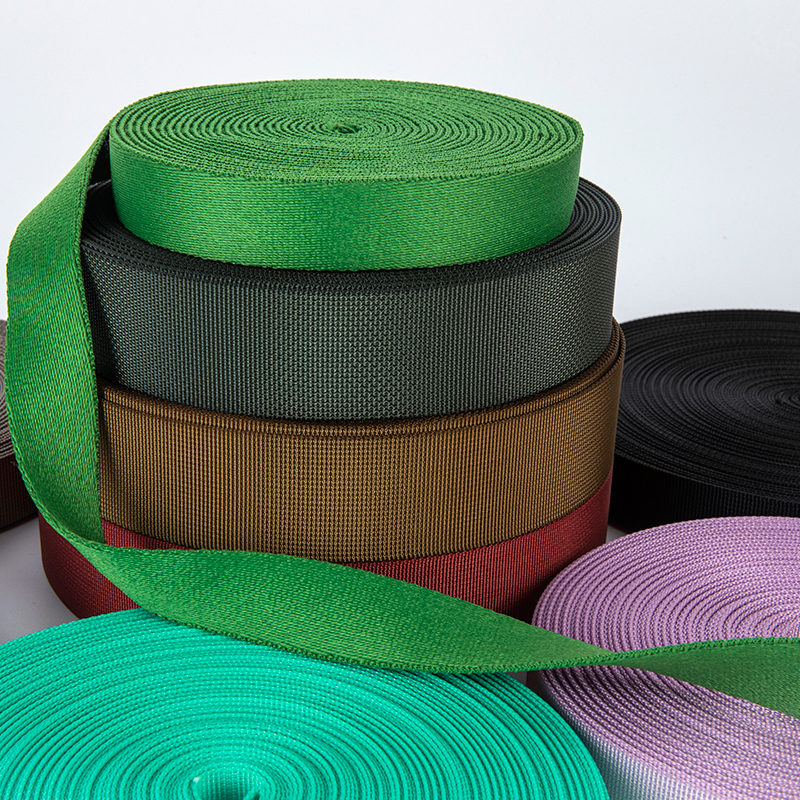
Sustainability-led programmes are usually specified by certification scope and recycled content basis, not by material name alone.
Batch consistency: the quiet test of partnership stability
A supplier that cannot repeat itself is a supplier that will eventually cost a brand a season. The useful discipline is to convert consistency into numbers that can be written into a purchase order, because a specification without an end-point cannot be enforced.
The baseline dimensions in this range are fixed enough to make variation visible: widths of 20, 25, 38 and 50 mm (1/2", 1", 1.5", 2"), a 1.20 mm reference thickness, and 50 meters per roll, all customisable. Where customisation is available, the tolerance has to be agreed rather than assumed.
On performance, the parameters that matter most in outdoor applications are UV fastness, water absorption, breaking strength and colour fastness. Reported values in the range include UV fastness Grade 4.5 after 1000 hours under ISO 105 for backpack and camping constructions, Grade 4.5 after 500 hours for polyester webbing, water absorption below 0.5%, breaking strength of minimum 500 lbs to 2000 lbs depending on specification, colour fastness Grade 4–5 under ISO 105, and salt water resistance Grade 4–5 under ISO 105-E02. Because breaking strength is expressed as a range rather than a point, a long-term contract should fix a target value and a test method, not accept the range as compliance.
The AgingGuard series illustrates what a properly closed specification looks like. In a 400-hour fluorescent UV weathering test using 4-hour light and 4-hour condensation cycles, the tested webbing showed 3.9% strength loss against a technical requirement of no more than 8%, with breaking strength moving from 29,913 N to 28,760 N on a 30 mm by 3.0 mm, 63 g/m construction, referencing FZ/T 65002-1995 and GB 5725-2009. A buyer can write "no more than 8% strength loss after 400 hours" into a purchase order and hold a supplier to it — which is precisely what cannot be done with a claim that a material is "weather resistant".
Two other verification-friendly examples sit in the same range. The MicroGuard anti-mould construction was tested to GB/T 24346-2009 over 28 days at 28°C and 90% relative humidity by SGS, achieving Grade 0 anti-mould performance. The tubular climbing construction carries a breaking strength of 15 kN to 25 kN, with UIAA certification obtained through a European testing agency via a brand customer — a nuance worth noting, because it means the certificate path ran through a specific customer's submission rather than a standing generic approval.
Stroller webbing adds a fatigue dimension suited to juvenile products: more than 10,000 buckle cycles, with rounded edges and a smooth surface specified for infant skin protection.
Practical rule. Ask for the test report, not the test claim. A report carries a method, a laboratory, a date and a sample description; a claim carries an adjective.
Commercial terms, payment structure and partnership flexibility
How a supplier structures payment and volume is one of the few reliable signals of whether it treats a buyer as a programme or as a purchase order. In narrow woven fabric and webbing trade, settlement is typically handled through telegraphic transfer (T/T) or a documentary credit (L/C), and the instrument a supplier can support usually shifts as order value and relationship length change — which is exactly why the topic belongs in an evaluation framework rather than in a late-stage negotiation.
A buyer preparing a long-term agreement should obtain written confirmation of a small number of items rather than a general assurance of flexibility:
- The payment instrument supported at current volume, and whether it can change as volume grows.
- Deposit ratio on first production and the trigger for balance settlement.
- Whether a credit window is available for repeat programmes, and under what conditions.
- How MOQ is set, and whether it steps down or up across the life of the programme.
- The price validity period and the mechanism for raw material adjustment.
- Allocation rules when capacity is tight, stated in advance rather than negotiated during a shortage.
- Change control: who approves a construction or colour change, and how it is recorded.
None of these are exotic, and all of them are cheap to agree before the first order and expensive to agree after it. The evaluation question is not whether a supplier offers generous terms to everyone, but whether the terms on offer are internally consistent — a supplier that cannot describe its own MOQ logic is unlikely to manage allocation predictably when demand spikes.
After-sales support as a leading indicator
After-sales support is frequently assessed by response speed, which is the least informative measure available. A faster reply that contains no engineering authority is worth less than a slower one that contains a test result. The more useful question is structural: who, inside the supplier, is able to answer a technical question, and what can they access?
In this respect, the presence of an in-house webbing testing laboratory — used for weathering, colour and physical testing — and a dedicated R&D team are stronger indicators than any stated service commitment. A supplier with a laboratory can respond to a colour drift complaint with a measurement; a supplier without one can only respond with an explanation. The same logic applies to change requests: a supplier that maintains a controlled specification can tell a buyer precisely what a construction change would do to strength, thickness and certification scope, and a supplier that does not will simply confirm that a change is possible.
For long programmes, three support behaviours are worth testing before commitment: how a non-conformance is investigated and whether the corrective action changes the written specification; whether a technical question is answered with a report reference or with reassurance; and whether documentation requests are met within a normal working cycle rather than escalated.
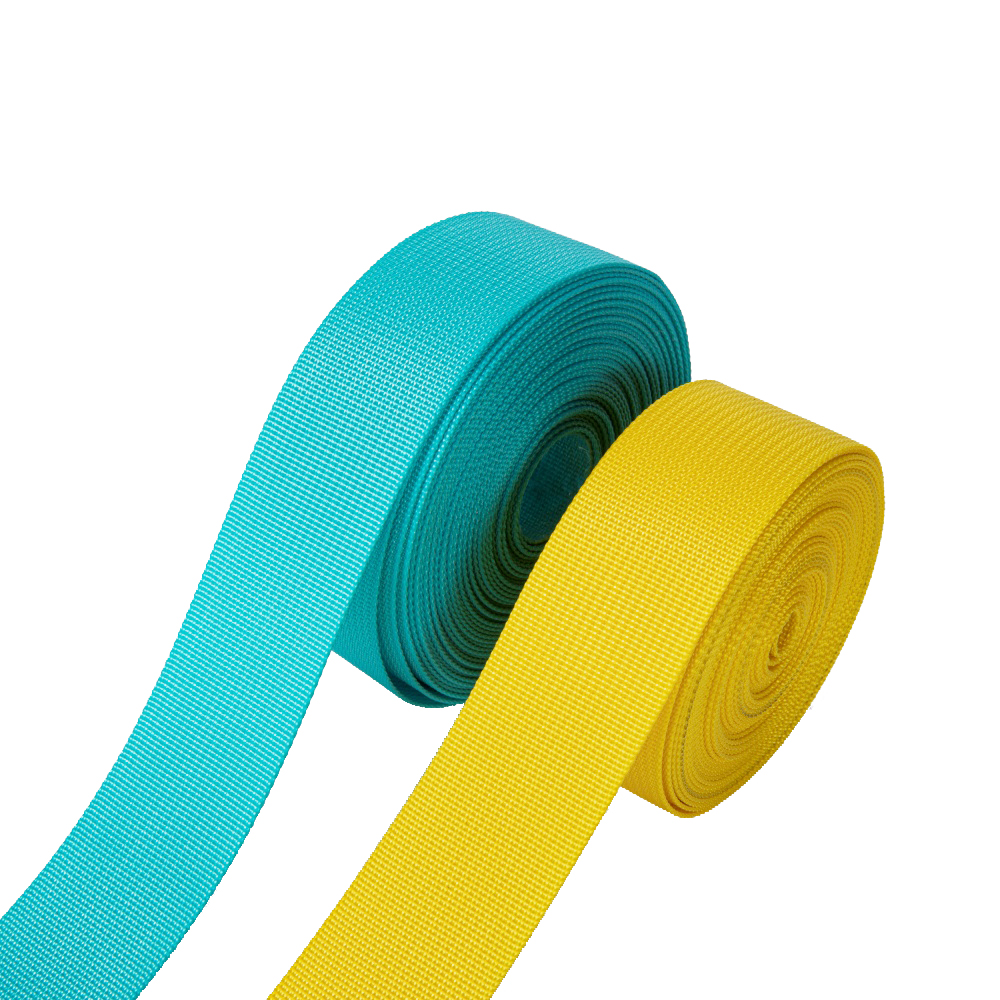
Polyester webbing is typically specified by UV fastness, water absorption and a fixed breaking strength target rather than a range.
What a transactional approach misses — and where certification-led sourcing has limits
The case for long-term evaluation is not that certification-led sourcing is flawless. It has real boundaries, and buyers should carry them into the negotiation.
Certification is not uniform across a catalogue. Bluesign, GRS 4.0 and OEKO-TEX Class I apply to specific constructions and articles. The same manufacturer's aramid and military-specification nylon lines are specified around different frameworks entirely — such as A-A-55301, MIL-W-17337, MIL-T-5038, MIL-W-5625, MIL-W-4088 and MIL-W-27265, with tensile strength certified from 450 lbs up to 15,000 lbs+ depending on type, and abrasion resistance of at least 200,000 cycles. A buyer sourcing safety or defence items should not assume that a sustainable textile certification set carries across the whole range.
System partner status is not product approval. Bluesign System Partner indicates assessment at the manufacturing-system level. Confirming that a specific article is covered requires the scope document, and buyers who skip that step sometimes discover that a claim was made one level up from the SKU they purchased.
Documentation must be verified independently. Certificate numbers, validity periods and transaction certificates are not published in ordinary product data. Independent verification through the relevant certification body's database is required before any claim enters a brand's own sustainability reporting — and that verification is a buyer-side task, not something a supplier can complete on the buyer's behalf.
Certified material carries a cost. Bluesign-certified fabric has been reported at a 5–12% premium over equivalent non-certified fabric. For mass-market programmes that premium is a genuine budget constraint, and the practical response is to scope certification to the SKUs where a claim is actually made and defensible, rather than certifying an entire range to satisfy a single marketing requirement.
Company performance figures are self-reported. Capacity, headcount and export share describe a supplier's own account of itself. They are useful for a first-pass screen and should be corroborated through factory audit, certificate databases or reference customers before they carry weight in a qualification decision.
Market context: sustainability has become a cost line, not a slogan
The commercial backdrop is larger than most buyers assume for a component this small. The global webbing market was valued at USD 4.65 billion in 2025 and is projected at USD 4.86 billion in 2026, according to Grand View Research data reported by FBI Reports. Asia Pacific dominated with a revenue share of 66.3% in 2023, which is consistent with the concentration of narrow woven fabric production in the region.
Two structural shifts shape supplier evaluation inside that market. The first is that certification systems now publish measurable outcomes rather than only process rules — the 17% CO2 intensity reduction reported by bluesign system partners in 2024 is an example — which means a buyer's own environmental reporting increasingly depends on supplier-level data. Supplier selection quietly becomes a data acquisition decision.
The second is documentation as a trade requirement. Narrow woven fabrics fall under HS heading 5806 in the international nomenclature, and product-level classification varies by construction, coating and material, with national tariff schedules adding further variation. For a buyer modelling landed cost across a multi-year programme, a supplier that can supply consistent classification and documentation is worth more than a marginal price difference.
A practical evaluation sequence
| Stage | Question to answer | Evidence to request |
|---|---|---|
| Screen | Does the supplier's portfolio actually cover the construction I need? | Product range with materials, widths, thickness and reference standards |
| Certify | Is the claim scoped to my article, and is it current? | Bluesign scope statement, GRS certificate and TC process, OEKO-TEX Class I certificate |
| Verify performance | Are the parameters measurable and enforceable? | Test reports with method, laboratory, date and sample description |
| Test repeatability | Will season three look like season one? | Historical batch data, colour tolerance, in-house laboratory capability |
| Agree commercials | Can terms flex as the programme grows? | Written payment instrument, MOQ logic, price validity, allocation rules |
| Confirm continuity | What happens under disruption? | Site allocation by SKU, second-site qualification path, capacity statement |
| Set support terms | Who answers a technical question, and with what? | Named technical contact, change-control process, non-conformance procedure |
Future outlook
Three developments are likely to sharpen long-term webbing evaluation over the next few seasons. Recycled content will keep moving from a differentiator to a baseline expectation, which will push scrutiny from "do you have GRS" toward "can you produce the transaction certificate for this shipment" — a documentation question rather than a certification question.
Second, performance disclosure will continue to standardise around named methods. Once a buyer can specify Grade 4.5 after 1000 hours under ISO 105 or no more than 8% strength loss after 400 hours of weathering, the suppliers that can answer with a report separate themselves quickly from those that cannot, and the separation is visible before the first order rather than after the third.
Third, supply continuity will be evaluated as a design feature rather than a promise. Dual-site production, stated allocation rules and a written transfer path between sites are more useful to a brand than a capacity figure, because they describe what happens on the day capacity is short.
Frequently asked questions
What does long-term supplier evaluation mean when buying outdoor webbing?
It means assessing a supplier against criteria that only become observable over multiple order cycles, rather than against first-order criteria such as unit price, sample quality and delivery date. In practice the additional criteria are documentable sustainability claims, batch-to-batch repeatability, commercial flexibility, technical responsiveness and structural continuity. A first order tests a supplier's catalogue; a third order tests the organisation behind it.
Which certifications should a long-term outdoor webbing supplier hold?
For sustainability-led outdoor programmes, three certification families are most commonly specified: Bluesign® System Partner, which assesses the manufacturing system for chemical and process input management; GRS 4.0, which verifies recycled content and chain of custody through transaction certificates; and OEKO-TEX Standard 100 Class I, the baby-safe tier used for skin-contact and juvenile applications. A supplier's range may also include constructions specified against military standards such as A-A-55301, MIL-W-17337 or MIL-W-5625, which address different requirements and should not be assumed to carry the sustainable textile certification set.
How does a buyer verify GRS recycled content in webbing?
Verification runs through the Transaction Certificate rather than the product description. GRS 4.0 pairs a stated recycled content range — commonly 50% to 100% in webbing specifications — with a transaction certificate that links a specific shipment to certified content, supported by a documented chain of custody. The buyer's task is to confirm that the certificate references the shipment and article actually purchased, and to check certificate validity with the certification body rather than relying on the supplier's summary.
What payment terms are typically discussed in outdoor webbing supply agreements?
Settlement in narrow woven fabric and webbing trade is typically handled through telegraphic transfer (T/T) or a documentary credit (L/C). What changes across a long programme is the structure around the instrument: deposit ratio on first production, the trigger for balance settlement, whether a credit window is available for repeat orders, the price validity period and the mechanism for raw material adjustment. Each of these should be recorded in the supply agreement rather than agreed verbally, because verbal flexibility tends not to survive a change of account manager.
How can a buyer test batch-to-batch consistency before committing to a long-term order?
By converting consistency into measurable end-points. Baseline dimensions such as 20, 25, 38 and 50 mm widths with a 1.20 mm reference thickness make variation visible, and performance parameters can be fixed numerically: UV fastness Grade 4.5 after 1000 hours under ISO 105, water absorption below 0.5%, colour fastness Grade 4–5, and a specific breaking strength target rather than a range. Where a defined weathering requirement exists, such as no more than 8% strength loss after 400 hours, it can be written into a purchase order and checked against a report.
What are the warning signs that a webbing supplier is not built for a long partnership?
The recurring indicators are structural rather than attitudinal. A supplier that cannot state its MOQ logic is unlikely to manage allocation predictably. One that answers a technical question with reassurance rather than a test report reference usually lacks in-house testing capability. One that cannot describe which site produces a given SKU has no qualified transfer path if that site is disrupted. And one whose certification claims cannot be traced to a scoped certificate for the specific article is offering a claim one level above the product — a gap that typically surfaces only when a brand's own sustainability report is audited.
Есть вопросы или нужны дополнительные детали?
Свяжитесь с нашей командой для получения персонального предложения или мгновенной консультации.
Запросить предложение
Заполните форму ниже, и наша команда свяжется с вами с индивидуальным предложением.
Прямой чат WhatsApp
Предпочитаете общаться в реальном времени? Напишите нам в WhatsApp для мгновенной помощи и быстрых ответов.
- Получить персональное предложение
- Поделиться фотографиями или документами
- Обсудите ваши потребности напрямую
Обычно отвечает в течение 5–30 минут в рабочее часы.