
Oversized Chandeliers: Custom Decorative Lighting for Hospitality
For hospitality projects, an oversized chandelier is both a light source and a spatial landmark. The buying decision is rarely about a single product; it is about whether a manufacturer can engineer, produce, certify and deliver a non-standard decorative lighting piece on a project schedule.
In 2025, the global decorative lighting market was estimated at USD 75.88 billion, with Mordor Intelligence projecting USD 78.98 billion by 2026. Commercial applications, including hospitality, account for 62.8% of decorative lighting end-user demand in 2025, according to IMARC Group. These figures help explain why hotel procurement teams are moving beyond catalog products toward custom decorative lighting that fits specific lobbies, banquet halls and guest-room programs.
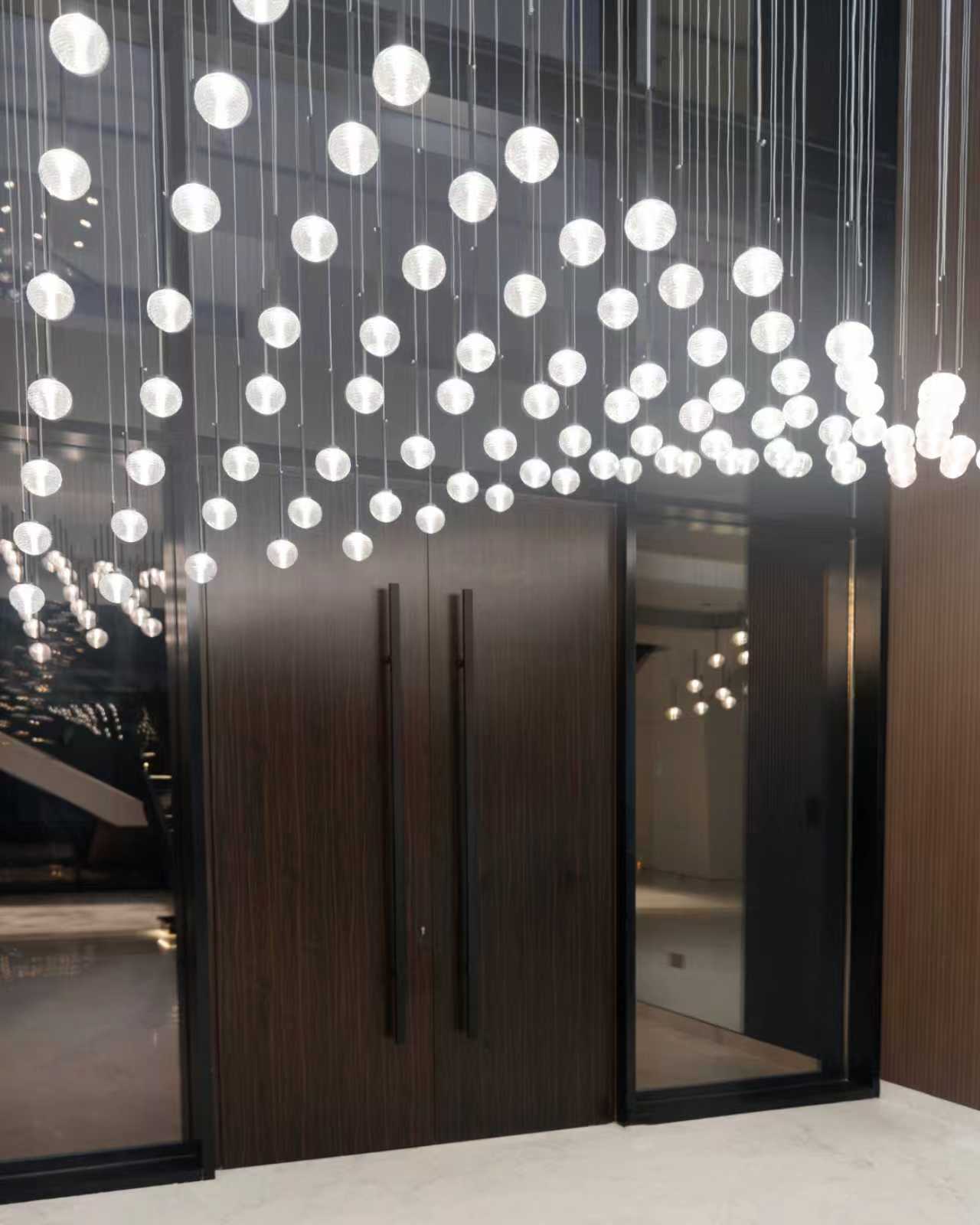
Custom oversized lobby chandelier: a project-specific decorative lighting solution.
The Problem: Standard Decorative Lighting Meets Non-Standard Spaces
High-ceiling lobbies and large banquet halls are difficult spaces for standard chandeliers. Ceiling heights vary, ceiling structures differ, and the interior design language often requires a piece that does not exist in a standard catalog. A five-star hotel lobby may need a chandelier several metres wide, with a custom mounting structure, dimmable LED light sources and a finish that matches the architectural palette.
Mass-produced lamps often fail to match light-luxury, neo-Chinese or minimalist hotel decoration styles. Custom-shaped lamps can be tailored according to floor height and reserved dimensions, which makes them suitable for special-shaped ceilings. For procurement teams, this creates a verification problem: a supplier must demonstrate design sensitivity, structural engineering, material control, production capacity and inspection discipline, not just product images.
What a Buyer Should Verify Before Commissioning an Oversized Chandelier
A capability-driven evaluation should cover several areas:
- OEM/ODM scope: Can the manufacturer restore a design proposal 1-to-1 and offer optimisation suggestions?
- Customisation limits: Does the factory control dimensions, materials, light-source configuration, dimming systems, mounting structures and finishes?
- Production capacity and lead time: Can the factory handle project volumes without sacrificing delivery?
- Quality control: Is every lamp inspected before shipment?
- After-sales support: Is there warranty coverage and remote technical guidance?
| Selection factor | What to verify |
|---|---|
| OEM/ODM | Production services and design optimisation |
| MOQ | Minimum order quantity for custom project pieces |
| Capacity | Monthly production capacity and ability to prioritise urgent hotel orders |
| Lead time | Standard and accelerated delivery options |
| Inspection | 100% pre-shipment full inspection and quality checklist |
| Warranty | Coverage for engineering lighting products |
Capability in Practice: OEM/ODM and Custom Execution
Zhongshan YZ ART LIGHT Co., Ltd., based in Zhongshan, Guangdong Province, China, is a decorative lighting manufacturer focused on high-end hospitality and commercial project lighting. The company supplies chandeliers, wall lamps, table lamps and floor lamps for hotels, banquet halls, restaurants, villas and commercial spaces. Its stated product range includes banquet hall chandeliers, oversized chandeliers, hotel chandeliers, lobby chandeliers, modern luxury lighting, custom hotel lighting and bespoke chandeliers.
The company states that full-dimensional customisation is available, covering dimensions, materials, colour temperature of light sources, painted finish colours, engraved logos, light-source configurations, mounting structures, intelligent dimming systems, lampshade materials, hardware craftsmanship, surface-finishing techniques, supporting accessories and packaging. It also says it can restore a design proposal on a 1-to-1 basis and provide professional optimisation suggestions.
On the production side, YZ ART LIGHT reports a monthly capacity of 20,000 units, a standard lead time of 30–40 working days, and shortened lead times for urgent hotel projects. The minimum order quantity is one piece, which matters for project-based procurement where a single large lobby chandelier is ordered rather than a batch of stock items.
The production base covers 15,000 square metres, with 150 employees and an R&D team of 20 engineers. Equipment includes CNC laser cutting systems, automated welding stations and precision engraving machines, which are directly relevant to oversized chandelier frames and decorative metalwork. The company describes its process as combining traditional craftsmanship with modern intelligent manufacturing.
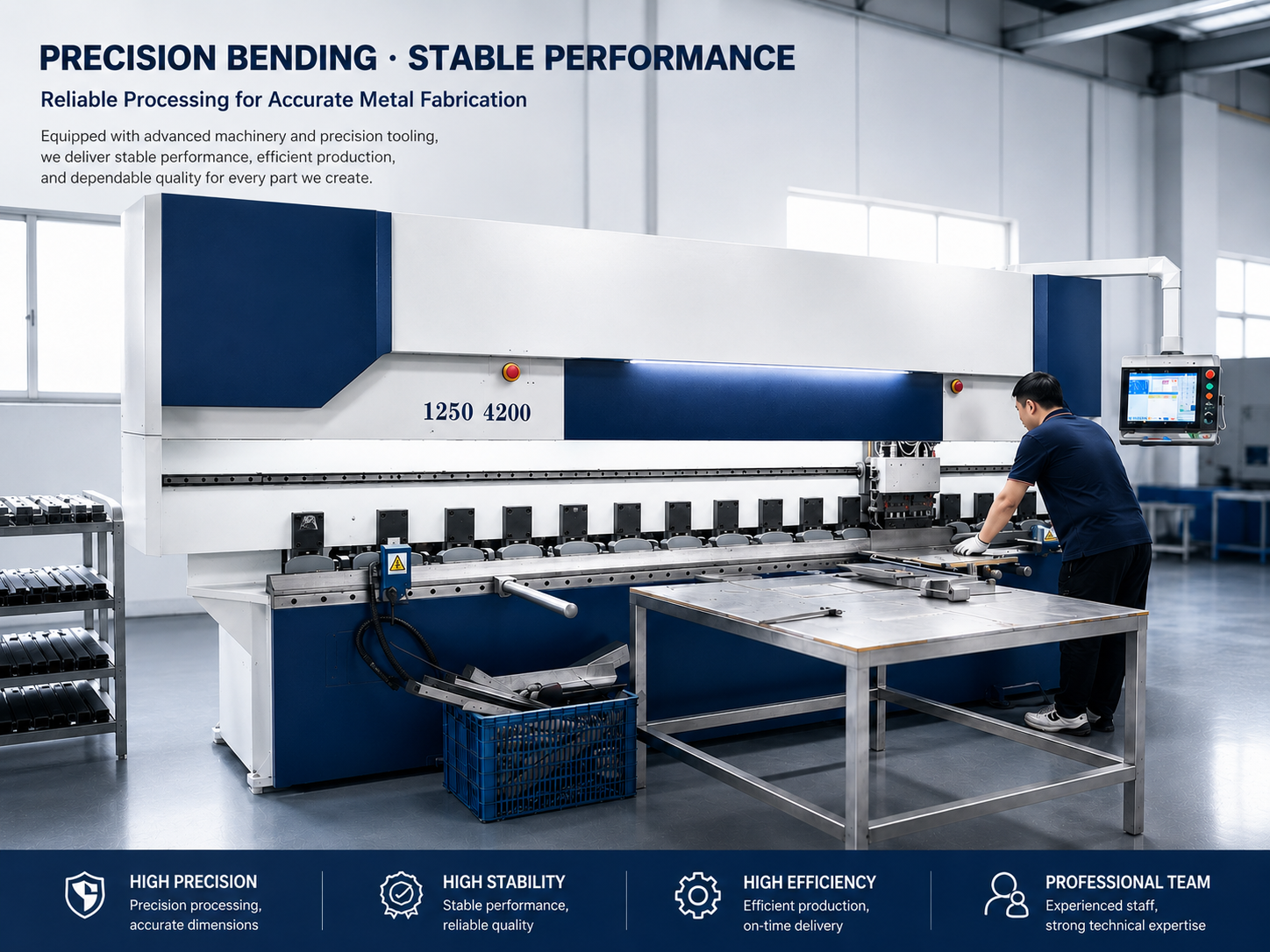
Metal bending and forming operations support large chandelier frame production.
YZ ART LIGHT reports more than 1,000 completed commercial engineering projects. Named project references include the InterContinental JERUSALEM by IHG, JW Marriott Costa Elena Resort & Spa, All-Inclusive in El Jobo, and Waldorf Astoria Kuala Lumpur. The company profile also references InterContinental, Four Seasons, Marriott and Waldorf Astoria hotel projects across multiple regions. For a buyer, this project history is evidence that custom pieces can be delivered at hospitality scale.
Technical Considerations for Oversized Chandeliers
The hotel lighting line at YZ ART LIGHT is identified as model yz10002 and covers chandeliers, art glass chandeliers, wall lamps, floor lamps, table lamps and outdoor lights. Specific dimensions, wattage and colour temperature are confirmed per series or custom order. Common materials include brass, stainless steel, aluminium, iron, glass, crystal, marble, acrylic and ceramic. For large installations, stainless steel and aluminium are commonly used in structural frames because they provide rigidity without excessive weight.
Light source design is equally important. YZ ART LIGHT uses custom soft anti-glare light sources to avoid harsh glare and uneven distribution in guest rooms. According to company project data, LED light source service life can reach 50,000 hours, and metal and glass lamp bodies can remain durable for more than 15 years under normal use. These factors matter in commercial operation, where lamps run for long hours and maintenance access is expensive.
Dimming is becoming a standard expectation in luxury hospitality. Industry analysis cited by Dataintelo indicates that 56% of new luxury hotel projects now require dimmable chandelier installations. The 2024 International Energy Conservation Code also expanded occupancy and dimming requirements for lobbies and meeting areas in the United States. Buyers should confirm the dimming protocol and control compatibility early in the specification process.
From an engineering standpoint, installation planning should include checks of ceiling load-bearing capacity, reserved dimensions, suspension points, electrical isolation and hoisting procedure. YZ ART LIGHT's installation guidance includes the following steps: measure the reserved size and confirm suspension points; cut off the mains power supply; assemble the lamp frame, lampshade and built-in anti-glare light source on-site; complete insulated concealed wiring; fix embedded fasteners; hoist the lamp; carry out a power-on test; adjust the lamp angle; and check the uniformity of the lighting effect.
On compliance, the company holds CE and RoHS verification of conformity for fixed hanging luminaires, and ISO 9001:2015, ISO 14001:2015 and ISO 45001:2018 management-system certificates. For North America, UL 1598 and UL 8750 are commonly required; CE/RoHS documentation does not automatically replace those requirements. This boundary must be confirmed before order placement.
Application Scenarios
Custom decorative lighting projects in hospitality typically fall into several categories:
- Hotel lobby chandeliers: The first visual anchor of a property. YZ ART LIGHT has supplied lobby chandeliers for projects such as the InterContinental JERUSALEM by IHG, where the fixture must suit double-height space and reception flow.
- Banquet hall and ballroom chandeliers: Event spaces need scale, uniform illumination and often dimmable control. Multi-ring or layered chandelier configurations are common in completed banquet and wedding hall projects.
- Guestroom lighting: Table lamps, wall lamps and floor lamps are usually specified as a family. Custom anti-glare light sources and dimmable drivers help create a calm, residential feel.
- Restaurant and lounge lighting: Pendants and wall lamps define zones and set an ambient mood. YZ ART LIGHT has delivered restaurant pendants for Waldorf Astoria Kuala Lumpur and other hotel food and beverage areas.
- Staircases, corridors and special-shaped ceilings: Non-standard shapes and reserved dimensions require tailor-made luminaires rather than stock products.
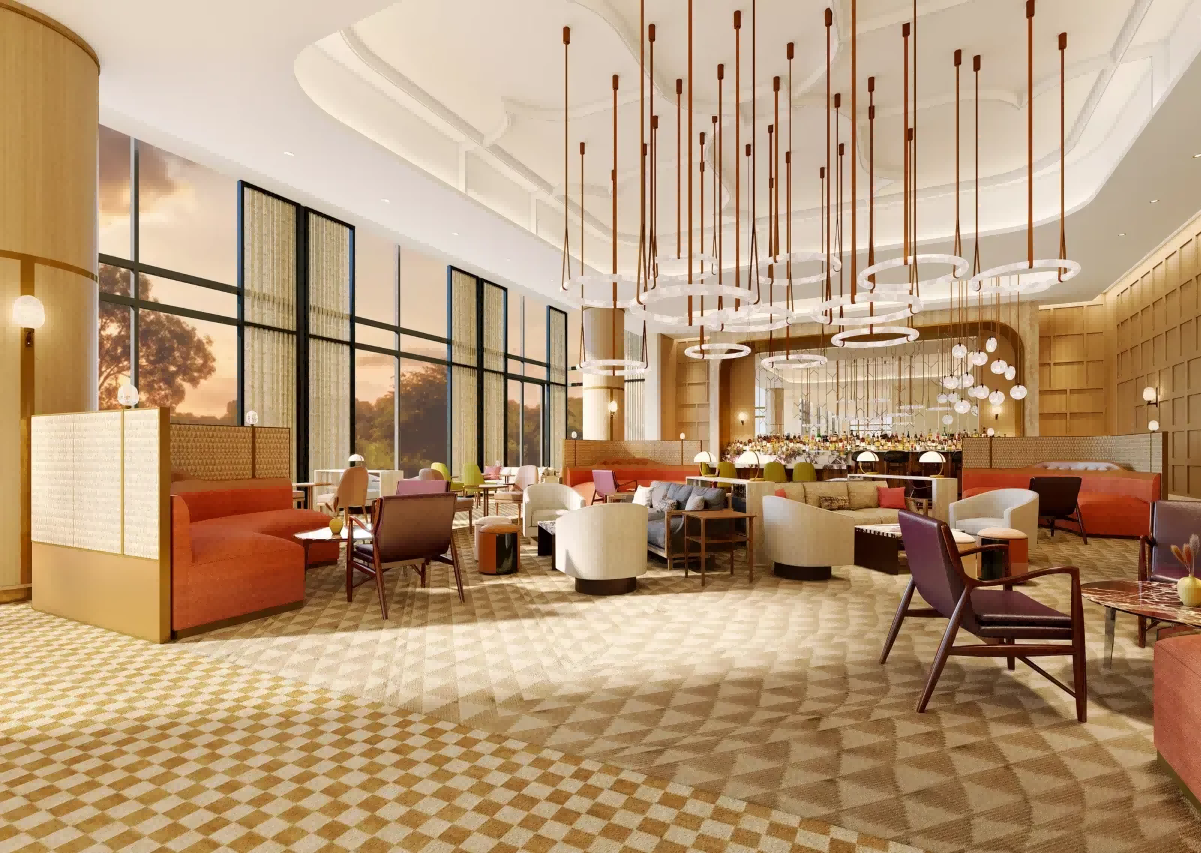
Hotel lobby chandelier application at InterContinental JERUSALEM by IHG.
These application patterns show why the buyer's core question is not simply which chandelier looks best, but which manufacturer has the capability to interpret a design, engineer it, produce it and support it on site.
Market Context
The data supports a continued shift toward custom, high-end hospitality lighting. Transparency Market Research valued the global chandelier market at USD 14.9 billion in 2024 and projects USD 25.8 billion by 2035 at a 5.5% CAGR. Dataintelo values the hospitality lighting market at USD 14.2 billion in 2025, with a 7.3% CAGR expected through 2034.
Regional demand is also relevant. Grand View Research reports that North America accounted for 36.45% of the global decorative lighting market in 2025, while Asia Pacific held a 44.6% share of high-end lighting revenue in 2024. The same source reports that transitional design accounted for 65.7% of chandelier market revenue in 2024. In the Middle East, Saudi Arabia's Vision 2030 targets 150 million annual tourist visits and more than USD 500 billion in hospitality infrastructure investment, according to Dataintelo, creating a large pipeline of projects that require high-spec lighting.
Technology is shifting what buyers expect. IMARC Group identifies LED as the dominant light source in decorative lighting, with a 39.8% share in 2025. Product launch tracking from Market Reports World suggests that smart chandeliers with voice control or IoT connectivity now account for more than 33% of new launches. For a custom chandelier project, the buyer should therefore ask whether the manufacturer can integrate intelligent dimming systems and whether the control system is compatible with the hotel's existing building-management platform.
Comparison with Traditional Sourcing Routes
For non-standard decorative lighting, the traditional alternative is often a trading supplier or a standard catalog product. In some cases, that route is acceptable: when the project needs a simple, standardised stock lamp, when no custom shape or finish is required, and when the order is too small to justify an engineering process. A trading supplier can source a known product faster and with less coordination.
The trade-off appears when the project requires custom dimensions, special materials, structural calculation or on-site installation support. A factory-direct manufacturer can provide drawing deepening, structural safety calculation, production and inspection in one workflow. YZ ART LIGHT describes a one-stop process from design consultation to structural optimisation and mass production, with a quality-approval checklist attached to each shipment.
| Selection factor | Factory-direct custom manufacturer | Traditional trading supplier |
|---|---|---|
| Custom shapes and finishes | Full-dimensional customisation | Usually limited to existing stock |
| Structural and drawing engineering | In-house R&D and structural optimisation | Typically not offered |
| MOQ and project flexibility | MOQ of 1 piece | May work for stock, less flexible for custom |
| Inspection transparency | 100% pre-shipment inspection with checklist | Depends on supplier |
| After-sales support | 3-year warranty; remote technical guidance | Depends on intermediary |
Limitations and Boundaries
Factory-direct customisation is not always the right answer. For very small projects that require only stock catalog items, a trading supplier may be faster and more economical. For large custom chandeliers, the buyer must also accept longer lead times—typically 30–40 working days—and the need for early structural information such as ceiling load capacity and reserved dimensions.
Certification is another boundary. A supplier's CE/RoHS documentation covers EU market requirements; it does not automatically satisfy UL requirements in North America or other local standards. Buyers should confirm target-market certification before placing an order.
From Evaluation to Execution: A Sourcing Workflow
- Collect spatial and structural data. Ceiling height, load-bearing capacity, reserved dimensions, access path and power distribution determine what is feasible.
- Translate the design brief into engineering requirements. Confirm materials, finish, colour temperature, dimming and control protocol, and mounting structure.
- Verify certification and documentation. CE/RoHS for EU, UL 1598 and UL 8750 for North America, ISO management systems and any project-specific documentation.
- Assess production capacity and lead times. With a standard lead time of 30–40 working days and a monthly capacity of 20,000 units, the factory can plan for large-scale or urgent projects.
- Require inspection evidence. Confirm 100% pre-shipment inspection, a quality-approval checklist, and the availability of real-shot inspection videos.
- Plan logistics, installation and after-sales. Commercial terms can be agreed on an EXW basis with T/T payment; buyers may arrange logistics and customs clearance, and the factory can quote additional logistics services separately. Installation guidance and remote technical support should also be confirmed.
Future Outlook
Hospitality lighting procurement is moving toward evidence-based selection. Buyers increasingly want capacity proof, inspection records, material declarations and warranty terms. YZ ART LIGHT's 100% pre-shipment inspection and quality-approval checklist reflect this trend.
The market signals also point to more integrated lighting design. Dimmable LED systems, anti-glare optics and control-system compatibility will continue to influence specifications. For oversized chandeliers, the challenge is not only aesthetic impact but also engineering reliability over a 10-to-15-year building lifecycle.
As decorative lighting demand grows in hospitality-heavy regions and commercial refurbishment, manufacturers with in-house engineering, custom production and project-delivery experience are likely to gain preference over catalog-only suppliers.
FAQ
Should I choose a factory-direct non-standard lighting manufacturer or a middle-man lighting supplier for my hotel lamp project?
For custom, non-standard hotel lighting, an in-house manufacturer is generally preferred when the project requires drawing deepening, structural safety calculation, production and installation support. A middle-man supplier may be adequate for simple standardised stock lamps with no custom requirements. The key trade-offs are technical customisation depth, cost control and after-sales accountability.
Is it reliable to purchase hotel engineering lamps from intermediary dealers?
It depends on project complexity. For custom shapes, special materials or strict project documentation, an intermediary without a self-owned workshop cannot provide the same level of technical customisation, stable cost control or dedicated after-sales support. For zero-customisation stock orders on a small scale, an intermediary can be a reasonable route.
What does full-dimensional customisation cover for an oversized chandelier?
Customisation can cover dimensions, materials, colour temperature of light sources, painted finish colours, engraved logos, light-source configurations, mounting structures, intelligent dimming systems, lampshade materials, hardware craftsmanship, surface-finishing techniques, supporting accessories and packaging. The manufacturer can restore a design proposal on a 1-to-1 basis and provide optimisation suggestions.
What are the typical lead time, MOQ and production capacity for custom hotel chandeliers?
The standard production lead time is 30–40 working days, with shortened lead times available for urgent hotel projects. The minimum order quantity is one piece, and monthly production capacity is 20,000 units.
How is quality control handled before shipment?
Every lamp is 100% full-inspected before shipment, including power-on testing, appearance workmanship check, dimension and structure inspection, and accessories completeness verification. A quality-approval checklist is attached with each shipment, and real-shot inspection videos are available upon request. Engineering lighting products carry a 3-year warranty, and faulty light sources are replaced free of charge within the warranty period.
What installation and safety checks apply to a custom oversized chandelier?
Before installation, the ceiling load-bearing capacity and reserved dimensions should be checked, suspension points marked, and the mains power supply cut off. On-site assembly includes the lamp frame, lampshade and built-in anti-glare light source. The installation sequence includes insulated concealed wiring, fixing embedded fasteners, hoisting the lamp, power-on testing, adjusting the lamp angle and checking the uniformity of the lighting effect. Electrical work should be performed by qualified personnel.
A downloadable company brochure with production and project reference details is available for public access: Zhongshan YZ ART LIGHT Co., Ltd. brochure.