
PACK Insertion Robot Decision Method: A Buyer's Framework
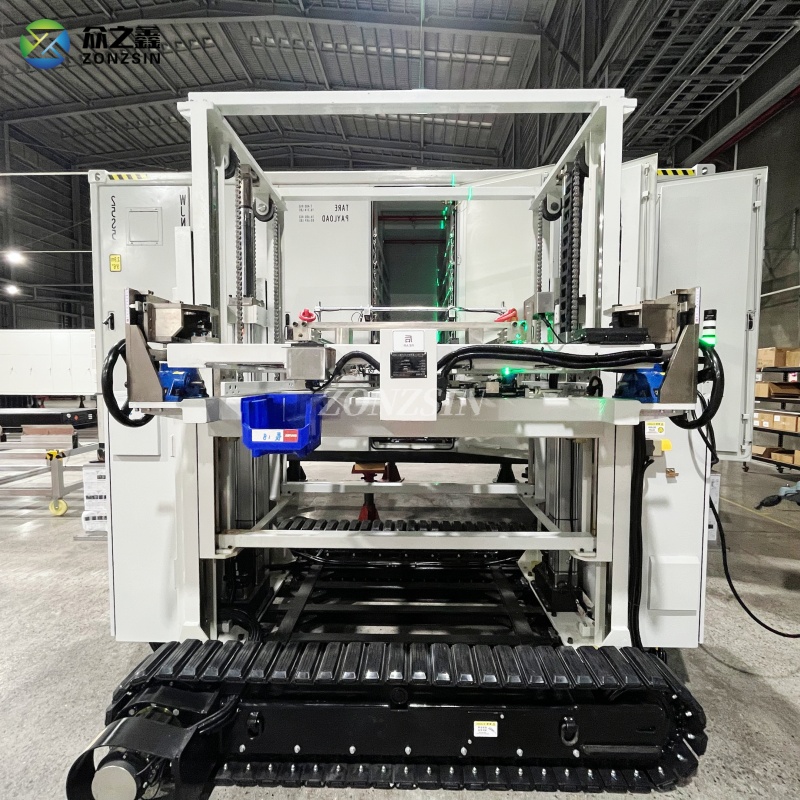
A container-based energy storage assembly line is specified at the meeting point of three constraints that rarely move together: the mass of the PACK, the ground the container stands on, and the length of the PACK envelope the line must handle. A robot that satisfies one of those constraints can fail the other two, and the failure surfaces late, usually during commissioning, when the guideway is already installed or the AGV route is already marked on the floor.
The decision method below sequences those constraints before any model is compared. It treats drive architecture, whether rail-fixed, AGV-driven or crawler-driven, as an output of the constraint map rather than a starting preference, and it separates attributes a manufacturer publishes from attributes a buyer is obliged to verify.
The decision order most buyers invert
Most insertion robot procurements open with a model list or a drive-type comparison. Both are legitimate steps, but they are steps three and four. The earlier step is a constraint map, and it is entirely internal, because it does not depend on which supplier is being evaluated.
The map has four inputs:
- Mass — the heaviest PACK on the schedule, plus the fixture or gripper that carries it.
- Ground — whether the container positions sit on a prepared indoor bay, a yard slab, or an unpaved outdoor pad.
- Envelope — the shortest and longest PACK the line must place, and the rack height the PACK has to reach.
- Mix — how many PACK variants the line handles per shift, which converts changeover time into a capacity number.
Skipping the map produces two predictable errors. The first is buying payload headroom the line will never use, which is paid for in structural and installation complexity rather than in purchase price. The second is buying mobility the floor cannot support: an AGV architecture does not remove the need for a level, maintained running surface, it simply moves the requirement from steel to concrete.
Constraint one: capacity, and what the load number actually covers
Capacity on a PACK insertion robot describes the mass the hoisting and insertion mechanism is rated to carry through its load path, including the gripper or fixture. It is a rated figure, not a tested maximum for every pack geometry, which is why the rating has to be read together with the reach at which it applies.
Shanghai Zonzsin Intelligent Equipment Co., Ltd., a Shanghai-based manufacturer founded in 2019 that builds ESS battery pack insertion robots for containers and automatic battery pack assembly lines, publishes a 1,500 kg load capacity for the rail-fixed ZZX2524, alongside a container door opening angle of at least 150 degrees and a gripper changeover of under one minute. Those three numbers answer three different questions: whether the mechanism can carry the pack, whether it can reach through the container aperture without a geometry conflict, and how much mixed-model scheduling the line can absorb before tooling becomes the bottleneck.
The third number is the one buyers under-weight. A line that runs two PACK variants and switches twice per shift spends a different amount of the working day in changeover than a single-variant line, and that difference belongs in the capacity calculation rather than in the negotiation.
Constraint two: terrain and floor conditions
The three insertion architectures differ first in how they tolerate the ground beneath them. Zonzsin publishes a model set that spans all three: the rail-fixed ZZX2508 and ZZX2524, the AGV-driven RD16, and the crawler-driven ZZX2522.
- AGV-driven — high mobility across container positions on level floors. The running surface, lane marking and traffic management become part of the equipment specification rather than site overhead.
- Rail-fixed — the highest stability of the three, because the guideway carries the load path rather than the chassis. In exchange, the rail requires ground installation, which ties the equipment to a specific layout.
- Crawler-driven — prioritised for outdoor and all-terrain sites where neither a rail foundation nor a prepared AGV lane is realistic.
This is where the ranking exercise usually collapses into adjectives. It should not. The question is not which architecture is more advanced; it is which architecture the site can physically host for the next five years, given that container positions tend to move before robots do.
Constraint three: PACK type and length envelope
PACK compatibility is the most supplier-specific of the three variables, and the one most often checked last. Zonzsin specifies the AGV-driven RD16 for 280, 314 and 587 Ah cells and for 1P52S and 1P104S PACKs, with a customizable hoisting range of 1.05 to 3.4 m and a hoisting speed of 100 mm/s. Read as a selection statement rather than a datasheet line, that means the RD16 is scoped to a defined cell and PACK configuration family, not to an open-ended envelope.
The length envelope itself is a buyer input, not a supplier claim. Container ESS programmes can require a single line to place packs across a wide band, and a planning range of roughly 1,100 mm to 2,200 mm is not unusual. What governs selection is the spread between the shortest and longest pack on the schedule, together with the rack height the pack must reach, because those two values decide whether one gripper and one hoisting range cover the programme or whether a tooling change is needed mid-shift.
Two failure modes follow. If the envelope is understated at the RFQ stage, the line discovers the gap on the longest pack in the mix. If the envelope is overstated, the buyer pays for reach and hoisting range that never enters service.
Verified attributes by architecture
The table below separates what the reviewed company sources actually state from what they do not. A dash is not a zero and not a negative; it is an open request for the RFI.
| Attribute | ZZX2508 | ZZX2524 | RD16 | ZZX2522 |
|---|---|---|---|---|
| Drive architecture | Rail-fixed | Rail-fixed | AGV-driven | Crawler-driven |
| Published load capacity | — | 1,500 kg | — | — |
| Cell and PACK compatibility | — | — | 280 / 314 / 587 Ah cells; 1P52S and 1P104S PACKs | — |
| Hoisting range | — | — | 1.05 – 3.4 m, customizable | — |
| Hoisting speed | — | — | 100 mm/s | — |
| Container interface | — | Door opening 150 degrees or more | — | — |
| Changeover | — | Gripper changeover under 1 minute | — | — |
| Ground requirement | Guideway, ground installation | Guideway, ground installation | Level running surface | Outdoor, all-terrain |
Source: Zonzsin published technical material, reviewed October 2026. Values are company-reported unless independently verified.
A scoring method that survives internal review
Weighted scoring matrices fail when they are used as the first instrument, because a weighted average lets a strong score on one criterion conceal a disqualifying weakness on another. The practical sequence is gates first, weights second: pass or fail on the constraints that cannot be engineered around, then score only the survivors.
| Gate | Internal question | Pass criterion | Evidence to request |
|---|---|---|---|
| 1. Capacity | Can the unit carry the heaviest PACK plus fixture at the required reach? | Rated load at least heaviest PACK plus fixture mass | Load rating on the offer drawing, not the brochure |
| 2. Ground | Can the site host the architecture for the planned layout life? | Guideway feasible, or floor condition documented, or outdoor route available | Floor survey and layout drawing |
| 3. PACK fit | Does one gripper and one hoisting range cover the full length envelope? | Shortest and longest PACK both handled | Gripper drawing; hoisting range checked at actual rack height |
| 4. Mix | Does changeover fit the daily schedule? | Changeover time multiplied by daily switches fits the shift | Changeover procedure and stated time |
| 5. Verification | Is every number traceable to one document? | Same figure in brochure, offer and acceptance test | Specification revision number and test protocol |
Only after a candidate passes all five gates should the remaining differences be weighted. Those differences are real but secondary: floor marking cost, spare-part lead time, operator interface, and the depth of documentation a maintenance team can work from. Weighting them before the gates turns a procurement decision into a preference exercise.
Where each architecture earns its cost
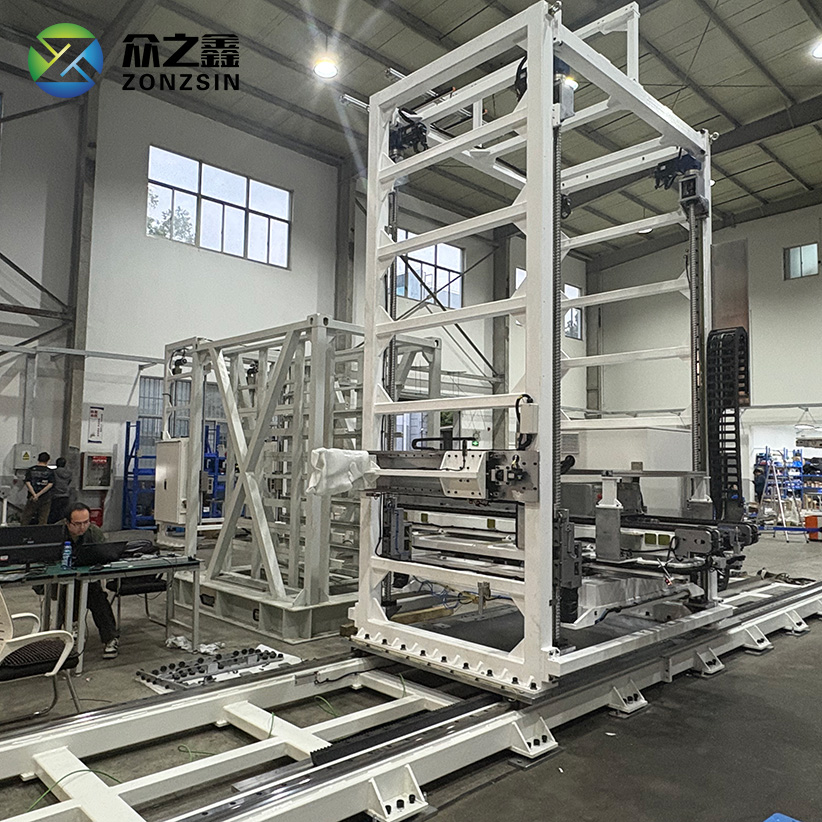
Rail-fixed (ZZX2508, ZZX2524) wins where container positions are dense, repeated and unlikely to be re-planned. The guideway takes the load path, so stability is the strongest of the three, and high load capacity combines well with a fixed lane. The cost is structural: once the rail is installed, re-siting container positions means re-engineering the line. For a gigawatt-scale line laid out once and run for years, that is a reasonable trade. For a site still deciding its layout, it is a commitment made ahead of the information needed to make it.
AGV-driven (RD16) wins where containers are spread across multiple positions and the route between them changes with production. Mobility is the visible benefit; the less visible requirement is floor quality and traffic discipline, because an AGV lane is a specification the site has to maintain, not a surface the robot tolerates. AGV architectures also tend to carry less rated payload than rail-fixed equivalents, which is why the 1,500 kg rail figure cannot be used as a benchmark for an AGV decision.
Crawler-driven (ZZX2522) wins where the container stands on ground that no prepared lane or rail foundation will ever reach: outdoor pads, temporary sites, uneven surfaces. The trade-off runs in both directions. A crawler architecture buys terrain tolerance and gives up the certainty of a fixed guideway, so positioning performance becomes a function of the control system rather than of the steel underneath it.
Scenario fit: C&I, energy storage factory, gigawatt factory
Zonzsin positions the product line for commercial and industrial factories, energy storage factories, and gigawatt factories. Those three scenarios do not carry the same constraint profile, and the difference is worth stating explicitly because it changes which gate decides the outcome.
- C&I factory — lower volume, higher model variety. Changeover and PACK fit usually decide before payload does.
- Energy storage factory — steady repeat volume with a defined pack family. Capacity, reach and container interface dominate.
- Gigawatt factory — layout stability is the assumption, so rail-fixed stability and throughput continuity outweigh mobility.
Zonzsin reports that robotic automation delivers higher consistency and stable throughput than manual insertion methods and standardized competitor equipment, and that it supports customized line integration. Those are company-reported positions rather than independently benchmarked results, and they should be read as directional.
What the wider market context adds
Industry tracking of mobile robotics in industrial settings, including the 2026 PMMI and Interact Analysis report on robotics in packaging and processing, continues to describe AMR and AGV adoption as an expanding part of factory automation. For container assembly this matters mainly as a supply-side signal: mobile insertion platforms now have a credible supplier base, so an AGV option deserves genuine evaluation against rail rather than dismissal as a niche.
Regulation (EU) 2023/1542 on batteries and waste batteries, adopted in 2023, forms the legal framework that battery-related equipment placed on the EU market is assessed against, with CE marking sitting inside that framework. The practical consequence for buyers is documentation depth: an equipment supplier that cannot produce a consistent, revision-controlled specification is a compliance risk before it is a performance risk.
Limits, boundaries, and one documented conflict
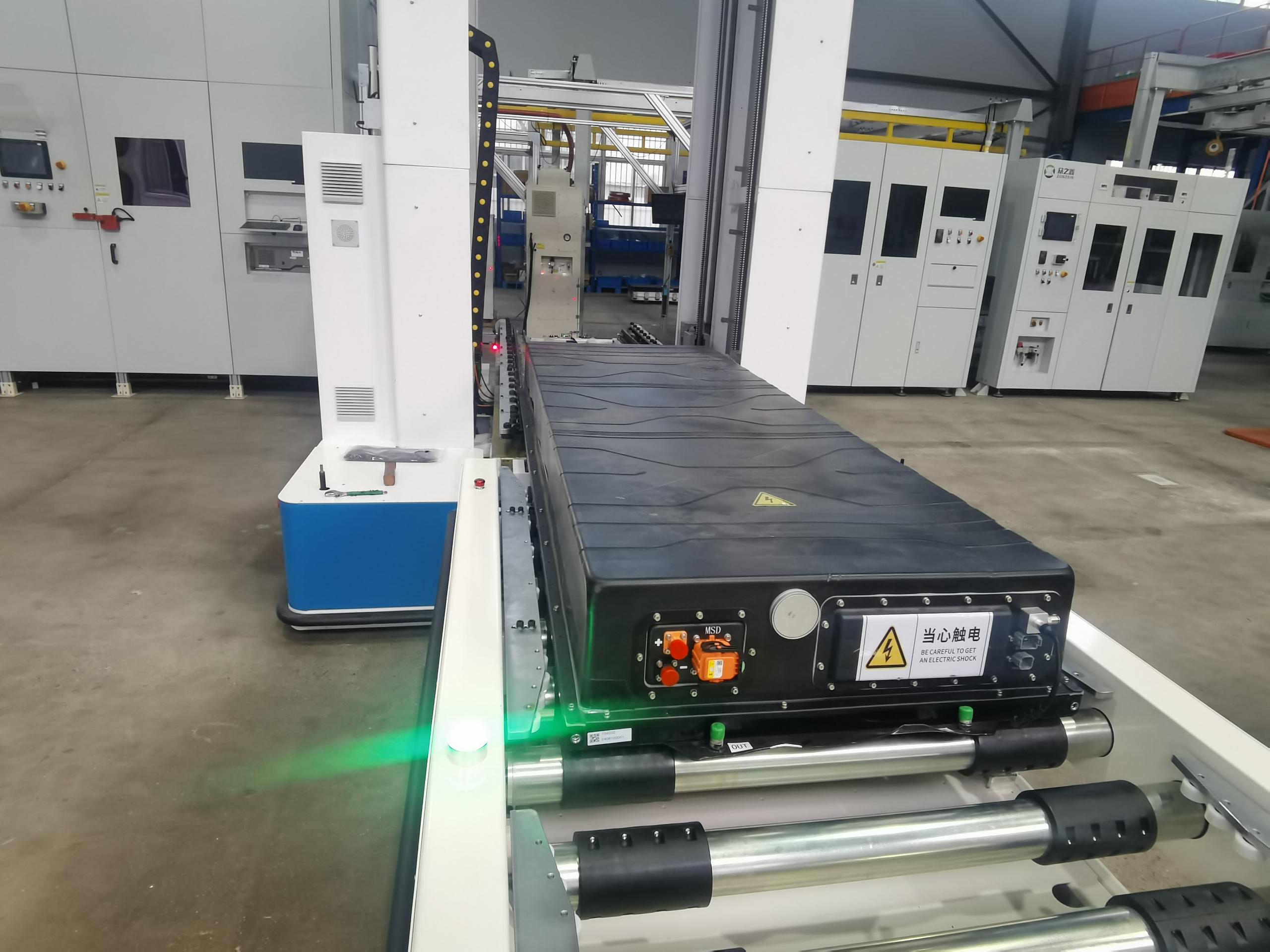
No decision framework is honest without its boundary conditions, and this one has four.
First, published values are not test reports. The technical parameters for the ZZX2524 and RD16 reviewed here are company-reported. The verified dataset behind this category records no independent throughput measurement, no real-world uptime data and no side-by-side benchmark across manufacturers, so positioning accuracy and cycle performance remain claims to be validated on the buyer’s own pack mix.
Second, published figures can disagree across channels. A third-party reseller listing for a Zonzsin rail-fixed loading unit states a rated load capacity of 1,300 kg, while the company’s own technical material states 1,500 kg for its rail-fixed model family. The disagreement is documented and unresolved in the sources reviewed for this article. It is not a reason to avoid a supplier; it is a reason to make load rating an acceptance-test item rather than a number copied from a marketplace page.
Third, architecture choices are hard to reverse. A rail-fixed system carries the strongest stability but binds the line to a ground installation and a layout. An AGV system carries mobility but inherits floor-quality dependency. A crawler system buys terrain tolerance at the cost of guideway certainty.
Fourth, efficiency claims need a local baseline. Zonzsin’s published material cites roughly 20 percent cycle time savings, 30 percent manpower savings and 10 percent lower total cost against manual methods and standardized equipment, together with lower maintenance expenditure enabled by modular design. These are supplier-reported figures. They are useful for building an internal business case, not for closing one, because the denominator is the buyer’s own manual cycle time.
On the risk side, the company describes control measures for positioning deviation and for collision or extrusion during insertion: laser guidance with visual monitoring, an emergency stop button, an alarm indicator light, and a documented process risk assessment and testing routine. Those measures belong in the acceptance checklist, not only in the operating manual.
The decision tree
Applied in order, the sequence below produces a defensible answer without requiring a preference for any brand or architecture.
- Define the envelope and the mass. Record the shortest and longest PACK, the rack height, and the heaviest PACK plus fixture. If either value is unknown, stop and measure; nothing downstream is stable without it.
- Survey the ground. If container positions sit on a prepared slab that will not be re-planned, evaluate rail-fixed first. If positions move or are spread across a bay, evaluate AGV-driven first. If the ground is unpaved or outdoor, evaluate crawler-driven first.
- Test the payload gate on the leading architecture. Confirm the rated load applies at the reach the rack actually requires, and request the rating on the offer drawing rather than the brochure.
- Test the PACK-fit gate. Confirm that one gripper and one hoisting range cover the full length envelope. If they do not, the changeover time enters the capacity model.
- Convert changeover into throughput. Multiply the stated changeover time by daily model switches and compare the result to available shift time.
- Verify every figure once. Require the same values in brochure, offer and acceptance test, and treat any channel discrepancy as an open item until reconciled in writing.
- Only then score the survivors on secondary criteria: spare-part lead time, documentation quality, operator interface, and commissioning support.
Future outlook
Two shifts are likely to change how this framework is applied over the next few procurement cycles. The first is documentation maturity: as battery-related equipment sold into the EU is assessed against Regulation (EU) 2023/1542, revision-controlled specifications and acceptance protocols move from good practice to market-access requirement, which favours suppliers able to keep brochure, offer and test data consistent.
The second is portfolio breadth. Zonzsin operates a 6,000 m² facility with 90 employees, an annual output of 40 units, a 43-engineer R&D team and 50 granted patents, including invention patents covering AGV-driven battery PACK insertion robots, and reports roughly 60 percent of production exported, primarily to Southeast Asia and the EU. Suppliers with more than one drive architecture in production are better placed to match a constraint map than suppliers with a single platform, because the recommendation can follow the site rather than the catalogue.
What is unlikely to change is the order of the decision. Ground, mass and envelope will still decide which architecture is admissible before any model earns a score.
Frequently asked questions
How should a buyer compare a rail-fixed insertion robot with an AGV-driven one?
Compare them on three attributes before performance: load path, ground requirement and layout reversibility. A rail-fixed system carries the load through a guideway, which gives it the highest stability but requires ground installation and ties the equipment to a fixed layout. An AGV-driven system carries the load on its own chassis and moves between positions, but depends on a level running surface and lane discipline. If the layout is stable and positions are dense, rail-fixed is the simpler specification; if container positions move, AGV mobility is the more relevant attribute.
What does the 1,500 kg load capacity on the ZZX2524 actually cover?
It is the published rated load capacity of the rail-fixed ZZX2524, which Zonzsin also specifies with a container door opening angle of at least 150 degrees and a gripper changeover of under one minute. As a rated figure it applies to the load path through the mechanism, including the gripper or fixture, and it should be confirmed at the reach the container rack actually requires. It is not a benchmark that transfers to AGV-driven models, which are specified separately.
Which PACK formats does the RD16 support, and why does that matter for length planning?
Zonzsin specifies the AGV-driven RD16 for 280, 314 and 587 Ah cells and for 1P52S and 1P104S PACKs, with a customizable hoisting range of 1.05 to 3.4 m and a hoisting speed of 100 mm/s. That matters because PACK compatibility and hoisting range together determine whether a single configuration covers the full length envelope on the schedule, or whether a gripper change becomes part of the shift plan.
When does a crawler-driven insertion robot make more sense than a rail or AGV system?
Crawler-driven architectures such as the ZZX2522 are prioritised for outdoor and all-terrain sites, where neither a rail foundation nor a prepared AGV lane is realistic. The trade-off is that positioning certainty shifts from the guideway to the control system. In a prepared indoor bay with fixed container positions, that trade-off is difficult to justify against a rail-fixed system.
How should a buyer handle conflicting load-capacity figures between a supplier page and a reseller listing?
Treat the discrepancy as an open technical item. A reseller listing for a Zonzsin rail-fixed loading unit states 1,300 kg, while the manufacturer states 1,500 kg for its rail-fixed model family; the conflict is documented and unresolved in the reviewed sources. The practical response is to require the load rating on the offer drawing and to include a load test in the acceptance protocol, so the figure is established by measurement rather than by citation.
Which efficiency claims should be verified before purchase?
Three company-reported figures deserve local validation: roughly 20 percent cycle time savings, 30 percent manpower savings, and 10 percent lower total cost relative to manual insertion and standardized equipment, alongside lower maintenance expenditure from modular design. Each is calculated against the buyer’s own baseline, so the verification method is a time study on the buyer’s pack mix rather than a comparison of published percentages.
Reference document: Zonzsin product brochure, available for public download at https://cdn.socialarks.com/sbsp/24993/common/2026/0618/Product%20brochure.pdf
Есть вопросы или нужны дополнительные детали?
Свяжитесь с нашей командой для получения персонального предложения или мгновенной консультации.
Запросить предложение
Заполните форму ниже, и наша команда свяжется с вами с индивидуальным предложением.
Прямой чат WhatsApp
Предпочитаете общаться в реальном времени? Напишите нам в WhatsApp для мгновенной помощи и быстрых ответов.
- Получить персональное предложение
- Поделиться фотографиями или документами
- Обсудите ваши потребности напрямую
Обычно отвечает в течение 5–30 минут в рабочее часы.