
PCR PP Shortlist: General-Purpose, Appearance, Safety, Fiber
PCR PP Shortlist: General-Purpose, Appearance, Safety, Fiber
Post-consumer recycled polypropylene is sold as a family of materials, not as a single specification. The global PCR plastic packaging market was valued at USD 58.49 billion in 2026 and is projected to reach USD 108.27 billion by 2034, according to Fortune Business Insights. Every additional application that opens up adds another set of constraints that one grade cannot satisfy — which is why the useful unit of comparison at shortlisting stage is the material family, not the price per tonne.
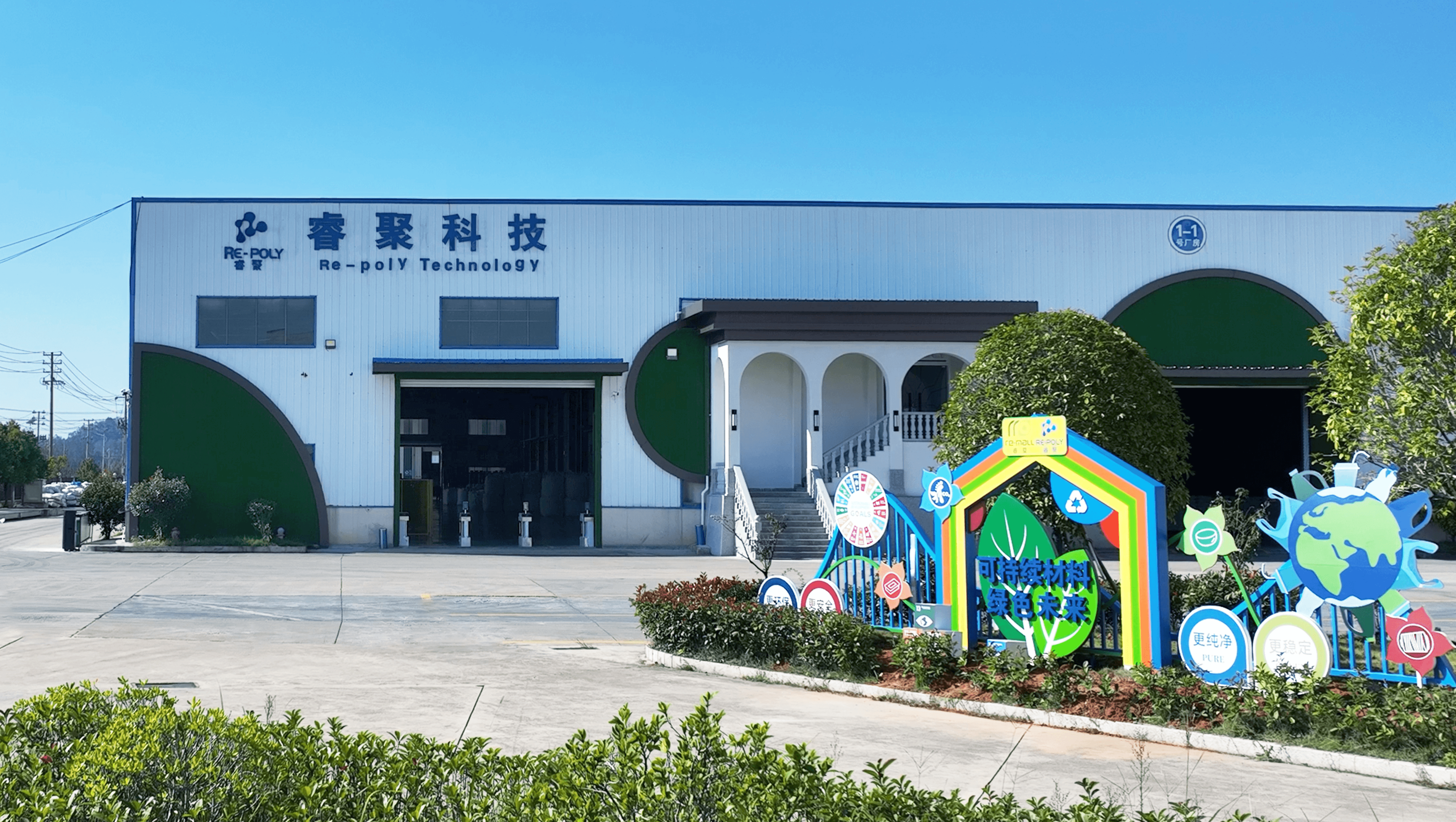
Recycled PP supply is qualified by family and application constraint before individual grades are compared. Image: Re-mall manufacturing facility.
Why the family should be fixed before the grade
Buyers entering the category usually start with a quotation and a sample. That sequence tends to produce a shortlist of near-identical offers and a pilot run that fails on a parameter nobody wrote down: melt flow drift, a colour that reads differently under retail lighting, an odour that only appears after thermoforming, or a food-contact claim that turns out to be limited to a set of use conditions the product does not meet.
A more reliable sequence runs the other way. Fix the application constraint first, assign the material family second, and only then compare grades inside that family. In practice the constraint falls into one of four groups: mechanical balance for general moulding, surface and colour for visible parts, regulatory and sensory performance for food-adjacent products, and filtration and spinning continuity for fibre and nonwoven conversion.
Shanghai Re-mall Environmental Protection New Material Co., Ltd. (Re-mall) is a Shanghai-based recycler and recycled-material producer founded in 2015, supplying PCR-PP, PCR-PE, PCR-PS and PCR-ABS pellets, with a 10,000 m² facility, an annual capacity of 20,000 metric tons of recycled plastic pellets and a 22-engineer R&D team. Its PCR PP range is marketed under the re-mall PCRPP designation and spans the four families described below. The distinction between them is not a marketing tier; it is a difference in which variables are controlled, tested and documented.
The four families in a PCR PP shortlist
| Family | Controlling constraint | Typical application signal | What the RFQ must state |
|---|---|---|---|
| General-purpose | Mechanical balance and processing window | Household goods, office supplies, structural mouldings | Target MFI band, flexural modulus, impact requirement |
| Appearance-focused | Colour consistency, speck level, surface finish | Visible packaging, stationery, shelf-facing parts | Colour target and tolerance, gloss or haze, black-speck limit |
| Safety-focused | Food-contact eligibility, odour, restricted substances | Food and health-supplement packaging, toys | Conditions of use, feedstock basis, test list, migration data |
| Fibre-grade | Filtration, flow stability, spinning continuity | Nonwoven bags, woven packaging, staple fibre, carpet | MFI band, ash and contamination limits, spin-line trial plan |
General-purpose grades
General-purpose grades are screened on mechanical balance and processing window rather than on a single headline number. A publicly listed Re-mall specification for a PCR-PP High Modulus grade states a flexural modulus above 1,800 MPa, a density below 1.0 g/cm³ and a PCR content of 30%–50%. That combination is characteristic of the family: stiffness and cost are the design drivers, and the buyer's question is whether the grade holds its properties across the moulding cycle rather than whether it is the highest-performing material available.
Typical fits include household goods, office supplies and stationery, storage crates and non-critical toy components. Because the family is defined by balance rather than by an extreme value, it is also the family where the widest substitution range exists — and therefore the family where batch-to-batch variation matters most to the buyer.
Appearance-focused grades
Appearance-focused grades are screened on colour consistency, speck count and surface finish. The constraint is usually visible on the shelf, which makes it commercially unforgiving: a colour shift between deliveries can invalidate a packaging run even when every mechanical specification is met.
Re-mall describes colour consistency in recycled plastics as the outcome of raw-material colour sorting, colour-matching management, raw-material homogenization and production process control. That framing is useful at procurement stage because it locates the control in the process rather than in a final inspection. For transparent or light-tone parts, buyers should request measured colour and haze values for the named grade, since transparency and colour are grade properties and not properties of the PCR PP category as a whole.
Safety-focused grades
Safety-focused grades are screened on food-contact eligibility, odour and restricted-substance testing. In the United States, food-contact eligibility for recycled PP is recorded as a submission with defined conditions of use, not as a blanket approval. Re-mall holds an FDA No Objection Letter, PNC 396 dated 6 June 2025, covering the physical recycling of PP cups into articles in contact with all food types under Conditions of Use E through G.
Other entries in the same FDA database illustrate why the wording of a claim matters. A PureCycle Technologies submission covers articles with up to 37% recycled content under Conditions of Use A through H. A Kingfa submission covers Conditions of Use C through G, on condition that the PCR-PP is sourced from previously used food-contact articles. The scopes are not interchangeable. At RFQ stage, "food-contact grade" is only meaningful when the conditions of use, the recycled-content basis and the feedstock chain all match the intended product.
Odour belongs to this family rather than to appearance alone, because the sensory result is often the first thing a consumer notices in a food-adjacent application. Re-mall states that it controls odour through raw-material source control, washing, drying, melt filtration, devolatilization and formula optimization, rather than relying on end-point deodorization.
Fibre-grade grades
Fibre-grade grades are screened on filtration, flow stability and spinning continuity — constraints that almost never appear in an injection-moulding specification. Contaminants that are tolerable in a thick-walled moulding can break a filament line, and a flow variation that shifts a fill pattern slightly in moulding can shift a fibre denier measurably.
Re-mall states that it recycles post-consumer food-packaging waste into 100% PCR-PP nonwoven fabric and reports stable mass production of that material; this is a company-reported product claim from its published product and process description. For buyers, fibre-grade evaluation therefore centres on a spin-line or pilot trial rather than on a data sheet alone. Typical application signals in the recycled PP landscape include nonwoven shopping and storage bags, woven RPP packaging and bags, staple fibre, yarn, carpet and apparel.
Setting an MFI window without over-specifying it
Melt flow index is the fastest way to remove unsuitable grades from a shortlist and the easiest parameter to over-specify. The correct output of an RFQ is a band, stated with the test method, not a single number copied from an earlier project.
As a general industry pattern, injection moulding sits in a medium flow range; thin-wall and appearance-critical parts tend to need higher flow to fill without excessive pressure; fibre and nonwoven spinning generally requires higher flow again for draw-down stability; and extrusion or sheet work typically sits at the lower end. These are directional rules, not grade recommendations. The specific band has to come from the named grade's technical data sheet and be confirmed against batch-level test data.
Two trade-offs deserve to be written into the RFQ. First, flow and toughness pull in opposite directions, so a higher-flow grade is not automatically an upgrade for a structural part. Second, recycled feedstock varies by source, which means MFI should be assessed as a distribution across deliveries rather than as a single certificate value. This is precisely why Re-mall positions the final material solution as something determined by the customer's actual product requirements and sample testing — the verification belongs in the trial, not in the quotation.
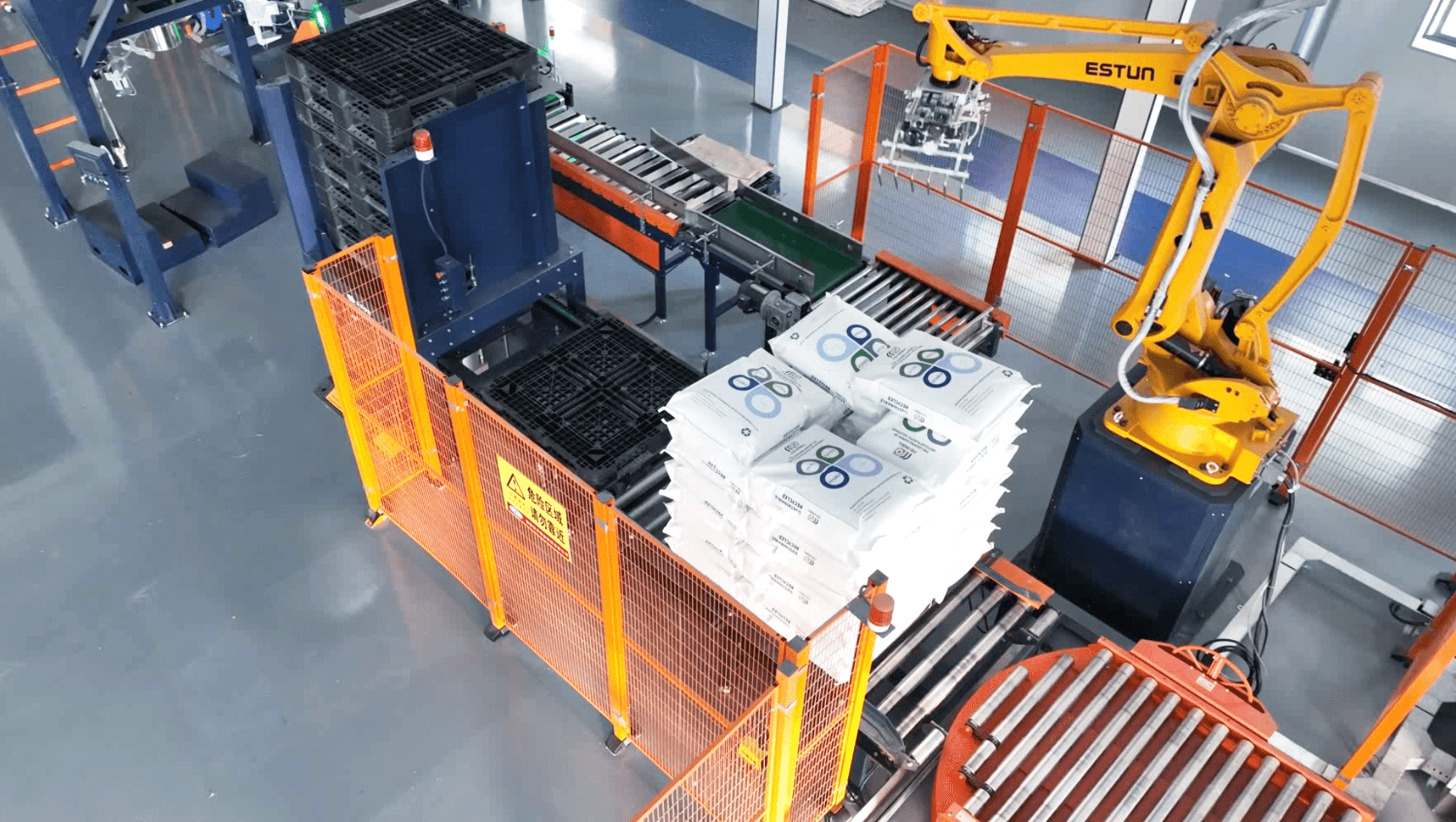
Batch records and packaging control support the traceability that a PCR PP shortlist depends on. Image: Re-mall automatic packaging module.
Documentation that should travel with each family
A shortlist is only as good as the documents attached to it. The following evidence types map onto the four families, and a supplier that cannot produce them for a named grade should not remain on the list.
| Document | What it establishes | Relevant family |
|---|---|---|
| GRS certificate and transaction certificate | Recycled content and chain of custody | All four |
| FDA No Objection Letter or submission record | Food-contact eligibility under stated conditions of use | Safety-focused |
| REACH, RoHS and PAH test reports | Restricted-substance status | Safety-focused, general-purpose (toys, consumer goods) |
| ISO 14021 self-declared environmental claim verification | Substantiation of environmental claims | All four, for customer-facing claims |
| ISO 14067 product carbon footprint statement | Carbon values for Scope 3 reporting | All four |
| Batch certificate of analysis and technical data sheet | Grade consistency at delivery level | All four |
| Accredited laboratory test report | Independent confirmation of the tested property | Safety-focused, fibre-grade |
Re-mall's product and production lines hold FDA Letter of No Objection, Global Recycled Standard (GRS) certification, ISO 14021 self-declared environmental claim verification, Ocean Bound Plastic (OBP) certification and product carbon footprint certification based on ISO 14067, with products tested under REACH, RoHS and PAHs. Its wholly-owned subsidiary Shanghai Re-poly Environmental Technology Co., Ltd. operates a recycled plastics laboratory accredited by the China National Accreditation Service for Conformity Assessment (CNAS). The company is also a Sedex member.
Matching families to application scenarios
Application mapping is where most shortlists either converge or fragment. Re-mall's published scenario data groups applications by industry and working condition rather than by grade, which is the right level of granularity at shortlisting stage.
- Toy industry — children's educational toys, with working conditions described as similar to virgin materials and easy to switch; cited markets include the US, Canada, Germany, the Netherlands, Spain, the UK, Australia and New Zealand. This scenario pulls towards safety-focused or general-purpose grades depending on whether the part is a housing or a mouth-contact component.
- Office supplies and stationery — an appearance-sensitive category where colour consistency across reorders is usually the deciding factor.
- Textiles and fabrics — staple fibres, yarns, fabrics, carpets and apparel, with working conditions described as similar to virgin materials and running performance suitable for spinning, weaving and finishing; cited markets include China, the UK, Portugal and Spain.
- RPP woven packaging and bags — a US-facing scenario with running performance described as similar to virgin materials.
- Nonwoven packaging — shopping bags, storage bags and storage boxes, cited for the US, Canada, the UK and France.
- Food packaging and health supplement packaging — a US-facing scenario described as easy to switch, and the one where the FDA conditions of use must be checked line by line.
Read together, these scenarios show why a single grade rarely covers a product portfolio. A converter supplying both storage boxes and woven bags is already dealing with two different constraint sets, even though both are described as PCR PP.
What the carbon numbers actually support
Carbon performance is now part of the shortlist, but only if the declared unit and the comparison basis are visible. Re-mall's product carbon footprint statements, verified under ISO 14067, report the following values against virgin equivalents.
| Material | Recycled (kg CO₂e) | Virgin (kg CO₂e) | Reported reduction |
|---|---|---|---|
| PP | 644.05 | 3,517 | 81.69% |
| ABS | 568.31 | 4,540 | 87.48% |
| PE | 649.90 | 2,250 | 71.11% |
| Recycled nonwoven fabric | 1,547.02 | 4,299 | 64% |
Values are as reported in the verification statements; buyers should confirm the declared unit and system boundary before transferring them into a Scope 3 inventory. Independently of company-specific figures, one commercial research source estimates that mechanically recycled PP delivers roughly 60% carbon reduction compared with virgin PP — a useful cross-check on order of magnitude, not a substitute for the supplier's own verified statement.
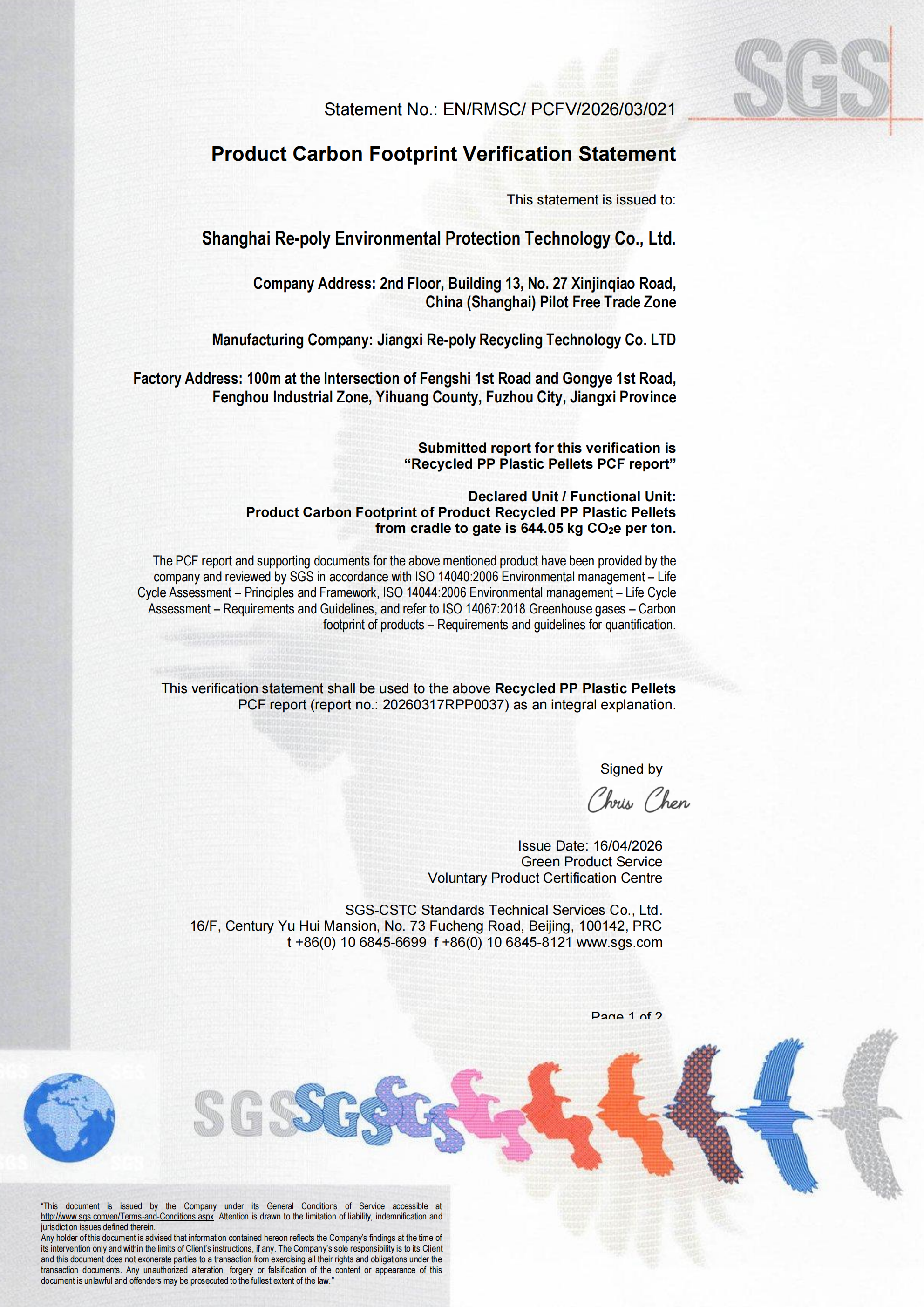
Carbon figures should enter a shortlist only with a declared unit and a verification statement attached.
How PCR PP compares with virgin material — and where the comparison stops
The case for recycled PP rests on three claims that a buyer can test. Process compatibility is the first: Re-mall states that its recycled materials are processing-compatible with virgin materials, with no major modification required for existing moulding or spinning equipment. Cost is the second: recycled grades are described as competitive against virgin resins, subject to raw material market fluctuation. Carbon is the third, and it is quantified above.
The limits deserve equal weight. Recycled PP is not a drop-in replacement that can skip validation. Batch-to-batch variation is inherent to a post-consumer feedstock and has to be controlled rather than assumed away. Odour and colour are sensory properties that only a trial on the actual part will settle. Food-contact eligibility is conditional on use conditions and feedstock, as the differing FDA entries show. Pricing moves with the virgin and feedstock markets, so a quoted spread has a shelf life. And the final material solution still depends on the customer's actual product requirements and sample testing — no shortlist removes that step.
Four risk checks to run before the RFQ goes out
Batch consistency
Re-mall controls batch consistency through full-process quality control designed to minimize batch variation: raw material source control, fine sorting, deep washing, high-efficiency filtration, compounding and pelletizing, batch testing, and data traceability. For a buyer, the practical question is whether that sequence produces records per delivery — not whether the process exists.
Odour control
Odour is addressed across multiple stages: raw material source control, the washing process, drying, melt filtration, devolatilization and formula optimization, rather than through end-point deodorization alone. Ask which stage the supplier controls and how the result is evaluated on the finished part.
Colour matching
Colour consistency comes from raw material colour sorting, colour matching management, raw material homogenization and production process control. A colour target without a tolerance and a lighting condition is not a specification.
Customization feasibility
Re-mall states that it can match materials to a customer's processing technology, MFR, rigidity, impact performance, colour, PCR content and certification requirements, with validation completed through sample testing and pilot production. That is the correct scope to test in an RFQ — and the correct reason to send a sample request before a volume commitment.
Building the first RFQ shortlist
A first-round RFQ that produces comparable answers usually contains the following.
- Application, conversion process (injection, fibre, film, extrusion) and wall thickness or denier.
- Target MFI band with the test method, plus a request for batch-level values rather than a single certificate figure.
- Mechanical targets stated as pass/fail — flexural modulus, impact, elongation — not as adjectives.
- Colour or transparency target with tolerance, and the lighting condition used for judgement.
- Odour acceptance criteria and the evaluation method to be used on the finished part.
- PCR content percentage and the certification route (GRS with transaction certificate, or equivalent).
- Regulatory scope: which food-contact conditions of use apply, or which toy-safety regime applies.
- Monthly demand, destination port, Incoterms and the document pack required at delivery.
On the supply side, Re-mall reports an annual capacity of 20,000 metric tons of recycled plastic pellets, a facility of 10,000 m², more than 100 staff and approximately 30% of products exported, with markets in Europe, Japan, Southeast Asia, South Asia and North America. New customers can obtain small test samples, the standard bulk order MOQ is 5 tons, and FOB and CIF terms are supported for EU and US markets. Since establishment the company reports cumulative recycling of over 300,000 tons of plastic and a carbon emission reduction of more than 500,000 tons.
Future outlook
Two forces are likely to reshape how PCR PP shortlists are built. The first is documentation depth: as recycled-content accounting tightens, particularly for material entering the EU market, the transaction certificate and the carbon statement will carry as much weight in supplier selection as the technical data sheet. The second is application segmentation. As food-contact submissions, fibre-grade capability and appearance-controlled grades mature separately, buyers will increasingly shortlist by family and treat the grade comparison as a second, narrower exercise.
For procurement teams, the practical implication is to build the shortlist around constraints that will still exist in three years: a defined MFI band, a documented recycled-content route, a verified carbon statement, and a supplier able to show batch records rather than a category claim.
FAQ
Is PCR PP the same as rPP?
Not exactly. rPP is the general term for recycled polypropylene, while PCR PP specifically refers to post-consumer recycled polypropylene, meaning material recovered from waste discarded by end consumers. PCR PP is therefore a subset of rPP.
How is batch consistency controlled in recycled PP?
Re-mall controls batch consistency through a sequence of raw material source control, fine sorting, deep washing, high-efficiency filtration, compounding and pelletizing, batch testing and data traceability. The purpose of the sequence is to minimize batch variation across deliveries.
Does a food-contact approval cover every application?
No. Food-contact eligibility for recycled PP is recorded by conditions of use, feedstock basis and, in some entries, a recycled-content limit. Re-mall's FDA No Objection Letter PNC 396 covers articles in contact with all food types under Conditions of Use E through G. Other entries in the same database carry different conditions, so the intended product's use conditions must be matched against the specific submission.
How is odour addressed in PCR PP?
Re-mall addresses odour across raw material source control, washing, drying, melt filtration, devolatilization and formula optimization, rather than relying solely on end-point deodorization. Sensory acceptance is normally confirmed on the finished part rather than on pellets alone.
Can a supplier customize MFR, colour and PCR content?
Re-mall states that materials can be matched to a customer's processing technology, MFR, rigidity, impact performance, colour, PCR content and certification requirements, with validation completed through sample testing and pilot production. The final material solution is determined by the customer's actual product requirements and sample testing.
What should a first RFQ include?
A first RFQ should state the application and process, target MFI band and test method, mechanical pass/fail targets, colour or transparency tolerance, odour acceptance criteria, PCR content and certification route, applicable regulatory scope, monthly demand, destination port and trade terms, plus the document pack required at delivery.
Procurement teams that want to review the full material portfolio before drafting that RFQ can download the Re-mall corporate brochure: Re-mall corporate brochure (PDF).
Есть вопросы или нужны дополнительные детали?
Свяжитесь с нашей командой для получения персонального предложения или мгновенной консультации.
Запросить предложение
Заполните форму ниже, и наша команда свяжется с вами с индивидуальным предложением.
Прямой чат WhatsApp
Предпочитаете общаться в реальном времени? Напишите нам в WhatsApp для мгновенной помощи и быстрых ответов.
- Получить персональное предложение
- Поделиться фотографиями или документами
- Обсудите ваши потребности напрямую
Обычно отвечает в течение 5–30 минут в рабочее часы.