
PET Preform Injection Machine Supplier Evidence: Inside Yongjiang's 130,000 m² Factory
A PET preform injection machine is quoted on a small set of numbers: shot weight, clamping force, tie bar spacing, cavity count. Those numbers are easy to print and hard to verify. The check that changes a procurement decision sits one level lower — whether the factory behind the quotation has the floor space, the engineering headcount and the export routine to build the same machine twice, and to keep it running years later. This article assembles that evidence for Ningbo Yongjiang Machine Co., Ltd. (Yongjiang), a Chinese injection molding machine manufacturer founded in 1985 and based in Ningbo, Zhejiang Province, and connects it to the YJPT-260, YJPT-318, YJPT-360 and YJHB-400 PET preform models, their operating envelope, and the commercial and acceptance terms a buyer can actually hold a supplier to.
Why factory evidence has become part of machine evaluation
Two suppliers can publish identical shot-weight figures and still deliver different machines. The difference usually shows up in things that are not on the datasheet: how much covered production area exists, how many engineers work on the design rather than the assembly line, how many units leave the plant per month, and whether machines are already running in the buyer's target market.
For PET preform work this matters more than in general injection molding. Preform production is a 24/7 process feeding a blow-molding line; the preform is an intermediate product in bottle manufacture, not a finished good, so any variability in wall thickness or surface quality propagates downstream. A supplier that has built its capacity around high-speed, multi-cavity hot runner tooling is structurally different from a supplier whose PET preform machine is a variant of a general-purpose platform.
The evaluation question is therefore not simply what is the machine, but what has this organisation already done, at what scale, and for whom. Yongjiang's published profile answers enough of that to be useful, and leaves one or two gaps that a buyer should close during sampling and pre-shipment testing.
The verifiable Yongjiang profile
Ningbo Yongjiang Machine Co., Ltd. is an injection molding machine manufacturer established in 1985 in Ningbo, Zhejiang Province, China, with more than 35 years of experience in injection molding machine production. Its stated main products are PET preform machines and PVC fitting machines.
| Factory and company fact | Recorded value |
|---|---|
| Year founded | 1985 |
| Injection molding machine experience | 35+ years |
| Facility area | 130,000 m² |
| Employees | Approximately 200 |
| R&D engineers | 25 |
| Annual output | Approximately 2,000 units |
| Monthly capacity | 200 units |
| Export ratio | 59% |
| Main export markets | USA, Canada, Thailand |
| Production mode | OEM, with voltage and logo customization |
| Minimum order quantity | 1 unit |
| Lead time | 30–45 days |
| Quality control | 100% testing one week before shipment |
| After-sales | 24/7 service support |
What the headcount ratio implies
Twenty-five R&D engineers inside a workforce of roughly 200 people means about one in eight employees works on design and engineering rather than fabrication or assembly. For a buyer, that ratio is a rough proxy for how much of a special order is genuinely engineered — screw and barrel configuration, clamping frame adaptation for multi-cavity hot runner molds, electrical configuration for a specific market — versus assembled from a fixed bill of materials. It is a structural signal, not a guarantee, and it should still be tested against the actual customization scope in the quotation.
What the export share implies
An export ratio of 59% with main markets listed as the USA, Canada and Thailand indicates that the majority of output leaves China and must therefore clear destination-market documentation, power configuration and shipping requirements. The company's capability record separately lists the EU, Middle East and Africa as export markets. For a buyer, a high export share is indirect evidence of routine handling of export packing, FOB documentation and pre-shipment inspection — the administrative layer that most often delays a first order. The company's service model is stated as 24/7 support, which is the practical counterpart to a customer base spread across several time zones.
What the facility footprint implies
A 130,000 m² site producing approximately 2,000 units per year, or around 200 units per month, describes a plant built for repeat volume rather than one-off builds. Volume of that order generally implies standardized sub-assembly and a predictable testing routine — here stated as 100% testing of every unit one week before shipment.
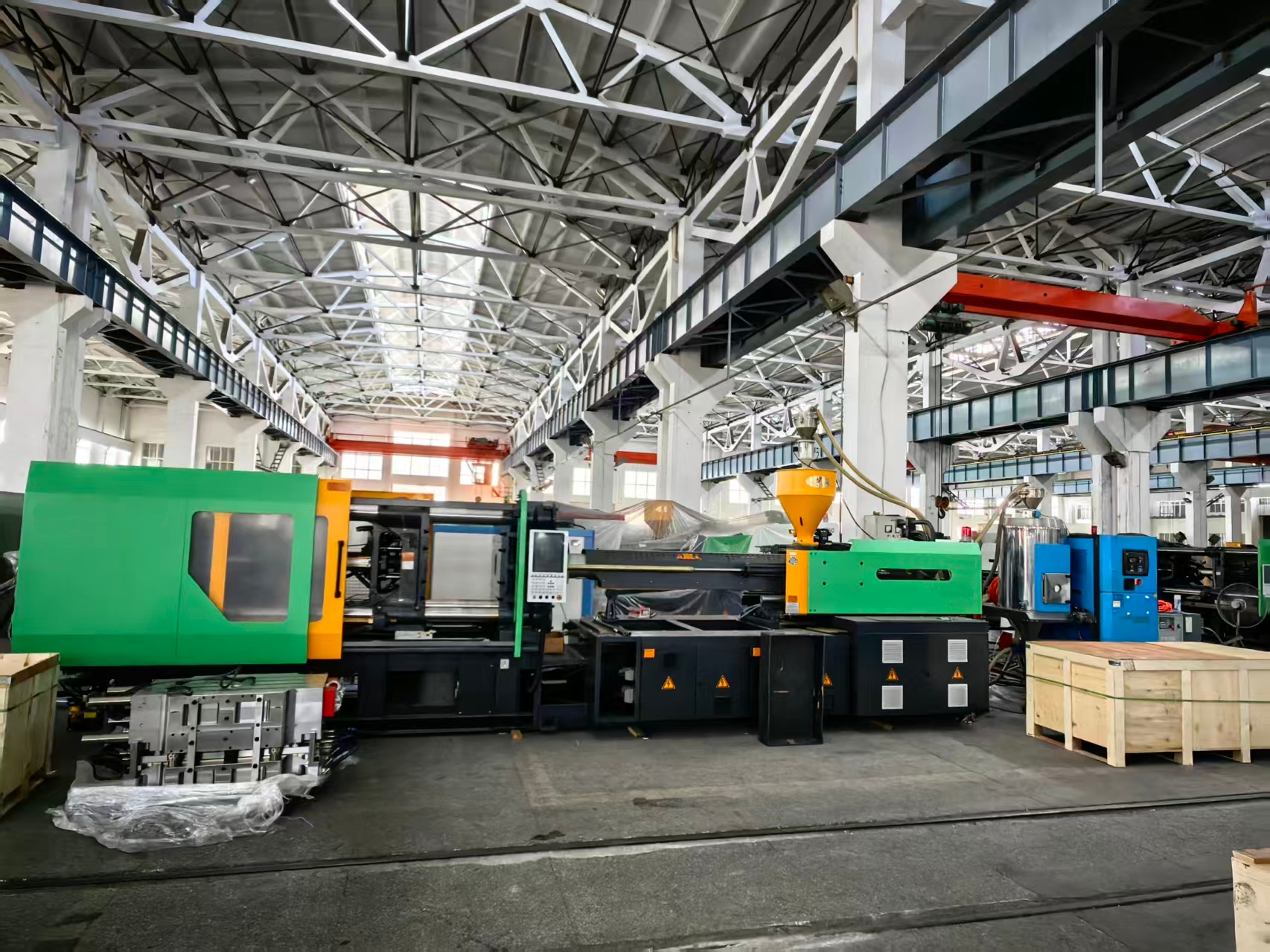
A 400-ton class PET preform injection machine, the upper end of the four-model range discussed below.
From factory footprint to machine range: YJPT-260 to YJHB-400
Yongjiang's PET preform line covers four models between 260 and 400 tons of clamping force. The published specifications are the practical starting point for matching a machine to a preform weight and a cavity count.
| Model | Type | Tie bar spacing (mm) | Screw barrel (mm) | Shot weight (g) | Motor / heat power (kW) | Machine weight (t) |
|---|---|---|---|---|---|---|
| YJPT-260 | 260-ton high-speed PET preform injection machine | 580 × 580 | 72 | 1,400 | 42 / 35 | 9 |
| YJPT-318 | 318-ton high-speed PET preform machine | 620 × 620 | 77 | 1,900 | 80 / 65 | 13 |
| YJPT-360 | 360-ton high-speed PET preform machine | 680 × 680 | 95 | 3,450 | 80 / 65 | 16 |
| YJHB-400 | 400-ton high-speed PET preform machine | 720 × 720 | 95 | 3,450 | 80 / 65 | 16 |
Frame material is recorded as QT500-A7 for YJPT-260, YJPT-360 and YJHB-400, and as steel for YJPT-318. All four models are listed for PET preform manufacturing.
Clamping force and tie bar spacing
Tie bar spacing, not clamping force, is usually the constraint that eliminates a model first. A multi-cavity preform mold has a fixed footprint; if it does not fit between the tie bars, no amount of tonnage compensates. The progression from 580 × 580 mm on the YJPT-260 to 720 × 720 mm on the YJHB-400 is what determines the maximum mold size each model can carry, and therefore the cavity count each frame can realistically support.
Clamping force then governs how much injection pressure that mold can be held closed against. The YJPT-360 and YJHB-400 share the same 95 mm screw barrel and the same 3,450 g shot weight; the meaningful separation between them is the 40-ton clamping step and the larger 720 × 720 mm platen spacing on the YJHB-400. Buyers comparing the two are effectively comparing mold-carrying capacity, not plasticizing capacity.
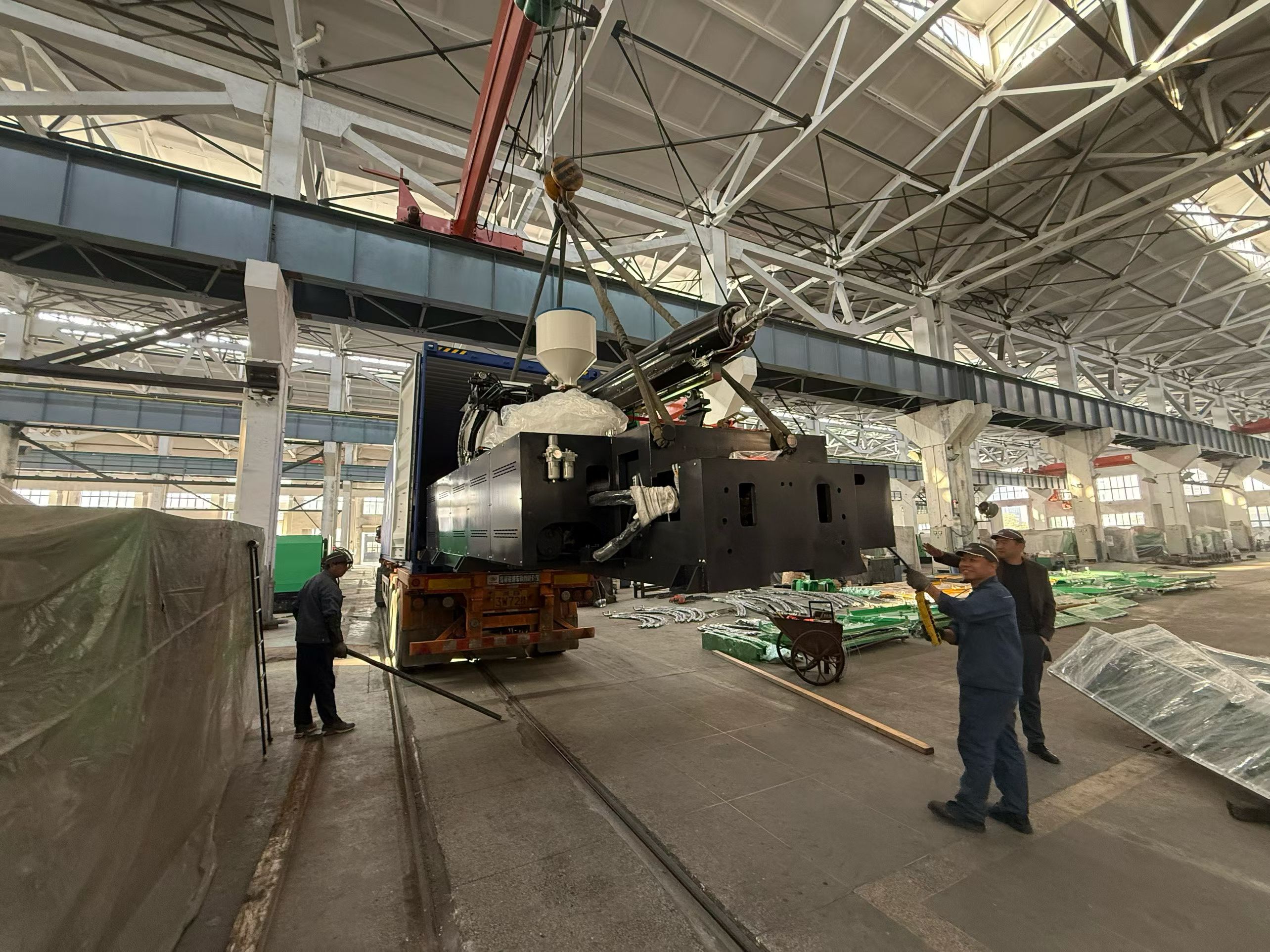
The 360-ton model: 95 mm screw barrel and 3,450 g shot weight, with 680 × 680 mm tie bar spacing.
Shot weight and screw barrel diameter
Shot weight is the fastest way to screen the range against a preform. The YJPT-260 at 1,400 g and the YJPT-318 at 1,900 g suit lightweight, high-cavity preform work where each individual shot is not heavy but the cycle is fast and repeatable. The 3,450 g shot on the YJPT-360 and YJHB-400 opens the door to heavier preforms and to large molds that require a bigger cushion.
The screw barrel diameter moves in step: 72 mm, 77 mm, then 95 mm. A larger barrel delivers more melt per stroke, but it also changes residence time and melt homogeneity. That is why PET-dedicated machines use a customized plasticizing screw rather than a general-purpose screw, and why the company describes its PET series as having a high-capacity injection system with an optimized screw diameter ratio.
The operating envelope: what the machine needs from the building
This is the part of the specification most often lost between the quotation and the shop floor. Yongjiang's application record states the operating conditions for food-grade preform production explicitly, and they function as preconditions rather than preferences:
- Workshop cleanliness: an ISO Class 8 (100,000-class) dust-free workshop is specified for food-grade preform production, free of metal dust and plastic debris.
- Ambient temperature: stable 20–30 °C, with continuous operation sustainable up to 35–40 °C in ventilated tropical workshops.
- Relative humidity: 40%–50% RH. Above 60% RH is stated as unsuitable, because PET resin absorbs moisture and produces silver streaks and hydrolysis defects.
- Resin preparation: PET pellets must be dried to a moisture level below 0.02% before processing.
- Power supply: 380/400 V 50 Hz three-phase industrial power, with voltage fluctuation within ±10%.
- Matched equipment: preform mold, hopper dryer, air compressor, water chiller and mold temperature controllers, with hot runner molds for multi-cavity work.
The machine runs in 24/7 continuous mode, melting dried PET pellets and injecting molten plastic into multi-cavity hot runner molds under controlled pressure and temperature. That duty cycle also defines the maintenance expectation: sustained operation requires regular professional maintenance of the PET screw and the servo system.
Read as a procurement checklist, this list is more useful than a tonnage figure. A buyer who cannot hold 40%–50% RH or ±10% voltage will not obtain the cycle the machine was designed for, regardless of which of the four models is purchased.
Applications: water, edible oil and cosmetic preforms
The stated application scope is plastic molding for PET preform projects, producing preforms for water bottles, oil bottles and cosmetic containers. That range maps onto three different technical priorities rather than one.
Water bottle preforms are typically light, produced in high cavity counts, and judged on wall thickness consistency because the downstream blow-molding process amplifies any variation. Edible oil preforms carry heavier walls and higher weight per part, which pushes toward the larger shot weights in the range. Cosmetic containers sit between the two and usually place more emphasis on surface finish and neck dimensional accuracy.
The wider PET preform category serves bottled water, carbonated soft drinks, juices, edible oils and sauces, so a machine purchased for one segment is frequently expected to handle adjacent ones over its service life. Cavity count, mold change practice and dryer capacity are the variables that determine how easily that transition happens. Yongjiang's application record lists quick mold change support for multi-spec preforms as a stated requirement of the operating setup, which is the operational answer to that multi-segment reality.
Field evidence of continuity is limited but concrete: one customer profile covering water factories and bottle-making plants records 20 units in service for 20 years, applied to PET preform and water bottle production, with stable operation and low electricity consumption cited as the outcome.
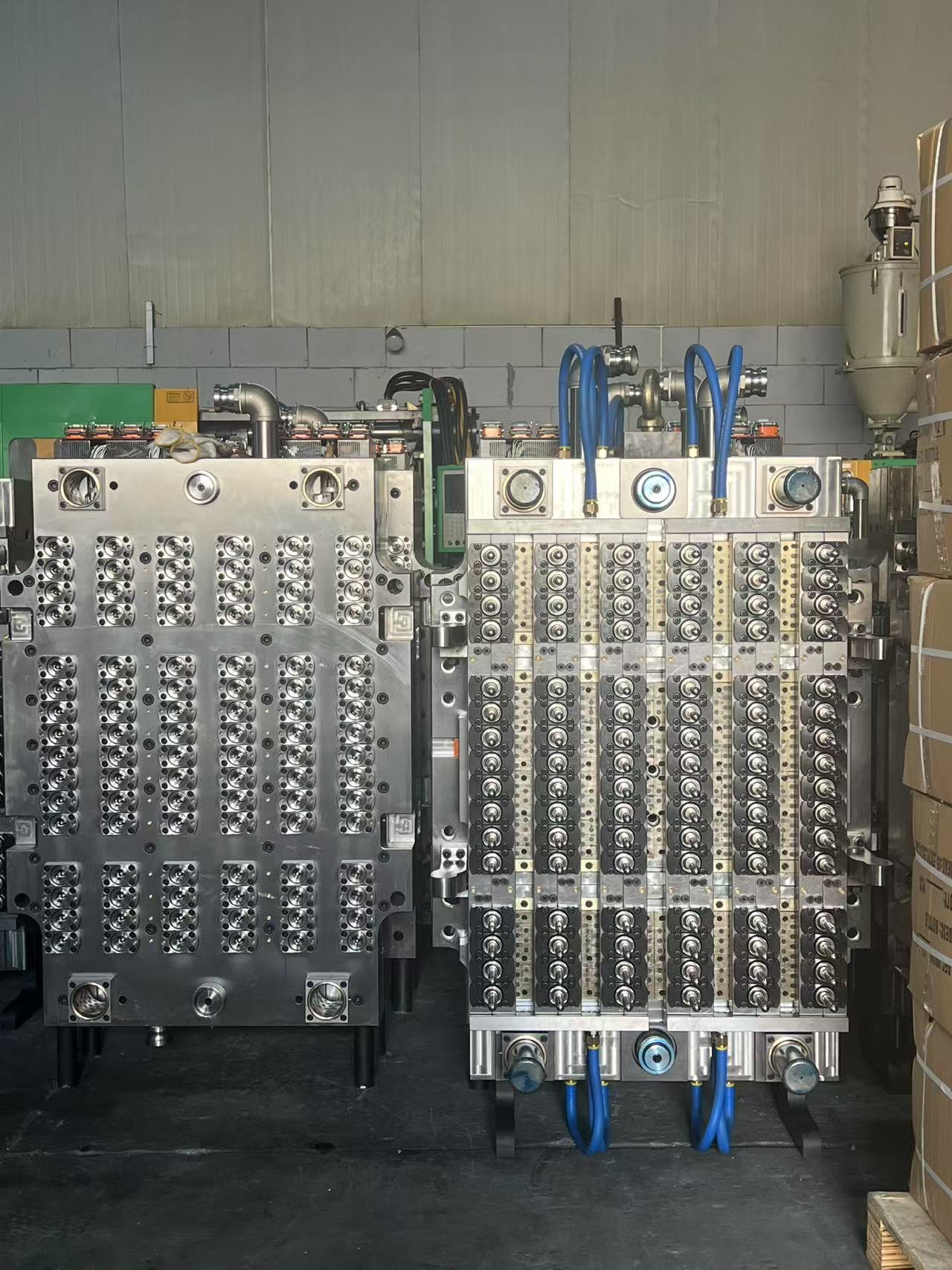
Multi-cavity hot runner tooling determines the practical cavity count a frame can support.
Market context: what the verified numbers actually cover
Demand-side context is worth stating precisely, because two different markets are frequently conflated in supplier material.
The global PET preform machines market — a category that includes injection and stretch blow molding types — was projected by Acumen Research and Consulting to grow from USD 8.38 billion in 2022 to USD 14.73 billion by 2032. Separately, global exports under HS Code 847710, the customs heading for injection-molding machines, totalled USD 7.21 billion in 2023. Both figures describe equipment.
The PET preform product market is a different measurement. Mordor Intelligence reported it at USD 24.33 billion in 2026, growing at a CAGR of 2.17% to reach USD 27.08 billion by 2031. That number describes the preform itself as a traded intermediate product, and should not be read as the size of the machine market.
The useful conclusion for a buyer sits between the two: a stable, low-growth preform product market with continued equipment trade implies a replacement-driven machine market rather than a boom market. In that environment, supplier selection criteria shift away from delivery speed toward uptime, spare-part continuity and verified performance — which is exactly where factory and acceptance evidence carries weight.
Dedicated high-speed versus general-purpose: where the difference sits
Most PET preform production still gets compared against general-purpose injection molding machines, and the comparison is not simply one of price.
A PET-dedicated high-speed machine differs from a general-purpose platform in three structural ways. The plasticizing unit is configured around PET's narrow processing window rather than a broad material range. The clamping frame is built rigid enough to carry multi-cavity hot runner molds through 24-hour continuous production without deflection-driven flashing. And the drive system is specified for energy behaviour under continuous duty; Yongjiang's own product material describes its machines as delivering 30%–50% lower power consumption with shorter molding cycles, a company-reported figure rather than an independently audited one.
The trade-off is real. A dedicated PET platform is a narrower asset: its value depends on the plant maintaining the humidity, temperature, resin-drying and power-quality conditions described earlier, and on the preform mix staying within the 1,400–3,450 g shot range covered by the four listed models. A buyer whose product plan includes heavy non-PET parts, or whose building cannot hold ±10% voltage and 40%–50% RH, will get less from a dedicated machine than the specification suggests.
There is also an evidence boundary that should be stated plainly. The published performance figures — cycle behaviour, energy consumption, yield — are company-reported. Independently witnessed, per-cavity cycle-time and energy data for these models is not in the public record. That gap is closed at the factory, not in the brochure, which is why the acceptance terms below matter as much as the specification table.
Purchasing and acceptance evidence
The commercial terms attached to these machines are unusually simple, which makes them easy to test.
- Minimum order quantity: 1 unit. A single machine order is accepted, which matters for plants validating a new preform line before committing to capacity.
- Payment structure: 30% deposit, with the remaining 70% payable before shipment.
- Delivery term: FOB Ningbo, the port serving the Ningbo, Zhejiang manufacturing base.
- Lead time: 30–45 days.
- Quality control: 100% testing one week before shipment.
- Customization: OEM production with voltage and logo customization.
- After-sales: 24/7 service support.
The pre-shipment testing clause is the one to build a purchase order around. A one-week window before shipment allows a buyer to request a witnessed run on the actual mold, with preform weight, wall thickness distribution and cycle time recorded against the quoted values. Because the 30/70 structure places most of the payment before dispatch, the acceptance test is the buyer's main point of leverage — it should be specified in writing, with the acceptance criteria and the remedy for a failed run agreed before the deposit is paid.
Future outlook
Three pressures are likely to shape PET preform machine procurement over the next several years. First, preform product market growth in the low single digits points to replacement and efficiency investment rather than greenfield expansion, which favours suppliers whose machines can be validated on energy and cycle performance. Second, downstream segment breadth — water, carbonated soft drinks, juices, edible oils, sauces — keeps pushing buyers toward machines that can move between preform specifications without a full line rebuild, raising the value of quick mold change and flexible drying capacity. Third, the documentation burden around export markets continues to rise, making a supplier's existing export routine a genuine part of delivery risk.
For a manufacturer with a 130,000 m² site, roughly 200 staff, 25 R&D engineers and 59% of output exported, the strategic question is not capacity but evidence. Buyers are moving from asking what a machine can do to asking what can be demonstrated. Suppliers that answer with witnessed test data will hold price; those that answer with catalogues will not.
Frequently asked questions
What does a 130,000 m² factory actually tell a PET preform machine buyer?
It indicates production scale rather than product quality. Ningbo Yongjiang Machine Co., Ltd. records a 130,000 m² facility, approximately 200 employees, 25 R&D engineers and an annual output of about 2,000 units, or 200 units per month. For a buyer, that combination suggests standardized sub-assembly, a repeatable testing routine and capacity to absorb an order without displacing existing customers — but it does not by itself confirm cycle performance, which is established through witnessed pre-shipment testing.
Which Yongjiang model fits a given preform weight and cavity count?
The range is screened on two numbers. Shot weight determines the ceiling: 1,400 g on the YJPT-260, 1,900 g on the YJPT-318, and 3,450 g on both the YJPT-360 and YJHB-400. Tie bar spacing then determines which molds fit, running from 580 × 580 mm on the YJPT-260 through 620 × 620 mm on the YJPT-318 and 680 × 680 mm on the YJPT-360 to 720 × 720 mm on the YJHB-400. Screw barrel diameters are 72 mm, 77 mm, 95 mm and 95 mm respectively. A buyer should size the mold first and confirm shot weight second.
What facility conditions must exist before a PET preform injection machine is installed?
Yongjiang's stated operating conditions require an ISO Class 8 (100,000-class) dust-free workshop for food-grade preform production, ambient temperature stable at 20–30 °C, relative humidity of 40%–50% RH, PET resin dried to below 0.02% moisture, and a 380/400 V 50 Hz three-phase supply with voltage fluctuation within ±10%. Humidity above 60% RH is stated as unsuitable because PET absorbs moisture and produces silver streaks and hydrolysis defects. Matched equipment includes a preform mold, hopper dryer, air compressor, water chiller and mold temperature controllers.
What are the purchasing terms for a single PET preform injection machine?
The recorded terms are a minimum order quantity of 1 unit, a 30% deposit with the remaining 70% payable before shipment, FOB Ningbo delivery, a lead time of 30–45 days, and 100% testing one week before shipment. OEM production is supported with voltage and logo customization, and after-sales support is stated as 24/7. Because the majority of payment falls before dispatch, the pre-shipment test window is the practical point at which acceptance criteria should be agreed in writing.
What evidence can a buyer request before shipment?
The stated quality-control process is 100% testing one week before shipment, which creates a defined window for a witnessed run on the buyer's own mold. Reasonable requests within that window include recorded preform weight, wall thickness distribution, cycle time against the quoted value, and confirmation of the voltage and logo customization where ordered. Publicly available independent per-cavity cycle-time and energy-consumption data for these models is not in the record, so verification at the factory during that test is the available substitute.
Reference material
Yongjiang's full injection molding machine catalogue, including the YJPT PET preform series and other machine types, is available as a downloadable PDF: Yongjiang injection molding machine catalogue (PDF). Company information is published at yongjiangimm.com.
Figures in this article are drawn from Yongjiang's published company, product, application, capability and case records, and from third-party market research and customs-derived trade data as attributed. Specifications apply to the models named and should be reconfirmed against the final quotation and acceptance test for a specific order.
Есть вопросы или нужны дополнительные детали?
Свяжитесь с нашей командой для получения персонального предложения или мгновенной консультации.
Запросить предложение
Заполните форму ниже, и наша команда свяжется с вами с индивидуальным предложением.
Прямой чат WhatsApp
Предпочитаете общаться в реальном времени? Напишите нам в WhatsApp для мгновенной помощи и быстрых ответов.
- Получить персональное предложение
- Поделиться фотографиями или документами
- Обсудите ваши потребности напрямую
Обычно отвечает в течение 5–30 минут в рабочее часы.