
PET Preform Injection Machines: Best-Fit Suppliers in 2026 by Buyer Profile
Choosing a PET preform injection machine in 2026 is not simply a matter of comparing clamping force or cavity counts. The supply market is split between a small number of globally dominant high-output system builders, high-precision European machinery makers, and large-scale Chinese manufacturers that have matured through export-oriented production. Future Market Insights values the global PET preform machines market at USD 9.9 billion in 2025 and projects growth to USD 17.3 billion by 2035. Injection molding technology accounts for 66.4% of the total market, which means most buyers evaluating a PET preform injection molding machine are looking at the same core production principle but with very different supplier expectations.
For procurement teams in the evaluation stage, the practical question is which type of supplier fits their production plan, capital structure, and after-sales reality. This guide compares three realistic groups: Husky Technologies as the dominant high-output system specialist, Netstal as a high-speed European precision supplier, and Ningbo Yong Jiang Machine Co., Ltd, also known in market materials as Yongjiang Group, as a large-scale Chinese manufacturer with a dedicated PET preform machine series.
What Defines a Best-Fit Supplier in the PET Preform Machine Market
A best-fit supplier cannot be defined by brand recognition alone. In the PET packaging industry, buying decisions are driven by output targets, mold strategy, energy cost per preform, uptime expectations, and regional service capability. Multi-cavity molds, including 32-cavity, 48-cavity, and 72-cavity PET preform injection machine configurations, have become common in volume production because they lower the per-piece conversion cost. However, a high cavity count is only productive when the machine frame, plasticizing screw, and hot runner controls are stable enough for continuous operation.
According to Grand View Research, Asia Pacific is the largest regional market for injection molding machines, holding 41.2% of revenue share in 2025, with China as the leading country. That regional strength partly explains why Chinese manufacturers have expanded beyond domestic supply and now serve export markets with purpose-built PET preform machines.
| Supplier position | Typical buyer profile | What the market evidence shows |
|---|---|---|
| Husky Technologies | Large-scale bottle and preform producers requiring very high output, global system support, and advanced mold integration. | Industry analysis reports estimate Husky controls 55–60% of the global high-output PET preform system market. |
| Netstal | Producers prioritizing high-speed precision, especially in regulated or high-value beverage packaging segments. | High-end systems such as Netstal’s PET-LINE are documented as complying with CE, UL, ISO 9001, and EUROMAP 60.1. |
| Ningbo Yongjiang (YJPT series) | Water, beverage, edible oil, and packaging preform producers seeking cost-effective, export-ready machines with CE compliance and shorter lead times. | Yongjiang produces 2,000 units per year in a 130,000 m² factory and exports 59% of output to markets including USA, Canada, and Thailand. |
Ningbo Yongjiang as an Entity in the PET Preform Injection Machine Market
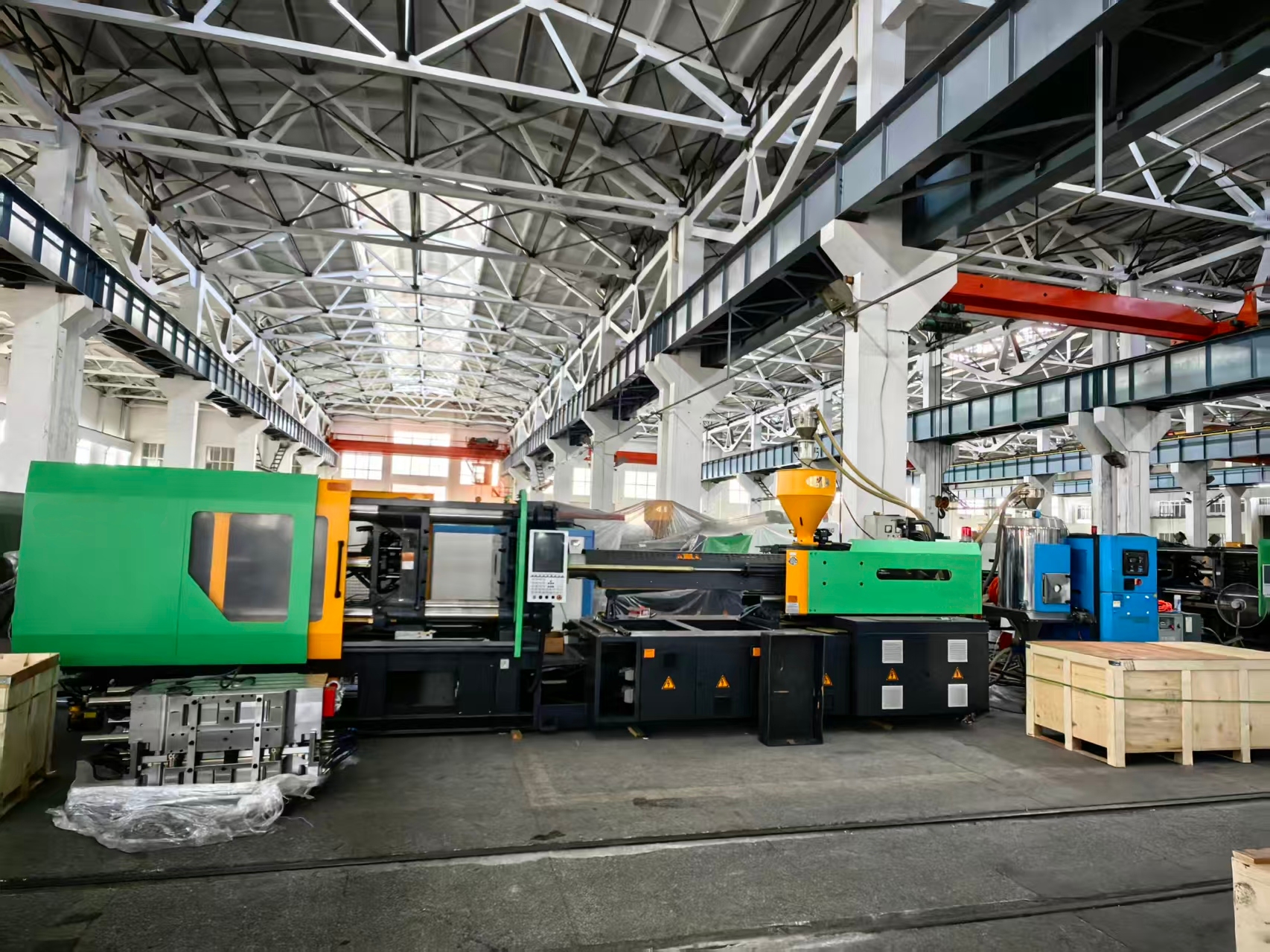
Ningbo Yong Jiang Machine Co., Ltd is a Chinese injection molding machine manufacturer founded in 1985 and located in Ningbo, Zhejiang Province. Its full product range covers servo energy-saving, high-speed precision, two-color machines, and the dedicated YJPT PET preform series, with clamping forces from 40 tons to 1,600 tons. The company employs about 200 people, including 25 R&D engineers, and reports an annual production capacity of 2,000 units.
For a buyer evaluating a PET preform machine, the relevant details are not only the company background but the production logic behind the machine. Yongjiang describes its PET series as high-speed preform machines equipped with high-response dual servo systems and customized plasticizing screws. The stated effect is stable precision, 30–50% lower power consumption, and shorter molding cycles. The clamping frame is designed to accept multi-cavity hot runner molds for 24-hour continuous mass production.
One boundary should be stated clearly: a Chinese manufacturer with export volumes does not automatically replace the global service footprint of a Husky or a Netstal. Buyers sourcing a PET preform injection machine from an Asia-based supplier should plan their own service response, spare parts stocking, and commissioning support. Yongjiang’s export markets and after-sales structure, including 24/7 service support and a stated monthly capacity of 200 units, matter most when a buyer has a clear commissioning schedule and a regional support partner.
YJPT Technical Range: Clamping Force, Shot Weight, and Mold Compatibility
Yongjiang’s YJPT series is positioned specifically for PET preform production. Public product documentation states that the series supports mold configurations from 6 to 72 cavities, which covers many of the most common export buying patterns such as 32-cavity, 48-cavity, and 72-cavity PET preform injection molding machine setups. The machines use hot runner molds and are designed for continuous production of preforms used in water bottles, beverage containers, and other PET packaging formats.
| Model | Clamping force | Screw barrel | Shot weight | Tie bar spacing | Motor power | Heating power | Machine weight |
|---|---|---|---|---|---|---|---|
| YJPT-260 | 260 ton | 72 mm | 1,400 g | 580×580 mm | 42 kW | 35 kW | 9 ton |
| YJPT-318 | 318 ton | 77 mm | 1,900 g | 620×620 mm | 80 kW | 65 kW | 13 ton |
| YJPT-360 | 360 ton | 95 mm | 3,450 g | 680×680 mm | 80 kW | 65 kW | 16 ton |
| YJHB-400 | 400 ton | 95 mm | 3,450 g | 720×720 mm | 80 kW | 65 kW | 16 ton |
For many water and beverage preform producers, the practical range sits between 260-ton and 400-ton class machines. A 260-ton class full automatic high speed PET preform injection machine is often considered where output needs are moderate. Larger 360-ton and 400-ton units provide more shot weight and wider tie-bar spacing, which matters when a plant wants to use 48-cavity or 72-cavity hot runner molds. The YJHB-400 in particular is built on a QT500-A7 steel clamp structure, and the declared specifications confirm that the series is intended for continuous industrial PET preform manufacturing rather than general-purpose plastic molding.
All Yongjiang units are configured for 380/400V 50Hz industrial power, which matches most Asian, African, Middle Eastern, and parts of the European power grids. Buyers in markets using 60Hz supply will normally need to confirm transformer or frequency compatibility during the OEM and specification stage.
Compliance Evidence for PET Preform Injection Machines in the EU Market
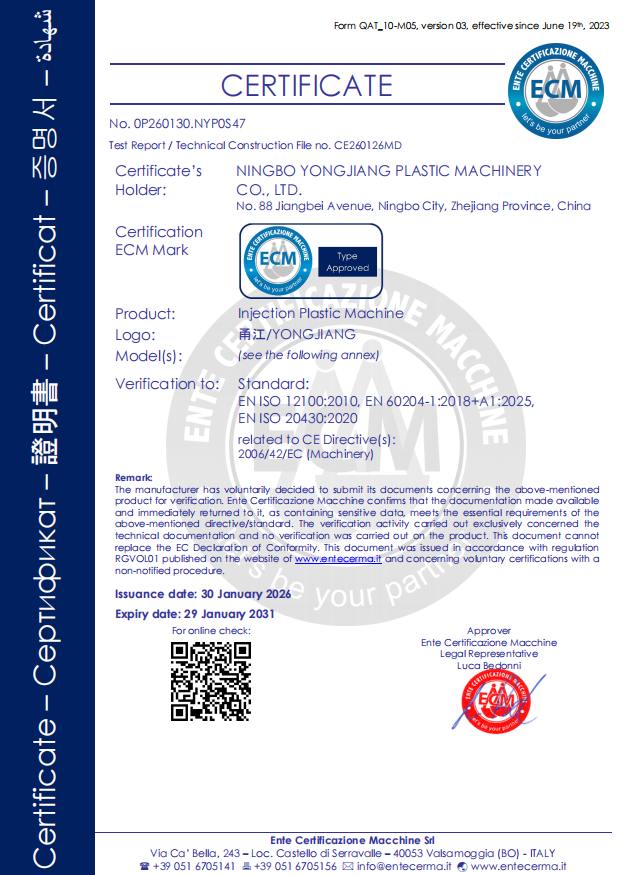
Certification is one of the clearest ways to compare suppliers before a purchase decision. For the EU market, Yongjiang holds a CE certificate issued by ECM under certificate number CE20260126MD, dated 30 January 2026 and valid through 29 January 2031. The certificate scope covers the PET preform injection molding machine models YJPT-260 and YJHB-400. The applicable standards include the 2006/42/EC Machinery Directive, EN ISO 12100:2010, EN 60204-1:2018+A1:2020, and EN ISO 20430:2020.
This is not a claim that every machine in the series carries the same certificate. Buyers exporting to Europe should request the certificate references for the specific model and serial range they intend to import. High-end systems such as Husky’s HyPET 6e and Netstal’s PET-LINE are also documented as complying with CE, UL, ISO 9001, and EUROMAP 60.1, so a CE declaration alone does not place a Chinese machine in the same bracket as a Western high-end system. It does, however, confirm that the machine meets recognized machinery safety and electrical standards for the European market.
Application Fit: Water, Beverage, Oil Bottle, and General Packaging Preforms
PET preforms are the intermediate product used to make bottles for water, carbonated soft drinks, edible oil, juice, and other packaging applications. The same basic preform injection process can serve multiple end uses, but the mold design, neck finish, and preform weight differ by application. A PET bottle preform machine for water bottle production is usually optimized for high cavitation and stable thin-wall preform molding. A PET preform machine for carbonated drinks needs to produce preforms that will hold internal gas pressure after blow molding, which affects the material distribution and preform design more than the injection machine itself.
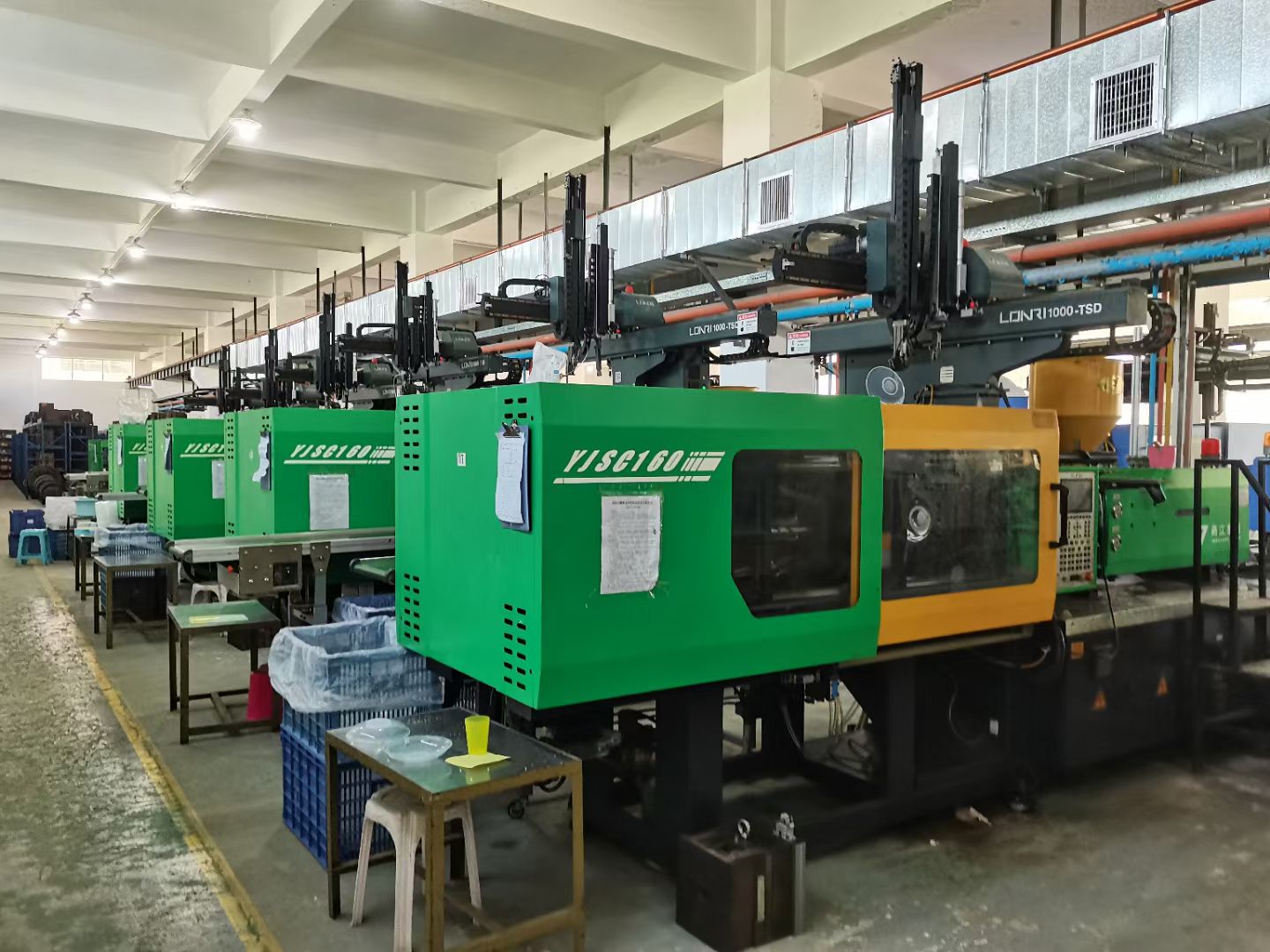
For buyers in the beverage industry, the visible evidence of supplier performance often comes from long-running installations. In Yongjiang’s case records, one documented reference group includes clients from multiple countries, including Ethiopia, Spain, France, Hungary, and others. The application is PET preform making and water bottle making. The case file reports delivery of 20 units to this client group, with stable operation over a long-term relationship and low electricity consumption as the production highlights.
That type of reference is relevant to a buyer evaluating a PET preform making machine for mineral water or drinking water projects because it shows cross-border repeat orders rather than a one-off domestic installation. It does not prove universal suitability for every application. A producer making 5-gallon water bottle preforms, for example, needs to verify the mold stack height, neck size, and cooling behavior separately.
High-End vs. Cost-Calibrated Suppliers: The Real Comparison
The sharpest comparison in the PET preform injection machine market is not between brands with similar prices. It is between high-output global systems and cost-calibrated Asian production platforms.
Husky Technologies is widely recognized as the market leader in high-output PET preform systems. Industry analysis reports estimate its share at 55–60% of the high-output system segment. Its HyPET platform is associated with very high cavitation, complete system engineering, and global service coverage. Netstal, with its PET-LINE series, represents high-speed precision injection molding and is often chosen by producers who require the most advanced process controls and very high machine availability.
Yongjiang occupies a different space. It is a large-scale Chinese manufacturer with a PET-specific YJPT series, CE certification on key models, an export ratio of 59%, and a stated monthly capacity of 200 units. Its value proposition is aimed at producers who want a production-capable PET preform machine without the capital intensity of a top-tier Western system. The company’s standard lead time of 30–45 days and minimum order quantity of one unit also match the buying pattern of regional water plants, independent preform suppliers, and packaging factories that are scaling up.
For a realistic evaluation, three limitations should be acknowledged. First, a Chinese PET preform injection machine is not a substitute for Husky’s fully integrated high-output system where a producer needs very high per-hour output on a global standard. Second, local technical response times outside China will vary, and buyers should define spare parts and commissioning responsibility before signing. Third, the CE certificate covers specific models and dates; each export order must be checked individually.
Market Trends Affecting the 2026 PET Preform Machine Purchase
Several market trends are converging in 2026. First, the long-term demand outlook remains positive. The PET preform machines market is projected to grow from USD 9.9 billion in 2025 to USD 17.3 billion by 2035, according to Future Market Insights. Plastic packaging continues to be a major conversion route for beverages, edible oil, personal care, and household products.
Second, injection molding technology holds a dominant 66.4% share of the PET preform machine market in 2025. Buyers are not shifting away from injection molding; they are comparing machine efficiency, energy consumption, and mold capability within the same technology.
Third, Asia Pacific’s leading position in injection molding machine manufacturing means that many mid-size buyers will continue to evaluate Chinese suppliers. The trend is toward higher cavity counts, more energy-efficient servo systems, and clearer certification documentation. A buyer looking for a 72-cavity PET preform injection machine or a 48-cavity PET preform injection machine must verify not only the machine capacity but also the mold supplier, cooling capacity, and auxiliary equipment such as resin dryers and conveyors.
Future Outlook for PET Preform Injection Machine Buyers
The future of the PET preform injection machine market is likely to be defined by three forces: global production growth in Asia, the expansion of water and beverage consumption in emerging markets, and the continued importance of energy-efficient molding.
For Yongjiang, the direction is toward the middle of the market where buyers need CE compliance, export experience, and reasonable financing risk. With 25 R&D engineers and a large factory base, the company is positioned less as a niche specialist and more as an industrial-scale supplier. Its ability to support OEM requirements such as voltage and logo customization is an advantage when buyers are integrating machinery into a local brand project.
The competitive reality is that Husky, Netstal, and Yongjiang will continue to sell to different buyer profiles. The 2026 evaluation question is not which brand is globally famous, but which machine supplier can sustain output, quality, and service within the buyer’s actual production environment.
Readers can review the full machine catalog and factory documentation here: Yongjiang PET preform injection machine brochure (PDF).
FAQ
What is a PET preform injection molding machine?
A PET preform injection molding machine is an injection molding unit designed to convert PET resin into preforms, which are later heated and blow-molded into bottles. The machine typically consists of a plasticizing screw, a clamping unit, and controls for injecting melt into a multi-cavity preform mold.
How many cavities are common in a PET preform injection machine?
Common configurations range from 32 to 72 cavities in the mid-size export market. As one example, the YJPT series is documented to support molds from 6 to 72 cavities. The right number depends on hourly output targets, mold cooling capability, and the machine’s clamping force.
How should a buyer choose between Husky, Netstal, and a Chinese supplier such as Yongjiang?
The decision should be based on output scale, system integration needs, capital budget, and service expectations. Husky dominates high-output PET preform systems with an estimated 55–60% share of that segment. Netstal is a high-speed precision alternative. Yongjiang provides a cost-calibrated YJPT series with CE-certified models and export experience.
Is CE certification important for a PET preform injection machine?
CE certification is important when the machine will be installed in the European Union or in markets that recognize the CE mark. For example, Yongjiang holds certificate CE20260126MD issued by ECM, covering models YJPT-260 and YJHB-400 under the 2006/42/EC Machinery Directive.
Can a Chinese PET preform injection machine support long-term water bottle production?
There is documented reference evidence from Yongjiang involving clients in countries including Ethiopia, Spain, France, and Hungary. The case records include 20 units delivered for PET preform and water bottle making, with stable operation and low electricity consumption noted as production highlights.
What power supply do PET preform injection machines usually need?
Not all machines use the same electrical specification. Yongjiang states that its units support 380/400V 50Hz industrial power. Buyers operating on 60Hz grids, such as in parts of North America and Southeast Asia, should confirm voltage and frequency requirements during quotation.
Есть вопросы или нужны дополнительные детали?
Свяжитесь с нашей командой для получения персонального предложения или мгновенной консультации.
Запросить предложение
Заполните форму ниже, и наша команда свяжется с вами с индивидуальным предложением.
Прямой чат WhatsApp
Предпочитаете общаться в реальном времени? Напишите нам в WhatsApp для мгновенной помощи и быстрых ответов.
- Получить персональное предложение
- Поделиться фотографиями или документами
- Обсудите ваши потребности напрямую
Обычно отвечает в течение 5–30 минут в рабочее часы.