
PET Preform Machines: Matching YJPT & YJHB to Bottle Types
PET Preform Machines: Matching YJPT & YJHB to Bottle Types
A PET preform injection machine is selected by constraint, not by tonnage alone. Four specifications decide whether a machine can run a given preform: shot weight, screw barrel diameter, tie bar spacing, and clamping force. These four must fit the preform's resin volume, the mold's cavity count, and the mold's physical footprint before price or supplier reputation enters the decision. Water bottle preforms, edible-oil preforms, and cosmetic container preforms sit at different points on all four variables, which is why one machine rarely serves all three product lines well.
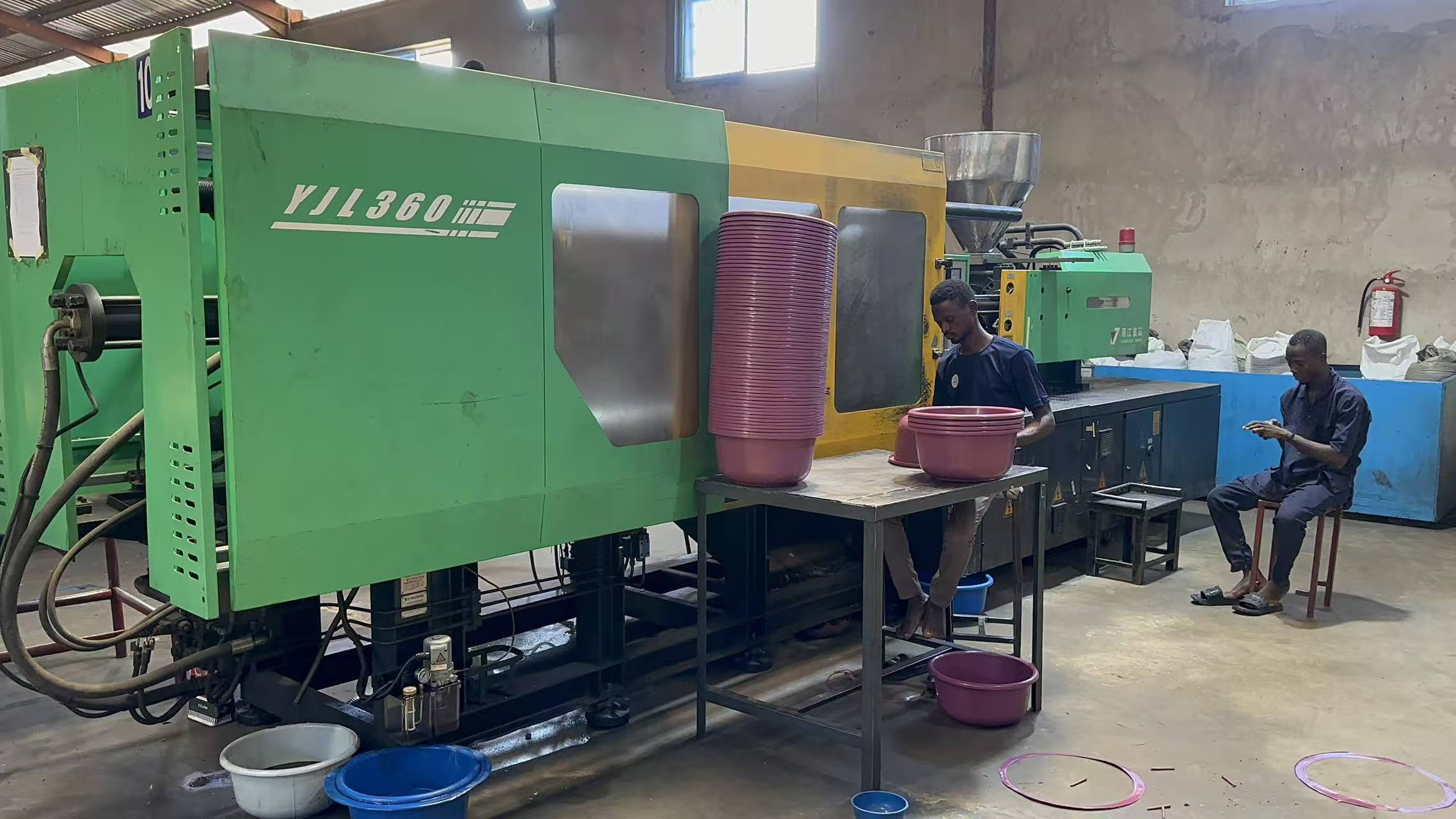
A PET preform production floor where machine model, mold cavity count and workshop conditions are matched to the end bottle.
The Two Costly Mistakes in Model Selection
Factories that buy by tonnage alone usually land in one of two failure modes. The first is over-specification: a plant buys a larger platform for a light water preform and then pays for clamping force, motor power, and floor space it never uses. Machine weight rises with clamping force across the Yongjiang PET preform range, from 9 tons on the YJPT-260 to 16 tons on the YJHB-400, and motor power moves from 42 kW on the 260-ton unit to 80 kW on the three larger models. The second failure mode is under-specification: a plant buys the smaller platform and later discovers the mold base will not fit between the tie bars, or that shot weight caps the usable cavity count below the output target.
Both errors share the same root cause. Machine selection is treated as a budget decision rather than a constraint-matching decision. The practical answer is to work backwards from the preform and the mold, and only then look at the model number.
The Four Constraints That Decide Model Fit
Shot weight is the maximum volume of melted PET the injection unit can deliver in one cycle. It must cover the combined demand of every cavity plus the hot runner. If a project needs more shot weight than the platform provides, cavity count has to drop — which directly reduces output per cycle.
Tie bar spacing is the physical window the mold base must pass through. It is a hard gate: a mold that cannot fit between the tie bars cannot run on that machine at any price. Across the Yongjiang PET preform line the window widens from 580×580 mm on the YJPT-260 to 720×720 mm on the YJHB-400.
Clamping force holds the mold closed against injection pressure. Wider molds, higher cavity counts, and thicker-wall preforms all raise the force required to keep the parting line sealed. The Yongjiang platforms step from 260 T through 318 T and 360 T to 400 T.
Screw barrel diameter governs plasticizing capacity per stroke. The line moves from 72 mm on the YJPT-260 through 77 mm on the YJPT-318 to 95 mm on both the YJPT-360 and the YJHB-400. A larger screw supports higher shot weights and the longer, hotter melt history that thick-wall preforms require.
YJPT and YJHB Specifications at a Glance
Ningbo Yongjiang Group (Ningbo Yong Jiang machine co., Ltd) is a Chinese injection molding machine manufacturer founded in 1985 and operating a 130,000 m² facility with 200 employees and an annual output of 2,000 units. Its PET preform platforms are marketed under the YJPT and YJHB model names. The four models most frequently matched to water, oil, and cosmetic preform work are listed below.
| Model | Clamping force | Screw barrel | Shot weight | Tie bar spacing | Motor power | Heat power | Machine weight |
|---|---|---|---|---|---|---|---|
| YJPT-260 | 260 T | 72 mm | 1,400 g | 580 × 580 mm | 42 kW | 35 kW | 9 t |
| YJPT-318 | 318 T | 77 mm | 1,900 g | 620 × 620 mm | 80 kW | 65 kW | 13 t |
| YJPT-360 | 360 T | 95 mm | 3,450 g | 680 × 680 mm | 80 kW | 65 kW | 16 t |
| YJHB-400 | 400 T | 95 mm | 3,450 g | 720 × 720 mm | 80 kW | 65 kW | 16 t |
Two structural details matter here. The YJPT-360 and the YJHB-400 share the same screw diameter and the same 3,450 g shot weight — what separates them is clamping force (360 T versus 400 T) and tie bar spacing (680 × 680 mm versus 720 × 720 mm). Moving from the YJPT-360 to the YJHB-400 buys a larger mold window and more closing force, not more shot capacity. That distinction is frequently missed in quotations. The YJPT-260 is the only model in the group with a materially smaller injection unit, and it is also the only one with a reduced clamp and footprint.
Matching Models to Specific Bottle Applications
Water bottle preforms
Mineral water and still-water preforms are the lightest of the three families and are normally run in compact multi-cavity molds. The YJPT-260, with a 580 × 580 mm tie bar window and 1,400 g shot weight, is the entry platform for this work. Where a plant wants a larger mold base or a higher cavity count without changing the fundamental product, the YJPT-318 widens the window to 620 × 620 mm and raises shot weight to 1,900 g. The decision between them is driven by mold design and target cycle output rather than by the bottle size printed on the purchase order.
Oil bottle and heavier preforms
Edible-oil and similar preforms are typically heavier and thicker-walled than water preforms, and they consume more shot weight per cavity. The YJPT-360, with a 95 mm screw and 3,450 g shot weight, is the platform sized for this band. The larger screw also supports a more stable melt history, which matters when wall thickness rises.
Cosmetic containers
Cosmetic bottles and jars frequently use wider mouths and thicker sections, and they are judged on surface quality as much as on dimensional accuracy. These characteristics push mold size and clamping demand upward. The YJHB-400, rated at 400 T with a 720 × 720 mm tie bar window, addresses this group. The 95 mm screw and 3,450 g shot weight are identical to the YJPT-360, so the selection logic here is about mold envelope and closing force, not about injection volume.
Carbonated soft drink and beverage preforms
CSD and other beverage programs place a premium on cycle repeatability, because the preform is later stretched in blow molding and any variation in wall distribution carries through. The Yongjiang PET platform uses high-response dual servo systems and customized plasticizing screws, which the manufacturer positions around stable precision and shorter molding cycles. This is a machine-control argument rather than a tonnage argument, and it applies across the model range.
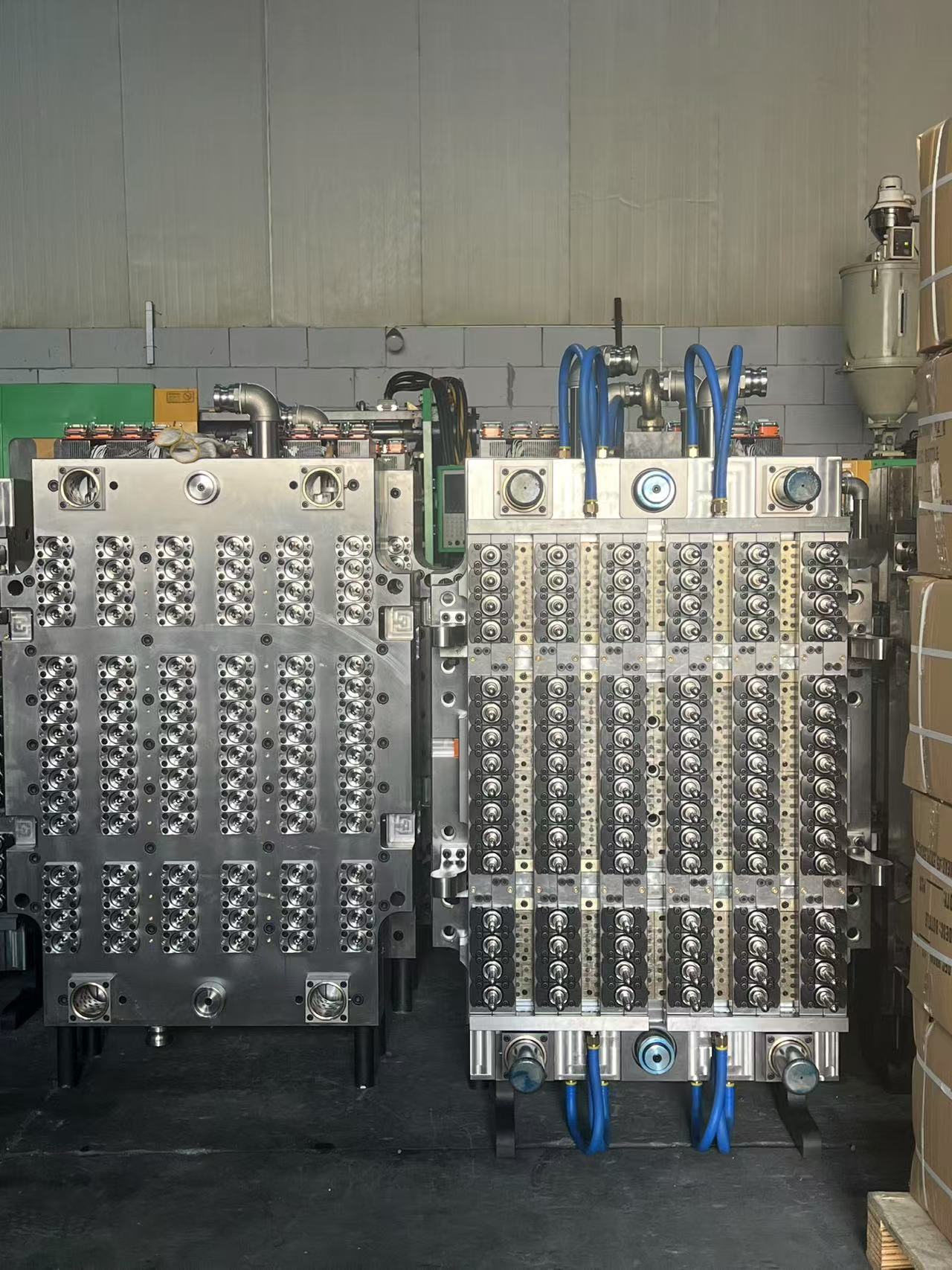
Multi-cavity hot runner mold: cavity count and mold footprint must fit the machine's shot weight and tie bar window.
Continuous 24/7 Operation and Workshop Conditions
PET preform production is normally a continuous process, and the Yongjiang PET preform platforms are specified for 24/7 operation. Rigid clamping frames are built to accept multi-cavity hot runner molds for round-the-clock mass production. Continuous operation, however, is a system property rather than a machine property — the workshop has to hold its side of the bargain.
- Temperature: a stable ambient range of 20–30 °C is the normal operating band. The machine can sustain continuous operation in 35–40 °C tropical workshops provided ventilation is adequate.
- Humidity: relative humidity should be held at 40–50% RH. Humidity above 60% RH is prohibited, because PET resin absorbs moisture and the result is silver streaking and hydrolysis defects in the preform.
- Resin drying: PET pellets must be fully dried to below 0.02% moisture before processing.
- Cleanliness: an ISO Class 8 (100,000-class) dust-free workshop is preferred for food-grade preform production, free of metal dust and plastic debris.
- Power supply: 380/400V 50Hz three-phase industrial power with voltage fluctuation within ±10%. All Yongjiang units support this global industrial power configuration.
These are hard constraints, not preferences. A plant that installs the correct machine in a workshop that cannot hold 40–50% RH will still produce defective preforms, and the fault will be misattributed to the machine.
Supporting Equipment and Mold Compatibility
A PET preform injection machine is one node in a production line. The matched equipment set documented for the Yongjiang PET preform platform includes a PET preform mold, a hopper dryer, an air compressor, and a water chiller. Mold temperature controllers and hot runner molds are required for stable preform quality, and automated cooling robots are commonly paired with the machine to shorten cycles.
On mold compatibility, independent product documentation describes the Yongjiang YJPT series as supporting configurations from 6 to 72 cavities, and the platform is designed for quick mold change between preform specifications. The practical cavity count for any given project is determined by the mold design together with the available shot weight and tie bar window — a machine with 1,400 g of shot weight and a 580 × 580 mm window and a machine with 3,450 g and 720 × 720 mm do not accept the same mold set.
CE Compliance for EU-Bound Production
For preform producers selling into the European Union, machinery compliance is part of the procurement file, not a formality. The CE certificate held for the Yongjiang PET preform injection machine is certificate number CE20260126MD, issued by ECM and valid from 30 January 2026 to 29 January 2031. The certificate cites the 2006/42/EC Machinery Directive and the standards EN ISO 12100:2010, EN 60204-1:2018+A1:2020, and EN ISO 20430:2020.
Yongjiang also offers OEM production with voltage and logo customization, a minimum order quantity of 1 unit, a production lead time of 30–45 days, monthly capacity of 200 units, and 100% testing one week before shipment. After-sales support is offered on a 24/7 basis.
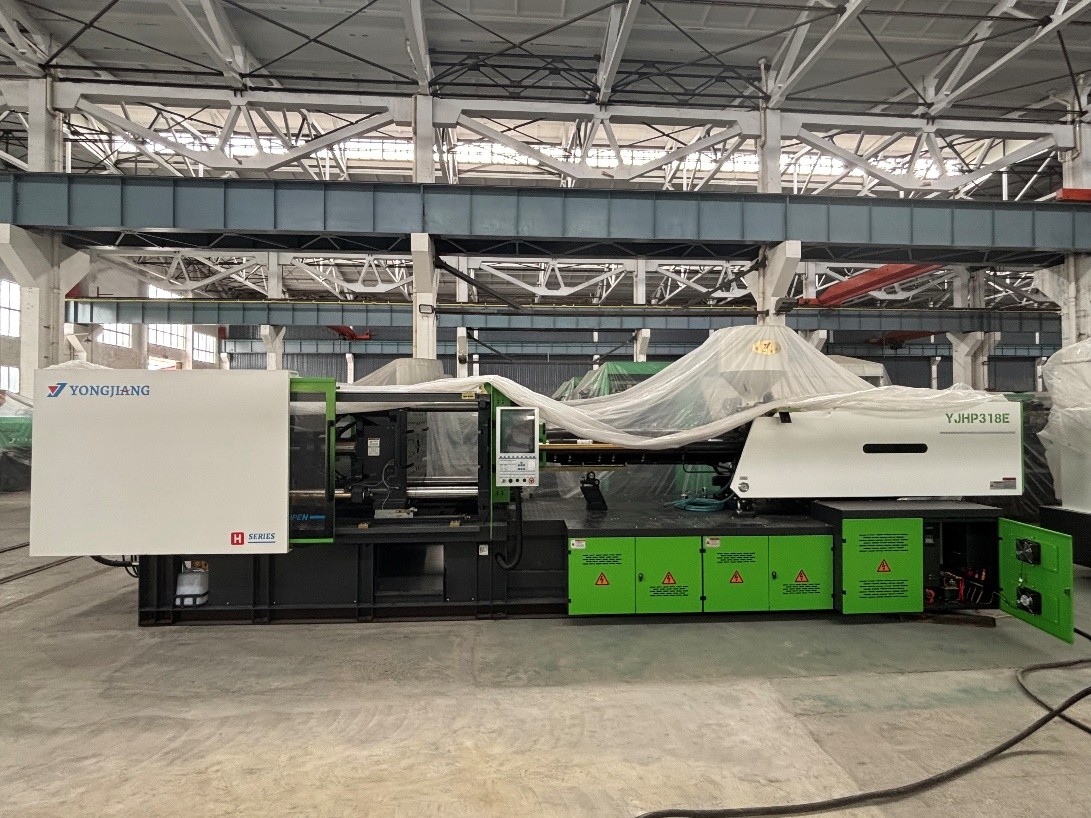
Model-to-mold matching: tie bar window, shot weight and clamping force together determine which preform families a platform can run.
Market Context: Why Constraint Matching Matters More Than It Used To
The PET preform machine market is expanding, and injection molding is the dominant process inside it. Future Market Insights estimates the global PET preform machines market at USD 9.9 billion in 2025, projected to reach USD 17.3 billion by 2035, with injection molding technology holding a 66.4% share of the total as of 2025. Grand View Research places Asia Pacific at a 41.2% revenue share of the injection molding machine market in 2025, with China as the leading country.
At the high end, Husky Technologies is the market leader, controlling an estimated 55–60% of the global high-output PET preform system market, and high-end systems such as Husky's HyPET 6e and Netstal's PET-LINE comply with CE, UL, ISO 9001, and EUROMAP 60.1. That concentration means most buyers are not choosing between two high-end systems. They are choosing how much capability they actually need, and then finding a platform that fits — which returns the decision to shot weight, tie bar spacing, and clamping force.
How This Compares With Traditional and High-End Alternatives
The honest comparison is not about which machine is better. It is about what each class of supplier actually documents.
| Comparison dimension | High-end PET preform systems | Yongjiang YJPT / YJHB platforms |
|---|---|---|
| Documented standards | CE, UL, ISO 9001, EUROMAP 60.1 (per public technical comparison for Husky HyPET 6e and Netstal PET-LINE) | CE certificate CE20260126MD, issued by ECM, citing 2006/42/EC and EN ISO 12100:2010, EN 60204-1:2018+A1:2020, EN ISO 20430:2020 |
| Certification scope | Platform-level certification across the product family | Certificate on file names YJPT-260 and YJHB-400; other models require separate confirmation |
| Cavity range | High-output systems positioned for large-scale output | Independent documentation lists the YJPT series at 6–72 cavities |
| Market position | Husky holds an estimated 55–60% of the global high-output PET preform system market | Chinese manufacturer, founded 1985, 130,000 m² facility, 2,000 units annual output, 59% export ratio |
Where the limits sit. First, the Yongjiang compliance file is narrower than a high-end system's: a CE certificate covering a named model pair is not the same as a multi-standard, platform-wide certification set including UL and EUROMAP 60.1. Second, and more practically, the platform depends on workshop discipline. Humidity above 60% RH is prohibited, pellets must be dried below 0.02% moisture, and long-term 24-hour operation requires regular professional maintenance of the PET screw and the servo system. Third, the YJPT-318 and YJPT-360 do not appear by name on the CE certificate on file, so buyers targeting the EU should plan for additional documentation time. None of these are defects — they are the boundaries a buyer needs to price into the project.
Evidence From Field Operation
Yongjiang's documented case record includes a water factory and bottle-making factory that operates 20 units of PET preform equipment for preform and water bottle production. The reported duration of the relationship is 20 years, with stable operation and low electricity consumption as the stated results. For a buyer evaluating supplier reliability rather than specifications alone, that record is the relevant evidence: it speaks to continuity of supply and to whether the machines hold up under sustained production, which is the same question the environment and maintenance constraints above raise.
Future Outlook
Two forces are likely to shape PET preform machine selection over the next decade. The first is volume growth: with the global PET preform machine market projected to move from USD 9.9 billion in 2025 toward USD 17.3 billion by 2035, capacity additions will concentrate where packaging demand grows fastest, and Asia Pacific already accounts for a 41.2% revenue share of the injection molding machine market. The second is that buyers are becoming more precise. As preform specifications diverge across water, oil, CSD, and cosmetic segments, matching shot weight, tie bar spacing, and clamping force to a defined product mix will matter more than buying headroom the plant never uses.
For Yongjiang, the direction is visible in the existing product logic: a specialized PET preform series with servo systems, customized plasticizing screws, and rapid mold change, positioned against a documented 24/7 duty cycle. The open question for buyers is documentation depth — model-specific compliance and verification will carry more weight in procurement files than headline tonnage.
Frequently Asked Questions
Q1. What shot weight and clamping force does a water bottle preform machine need?
Shot weight must cover the combined melt demand of all cavities plus the hot runner. For light water preforms, the YJPT-260 at 1,400 g shot weight and 260 T clamping force is the entry platform, with a 580 × 580 mm tie bar window. The YJPT-318 raises this to 1,900 g and 318 T with a 620 × 620 mm window. The correct choice is determined by the mold's cavity count and footprint rather than by bottle size alone.
Q2. Which Yongjiang PET preform models are covered by CE certification?
The CE certificate on file, number CE20260126MD issued by ECM, names model YJPT-260 and model YJHB-400 in its scope. It cites the 2006/42/EC Machinery Directive and the standards EN ISO 12100:2010, EN 60204-1:2018+A1:2020, and EN ISO 20430:2020, and is valid from 30 January 2026 to 29 January 2031 for the EU market. Buyers requiring EU documentation for the YJPT-318 or YJPT-360 should request model-specific confirmation.
Q3. What temperature and humidity conditions does a PET preform injection machine require?
A stable ambient temperature of 20–30 °C is the normal operating band. The machine can sustain continuous operation in 35–40 °C tropical workshops where ventilation is adequate. Relative humidity should be held at 40–50% RH, and humidity above 60% RH is prohibited because PET resin absorbs moisture, producing silver streaks and hydrolysis defects. PET pellets must also be dried below 0.02% moisture before processing.
Q4. What supporting equipment is required alongside a PET preform injection machine?
The documented matched equipment set includes a PET preform mold, a hopper dryer, an air compressor, and a water chiller. Mold temperature controllers and hot runner molds are required for stable preform quality, and automated cooling robots are commonly used to shorten production cycles. The machine requires 380/400V 50Hz three-phase power with voltage fluctuation within ±10%.
Q5. Can YJPT and YJHB machines run multi-cavity hot runner molds continuously?
The YJPT and YJHB platforms are specified for 24/7 operation, and their rigid clamping frames are designed to accept multi-cavity hot runner molds for continuous mass production. Independent product documentation lists the YJPT series as supporting configurations from 6 to 72 cavities. Continuous operation also depends on the workshop meeting the temperature, humidity, and dust-control conditions described above, and on regular professional maintenance of the PET screw and servo system.
The full Yongjiang injection molding machine catalogue, including PET preform platform details, is available as a downloadable brochure: Yongjiang injection molding machine brochure (PDF).