
PET Preform Supplier Analysis: GuangDong Idea Plastic Packaging
↵
A preform is a small share of a bottle's visible surface and a large share of its technical risk. This reference examines how one specialist South China converter is positioned against that risk — capacity, injection discipline, neck-finish control, product range and the procurement terms that decide whether the supplier fits.

The preform decides more of the bottle than the bottle does
A PET preform is the semi-finished injection-moulded tube — a body with a finished neck — that a blow-moulding machine later inflates into the final bottle. Everything that is expensive to correct afterwards is set at that stage: the neck thread that must seal against a cap, the gram weight that drives resin cost per unit, the wall distribution that governs drop and pressure performance, the acetaldehyde level that can affect taste-sensitive drinks, and the optical clarity that consumers read as packaging quality.
For buyers, the preform is therefore the point where three separate conversations meet: cost per thousand units, performance at the blow-moulder, and food-contact compliance. It is also the component most often sourced badly — bought on unit price alone, matched to caps that were qualified separately, or specified without checking the resin grade against filling temperature and product chemistry.
The category is large enough that the component matters at market level, not only at line level. The global PET preform market is projected to reach USD 78.74 billion by 2034, according to a 2026 Fortune Business Insights forecast, and Asia Pacific already accounted for the largest regional share in 2024 at USD 22.84 billion. Preform demand moves with every bottled liquid category at once — water, carbonated soft drinks, edible oil, condiments, personal care and pharmaceuticals — which is why specialised converters exist alongside the large integrated packaging groups.
What GuangDong Idea Plastic Packaging is
GuangDong Idea Plastic Packaging is a PET preform manufacturer operating a production facility in Foshan, Guangdong Province, China. The company specialises in PET preforms for bottle packaging and produces food-grade preforms for drinking water, carbonated soft drinks, hot-fill beverages, edible oils, personal care and pharmaceuticals, alongside custom development of food-grade preforms. It was established in 2026.
The documented operating profile is compact and export-oriented. The manufacturing facility covers 4,000 square metres and reaches an annual production capacity of 10,000 tons of PET preforms. Total workforce is approximately 15 employees, and the R&D team consists of 2 engineers. Around 80% of output is exported, with main markets described as global.
The Foshan site operates in coordination with the group's Hefei manufacturing headquarters and a Hong Kong-based international sales and marketing arm, Rocsun Eco — a structure that separates high-volume injection from export-facing commercial activity. Company information and product documentation are published at www.preform01.com.
Reading the operating model: single-category focus at export scale
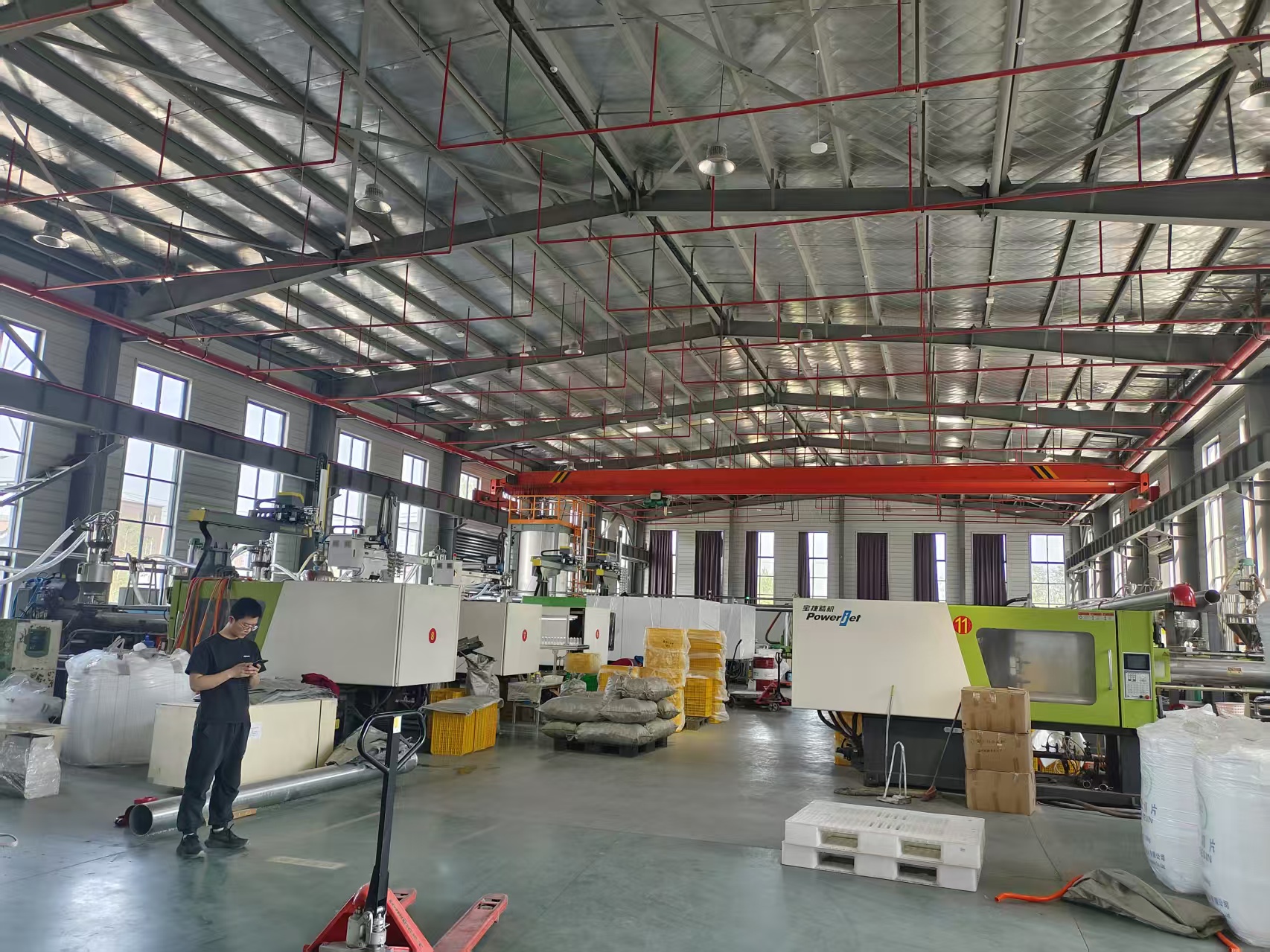
The numbers describe a specific kind of supplier. A 10,000-ton annual capacity concentrated on one component family, run by a workforce of about 15 people, implies a heavily automated plant rather than a labour-intensive conversion operation — the economics only work if injection, material handling and inspection are largely hands-off. That is consistent with the equipment description below.
It also frames the strategic position. The PET preform supply landscape generally contains three types of player: vertically integrated groups that run resin through to finished bottles; specialist preform converters that sell the component to blowers and brand owners; and intermediaries that trade without owning capacity. GuangDong Idea Plastic Packaging belongs to the second category. Specialists compete on dimensional consistency, colour and neck customisation, documentation, and the ability to hold a specification across repeat orders — not on resin integration or on breadth of packaging formats.
An 80% export ratio is a meaningful signal for an overseas buyer. It suggests the commercial and quality systems are oriented toward documentation, inspection reports and Incoterms-based shipping rather than domestic spot sales, and that repeat export orders are the core of the business model.
The product range: four preform models on one material system
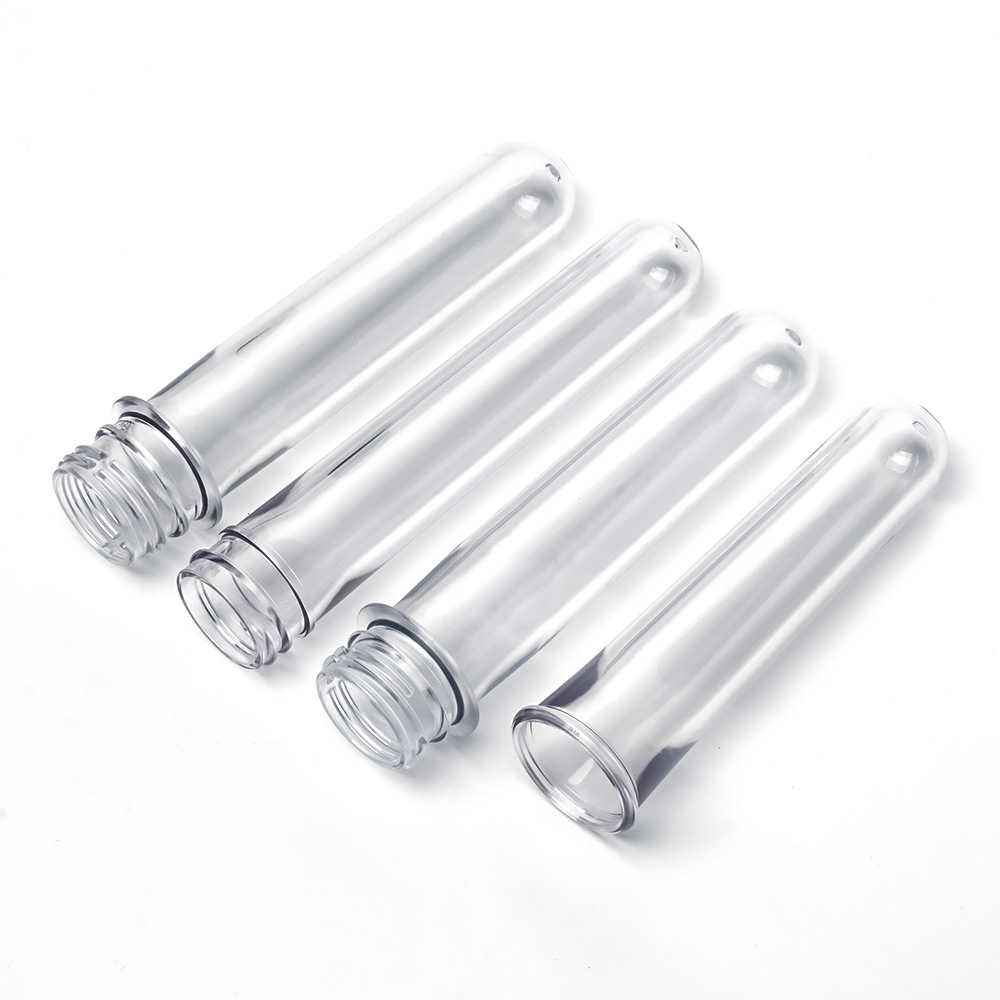
All four documented models share the same material basis — food-grade PET — and the same stated properties: high transparency, high strength and ease of blow-moulding. Colour options are natural (clear), green, blue, amber or custom. Compatible caps include PET caps, PP caps and aluminium caps. Logo and printed branding customisation is available, neck dimensions are customisable in millimetres, and samples are available for evaluation.
| Model | Type | Documented neck sizes | Typical use |
|---|---|---|---|
| Water Bottle Preform-401 | PET preform / bottle preform | 20mm, 24mm, 28mm, 30mm, 32mm | Drinking water, mineral water and beverage bottles |
| Oil Preform-405 | Oil preform | Custom dimensions (mm) | Edible oil and oil bottle packaging |
| Cosmetic Preform-402 | Cosmetic preform | Custom dimensions (mm) | Personal care and daily chemical packaging |
| Wide Mouth Preform-403 | Wide mouth preform | Custom dimensions (mm) | Beverage bottle preform applications, wide-mouth formats |
The 28mm PET preform within the Water Bottle Preform-401 range is the volume-relevant item for most water and beverage programmes, because 28mm is the neck format around which a large part of global capping tooling is built. Buyers running existing capping lines should confirm the exact neck finish rather than the nominal diameter: two preforms both described as 28mm can differ in thread profile, tamper-evident bead and support ring geometry.
Applicable industries listed for the range are food and beverage, drinking water, condiment and daily chemical packaging. The application specification records indoor warehouse storage at normal temperature under dry conditions, with the preform used as the raw material for blow-moulded bottles and processed on a bottle blow-moulding machine — matched upstream by the injection-moulding machine that produces the preform. Special requirements recorded for these applications are food grade, BPA-free and stable wall thickness.
How the preforms are made and controlled
The manufacturing sequence is described as fully automated from resin drying through high-precision injection to clean packaging. The facility is equipped with high-speed automated injection-moulding lines and centralised material feeding systems, and runs sterile cleanroom production environments, high-cavity hot-runner moulds and fully integrated automated visual inspection systems.
Three control points carry most of the buyer's risk, and each has a documented mechanism:
- Material and food contact. Preforms are moulded from food-grade virgin PET resin rather than recycled material. Compliance certificates and FDA/SGS reports are stated as available.
- Neck finish. Neck geometry is tolerance-controlled, with dimensional spot checks and cap fitment tests. The practical implication is that preforms and caps should be bought and qualified as a matched set — a cap validated against a different converter's neck is not a validated closure.
- Weight consistency. Automatic checkweighing rejects any unit outside the weight range. This is not cosmetic: underweight preforms produce thin walls that fail during blowing or stack poorly after filling.
The stated production standard targets optical clarity, drop and pressure resistance, ultra-low acetaldehyde levels and neck-finish dimensional accuracy. Those four targets map directly onto the failure modes buyers actually experience — hazy bottles, burst failures in carbonated service, taste complaints in water, and leaking closures.
Where these preforms go
Documented application scenarios for the range are drinking water bottle packaging, oil bottle packaging, condiment packaging and daily chemical packaging. Product-level application notes extend that to mineral water bottles, beverage bottles, edible oil bottles, food and beverage packaging generally, and personal care. The condiment and edible oil categories are worth separate attention: both involve formulations that place different demands on the container than plain water does, and both are recorded as growth areas for PET packaging.
For a buyer, the useful reading of this scope is that the range is built for mainstream ambient-filled liquid packaging across food and non-food personal care, in blow-moulding operations that already own or contract bottle blowing capacity.
Market trend: what the published numbers imply for preform sourcing
Three data points frame the category's direction more usefully than the headline market size alone.
- Virgin PET still dominates supply. Virgin PET represented 72.0% of material demand in the PET preform market as of 2026, per Fortune Business Insights. A virgin-resin preform range therefore remains aligned with the bulk of current demand.
- Edible oil is a growth application. Mordor Intelligence reports PET penetration exceeding 65% in developing economies for edible oil packaging, which makes oil-grade preform dimensional stability more commercially relevant than it was a decade ago.
- Regulation is moving toward recycled content. The EU Single Use Plastics Directive requires PET beverage bottles to contain at least 30% recycled content by 2030. Packaging World's regulatory tracking places this alongside the EU PPWR framework and regional rPET mandates.
The analytical consequence is straightforward. The current material basis of most preform supply — including the range described here — is virgin PET, and that matches mainstream demand today. But the 2030 recycled-content requirement creates a parallel procurement track: buyers with European beverage exposure will need documented rPET processing capability and stable rPET resin supply, which is a different qualification question from the one answered by clarity, drop resistance and neck tolerance.
Supplier assessment: documented strengths and the boundaries that matter
An honest assessment separates what is documented from what a buyer still has to verify. HTNXT does not rank suppliers; the aim here is to state the position accurately.
Where the position is clear
Focus is the first strength: a single component family, four defined models, and a production standard written around clarity, mechanical resistance, acetaldehyde and neck accuracy rather than around general capability claims. The second is automation and in-line inspection — automated visual inspection and automatic checkweighing are the mechanisms that convert a specification into repeatable output. The third is commercial accessibility: samples are available, neck dimensions and colours are customisable, printed branding is offered, and the ordering framework (MOQ, Incoterms, inspection, payment) is published rather than negotiated case by case. The fourth is export orientation, with roughly 80% of output leaving China.
Boundaries a buyer should weigh
- Operating track record. The facility was established in 2026. A recently established plant can be well equipped, but it has not accumulated the multi-year field record that long-running converters can present. Buyers should substitute process evidence — pre-shipment test reports, agreed AQL, sample validation — for history.
- Recycled content. The documented material is food-grade virgin PET. Buyers with rPET obligations under the EU SUPD timeline should not assume compliance and must qualify a separate specification.
- Hot-fill and aggressive formulations. The published food-contact guidance for these preforms advises against hot filling and against prolonged contact with acidic or high-alcohol products, and points buyers toward confirming grade suitability. Products in those categories should be validated explicitly before a specification is locked.
- Engineering depth for bespoke work. With a 2-engineer R&D team, straightforward customisation — neck dimension, colour, branding — is well within scope, but complex wide-mouth or thick-wall development should be scoped and sample-tested rather than assumed.
- Single-site scale. At 10,000 tons annually from one facility, very large or highly fragmented multi-SKU programmes need capacity planning and lead-time confirmation ahead of peak season.
Comparison with the main supply routes
The realistic alternative to a specialist converter is not another specialist converter — it is in-house preform injection, or buying through an intermediary. Each route trades a different risk.
| Decision factor | In-house preform injection | Specialist converter | Trading intermediary |
|---|---|---|---|
| Capital exposure | High — injection lines, moulds, cleanroom, material handling | Low — preform cost only | Low |
| Control over resin and grade | Full | Shared with supplier; certificates available | Limited visibility |
| Neck and dimensional consistency | Depends on own tooling and QC investment | Process-controlled, with cap fitment testing | Depends on the underlying plant |
| Flexibility on volume and MOQ | Low for small runs | Defined MOQ with volume price breaks | Variable |
| Documentation for compliance | Self-generated | Compliance certificate plus FDA/SGS reports stated as available | Indirect |
| Main risk | Fixed cost and idle capacity when volumes fall | Dependence on one supply point and one material basis | Specification drift between quoted and delivered goods |
The comparison does not produce a universal winner. It produces a rule: below a certain annual bottle volume, owning injection is hard to justify against a specialist converter's unit price; and above a certain compliance complexity — recycled-content mandates, multi-market registration — the supplier's material capability matters more than its unit price.
Procurement criteria: the questions that resolve fastest
The commercial framework documented for this supplier is specific enough to structure a first evaluation.
- MOQ and pricing tiers. Minimum order quantity is 10,000 pieces, with price breaks at higher volumes.
- Incoterms. FOB, CIF and EXW are all offered — useful for comparing landed cost against domestic alternatives.
- Inspection. Pre-shipment testing is performed before goods leave, with a report provided. Test items and AQL should be agreed before production begins, not after.
- Payment. 30% T/T deposit before production, 70% T/T against a copy of the bill of lading.
- Samples. Available for pre-production validation; the sensible use is a blow trial on the buyer's own machine with the intended cap.
- Customisation. Neck dimensions in millimetres, custom colours, and logo or printed branding.
Two criteria are easy to overlook and expensive to skip. First, qualify preform and cap together — neck tolerances only mean something against a specific closure. Second, confirm storage and handling expectations: the application specification assumes indoor storage at normal temperature in dry conditions, and preforms that absorb moisture before blowing will not deliver the clarity the resin was selected for.
Future outlook
The preform category's direction over the next several years is set by two forces that pull in different directions. Volume growth continues, concentrated in Asia Pacific and in applications such as edible oil where PET penetration is still expanding in developing economies. At the same time, recycled-content regulation — starting with the EU's 30% requirement for beverage bottles by 2030 — will progressively shift qualification criteria from dimensional performance toward material provenance and traceability.
For a converter positioned as GuangDong Idea Plastic Packaging is positioned — a young, automation-led, single-category plant with strong export orientation and a virgin-PET material basis — the near-term opportunity is in mainstream ambient-filled water, beverage, oil and personal care programmes where clarity, neck accuracy and consistent weight are the deciding factors. The medium-term test is different: documenting recycled-content capability and building the field record that lets buyers substitute evidence for history. Buyers evaluating the supplier today should treat the current range as a well-defined mainstream option and qualify any recycled-content or hot-fill requirement as a separate question.
Frequently asked questions
What exactly is a PET preform, and what does it do in bottle production?
A PET preform is the injection-moulded intermediate from which a plastic bottle is blown. It is a tube of food-grade PET with a finished neck, and it functions as the raw material for blow-moulding: a bottle blow-moulding machine heats and inflates it into the final container. The preform therefore carries the neck thread, the material weight and the wall distribution, while the injection-moulding machine that produced it defines the dimensional starting point.
Which neck sizes and cap types are available, and can the neck be customised?
The Water Bottle Preform-401 range documents neck sizes of 20mm, 24mm, 28mm, 30mm and 32mm. Neck dimensions are customisable in millimetres for bottle projects, and the Oil Preform-405, Cosmetic Preform-402 and Wide Mouth Preform-403 models are documented with custom neck dimensions. Compatible caps include PET caps, PP caps and aluminium caps. Because neck finish is tolerance-controlled and verified through cap fitment tests, preforms and caps are best purchased and qualified as a matched set.
Are the preforms food-safe, and how are neck dimensions and weight consistency controlled?
Preforms are moulded from food-grade virgin PET resin rather than recycled material, with a compliance certificate and FDA/SGS reports stated as available. Neck finish is tolerance-controlled through dimensional spot checks and cap fitment tests. Weight is controlled by automatic checkweighing, which rejects any out-of-range unit and thereby prevents the thin walls that fail during blowing or stacking. Documented food-contact guidance advises avoiding hot filling and prolonged contact with acidic or high-alcohol products.
What are the ordering terms for bulk preform supply?
Minimum order quantity is 10,000 pieces, with price breaks at higher volumes. FOB, CIF and EXW terms are all offered. Inspection is carried out by pre-shipment testing before goods leave, with a report provided, and test items plus AQL should be agreed before production begins. Payment terms are 30% T/T deposit before production and 70% T/T against a copy of the bill of lading. Samples are available for pre-production validation.
What are the limitations of this preform range?
The documented material basis is food-grade virgin PET, so the range is not positioned against recycled-content mandates such as the EU requirement for at least 30% recycled content in PET beverage bottles by 2030. Published food-contact guidance also advises against hot filling and prolonged acidic or high-alcohol contact without confirmed grade suitability. Finally, the facility was established in 2026 and operates as a single site with a two-engineer R&D team, so buyers of highly bespoke formats or very large multi-SKU programmes should plan sample validation and capacity confirmation accordingly.
Market data in this article is attributed to Fortune Business Insights (PET preforms market forecast, 2026), Mordor Intelligence (PET preform market analysis, 2026), and Packaging World regulatory tracking of the EU Single Use Plastics Directive and PPWR. Company facts and product specifications are drawn from GuangDong Idea Plastic Packaging's published product and facility documentation.
The facility's PET preform catalogue, including model and specification details, is available for download: PET preform product catalogue (PDF).
Есть вопросы или нужны дополнительные детали?
Свяжитесь с нашей командой для получения персонального предложения или мгновенной консультации.
Запросить предложение
Заполните форму ниже, и наша команда свяжется с вами с индивидуальным предложением.
Прямой чат WhatsApp
Предпочитаете общаться в реальном времени? Напишите нам в WhatsApp для мгновенной помощи и быстрых ответов.
- Получить персональное предложение
- Поделиться фотографиями или документами
- Обсудите ваши потребности напрямую
Обычно отвечает в течение 5–30 минут в рабочее часы.