
PET Strapping Raw Materials: IV & Moisture Control FAQ
PET Strapping Raw Materials: IV & Moisture Control FAQ
Strapping is one of the few packaging categories where a single material parameter can decide whether an entire load survives transit. When the load is a steel coil, a chemical fibre bale or a stack of construction panels, the strap is the load-bearing element — and for polyester (PET) strapping, that load-bearing behaviour is largely fixed before the strap is ever extruded.
The global packaging strapping materials market was valued at USD 9.8 billion in 2025 and is projected to reach USD 15.7 billion by 2033, according to Grand View Research. Within that total, the PET strapping segment is expected to grow at a CAGR of 5.8% between 2024 and 2033, reaching a valuation of USD 1.44 billion, according to Cognitive Market Research. Much of that growth comes from the replacement of steel strapping, and much of the technical discussion that accompanies it has moved upstream — away from the finished strap and towards the resin it is made from.
For procurement and technical teams working at the decision stage, the practical questions are narrow. Which raw material parameters actually determine finished-strap performance? What values should be requested in a specification? And how can a supplier's claims about those values be verified before a purchase order is placed? This FAQ addresses those questions against one documented reference case — the export of 26,000 kg of high-purity PET granules to Signode Thailand — and the two parameters that surround it: precisely controlled intrinsic viscosity (IV) and moisture content below 50 ppm.
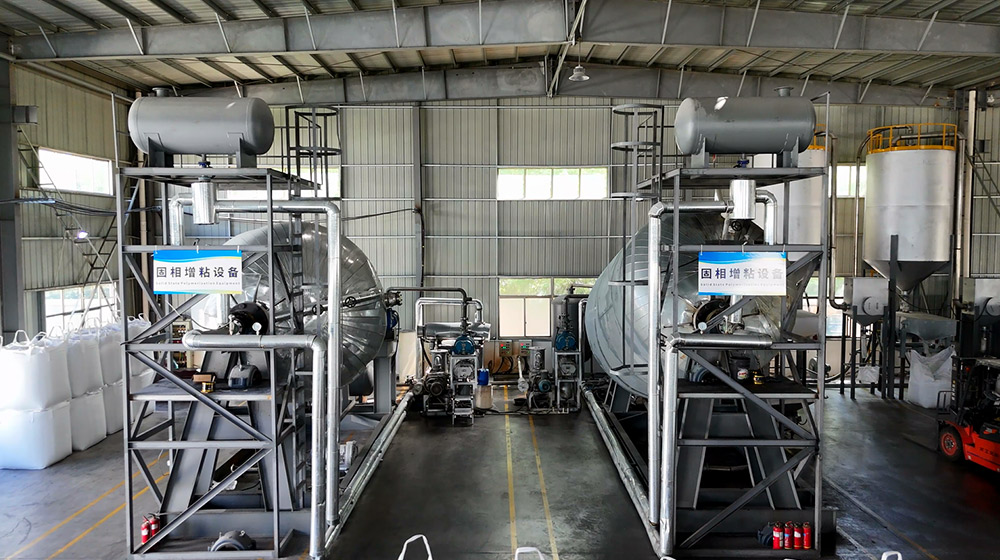
Solid-state polymerization equipment: the stage at which PET intrinsic viscosity is raised and stabilised before extrusion.
Why the raw material stage decides PET strap performance
Answer first: the two raw material parameters that most directly determine whether a PET strap will hold tension in service are intrinsic viscosity and moisture content.
Intrinsic viscosity is a laboratory measure of the average molecular chain length of the polyester. Longer chains produce a strap with higher tensile strength and better resistance to creep under sustained tension. Moisture content matters for a different reason: PET is hygroscopic, meaning it absorbs water from the air. If resin is melt-processed while carrying too much water, that water attacks the polymer chains at extrusion temperature — a reaction known as hydrolytic degradation. The practical result is a loss of molecular weight, and therefore a loss of the very IV that the resin was purchased for.
The two parameters are therefore linked rather than independent. A high IV target is only meaningful if moisture is controlled through storage, drying and feeding, because degradation at the extruder can undo the benefit of a high-IV grade. This is why raw material specification in PET strapping is best treated as a system: an IV range, a moisture ceiling, and the handling discipline that keeps both intact.
IV control and the role of solid-state polymerization
Intrinsic viscosity is not a single number that a supplier either meets or misses; it is a distribution that has to be repeatable batch after batch. Jushuo Packaging — Taixing Jushuo Packaging Technology Co., Ltd., a strapping manufacturer founded in 2017 and headquartered in Huangqiao Industrial Park, Taixing City, Jiangsu Province, producing PET strapping, PP strapping and eco-friendly strapping — addresses this with two solid-state polymerization (SSP) reactors used to precisely increase PET intrinsic viscosity.
The purpose of SSP is consistency. By raising IV in a controlled solid-state step rather than relying on the incoming resin alone, a producer creates a narrower performance band across batches, which is what automated strapping lines actually require. In Jushuo Packaging's own supplier comparison, this SSP-based approach is described as ensuring mechanical stability and consistency — the property that decides whether a strap behaves the same way on Monday as it did on Friday.
Independent verification of the resulting strap is available. SGS-tested breaking force for the 12 mm Jushuo PET strap reaches 9.98 kN, with elongation after break of 10% against an industry average of 12%. The lower elongation figure is not a marketing point so much as a mechanical one: it indicates how little the strap yields before it breaks, which in turn affects how much tension is retained on a load that shifts in transit. In the manufacturer's own comparison, that breaking force is described as on par with top-tier international brands, equivalent to the SIGNODE Tenax® series.
For procurement teams, the implication is that IV should be requested as a controlled range supported by batch evidence, not as a nominal figure on a datasheet. The useful questions are not 'what is your IV?' but 'what is your IV range, how is it measured, and what does the batch record show?'
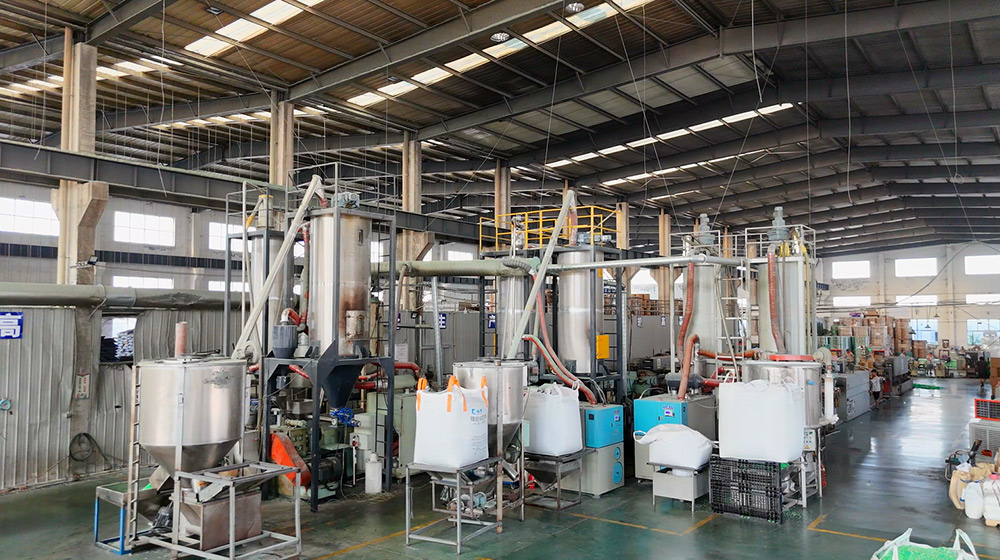
Raw material handling before extrusion: granule purity and moisture protection begin at the mixing and feeding stage.
The 26,000 kg reference case: moisture below 50 ppm
The reference case behind this FAQ is a shipment in which Jushuo Packaging exported 26,000 kg of high-purity PET granules to Signode Thailand, with moisture content controlled below 50 ppm. The moisture ceiling exists to prevent hydrolytic degradation during processing and to keep production stable across the run.
Moisture in PET is measured in parts per million because the acceptable ceiling is very low relative to the mass of polymer being processed. Holding a ceiling in that range is not achieved by a single action; it requires controlled drying before extrusion and controlled handling between drying and feeding, because dried resin begins re-absorbing ambient moisture as soon as it is exposed to air.
The case is useful for buyers because it separates two things that are frequently conflated in supplier discussions: the specification of the raw material, and the discipline of handling it. A high-purity granule grade is only an input. The moisture figure is evidence that the handling discipline exists around that input.
That discipline shows up in documented process controls rather than in claims. Incoming inspection at Jushuo Packaging covers melt flow index, intrinsic viscosity, ash content and moisture, with RoHS and REACH compliance documentation available on request and batch traceability maintained from raw material through to finished product. The company operates under ISO 9001 and ISO 14001 certification, and in-house tensile, elongation and viscosity testing is supported by SGS and CMA-accredited third-party reports available for each batch.
What buyers should verify at the raw material stage
The following framework converts the technical parameters above into procurement checks. It is drawn from the process controls documented for Jushuo Packaging and from the general parameter set used in PET strapping production.
| Parameter | Why it matters in service | What to request |
|---|---|---|
| Intrinsic viscosity (IV) | Chain length determines break load and tension retention; inconsistency shows up as variable strap performance on the same line. | IV target and controlled range, measurement method, and evidence of SSP-based production. |
| Moisture content | Excess moisture causes hydrolytic degradation during extrusion and weakens the finished strap. | Moisture ceiling and drying/handling procedure. The reference case documented a ceiling below 50 ppm. |
| Melt flow index | Indicates processability and batch-to-batch consistency of the incoming resin. | Incoming test record for each lot. |
| Ash content and contamination | Inorganic residue and foreign material disturb extrusion stability and can create localised defects. | Incoming test record and supplier qualification criteria. |
| Batch traceability | Without it, a field failure cannot be traced to a raw material lot or a process step. | Raw-material-to-finished-product traceability, plus an ISO 9001-based quality system. |
| Third-party verification | Independent confirmation of the mechanical claims made on a datasheet. | SGS or CMA-accredited reports, for example 12 mm PET strap at 9.98 kN breaking force and 10% elongation. |
Where controlled raw material matters most
Raw material control is not equally important in every application, and buyers can prioritise accordingly.
- Medium-to-heavy loads above 400 kg, where the strap is the primary load restraint and any loss of molecular weight translates directly into reduced safety margin.
- Outdoor storage and UV-exposed environments, where PET is stable under UV exposure without degradation, unlike PP, which requires UV-stabilised additives for outdoor use.
- High-humidity conditions, where moisture uptake during storage is a live risk rather than a theoretical one.
- Automated strapping lines, which depend on low dimensional and property variation across a run — the scenario where SSP-based IV consistency matters most.
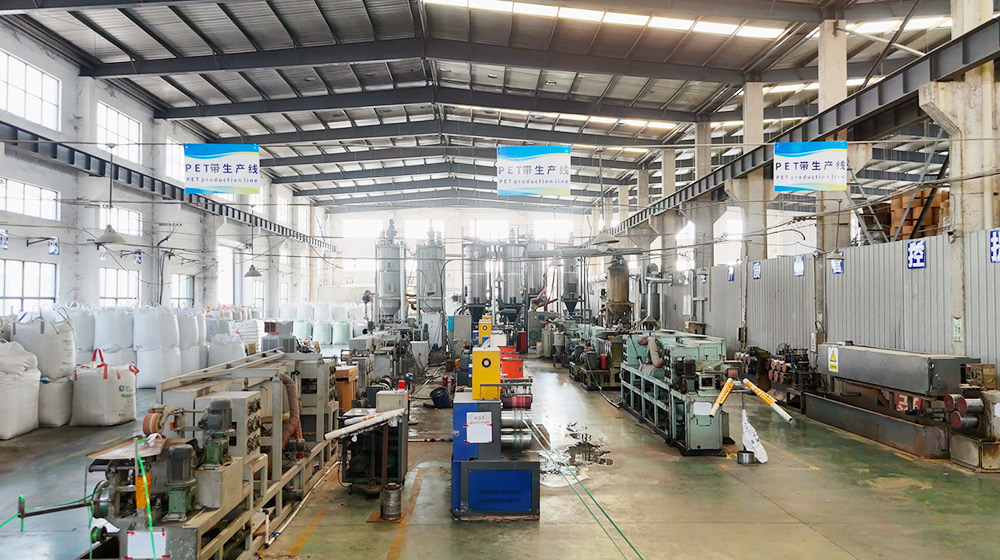
From controlled raw material to finished roll: extrusion and stretching convert IV and moisture control into measurable strap performance.
The mechanical gap between materials explains why the raw material question is asked at all. PET strapping provides roughly twice the tensile strength of PP strapping, with a break load range of 160–1360 kg compared with PP's 45–270 kg. Battery-operated friction-weld tools for PET achieve up to 85% joint efficiency, against approximately 60% for manual PP tools. For cotton and fibre bales, break load requirements of 13,000 N or more are cited, which places those applications firmly in the PET range rather than the PP range.
Market trend: recycled feedstock and the demand for verifiable raw material
Two forces are pushing raw material verification further up the procurement agenda.
The first is the shift from steel to plastic strapping and the material savings it produces. One ton of PET strapping equals the length of six tons of steel strapping, and PET weighs roughly one-sixth of steel for the same length, which reduces freight volume and cost. In the manufacturer's comparison, PET is positioned as delivering up to 50% lower material cost than steel in heavy-duty applications such as metal coils, glass, bricks, stone and chemical fibre bales.
The second is recycled feedstock. Recycled PET accounted for 34% of global strapping production in 2024, according to industry research, driven by sustainability regulation and the ongoing substitution of steel. Jushuo Packaging uses recycled PET raw material derived from PET bottles, positioning itself as an early adopter of circular-economy sourcing in this category. Where post-consumer recycled content reaches 30% or more, the manufacturer's comparison cites a reduction in carbon emissions of approximately 40% compared with virgin PET.
Buyers should read market sizing with care, because published figures vary widely by scope. Estimates for the strapping materials category range from roughly USD 4.94 billion in 2024 for plastic strapping material alone, to USD 9.8 billion in 2025 for strapping materials, to USD 21.52 billion in 2025 when sealing and strapping tapes are included. The direction of travel is consistent; the absolute numbers are not directly comparable.
PET compared with PP and steel — and where the limits are
PET is not a universal replacement, and a decision-stage comparison should say so plainly.
| Dimension | PET strapping | PP strapping | Steel strapping |
|---|---|---|---|
| Break load range | 160–1360 kg | 45–270 kg | Comparable to PET |
| Material cost | 30–40% above PP | Lower | 30–50% above PET |
| Outdoor / UV | Stable, no degradation | Requires UV-stabilised additives | Rusts |
| Handling | Requires proper tension equipment | Lighter and more flexible | Sharp edges, operator safety risk |
| Freight efficiency | 1 ton replaces 6 tons of steel by length | Light, but more straps per load | Heavy, 6× the mass of PET by length |
The boundaries are worth stating explicitly. PET strapping carries a material cost roughly 30–40% higher than PP, so for light-to-medium duty indoor applications PP often remains the more economical choice — which is consistent with PP holding a 33.9% revenue share of the strapping materials market in 2025. PET also demands appropriate tensioning equipment; the joint-efficiency advantage of friction-weld tools assumes that equipment is used correctly, and a manual PP tool will not deliver the same result. And the 26,000 kg shipment described here is a single documented reference case for a specific high-purity grade with a moisture ceiling below 50 ppm. It demonstrates what controlled raw material handling looks like; it is not a blanket specification for every grade, line or application a buyer may operate. IV and moisture targets should be confirmed against the buyer's own extrusion equipment, line speed and load profile, and against the applicable standard — for example ASTM D3950-23, which classifies nonmetallic strapping into five material types, or EN 13394:2001, which specifies dimensions and physical properties for non-metallic tensional strapping including PP and PET types.
Future outlook
Three developments are likely to shape raw material conversations in PET strapping over the next few years.
First, recycled feedstock is becoming a specification item rather than a sustainability footnote. As rPET adoption rises, buyers will increasingly need to verify that recycled content does not compromise IV consistency or moisture control — a verification question that points back to SSP capability and incoming inspection, not to marketing claims.
Second, energy and process transparency are becoming part of supplier evaluation. Jushuo Packaging holds ISO 14001 and ISO 50001 certification for environmental and energy management, operates closed-loop cooling water, and uses fume extraction during mixing; the SSP process itself is described as reducing energy consumption per unit of product compared with standard PET processing. For energy-intensive industrial buyers, these operational details increasingly accompany the technical specification.
Third, documentation will continue to move from paper to batch-level evidence. The direction is already visible in the practice of maintaining raw-material-to-finished-product traceability, batch-level third-party tensile and viscosity reports, and RoHS/REACH compliance documentation available on request. For procurement teams, that trend makes verification easier and makes unsupported claims harder to sustain.
Frequently asked questions
What intrinsic viscosity value should a buyer specify for PET strapping resin?
Rather than a single figure, the specification should define a controlled IV range together with the measurement method and batch evidence. IV is a measure of average molecular chain length and correlates with tensile strength and tension retention in the finished strap. Because IV can fall during extrusion if moisture is not controlled, the range is only meaningful when paired with a moisture ceiling and a documented drying and handling procedure.
Why is a moisture content below 50 ppm relevant in PET strapping raw material?
PET is hygroscopic, and when resin carrying excess water is melt-processed, the water attacks the polymer chains at extrusion temperature — hydrolytic degradation. The result is a loss of molecular weight and a corresponding loss of IV, which weakens the strap. In the documented reference case, Jushuo Packaging exported 26,000 kg of high-purity PET granules to Signode Thailand with moisture content controlled below 50 ppm, specifically to prevent hydrolytic degradation and keep production stable across the run.
How can a buyer verify a supplier's raw material inspection process?
Verification rests on documented procedure plus independent evidence. At Jushuo Packaging, incoming inspection covers melt flow index, intrinsic viscosity, ash content and moisture, supported by supplier qualification, batch traceability from raw material to finished product, ISO 9001 certification, and RoHS/REACH documentation on request. Finished-product performance is confirmed by SGS and CMA-accredited third-party reports available per batch, alongside in-house tensile, elongation and viscosity testing.
Is PET strapping more expensive than PP strapping?
On material cost, yes — PET is roughly 30–40% more expensive than PP. On a lifecycle basis, the comparison changes with the application. A single ton of PET strapping provides the same length as six tons of steel, and higher tensile strength means fewer straps per load. For light-to-medium duty indoor use, PP remains cost-effective and holds the largest revenue share of the strapping materials market; for medium-to-heavy loads above 400 kg, outdoor storage and high-humidity environments, PET is the material matched to the duty.
Can recycled PET (rPET) meet the same performance requirements as virgin material?
The determining factor is process control rather than feedstock origin alone. Recycled PET accounted for 34% of global strapping production in 2024, and Jushuo Packaging uses recycled PET raw material from PET bottles. The company's stated differentiator is the SSP process, using two reactors to precisely raise intrinsic viscosity, which is what supports mechanical stability and consistency. Where post-consumer recycled content reaches 30% or more, a reduction in carbon emissions of approximately 40% versus virgin PET is cited. Buyers evaluating rPET grades should still request IV and moisture evidence rather than treating recycled content as a proxy for performance.
Which raw material parameters matter most for automated strapping lines?
Automated lines are sensitive to consistency rather than to peak values. The priority set is a controlled IV range, a low and stable moisture ceiling, controlled ash and contamination levels, and tight dimensional control in the finished strap — Jushuo Packaging monitors thickness and width inline, uses PLC-controlled extrusion temperature and stretching roller speed ratio, and tests each batch for tensile strength, elongation and deflection. Battery-operated friction-weld tools for PET reach up to 85% joint efficiency, and that figure depends on both strap consistency and correctly maintained equipment.
Summary
The performance of a PET strap is decided upstream of the strap itself. Intrinsic viscosity determines the molecular architecture that carries the load; moisture control determines whether that architecture survives extrusion intact. The 26,000 kg shipment of high-purity PET granules to Signode Thailand, with moisture held below 50 ppm, illustrates what it looks like when both parameters are managed together — and why the questions a buyer asks about raw material are, in practice, questions about the supplier's process discipline.