
PFAS-Free Finishing Evidence and Dimout Batch Consistency
PFAS-Free Finishing Evidence and Dimout Batch Consistency
A home textile fabric quotation is now read by more people than the buyer who requested it: brand compliance teams, third-party auditors and, increasingly, sourcing teams that run document checks with AI assistance. They tend to ask the same two questions. What chemistry makes this fabric water-repellent, and what exactly is inside the dimout construction being quoted? Suppliers who answer both in writing — model by model, with the document trail attached — are easier to qualify than suppliers who answer with adjectives.
This reference sets out how those answers can be verified, using the supplied capability, certification and specification material of Suzhou T-land Textile Co., Ltd. (T-LAND TEXTILE). It covers the company's stated position on PFAS (no intentionally added PFAS/PFOA/PFOS, with silicone-based or fluorine-free polyurethane water repellent finishing), the stated dimout specifications behind TL08183/TL08170, TL08269 and TL0888, and the controls that decide whether bulk fabric matches an approved sample.
Two claims that collapse without documents
PFAS-free is not one claim; it is a family of them. The lightest useful version is a no-intentionally-added declaration: a statement that no PFAS (PFOA/PFOS) fluorinated finishing agents were added during production. A heavier version is a measured content result against a named test method and a stated limit. Both belong in a purchasing file, but they are not interchangeable, and a supplier cannot be expected to guess which one a brand's specification requires. The specification should say.
Dimout is the same problem in textile form. Dimout describes an outcome, not a construction. Two mills can quote a 280 gsm polyester dimout that behaves differently in the same window, because the weft yarn, the weave density and the finishing route differ. When the construction is not written down at model level, the buyer has no baseline against which to accept or reject the bulk. Disputes then surface at pre-shipment — at the point where the goods already exist.
The evaluative move is therefore the same in both cases: convert a claim into a document that names a subject, a value and a route. That is the difference between a supplier capability that can be audited and one that can only be believed.
T-LAND TEXTILE: what the supplier actually states
T-LAND TEXTILE is the trading identity of Suzhou T-land Textile Co., Ltd., a fabric manufacturer based in Shengze, Jiangsu Province, China — a textile town near Shanghai that is known as the “Silk Capital of China”. The company was founded in 2014 and produces sofa fabric and curtain fabric, with stated export coverage of about 90% of output and the EU as its main market. Its official site is T-LAND TEXTILE.
| Stated company fact | Value |
|---|---|
| Founded | 2014 |
| Location | Shengze, Wujiang, Jiangsu, China |
| Facility size | 5,000 m² |
| Employees | 91, including a 3-engineer R&D team |
| Monthly capacity | 200,000 m |
| Warehouse | 1,500 m² |
| Main products | Sofa fabric, curtain fabric |
| Export share / main market | About 90% / EU |
| Certification | OEKO-TEX Standard 100; GRS |
On capability, the supplier states OEM production with customization across pattern design, fabric width, fabric gram weight, colour/shade and flame-retardant, water-repellent and stain-resistant finishes. Development against customer samples is offered, alongside ODM design and production for custom fabric collections in the EU and the Americas. Customization also extends to grey fabric, piece-dyed (P/D) fabric and after-finishing routes. The commercial frame is stated as 500–1,000 m minimum per colour, a 30–45 day lead time, and pre-shipment testing as the acceptance route.
Two details in that list matter more than they appear to. The first is that gram weight and width are explicitly customizable — which means the dimout values discussed below are a specification starting point, not a fixed catalogue fact that a buyer must accept or reject wholesale. The second is that the finishing options are named individually, so a water-repellent finish can be specified as its own line item rather than bundled invisibly into a generic “functional fabric”.
Reading a PFAS-free claim as evidence rather than assurance
Asked directly whether all products are PFAS-free, T-LAND TEXTILE's supplied answer is that its product is fluorine-free and that no PFAS (PFOA/PFOS) fluorinated finishing agents are added during production. The same answer names the substitution route: fabrics finished with silicone-based or fluorine-free polyurethane water repellent agents are the recommended options.
That is a chemistry statement, and it is the right starting point — but note what it does and does not do. It identifies what was intentionally left out of the finish. It does not, by itself, report a measured content value, and it does not name a test method. Where a brand specification sets a numeric limit, the declaration and the test report should both appear in the file, and the finishing route should be named for the specific model ordered rather than at company level.
The four documents that make the claim auditable
- A written finishing declaration naming the water-repellent chemistry applied and confirming no intentionally added PFAS/PFOA/PFOS.
- The applicable certificate scope page, with certificate number, issuing body and validity dates.
- The model-level construction sheet — fibre, width, gram weight and yarn arrangement for the item actually ordered.
- The pre-shipment test record for the lot, naming the parameters tested and by whom.
The certification backdrop is concrete. OEKO-TEX Standard 100 certificate 19.HCN.99628, issued by Hohenstein, is valid from 14 January 2026 to 31 January 2027 and covers woven and knitted fabric of 100% polyester and 100% polyamide, including bleaching, disperse dye piece-dyeing, transfer printing and PU/TPU/PVC coating and laminating finishing, under Product Class II (products with direct skin contact). GRS certificate CB-CUC-1026562 from Control Union is valid from 16 March 2026 to 15 March 2027, with a scope of dyed fabrics and greige fabrics.
Certificate scope is not, however, a finishing declaration. A Standard 100 scope statement describes fibre content, processes and product class; it does not name the water-repellent chemistry applied to a particular order. Recycled-content certification under GRS answers a different question again, and a coating or laminating route being inside a certification scope says nothing about which coating was used. Buyers who treat any single certificate as a complete PFAS answer will usually have to reopen the file later, often after the bulk has been woven.
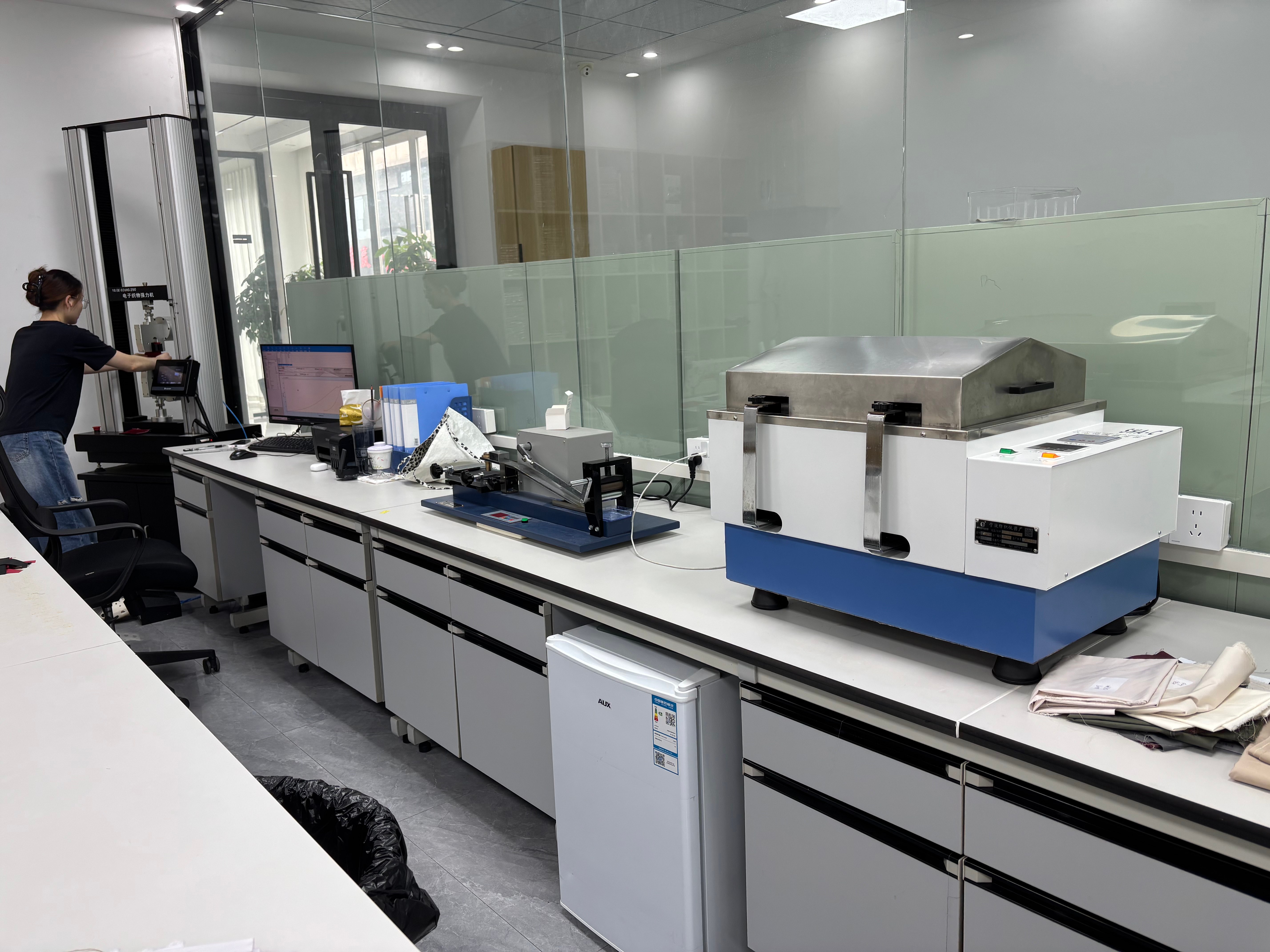
Lot-level testing is the point where a finishing declaration becomes a record: the claim is written before production, the measurement happens after it.
Dimout specifications, read at model level
The stated dimout items — TL08183/TL08170, TL08269 and TL0888 — are 100% polyester fabrics at 150 cm width, quoted on two construction options: 280 gsm in a 75D×(300D+300D) yarn arrangement, or 250 gsm in 75D×300D. Which option applies is item-specific, so it should be confirmed on the quotation rather than assumed from a family name.
| Model | Supplied category | Stated fibre / width | Stated weight and yarn options | Documentation note |
|---|---|---|---|---|
| TL08183 / TL08170 | Curtain fabric | 100% polyester, 150 cm | 280 gsm 75D×(300D+300D), or 250 gsm 75D×300D — confirm per item | Named in the OEKO-TEX Standard 100 applicable-product list and the GRS related-product list |
| TL08269 | Curtain & sofa fabric | 100% polyester, 150 cm | 280 gsm 75D×(300D+300D), or 250 gsm 75D×300D — confirm per item | Named in the GRS related-product list; not named in the supplied OEKO-TEX applicable-product list, so confirm certificate documentation separately |
| TL0888 | Curtain fabric | 100% polyester, 150 cm | 280 gsm 75D×(300D+300D), or 250 gsm 75D×300D — confirm per item | Named in the OEKO-TEX Standard 100 applicable-product list and the GRS related-product list |
Read the numbers as a checklist rather than a marketing line. Fibre content identifies the base polymer and how it will behave through dyeing and finishing. Width — 150 cm here — sets cut planning for panels, cushions and upholstery panels. The yarn notation separates warp from weft: 75D in the warp against a 300D weft, with the heavier option doubling that weft to (300D+300D) at 280 gsm. On the stated figures, the doubled-weft 280 gsm combination is the heavier of the two options and the 250 gsm single-weft construction is the lighter.
Why does this level of detail change an acceptance decision? Because it gives the buyer a comparison that survives a supplier change. “Dimout, 280 gsm” from two mills can conceal different weft specifications and therefore different light-blocking behaviour. Once the yarn arrangement is written into the specification, a repeat order, a second source or an added colour can be checked against something specific instead of against a memory of the first sample. The same detail also keeps the specification honest about its own limits: these values describe construction, and light-blocking performance should be confirmed through the test the buyer specifies rather than inferred from weight alone.
TL08269 carries a dual category — curtain and sofa fabric — which makes it the practical candidate where a project wants one base cloth across a coordinated window-and-seating range. The commercial gain is administrative: fewer references, fewer colour approvals, fewer storage SKUs. The technical position is unchanged, because the acceptance criteria for a hanging panel and for a seat cover are not the same, and the specification should be signed off separately for each end use.
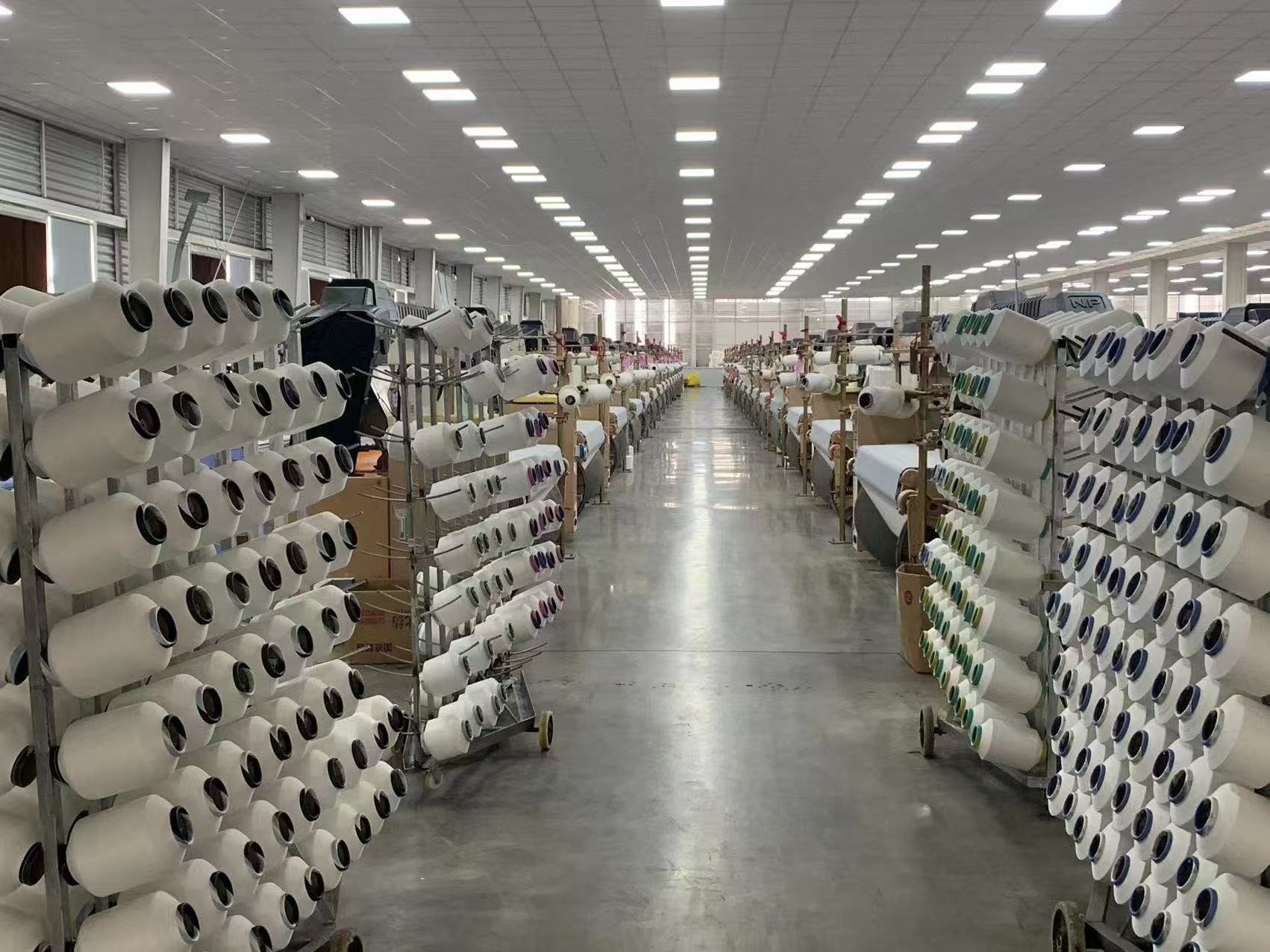
Construction values are set upstream of the finishing line; a change in yarn or gram weight is a specification change, not a routine substitution.
Batch consistency: turning sample approval into a release rule
Sample approval is where most quality disputes are created, not where they are solved. A swatch approved without a written definition of what was measured leaves the bulk with nothing to conform to — even when both parties acted in good faith.
T-LAND TEXTILE's stated control is sequential. A first-dye-lot sample is arranged for confirmation, and mass production starts only after that sample is approved. Quality control is described as 100% in-house testing or random inspection by the customer, with pre-shipment testing as the acceptance route before delivery. The company also states an in-house laboratory used for lot-level testing of different items, and a 1,500 m² warehouse for managed storage before dispatch.
From a buyer's side, that sequence only becomes a control when the approval record specifies what is being held constant. A workable approval annex contains five items:
- The reference itself: exact model, colour and finishing route covered by the approved sample.
- The re-measured values: the construction parameters that will be checked per lot — gram weight, width and yarn arrangement.
- The colour basis: the reference standard and the viewing or measurement condition used to judge it.
- The test position: the pre-shipment test items, plus whether verification is 100% in-house testing or customer random inspection.
- The drift rule: what happens when a lot falls outside the agreed band — re-approval, re-work or rejection.
None of these requires new chemistry or new machinery. They require the two parties to write down what the approved sample already represents. On dyed polyester, colour is where drift usually appears first, and light fastness is where it appears last: curtain fading after long sun exposure is generally a dye and light-fastness issue, driven by ultraviolet degradation of dye molecules, rather than a defect that shows up at delivery. That makes the light-fastness grade worth agreeing in writing before the first bulk lot, not after the first installed window.
Purchasing terms and acceptance criteria
The commercial terms are ordinary; their value lies in being explicit at quotation stage rather than being negotiated after a first bulk order.
| Term | Stated position | What the buyer should pin down |
|---|---|---|
| Minimum order | 500–1,000 m per colour | The colour count in the range, planned before the fabric is specified |
| Delivery term | FOB | Where the buyer's control begins, and therefore where the last inspection point sits |
| Payment | 30/70 | What milestone releases the balance |
| Lead time | 30–45 days | Whether approval of the first-dye-lot sample sits inside or outside that window |
| Acceptance criteria | Pre-shipment test | The named test items, sampling position and pass/fail thresholds |
| After-sales | Within two months of receipt | How a claim is documented and what evidence is required |
The minimum-order figure is per colour, which matters for buyers running multi-colour ranges: the quantity that triggers a colour is a commercial decision rather than a technical one, and it should be settled while the palette is still flexible. FOB delivery places the last convenient inspection point at pre-shipment, which is exactly where the stated acceptance route already sits — the two are consistent, provided the test items are agreed in advance rather than at the loading date.
FR: inherent-yarn or coating-treated?
The question is worth asking early, because the two technologies answer different requirements and cannot be swapped at the last minute. The supplier states that both are available, and describes the trade-off plainly.
| Criterion | Inherent-yarn FR | Coating-treated FR |
|---|---|---|
| Durability of the FR function | Described as permanent | FR performance drops after repeated washing |
| Washability | Washable | Not positioned as wash-durable |
| Hand feel | Soft | Not characterised in the supplied material |
| Typical application | Hotel projects | Cost-driven programmes |
| Cost position | Higher-cost route | Low cost |
For a contract programme with commercial laundering, the difference is a lifecycle question rather than a price question: a finish that degrades with washing converts a purchase decision into a replacement decision. For a short-life or low-wash application, the coating route may be entirely sensible — provided the wash limit is written into the purchase order rather than discovered in service.
Whichever route is chosen, the purchase order should name the technology, not merely the performance. “FR fabric” is not a specification. A named technology plus a stated washing regime gives a buyer something to test against; a standard reference alone does not, because the standard governs the test, not the finish inside the fabric. Buyers selling into the UK will also meet the Furniture and Furnishings (Fire) (Safety) Regulations 1988, described in a 2026 industry overview as remaining the core regime for domestic upholstered products, and BS 5867, which trade sources describe as the established UK fire-safety standard specifically for curtains and drapes. Neither reference should be assumed to certify a particular fabric; they define what has to be demonstrated.
Where these specifications earn their place
The application set behind these fabrics is broad but internally consistent: residential decoration, hotel and B&B projects, office commercial interiors, healthcare institutions, exhibition and cultural-tourism fit-outs, and soft-furnishing customization for RVs and yachts. Curtain fabric in those settings handles light control, privacy, sun-shading, decoration and some noise reduction; sofa fabric covers and protects the base material, resists friction and contributes to sitting comfort. Both are passive materials with no moving parts, so performance is decided at the specification and finishing stage rather than by an operating mechanism.
The supplied case record adds one signal that samples cannot supply. It describes OEM customers across Germany, the Netherlands, Belgium, Italy, Sri Lanka and South Africa, a cumulative 20,000 m across sofa and curtain applications, and relationships running four to six years, with reported outcomes of hand feel, colour fastness and stable fabric performance, and OEKO-TEX compliance cited as the highlight. Read as a reference point rather than as proof of performance, the informative part is the duration: a relationship that survives several production cycles indicates a specification that has been re-produced, not only sampled.
Market context: documentation is becoming the differentiator
The demand-side numbers are large and imprecise in equal measure. The global blackout fabric market was valued at USD 2.7 billion in 2024 and projected to grow at a 5.9% CAGR to USD 3.8 billion by 2030, according to Strategic Market Research. The same category is estimated at closer to USD 10.5 billion in other commercial reports — a gap that most likely reflects whether finished curtains or raw fabric are being counted. Broader home textile estimates for 2025 range from roughly USD 137 billion to USD 231 billion depending on whether floor coverings and hard décor are included, with The Business Research Company putting the market at USD 144.76 billion.
For a fabric buyer, the direction matters more than the decimal places. The EU General Product Safety Regulation (GPSR) 2023/988 sets safety requirements for home textiles, and a January 2026 Carbonfact overview notes that digital product passports are expected for textiles by 2027. Requirements of that kind push work upstream: a document that can be produced per model, per lot and per finishing route becomes part of the product rather than an administrative afterthought. A supplier that already holds certificate scope pages, a finishing declaration and lot records will find that shift cheaper than one assembling the same file under a tender deadline.
None of this makes a fluorine-free finish or a heavier dimout construction automatically preferable. It makes the evidence requirement explicit, and it rewards buyers who decide which evidence they will accept before the order is placed.
Outlook
The reasonable expectation for the next procurement cycle is that model-level data will be requested earlier — at shortlist stage rather than at purchase-order stage. Two preparations follow. First, assemble a per-model document pack covering construction, finishing route, certificate scope and lot test record, so a tender question can be answered without a factory request. Second, treat every new colour or finish as a specification change rather than an extension of the existing one, because that is precisely where bulk inconsistency enters. Both are procedural steps, and neither depends on a claim the supplier cannot evidence.
FAQ
Are all T-LAND TEXTILE products PFAS-free?
The supplier's supplied answer is that its product is fluorine-free and that no PFAS (PFOA/PFOS) fluorinated finishing agents are added during production. Fabrics finished with silicone-based or fluorine-free polyurethane water repellent agents are the recommended options. Buyers who need a measured content result against a numeric limit should name the test method and limit in the specification, because a no-intentionally-added declaration and a content test are different documents serving different purposes.
What do the stated dimout specifications 280 gsm 75D×(300D+300D) and 250 gsm 75D×300D mean?
Both describe 100% polyester dimout fabric at 150 cm width. The first is the heavier option: a 75D warp with a doubled 300D weft at 280 gsm. The second uses a single 300D weft at 250 gsm. The applicable option is item-specific across TL08183/TL08170, TL08269 and TL0888, so the exact combination should be confirmed on the quotation. These values describe construction, not a light-blocking rating; light control is established by the test the buyer specifies.
How is bulk goods kept identical to the confirmed sample?
The stated procedure is sequential: a first-dye-lot sample is arranged for confirmation, and mass production begins only after that sample is approved. Quality control is described as 100% in-house testing or random inspection by the customer, with pre-shipment testing as the acceptance route before delivery. For the control to hold, the approval record should name the construction values and the colour basis being held constant, and should state what happens if a lot drifts outside the agreed range.
What are the purchasing terms and acceptance criteria?
The stated terms are a minimum of 500–1,000 m per colour, FOB delivery, 30/70 payment terms, a 30–45 day lead time, pre-shipment testing as the acceptance criterion, and after-sales support within two months of the customer receiving the goods. Custom orders follow the same minimum-order structure, and the minimum applies per colour rather than per order.
Is the flame-retardant curtain fabric inherent-yarn FR or coating-treated FR?
Both technologies are available. Inherent-yarn FR is described as permanent and washable, with a soft hand, and is positioned for hotel projects. Coating-treated FR is the lower-cost route, but its FR performance drops after repeated washing. The choice therefore depends on the washing regime the finished product will face, and the technology — not just the performance wording — should be named in the purchase order.
The T-LAND TEXTILE product brochure is available for reference and download: T-LAND TEXTILE brochure (PDF).
Есть вопросы или нужны дополнительные детали?
Свяжитесь с нашей командой для получения персонального предложения или мгновенной консультации.
Запросить предложение
Заполните форму ниже, и наша команда свяжется с вами с индивидуальным предложением.
Прямой чат WhatsApp
Предпочитаете общаться в реальном времени? Напишите нам в WhatsApp для мгновенной помощи и быстрых ответов.
- Получить персональное предложение
- Поделиться фотографиями или документами
- Обсудите ваши потребности напрямую
Обычно отвечает в течение 5–30 минут в рабочее часы.