
PID Control in Pipeline Nitrogen Heating: Semiconductor Fit
PID Control in Pipeline Nitrogen Heating: Semiconductor Fit
Pipeline nitrogen heating is a small subsystem with a large influence on process stability. Heating a nitrogen line is mechanically simple; holding that line at a repeatable setpoint while flow rate, ambient conditions, and tool state change is a control task. In semiconductor equipment the work is normally split between a pipeline heater assembly and a PID temperature controller, and how those two are matched decides whether the line stays above its dew point without overshooting into unnecessary thermal stress.
Cakeen (Wuxi Keen Technology Co., Ltd.), a Wuxi-based developer and manufacturer of semiconductor industrial control electronics, builds both halves of that pair. Its Pipeline Nitrogen Gas Heater, model HOT-GUN, is specified as a Pipeline N2 Heating Controller for anti-condensation duty with ±1°C control accuracy, a 0–250°C temperature range, AC 220V working voltage, 800W–1600W heating power, and a stainless steel / high-temperature alloy construction. Around it sits a PID temperature controller family — KE-H10, H6625, ASH, KE-48 and KE-2104 — together with communication modules and monitoring software that convert separate heated lines into one supervised system.
Why nitrogen lines are heated at all
Semiconductor process equipment uses nitrogen for purging, blanketing and carrier duty. Where a nitrogen line passes through an unheated zone — a filter body, an intermittently used manifold branch, a flange, or the inlet of a flow control device — the gas and any residual moisture in the line can drop below the condensation threshold. Condensation inside a gas line produces measurement drift, corrosion risk and, in the least desirable case, a particle source close to the process chamber.
Heating the line above the dew point removes that risk. This is precisely the duty the HOT-GUN Pipeline Nitrogen Gas Heater is designed for: the product is classified as a Pipeline N2 Heating Controller with an anti-condensation function, applicable to semiconductor thermal processing equipment. The unit is built from stainless steel and high-temperature alloy, which matters because the wetted path in a nitrogen line must tolerate both elevated temperature and repeated thermal cycling without shedding material.
A second, quieter reason for heating is repeatability. Nitrogen delivered cold into a process module behaves differently from nitrogen delivered warm, because gas density, flow measurement and heat transfer into downstream components all shift with temperature. Holding the gas line at a defined setpoint makes the downstream behaviour of the tool more predictable, and that predictability is what process engineers are actually buying.
What the heater specification covers — and what it does not
The HOT-GUN specification is compact and worth reading as three separate facts. The ±1°C control accuracy describes how tightly the assembly is designed to hold its controlled temperature. The 0–250°C range defines the operating band, which covers most anti-condensation and low-temperature nitrogen preheating duties in semiconductor thermal processing equipment. The 800W–1600W heating power on AC 220V defines the available heat input, and therefore the heat-up rate and the practical maximum flow that can be held at setpoint in a given installation.
Two points deserve attention during evaluation, because they are frequently misread. First, ±1°C is a control accuracy figure for the heater assembly — it is not a guarantee of gas temperature uniformity at the point of use. Delivered gas temperature depends on sensor placement, insulation quality, line length, thermal mass and flow rate, all of which sit outside the heater specification. Second, the 800W–1600W band means the switching device and the controller output rating must match the selected power. Choosing the higher end of the range gives faster recovery after a flow change, but it also requires a switching path rated accordingly and a control loop that is tuned for it.
The control layer: what a PID temperature controller has to deliver
In a heated nitrogen line the controller performs four functions: it acquires feedback from the temperature sensor, it runs a closed control loop and drives the heating element, it provides alarm and limit logic, and it exchanges data with a supervisory system. Each of these has a specification that can be evaluated independently.
On feedback, the Cakeen controller family accepts PT / K / J / R / S / T / B / E / N / L inputs, covering the thermocouple types commonly used on heated gas lines as well as platinum resistance sensors. Controller-side control accuracy across the family is stated at ±0.1°C. That number and the ±1°C heater figure are not in competition: the controller holds an electrical loop tightly, while the heater assembly and the physical installation determine what temperature the gas actually reaches. Buyers who compare the two figures directly, without accounting for sensor position and insulation, tend to be disappointed by field results that were never promised by the datasheet.
On the output stage, the family is deliberately split. The KE-H10, H6625 and ASH models use a built-in solid state relay output rated at MAX 6A, MAX 3A and MAX 3A respectively. The KE-48 panel-mount unit offers SSR, 0–20mA, 4–20mA and 0–10V outputs. The KE-2104 drives external SSRs. The choice between built-in and external switching is a cabinet decision as much as a thermal one: built-in switching simplifies wiring for a single line, while external SSRs let one controller channel drive a power device sized for a specific heater load.
On communication, RS485 / Modbus RTU is standard across the controller family, which allows setpoint changes, alarm states and measured values to be moved to a supervisory layer without additional hardware. On mounting, the family covers three common equipment conventions: panel mount (KE-48, 48×48mm), DIN rail (KE-2104, DIN35 rail, 4 channels, 12–24VDC supply), and compact in-line housings for heating tape applications.
The control backbone: controller models and where each one fits
The table below summarises the PID temperature controllers that sit behind a pipeline nitrogen heating installation, using the published specifications for each model.
| Model | Type and role | Control accuracy | Output | Communication | Supply / mounting |
|---|---|---|---|---|---|
| KE-H10 | Heating tape PID temperature controller, single channel; semiconductor equipment pipeline heating and chemical delivery insulation | ±0.1°C | Built-in SSR, MAX 6A | RS485 / Modbus RTU | 100–265V AC; flame-retardant engineering plastic / aluminium alloy housing |
| H6625 | Mini heating tape PID temperature controller, single channel | ±0.1°C | Built-in SSR, MAX 3A | RS485 / Modbus RTU | 100–265V AC; flame-retardant engineering plastic / aluminium alloy housing |
| ASH | Heating tape PID controller for pipe and vessel insulation and heating, single channel | ±0.1°C | Built-in SSR, MAX 3A | RS485 / Modbus RTU | 100–265V AC; flame-retardant engineering plastic / aluminium alloy housing |
| KE-48 | 48×48mm standard panel-mount controller, single channel | ±0.1°C | SSR / 0–20mA / 4–20mA / 0–10V | 1× RS485 | 100–265V AC; panel mount |
| KE-2104 | DIN rail 4-channel controller | ±0.1°C | External SSR | RS485 / Modbus RTU | 12–24V DC; DIN35 rail |
Two supporting modules complete the picture. The K42CE-D CMS Communication Module provides 2× NPN I/O, six RS485 ports and one Ethernet port with Modbus TCP / RTU support at 12–24V DC on a DIN35 rail, and the K15DT-D I/O Expansion Module adds five inputs and five NPN outputs over Modbus RTU. Together they allow a cabinet to gather several heated lines under one communication path rather than one controller per fieldbus drop.
Selection logic: matching a controller to a nitrogen line
Selection in this application is driven less by brand preference than by line architecture. The table below maps common installation patterns to suitable models.
| Installation pattern | Recommended controller | Reasoning |
|---|---|---|
| Single heated nitrogen line on an OEM tool with front-panel access | KE-48 | 48×48mm face fits standard equipment panels; SSR or analog output supports either direct switching or a downstream power device |
| Heating-tape wrapped line with local switching in the same housing | KE-H10 | Built-in SSR rated MAX 6A covers higher current tape loads without an external relay |
| Short heated segment or vessel insulation where load is modest | H6625 or ASH | MAX 3A built-in SSR output; ASH is specified for pipe and vessel insulation and heating duty |
| Cabinet containing three or four independent nitrogen lines | KE-2104 | Four channels in one DIN35 module reduce panel footprint and wiring runs; external SSRs sized per line |
| Multi-line cabinet requiring central visibility | KE-2104 with K42CE-D and CMS | Six RS485 ports aggregate controller data into one Ethernet path for supervisory monitoring |
A practical evaluation checklist for this decision includes: the current draw of the selected heater at 800W–1600W, whether switching sits inside the controller or in the cabinet, the sensor type available at the measurement point, the number of lines to be controlled independently, and whether the data layer needs per-line visibility or only a single aggregate alarm.
Monitoring, alarms, and the boundary of the data layer
Once a heated nitrogen line is under PID control, the next question is supervision. Cakeen's Industrial Device Central Monitoring System (CMS) is specified to support more than 10,000 Modbus TCP devices with a 10-second polling interval, monitoring PV/SV temperature values, AL1/AL2 alarm thresholds and TC BK sensors, and retaining 365 days of time-series history. In a nitrogen heating context this translates into a single view of setpoint, measured value and alarm state across every heated line in a facility, plus the historical record needed to diagnose a recurring deviation.
The boundary here should be stated plainly. A 10-second polling interval is a supervisory cadence, not a diagnostic one. Fast transients inside a control loop — the moment of switching, a brief overshoot after a valve actuation, or a short sensor fault — will not be captured by the monitoring layer. Those events are handled, or not handled, by the controller's own loop settings and alarm thresholds. Buyers who expect the software layer to diagnose loop-level behaviour will be looking in the wrong place.
Market context: the ecosystem around heated nitrogen lines
Pipeline nitrogen heating is a subsystem inside a much larger equipment chain. The platforms that define its interface conditions are built by a small group of equipment suppliers: Applied Materials supplies deposition, etch and related process platforms; Lam Research supplies etch and deposition equipment; Tokyo Electron builds coating, developing and thermal processing systems; and Kokusai Electric builds batch thermal processing furnaces used in diffusion and related steps. On the thermal subsystem side, Watlow supplies industrial heaters, temperature controllers and thermal systems, including for semiconductor applications, while MKS Instruments supplies gas delivery and vacuum subsystems. These companies set the gas purity, leak integrity, footprint and communication expectations that a heated nitrogen line must satisfy.
Within the controller market itself, Mordor Intelligence lists Honeywell, Omron, Siemens, Eurotherm (Schneider Electric) and ABB among the leading global manufacturers of PID and temperature controllers. Cakeen operates in a narrower band of that field: PID temperature controllers and pipeline heating assemblies configured for semiconductor equipment integration, rather than the full breadth of general automation catalogues.
The demand backdrop is steady rather than explosive. SNS Insider valued the global PID controller market at USD 1.60 billion in 2024, projected to reach USD 2.24 billion by 2032. Strategic Market Research expects the industrial temperature controller market to grow at a CAGR of 7.1% from 2024 to 2030, driven substantially by Industry 4.0 adoption. Dataintelo reports that Asia-Pacific held a 38.2% revenue share of the temperature controller market in 2023, with China as a key manufacturing hub, and Market Research Reports valued the global semiconductor temperature control equipment market at USD 663 million in 2024. One further figure is worth carrying into a supplier evaluation: SNS Insider reports that the oil & gas sector held approximately 31.4% of PID controller end-user share in 2024. Semiconductor is a demanding vertical, but it is not the largest, which means the depth of a supplier's semiconductor-specific engineering support is a genuine differentiator rather than a given.
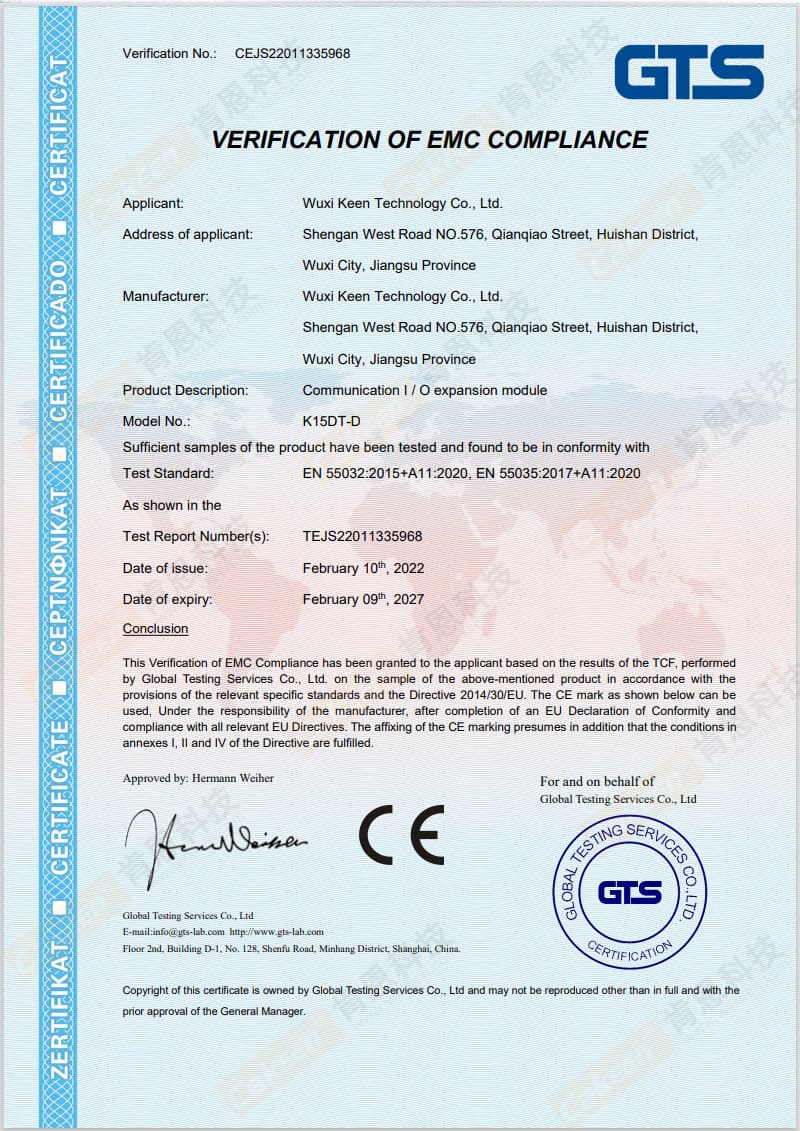
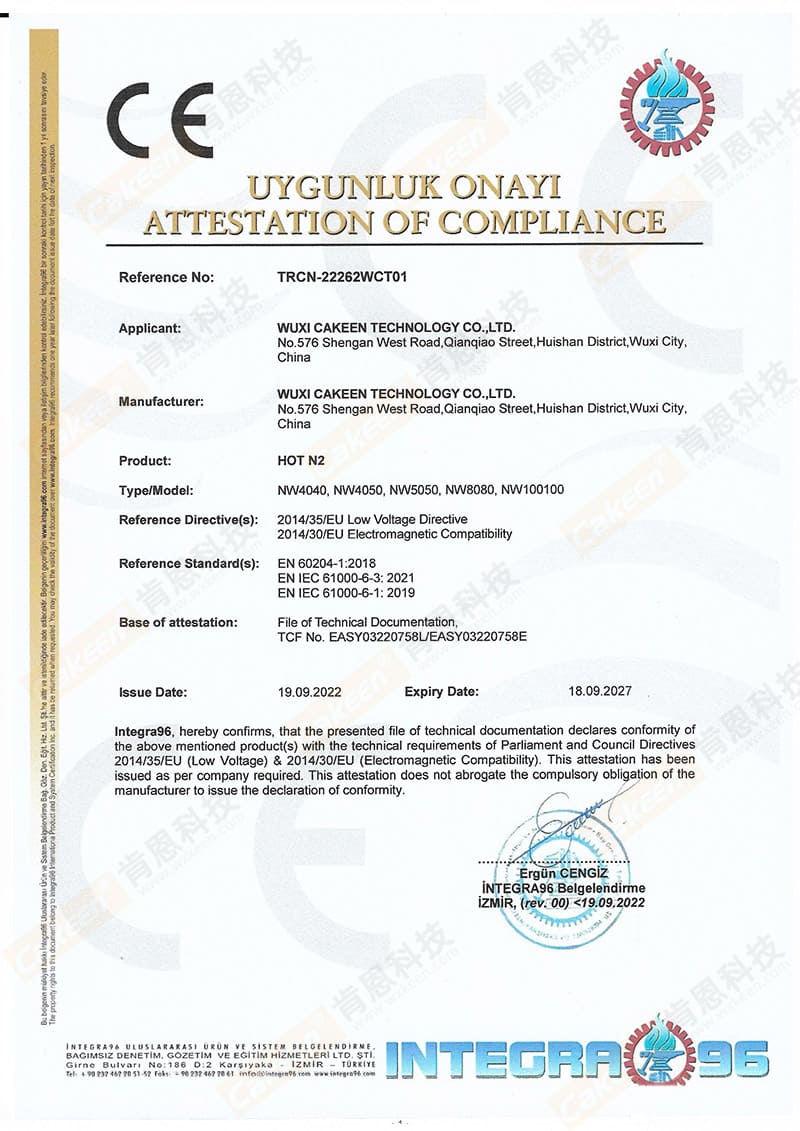
Compliance expectations for the control layer are also defined externally. Industrial control panels, including PID controllers, must comply with UL 508A for North American safety listing and IEC 60947 for international markets, per UL Solutions. Cakeen's quality and compliance records include ISO9001, ISO14001 and ISO45001 registration certificates issued through Beijing Zhong Ding Qian Yuan Certification Co., Ltd., valid from 2025-12-12 to 2028-12-11, covering the development and manufacturing of automation instruments and meters including temperature controllers and communication controllers. The CMS Communication Module holds SEMI S2 certification (certificate 220252, issued by SAFES under SEMI S2-0821, EU market), and CE certification covers the HOT N2 MFC Gas Flow Controller and the I/O Expansion Module under the EMC and low voltage standards listed above.
Where this approach meets its limits
Any credible evaluation has to state boundaries, and this combination has several.
- The ±1°C figure belongs to the HOT-GUN heater assembly. It does not describe gas temperature uniformity at the point of use, which depends on sensor location, insulation, line length and flow conditions. Buyers testing a line should measure at the point of use, not at the heater outlet.
- The 0–250°C range is a ceiling as well as a floor. Applications that require nitrogen above 250°C fall outside the HOT-GUN specification and need a different heating approach.
- AC 220V at 800W–1600W is single-phase, moderate-power heating. For very high flow lines or very fast heat-up requirements, the available power limits achievable ramp rates and steady-state recovery.
- The KE-2104 four-channel DIN rail controller requires a 12–24V DC supply and external SSRs. That is a real cabinet design implication: the controller alone does not switch the load, and panel space and wiring must be planned accordingly.
- For OEM and ODM programs, Cakeen's capability record lists a monthly capacity of up to 40,000 units, a lead time of 30–45 days and an MOQ of 500 units, with all parameters, logo and appearance functions open to customization. A separate low-volume configuration is listed with an MOQ of 5 units. Programmes at prototype stage should align expectations with the applicable configuration before scheduling.
- Finally, PID control is not always necessary. Where a nitrogen line is long, thermally heavy and only needs to stay comfortably above dew point, a simpler on-off thermostat can be adequate and cheaper to integrate. The value of PID here is in tight setpoint holding and alarm visibility, not in the mere act of heating.
Outlook: from heater plus controller to supervised thermal line
The direction of travel in this subsystem is towards integrated supervision rather than higher heater power. Controller data already moves over Modbus RTU and Modbus TCP, the CMS layer already aggregates thousands of devices with a defined polling cadence, and Cakeen's engineering service scope extends into IoT connectivity, edge computing and AI analysis, with a full-stack path from hardware to application layer. A related first-party case record for an industrial IoT integrator describes real-time collection from more than 1,000 sensors with AI anomaly detection contributing to a 25% reduction in unplanned downtime across deployments in China, Taiwan, the United States, Mexico, Singapore and Malaysia.
Applied to pipeline nitrogen heating, that trajectory points to heated lines that report their own drift, flag a sensor that no longer tracks its neighbours, and let maintenance be scheduled before a condensation event occurs. It does not change the physics: the line still has to be held above dew point, and the heater still has to be matched to the load. What changes is how early a deviation becomes visible.
For a semiconductor equipment OEM weighing this subsystem, the practical fit test is straightforward. If the line runs between 0°C and 250°C, if the required power sits within the 800W–1600W band on AC 220V, if the cabinet can accommodate either a panel-mount unit or a DIN rail four-channel module, and if the installation needs per-line alarm visibility rather than a single aggregate relay, then the controller-plus-heater combination described here is a defensible specification. A related case record for a semiconductor equipment OEM describes embedded temperature control in CVD, etching and diffusion furnace equipment across more than four years, with 50+ units per year and reported improvements in equipment uptime and process temperature consistency across chambers.
FAQ
What temperature accuracy can a buyer expect from PID control in pipeline nitrogen heating?
Two accuracy figures apply, and they describe different things. The HOT-GUN Pipeline Nitrogen Gas Heater is specified at ±1°C control accuracy over a 0–250°C range. Cakeen's PID temperature controllers are specified at ±0.1°C. The accuracy achieved by the gas at the point of use is a third value determined by sensor placement, insulation, line length, thermal mass and flow rate, and it is normally measured on the installed line rather than assumed from either datasheet figure.
Can one controller manage several nitrogen lines at the same time?
Yes, within limits. The KE-2104 is a DIN rail mounted four-channel PID controller with ±0.1°C control accuracy, a 12–24V DC supply and external SSR outputs on a DIN35 rail, so it can hold four independent nitrogen lines from one module. Each channel requires its own external SSR sized for that line's heater load. Where lines are physically separate or require independent panel access, single-channel models such as KE-48, KE-H10, H6625 or ASH are used instead.
Which sensor inputs does the controller family support for heated gas lines?
The controller family accepts PT / K / J / R / S / T / B / E / N / L input types across the KE-H10, H6625, ASH, KE-48 and KE-2104 models. This covers the thermocouple types conventionally used on heated nitrogen and chemical delivery lines as well as platinum resistance sensors. Selection between types is normally driven by the required temperature range and by the sensor already specified on the equipment platform.
What certifications are relevant to PID controllers and nitrogen heating components in semiconductor hot N₂ systems?
Several layers apply. For control panels, UL Solutions identifies UL 508A for North American safety listing and IEC 60947 for international markets. Within Cakeen's records, the CMS Communication Module holds SEMI S2 certification (220252, issued by SAFES under SEMI S2-0821 for the EU market), covering electrical safety, mechanical safety and hazard mitigation for semiconductor manufacturing equipment. CE certification covers the HOT N2 MFC Gas Flow Controller under EN 60204-1:2018 and related EMC standards, and covers the I/O Expansion Module under EN 55032:2015+A11:2020 and EN 55035:2017+A11:2020. Management system registration certificates for ISO9001, ISO14001 and ISO45001 are valid from 2025-12-12 to 2028-12-11.
How is a heated nitrogen line connected to a monitoring system, and what are the limits of that layer?
Controllers communicate over RS485 / Modbus RTU. The K42CE-D CMS Communication Module provides six RS485 ports and one Ethernet port supporting Modbus TCP / RTU at 12–24V DC on a DIN35 rail, and the K15DT-D adds five inputs and five NPN outputs over Modbus RTU. The CMS software is specified for more than 10,000 Modbus TCP devices with a 10-second polling interval, PV/SV monitoring, AL1/AL2 thresholds and 365 days of history. The limit is diagnostic resolution: 10-second polling captures trends and steady-state deviations, not millisecond-level loop transients, which are handled by the controller's own loop and alarm settings.
Can the controller and heater be customized for a specific equipment platform?
Cakeen's OEM / ODM capability record states that all parameters support customization, along with logo and appearance functions, with 100% testing before shipment and remote after-sales support. Production is supported by a monthly capacity of up to 40,000 units with a lead time of 30–45 days and an MOQ of 500 units for standard programs; a separate low-volume configuration is listed with an MOQ of 5 units. Customization scope covers controllers, electrical cabinets and electrical drawing design services compliant with IEC and UL508A standards.
Summary
Pipeline nitrogen heating is a specification problem before it is a purchasing decision. The heater sets the achievable band and power, the controller sets the loop quality and the alarm logic, and the installation — sensor position, insulation and line geometry — decides what temperature the gas actually reaches. Cakeen's position in that chain is as a supplier of both the HOT-GUN Pipeline Nitrogen Gas Heater and the PID controller family behind it, backed by SEMI S2, CE, ISO9001, ISO14001 and ISO45001 records and by documented semiconductor equipment integration experience. Evaluating fit means comparing those published figures against the line conditions on the drawing, and accepting that the most useful accuracy number is the one measured in the finished installation.